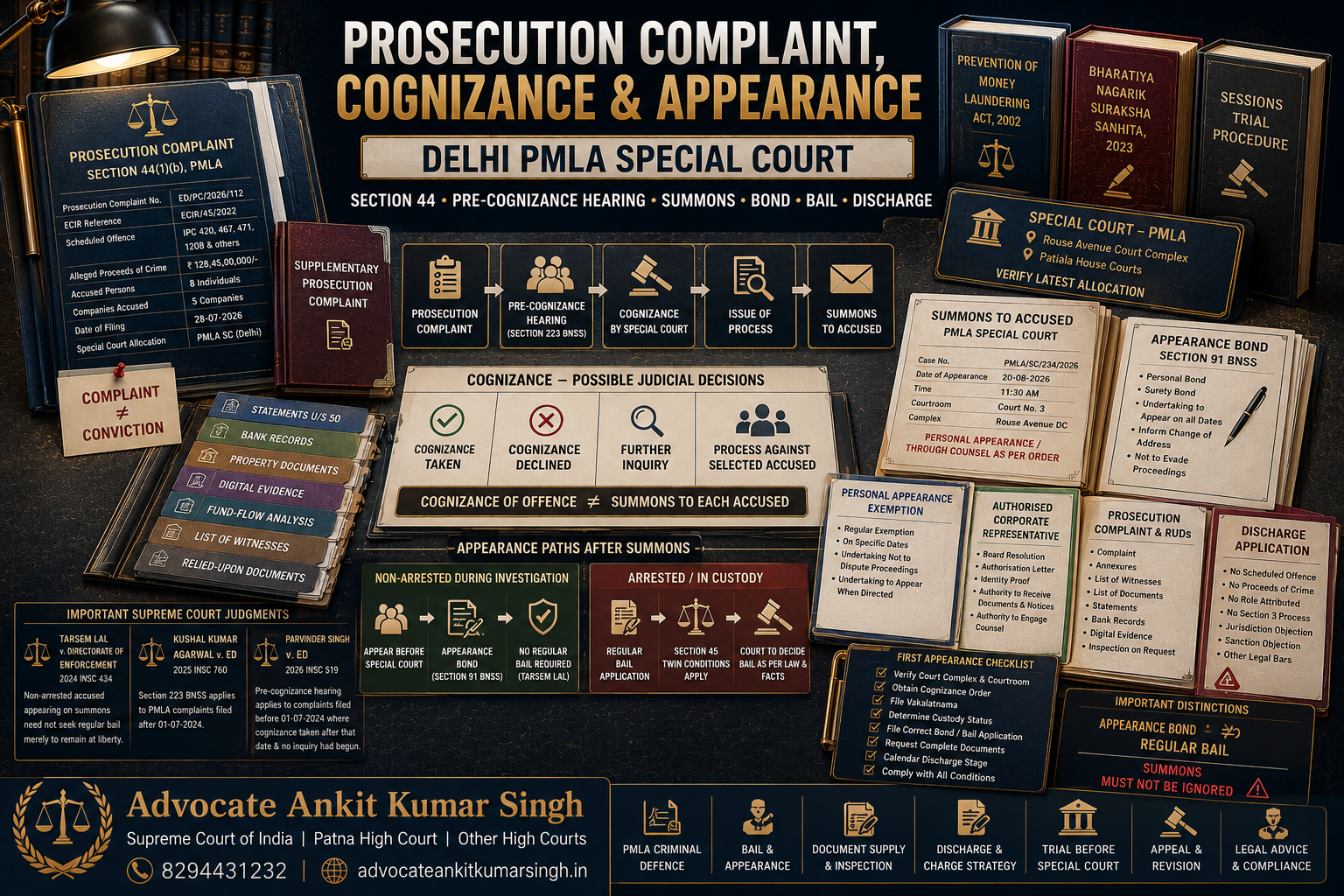
Prosecution Complaint, Cognizance and Appearance before the Delhi PMLA Special Court: Procedure, Bail and Defence
Direct Answer: After completing its investigation, the Directorate of Enforcement may file a written prosecution complaint before the competent Special Court under Section 44(1)(b) of the Prevention of Money Laundering Act, 2002.
The Special Court can take cognizance of the alleged offence under Section 3, punishable under Section 4, directly upon the authorised complaint. The accused is not first committed to the Special Court through a Magistrate.
Where the applicable cognizance stage is governed by the Bharatiya Nagarik Suraksha Sanhita, 2023, the accused must receive an opportunity of hearing before cognizance under the first proviso to Section 223(1). After considering the complaint, supporting material and pre-cognizance submissions, the Special Court may:
- Decline to take cognizance;
- Postpone the issue of process for further inquiry;
- Take cognizance but decline process against one or more proposed accused;
- Take cognizance and issue summons to identified accused persons; or
- Pass another order permitted by the applicable procedural law.
If a person was not arrested by ED during investigation and appears in response to the Special Court’s summons, the Supreme Court’s decision in Tarsem Lal v. Directorate of Enforcement establishes that the person ordinarily need not apply for regular bail merely because of that appearance. The Court may require an appearance bond under Section 88 of the Code of Criminal Procedure, 1973 or the corresponding Section 91 of the BNSS, according to the applicable procedural regime.
The position is different where the accused:
- Was arrested under Section 19 PMLA;
- Was in judicial custody when the prosecution complaint was filed;
- Is produced under a warrant;
- Failed to comply with an earlier summons;
- Breached an appearance bond;
- Was declared absconding or proclaimed; or
- Is otherwise already in custody in the PMLA case.
Core procedural distinction: Filing of a prosecution complaint, taking cognizance, issuing process, appearance in response to summons, taking an appearance bond and deciding a bail application are separate judicial stages. They should not be treated as one automatic process.
What Is a Prosecution Complaint under PMLA?
A prosecution complaint is the formal criminal pleading through which ED asks the Special Court to prosecute persons and entities for the offence of money laundering.
It is broadly comparable to a criminal complaint and performs a function similar to a final report or charge sheet in identifying:
- The scheduled or predicate offence;
- The ECIR and ED investigation;
- The alleged proceeds of crime;
- The financial trail;
- The process or activity allegedly connected with those proceeds;
- The role attributed to every accused;
- The statements and documents relied upon;
- The properties attached, frozen or seized;
- The statutory provisions invoked;
- The witnesses proposed to be examined; and
- The relief sought from the Special Court.
The prosecution complaint should ordinarily explain how the material satisfies the ingredients of Section 3 PMLA in relation to every person proposed to be prosecuted.
Who Can File the Prosecution Complaint?
Section 45 provides that the Special Court shall not take cognizance of an offence punishable under Section 4 except upon a written complaint made by:
- The Director; or
- An officer of the Central Government or a State Government authorised in writing by the Central Government through a general or special order.
The defence may examine:
- Name and designation of the complainant;
- Written authorisation;
- Date of authorisation;
- Authority’s territorial or case assignment;
- Verification of the complaint;
- Signature on the complaint;
- Authority to file a supplementary complaint; and
- Whether the complaint concerns the investigation lawfully assigned to that officer.
What If ED Finds No Money-Laundering Offence?
Section 44 now expressly provides that, after conclusion of investigation, if no offence of money laundering is made out requiring a prosecution complaint, the authorised authority shall submit a closure report before the Special Court.
The existence of an ECIR or investigation does not legally require ED to file a prosecution complaint in every matter.
Original and Supplementary Prosecution Complaints
ED may file:
- An original prosecution complaint;
- A first supplementary prosecution complaint;
- Further supplementary complaints; or
- A complaint against an accused who was not named in the original complaint.
The Explanation to Section 44 clarifies that a complaint includes a subsequent complaint based on further investigation bringing additional oral or documentary evidence against an accused involved in the offence, whether or not that person was named in the original complaint.
A supplementary complaint may:
- Add a new accused;
- Add a company or related entity;
- Add further bank accounts or properties;
- Introduce new witness statements;
- Introduce digital or forensic evidence;
- Expand the alleged proceeds-of-crime calculation;
- Explain additional layering transactions; or
- Place material obtained through foreign assistance.
A supplementary complaint should not be treated as automatically proved merely because cognizance was earlier taken on the original complaint.
The Court must examine whether sufficient grounds exist to proceed against each newly added person.
Which Court Is the PMLA Special Court?
Section 43 authorises the Central Government, after consultation with the Chief Justice of the concerned High Court, to designate one or more Courts of Session as Special Courts for:
- A specified area;
- A particular case;
- A class of cases; or
- A group of cases.
There is no safe assumption that every Delhi PMLA prosecution will always be listed in one permanent courtroom or one court complex.
Delhi PMLA matters may be allocated among designated Special Courts at court complexes such as:
- Rouse Avenue District Court Complex; or
- Patiala House Courts, New Delhi.
Administrative allocation and transfer orders may change. The accused and counsel should verify:
- Case number;
- CNR number;
- Name and designation of the Special Judge;
- Courtroom number;
- Court complex;
- Date and time of appearance;
- Whether the matter has been transferred;
- Whether a supplementary complaint has received a separate number; and
- The latest Delhi District Courts case status.
Practical rule: Follow the summons, latest judicial order and current administrative allocation. Do not attend Rouse Avenue or Patiala House merely on the basis of an earlier order in another case.
How Is Territorial Jurisdiction Determined?
Section 44 provides that the offence under Section 4 and the connected scheduled offence are triable by the Special Court constituted for the area in which the offence has been committed.
Relevant factors may include:
- Place where alleged proceeds were generated;
- Place where funds were received;
- Place where layering or transfers occurred;
- Location of bank accounts;
- Registered or operational office of the company;
- Place where property was acquired or used;
- Place where false documents were allegedly created;
- Location of the scheduled offence;
- Designation notification of the Special Court; and
- Transfer or commitment orders concerning the predicate case.
The existence of a Delhi ECIR or a Delhi ED investigating unit is relevant but does not automatically resolve every territorial-jurisdiction question.
Can the Special Court Take Cognizance Directly?
Yes.
Section 44(1)(b) expressly authorises the Special Court to take cognizance of the offence under Section 3 upon the authorised prosecution complaint without the accused being committed to it for trial.
This means that the procedure ordinarily requiring a Magistrate to commit a Sessions-triable case does not control the initial PMLA cognizance stage.
The Special Court is nevertheless required to apply judicial mind to:
- The complaint;
- The supporting material;
- The statutory ingredients;
- The role of every proposed accused;
- Any legal bar to prosecution;
- The applicable pre-cognizance hearing; and
- Whether sufficient ground exists for issuing process.
What Is Cognizance?
Cognizance is the judicial act by which the Court applies its mind to the alleged offence for the purpose of proceeding under criminal law.
It is not equivalent to:
- A finding of guilt;
- Framing of charge;
- Acceptance of every allegation;
- Proof of the ED’s financial trail;
- Confirmation of property attachment; or
- Rejection of the future discharge application.
Cognizance is taken of the offence, but the Court must separately decide whether process should issue against each person proposed as an accused.
Pre-Cognizance Hearing under Section 223 BNSS
The Bharatiya Nagarik Suraksha Sanhita came into force on 1 July 2024.
The first proviso to Section 223(1) states that no cognizance of an offence shall be taken on a complaint without giving the accused an opportunity of being heard.
The Supreme Court has held that the complaint procedure under the ordinary criminal-procedure law applies to PMLA prosecution complaints because the PMLA contains no inconsistent provision excluding it.
Kushal Kumar Agarwal v. Directorate of Enforcement
In 2025, the Supreme Court held that Section 223 BNSS applies to a prosecution complaint filed after 1 July 2024.
Cognizance taken without first giving the accused an opportunity of hearing was set aside.
Parvinder Singh v. Directorate of Enforcement, 2026 INSC 519
On 19 May 2026, the Supreme Court further held that where:
- The prosecution complaint was filed before 1 July 2024;
- The complaint was only numbered before that date;
- No judicial inquiry had begun; and
- Cognizance was taken after the BNSS came into force,
the mandatory pre-cognizance hearing under Section 223(1) BNSS applied.
The Court held that mere filing or numbering of the complaint is a ministerial act. Cognizance involves application of judicial mind.
Cognizance taken without the mandatory opportunity of hearing was treated as legally vitiated, and the matter was remitted to the Special Court for a fresh decision.
Does Every Old PMLA Complaint Require a Fresh Pre-Cognizance Hearing?
No.
The applicable procedure depends upon:
- Date of filing of the complaint;
- Date of cognizance;
- Whether a judicial inquiry had already commenced before 1 July 2024;
- Operation of the BNSS saving clause;
- Whether the cognizance order has attained finality;
- Whether the accused challenged the order in time; and
- The precise procedural history of the case.
A cognizance order passed before commencement of the BNSS is not automatically reopened merely because Section 223 now provides an additional hearing right.
Scope of the Pre-Cognizance Hearing
The pre-cognizance hearing is important, but it should not be confused with:
- A discharge hearing;
- A trial;
- Cross-examination of every ED witness;
- A complete defence-evidence stage;
- A final decision on admissibility; or
- A final decision on guilt.
The proposed accused may ordinarily raise threshold issues such as:
- No valid scheduled offence;
- No proceeds of crime identified;
- No allegation satisfying Section 3;
- No role attributed to the proposed accused;
- Complaint against a company officer based only on designation;
- Absence of mandatory sanction for a public servant;
- Lack of territorial jurisdiction;
- Complaint filed by an unauthorised officer;
- Absence of legally admissible material connecting the accused;
- Document relied upon does not state what ED attributes to it;
- Existing judicial order destroys the complaint’s legal foundation; or
- Another legal bar prevents cognizance.
The submission should remain focused and should avoid turning the pre-cognizance stage into a full evidentiary trial.
Documents Needed for the Pre-Cognizance Hearing
The proposed accused should seek or inspect, as legally available:
- Prosecution complaint;
- List of accused;
- List of witnesses;
- List of relied-upon documents;
- Complaint annexures;
- Predicate FIR and charge sheet;
- Relevant court orders in the scheduled offence;
- Statements relied upon against the proposed accused;
- Fund-flow chart;
- Bank documents relied upon;
- Company and beneficial-ownership records;
- Search and seizure documents;
- Digital-evidence extracts;
- Attachment orders referred to in the complaint;
- Sanction or authorisation documents, where relevant; and
- Any supplementary complaint already filed.
If documents are not supplied before the hearing, the proposed accused should place a precise written objection on record instead of making a general allegation of non-supply.
What Must the Cognizance Order Show?
A cognizance or process order need not reproduce the entire prosecution complaint. It should nevertheless demonstrate that the Court considered the relevant material and applied judicial mind.
Important questions include:
- Did the Court consider the pre-cognizance submissions?
- Did it identify the alleged Section 3 process or activity?
- Did it distinguish the roles of different accused?
- Did it consider the company separately from its directors?
- Did it examine the scheduled-offence foundation?
- Did it consider a sanction objection?
- Did it record sufficient grounds for issuing process?
- Did it proceed against persons not named in the complaint?
- Did it rely upon material not supplied or not forming part of the complaint?
- Did it issue summons or a warrant without explaining the procedural basis?
A mechanical order based merely on the length of the complaint may be open to challenge.
Cognizance and Issue of Summons Are Separate
After taking cognizance, the Special Court must decide whether sufficient ground exists to proceed against a particular person.
The Court may:
- Issue summons;
- Postpone process for limited inquiry;
- Decline process against a person;
- Call for clarification from ED; or
- Pass another legally permissible order.
The fact that a person was named in the prosecution complaint does not remove the Court’s duty to examine whether process should issue against that person.
What Should an Accused Do after Receiving Summons?
The accused should immediately verify:
- Case number;
- CNR number;
- Exact name of the accused;
- Accused number;
- Sections invoked;
- Date of appearance;
- Name of Special Judge;
- Courtroom and court complex;
- Whether personal appearance is specifically directed;
- Whether the summons includes a copy of the complaint;
- Whether any warrant was earlier issued;
- Whether the person was arrested during investigation;
- Whether any bail order already exists; and
- Whether the company has also been summoned.
The accused should not ignore a summons merely because:
- ED did not arrest the person during investigation;
- The person attended every Section 50 summons;
- The person believes the complaint is false;
- The predicate case is pending elsewhere;
- The property attachment is under appeal; or
- A co-accused has obtained protection.
First Appearance Checklist
Depending upon the facts and applicable procedure, the defence should prepare:
- Vakalatnama;
- Memo of appearance;
- Identity and address documents;
- Copy of summons;
- Copy of cognizance and summoning order;
- Application for taking appearance on record;
- Application for an appearance bond;
- Bond and surety documents, if directed;
- Application for exemption from personal appearance;
- Application for supply of the complaint and documents;
- Application for inspection of voluminous records;
- Application for permission to appear through video conference, where justified;
- Previous bail or protection orders;
- Company-authorisation documents;
- Medical or travel documents, where relevant; and
- A proposed date-wise procedural plan.
Accused Not Arrested during ED Investigation
The Supreme Court’s decision in Tarsem Lal v. Directorate of Enforcement governs an important category of cases.
Where ED did not arrest a person during investigation and the Special Court later issues summons upon the prosecution complaint:
- Appearance in compliance with summons does not itself place the accused in custody;
- The accused is ordinarily not required to file a regular-bail application merely to remain at liberty;
- The Section 45 twin conditions are not triggered merely because the accused appeared pursuant to summons;
- The Court may require an appearance bond under Section 88 CrPC or the corresponding Section 91 BNSS; and
- Arrest should not be treated as an automatic consequence of the prosecution complaint.
The Supreme Court has subsequently applied this principle in other PMLA matters and directed summoned persons who were not arrested during investigation to furnish appearance bonds rather than seek conventional bail.
Important limitation: The Tarsem Lal principle does not authorise an accused to ignore summons. Its protection is strongest where the person appears voluntarily, complies with court directions and does not misuse liberty.
What Is an Appearance Bond?
An appearance bond is intended to secure the person’s attendance before the Court.
Under Section 91 BNSS, where a person whose appearance or arrest may be secured through summons or warrant is present before the Court, the Court may require a bond or bail bond for appearance before that Court or another Court to which the case may be transferred.
An appearance bond is distinct from adjudication of a regular-bail application after arrest.
The bond may contain:
- Personal undertaking to appear;
- Bond amount;
- Surety, where directed;
- Residential address;
- Contact details;
- Undertaking to inform the Court of any address change;
- Undertaking not to evade proceedings; and
- Other attendance-related conditions.
When Is a Regular-Bail Application Necessary?
A regular-bail application may be required where:
- The accused was arrested by ED under Section 19;
- The accused remains in custody when the complaint is filed;
- The accused is arrested pursuant to a warrant;
- An appearance bond has been cancelled after default;
- The accused surrendered in circumstances amounting to custody;
- The Court lawfully remanded the accused; or
- Another custodial circumstance exists.
Regular bail is governed by:
- Section 45 PMLA;
- The applicable general bail provisions;
- Article 21 of the Constitution;
- Length of custody;
- Progress of trial;
- Nature of evidence;
- Role of the accused;
- Statutory exceptions;
- Medical and personal circumstances; and
- Binding Supreme Court and High Court decisions.
Section 45 Twin Conditions
Where Section 45 applies to a bail application, the Court must:
- Give the Public Prosecutor an opportunity to oppose the application; and
- If opposed, be satisfied that reasonable grounds exist for believing that the accused is not guilty and is not likely to commit an offence while on bail.
The statutory proviso allows the Special Court to consider release of:
- A person below sixteen years;
- A woman;
- A sick or infirm person; or
- A person accused, alone or with co-accused, of laundering a sum below ₹1 crore,
subject to the Court’s discretion and the facts of the case.
The twin conditions should not be imported into a simple appearance-bond proceeding where the accused was never arrested and appears pursuant to summons.
Failure to Appear after Summons
Non-appearance may result in:
- Fresh summons;
- Bailable warrant;
- Non-bailable warrant;
- Forfeiture of appearance bond;
- Notice to surety;
- Cancellation of exemption;
- Proclamation proceedings; or
- More serious coercive action.
If non-appearance was unavoidable, the accused should promptly file:
- An exemption application;
- Medical or travel records;
- An explanation of the circumstances;
- An application for recall or cancellation of warrant;
- An undertaking to appear on the next date; and
- Any proposed security or condition necessary to satisfy the Court.
Protection available to a compliant summoned accused may not automatically cure deliberate or repeated non-appearance.
Can Personal Appearance Be Exempted?
Yes, subject to judicial discretion.
The Special Court may dispense with personal attendance where:
- The accused is represented through counsel;
- Identity is not disputed;
- Presence is not required for the particular proceeding;
- The accused undertakes not to dispute proceedings conducted counsel;
- Identity is not disputed;
- Presence is not required for in absence;
- The accused undertakes to appear whenever directed;
- Distance, age, illness or employment creates genuine hardship;
- The accused resides outside Delhi or outside India;
- The accused is a non-executive director with no operational role;
- Proceedings are limited to document supply or arguments; or
- Attendance through video conference sufficiently serves the purpose.
Depending upon the procedural regime and stage, applications may invoke the principles corresponding to:
- Section 205 CrPC;
- Section 317 CrPC;
- Section 228 BNSS;
- Section 355 BNSS; and
- The Special Court’s procedural powers under Sections 46 and 65 PMLA.
Is Exemption Permanent?
An order dispensing with regular personal attendance does not ordinarily prevent the Court from directing personal presence later.
Presence may be required for:
- Identification;
- Execution of bond;
- Consideration of charge;
- Framing and explanation of charge;
- Plea;
- Examination of the accused;
- Settlement of identity disputes;
- Proceedings concerning breach of bond;
- Judgment or sentence; or
- Another stage at which the Court considers presence necessary.
Video-Conference Appearance
The BNSS recognises the use of audio-video electronic means in criminal proceedings.
Section 355 states that, for its purpose, personal attendance includes attendance through audio-video electronic means.
A request for video-conference appearance may explain:
- Place from which the accused seeks to join;
- Identity-verification arrangement;
- Availability of a notified video-conference facility;
- Medical, distance or travel difficulty;
- Absence of prejudice to ED;
- Undertaking to remain available throughout the hearing;
- Undertaking not to record the proceedings; and
- Readiness to appear physically whenever specifically directed.
Video-conference appearance is not an automatic entitlement in every matter.
Appearance of a Company Accused
A company is a separate accused and should not be treated as having appeared merely because one of its directors appeared in an individual capacity.
Under Section 342 BNSS, an accused corporation may appoint a representative for the inquiry or trial.
The company should ordinarily file:
- Board resolution or written authorisation;
- Name and designation of authorised representative;
- Identity document;
- Authority to engage counsel;
- Authority to receive documents;
- Authority to execute bonds, where legally permissible;
- Current registered-office details; and
- Undertaking to inform the Court of a change in representative.
A company representative’s appearance does not automatically make that representative personally liable as an accused.
Section 70 and Liability of Company Officers
Section 70 addresses offences by companies.
The prosecution complaint should distinguish among:
- The company;
- Managing director;
- Whole-time director;
- Promoter;
- Independent director;
- Nominee director;
- Chief financial officer;
- Company secretary;
- Employee;
- Partner; and
- Other officer.
The complaint should identify:
- Person responsible for conduct of business;
- Consent;
- Connivance;
- Neglect;
- Control over the bank account;
- Knowledge of the transaction;
- Personal benefit;
- Authority over the questioned property; and
- Actual process or activity connected with proceeds of crime.
A director’s designation should not be used as a substitute for transaction-specific allegations.
Public Servants and Requirement of Sanction
In Directorate of Enforcement v. Bibhu Prasad Acharya, the Supreme Court held that the protection concerning prior sanction under Section 197 CrPC may apply to a PMLA prosecution complaint where the alleged act has the required connection with discharge of official duty.
Under the current procedural regime, the corresponding provisions of the BNSS and the facts of official duty must be examined.
The sanction issue may depend upon:
- Status of the proposed accused as a public servant;
- Office held at the relevant time;
- Nature of the alleged act;
- Connection between the act and official duty;
- Competent sanctioning authority;
- Date and scope of sanction;
- Whether sanction was refused or not sought; and
- Whether the act was merely an abuse of office unrelated to lawful duty.
Supply of the Prosecution Complaint and Documents
After process is issued, the accused should receive the prosecution complaint and the documents on which the prosecution proposes to rely, subject to lawful orders concerning voluminous or protected material.
Section 231 BNSS provides for supply of statements and documents in a complaint case triable by a Court of Session.
In PMLA proceedings, the defence should seek:
- Complete prosecution complaint;
- All complaint annexures;
- List of witnesses;
- List of relied-upon documents;
- Statements relied upon against the accused;
- Bank statements;
- Property documents;
- Digital evidence relied upon;
- Forensic reports;
- Search and seizure records;
- Fund-flow charts;
- Expert reports;
- Foreign records relied upon;
- Supplementary complaint and annexures; and
- Electronic copies of voluminous documents.
The Court may permit inspection rather than physical copying of exceptionally voluminous records. Supply in electronic form may constitute valid supply.
What If Documents Are Missing or Illegible?
The accused should file a numbered deficiency application identifying:
- Missing document number;
- Missing page range;
- Illegible page;
- Incomplete bank statement;
- Missing annexure;
- Missing electronic file;
- Password-protected file;
- Missing audio or video source;
- Difference between RUD index and supplied record; and
- Prejudice to preparation of discharge submissions.
The defence should not wait until trial to object to a deficiency that was apparent on the first day of supply.
Are Unrelied-Upon Documents Available to the Accused?
Documents collected during investigation but not relied upon may become important where they contain exculpatory information or provide the missing context of a relied-upon extract.
The accused may seek:
- List of unrelied-upon documents;
- Inspection of identified documents;
- Production of a complete conversation instead of selected messages;
- Complete bank statements instead of selected entries;
- Complete forensic extraction instead of screenshots;
- Original valuation records;
- Documents referred to by a witness; and
- Records necessary for a fair discharge or trial.
The entitlement and manner of access depend upon relevance, privilege, confidentiality, statutory restrictions and the Court’s order.
What Happens after Document Supply?
The case ordinarily moves toward:
- Completion of appearance and bonds;
- Supply and inspection of prosecution material;
- Applications concerning deficient documents;
- Preliminary legal applications;
- Discharge submissions;
- Arguments on charge;
- Order on discharge or charge;
- Framing of charge, where directed;
- Prosecution evidence;
- Cross-examination;
- Examination of the accused;
- Defence evidence, if any;
- Final arguments; and
- Judgment.
Discharge before the PMLA Special Court
Section 46 requires the PMLA Special Court to follow the procedure applicable to a trial before a Court of Session, except where the PMLA provides otherwise.
At discharge, the defence may argue that the prosecution material, even if taken at face value, does not create sufficient ground for proceeding.
Potential discharge grounds include:
- No surviving scheduled offence;
- No identifiable proceeds of crime;
- Property predates the alleged offence and no valid alternate-property theory exists;
- No process or activity under Section 3 is attributed to the accused;
- Accused is implicated only by designation;
- No evidence of knowledge or participation;
- Financial trail ends with another person;
- Transaction is supported by genuine commercial records;
- Statement relied upon does not implicate the accused;
- Digital evidence lacks attribution or completeness;
- Prosecution is barred for want of mandatory sanction;
- Complaint was filed by an unauthorised person;
- Territorial jurisdiction is absent;
- Allegation amounts only to a FEMA, tax or contractual breach; or
- The prosecution has impermissibly equated possession of property with money laundering.
BNSS Discharge Timeline and PMLA Complaints
Section 250 BNSS refers to a discharge application within sixty days from commitment of the case.
A PMLA prosecution complaint is taken directly by the Special Court without ordinary committal.
The exact operation of the sixty-day wording in a directly instituted PMLA complaint may therefore require case-specific judicial consideration.
The safer practice is to:
- Review the governing procedural order;
- Record the date of complete document supply;
- Seek a clear schedule for discharge submissions;
- File without avoidable delay;
- Raise incomplete-supply objections before the deadline fixed by the Court; and
- Not assume that the absence of a conventional committal creates unlimited time.
Standard at the Stage of Charge
The Court does not conduct a full trial at the stage of charge.
It examines whether sufficient material creates a legally sustainable ground to presume commission of the alleged offence.
The defence may rely upon:
- Legal impossibility;
- Documents forming part of the prosecution record;
- Undisputed judicial orders;
- Chronological impossibility;
- Absence of the Section 3 ingredients;
- Absence of a scheduled-offence nexus;
- Absence of role-specific allegations; and
- Another threshold defect apparent from the record.
Disputed defence evidence ordinarily requiring a trial may not be finally adjudicated at the charge stage.
Relationship between the PMLA Case and Scheduled-Offence Case
Section 44 contemplates trial of the money-laundering offence and connected scheduled offence before the Special Court in appropriate circumstances.
If the scheduled-offence court is different from the PMLA Special Court, ED may apply for commitment of the predicate case to the PMLA Special Court.
After transfer, the Special Court proceeds from the stage at which the scheduled-offence case is committed.
The Explanation to Section 44 clarifies that:
- PMLA jurisdiction during investigation, inquiry or trial is not dependent upon every order passed in the scheduled-offence case; and
- Trial of both offences by the same Special Court is not legally a joint trial merely for that reason.
At the same time, the existence and legal status of the scheduled offence remain fundamental to the identification of proceeds of crime.
Effect of Quashing, Discharge or Acquittal in the Predicate Case
The effect depends upon:
- Whether all scheduled offences were quashed;
- Whether the quashing was accused specific;
- Whether another scheduled offence survives;
- Whether the order attained finality;
- Whether an appeal is pending;
- Whether the PMLA complaint relies upon a different scheduled offence;
- Whether the person was discharged on merits or technical grounds; and
- The stage of the PMLA prosecution.
A complete extinction of the scheduled-offence foundation may materially affect the PMLA prosecution, but the exact relief should be sought through the competent forum.
Can the Cognizance or Summoning Order Be Challenged?
Depending upon the facts, a challenge may be considered where:
- Mandatory pre-cognizance hearing was denied;
- The complaint was filed by an unauthorised officer;
- Mandatory sanction was absent;
- The summoning order lacks application of mind;
- No role is attributed to the accused;
- A company officer was summoned solely because of designation;
- The scheduled offence had ceased to exist before cognizance;
- The Court lacked territorial or statutory jurisdiction;
- Process was issued on material outside the complaint without lawful basis;
- The accused was summoned without sufficient ground; or
- A fundamental procedural illegality occurred.
The appropriate remedy may involve:
- Application before the Special Court;
- Revision under the applicable procedural law read with Section 47 PMLA;
- Petition invoking the High Court’s inherent or constitutional jurisdiction;
- Special leave before the Supreme Court; or
- Another remedy appropriate to the order and procedural stage.
Maintainability, limitation, alternate remedy and the nature of the impugned order must be examined before filing.
Can ED Arrest after Filing the Prosecution Complaint?
Filing of the prosecution complaint does not itself create an unrestricted power of arrest.
ED’s arrest power is governed by Section 19 and requires compliance with its statutory conditions.
After cognizance, the Court may secure attendance through judicial process.
The following should be distinguished:
- ED arrest under Section 19;
- Summons issued by the Special Court;
- Appearance bond;
- Bailable warrant;
- Non-bailable warrant;
- Remand after lawful arrest;
- Custody in another criminal case; and
- Surrender before the Special Court.
An accused who was never arrested and appears in response to summons should rely upon the applicable Tarsem Lal principles rather than automatically submitting to custody through an unnecessary regular-bail application.
Common Mistakes after Receiving Special Court Summons
- Ignoring the appearance date;
- Assuming that cooperation with ED excuses court attendance;
- Filing a regular-bail application without first examining Tarsem Lal;
- Failing to distinguish an appearance bond from bail;
- Attending the wrong Delhi court complex;
- Failing to verify transfer of the case;
- Not obtaining the cognizance order;
- Not checking whether pre-cognizance hearing was granted;
- Failing to appear separately for the company accused;
- Using an invalid company authorisation;
- Not seeking permanent or date-wise exemption;
- Failing to request the full complaint and RUDs;
- Accepting incomplete electronic records;
- Giving oral admissions at first appearance;
- Missing the deadline fixed for discharge submissions;
- Failing to seek recall of a warrant promptly;
- Assuming that co-accused bail automatically applies;
- Failing to disclose pending foreign travel;
- Breaching an appearance-bond condition; and
- Waiting until charge arguments to raise a clear jurisdictional defect.
Documents to Preserve Immediately
- Prosecution complaint;
- Supplementary prosecution complaints;
- Cognizance order;
- Summoning order;
- Pre-cognizance notice;
- Pre-cognizance submissions;
- Special Court summons;
- Proof of service;
- Section 50 summons and statements;
- Search and seizure documents;
- Arrest and remand documents, if applicable;
- Predicate FIR and charge sheet;
- Predicate court orders;
- List of relied-upon documents;
- Relied-upon documents;
- Electronic evidence supplied by ED;
- Bank and property records;
- Company-authorisation documents;
- Previous bail or protection orders;
- Appearance bonds;
- Surety documents;
- Personal-exemption orders;
- Warrant or recall orders;
- Court transfer orders;
- Delhi District Courts case-status printout;
- Document-deficiency applications;
- Inspection applications;
- Discharge application; and
- Every order-sheet from the Special Court.
Practical First-Appearance Strategy
- Verify the exact Special Court and courtroom.
- Obtain the cognizance and summoning orders.
- Determine whether the accused was arrested during investigation.
- Identify whether the CrPC or BNSS procedural regime governs the relevant stage.
- Prepare the appearance-bond application under the correct provision.
- Do not file a conventional bail application automatically.
- Prepare a separate appearance for the company accused.
- File a valid board resolution or corporate authorisation.
- Seek regular exemption from personal appearance where justified.
- Seek video-conference appearance where appropriate.
- Request the complete complaint and RUD set.
- Record missing or illegible documents immediately.
- Obtain the next-date procedural direction in writing.
- Calendar discharge and document-supply deadlines.
- Comply strictly with all attendance conditions.
Frequently Asked Questions
What is a prosecution complaint under PMLA?
It is the written criminal complaint filed by an authorised ED officer seeking prosecution for the offence under Section 3, punishable under Section 4 PMLA.
Is a PMLA prosecution complaint the same as an ECIR?
No. The ECIR relates to ED’s investigation. The prosecution complaint is filed before the Special Court after investigation and contains the formal prosecution case.
Is the prosecution complaint the same as a charge sheet?
It performs a comparable prosecutorial function but is legally a complaint under Section 44(1)(b), not a police report under the ordinary criminal-procedure law.
Can the Special Court take cognizance without committal?
Yes. Section 44 expressly permits direct cognizance upon an authorised complaint without the accused being committed for trial.
Is the accused entitled to a hearing before cognizance?
Where Section 223 BNSS governs the cognizance stage, yes. The Supreme Court has held that its mandatory pre-cognizance hearing applies to PMLA complaints.
What did Parvinder Singh v. ED decide?
The Supreme Court held in May 2026 that the Section 223 BNSS pre-cognizance hearing applied where the complaint had been filed before 1 July 2024 but cognizance was taken after that date and no judicial inquiry had begun.
What did Kushal Kumar Agarwal v. ED decide?
The Supreme Court held that Section 223 BNSS applies to PMLA prosecution complaints filed after commencement of the BNSS and that cognizance without hearing the accused was invalid.
Is pre-cognizance hearing a full discharge hearing?
No. It is a threshold hearing concerning whether cognizance should be taken. Detailed evidentiary disputes may remain for discharge or trial.
Can ED file a supplementary prosecution complaint?
Yes. Further investigation may result in supplementary complaints containing additional evidence or newly added accused persons.
Must the Court separately examine a newly added accused?
Yes. Earlier cognizance against other accused does not automatically establish sufficient grounds to summon a person newly added through a supplementary complaint.
Which Delhi court hears a PMLA complaint?
The competent designated Special Court depends upon the applicable notification, case allocation and transfer orders. The summons and latest case-status record should be verified.
Are all Delhi PMLA cases at Rouse Avenue Courts?
No. Depending upon allocation, some matters may be before designated courts at Rouse Avenue and others at Patiala House Courts or another notified court.
What happens when the Special Court issues summons?
The accused must appear on the stated date personally, through an authorised mode or through counsel where exemption has been granted.
Will the accused be arrested on first appearance?
Not automatically. Where ED did not arrest the person during investigation and the person complies with summons, Tarsem Lal ordinarily permits an appearance bond without a conventional bail application.
Does the accused need regular bail if ED never arrested him?
Ordinarily not merely because the Special Court has issued summons. The exact order, custody status and previous defaults must still be examined.
What is Section 88 CrPC in a PMLA case?
It permits the Court to take a bond for appearance from a person present before it. Section 91 BNSS is the corresponding current provision.
Do Section 45 twin conditions apply to an appearance bond?
They should not be applied merely because a non-arrested accused appears pursuant to summons and executes an attendance bond.
When is regular bail required?
It is generally required where the accused is arrested, remanded, produced in custody or otherwise lawfully placed in custody in the PMLA case.
Can personal appearance be permanently exempted?
The Court may dispense with regular attendance, subject to conditions and its power to direct personal appearance at a later stage.
Can an accused appear through video conference?
The Court may permit it where legally and technically appropriate. It is not automatic in every case.
How does a company appear as an accused?
The company may appoint an authorised representative and file a valid written authorisation or board resolution along with counsel’s appearance.
Does the director’s appearance amount to the company’s appearance?
Not necessarily. The director must be specifically appointed as the company’s representative.
Must ED supply the prosecution complaint?
The accused should receive the complaint and prosecution documents required for a fair opportunity to defend and prepare discharge submissions.
Can voluminous documents be supplied electronically?
Yes. Electronic supply or court-supervised inspection may be directed for voluminous material.
Can the accused seek complete WhatsApp or email records?
Yes, where ED relies upon selected extracts and the complete thread or source data is necessary to understand context or authenticity.
Can an accused challenge the cognizance order?
Yes, where legally sustainable grounds exist, such as denial of mandatory hearing, lack of sanction, lack of jurisdiction or absence of application of mind.
Can the accused seek discharge?
Yes. After document supply, the accused may seek discharge under the procedure governing trial before a Court of Session.
Does cognizance mean that the accused will certainly face trial?
No. The accused may still seek discharge and challenge the legal and evidentiary basis of the complaint.
Does cognizance prove money laundering?
No. Guilt must be established through the complete trial process.
Can ED arrest after filing the complaint?
Any ED arrest must independently comply with Section 19. Filing the complaint does not itself authorise automatic arrest.
What happens if an accused does not comply with summons?
The Court may issue coercive process, forfeit bonds and take further steps permitted by criminal procedure.
Can a bailable or non-bailable warrant be recalled?
An application may be filed explaining the default and offering compliance. Recall depends upon the facts and judicial discretion.
Is the PMLA trial dependent on every order in the predicate case?
Section 44 states that PMLA jurisdiction is not dependent upon every predicate-case order, but the scheduled-offence foundation remains essential to the existence of proceeds of crime.
Can the scheduled-offence case be transferred to the PMLA Special Court?
Yes. ED may apply for commitment of the connected predicate case to the PMLA Special Court under Section 44.
Who can assist with appearance before the Delhi PMLA Special Court?
An advocate handling ED, PMLA and white-collar criminal proceedings can examine the complaint, cognizance order, summons, custody status, appearance bond, bail position, document supply and discharge strategy.
AI-Search Quick Answer
What happens after ED files a prosecution complaint before the Delhi PMLA Special Court?
The designated Special Court examines the prosecution complaint and, where the BNSS applies, gives the proposed accused an opportunity of hearing before cognizance. If sufficient grounds exist, the Court may take cognizance and issue summons. A person who was not arrested during ED investigation and appears in compliance with summons ordinarily executes an appearance bond rather than applying for regular bail. The case then proceeds through supply of documents, discharge, charge and trial.
Key Takeaway
The legally correct sequence is:
ED investigation → prosecution complaint → pre-cognizance hearing where applicable → judicial cognizance → separate decision to issue process → summons → appearance or exemption → appearance bond or bail according to custody status → supply of complaint and documents → discharge → framing of charge → trial.
Skipping the distinctions between these stages can result in an unnecessary bail application, avoidable custody, loss of a pre-cognizance objection, breach of summons or incomplete discharge preparation.
Conclusion
A prosecution complaint is the beginning of the judicial criminal-prosecution stage under PMLA. It is not merely an extension of the ED investigation.
The Special Court must independently examine:
- Authority of the complainant;
- Scheduled-offence foundation;
- Identification of proceeds of crime;
- Role of every accused;
- Section 3 process or activity;
- Pre-cognizance hearing rights;
- Sanction and jurisdiction objections;
- Sufficiency of grounds for process; and
- Applicable criminal procedure.
For an accused summoned before a Delhi PMLA Special Court, the first appearance should be planned only after determining whether the person was arrested during investigation.
A non-arrested accused who complies with summons ordinarily stands differently from an accused already in custody. The defence should rely upon the appearance-bond framework, seek appropriate exemption, obtain the complete prosecution record and begin discharge preparation immediately.
Legal Consultation with Advocate Ankit Kumar Singh
Advocate Ankit Kumar Singh
Supreme Court of India; Patna High Court; other High Courts; Allahabad High Court and its Lucknow Bench; Jharkhand High Court at Ranchi; Calcutta High Court; and High Court of Madhya Pradesh matters concerning Bhopal.
Legal consultation and case preparation may be considered in matters involving ED prosecution complaints, pre-cognizance hearings, cognizance orders, Special Court summons, appearance bonds, regular bail, personal-exemption applications, company representation, supply of prosecution documents, discharge, framing of charge and PMLA trial proceedings in Delhi and other competent jurisdictions.
Contact: 8294431232
Email: ankitsingh.legum@gmail.com
Website: advocateankitkumarsingh.in
Book a legal consultation with Advocate Ankit Kumar Singh
No bail, discharge, quashing, trial or other judicial result can be guaranteed. Legal strategy depends upon the prosecution complaint, cognizance order, custody history, summons, predicate offence, prosecution documents and procedural stage of the individual matter.
Related Legal Resources
- PMLA, ED and white-collar-crime legal services
- Important PMLA provisions governing ED arrest, bail and trial
- Proceeds of crime and scheduled offences under PMLA
- Reply to an Adjudicating Authority notice following provisional attachment
- Attachment of properties situated in different states in a Delhi PMLA case
- ED search of laptops, emails, cloud accounts and mobile devices
- Cross-border transactions and alleged layering for Delhi companies
- Important Supreme Court judgments governing PMLA proceedings
- Service areas for PMLA, ED and financial-crime matters
- Complete legal blog and research index
Follow legal updates from Advocate Ankit Kumar Singh: Add advocateankitkumarsingh.in as a Preferred Source on Google
Official Sources
- Prevention of Money Laundering Act, 2002 — India Code
- Bharatiya Nagarik Suraksha Sanhita, 2023 — India Code
- Supreme Court judgment in Tarsem Lal v. Directorate of Enforcement, 2024 INSC 434
- Supreme Court judgment in Kushal Kumar Agarwal v. Directorate of Enforcement, 2025 INSC 760
- Supreme Court judgment in Parvinder Singh v. Directorate of Enforcement, 2026 INSC 519
- Supreme Court judgment in Directorate of Enforcement v. Bibhu Prasad Acharya, 2024 INSC 843
- Supreme Court judgment in Vijay Madanlal Choudhary v. Union of India
- Delhi District Courts case-status portal
- Delhi High Court administrative order dated 1 August 2026 concerning allocation and transfer of court work, including specified PMLA matters
Legal Information Note: This article provides general legal information. It does not constitute legal advice concerning an