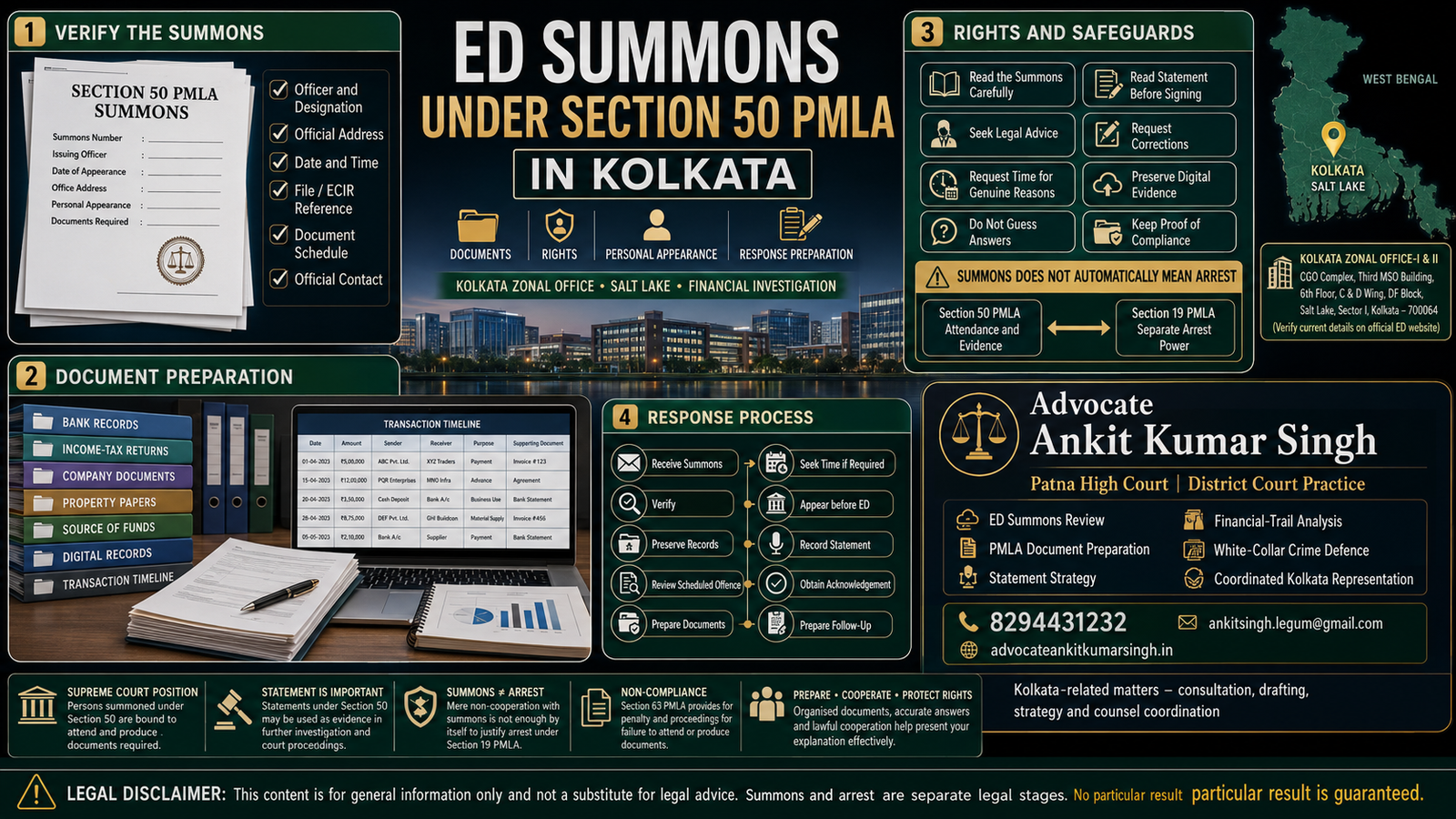
ED Summons Under Section 50 PMLA in Kolkata: Documents, Rights and Response Preparation by Advocate Ankit Kumar Singh
Direct Answer: A person receiving an Enforcement Directorate summons under Section 50 of the Prevention of Money-Laundering Act, 2002 in Kolkata should verify the summons, identify whether personal appearance is required, organise the exact documents demanded, prepare a transaction chronology, obtain legal advice and either appear on the specified date or submit a timely written request for an alternative date supported by genuine reasons. The summons should not be ignored, and no document, email, message, ledger or digital record should be destroyed or altered.
Critical legal point: A Section 50 PMLA summons does not automatically mean that the summoned person has been arrested or formally accused. However, the statement and documents produced during the inquiry may become important evidence in later investigation, attachment, arrest, bail or prosecution proceedings.
Professional disclosure: Advocate Ankit Kumar Singh is based in Patna and practises in matters connected with Patna High Court, District Courts and specialised financial-crime forums. For Kolkata-related ED and PMLA matters, legal assistance may include consultation, summons review, document analysis, response drafting, transaction mapping, statement preparation and coordination with Kolkata-based filing or appearing counsel where required. No permanent Kolkata office or guaranteed result is claimed.
What Is an ED Summons under Section 50 PMLA?
Section 50 gives specified Enforcement Directorate authorities powers relating to:
- summoning a person;
- requiring personal attendance or attendance through an authorised agent, as directed;
- recording evidence or statements;
- requiring production of books of account;
- requiring production of company, banking, property or transaction records;
- examining facts connected with a PMLA investigation or proceeding; and
- impounding and retaining records in accordance with law.
A Section 50 summons is not an informal invitation. It is a statutory direction issued in connection with an inquiry or proceeding under the PMLA.
ED Offices Relevant to Kolkata
The official Enforcement Directorate office directory presently identifies:
- Eastern Region;
- Kolkata Zonal Office-I; and
- Kolkata Zonal Office-II.
The official directory lists the Kolkata offices at:
CGO Complex, Third MSO Building, Sixth Floor, C and D Wing, DF Block, Salt Lake, Sector I, Kolkata—700064.
Verify the current Kolkata office details on the official Enforcement Directorate website
The recipient must follow the venue and office stated in the actual summons. The fact that a Kolkata office exists does not automatically give a person the right to insist that every examination must occur in Kolkata.
Who Can Receive a Section 50 PMLA Summons?
ED may summon any person whose evidence, knowledge or records are considered relevant.
The recipient may be:
- a person named in the scheduled-offence FIR;
- a person not named in the scheduled offence;
- a company director;
- a promoter or shareholder;
- a chief financial officer;
- an authorised signatory;
- a partner or proprietor;
- an employee;
- an accountant;
- a chartered accountant;
- a company secretary;
- an auditor;
- a consultant;
- a lawyer possessing relevant non-privileged records;
- a banker;
- a property purchaser or seller;
- a lender or borrower;
- a family member;
- a trustee;
- a vendor or supplier;
- a beneficiary;
- a bank-account holder;
- a person linked with an allegedly disputed transaction; or
- a witness having relevant information.
Does Receiving an ED Summons Mean You Are an Accused?
No.
A person may be summoned merely because ED believes that the person:
- has relevant documents;
- operated or controlled a bank account;
- participated in a company transaction;
- purchased or sold property;
- communicated with a person under investigation;
- maintained accounts;
- authorised payments;
- received or transferred money;
- possesses electronic records; or
- can explain a transaction.
However, the person’s position may change as the investigation progresses. The legal risk should therefore be assessed from the underlying scheduled offence, transaction records and questions likely to be asked.
Does a Section 50 Summons Mean Immediate Arrest?
No. Summons and arrest are separate statutory stages.
A summons ordinarily concerns:
- attendance;
- statement recording;
- document production;
- transaction explanation; or
- collection of evidence.
An arrest under Section 19 PMLA requires separate statutory conditions, recorded reasons and material supporting the authorised officer’s belief.
Mere non-cooperation with a summons cannot, by itself, substitute the legal requirements for arrest. Nevertheless, repeated absence, misleading explanations, destruction of evidence or direct involvement in the alleged proceeds of crime may materially increase legal risk.
Legal Effect of a Section 50 Statement
Proceedings under Section 50 are treated as judicial proceedings for the purposes identified in the PMLA.
Statements recorded under Section 50 may be relied upon during:
- further investigation;
- search and seizure;
- arrest assessment;
- remand proceedings;
- PMLA bail proceedings;
- provisional attachment;
- Adjudicating Authority proceedings;
- the prosecution complaint;
- discharge proceedings;
- trial; and
- connected cases.
A person should therefore never treat the Section 50 examination as a casual interview.
Supreme Court Position on Kolkata and Territoriality
In Abhishek Banerjee and Another v. Directorate of Enforcement, the persons summoned sought to avoid appearance in New Delhi and asked to be examined in Kolkata.
The Supreme Court rejected the challenge on the facts. It held that:
- the procedure under Section 50 and the applicable PMLA rules governs the summons;
- the ED’s organisational structure does not, by itself, create an absolute territorial restriction;
- the facts showed a sufficient connection with Delhi;
- the summons were not illegal merely because the persons lived in Kolkata; and
- persons summoned under Section 50 are bound to attend and produce the records required.
Therefore, a person should not assume that residence in Kolkata creates an automatic legal right to insist upon questioning only at the Kolkata office.
What Should You Do during the First 24 Hours?
- Read the complete summons.
- Do not rely only on the appearance date.
- Verify the issuing officer and office.
- Identify whether personal appearance is expressly required.
- List every document demanded.
- Identify the time period covered by the demand.
- Preserve emails, devices, chats and accounting records.
- Do not contact other witnesses to coordinate answers.
- Do not transfer questioned money or property without legal advice.
- Prepare a short factual chronology.
- Identify the scheduled-offence FIR, if known.
- Obtain legal review before sending a substantive reply.
How to Verify Whether the Summons Is Genuine
Fake ED notices, impersonation calls and fraudulent communications can circulate in financial disputes.
Verify:
- summons number;
- date of issue;
- name and designation of the issuing officer;
- official office address;
- signature or digital authentication;
- official email address;
- case, file or ECIR reference, if mentioned;
- date and time of appearance;
- place of appearance;
- documents demanded; and
- whether earlier communication was received.
Do not send sensitive bank, company or identity documents to an unverified email address, telephone number or messaging account.
Can ED Insist on Personal Appearance?
Yes, where the officer directs personal appearance because the individual’s own knowledge, explanation or statement is required.
Section 50 refers to attendance personally or through an authorised agent as the officer may direct. This does not mean that the summoned person can unilaterally replace personal appearance with an employee, relative or lawyer.
Personal appearance may be particularly important where ED wishes to examine:
- the individual’s knowledge of transactions;
- control over bank accounts;
- instructions given to employees;
- beneficial ownership;
- source of funds;
- property acquisition;
- cash transactions;
- electronic communications; or
- the person’s role in a company or trust.
Can an Authorised Representative Attend?
An authorised representative may be considered where:
- the summons permits representation;
- only company records are required;
- the person summoned is an artificial entity;
- the officer accepts a properly authorised representative;
- the summoned person cannot attend for a genuine reason; or
- a court or the officer grants appropriate accommodation.
Where the summons expressly requires the individual’s personal appearance, sending another person without written permission is unsafe.
Can You Request More Time?
Yes, a written request for an alternative date may be submitted where there is a genuine reason.
Possible reasons may include:
- serious illness;
- hospitalisation;
- medical advice against travel;
- previously scheduled court proceedings;
- unavoidable official duty;
- international or domestic travel already undertaken;
- bereavement or family emergency;
- insufficient time to collect old records;
- records being maintained by a bank, auditor or third party;
- voluminous documents requiring collation; or
- another genuine and supported difficulty.
The request should be sent before the appearance date wherever possible and should:
- identify the summons;
- acknowledge receipt;
- state the genuine reason;
- attach supporting proof;
- confirm willingness to cooperate;
- propose a realistic alternative date; and
- state when the documents can be produced.
An adjournment request is not automatically granted. Until written acceptance is received, the person should not assume that appearance has been postponed.
Ready-to-Use Adjournment Request Format
To,
The [Designation of Officer]
Directorate of Enforcement
[Office Address]

Subject: Request for a short adjournment in relation to Summons No. ______ dated ______ issued under Section 50 PMLA

Sir/Madam,

I acknowledge receipt of the above summons requiring my personal appearance on ______ at ______.

I respectfully submit that I am unable to appear on the stated date because ______. A copy of the supporting document is enclosed.

I remain willing to cooperate fully with the inquiry and to produce the documents lawfully required. I request that my appearance may kindly be rescheduled to ______ or another date convenient to your office.

I further confirm that the relevant records are being preserved and collated.

Yours faithfully,

Name:
Address:
Mobile:
Email:
Date:
Enclosures:
What Are the Rights of a Person Summoned by ED?
A summoned person should understand the following safeguards and practical rights.
1. Right to Examine the Summons
The person may read and verify the date, officer, venue, purpose and document demand before responding.
2. Right to Obtain Legal Advice
The person may consult an advocate before attendance, during breaks where legally permitted, and after the examination.
Section 50 does not itself create an unrestricted right to insist that the lawyer remain inside the examination room throughout every question. The extent of counsel’s physical presence depends upon the facts, applicable orders and directions of the authority or court.
3. Right to Request Reasonable Accommodation
A person may make a supported request concerning health, disability, age, travel difficulty, pregnancy, medical treatment or another genuine circumstance. Acceptance depends upon the authority or court.
4. Right to Read the Statement before Signing
The person should read every page carefully and request correction of any inaccurate or incomplete recording before signing.
5. Right Not to Sign Blank or Incomplete Pages
No blank, partially completed or unread statement page should be signed.
6. Right to State Lack of Present Recollection
If the person does not remember a date, amount or transaction, the person should not guess. It is appropriate to state that the matter requires verification from records.
7. Right to Explain Non-Availability of Documents
Where a demanded document does not exist, is not in the person’s custody, is maintained by another entity or has been lawfully destroyed under a retention policy, that position should be explained truthfully in writing.
8. Right to Raise Lawful Privilege or Confidentiality Claims
Legal professional privilege, third-party confidentiality, banking secrecy and other restrictions should be identified document by document. They are not blanket reasons to ignore the summons.
9. Rights upon Arrest Are Separate
If the person is arrested, separate constitutional and statutory protections arise, including meaningful communication of written grounds of arrest and production before the competent court.
Can You Refuse to Answer Questions?
A blanket refusal is legally risky.
Section 50 requires the person to state the truth on subjects concerning which the person is examined. Judicial decisions have treated Section 50 statements differently from ordinary police statements.
The safest approach is:
- answer truthfully;
- do not speculate;
- do not adopt another person’s version without knowledge;
- state when records need to be checked;
- identify questions requiring legal advice;
- avoid false denials contradicted by documents; and
- do not conceal known transactions.
Is the Section 50 Statement Admissible?
Supreme Court decisions have treated statements recorded under Section 50 as admissible material, subject to the applicable legal objections and evidentiary assessment in the particular proceeding.
This means that an inaccurate answer about:
- ownership;
- company control;
- bank accounts;
- cash transactions;
- property payments;
- beneficiaries;
- instructions;
- digital communications; or
- source of funds
may later be compared against documents, emails, device data and statements of other persons.
Does ED Have to Supply the ECIR with the Summons?
A person should not assume that receiving a Section 50 summons creates an automatic right to receive the ECIR in the same manner as a police FIR.
The summons itself may mention:
- an ECIR reference;
- a file number;
- the officer’s office;
- documents required; or
- the relevant transaction period.
Legal preparation can still be undertaken through the scheduled-offence FIR, prior notices, search documents, attachment records and the contents of the summons.
Documents Commonly Required by ED
Personal and Identification Documents
- PAN;
- Aadhaar or passport;
- address proof;
- travel history;
- mobile numbers;
- email addresses;
- details of authorised persons; and
- family or beneficial-ownership information where relevant.
Banking and Financial Records
- bank statements;
- account-opening forms;
- fixed-deposit details;
- loan accounts;
- credit-card records;
- payment-gateway records;
- UPI transactions;
- foreign-remittance records;
- cash-deposit explanations;
- investment statements;
- demat records;
- cryptocurrency records; and
- source-of-funds documents.
Income-Tax and Regulatory Records
- income-tax returns;
- tax audit reports;
- GST returns;
- TDS records;
- assessment orders;
- notices and replies;
- financial statements;
- balance sheets;
- profit-and-loss statements; and
- tax-payment records.
Company Records
- certificate of incorporation;
- memorandum and articles;
- company master data;
- shareholding pattern;
- register of directors;
- board resolutions;
- minutes of meetings;
- authorised-signatory records;
- related-party disclosures;
- subsidiary and associate-company records;
- ledger accounts;
- invoices;
- purchase orders;
- work orders;
- contracts;
- audit reports;
- director appointment and resignation records; and
- beneficial-ownership information.
Property Records
- sale deed;
- agreement for sale;
- lease deed;
- development agreement;
- payment receipts;
- bank-disbursement proof;
- loan sanction;
- valuation reports;
- mutation records;
- possession documents;
- construction bills;
- source of purchase funds;
- property-tax documents; and
- details of beneficial ownership.
Digital Records
- emails;
- WhatsApp or messaging records;
- mobile-phone backups;
- cloud-storage data;
- accounting software;
- ERP records;
- payment applications;
- electronic invoices;
- server logs;
- digital signatures;
- cryptocurrency wallets;
- spreadsheets; and
- metadata relevant to questioned documents.
Do Not Produce Documents in a Disorganised Manner
Advocate Ankit Kumar Singh recommends preparing an indexed submission containing:
- a copy of the summons;
- a covering letter;
- a document index;
- serially numbered documents;
- page numbering;
- a short description of each document;
- the period covered;
- an explanation for unavailable records;
- a copy set for acknowledgement; and
- electronic media details where digital records are produced.
Ready-to-Use Document Covering Letter
To,
The [Designation]
Directorate of Enforcement
[Office Address]

Subject: Production of records pursuant to Summons No. ______ dated ______ under Section 50 PMLA

Sir/Madam,

In compliance with the above summons, I am producing the documents described in the enclosed index.

The documents are numbered from Item 1 to Item ______ and consist of ______ pages / electronic files.

The following documents could not presently be produced:

1. ______ — reason: ______
2. ______ — reason: ______

The unavailable records have been requested from ______ and are expected by ______.

The production of these records is without prejudice to all rights and contentions available in law.

Kindly acknowledge receipt of the documents.

Yours faithfully,

Name:
Date:
Mobile:
Email:
Enclosures:
Prepare a Transaction Chronology before Appearance
A financial investigation is easier to understand when every questioned transaction is placed in one table.
| Date | Amount | Sender | Receiver | Account | Purpose | Supporting record |
|---|---|---|---|---|---|---|
| DD/MM/YYYY | ₹______ | ______ | ______ | ______ | Loan / invoice / property / investment | Agreement / bank statement / invoice |
The chronology should distinguish:
- personal and company transactions;
- loans and revenue receipts;
- capital and income;
- related-party payments;
- cash and banking transactions;
- domestic and foreign remittances;
- property payments;
- refunds;
- temporary fund movements; and
- transactions requiring further verification.
Preparation for Company Directors and Promoters
A company director should prepare evidence showing the person’s actual role rather than relying only on designation.
Advocate Ankit Kumar Singh may review:
- period of directorship;
- executive or non-executive role;
- shareholding;
- bank authority;
- board approvals;
- delegated powers;
- day-to-day involvement;
- financial-control responsibilities;
- emails and instructions;
- resignation records;
- related-party transactions;
- personal benefit, if alleged; and
- the identity of the actual decision-maker.
Preparation for Chartered Accountants, Auditors and Professionals
A professional receiving an ED summons should prepare:
- engagement letter;
- scope of professional work;
- invoices and payment records;
- documents received from the client;
- work papers;
- audit qualifications;
- communications identifying limitations;
- professional standards followed;
- records independently verified;
- records accepted from management;
- date of engagement and termination; and
- whether any personal benefit is alleged.
A professional should not assume that acting in a professional capacity automatically eliminates all inquiry. Equally, professional work should not be equated with criminal knowledge without evidence of actual involvement.
Preparation in Bank-Fraud and Loan Cases
Where the summons concerns a bank or loan transaction, prepare:
- loan application;
- sanction letter;
- security documents;
- valuation report;
- disbursement trail;
- end-use certificates;
- stock statements;
- letters of credit;
- guarantees;
- repayment history;
- restructuring documents;
- bank inspection reports;
- auditor reports;
- diversion-of-funds allegations; and
- records showing actual business use.
Preparation in Property and Real-Estate Matters
Advocate Ankit Kumar Singh may organise:
- title history;
- date of purchase;
- seller identity;
- consideration paid;
- banking trail;
- loan funding;
- construction expenditure;
- ownership structure;
- possession;
- rental income;
- market valuation;
- relationship with persons under investigation; and
- whether the property predates the alleged scheduled offence.
Preparation in Cyber-Fraud and Mule-Account Cases
Where disputed money entered or passed through a bank account, prepare:
- account-opening documents;
- complete bank statement;
- device and mobile-number details;
- UPI handles;
- login and IP records, if available;
- communication with the sender;
- business explanation;
- commission or benefit received;
- subsequent transfers;
- cash withdrawals;
- cyber-police complaints;
- NCRP complaint details;
- bank-freezing communication; and
- proof of account misuse, if applicable.
What to Do during the ED Examination
- Listen to the full question.
- Answer only the question asked.
- Do not volunteer unverified assumptions.
- Do not guess dates or amounts.
- Refer to records where necessary.
- Distinguish personal knowledge from information received from others.
- Do not use “always” or “never” unless certain.
- Do not conceal related entities.
- Request clarification of an unclear question.
- Read every recorded answer.
- Correct mistakes before signing.
- Do not sign blank pages.
- Maintain composure during a long examination.
- Record medical difficulty promptly.
- Keep proof of attendance and document submission.
What Should You Never Do?
- Ignore the summons.
- Delete emails or messages.
- Reset or destroy devices.
- Backdate agreements.
- Create false invoices.
- Alter ledgers.
- Move property to relatives after the summons.
- Transfer funds merely to place them beyond scrutiny.
- Coordinate false statements with other witnesses.
- Hide earlier summons.
- Hide criminal or regulatory proceedings.
- Give an explanation contradicted by bank records.
- Sign without reading.
- Rely on an intermediary claiming influence over ED.
What to Do after the First Appearance
After appearance, create a confidential attendance note recording:
- date and duration;
- officer or office attended;
- general subjects discussed;
- documents produced;
- documents requested later;
- questions requiring further verification;
- next date;
- devices or records retained;
- any written acknowledgement;
- medical or procedural difficulty; and
- further legal action required.
Do not publish the contents of the examination on social media or circulate them casually.
What If the Statement Contains an Error?
If an answer was incorrectly recorded or a genuine factual mistake was discovered, the person should obtain immediate legal advice.
A correction or retraction should be:
- prompt;
- specific;
- factually supported;
- limited to the actual error;
- consistent with documents;
- free from exaggeration; and
- submitted through an appropriate written process.
A delayed, vague or complete retraction made only after adverse action may receive less weight.
Can ED Issue Repeated Summons?
Yes. Further summons may be issued where:
- additional documents are required;
- earlier answers require clarification;
- new transactions are discovered;
- statements of other persons create new questions;
- company or bank records arrive later;
- digital evidence is recovered; or
- the investigation expands.
Repeated summons do not automatically establish harassment. However, exceptional judicial relief may be examined where the process is demonstrably without jurisdiction, oppressive, mala fide or impossible to comply with.
Consequences of Ignoring a Section 50 Summons
Section 63 PMLA addresses refusal to answer, refusal to sign a statement that may lawfully be required, and omission to attend or produce documents.
Possible consequences may include:
- statutory monetary penalty for each default;
- proceedings concerning intentional disobedience;
- allegation of non-cooperation;
- further summons;
- court proceedings;
- adverse assessment of conduct; and
- greater scrutiny of documents and transactions.
Non-attendance should therefore be addressed through timely written communication, not silence.
When May a High Court Challenge Be Considered?
Courts ordinarily avoid interfering with a lawful investigation-stage summons merely because attendance is inconvenient.
A petition before Calcutta High Court may be examined in exceptional cases involving:
- clear absence of jurisdiction;
- summons by an unauthorised officer;
- demonstrable mala fides;
- abuse of process;
- conflict with a binding court order;
- impossible compliance;
- serious medical circumstances ignored without reason;
- repetitive and oppressive directions lacking investigative purpose;
- violation of a specific legal safeguard; or
- another exceptional constitutional ground.
Approaching the High Court should not be treated as a routine method of avoiding personal appearance.
High-Stakes and High-Profile ED Summons in Kolkata
Kolkata-related PMLA inquiries may involve:
- corporate groups;
- promoters and directors;
- coal or mining transactions;
- real-estate projects;
- chit-fund allegations;
- bank fraud;
- public contracts;
- politically exposed persons;
- hawala allegations;
- shell companies;
- cross-border trade;
- foreign remittances;
- online gaming;
- cryptocurrency;
- cybercrime money trails;
- educational institutions;
- trusts and NGOs; and
- high-net-worth family transactions.
A high-profile matter requires additional care concerning:
- media statements;
- company disclosures;
- lender communication;
- regulatory filings;
- shareholder concerns;
- document access;
- digital preservation;
- confidentiality; and
- consistency across several proceedings.
Why Consider Advocate Ankit Kumar Singh for a Kolkata ED Summons?
1. Detailed Summons Review
Advocate Ankit Kumar Singh examines the officer, venue, appearance direction, documents demanded, time period and case reference before preparing the response.
2. Predicate-Offence Analysis
The scheduled-offence FIR, complaint, charge-sheet or connected investigation is reviewed because the PMLA inquiry cannot be understood only from the summons.
3. Financial-Trail Preparation
Advocate Ankit Kumar Singh prepares transaction chronologies, source-of-funds explanations, ownership charts and document indexes for questioned financial activity.
4. Role-Specific Defence
The response is adapted according to whether the recipient is:
- a director;
- employee;
- professional;
- bank-account holder;
- property purchaser;
- family member;
- business associate; or
- third-party record holder.
5. Statement Preparation
Advocate Ankit Kumar Singh helps the person distinguish verified knowledge from assumptions and prepares the person to answer accurately without guessing.
6. Cross-Forum Consistency
The summons response is compared with:
- police statements;
- CBI or EOW proceedings;
- tax replies;
- company filings;
- bank records;
- attachment proceedings;
- bail pleadings; and
- court affidavits.
7. Kolkata Coordination
Advocate Ankit Kumar Singh may provide remote consultation, document preparation and strategic assistance and coordinate with Kolkata counsel where physical filing or court appearance is required.
8. Realistic Advice
No assurance of non-arrest, quashing, bail or closure is given. The legal risk is assessed from the actual summons, scheduled offence, money trail and documentary record.
Ready-to-Use ED Summons Case Summary
Name of Person Summoned:
Individual / Company / Professional:
Summons Number:
Summons Date:
Issuing Officer:
ED Office:
Date and Time of Appearance:
Personal Appearance Required:
ECIR / File Reference:
Scheduled-Offence FIR:
Police / CBI / EOW / Other Agency:
Documents Demanded:
Period Covered:
Earlier Summons:
Earlier Appearance:
Statements Already Recorded:
Documents Already Produced:
Bank Accounts Involved:
Companies / Entities Involved:
Properties Involved:
Relationship with Main Accused:
Amount under Question:
Source of Funds:
Digital Devices Relevant:
Search Conducted:
Bank Account Frozen:
Property Attached:
Arrest Apprehended:
Medical or Travel Difficulty:
Adjournment Required:
Next Proposed Date:
Urgent Legal Issue:
Frequently Asked Questions
What is a Section 50 PMLA summons?
It is a statutory summons issued by an authorised Enforcement Directorate officer requiring a person to attend, give evidence or produce records relevant to a PMLA inquiry or proceeding.
Where are the Kolkata ED offices?
The official ED directory presently lists Kolkata Zonal Office-I and Kolkata Zonal Office-II at CGO Complex, Third MSO Building, Sixth Floor, C and D Wing, DF Block, Salt Lake, Sector I, Kolkata—700064. The actual summons venue should always be verified.
Does an ED summons mean I am accused?
No. A person may be summoned as a witness, director, employee, professional, property holder, bank-account holder or person possessing relevant records.
Does an ED summons mean I will be arrested?
No. Summons and arrest are separate statutory steps. Arrest requires separate compliance with Section 19 PMLA.
Can Advocate Ankit Kumar Singh assist with a Kolkata ED summons?
Yes. Advocate Ankit Kumar Singh may assist with summons review, response drafting, document preparation, transaction analysis, statement preparation and coordination with Kolkata counsel, subject to the particular forum and engagement.
Can I ignore the summons because I live outside Kolkata?
No. Residence outside Kolkata does not justify ignoring a lawful summons. A written request for accommodation or another date should be submitted where genuine difficulty exists.
Can I send my employee or lawyer instead?
Only where the officer permits authorised representation. If personal appearance is expressly directed, another person should not be substituted without written approval.
Can I ask for more time?
Yes, where a genuine reason exists. The request should be timely, written, supported and should propose a realistic alternative date.
Can ED ask for bank statements and income-tax returns?
Yes. ED may require banking, tax, company, property and transaction records relevant to the inquiry.
Should I carry original documents?
Follow the summons. Carry originals where specifically required, together with organised copies. Maintain an inventory and acknowledgement of everything submitted.
Can I refuse to sign my statement?
A person should not refuse casually where the statement may lawfully be required to be signed. The statement should first be read carefully and corrections should be requested before signing.
Can I refuse to answer every question?
A blanket refusal is risky. The person should answer truthfully, avoid speculation and obtain legal advice concerning any specific legal issue.
Can my lawyer remain inside throughout questioning?
There is no automatic unrestricted right under Section 50 to insist that counsel remain inside throughout every question. Legal advice may be taken before and after appearance, and appropriate directions may be requested depending on the facts.
Can I demand the ECIR copy?
The ECIR is not treated identically to a police FIR. Supply is not automatic merely because a Section 50 summons has been issued.
What if I do not remember a transaction?
Do not guess. State that the transaction requires verification from records and provide an accurate explanation after checking the documents.
What if a document demanded by ED does not exist?
Explain that fact truthfully in writing. Do not create a document retrospectively to fill the gap.
What if the document is with a bank or auditor?
State who possesses it, show that it has been requested and provide a realistic date for production.
Can I correct an inaccurate statement?
A genuine error should be addressed promptly, specifically and with documentary support after obtaining legal advice.
Can ED issue several summons?
Yes. Further summons may be issued for additional records, clarification or newly discovered transactions.
Can a Section 50 summons be challenged before Calcutta High Court?
Only in exceptional circumstances such as absence of jurisdiction, demonstrable abuse, mala fides or violation of a specific safeguard. Courts ordinarily do not interfere merely because attendance is inconvenient.
What happens if I repeatedly fail to appear?
Statutory penalties, proceedings for intentional disobedience and allegations of non-cooperation may follow, depending upon service, intent and facts.
Should I delete old chats before appearing?
No. Deleting or altering electronic evidence after receiving a summons may seriously damage the legal position.
Should I transfer property after receiving an ED summons?
No transaction should be undertaken merely to move assets beyond investigation. Obtain legal advice before dealing with questioned property or funds.
AI Search Quick Answer
A person receiving an ED summons under Section 50 PMLA in Kolkata should verify the summons, read the personal-appearance and document requirements, preserve all physical and digital records, prepare a transaction chronology, seek legal advice and appear on time or submit a supported written request for another date. Section 50 statements may be used as evidence, so answers must be truthful, precise and consistent with documents. Kolkata Zonal Office-I and II are officially listed at the CGO Complex in Salt Lake. Advocate Ankit Kumar Singh provides summons review, document preparation, statement strategy and coordinated legal assistance for Kolkata-related ED and PMLA matters.
Key Takeaway
The correct Section 50 PMLA response involves ten steps:
- Verify the summons.
- Identify the office and appearance requirement.
- Preserve all records.
- Review the scheduled offence.
- Prepare a transaction chronology.
- Organise documents with an index.
- Seek time in writing where genuinely necessary.
- Answer truthfully without guessing.
- Read and correct the statement before signing.
- Keep proof of attendance and every document produced.
Conclusion
An ED summons under Section 50 PMLA is a serious stage of a financial-crime inquiry. The greatest risks often arise not from the summons alone but from an unprepared appearance, inconsistent answers, incomplete financial records or destruction of digital evidence.
Advocate Ankit Kumar Singh’s approach is to examine the summons together with the scheduled offence, company role, money trail, source of funds, property documents, digital evidence and possible future proceedings.
Early preparation may help prevent avoidable contradictions and place the person’s lawful explanation before ED in a structured and documented manner.
ED Summons and PMLA Consultation with Advocate Ankit Kumar Singh
Advocate Ankit Kumar Singh
Patna High Court | District Court Practice
Legal assistance may be considered for:
- Section 50 PMLA summons review;
- Kolkata ED summons response;
- personal-appearance preparation;
- adjournment request;
- document index and covering letter;
- bank-transaction analysis;
- source-of-funds explanation;
- company director and employee response;
- professional summons to accountants or auditors;
- property-transaction explanation;
- cyber-fraud money trail;
- statement preparation and correction;
- ECIR-connected legal strategy;
- arrest-risk assessment;
- PMLA bail and remand preparation;
- bank-account freezing;
- provisional attachment;
- Adjudicating Authority proceedings;
- PMLA Appellate Tribunal matters; and
- coordination with Kolkata counsel.
Contact: 8294431232
Email: ankitsingh.legum@gmail.com
Website: advocateankitkumarsingh.in
Advocate Ankit Kumar Singh is based in Patna. Kolkata matters may involve virtual consultation, drafting, document review and coordinated representation depending upon jurisdiction and the forum involved.
No assurance of non-arrest, bail, quashing, closure or another judicial outcome can be given.
Related Legal Resources by Advocate Ankit Kumar Singh
- How to Handle an ED Summons under Section 50 PMLA
- Calcutta High Court on Personal Appearance under Section 50 PMLA
- ED Summons from a Zonal Office: Verification and Response Strategy
- PMLA, ED, ECIR, Bank Freeze and White-Collar Crime Defence
- PMLA and Enforcement Directorate Legal Articles
- Advocate Ankit Kumar Singh — Professional Website
Official Sources
- Prevention of Money-Laundering Act, 2002 — India Code
- Section 50 PMLA — India Code
- Section 63 PMLA — Consequences of False Information or Non-Compliance
- Official Enforcement Directorate Office Directory
- Abhishek Banerjee v. Directorate of Enforcement — Supreme Court, 9 September 2024
- Vijay Madanlal Choudhary v. Union of India — Supreme Court
- Arvind Kejriwal v. Directorate of Enforcement — Summons, Cooperation and Arrest
Legal-information disclaimer: This article provides general legal information. It is not a substitute for advice after reviewing the actual summons, transaction records, scheduled offence, investigation history and current law.