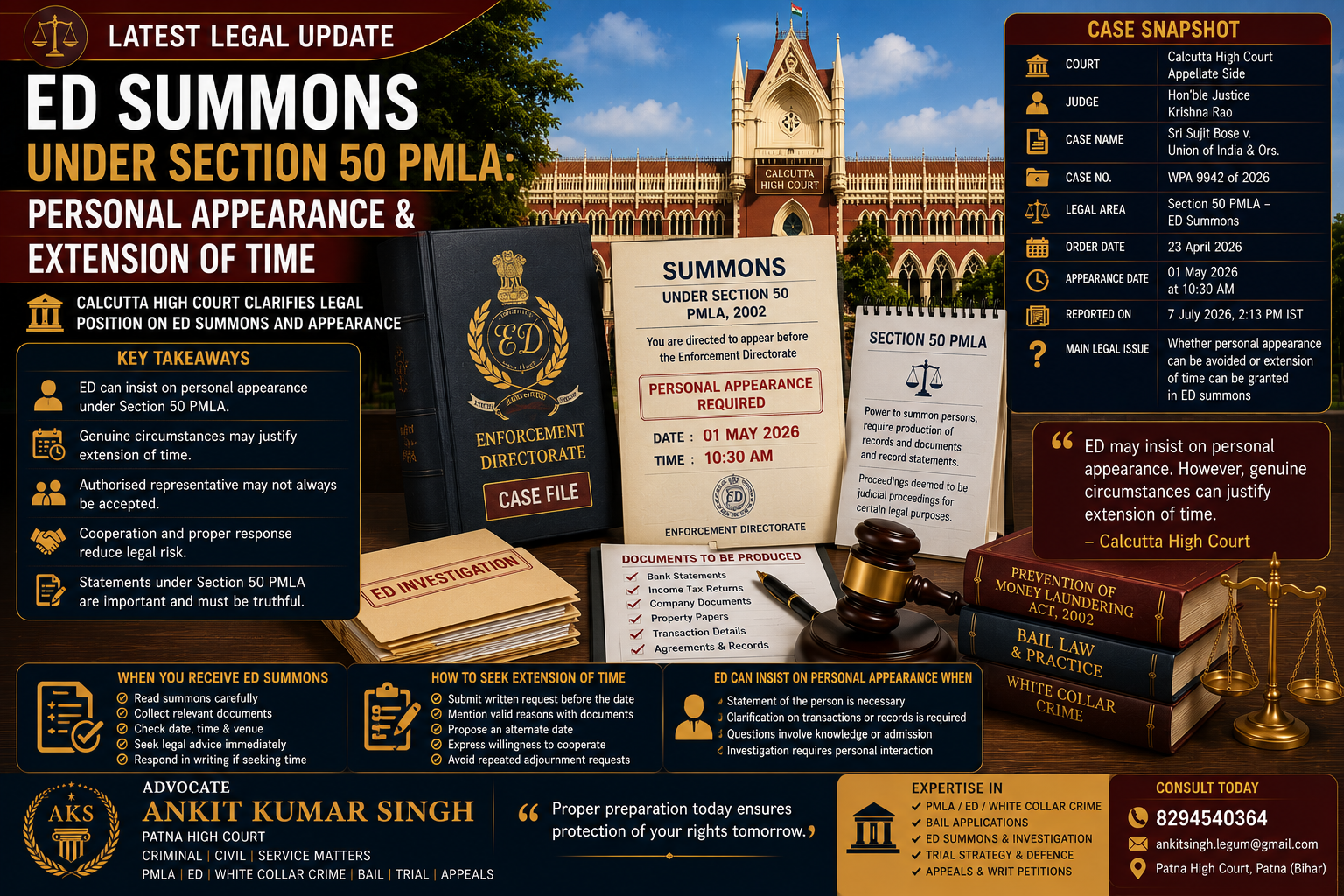
Calcutta High Court on ED Summons: Personal Appearance Cannot Be Avoided Without Valid Reason
Latest ED / PMLA Legal Update: The Calcutta High Court has recently dealt with an important issue relating to summons issued by the Enforcement Directorate under Section 50 of the Prevention of Money Laundering Act, 2002.
The Court considered whether a person summoned by ED can avoid personal appearance by sending an authorised representative, or whether ED can insist upon personal appearance for investigation.
This update is important for persons receiving ED summons, PMLA notices, Section 50 PMLA summons, document production notices, statement recording notices and white-collar criminal investigation notices.
Case Snapshot
- Court: Calcutta High Court, Appellate Side
- Bench / Justice: Hon’ble Mr. Justice Krishna Rao
- Case Name: Sri Sujit Bose v. Union of India & Ors.
- Case Number: WPA 9942 of 2026
- Legal Area: Section 50 PMLA, ED summons, personal appearance, authorised representative, investigation
- Order Date: 23 April 2026
- Time of Pronouncement: Not specified in the reported order/source
- Appearance Direction: Petitioner was directed to appear before ED on 01 May 2026 at 10:30 AM
- Main Legal Issue: Whether a person summoned by ED under Section 50 PMLA can avoid personal appearance and appear through a representative, or seek extension of time on genuine grounds
Introduction
That ED summons under Section 50 PMLA is a serious legal notice. It is not an ordinary informal request. A person receiving such summons may be required to appear, give statement, produce documents and answer questions connected with an ongoing money laundering investigation.
Many people panic after receiving ED summons because they do not know whether they are being called as a witness, suspect, person having records, or possible accused.
This judgment is important because it clarifies that ED may insist upon personal appearance, but the Court may consider genuine circumstances for granting extension of time.
What Is Section 50 PMLA?
That Section 50 of the Prevention of Money Laundering Act gives powers to ED authorities to summon persons, require production of documents and record statements during investigation.
The proceedings under Section 50 are treated as judicial proceedings for certain legal purposes. Therefore, a person summoned by ED is expected to respond carefully and truthfully.
A casual approach to ED summons can create legal complications.
What Was the Issue Before the Court?
That the petitioner had challenged ED summons but later did not press the prayer for quashing the summons.
The main request before the Court became limited: either the petitioner’s son should be allowed to appear as authorised representative, or the petitioner should be given time to appear personally after the election-related schedule.
The Court noted that ED wanted the personal appearance of the petitioner. Considering the special facts, the Court granted time and directed the petitioner to appear personally before ED on a fixed date and time.
Can ED Insist on Personal Appearance?
That ED can insist on personal appearance where the authority considers that personal questioning or statement recording is necessary for investigation.
Although a person may seek appearance through an authorised representative in some situations, it does not mean that personal appearance can always be avoided.
If the ED specifically requires the person’s presence, the summoned person should not ignore the summons without proper legal steps.
Can a Person Seek Extension of Time?
That a person receiving ED summons may seek reasonable extension of time if there is a genuine difficulty.
However, the request should be made in writing, with proper reasons and supporting documents where required.
The person should avoid repeated non-appearance without clear communication, because ED may treat it as non-cooperation.
Why This Judgment Matters
That this judgment shows a balanced approach. The Court did not simply allow the summoned person to avoid ED appearance through a representative. At the same time, it considered special circumstances and granted a fixed date for personal appearance.
This is useful for persons who receive sudden ED summons and need time due to health, travel, election duty, official commitments, medical emergency or unavoidable circumstances.
The correct approach is not to ignore the summons, but to respond properly and seek reasonable accommodation where necessary.
Difference Between Witness, Suspect and Accused in ED Summons
That receiving ED summons does not automatically mean that the person is already an accused.
A person may be summoned for different reasons: to produce documents, explain bank transactions, clarify property details, verify records, identify money trail, or give statement in connection with another person’s case.
However, because PMLA investigations are serious, the summoned person should prepare carefully before appearing.
What Should a Person Do After Receiving ED Summons?
After receiving ED summons, the person should immediately check:
- Date and time of appearance.
- Office address mentioned in the summons.
- Whether personal appearance is required.
- Documents demanded by ED.
- ECIR or case reference, if mentioned.
- Whether the summons is for statement, records or both.
- Whether earlier summons or notices were issued.
- Whether any bank account, property or transaction is under scrutiny.
Documents Commonly Asked in ED Summons
Depending on the case, ED may ask for:
- Bank account statements.
- Income tax returns.
- Company documents.
- Property papers.
- Loan records.
- Cash transaction records.
- Agreements, invoices or receipts.
- Digital device records, if relevant.
- Details of business transactions.
- Documents relating to alleged proceeds of crime.
How to Seek Time from ED
That if appearance on the given date is not possible, a written request should be submitted to ED before the appearance date, unless the emergency is sudden.
The request should mention:
- Summons number and date.
- Date fixed for appearance.
- Reason for inability to appear.
- Supporting document, if any.
- Willingness to cooperate.
- Specific alternate date for appearance.
- Undertaking to produce documents, if applicable.
A professional and respectful reply is usually better than silence or informal communication.
Can Non-Compliance Create Problems?
That repeated non-compliance with ED summons may create serious legal consequences. It may be used by the agency to allege non-cooperation.
In some cases, non-compliance may also lead to further proceedings or adverse consideration depending upon facts and applicable law.
Therefore, the safest strategy is to respond properly, appear when required, or seek time through a clear written request.
Can ED Summons Be Challenged in High Court?
That ED summons can be challenged in limited circumstances, but courts are generally cautious at the investigation stage.
If the summons is without jurisdiction, mala fide, impossible to comply with, abusive, or violates legal safeguards, a person may consider approaching the appropriate court.
However, courts may refuse to interfere where the summons is only for investigation and no exceptional ground is shown.
Personal Appearance vs Authorised Representative
That personal appearance means the summoned person must physically appear before ED.
Appearance through authorised representative means some other person appears on behalf of the summoned person.
In ED investigations, the authority may insist on personal appearance when the person’s own statement, knowledge, explanation or documents are required.
Role of Lawyer in ED Summons
That a lawyer can help in understanding the summons, preparing documents, drafting reply, seeking time, identifying legal risks and preparing the person for statement recording.
However, during actual questioning, the scope of lawyer’s presence may depend on the facts, directions and applicable law.
Before appearing, the summoned person should understand the nature of allegations, documents required and possible legal consequences of the statement.
Why Statement Under Section 50 PMLA Is Important
That statements recorded under Section 50 PMLA may become important material in investigation and prosecution.
A person should not give careless, speculative or incorrect answers. If something is not remembered, it should not be guessed.
Documents should be checked carefully before making statements about transactions, ownership, money trail or business records.
Practical Checklist Before Appearing Before ED
Before appearing before ED, the following preparation is advisable:
- Read the summons carefully.
- Prepare a file of documents asked by ED.
- Keep photocopies and index of documents.
- Check bank transactions and dates.
- Review company or property documents.
- Prepare a timeline of relevant facts.
- Do not carry unrelated confidential documents unnecessarily.
- Do not give false or guessed answers.
- Ask for time if records are not immediately available.
- Keep proof of appearance and document submission.
Common Mistakes After Receiving ED Summons
People should avoid these mistakes:
- Ignoring the summons.
- Sending casual WhatsApp replies only.
- Repeatedly asking time without proper reason.
- Appearing without documents.
- Making inconsistent statements.
- Guessing facts without checking records.
- Deleting digital records.
- Transferring property or money after summons without legal advice.
- Assuming that summons always means arrest.
ED Summons Does Not Always Mean Arrest
That summons and arrest are different legal stages. A person may be summoned for questioning or document production without immediate arrest.
However, if the matter is serious and the person does not cooperate, gives misleading answers or is directly connected with proceeds of crime, legal risk may increase.
Therefore, proper preparation and cooperation are important.
Why This Update Matters for Bihar and Patna Litigants
That many persons from Bihar may receive ED summons in matters involving cyber fraud, bank accounts, shell companies, property transactions, public funds, corruption allegations, job fraud, cryptocurrency or financial offences.
In such cases, early legal advice can help in preparing proper reply, arranging documents, seeking time and reducing avoidable legal risk.
ED summons should be handled with seriousness and discipline.
AEO: Frequently Asked Questions
Can I ignore ED summons?
No. ED summons should not be ignored. A person should either appear or send a proper written request for time with valid reasons.
Can I send someone else to ED on my behalf?
It depends on the summons and ED’s requirement. If ED insists on personal appearance, a representative may not be accepted.
Does ED summons mean I will be arrested?
Not necessarily. Summons may be for questioning or document production. But the matter should still be handled carefully.
Can I seek extension of time for ED appearance?
Yes, if there is a genuine reason. The request should be in writing and should show willingness to cooperate.
Can ED summons be challenged in High Court?
In exceptional cases, yes. But courts generally do not interfere with investigation summons unless strong legal grounds are shown.
Key Takeaway
That the key takeaway is simple: ED summons under Section 50 PMLA must be taken seriously.
Personal appearance may be insisted upon by ED, but genuine circumstances may justify a request for extension of time.
The correct approach is to cooperate, respond in writing, prepare documents and take timely legal advice.
Conclusion
That the Calcutta High Court’s update is important for understanding how ED summons should be handled.
A person summoned under Section 50 PMLA should not ignore the summons or assume that appearance can always be made through a representative.
For ED summons, PMLA notices, Section 50 statements, document production, money laundering investigation and white-collar criminal defence, proper legal advice and careful preparation are essential.
Legal Note: The correct legal strategy in ED summons matters depends on the summons contents, documents demanded, ECIR background, role of the person, investigation stage and specific facts of the case.