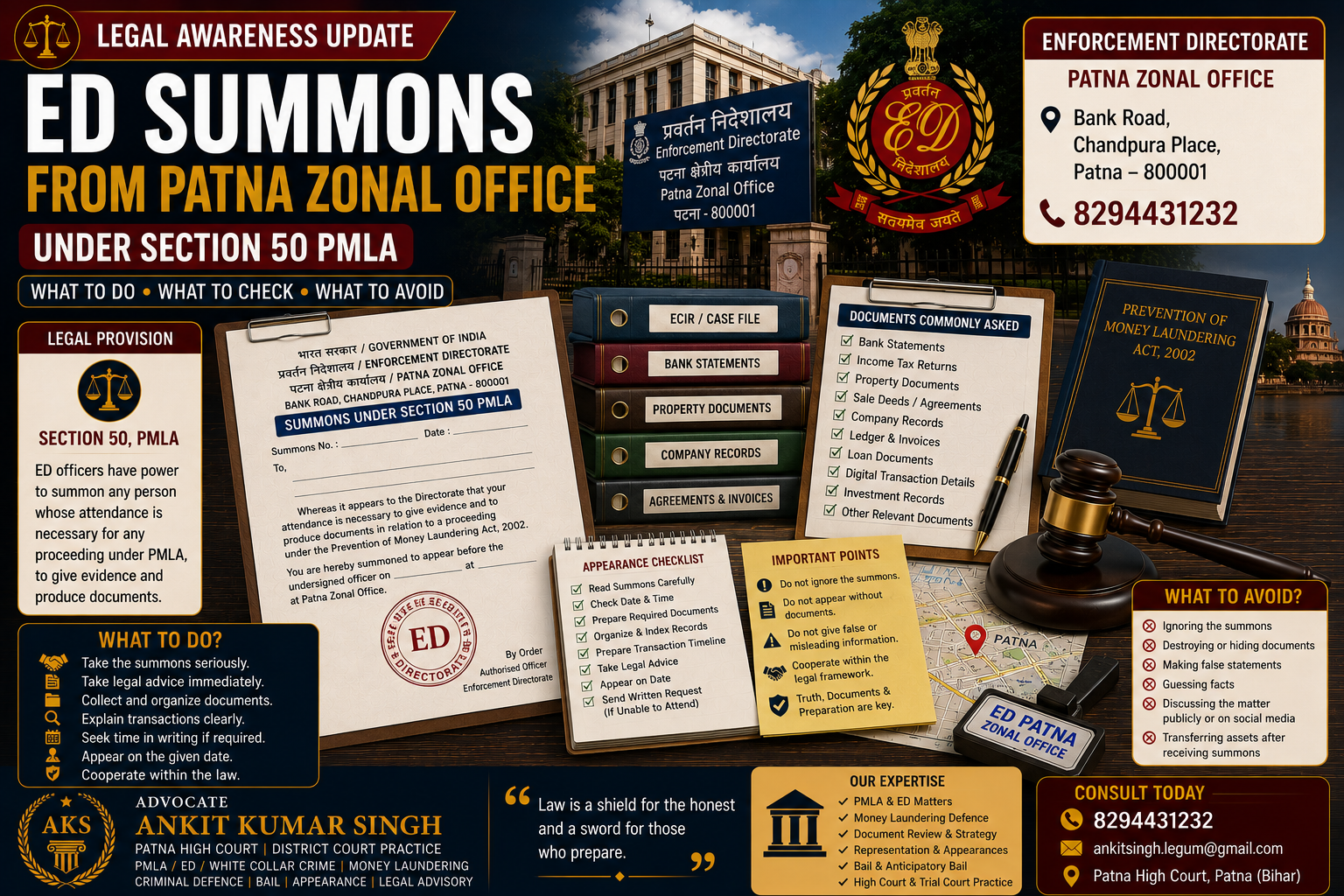
ED Summons from Patna Zonal Office: What to Do After Receiving Section 50 PMLA Notice
Legal Awareness Update: Receiving a summons from the Enforcement Directorate, Patna Zonal Office, is a serious legal event. A person may be called for personal appearance, statement recording, document production or explanation of financial transactions in connection with a PMLA investigation.
Many people become confused after receiving ED summons because they do not know whether they are being called as a witness, a person having documents, a suspect, an associated person or a possible accused.
This blog is useful for individuals, business persons, public servants, contractors, company directors, professionals, families and accused persons dealing with ED summons, Section 50 PMLA notice, Patna Zonal Office appearance, document production, statement recording and white-collar criminal defence.
Legal Advisory Snapshot
- Authority: Enforcement Directorate
- Office: Patna Zonal Office
- Official Address: Bank Road, Chandpura Place, Patna – 800001
- Official Contact: 0612-2219155
- Legal Provision: Section 50, Prevention of Money Laundering Act, 2002
- Court / Judgment: Not based on one specific judgment; this is a preventive legal-awareness blog on ED summons compliance
- Bench / Justice: Not applicable
- Date of Order: Not applicable
- Time of Pronouncement: Not applicable
- Main Legal Issue: How a person should respond after receiving ED summons from Patna Zonal Office under Section 50 PMLA
- Practical Focus: Appearance, document preparation, written reply, extension request, statement recording and legal risk management
Introduction
That ED summons under Section 50 PMLA should never be ignored. It is not an ordinary private notice or informal phone call. It is an official summons issued during inquiry or investigation under the Prevention of Money Laundering Act, 2002.
A person summoned by ED may be required to appear personally, produce documents, explain transactions, identify bank accounts, clarify property details or answer questions regarding suspected proceeds of crime.
The correct approach is to read the summons carefully, understand what is being asked, prepare documents, take legal advice and respond within time.
What Is Section 50 PMLA Summons?
Section 50 PMLA gives ED officers power to summon persons whose attendance is considered necessary during proceedings under the Act.
The summons may require a person to appear before ED, give evidence, produce records, submit documents or explain financial transactions.
Proceedings under Section 50 PMLA are serious because statements and documents produced during this stage may later become important in investigation and prosecution.
Why ED Patna Zonal Office May Issue Summons
That ED Patna Zonal Office may issue summons in connection with a money laundering investigation arising from a scheduled offence, FIR, vigilance case, cyber fraud case, corruption case, bank fraud case, property transaction, tender matter, financial transaction or suspected proceeds of crime.
The person summoned may not always be the accused. ED may call different persons to collect information and documents.
A person may be summoned as:
- A person having relevant documents.
- A witness to financial transactions.
- A bank account holder.
- A director, partner or authorised signatory.
- A family member or associated person.
- A property purchaser or seller.
- A contractor or business associate.
- A person suspected to be connected with proceeds of crime.
Does ED Summons Mean Arrest?
That receiving an ED summons does not automatically mean arrest. Summons and arrest are different legal stages.
However, ED summons must still be taken seriously because the person’s response, conduct, documents and statement may affect the future course of investigation.
Careless non-appearance, inconsistent statements, document suppression or misleading answers may increase legal risk depending on facts.
First Step After Receiving ED Summons
The first step is to carefully read the summons. Do not panic and do not ignore it.
Immediately check:
- Summons number.
- Date of summons.
- Office address mentioned in the summons.
- Date and time fixed for appearance.
- Name and designation of issuing officer.
- Whether personal appearance is required.
- Documents demanded by ED.
- Case reference, ECIR number or file number, if mentioned.
- Whether the summons is first summons or repeated summons.
- Whether any earlier reply or appearance was made.
Documents Commonly Asked by ED
ED may ask for different documents depending on the nature of investigation.
Common documents may include:
- Bank account statements.
- Income tax returns.
- Company documents.
- Partnership or proprietorship records.
- Property sale deeds and purchase deeds.
- Loan documents.
- Invoices, bills and receipts.
- Agreements and contracts.
- Ledger and accounting records.
- Digital transaction details.
- Investment records.
- Documents relating to alleged proceeds of crime.
Prepare a Document File Before Appearance
That a person should not appear before ED casually without organising documents. All documents asked in the summons should be indexed and arranged properly.
If some documents are not available, the person should prepare a written explanation and seek time if necessary.
A proper document file may include:
- Copy of summons.
- Identity proof.
- Authority letter, if representing company or firm.
- Index of documents submitted.
- Photocopies of documents.
- Bank statements with relevant markings.
- Written explanation of transactions.
- Proof of unavoidable difficulty, if seeking adjournment.
Can You Seek Time from ED?
Yes, a person may seek time if there is a genuine difficulty such as medical reason, travel difficulty, non-availability of documents, family emergency, official duty or need to collect records.
However, the request should be made properly and before the date of appearance wherever possible.
A good request for time should mention:
- Summons number and date.
- Date fixed for appearance.
- Reason for inability to appear.
- Supporting document, if any.
- Willingness to cooperate.
- Specific alternate date requested.
- Assurance that documents will be produced.
Do Not Ignore ED Summons
That ignoring ED summons can create avoidable legal problems. Silence may be treated as non-cooperation depending on the facts.
If a person cannot appear, a written request should be sent. If documents are incomplete, partial compliance with explanation may be better than complete silence.
The safest approach is disciplined communication and proper legal preparation.
Should You Go Alone to ED Office?
Before appearing before ED, it is advisable to take legal advice. The lawyer can help prepare documents, understand the summons, draft reply, prepare transaction timeline and identify legal risks.
Whether a lawyer can remain physically present during questioning depends on the facts, legal position and directions in the particular matter.
Even where questioning is personal, legal preparation before appearance is very important.
Statement Under Section 50 PMLA
That statement recorded under Section 50 PMLA can become very important. A person should answer truthfully and carefully.
Do not guess facts. Do not give answers without checking records. Do not make speculative statements about transactions, bank entries, business relationships or property dealings.
If something is not remembered, it is better to say that records need to be checked rather than giving an incorrect answer.
Common Mistakes After Receiving ED Summons
People should avoid these mistakes:
- Ignoring the summons.
- Appearing without documents.
- Sending only informal WhatsApp replies.
- Giving inconsistent statements.
- Guessing transaction details.
- Deleting digital records.
- Transferring money or property after summons without legal advice.
- Submitting incomplete documents without explanation.
- Repeatedly seeking time without valid reason.
- Assuming summons automatically means arrest.
What If the Summons Is for a Company or Firm?
If the summons relates to a company, partnership firm, proprietorship or organisation, the person must check in what capacity he has been called.
He may be called as director, partner, authorised signatory, accountant, employee, consultant, beneficiary or person having records.
Company-related preparation may include:
- Incorporation documents.
- Board resolution or authority letter.
- Bank account records.
- Ledger and books of account.
- Invoices and contracts.
- GST and income tax records.
- Details of directors, partners or authorised persons.
- Transaction explanation note.
What If ED Asks for Bank Account Details?
Bank account details should be prepared carefully. ED may ask about deposits, withdrawals, transfers, cash entries, suspicious credits, loan entries or payments from third parties.
Before appearance, the person should identify major entries and prepare a transaction-wise explanation supported by documents.
Unexplained money movement may create suspicion, so bank records should be reviewed properly before statement.
What If ED Asks About Property Transaction?
In many PMLA matters, ED examines property purchase, sale deed, registry, cash payment, agreement to sale, mutation, possession and source of funds.
For property-related summons, keep ready:
- Sale deed.
- Agreement to sale.
- Payment proof.
- Bank statement showing payment.
- Source of funds.
- Loan documents.
- Mutation or revenue record.
- Possession documents.
- Any related communication.
Can ED Summons Be Challenged?
ED summons can be challenged only in limited circumstances. Courts generally do not interfere with summons issued for investigation unless there is a strong legal ground.
Possible grounds may include lack of jurisdiction, abuse of process, impossibility of compliance, repeated harassment without purpose, violation of legal safeguards or other exceptional circumstances.
However, the usual first step is to comply, seek time properly, or respond with documents unless a clear legal ground exists for court intervention.
Personal Appearance at Patna Zonal Office
If the summons directs personal appearance at ED Patna Zonal Office, the person should reach on time with the summons copy, identity proof and documents.
The person should keep a record of documents submitted and request acknowledgement wherever possible.
If statement continues for long hours or further documents are required, the person should remain calm and request reasonable time for documents not immediately available.
Checklist Before Going to ED Patna Zonal Office
Before going for appearance, check:
- Summons copy.
- Date and time of appearance.
- Correct office address.
- Identity proof.
- Documents demanded in summons.
- Indexed file of documents.
- Transaction timeline.
- Bank entry explanation.
- Property documents, if relevant.
- Company records, if relevant.
- Medical or travel documents, if seeking time.
- Legal consultation before appearance.
How to Reply If You Need Adjournment
If you cannot appear on the date fixed by ED, send a respectful written request.
The reply should not be aggressive or casual. It should clearly say:
- You have received the summons.
- You respect the authority of ED.
- You are willing to cooperate.
- You are unable to appear on the fixed date due to genuine reason.
- You request a short alternate date.
- You will produce documents and appear as directed.
Can Family Member Appear on Your Behalf?
In some cases, a representative may submit documents or request time. But if ED has specifically required personal appearance, a family member may not be accepted as a substitute.
Personal statement and explanation may be required from the person summoned.
Therefore, do not assume that sending a relative will automatically satisfy the summons.
What If the Person Is Unwell?
If the person is medically unwell, a written request should be submitted with medical documents.
The request may seek short adjournment, virtual accommodation if possible, or permission to submit documents through authorised person, depending on facts.
Medical ground should be genuine and properly supported.
ED Summons and Arrest Risk
That arrest risk depends on the facts, role of the person, investigation material, cooperation, statements, proceeds of crime link and ED’s assessment.
A summons alone does not mean arrest, but a person should not take it lightly.
If the person fears coercive action, legal strategy should be prepared in advance after reviewing the summons, case background and available documents.
Difference Between ED Summons and Police Notice
ED summons under PMLA is different from an ordinary police notice. PMLA involves special statutory powers, money laundering allegations and investigation into proceeds of crime.
Documents, statements and financial explanations are very important in ED matters.
Therefore, ED summons should be handled with greater preparation and legal caution.
Why Transaction Timeline Is Important
In ED matters, a transaction timeline can help explain facts clearly.
The timeline may include:
- Date of account opening.
- Date of major credits.
- Date of withdrawals.
- Source of funds.
- Purpose of transaction.
- Agreement or invoice connected with transaction.
- Tax treatment of transaction.
- Property or business link, if any.
A clear timeline reduces confusion during questioning.
Role of Legal Strategy
That legal strategy in ED summons matters begins before appearance. The person should know what documents exist, what entries require explanation, what legal risk may arise and what should be avoided.
A rushed or careless statement may later create difficulty.
The best strategy is truth, preparation, documents and legal clarity.
AEO: Frequently Asked Questions
What should I do after receiving ED summons from Patna Zonal Office?
Read the summons carefully, check the date and documents required, prepare an indexed file, take legal advice and appear or seek time through written request.
Does ED summons mean I am accused?
Not necessarily. You may be called as a witness, person having records, associated person, business person or possible suspect depending on the investigation.
Can I seek time for ED appearance?
Yes, if there is a genuine reason. The request should be in writing and should show willingness to cooperate.
Can ED ask for bank statements and property documents?
Yes. ED may ask for records relevant to money trail, transactions, property, business, company accounts or alleged proceeds of crime.
Should I ignore ED summons if I have done nothing wrong?
No. Even if you believe you have done nothing wrong, you should respond properly and cooperate through lawful process.
Why This Matters for Bihar and Patna Litigants
That many ED matters in Bihar may relate to cyber fraud, bank accounts, property transactions, public contracts, corruption allegations, company transactions, job fraud, tender matters or suspicious money trail.
Persons receiving summons from ED Patna Zonal Office should treat it seriously and prepare before appearance.
Early legal advice can help avoid mistakes in document production, statement recording and compliance.
Key Takeaway
That the key takeaway is simple: an ED summons from Patna Zonal Office under Section 50 PMLA should be answered carefully, respectfully and within time.
Do not ignore the summons. Do not appear unprepared. Do not guess facts. Prepare documents, understand transactions and take timely legal advice.
Conclusion
That ED summons is a serious stage in a PMLA investigation. A person summoned by ED should remain calm, organised and legally prepared.
Whether the issue relates to bank accounts, property, company transactions, cash entries, contracts or alleged proceeds of crime, the response must be careful and document-based.
For ED summons from Patna Zonal Office, Section 50 PMLA notice, document production, statement preparation, adjournment request and white-collar criminal defence, proper legal advice and complete document review are essential.
Legal Note: The correct strategy in any ED summons matter depends on the summons contents, ECIR background, documents demanded, transaction history, role of the person, investigation stage and specific facts of the case.