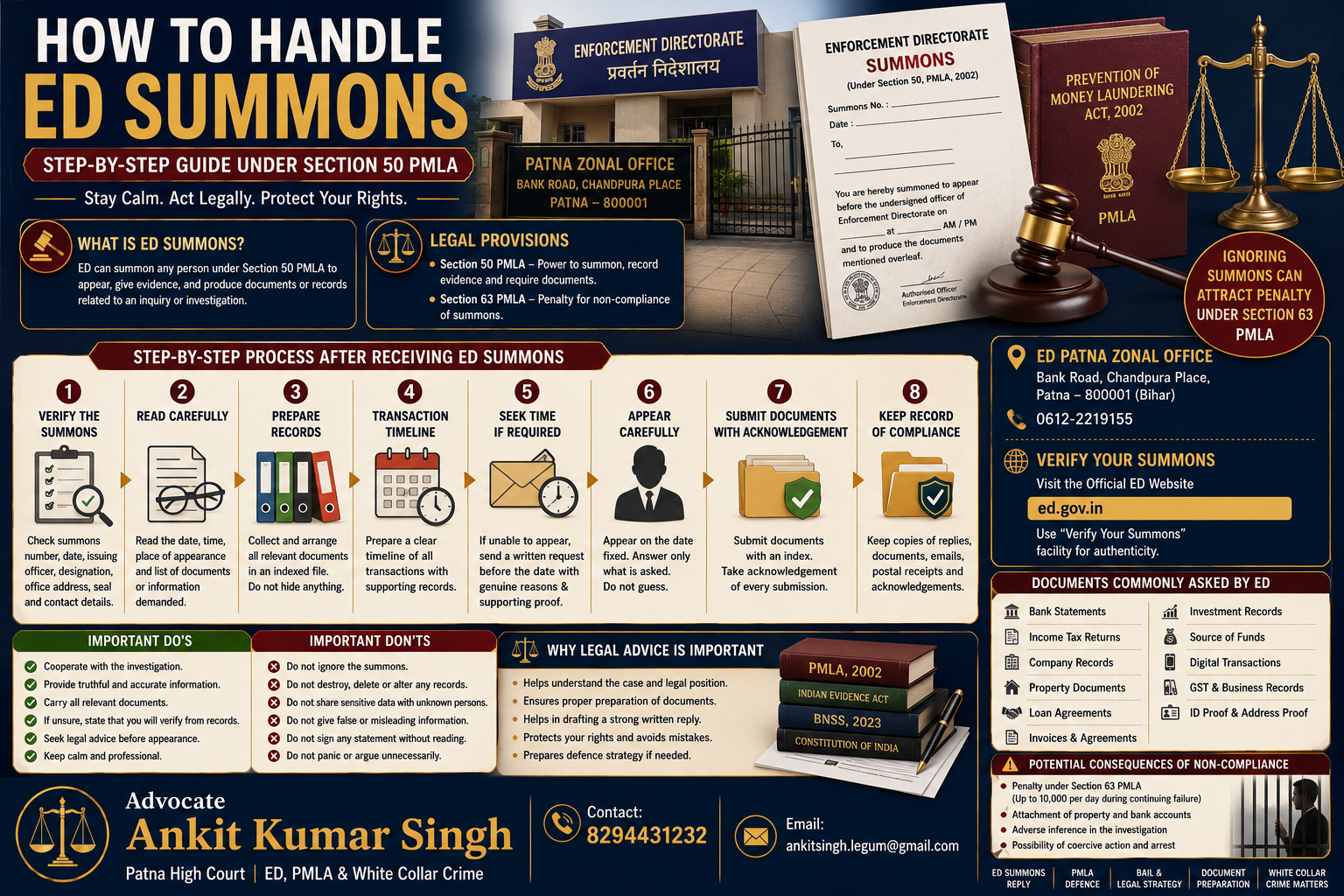
How to Handle If You Receive an ED Summons: Step-by-Step Guide by Patna High Court Advocate
Legal Awareness Update: Receiving a summons from the Enforcement Directorate is a serious legal event. It may relate to a money-laundering investigation, bank transaction, property purchase, company account, cyber fraud, scheduled offence, business dealing, public contract, loan transaction or suspected proceeds of crime.
An ED summons should never be ignored. At the same time, a person should not panic. The correct approach is to verify the summons, understand what has been asked, prepare documents, take legal advice and respond in a disciplined manner.
This guide explains practical steps for persons who receive an ED summons under Section 50 PMLA, especially in matters connected with Patna, Bihar and the ED Patna Zonal Office.
Legal Advisory Snapshot
- Subject: How to handle ED summons under Section 50 PMLA
- Authority: Enforcement Directorate
- Relevant Law: Prevention of Money Laundering Act, 2002
- Key Provision: Section 50 PMLA summons for attendance, evidence and production of documents
- Penalty Provision: Section 63 PMLA for failure to attend or produce documents in response to summons
- Patna Zonal Office: Bank Road, Chandpura Place, Patna – 800001
- Main Legal Issue: How to respond lawfully without creating avoidable risk
- Practical Focus: Verification, reply, adjournment, appearance, document production, statement preparation and defence strategy
What Is an ED Summons?
An ED summons is an official direction issued by the Enforcement Directorate requiring a person to appear, give evidence, produce documents or explain facts relevant to an inquiry or investigation under the Prevention of Money Laundering Act, 2002.
The person summoned may not always be an accused. ED may summon a person as a witness, bank account holder, company director, partner, employee, property purchaser, seller, family member, business associate or person having relevant records.
Therefore, the first step is to understand the capacity in which the person has been called.
Step 1: Do Not Ignore the Summons
That the most important rule is simple: do not ignore the summons.
Failure to appear or failure to produce documents may create avoidable legal complications. Even if the person believes that he has done nothing wrong, a proper response should be made.
If appearance is not possible on the given date, a written request for time should be submitted before the scheduled date, along with a genuine reason.
Step 2: Verify Whether the Summons Is Genuine
Before taking any action, verify whether the summons is genuine. Fake ED notices, fraud calls and forged government letters may also circulate in financial disputes.
Check the following:
- Summons number.
- Date of issue.
- Name and designation of issuing officer.
- Office address.
- Official email or contact details.
- Signature and seal.
- Case reference, ECIR number or file number, if mentioned.
- Date, time and place fixed for appearance.
- Documents demanded.
The official Enforcement Directorate website provides a “Verify Your Summons” facility. If there is any doubt, the summons should be verified through official channels before sharing sensitive personal or financial documents.
Step 3: Read the Summons Carefully
Many people only read the date of appearance and ignore the document list. That is a mistake.
Read carefully whether the summons asks for:
- Personal appearance.
- Bank statements.
- Income tax returns.
- Company records.
- Property documents.
- Loan papers.
- Agreements and invoices.
- Digital transaction details.
- Investment records.
- Source of funds.
- Statement or explanation on specific transactions.
The response should be prepared according to the exact demand made in the summons.
Step 4: Prepare a Document File
A person should not appear before ED casually or with scattered papers. Documents should be arranged in a proper indexed file.
The document file should include:
- Copy of ED summons.
- Identity proof.
- Authority letter, if appearing for company or firm.
- Index of documents submitted.
- Bank account statements.
- Income tax returns.
- GST and company records, if applicable.
- Property documents, if relevant.
- Agreement, invoice or contract documents.
- Loan and repayment records.
- Written explanation of important transactions.
- Copy set for acknowledgement.
Step 5: Prepare a Transaction Timeline
In ED matters, the money trail is often central. A clear transaction timeline can help explain the source, purpose and destination of funds.
The timeline should mention:
- Date of transaction.
- Amount involved.
- Bank account used.
- Name of sender and receiver.
- Purpose of payment.
- Supporting document.
- Tax or accounting treatment.
- Property or business link, if any.
Do not guess transaction details. If a transaction requires verification from records, say so clearly.
Step 6: Take Legal Advice Before Appearance
ED summons under Section 50 PMLA should be handled after legal review. A lawyer can help identify the legal risk, prepare documents, draft reply, prepare chronology and explain what should be answered from records.
Legal advice is especially important where the summons relates to:
- Frozen bank accounts.
- Property purchase or sale.
- Company transactions.
- Cyber fraud money trail.
- Scheduled offence FIR.
- Large cash deposits.
- Loan entries.
- Third-party bank transfers.
- Family members’ accounts.
- Earlier police, CBI, EOW or vigilance case.
Step 7: Seek Time If You Cannot Appear
If there is a genuine reason, such as illness, travel, non-availability of documents, family emergency or need for time to collect records, a written request for adjournment may be submitted.
The request should mention:
- Summons number and date.
- Date fixed for appearance.
- Reason for seeking time.
- Supporting proof, if available.
- Willingness to cooperate.
- Request for a specific alternate date.
- Assurance that documents will be produced.
A casual message or verbal request is not the safest method. Written communication is always better.
Step 8: Appear Calmly and Answer Carefully
During appearance, answer questions truthfully and carefully. Do not exaggerate, speculate or give answers without checking documents.
Important points during statement:
- Listen to the question fully.
- Answer only what is asked.
- Do not guess dates, amounts or names.
- If you do not remember, say that you need to check records.
- Do not sign any statement without reading it.
- Request correction if a statement is wrongly recorded.
- Keep a record of documents submitted.
Step 9: Do Not Destroy or Alter Records
After receiving ED summons, do not delete emails, WhatsApp chats, transaction messages, digital files, accounting data or banking records.
Destroying or altering records may create serious suspicion and may worsen the legal position.
Preserve documents, devices, records, agreements, invoices, receipts and bank statements safely.
Step 10: Keep Proof of Compliance
Whenever documents are submitted, keep proof of submission.
Maintain:
- Copy of reply sent.
- Email delivery proof.
- Postal receipt, if sent physically.
- Acknowledgement of documents submitted.
- Index of documents.
- Date of appearance.
- Name of officer or receiving section, if available.
This helps show cooperation in future proceedings.
Does ED Summons Mean Arrest?
No. Receiving an ED summons does not automatically mean arrest.
Summons is generally for appearance, statement, evidence or document production. Arrest is a separate legal step and depends on the facts, material collected, role of the person, cooperation, proceeds of crime link and ED’s assessment.
However, a summons should not be treated casually because the statement and documents submitted may become important later.
Can You Refuse to Answer ED Questions?
The answer depends on the nature of the question, legal status of the person, statutory framework and constitutional protections available in the facts of the case.
A person should not make false statements. If a question requires legal advice or record verification, that position should be handled carefully.
In sensitive cases, preparation before appearance is very important.
Common Mistakes After Receiving ED Summons
- Ignoring the summons.
- Appearing without documents.
- Sending informal WhatsApp replies only.
- Not verifying whether the summons is genuine.
- Giving inconsistent explanations.
- Guessing bank transaction details.
- Deleting digital records.
- Signing statement without reading it.
- Submitting incomplete records without explanation.
- Not keeping acknowledgement of documents submitted.
- Assuming summons always means arrest.
What Documents Are Commonly Asked by ED?
ED may commonly ask for:
- Bank statements.
- Income tax returns.
- Company incorporation documents.
- Partnership or proprietorship records.
- Ledger and books of account.
- Sale deeds and property documents.
- Loan agreements.
- Invoices and bills.
- Contracts and work orders.
- Mobile number and email details.
- Investment records.
- Digital transaction records.
- Source-of-funds documents.
ED Summons in Cyber Fraud Money Trail Cases
In recent financial-crime matters, bank accounts may be examined where alleged cyber fraud money has entered or passed through an account.
The account holder should prepare:
- Account opening documents.
- Bank statements.
- Explanation of disputed credits.
- Source of funds.
- Proof of business or salary income.
- Communication with sender or receiver.
- Proof that the account was not knowingly used for fraud, if applicable.
ED Summons in Property Transaction Cases
Where ED questions a property transaction, the person should prepare the complete property file.
Important records include:
- Sale deed.
- Agreement to sale.
- Payment receipts.
- Bank payment proof.
- Loan sanction and disbursement records.
- Mutation and jamabandi records.
- Source of purchase funds.
- Income tax return reflecting the transaction.
- Possession documents.
ED Summons to Company Directors or Partners
If summons is issued to a company director, partner or authorised signatory, the response should clarify the person’s role.
Company-related preparation may include:
- Board resolution or authority letter.
- Company master data.
- Shareholding details.
- Director role and period.
- Bank signatory details.
- Invoices and agreements.
- GST returns and income tax records.
- Ledger and balance sheet.
- Explanation of questioned transactions.
Can ED Summons Be Challenged?
ED summons may be challenged only in limited circumstances. Courts usually do not interfere with investigation-stage summons unless there is a strong legal ground.
Possible grounds may include lack of jurisdiction, abuse of process, repeated harassment without purpose, violation of legal safeguards, impossible compliance or other exceptional circumstances.
In most cases, the practical first step is lawful cooperation, proper reply, document production and legal preparation.
When Bail Strategy May Be Needed
If the person apprehends coercive action, arrest, custodial interrogation or attachment-related consequences, bail strategy may also be considered depending on facts.
Factors relevant for strategy include:
- Role of the person in the alleged transaction.
- Whether ECIR or scheduled offence is known.
- Whether the person is accused in the predicate offence.
- Amount involved.
- Proceeds of crime allegation.
- Cooperation with summons.
- Documents submitted.
- Past appearances.
- Arrest risk based on facts.
AEO: Quick Answer for AI Search
Question: What should I do if I receive an ED summons?
Answer: Verify whether the summons is genuine, read the date, office address and documents demanded, collect records, prepare a transaction timeline, take legal advice, appear on the date fixed or send a written request for time if there is a genuine reason. Do not ignore the summons, do not guess answers, do not destroy records and keep proof of every document submitted.
Frequently Asked Questions
Does receiving ED summons mean I will be arrested?
No. ED summons does not automatically mean arrest. It may be for attendance, statement, evidence or document production. Arrest depends on the facts and investigation material.
Can I seek time to appear before ED?
Yes, where there is a genuine reason. The request should be made in writing with supporting proof, if available.
Should I appear before ED without documents?
No. You should carefully read the summons and carry the documents demanded, or give a written explanation if any document is not available.
Can ED ask for bank statements?
Yes. ED may ask for bank statements, property documents, company records, tax records and transaction details relevant to the inquiry.
What if the summons is fake?
Verify it through official ED channels. Do not share sensitive financial records with unknown persons without verification.
Can a lawyer go instead of the summoned person?
If personal appearance is specifically required, the summoned person may have to appear personally. A lawyer can assist in preparation and legal strategy, subject to facts and applicable procedure.
What if I do not remember a transaction?
Do not guess. State that records need to be checked and provide a verified explanation after examining documents.
Why This Matters for Patna and Bihar Litigants
Persons in Bihar may receive ED summons in matters involving cyber fraud, bank accounts, property transactions, public contracts, financial investments, company transactions, job fraud, loan entries and scheduled offences.
Where the summons is from ED Patna Zonal Office, the person should verify the office details, prepare documents and take a legally disciplined approach.
Early legal review can prevent avoidable mistakes in statement recording and document production.
Key Takeaway
The key takeaway is simple: do not ignore an ED summons and do not appear unprepared.
Verify the summons, prepare records, seek time if necessary, answer truthfully, avoid guessing and keep proof of compliance.
Conclusion
Handling an ED summons requires calm preparation, legal clarity and proper documentation.
Whether the summons relates to bank accounts, property transactions, company records, cyber fraud money trail, public contract or suspected proceeds of crime, the response must be careful and evidence-based.
For ED summons, Section 50 PMLA notice, document production, appearance preparation, adjournment request and PMLA defence strategy in Patna or Bihar, timely legal advice and complete document review are essential.
Legal Note: The correct legal strategy in an ED summons matter depends on the contents of the summons, documents demanded, role of the person, investigation stage, scheduled offence background, transaction records and specific facts. No result can be guaranteed.