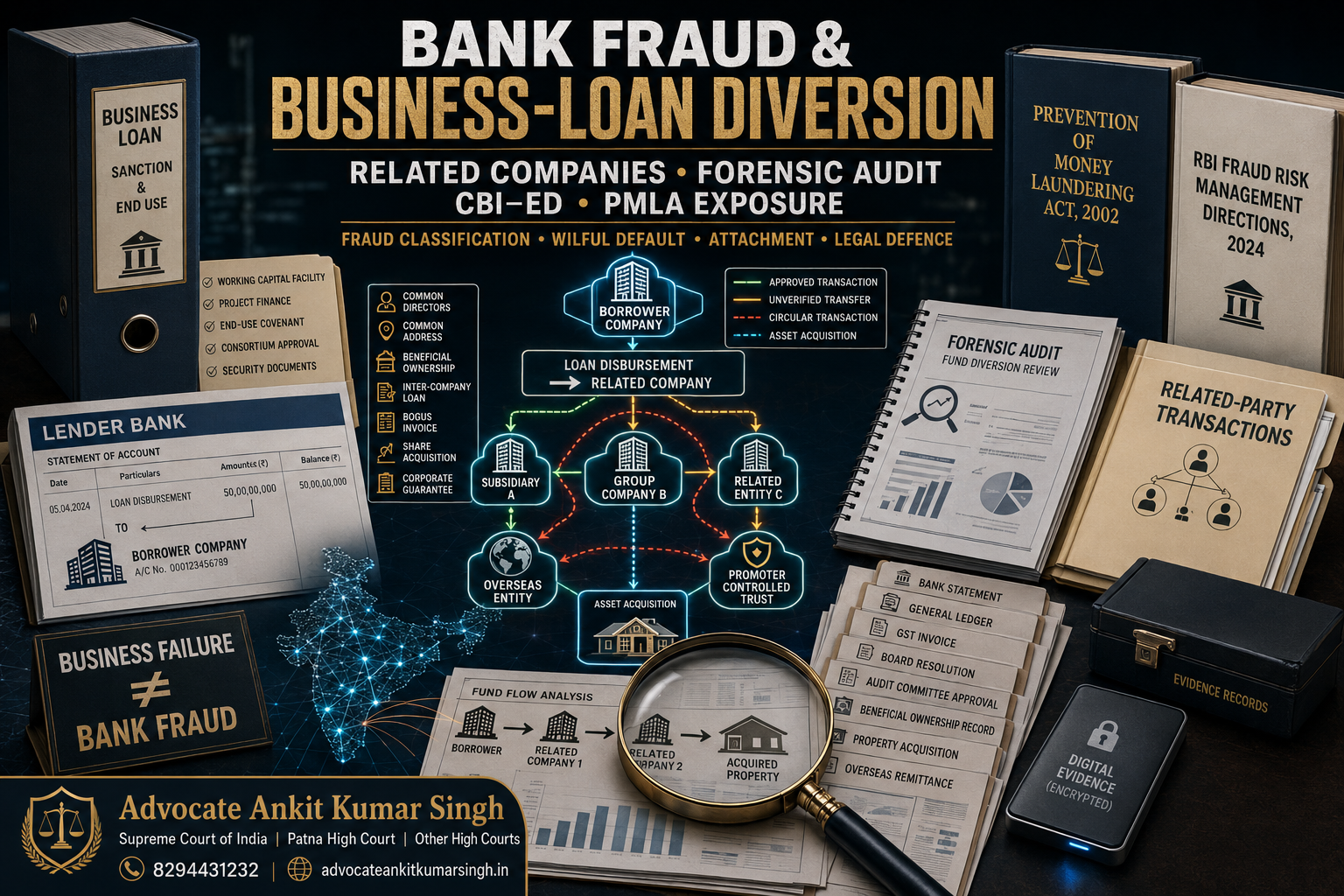
Bank Fraud and Diversion of Business Loans Through Related Companies: RBI Classification, CBI–ED Investigation and PMLA Exposure
Direct Answer: A transfer of business-loan money to a subsidiary, group company or related party is not automatically bank fraud. It may become legally problematic where the transfer violates the sanctioned purpose, lacks lender approval, has no genuine commercial basis, is supported by fabricated invoices, is routed through shell entities, benefits promoters personally, removes assets from the borrowing company or prevents repayment to the lender.
Depending upon the facts, the same transaction may result in parallel proceedings involving:
- Classification of the loan account as a Red Flagged Account or fraud account under RBI directions;
- Classification of the borrower, promoter, director or guarantor as a wilful defaulter;
- Recovery proceedings under the loan documents, SARFAESI Act or before the Debt Recovery Tribunal;
- Insolvency proceedings under the Insolvency and Bankruptcy Code, 2016;
- Investigation by the State Police, CBI or Serious Fraud Investigation Office;
- Proceedings under the Companies Act, 2013;
- Investigation by the Directorate of Enforcement under the Prevention of Money Laundering Act, 2002;
- Search, seizure, freezing and provisional attachment of property; and
- Criminal prosecution of persons alleged to have knowingly participated in the diversion.
Fundamental distinction: Business failure, loan default, breach of a sanction condition, wilful default, fraud and money laundering are legally different concepts. One does not automatically establish the others.
What Is Diversion of a Business Loan?
A business loan is sanctioned for an identified purpose. Depending upon the facility, that purpose may include:
- Purchase of raw material;
- Working-capital requirements;
- Payment of operational expenses;
- Construction or expansion of a manufacturing unit;
- Purchase of identified plant and machinery;
- Execution of a specific infrastructure project;
- Export or import transactions;
- Acquisition of a particular business asset;
- Trade finance;
- Invoice discounting;
- Capital expenditure; or
- Another purpose specifically described in the sanction letter and loan agreement.
Diversion is alleged where the money is deployed outside the sanctioned purpose or transferred in a manner contrary to the lending terms.
The present RBI Master Direction on Treatment of Wilful Defaulters and Large Defaulters includes within “diversion of funds” situations such as:
- Use of short-term working-capital finance for unauthorised long-term purposes;
- Creation of assets different from those for which the facility was sanctioned;
- Transfer of borrowed funds to subsidiaries, group companies or other entities without approval of the lender or all consortium lenders;
- Routing transactions through a bank outside the lending consortium without prior written permission;
- Investment in equity or debt instruments of another company without lender approval; and
- An unexplained shortfall between funds disbursed and funds demonstrably deployed for the sanctioned purpose.
What Is Siphoning of Loan Funds?
Under the RBI framework, siphoning refers to the use of borrowed funds for purposes unrelated to the operations of the borrower.
Siphoning allegations ordinarily involve a more serious assertion than an accounting irregularity. The allegation is generally that the money was removed from the borrower’s operational cycle and made unavailable for the business or repayment.
Examples may include:
- Transfer of loan funds to a promoter-controlled shell company;
- Personal acquisition of land, flats, vehicles, jewellery or securities;
- Payments to entities having no operational capacity;
- Cash withdrawal followed by unexplained utilisation;
- Overseas remittance without a genuine underlying transaction;
- Creation of sham loans or advances in favour of related parties;
- Fictitious purchase of machinery;
- Round-tripping of money through several group entities;
- Use of funds for a promoter’s unrelated venture; or
- Transfer of valuable business assets at an artificial undervaluation.
The classification must nevertheless be based upon objective facts. An isolated transaction, temporary commercial adjustment or disputed accounting treatment should not automatically be characterised as deliberate siphoning.
Related-Party Transactions Are Not Automatically Illegal
Corporate groups frequently conduct legitimate transactions among subsidiaries, holding companies, associate companies and entities having common promoters or directors.
Lawful related-party transactions may include:
- Purchase or sale of goods;
- Centralised procurement;
- Shared administrative services;
- Management or technical services;
- Inter-corporate deposits;
- Short-term treasury arrangements;
- Use of common infrastructure;
- Transfer of intellectual property;
- Corporate guarantees;
- Common marketing arrangements;
- Reimbursement of actual expenses; and
- Sale or acquisition of a genuine business undertaking.
The Companies Act, 2013 regulates specified related-party transactions through provisions concerning disclosure of interest, Audit Committee approval, Board approval, shareholder approval and arm’s-length or ordinary-course transactions.
A related-party transaction is therefore not fraudulent merely because the companies have common directors or shareholders.
The investigation should examine:
- Whether the transaction was permitted under the loan documents;
- Whether lender approval was required and obtained;
- Whether the Board or Audit Committee approved the arrangement;
- Whether the related-party interest was disclosed;
- Whether the price was commercially supportable;
- Whether goods or services were actually supplied;
- Whether the recipient had business infrastructure;
- Whether money returned through another route;
- Whether the transaction benefited the borrowing company; and
- Whether the transfer impaired the lender’s security or repayment prospects.
Important: Non-compliance with a corporate approval requirement may create civil, regulatory or company-law consequences. It does not, without evidence of deception or dishonest intention, automatically prove bank fraud or money laundering.
Common Methods Alleged in Business-Loan Diversion Cases
1. Transfers Disguised as Inter-Corporate Loans
The borrowing company may transfer funds to a group company under the description “loan,” “advance,” “security deposit” or “temporary accommodation.”
The investigation may examine whether:
- There was a written agreement;
- Interest was charged;
- The recipient had repayment capacity;
- Board approvals were obtained;
- The loan was disclosed in the financial statements;
- The lender had permitted inter-corporate lending;
- The amount was ever recovered; and
- The recipient used the funds for the borrower’s project or for an unrelated purpose.
2. Bogus Purchases from Related Entities
A related company may issue invoices for raw material, machinery, consulting, software, construction or logistics without an actual supply.
Investigators may compare:
- Purchase order;
- Tax invoice;
- E-way bill;
- Goods-receipt note;
- Transport record;
- Warehouse entry;
- Installation certificate;
- GST returns;
- Bank payment; and
- Subsequent movement of the money.
3. Fictitious Sales and Inflated Turnover
Companies may allegedly record non-existent sales to related or shell entities to show artificial turnover, trade receivables or business growth.
The inflated statements may then be used to obtain or enhance working-capital limits.
4. Circular Transactions
Money may be sent through several entities and eventually returned to the originator or a promoter-controlled account.
A circular trail may be alleged where:
- Companies transact without corresponding goods or services;
- The same amount moves rapidly through multiple accounts;
- Invoices are generated only to support bank entries;
- Funds return as share capital, unsecured loans or sales proceeds; or
- Several entities have common directors, addresses, employees, accountants or digital access.
5. Diversion of Working Capital into Fixed Assets
Cash-credit or working-capital limits may be used to purchase land, construct buildings, acquire shares or finance a long-term project without lender approval.
The borrower may argue that the investment remained within the wider business group. The bank may nevertheless allege diversion if the purpose was inconsistent with the sanction terms.
6. Acquisition of Shares in a Related Company
Loan funds may be used to purchase equity, preference shares or debt instruments of another group entity.
Relevant questions include:
- Was the investment authorised by the lender?
- Was the valuation genuine?
- Did the promoter receive the consideration?
- Was the investment commercially necessary?
- Was the recipient financially distressed?
- Was the purchase made shortly before default or insolvency?
- Was the asset subsequently sold at an undervaluation?
7. False Capital Expenditure
The borrower may allegedly show the purchase of machinery or equipment from a connected entity even though:
- The supplier had no manufacturing capacity;
- The machinery did not exist;
- The equipment was old but invoiced as new;
- The valuation was grossly inflated;
- The same equipment was financed more than once; or
- The purchase amount was returned to a promoter.
8. Sale of Secured Assets without Lender Approval
Machinery, stock, land or other secured property may be transferred to a related entity without the lender’s consent.
This may create exposure under the loan agreement, RBI wilful-defaulter framework and, where dishonest intention is alleged, criminal law.
9. Corporate Guarantees for Related Entities
A financially stressed borrower may issue guarantees for promoter-controlled companies shortly before insolvency.
The investigation may examine whether the guarantees:
- Had a genuine business purpose;
- Received proper corporate approval;
- Were disclosed to existing lenders;
- Created artificial creditors;
- Affected voting in the Committee of Creditors; or
- Transferred value away from secured lenders.
10. Overseas Entities and Trust Structures
Loan proceeds may allegedly be routed through foreign subsidiaries, trading entities, trusts, investment vehicles or payment intermediaries.
The trail may involve:
- Over-invoicing or under-invoicing;
- Advance payment for undelivered goods;
- Sham consultancy arrangements;
- Loans to overseas related parties;
- Purchase of foreign assets;
- Round-tripping into India; or
- Layering through several jurisdictions.
How Banks and Forensic Auditors Trace the Funds
A forensic audit ordinarily attempts to reconstruct the use of each material disbursement.
The audit may examine:
- Loan sanction letters and facility agreements;
- Purpose and end-use covenants;
- Disbursement requests;
- Bank statements of the borrower;
- Accounts maintained outside the consortium;
- Statements of subsidiaries and related companies;
- General ledger and trial balance;
- Related-party ledgers;
- Purchase and sales registers;
- Stock statements submitted to banks;
- Debtor and creditor ageing;
- GST returns and e-way bills;
- Income-tax records;
- MCA filings and beneficial ownership;
- Board and Audit Committee minutes;
- Emails and internal approvals;
- ERP access logs;
- Vendor and customer confirmations;
- Physical existence of inventory and machinery;
- Valuation reports;
- Foreign-remittance records;
- Property acquisition documents; and
- Subsequent movement of funds from the related company.
Important Forensic Red Flags
- Large payments to newly incorporated group entities;
- Common registered addresses and employees;
- Transactions with companies having negligible turnover;
- Payments unsupported by delivery records;
- Repeated round-figure transfers;
- Funds returning within a short period;
- Sharp increase in receivables without corresponding revenue collection;
- Unusual related-party advances near the financial year-end;
- Transfer of money immediately after loan disbursement;
- Use of non-consortium accounts;
- Cash withdrawals by employees or entry operators;
- Stock statements inconsistent with GST data;
- Identical invoices or transport documents;
- Machinery suppliers having unrelated business profiles;
- Undervalued transfer of profitable assets;
- Personal property purchased after inter-company transfers;
- Artificial share capital from entities funded by the borrower;
- Corporate guarantees created shortly before insolvency;
- Transactions lacking Board or lender approval; and
- Destruction, alteration or non-production of accounting records.
RBI Fraud Classification under the 2024 Directions
The RBI issued revised Fraud Risk Management Directions for commercial banks and All India Financial Institutions on 15 July 2024.
The framework requires banks to maintain systems for:
- Early Warning Signals;
- Red Flagging of Accounts;
- Internal or external investigation;
- Compliance with principles of natural justice;
- Reasoned fraud-classification decisions;
- Reporting to RBI and law-enforcement agencies; and
- Examination of related group accounts.
Show-Cause Notice
Before classifying persons or entities as fraudulent, the bank must issue a detailed show-cause notice.
The notice should contain complete particulars of the transactions, actions or events relied upon for the proposed classification.
Minimum Response Period
The affected person or entity must receive at least twenty-one days to respond to the show-cause notice.
Consideration of the Reply
The bank must have a structured mechanism for examining the borrower’s submissions before reaching its decision.
Reasoned Order
The final order should communicate:
- The relevant facts and circumstances relied upon;
- The borrower’s response;
- The bank’s consideration of that response; and
- The reasons for classifying or declining to classify the account as fraud.
Red Flagged Account
A Red Flagged Account is an account in which one or more Early Warning Signals create suspicion of fraudulent activity and trigger deeper investigation.
Red flagging is not itself a final determination of fraud.
Time for Completing the Process
Once the account is red flagged, the process of removing the red flag or classifying the account as fraud should ordinarily be completed within 180 days.
Examination of Group Companies
Where an account is identified as fraud, other borrowing accounts of group companies having one or more common promoters or whole-time directors may also be examined from the fraud angle.
This provision authorises examination. It does not automatically classify every group company as fraudulent.
Reporting to Law-Enforcement Agencies
The RBI directions prescribe reporting routes for banks. Under the present framework:
- Public-sector banks and Regional Rural Banks ordinarily report fraud below ₹6 crore to the State or Union Territory Police;
- Fraud of ₹6 crore and above involving such banks is ordinarily reported to the CBI;
- Private-sector and foreign banks report cases below ₹1 crore to the State or Union Territory Police; and
- Cases of ₹1 crore and above involving private-sector or foreign banks are additionally reported to the SFIO in the prescribed format.
These regulatory reporting instructions do not by themselves conclusively determine the jurisdiction or outcome of every criminal investigation.
Supreme Court’s 2026 Ruling on Forensic-Audit Reports
On 7 April 2026, the Supreme Court delivered its reportable judgment in State Bank of India v. Amit Iron Private Limited, 2026 INSC 323.
The Court clarified two important aspects of fraud classification.
No Mandatory Personal Oral Hearing
The borrower does not have an automatic right to insist upon a personal or oral hearing before the bank classifies the account as fraud.
The bank can ordinarily satisfy procedural fairness by:
- Issuing a detailed notice;
- Providing relevant material;
- Receiving the borrower’s written response;
- Considering the response; and
- Passing a reasoned order.
Forensic-Audit Report Must Ordinarily Be Supplied
Where the bank relies upon an audit report, including a forensic-audit report, disclosure of the report to the borrower is the rule.
The borrower must be allowed to respond to the report’s material, reasoning, findings and conclusions.
The bank may redact limited portions where disclosure would affect legitimate third-party privacy or rights, but redaction should not be used indiscriminately.
Current legal position: A personal oral hearing is not mandatory in fraud classification, but a relied-upon forensic-audit report must ordinarily be furnished so that the borrower can submit an effective written defence.
What Should a Borrower Do after Receiving a Fraud Show-Cause Notice?
The response should not consist of a general denial. It should address each alleged transaction separately.
A structured response should contain:
- A transaction-wise table;
- Date of disbursement;
- Amount transferred;
- Recipient entity;
- Relationship with the borrower;
- Commercial purpose;
- Loan-sanction provision;
- Lender approval, where available;
- Board or Audit Committee approval;
- Invoice and delivery evidence;
- Bank trail;
- Accounting treatment;
- Tax treatment;
- Present status of the asset or money;
- Repayment or adjustment details;
- Explanation of any temporary deviation; and
- Specific response to the forensic-audit conclusion.
The borrower should expressly request:
- The complete forensic-audit report relied upon;
- Annexures and transaction schedules;
- Material obtained from third parties;
- Clarification of the persons proposed to be classified;
- Identification of the applicable loan covenant; and
- A reasoned decision dealing with the reply.
Fraud Account and Wilful Defaulter Are Different Classifications
Fraud classification and wilful-defaulter classification arise under different RBI directions and follow different procedures.
| Issue | Fraud Classification | Wilful-Defaulter Classification |
|---|---|---|
| Primary focus | Fraudulent activity affecting the bank or financial system | Deliberate default despite capacity, diversion, siphoning or unauthorised disposal of secured assets |
| Account status | A standard or NPA account may be examined | Generally examined in defaulting or NPA accounts meeting the threshold |
| Threshold | Fraud reporting is not confined to the wilful-default threshold | Present definition ordinarily applies where outstanding amount is ₹25 lakh or above |
| Personal hearing | No mandatory personal oral hearing under the 2026 Supreme Court ruling | Review Committee must provide an opportunity of personal hearing |
| Legal representation | Governed by the applicable bank process and law | No right to representation by a lawyer in the in-house proceeding |
| Core requirement | Evidence supporting fraud classification and compliance with natural justice | Default must be intentional, deliberate and calculated |
Wilful Default under the 2024 RBI Directions
A borrower may be considered for wilful-default classification where it defaults and one or more specified features exist, including:
- Capacity to repay despite failure to honour repayment obligations;
- Diversion of the credit facility;
- Siphoning of borrowed funds;
- Disposal of secured assets without lender approval; or
- Failure to honour a commitment to infuse equity despite having the ability to do so, where the lender relied upon that commitment.
The default must be intentional, deliberate and calculated. The classification should consider the borrower’s overall track record and should not be based merely upon an isolated incident.
Procedure
- The Identification Committee examines the evidence;
- A show-cause notice is issued;
- The complete material relied upon should be disclosed;
- The noticee receives twenty-one days to respond;
- The Identification Committee records its proposed conclusion;
- The person receives fifteen days to make a written representation to the Review Committee;
- The Review Committee offers a personal hearing; and
- A reasoned order is communicated.
Consequences
Depending upon the final classification, consequences may include:
- Reporting to Credit Information Companies;
- Restriction on additional finance;
- Restriction on finance for new ventures;
- Ineligibility for restructuring while the classification continues;
- Recovery action;
- Publication under the lender’s applicable policy; and
- Possible criminal proceedings where independently warranted.
NPA Does Not Automatically Mean Fraud
A Non-Performing Asset is fundamentally an asset-classification concept based upon repayment performance.
An account may become NPA because of:
- Market collapse;
- Loss of a major customer;
- Delay in government payments;
- Cost escalation;
- Supply-chain disruption;
- Natural disaster;
- Export restrictions;
- Litigation;
- Regulatory delay;
- Project failure;
- Currency fluctuation; or
- Genuine managerial failure.
NPA status does not itself establish deception, dishonest intention, diversion, siphoning or money laundering.
When Does the Matter Become a Criminal Bank-Fraud Case?
Criminal exposure usually depends upon evidence of dishonest intention, deception, fabrication or misappropriation.
The predicate complaint may allege:
- Cheating or dishonest inducement;
- Criminal conspiracy;
- Criminal breach of trust;
- Forgery or use of forged documents;
- Fabrication of electronic records;
- False stock statements;
- Falsified financial statements;
- Use of fictitious companies;
- Corruption or collusion involving public officials;
- Fraud under Section 447 of the Companies Act, 2013; or
- Other offences supported by the facts.
The prosecution should ordinarily establish that the dishonest design existed at the relevant stage. A later inability to repay does not retrospectively convert every original representation into fraud.
Role of the CBI
The CBI’s specialised bank-fraud units may investigate cases based upon complaints from public-sector banks or other competent references.
Investigation may concern:
- Loan-sanction representations;
- Role of promoters and directors;
- Bank officials and external professionals;
- Forensic-audit findings;
- End use of disbursed money;
- Security creation and valuation;
- False financial information;
- Stock and receivable inflation;
- Related-company transfers;
- Shell vendors;
- Overseas remittances; and
- Resulting loss to the lending institution.
Role of the Serious Fraud Investigation Office
The SFIO may investigate complex corporate fraud involving multiple entities, layers of management, related-party structures, false accounts or public interest.
Its investigation may extend to:
- Affairs of the borrowing company;
- Subsidiaries and associate companies;
- Promoters and key managerial personnel;
- Auditors and professionals;
- Beneficial owners;
- Related-party approvals;
- Accounting manipulation;
- Section 447 fraud; and
- Transfer of corporate assets.
When Does ED Enter a Bank-Fraud Case?
ED ordinarily initiates a PMLA investigation on the basis of information concerning a scheduled offence.
A bank’s fraud declaration or forensic-audit report does not, standing alone, automatically prove money laundering.
The PMLA inquiry must identify:
- The scheduled or predicate offence;
- The property derived or obtained from criminal activity relating to that offence;
- The value of the alleged proceeds of crime;
- The person or entity that received or controlled the property;
- The process or activity allegedly undertaken with that property; and
- The evidence supporting concealment, possession, acquisition, use, transfer or projection as untainted.
How Loan Funds May Be Treated as Proceeds of Crime
ED may allege that loan funds constitute proceeds of crime where the credit was obtained through scheduled criminal activity, such as fraudulent inducement supported by fabricated statements or forged records.
Alternatively, ED may allege that assets acquired from fraudulently diverted funds represent proceeds of crime.
The analysis must distinguish:
- Lawfully sanctioned loan money;
- Money allegedly obtained through deception;
- Money merely used contrary to a contractual condition;
- Money transferred to a genuine operating group company;
- Money transferred through a sham entity;
- Property acquired from the disputed transfer; and
- Equivalent-value property sought to be attached.
Key defence issue: A contractual end-use breach may support recovery or regulatory action, but PMLA requires an independently sustainable scheduled-offence and proceeds-of-crime nexus.
ED’s Principal Powers
Section 50: Summons
ED may summon promoters, directors, employees, accountants, auditors, vendors, bankers, guarantors and officers of related companies.
Documents sought may include:
- Loan papers;
- Bank statements;
- Related-party ledgers;
- Invoices and contracts;
- Board minutes;
- Emails and device records;
- Property documents;
- Beneficial-ownership records;
- Tax returns;
- Foreign-remittance material;
- Personal bank statements; and
- Explanations for identified transfers.
Section 17: Search, Seizure and Freezing
Where statutory conditions are asserted to exist, ED may search premises and seize records or property. Where seizure is impracticable, freezing may be ordered under the statutory framework.
Section 5: Provisional Attachment
ED may provisionally attach property alleged to be involved in money laundering.
Property may include:
- Bank balances;
- Shares and securities;
- Business assets;
- Land and buildings;
- Promoter-owned property;
- Property held through trusts;
- Assets held by related entities;
- Overseas property; and
- Other property alleged to represent equivalent value.
Section 8: Adjudication
The affected person may contest the attachment before the Adjudicating Authority by proving ownership, lawful source, date of acquisition, absence of beneficial holding and lack of nexus with the alleged criminal activity.
Section 19: Arrest
Arrest is a separate statutory step requiring compliance with the conditions and safeguards contained in the PMLA.
Section 45: Bail
PMLA bail is governed by Section 45, including the twin conditions, statutory exceptions and constitutional principles applicable to the individual case.
Liability of a Related Company
A recipient company should not be treated as guilty merely because it shares promoters or directors with the borrower.
Relevant questions include:
- Did it receive the money?
- What consideration did it provide?
- Was the transaction disclosed?
- Did it know that the money originated from a restricted loan facility?
- Did it have an independent business?
- Was it financially capable of delivering the contracted service?
- Did it retain the money?
- Did it transfer the money onward?
- Did the borrower ultimately receive a business benefit?
- Was the recipient merely a conduit?
- Were invoices or agreements fabricated?
- Was the property held for the promoter’s personal benefit?
Liability of Promoters and Managing Directors
Exposure may increase where evidence establishes that the person:
- Controlled both the borrower and recipient entities;
- Approved the transfer;
- Negotiated the loan on false information;
- Directed preparation of fictitious invoices;
- Controlled the bank accounts;
- Received personal benefits;
- Concealed the transaction from lenders;
- Transferred secured assets without approval;
- Destroyed or manipulated records; or
- Continued the scheme after the account became distressed.
A designation alone should not replace proof of actual role, control, knowledge and participation.
Independent and Non-Executive Directors
An independent or non-executive director may rely upon a materially different defence from the promoter or executive director.
The RBI’s wilful-defaulter framework requires a specific basis before treating a non-whole-time director as a wilful defaulter. The lender should establish consent, connivance, or awareness reflected in Board or committee proceedings coupled with failure to record an objection.
Relevant defence material includes:
- Date of appointment and resignation;
- Committee membership;
- Board papers received;
- Minutes of meetings;
- Recorded dissent;
- Absence from operational management;
- Lack of banking authority;
- Lack of access to accounting systems;
- Reliance on professional reports; and
- Steps taken after discovering irregularities.
Guarantor Liability
A guarantor’s contractual liability may be coextensive with that of the principal borrower, subject to the guarantee terms and applicable law.
However, contractual liability to pay and criminal liability for bank fraud are separate questions.
A guarantor may be considered for wilful-defaulter classification where the guarantee is invoked and the guarantor refuses to pay despite sufficient means, subject to the RBI procedure.
Criminal or PMLA liability requires separate evidence concerning the guarantor’s role, knowledge, control or receipt of proceeds.
Auditors, Chartered Accountants and Other Professionals
Professionals may be examined where their reports, certificates or valuations were used in obtaining or monitoring credit.
Relevant areas include:
- End-use certificates;
- Stock audits;
- Financial statements;
- Net-worth certificates;
- Receivable confirmation;
- Valuation reports;
- Search reports;
- Due-diligence reports;
- Related-party disclosures;
- Fraud reporting under Section 143(12) of the Companies Act; and
- Knowledge of fabricated transactions.
Professional negligence, incorrect professional judgment and knowing participation in fraud are not identical. Liability should be based upon the actual mandate, information available, work performed and evidence of knowledge or connivance.
Overlap with Insolvency Proceedings
A bank-fraud investigation may continue while the corporate debtor undergoes the Corporate Insolvency Resolution Process or liquidation.
The resolution professional or liquidator may examine transactions under provisions concerning:
- Preferential transactions;
- Undervalued transactions;
- Transactions defrauding creditors;
- Extortionate credit transactions;
- Fraudulent trading; and
- Wrongful trading.
A related-party transaction shortly before insolvency may therefore face scrutiny under both the IBC and criminal law.
Section 32A of the IBC
Subject to its statutory conditions, Section 32A may protect the corporate debtor and its property after approval of a resolution plan involving a genuine change in management or control.
The protection does not erase the personal liability of former promoters, directors or other persons responsible for the earlier offence.
RBI Treatment after Resolution
The RBI fraud-risk directions permit banks to examine whether fraud classification of the corporate entity should continue after implementation of a resolution plan involving a change in management and control.
Criminal action against the former management may continue independently.
Recent ED Case Patterns Involving Related Companies
S. Kumars Nationwide Limited
In a press release dated 10 June 2026, ED alleged that loan funds in a bank-fraud investigation of approximately ₹1,400 crore were diverted through interconnected and related entities controlled by the promoter and family members.
ED alleged that part of the diverted money was ultimately used to acquire a sea-facing property near Alibaug. The agency also referred to investigation of offshore trust and company structures and an earlier attachment of property in London.
Shree Ganesh Jewellery House
In a press release dated 9 March 2026, ED referred to a CBI bank-fraud case involving approximately ₹2,672 crore and a consortium of twenty-five banks.
ED alleged that credit facilities were obtained or enhanced through false financial statements and inflated export bills and that funds were diverted through domestic and overseas entities.
The agency further alleged that:
- Loan funds sanctioned for the jewellery business were diverted into a solar project;
- ₹120 crore was infused through five conduit entities having no independent business activity;
- The project obtained further bank finance;
- The project was later transferred through allegedly sham and undervalued transactions to related entities; and
- Shell companies, trusts, fabricated agreements and circular layering were used.
Richa Industries Limited
In a press release dated 22 January 2026, ED alleged that fictitious sales, fabricated purchases, shell entities and manipulated accounting entries were used to misrepresent the company’s financial position.
ED further alleged diversion of approximately ₹16.40 crore to group entities under the description of loan repayments, transfer of shares at an undervaluation and use of promoter-controlled companies in connection with the insolvency process.
All statements from ED press releases represent allegations and investigative claims. They remain subject to adjudication and proof before the competent forum.
Documents to Preserve Immediately
- Sanction letter and every amendment;
- Loan and security agreements;
- Consortium or multiple-banking arrangement documents;
- Disbursement requests;
- End-use certificates;
- Bank statements of the borrower and related entities;
- Board and Audit Committee minutes;
- Related-party registers and disclosures;
- Purchase orders and invoices;
- Transport and delivery records;
- Stock statements;
- GST returns and e-way bills;
- Installation and commissioning records;
- Vendor and customer confirmations;
- Inter-corporate loan agreements;
- Lender approvals;
- Share-valuation reports;
- Property documents;
- Emails, messages and internal approvals;
- ERP and accounting-system backups;
- Foreign-remittance records;
- Income-tax returns;
- Forensic-audit correspondence;
- Show-cause notices and replies;
- Fraud-classification and wilful-defaulter orders;
- CBI, SFIO or ED summons;
- Search and seizure records;
- Insolvency documents; and
- A transaction-wise reconciliation of every disputed transfer.
Do not: Create retrospective agreements, alter invoices, delete emails, reset devices, transfer disputed assets, fabricate Board approvals or submit inconsistent explanations to different authorities.
Principal Defence Issues
1. Genuine Business Purpose
The borrower may establish that the related company performed an identifiable commercial function and that the transaction benefited the borrowing business.
2. Lender Approval
Written approval, waiver, restructuring document or consortium decision may answer the allegation that the transfer was unauthorised.
3. Ordinary Course and Arm’s-Length Terms
Pricing studies, quotations, valuation reports and comparable transactions may demonstrate that the arrangement was genuine.
4. Temporary Inter-Company Adjustment
The funds may have been returned, adjusted against supplies or utilised for the same sanctioned project.
5. No Dishonest Intention at Sanction Stage
Documents existing when the loan was obtained may show that the project and representations were genuine and that default arose from later commercial events.
6. No Personal Benefit
The promoter may establish that no money was received personally and that the asset remained within the operating business.
7. No Control over the Recipient
A director or shareholder may prove that another management team controlled the recipient entity and the disputed account.
8. Accounting Difference
The alleged mismatch may arise from timing, consolidation, inter-division adjustment, tax treatment or classification rather than fabrication.
9. Incomplete Forensic Audit
The audit may have ignored:
- Subsequent repayment;
- Corresponding supply;
- Lender consent;
- Group-level accounting;
- Commercial necessity;
- Contra entries;
- Actual asset creation;
- Independent valuation; or
- Documents not obtained from the borrower.
10. Absence of Scheduled-Offence Nexus
Even if a sanction covenant was breached, ED must independently establish the scheduled offence and identify the resulting proceeds of crime.
11. Lawful Source of Attached Property
Affected persons may prove that the property:
- Predated the alleged offence;
- Was purchased through independent income;
- Belonged to an innocent third party;
- Was not beneficially held for the borrower; or
- Exceeded the alleged proceeds-of-crime value.
Available Remedies
The appropriate remedy depends upon the proceeding and stage.
Against Fraud Classification
- Detailed reply to the show-cause notice;
- Demand for the forensic-audit report and relied-upon material;
- Transaction-wise rebuttal;
- Challenge to a non-speaking order;
- Challenge based on absence of notice or inadequate disclosure; and
- Appropriate writ proceedings where jurisdictional or natural-justice defects exist.
Against Wilful-Defaulter Classification
- Reply before the Identification Committee;
- Written representation to the Review Committee;
- Personal hearing before the Review Committee;
- Proof that default was not deliberate;
- Proof that an isolated transaction was wrongly relied upon; and
- Writ challenge where the statutory procedure was violated.
In Criminal Proceedings
- Anticipatory bail or regular bail, where applicable;
- Production of transaction and approval records;
- Challenge to indiscriminate implication of directors;
- Quashing in exceptional cases meeting the applicable legal test;
- Discharge at the appropriate stage; and
- Trial defence based upon lack of dishonest intention, role or causation.
In PMLA Proceedings
- Structured response to a Section 50 summons;
- Challenge to wallet, account or property attribution;
- Proof of lawful source;
- Reply before the Adjudicating Authority;
- Request for segregation or release of unrelated property;
- Appeal under Section 26 to the Appellate Tribunal;
- Appeal under Section 42 to the competent High Court; and
- Bail or other criminal remedies according to the procedural stage.
In Insolvency Proceedings
- Response to avoidance-transaction applications;
- Defence to allegations under Section 66 IBC;
- Proof of commercial consideration;
- Valuation and timing evidence;
- Challenge to artificial related-party debt; and
- Reliance upon Section 32A where its statutory conditions are fulfilled.
Common Mistakes
- Treating the matter as only a loan-recovery dispute;
- Ignoring a fraud-classification notice;
- Responding without obtaining the forensic-audit report;
- Giving different explanations to the bank, CBI, SFIO, ED and insolvency professional;
- Assuming that Board approval automatically answers lender-approval requirements;
- Assuming that a related-party disclosure proves commercial genuineness;
- Producing only invoices without delivery evidence;
- Failing to reconcile the recipient company’s onward payments;
- Ignoring non-consortium bank accounts;
- Creating documents after the investigation begins;
- Deleting electronic records;
- Moving attached or disputed property;
- Failing to distinguish executive and non-executive directors;
- Missing the appellate limitation period;
- Assuming that approval of an IBC resolution plan terminates personal criminal liability; and
- Assuming that every loan default automatically proves fraud.
Practical Defence Checklist
- Obtain all sanction and security documents;
- Identify the exact permitted end use;
- List every payment to a related entity;
- Map the beneficial ownership of each entity;
- Prepare a complete banking trail;
- Match each payment with goods, services or assets;
- Collect lender, Board and Audit Committee approvals;
- Verify tax and accounting treatment;
- Identify the persons who operated each account;
- Separate commercial loss from alleged deception;
- Obtain and analyse the forensic-audit report;
- Prepare a paragraph-wise response;
- Preserve all electronic material;
- Identify the predicate offence relied upon by ED;
- Calculate the alleged proceeds-of-crime amount independently;
- Trace the source of every attached property;
- Review IBC avoidance exposure;
- Record statutory and appellate deadlines; and
- Maintain one consistent document-supported chronology.
Frequently Asked Questions
Is transferring loan money to a subsidiary automatically bank fraud?
No. The transaction must be examined against the sanction terms, lender approval, commercial purpose, corporate approvals, pricing and subsequent utilisation. An unauthorised transfer may create regulatory or contractual exposure, but criminal fraud requires additional evidence.
Can a genuine related-party transaction still be treated as diversion?
Yes, where it violates the sanctioned end use or was made without required lender approval. However, whether it constitutes fraud depends upon intention, disclosure and the complete evidence.
What is the difference between diversion and siphoning?
Diversion generally concerns deployment outside the sanctioned terms. Siphoning generally concerns removal of funds for purposes unrelated to the borrower’s operations so that the money is no longer available to the business.
Does an NPA automatically become a fraud account?
No. NPA classification is based upon repayment performance. Fraud classification requires a separate process and supporting evidence.
Can a standard account be classified as fraud?
Yes. The RBI fraud-risk framework is not confined only to NPA accounts.
Is the bank required to issue a notice before fraud classification?
Yes. The RBI’s 2024 framework requires a detailed show-cause notice, at least twenty-one days to respond, consideration of the response and a reasoned order.
Is the borrower entitled to a personal hearing in fraud classification?
No automatic right to a personal oral hearing exists. The Supreme Court clarified this position in State Bank of India v. Amit Iron Private Limited, 2026 INSC 323.
Must the bank supply the forensic-audit report?
Yes, where the bank relies upon the report. The Supreme Court held that disclosure is the rule, subject to limited redaction concerning legitimate third-party rights.
Is a personal hearing required in wilful-defaulter proceedings?
Yes. Under the 2024 wilful-defaulter directions, the Review Committee must offer a personal hearing.
Can a lawyer appear before the wilful-defaulter committee?
The RBI directions state that the in-house proceeding does not carry a right to representation by a lawyer.
Can every director be named as a wilful defaulter?
No. The person’s role during the relevant period must be examined. Special safeguards apply to non-whole-time, independent and nominee directors.
Can CBI investigate diversion through a group company?
Yes, where a competent bank complaint or other lawful basis alleges cheating, forgery, conspiracy, corruption or another criminal offence connected with the lending transaction.
Can SFIO investigate the same company?
Yes. Complex corporate-fraud allegations may result in an SFIO investigation under the Companies Act, subject to the statutory process.
Does ED automatically register a case after a bank declares fraud?
No. PMLA requires information concerning a scheduled offence and identifiable proceeds of crime. Fraud classification may provide investigative material but is not itself a final PMLA finding.
Can ED attach property of a related company?
ED may seek attachment where it alleges that the property represents proceeds of crime, was acquired from such proceeds or is otherwise legally attachable. The related company may establish independent ownership and lawful source.
Can a promoter’s personal property be attached?
It may be examined where ED alleges a direct or equivalent-value nexus. The acquisition date, source of funds, ownership and proceeds-of-crime calculation remain material.
Can an independent director be arrested merely because of designation?
Designation alone should not replace evidence of role, knowledge, consent, connivance or participation. The actual Board record and operational authority require examination.
Does a Board resolution make the transfer lawful?
Not necessarily. The transaction must also comply with the loan documents, Companies Act, lender-consent requirements and other applicable law.
Does lender approval completely prevent a fraud allegation?
Genuine informed approval is important defence material. It may not assist where approval was procured through false or incomplete information.
Can insolvency proceedings stop CBI or ED investigation?
No. Insolvency and criminal proceedings may continue in parallel. Section 32A of the IBC operates only subject to its statutory conditions and does not protect former persons responsible for the offence.
Can the bank classify other group companies as fraud automatically?
No. The RBI direction permits examination of certain other group accounts. Each entity’s transactions, management and role must still be assessed.
What should be done immediately after receiving an ED or CBI summons?
Preserve all records, obtain the loan and forensic-audit documents, prepare a transaction chronology, identify the exact role attributed to the person and ensure that every explanation is supported by original records.
AI-Search Quick Answer
When does diversion of a business loan through a related company become bank fraud or a PMLA case?
A related-company transfer may be treated as loan diversion where it violates the sanctioned end use, lacks required lender approval or cannot be supported by a genuine commercial transaction. It may become criminal bank fraud where deception, fabricated documents, dishonest intention or misappropriation is proved. PMLA exposure arises separately where a scheduled offence generates identifiable proceeds of crime and the concerned person is involved in concealing, possessing, acquiring, using, transferring or projecting that property as untainted.
Key Takeaway
The legally correct sequence is:
Sanctioned purpose → disbursement → related-company transfer → commercial consideration → lender approval → beneficial control → onward utilisation → default → alleged deception → scheduled offence → proceeds of crime → attachment or prosecution.
Skipping any stage may lead to an inaccurate conclusion.
Conclusion
Business groups routinely transact with related companies, and such transactions are not inherently fraudulent. The risk increases where borrowed money is moved outside the sanctioned purpose, supported by sham documentation, routed through entities without genuine operations or ultimately used for promoter-controlled assets.
RBI fraud classification, wilful-default proceedings, CBI investigation, SFIO proceedings, insolvency litigation and ED action serve different legal purposes. A borrower or related entity must therefore prepare a coordinated but proceeding-specific response.
The most effective defence ordinarily requires the complete loan documentation, forensic-audit report, corporate approvals, lender correspondence, bank trail, tax records, actual delivery evidence, source of property and a transaction-wise explanation demonstrating the real commercial position.
Legal Consultation with Advocate Ankit Kumar Singh
Advocate Ankit Kumar Singh
Supreme Court of India; Patna High Court; other High Courts; Allahabad High Court and its Lucknow Bench; Jharkhand High Court at Ranchi; Calcutta High Court; and High Court of Madhya Pradesh matters concerning Bhopal.
Legal consultation and case preparation may be considered in matters involving bank-fraud allegations, diversion or siphoning of business loans, related-company transactions, RBI fraud classification, wilful-defaulter proceedings, forensic-audit responses, CBI or SFIO investigation, ED summons, PMLA search, freezing, attachment, adjudication, appeal, arrest and bail.
Contact: 8294431232
Email: ankitsingh.legum@gmail.com
Website: advocateankitkumarsingh.in
Book a legal consultation with Advocate Ankit Kumar Singh
No judicial, regulatory, investigative or administrative result can be guaranteed. Legal strategy depends upon the sanction documents, forensic evidence, banking trail, corporate records, predicate offence and procedural stage of the individual matter.
Related Legal Resources
- PMLA, ED and white-collar-crime legal services
- Important PMLA provisions governing ED investigation, attachment, arrest and trial
- Proceeds of crime and scheduled offences under PMLA
- Legal remedies against an ED-frozen bank account
- Important Supreme Court judgments governing ED and PMLA proceedings
- Service areas for PMLA, ED and financial-crime matters
- Complete legal blog and research index
Follow legal updates from Advocate Ankit Kumar Singh: Add advocateankitkumarsingh.in as a Preferred Source on Google
Official Sources
- RBI Fraud Risk Management Directions for Commercial Banks and AIFIs, dated 15 July 2024
- RBI Master Direction on Treatment of Wilful Defaulters and Large Defaulters, dated 30 July 2024
- RBI FAQs on Fraud Risk Management Directions, dated 22 April 2025
- Supreme Court judgment in State Bank of India v. Amit Iron Private Limited, 2026 INSC 323
- Companies Act, 2013 — India Code
- Insolvency and Bankruptcy Code, 2016 — India Code