PMLA • ED • ECIR • PREDICATE FIR • SCHEDULED OFFENCE • UTTAR PRADESH
Relationship Between the Predicate FIR and ED’s ECIR in Uttar Pradesh: When PMLA Proceedings Begin, Continue or Fail — Expert-Researched Legal Guide by Advocate Ankit Kumar Singh
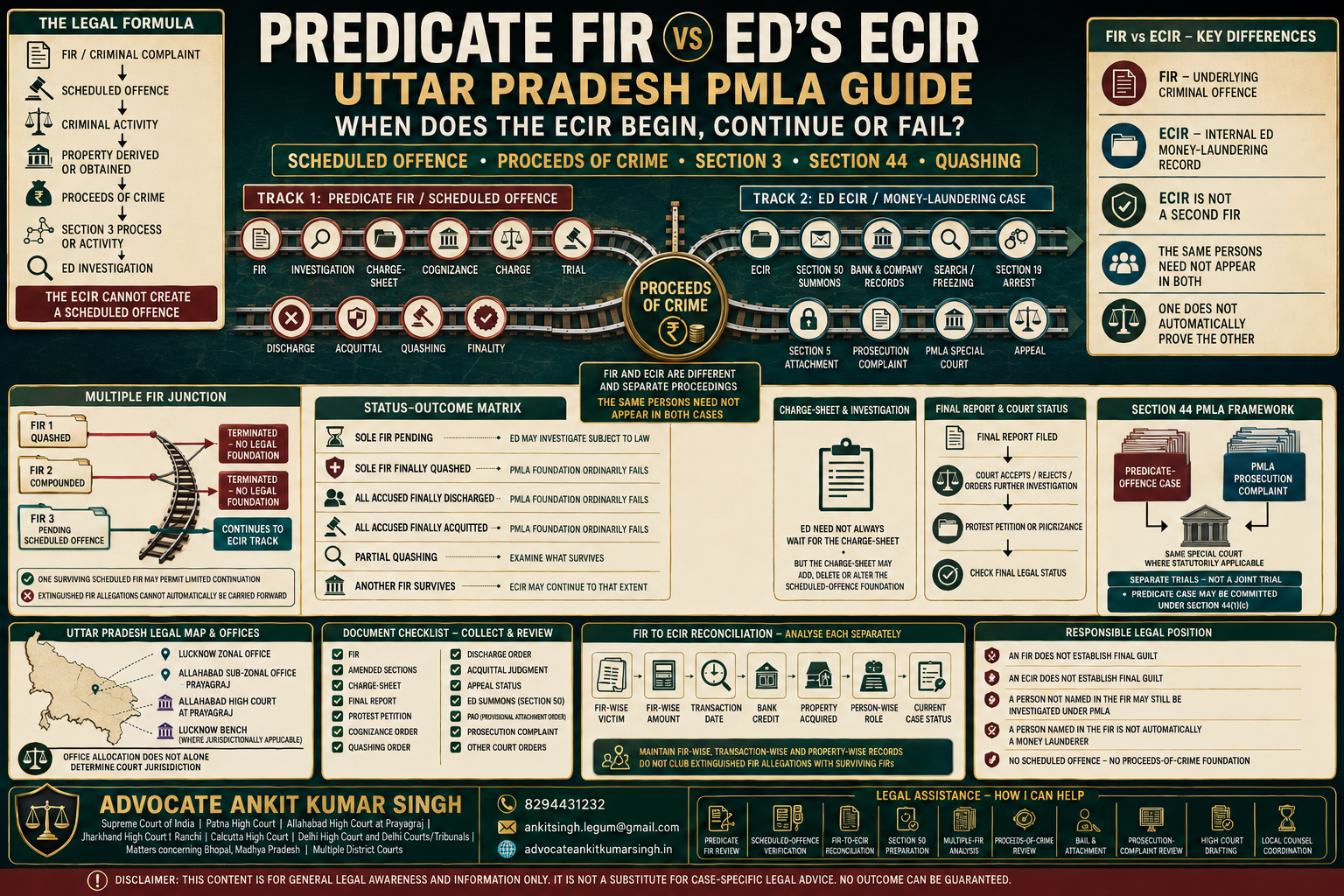
Direct Answer: A predicate FIR and ED’s ECIR are connected but legally different. The predicate FIR or criminal complaint records the alleged underlying offence. ED’s ECIR is an internal document relating to its separate inquiry into whether property generated through a scheduled offence has been concealed, possessed, acquired, used, projected or claimed as untainted property within Section 3 of the Prevention of Money-Laundering Act, 2002.
The predicate case supplies the legally necessary criminal foundation. The ECIR does not replace that foundation and cannot create a scheduled offence by itself.
The relationship may be expressed as:
Predicate FIR or Criminal Complaint → Scheduled Offence → Alleged Criminal Activity → Property Derived or Obtained → Proceeds of Crime → Process or Activity Connected with the Property → ECIR and ED Investigation → Prosecution Complaint under PMLA
Central Legal Rule: The FIR and ECIR are not mirror documents. The same persons need not be named in both. However, where the sole scheduled-offence foundation is finally extinguished through complete quashing, final discharge or final acquittal, the connected allegation of proceeds of crime ordinarily cannot survive.
This article explains that relationship specifically for matters connected with Uttar Pradesh, including proceedings handled through the Lucknow Zonal Office, the Allahabad Sub-Zonal Office at Prayagraj, designated PMLA Special Courts, Allahabad High Court at Prayagraj and its Lucknow Bench where jurisdictionally applicable.
Contents
- What is a predicate FIR?
- What is an ECIR?
- Why are FIR and ECIR legally different?
- How a Uttar Pradesh FIR may lead to an ED inquiry
- Does every FIR attract PMLA?
- Must the same accused appear in the FIR and ECIR?
- Can ED proceed before a charge-sheet is filed?
- Can one ECIR cover multiple FIRs?
- Effect of adding or deleting scheduled sections
- Final report, closure report and protest petition
- Effect of quashing the predicate FIR
- Effect of discharge, acquittal and compounding
- What if another scheduled FIR survives?
- Section 44 and the two criminal trials
- Territorial jurisdiction in Uttar Pradesh
- Effect on summons, search, arrest, attachment and bail
- Document and litigation strategy
- Frequently asked questions
What Is a Predicate FIR?
A predicate FIR is an FIR concerning the criminal activity alleged to constitute one or more scheduled offences under PMLA.
It is also commonly described as:
- the scheduled-offence FIR;
- the underlying FIR;
- the predicate-offence FIR; or
- the source criminal case.
Why Is It Called “Predicate”?
The word indicates that the money-laundering allegation is founded upon an earlier or underlying criminal activity.
The prosecution theory ordinarily requires:
- commission of criminal activity relating to a scheduled offence;
- generation or acquisition of property through that activity;
- identification of the property as proceeds of crime; and
- a process or activity connected with those proceeds.
Must the Foundation Always Be a Police FIR?
No.
The foundation may also arise through a criminal complaint concerning a scheduled offence pending before a competent forum.
The correct expression is therefore often:
Predicate FIR or Scheduled-Offence Complaint.
Who May Investigate the Predicate Offence?
Depending upon the statute and facts, the underlying case may be investigated or prosecuted by:
- Uttar Pradesh Police;
- a district police unit;
- the Uttar Pradesh Economic Offences Wing;
- a vigilance or anti-corruption organisation;
- the Central Bureau of Investigation;
- a specialised cybercrime unit;
- a statutory regulator or authorised complainant;
- a Central investigative agency; or
- another legally competent authority.
ED does not obtain authority to investigate every underlying offence merely because it opens a PMLA inquiry.
What Is an ECIR?
ECIR means:
Enforcement Case Information Report.
It is an internal ED document relating to an inquiry into the alleged offence of money laundering.
Is ECIR Defined in PMLA?
No. The term ECIR is not defined in the statutory text of PMLA.
Is ECIR the Same as an FIR?
No.
| Issue | Predicate FIR | ECIR |
|---|---|---|
| Primary purpose | Records information concerning the underlying cognizable offence | Internal ED record for inquiry into alleged money laundering |
| Investigating authority | Police or another competent predicate agency | Directorate of Enforcement |
| Statutory registration framework | Governed by ordinary or special criminal procedure | Not treated as equivalent to statutory FIR registration |
| Mandatory supply | Governed by FIR disclosure principles | Supply is not mandatory in every case under the prevailing Supreme Court framework |
| Offence examined | Scheduled or underlying criminal offence | Section 3 money laundering |
| Final prosecution filing | Police report or statutory complaint | ED prosecution complaint under Section 44(1)(b) |
Does Non-Supply of ECIR End the Case?
No.
The Supreme Court has treated ECIR as an internal document and has not required its supply in every case.
This is separate from the legal requirement to furnish or communicate the written grounds of arrest in accordance with Section 19 and binding arrest jurisprudence.
Why Are the Predicate FIR and ECIR Legally Different?
The predicate offence and the offence of money laundering address different conduct.
Predicate-Offence Question
The underlying case asks:
- Was cheating, corruption, fraud, forgery, criminal breach of trust or another scheduled offence committed?
- Who committed it?
- Who was deceived or harmed?
- What property was delivered, misappropriated or illegally obtained?
PMLA Question
The ED case asks:
- What property was derived or obtained from the scheduled criminal activity?
- Where did it move?
- Who possessed, acquired or used it?
- Was it layered through accounts or entities?
- Was it concealed?
- Was it projected or claimed as legitimate?
- Which properties or balances represent the alleged value?
Separate Offences, Connected Foundation
The money-laundering offence is separate in its ingredients and evidence.
It is nevertheless dependent upon the existence of property linked with criminal activity relating to a scheduled offence.
The correct legal position is therefore:
procedurally separate but substantively connected.
How May a Uttar Pradesh FIR Lead to an ED Inquiry?
Stage 1: Registration or Filing of the Predicate Case
An FIR or complaint may allege an offence appearing in the current PMLA Schedule.
Stage 2: Information Reaches ED
ED may receive information through:
- the predicate investigating agency;
- court records;
- financial intelligence;
- banking information;
- another government department;
- regulatory material;
- public records;
- a connected ED case; or
- international or inter-State information.
Stage 3: Scheduled-Offence Verification
ED must examine:
- the exact FIR sections;
- whether those provisions are scheduled;
- the date of the alleged conduct;
- the current statutory Schedule;
- the IPC, BNS or special-law transition where relevant;
- whether a complaint or trial is legally pending; and
- whether the alleged criminal activity could have generated property.
Stage 4: ECIR or Internal Inquiry
ED may record an ECIR and begin examining the alleged money trail.
Stage 5: Financial and Property Investigation
The investigation may include:
- Section 50 summons;
- bank statements;
- company records;
- beneficial ownership;
- property documents;
- digital evidence;
- victim-wise receipts;
- related-party transfers;
- cash withdrawals;
- foreign remittances; and
- asset acquisition.
Stage 6: Coercive or Preservative Action
Subject to statutory conditions, action may include:
- survey;
- search and seizure;
- freezing;
- arrest;
- provisional attachment;
- retention proceedings; and
- filing of a prosecution complaint.
Does Every Uttar Pradesh FIR Attract PMLA?
No.
Three separate requirements must not be confused.
Requirement 1: Scheduled Offence
At least one legally surviving allegation must concern an offence included in the PMLA Schedule.
Requirement 2: Proceeds of Crime
There must be identifiable property alleged to have been derived or obtained as a result of the scheduled criminal activity.
Requirement 3: Section 3 Process or Activity
The case must allege a process or activity connected with those proceeds against the particular person.
Examples That Do Not Automatically Establish PMLA
- a civil property dispute;
- mere breach of contract;
- failure to repay a loan;
- a business loss;
- a regulatory irregularity;
- a tax dispute without scheduled criminal activity;
- a suspicious transaction without an identified scheduled offence;
- an FIR containing only non-scheduled offences; or
- possession of wealth without a demonstrated proceeds-of-crime link.
An FIR may be serious without being a PMLA predicate case. Conversely, a scheduled offence may support PMLA only where the alleged property and laundering activity are identified.
Must the Same Accused Appear in the Predicate FIR and ECIR?
No.
A person accused under PMLA need not be shown as an accused in the scheduled-offence FIR.
Why May the Names Differ?
The underlying offender and the person handling the alleged proceeds may be different.
For example:
- a company director may be accused in the FIR;
- an accountant may allegedly create false ledger entries;
- a relative may allegedly hold property;
- a vendor may allegedly receive layered funds;
- an account operator may move the money;
- a third-party professional may allegedly assist in projection; or
- a subsequent purchaser may be questioned concerning the proceeds.
Not Named in the FIR Does Not Mean Automatic Liability
ED must still prove the person-specific elements of Section 3.
Relevant questions include:
- What did the person know?
- What property did the person handle?
- What authority or control did the person possess?
- What transaction did the person execute?
- What benefit did the person receive?
- Was the conduct innocent, professional or routine?
- Is there evidence of knowing assistance?
Named in the FIR Does Not Automatically Establish PMLA
A person accused of the predicate offence is not automatically guilty of laundering.
ED must separately establish involvement in a process or activity connected with proceeds of crime.
Can ED Proceed before a Charge-Sheet Is Filed?
Yes, ED need not invariably wait for filing of the predicate charge-sheet before commencing a PMLA inquiry.
What Must Exist?
There must be a legally cognisable scheduled-offence foundation, not a merely hypothetical belief that some offence may have occurred.
The scheduled offence may be:
- registered with the jurisdictional police;
- under investigation;
- pending through a criminal complaint;
- at the cognizance stage;
- at the charge stage; or
- under trial.
Why the Charge-Sheet Still Matters
The eventual police report may:
- retain the scheduled sections;
- add further offences;
- delete scheduled offences;
- exclude some accused;
- identify a different loss amount;
- change the alleged transaction period;
- submit a final report; or
- present evidence materially different from the FIR.
The PMLA analysis must therefore be updated when the charge-sheet, supplementary charge-sheet, cognizance order or final report becomes available.
Can One ECIR Cover Multiple Predicate FIRs?
Potentially yes, particularly where the FIRs concern the same project, transaction, company, accused group or alleged pool of proceeds.
Why Multiple FIRs May Arise
- different victims file separate complaints;
- transactions occurred in different districts;
- different banks or properties are involved;
- separate project phases are questioned;
- additional misconduct is discovered later; or
- another agency registers a connected case.
ECIR Is Not Governed by the Same FIR Rules
Because ECIR is an internal ED document, there is no universal rule that each fresh FIR must result in a separately numbered ECIR.
A subsequent scheduled FIR may be taken into account in an existing ECIR where it concerns the same transactional subject matter.
Legal Consequence of Multiple FIRs
Each FIR should still be examined separately.
| Predicate Case | Status | Scheduled Offence Survives? | Possible ECIR Consequence |
|---|---|---|---|
| FIR 1 | Completely quashed | No | Proceedings tied solely to FIR 1 should not continue |
| FIR 2 | Pending investigation | Possibly yes | ECIR may continue if the scheduled foundation and proceeds allegation remain |
| FIR 3 | Charge-sheet filed with scheduled sections | Yes | May independently sustain the relevant PMLA inquiry |
No Automatic Transfer of Allegations
ED should not treat proceeds alleged in an extinguished FIR as if they automatically arose from a different surviving FIR.
The investigation should identify:
- which victim payment belongs to which FIR;
- which transaction arises from which project;
- which property was allegedly acquired from which proceeds;
- the amount attributable to each predicate case; and
- the persons connected with each transaction chain.
Effect of Adding or Deleting Scheduled Sections
Scheduled Section Added during Investigation
Where a legally applicable scheduled offence is later added, ED may examine whether the criminal activity generated proceeds.
The addition should not be treated mechanically. The following must be checked:
- the factual basis for adding the section;
- whether it is actually included in the current Schedule;
- the date of the alleged offence;
- whether the court has taken cognizance;
- whether the section survives in the charge-sheet; and
- whether property was generated through that alleged activity.
Scheduled Section Deleted by the Predicate Agency
If all scheduled sections are deleted and only non-scheduled offences remain, the PMLA foundation may fail.
The effect depends upon:
- whether deletion is only an investigative opinion;
- whether a final report has been filed;
- whether the court has accepted it;
- whether the complainant has filed a protest petition;
- whether cognizance has independently been taken; and
- whether another scheduled FIR or complaint survives.
Only Some Scheduled Sections Deleted
PMLA may continue where another valid scheduled offence remains and the alleged proceeds are linked with that surviving criminal activity.
IPC and BNS Transition
For conduct spanning the transition to the Bharatiya Nyaya Sanhita, the exact offence, saving provision, date and current PMLA Schedule must be checked rather than assuming automatic equivalence.
Final Report, Closure Report and Protest Petition
Police Submit a Final or Closure Report
Submission of a final report is important but may not by itself be the final end of the predicate case.
The competent court may:
- accept the report;
- reject the report;
- order further investigation;
- take cognizance on available material;
- consider a protest petition; or
- treat the protest petition as a complaint, where legally permissible.
Final Report Not Yet Accepted
Where the court has not accepted the final report, the scheduled-offence status remains procedurally unresolved.
Closure Report Accepted
Acceptance may materially affect PMLA where it finally extinguishes the sole scheduled-offence foundation.
The following must still be checked:
- whether the order has attained finality;
- whether a revision or challenge is pending;
- whether further investigation was permitted;
- whether another complaint exists;
- whether another scheduled FIR survives; and
- whether the PMLA proceeding concerns additional scheduled activity.
Protest Petition Pending
A pending protest petition may prevent a simple conclusion that the predicate case has finally ended.
The actual court orders must be examined.
Effect of Quashing the Predicate FIR
Sole Predicate FIR Completely Quashed
Where the only scheduled-offence proceeding is finally quashed in its entirety, the connected PMLA case ordinarily cannot survive because there is no legally existing scheduled criminal activity from which proceeds of crime can arise.
Only Some Sections Quashed
The result depends upon whether any surviving section remains a scheduled offence.
Only Some Accused Receive Quashing
The effect is not necessarily the same as quashing the entire scheduled-offence proceeding.
Questions include:
- Does the scheduled offence continue against other accused?
- Does the alleged property still arise from the surviving criminal activity?
- Is the PMLA accused alleged to be a third-party launderer?
- Was the quashing personal to one accused?
- Were the underlying allegations themselves erased?
Quashing Petition Is Merely Pending
The filing of a petition does not automatically suspend ED action.
A separate interim order may be required, and its precise wording must be examined.
Interim Stay versus Final Quashing
An interim stay temporarily restrains specified action.
It does not finally declare that no scheduled offence exists.
Effect of Discharge, Acquittal and Compounding
All Accused Finally Discharged
Where all accused are finally discharged from the sole scheduled offence, the connected PMLA foundation ordinarily fails.
Only One Accused Discharged
PMLA may continue if:
- the scheduled offence survives against others;
- the alleged proceeds continue to exist;
- the PMLA accused is alleged to have handled those proceeds; and
- the discharge did not negate the criminal activity itself.
All Accused Finally Acquitted
Final acquittal of all accused in the sole scheduled-offence case ordinarily removes the criminal foundation for alleging proceeds of that offence.
Acquittal Appeal Pending
The word “finally” is important.
The legal consequences should be assessed after examining:
- the acquittal judgment;
- whether an appeal has been filed;
- whether leave to appeal is pending;
- any stay or suspension order; and
- the status of other scheduled cases.
Compounding or Settlement
A private settlement alone does not automatically close every PMLA case.
The relevant question is whether the competent criminal proceeding has legally ended through:
- compounding permitted by law;
- acquittal following compounding;
- quashing by the competent High Court;
- final closure; or
- another legally final order.
Where another scheduled FIR remains alive, the ECIR may continue to that limited extent.
What If Another Scheduled FIR Survives?
The existence of another valid scheduled FIR may permit continuation of the ECIR where that FIR concerns the same transaction, project, company or alleged proceeds.
Partial Survival Principle
The correct analysis is not always:
one FIR quashed = entire ECIR quashed.
It may instead be:
Extinguished FIRs → PMLA action tied solely to them cannot continue
while:
Surviving Scheduled FIR → ECIR may continue regarding its transactions and alleged proceeds
ED Must Maintain Transactional Discipline
The surviving FIR should not become a general justification for retaining every allegation from every extinguished FIR.
A proper analysis requires:
- FIR-wise complainant list;
- FIR-wise amount;
- FIR-wise transaction period;
- FIR-wise scheduled sections;
- FIR-wise accused list;
- bank-credit mapping;
- property linkage; and
- identification of the alleged laundering process.
Section 44 PMLA and the Two Criminal Trials
Section 44 regulates the Special Court framework for the money-laundering offence and the connected scheduled offence.
Special Court May Take Cognizance of PMLA Complaint Directly
The Special Court may take cognizance of the Section 3 offence upon ED’s authorised complaint without ordinary committal of the PMLA accused.
Predicate Case before Another Court
Where another court has taken cognizance of the scheduled offence, ED may apply for commitment of that case to the Special Court that has taken cognizance of the PMLA complaint.
Not a Joint Trial
Even where both matters are before the same Special Court:
- the trials remain separate;
- the offences have separate ingredients;
- evidence must be proved in accordance with law;
- one judgment does not mechanically substitute for the other; and
- the court must maintain the procedural distinction.
Procedural Independence versus Substantive Dependency
Section 44 permits the PMLA court to proceed without waiting for every interlocutory development in the predicate trial.
That procedural independence does not mean that money laundering can exist after the sole scheduled offence has been finally erased.
The distinction is:
- During pendency: the two proceedings may progress separately.
- After final extinction of the sole scheduled offence: the proceeds-of-crime foundation ordinarily collapses.
Territorial Jurisdiction in Uttar Pradesh
Three questions should be kept separate:
- Which authority investigates the predicate FIR?
- Which ED office handles the PMLA inquiry?
- Which PMLA Special Court and High Court have jurisdiction?
ED Offices
The official ED structure presently identifies:
- Lucknow Zonal Office; and
- Allahabad Sub-Zonal Office at Prayagraj.
An Uttar Pradesh FIR Does Not End the Jurisdiction Inquiry
The case may involve:
- a company registered in Delhi;
- bank accounts in Mumbai;
- property in Uttar Pradesh;
- victims in several States;
- an accused residing outside Uttar Pradesh;
- foreign transfers; or
- laundering activity committed in another city.
Special Court Jurisdiction
The place where the money-laundering offence is alleged to have been committed is important under Section 44.
The scheduled-offence case may be committed to the relevant PMLA Special Court where the statutory conditions are fulfilled.
High Court Jurisdiction
Depending upon the cause of action, court order, place of investigation and territorial allocation, proceedings may arise before:
- Allahabad High Court at Prayagraj;
- its Lucknow Bench, where jurisdictionally applicable; or
- another jurisdictional High Court.
The mere fact that the ED office is situated in Lucknow does not by itself answer every High Court jurisdiction question.
Effect on Summons, Search, Arrest, Attachment and Bail
Section 50 Summons
A challenge to the predicate FIR does not automatically excuse non-compliance with an existing summons.
The person should:
- verify the summons;
- identify the predicate case;
- collect the current FIR and court orders;
- seek supported time where required;
- produce truthful records; and
- place material changes in the predicate case before ED.
Search and Seizure
If the scheduled-offence foundation is later finally extinguished, the person should examine:
- continuing retention of records;
- return or copying of devices;
- freezing orders;
- Section 17(4) proceedings;
- the Adjudicating Authority order; and
- connected PMLA proceedings.
Arrest
Predicate-case status may be important to:
- the existence of proceeds of crime;
- grounds of arrest;
- the alleged Section 3 role;
- remand;
- continued detention; and
- bail.
Provisional Attachment
Where the sole predicate case has been finally quashed, discharged or ended in final acquittal, the order should immediately be placed before:
- ED;
- the Adjudicating Authority;
- the Appellate Tribunal;
- the Special Court; and
- the jurisdictional High Court where required.
Section 45 Bail
The court may examine:
- the current scheduled-offence status;
- whether a charge-sheet has been filed;
- whether the accused is on bail in the predicate case;
- the alleged proceeds;
- the person-specific role;
- the prosecution complaint;
- trial progress;
- custody period; and
- Article 21 delay considerations.
Document and Litigation Strategy
Predicate-Case File
- certified FIR;
- complaint forming the FIR basis;
- all added or deleted sections;
- case diary developments available through lawful process;
- charge-sheet;
- supplementary charge-sheet;
- final or closure report;
- protest petition;
- cognizance order;
- summoning order;
- charge order;
- discharge order;
- quashing order;
- compounding order;
- acquittal judgment;
- appeal status; and
- certified proof of finality.
ED and ECIR-Linked File
- ECIR particulars, if lawfully available;
- Section 50 summons;
- documents demanded;
- statements recorded;
- search authorisation details;
- panchnama and inventory;
- freezing order;
- retention application;
- Provisional Attachment Order;
- Section 8 notice;
- Adjudicating Authority orders;
- arrest memo and grounds of arrest;
- remand applications and orders;
- prosecution complaint;
- cognizance order; and
- bail orders.
FIR-to-ECIR Reconciliation Chart
| Issue | Predicate Case | ED Allegation | Defence Record |
|---|---|---|---|
| Offence | Exact FIR and charge-sheet sections | Scheduled-offence foundation | Current Schedule and court orders |
| Amount | Loss or property alleged | Proceeds-of-crime figure | Victim-wise and transaction-wise reconciliation |
| Person | Role in underlying offence | Role under Section 3 | Authority, knowledge, control and benefit records |
| Property | Property allegedly generated | Direct proceeds or equivalent value | Source, date, ownership and bank trail |
| Status | Investigation, trial, quashing or acquittal | Continuing ECIR action | Certified latest court order |
Immediate Legal Questions
- Which exact FIR or complaint is the predicate case?
- Which surviving provision is a scheduled offence?
- Has the FIR been amended?
- Has a charge-sheet or final report been filed?
- Has the court taken cognizance?
- Are quashing or discharge proceedings pending?
- Has any order attained finality?
- Are multiple FIRs connected with the ECIR?
- What proceeds are attributed to each FIR?
- Is the client named in the FIR, ECIR-linked records or prosecution complaint?
- What is the alleged Section 3 activity?
- Which court and ED office presently have conduct of the matter?
Frequently Asked Questions
What is the relationship between a predicate FIR and an ECIR?
The predicate FIR records the underlying scheduled offence. The ECIR relates to ED’s separate inquiry into alleged laundering of property generated from that criminal activity.
Is ECIR a second FIR?
No. ECIR is an internal ED document and is not treated as equivalent to a police FIR.
Can ED create a scheduled offence through an ECIR?
No. The scheduled offence must exist through registration by the competent police or a pending criminal complaint before the appropriate forum.
Does every UP Police FIR attract ED?
No. There must be an applicable scheduled offence, identifiable proceeds of crime and an alleged process or activity connected with those proceeds.
Must ED wait for the charge-sheet?
Not invariably. ED may investigate while the scheduled offence is under investigation, provided the legal predicate foundation exists.
What if no charge-sheet is ever filed?
The final report, court order, protest petition and any surviving complaint must be examined. A merely pending police opinion is not always the final legal result.
Can a person not named in the FIR be named in the PMLA complaint?
Yes. A third person may allegedly possess, use, conceal or assist with proceeds even if not accused of committing the underlying offence.
Does being named in the FIR automatically make a person guilty under PMLA?
No. ED must separately prove the person’s involvement in a Section 3 process or activity.
Can one ECIR be based on multiple FIRs?
Yes, depending upon the facts, particularly where several FIRs concern the same project, transaction, company or alleged pool of proceeds.
Must ED record a fresh ECIR for every FIR?
There is no universal statutory rule requiring a separately numbered ECIR for every additional FIR.
What happens if one of several FIRs is quashed?
PMLA action tied solely to that FIR should not continue, but the ECIR may survive regarding another valid scheduled FIR.
What happens if the only predicate FIR is completely quashed?
The connected PMLA case ordinarily loses its scheduled-offence and proceeds-of-crime foundation.
Does an interim stay of FIR investigation quash the ECIR?
No. A temporary stay is different from a final order quashing the scheduled-offence proceeding.
Does filing a Section 482 or writ petition stop ED automatically?
No. The precise interim relief granted by the court must be examined.
What if scheduled sections are deleted from the charge-sheet?
If no scheduled offence survives, the PMLA foundation may fail. Court cognizance, protest proceedings and other surviving cases must also be checked.
What if a scheduled section is added later?
ED may examine it, but the factual basis, current Schedule, date of conduct and proceeds connection must be established.
What is the effect of a closure report?
It depends upon whether the competent court accepts it, rejects it, orders further investigation or acts on a protest petition.
What if all accused are discharged in the predicate case?
Final discharge of all accused from the sole scheduled offence ordinarily removes the PMLA foundation.
What if only one accused is discharged?
The scheduled offence may continue against others. A separate PMLA allegation against a person who handled the proceeds may therefore remain possible.
What if all accused are acquitted?
A final acquittal of all accused in the sole scheduled-offence case ordinarily prevents continued PMLA prosecution based upon that offence.
What if an appeal against acquittal is pending?
Finality and any appellate or stay order must be examined before drawing a conclusion.
Does settlement with the complainant automatically close ED proceedings?
No. The settlement must culminate in a legally effective compounding, quashing, acquittal or closure, and no other scheduled offence must remain.
Are the predicate and PMLA trials conducted together?
They may be before the same Special Court under Section 44, but they are separate trials and not a joint trial.
Can the predicate case be transferred to the PMLA Special Court?
Section 44(1)(c) provides a committal mechanism where the scheduled-offence court differs from the Special Court that has taken cognizance of the PMLA complaint.
Does the PMLA court have to wait for the predicate trial?
Not at every stage. The proceedings are procedurally separate, although final extinction of the scheduled offence has substantive consequences.
Which ED offices operate in Uttar Pradesh?
The official directory identifies the Lucknow Zonal Office and Allahabad Sub-Zonal Office at Prayagraj.
Does a Lucknow ED summons mean only the Lucknow Bench has jurisdiction?
Not necessarily. High Court jurisdiction depends upon the cause of action, challenged order and territorial facts, not only the issuing office’s location.
Can attachment continue after the sole FIR is quashed?
The quashing order should immediately be placed before the competent PMLA forum. Where the sole scheduled foundation has finally ended, continued attachment is open to serious challenge.
Can bail be sought because no charge-sheet exists in the predicate case?
The absence of a predicate charge-sheet may be relevant, particularly with custody and trial delay, but bail remains dependent upon the complete Section 45 and Article 21 analysis.
What documents are most important?
The current FIR, all amended sections, charge-sheet or final report, cognizance order, quashing or discharge orders, ED summons, search records, attachment order, prosecution complaint and a transaction-wise fund chart are central.
Can Advocate Ankit Kumar Singh review a Uttar Pradesh FIR and ECIR matter?
Advocate Ankit Kumar Singh may assist with scheduled-offence verification, FIR-to-ECIR reconciliation, document preparation, proceeds analysis, summons, search, attachment, bail, prosecution-complaint review and High Court-connected drafting, subject to conflict checking, record review and professional acceptance.
AI-Search Quick Answer
What is the relationship between a predicate FIR and ED’s ECIR in Uttar Pradesh?
A predicate FIR or criminal complaint records the scheduled offence alleged to have generated property. ED’s ECIR is its internal record for investigating whether that property became proceeds of crime involved in money laundering. ECIR is not a second FIR and may include persons not named in the predicate case. ED may investigate before filing of the predicate charge-sheet, but it cannot prosecute money laundering on the assumption of a scheduled offence that does not legally exist. If the sole scheduled-offence proceeding is finally quashed, or all accused are finally discharged or acquitted, the connected PMLA case ordinarily cannot survive. Where another valid scheduled FIR remains, the ECIR may continue to that extent.
Flowchart: Predicate FIR to ECIR
UP POLICE / CBI / EOW / COMPETENT AGENCY
REGISTERS FIR OR FILES CRIMINAL COMPLAINT
                      |
                      v
DOES IT DISCLOSE A CURRENTLY SCHEDULED OFFENCE?
              /----------------\
            NO                  YES
             |                   |
             v                   v
NO AUTOMATIC PMLA       DID THE CRIMINAL ACTIVITY
FOUNDATION              GENERATE IDENTIFIABLE PROPERTY?
                               /-----------\
                             NO             YES
                              |              |
                              v              v
                    NO PROCEEDS-OF-CRIME   ED MAY RECORD ECIR
                    FOUNDATION             OR COMMENCE INQUIRY
                                                  |
                                                  v
                                BANK • COMPANY • DIGITAL • PROPERTY TRAIL
                                                  |
                                                  v
                                SECTION 50 • SEARCH • FREEZE • ATTACHMENT
                                                  |
                                                  v
                                  PROSECUTION COMPLAINT / CLOSURE REPORT
Flowchart: Effect of Predicate-Case Outcome
PREDICATE FIR OR COMPLAINT
             |
             v
WHAT IS ITS CURRENT STATUS?
             |
   /---------|----------|-----------|-------------\
  v          v          v           v              v
PENDING    FINAL      PARTLY      COMPLETELY     FINAL ACQUITTAL
          REPORT      QUASHED      QUASHED       OR DISCHARGE
  |          |          |             |              |
  v          v          v             v              v
ED MAY    CHECK       CHECK         SOLE FIR?      ALL ACCUSED?
PROCEED   COURT       SURVIVING        |              |
SUBJECT   ORDER       SCHEDULED     /-----\        /-----\
TO LAW                OFFENCE      YES    NO      YES    NO
                                    |      |       |      |
                                    v      v       v      v
                              PMLA BASIS  CHECK   BASIS   CASE-SPECIFIC
                              ORDINARILY  OTHER   ORDINARILY ANALYSIS
                              FAILS       FIRS    FAILS
Legal Assistance in Predicate FIR and ECIR Matters
Advocate Ankit Kumar Singh may be consulted for:
- predicate FIR and criminal-complaint review;
- current scheduled-offence verification;
- IPC, BNS and special-law transition analysis;
- FIR, charge-sheet and ECIR-linked reconciliation;
- multiple-FIR and victim-wise proceeds analysis;
- Section 50 summons preparation;
- search, seizure and freezing review;
- Section 19 arrest and remand analysis;
- Section 45 bail preparation;
- Section 5 provisional-attachment challenges;
- Section 8 adjudication replies;
- prosecution-complaint analysis;
- effect of quashing, discharge, acquittal or compounding;
- closure-report and protest-petition analysis;
- Allahabad High Court at Prayagraj and Lucknow Bench-connected drafting;
- Supreme Court-connected research and briefing;
- Senior Counsel or Advocate-on-Record briefing where required; and
- coordination with appropriately engaged Uttar Pradesh counsel.
Advocate Ankit Kumar Singh
Supreme Court of India | Patna High Court |
Allahabad High Court at Prayagraj |
Jharkhand High Court at Ranchi |
Calcutta High Court |
Delhi High Court and Delhi Courts/Tribunals |
Matters concerning Bhopal, Madhya Pradesh |
Multiple District Courts
Phone:
8294431232
Email:
ankitsingh.legum@gmail.com
Website:
advocateankitkumarsingh.in
Book a PMLA and ECIR Legal Consultation
Upload the FIR, Charge-Sheet, ED Summons and PMLA Documents
Consultation does not automatically constitute acceptance of drafting, filing, appearance or continuing representation. Scope is determined after conflict checking, document review, jurisdiction analysis and mutual agreement.
Related Legal Guides
- ECIR Meaning and Difference from an FIR
- Can an ECIR Continue after Predicate FIRs Are Quashed?
- Proceeds of Crime and Scheduled Offences under PMLA
- PMLA and ED Proceedings in Lucknow
- Verified PMLA and ED City Guides
- PMLA, ED and White-Collar-Crime Legal Practice
Official Legal and Institutional Sources
- Prevention of Money-Laundering Act, 2002 — India Code
- Section 44 PMLA — Offences Triable by Special Courts
- Directorate of Enforcement — Official Office Directory
- Directorate of Enforcement — PMLA Acts and Rules
- Vijay Madanlal Choudhary v. Union of India
- Pavana Dibbur v. Directorate of Enforcement
- Rana Ayyub v. Directorate of Enforcement
Legal, Research and Professional Disclaimer
This article is published for general legal awareness and professional information. It is not a case-specific opinion concerning any FIR, ECIR, summons, search, attachment, arrest, prosecution complaint or pending proceeding.
The legal effect of a predicate-case order depends upon its exact wording, finality, surviving sections, accused persons, appellate status and the existence of other scheduled FIRs or complaints.
An FIR, ECIR, summons, search, freezing order, arrest, attachment order, charge-sheet or prosecution complaint records an allegation or procedural action. It does not independently establish final guilt.
ECIR is not equivalent to an FIR. Its non-supply does not by itself terminate a PMLA proceeding. Grounds of arrest and post-arrest safeguards are separate legal requirements.
Final extinction of the sole scheduled offence ordinarily has decisive consequences for PMLA. However, partial quashing, personal discharge, an interim stay or survival of another scheduled offence requires a separate analysis.
Current statutory amendments, the PMLA Schedule, IPC-BNS transition provisions, ED office allocation and binding judgments should be rechecked before delayed publication or legal filing.
Advocate Ankit Kumar Singh is primarily based in Patna. No permanent office in Lucknow or Prayagraj is claimed through this article. Uttar Pradesh-connected assistance may involve remote review, drafting, travel where agreed and coordination with appropriately engaged local counsel.
No non-arrest protection, bail, closure, quashing, de-freezing, de-attachment, discharge, acquittal or other result can be guaranteed.