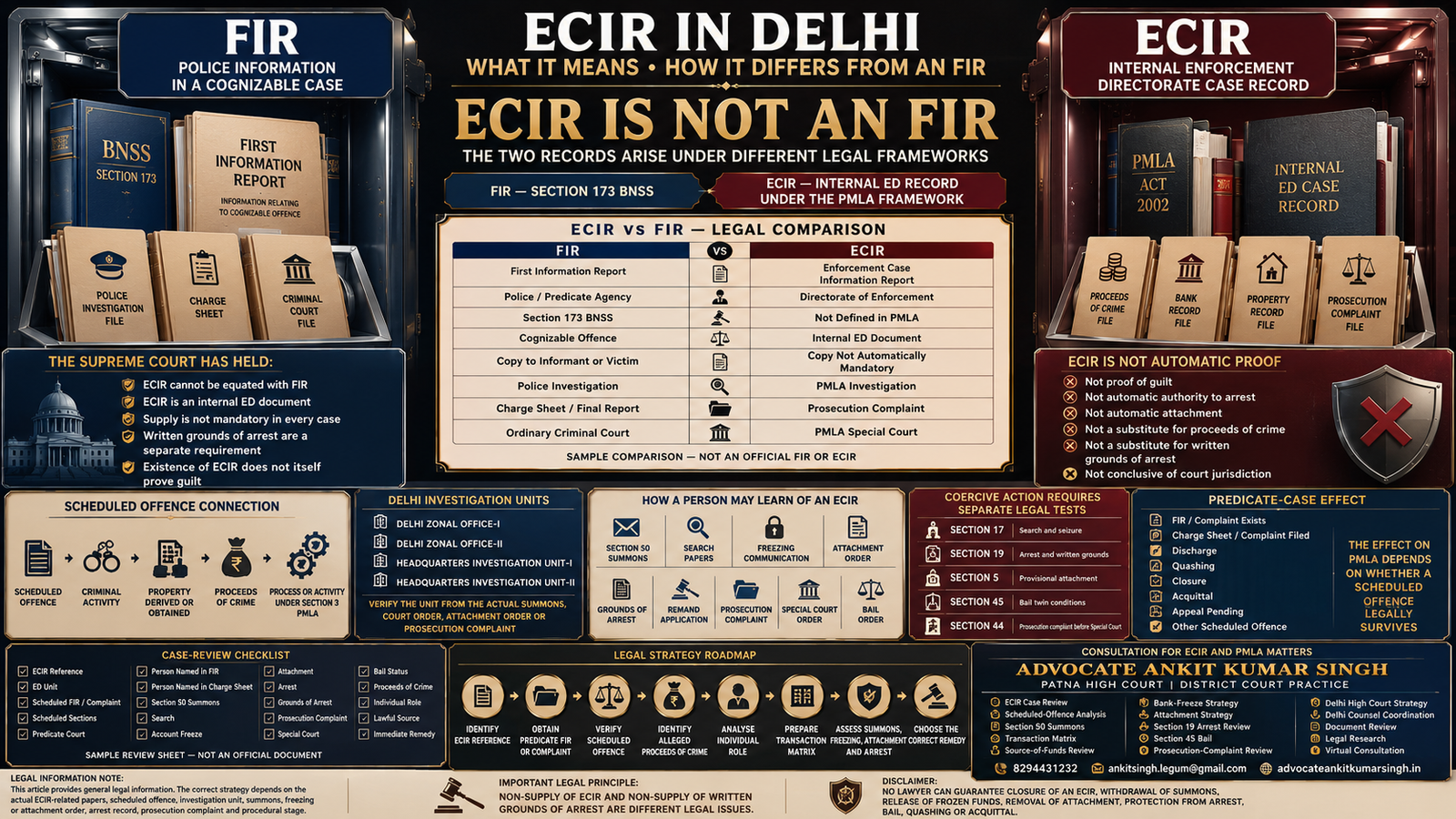
ECIR in Delhi: What It Means and How It Differs from an FIR under the PMLA
Direct Answer: An ECIR, commonly expanded as an Enforcement Case Information Report, is an internal record used by the Directorate of Enforcement for an investigation under the Prevention of Money Laundering Act, 2002.
An ECIR is not the same as a First Information Report registered by the police. The Supreme Court has held that an ECIR cannot be equated with an FIR, is essentially an internal document of the ED and need not be supplied automatically in every case.
An FIR is recorded by the police under the statutory criminal-procedure framework upon receiving information relating to the commission of a cognizable offence. An ECIR, in contrast, is not defined or prescribed as a mandatory document by the PMLA itself.
The practical consequences of an ECIR may nevertheless be serious. An ECIR-related investigation may result in:
- summons under Section 50 PMLA;
- collection of banking and company records;
- search and seizure under Section 17;
- freezing of accounts or property;
- provisional attachment under Section 5;
- arrest under Section 19;
- regular bail proceedings under Section 45;
- filing of a prosecution complaint under Section 44; and
- trial before the jurisdictional PMLA Special Court.
Advocate Ankit Kumar Singh – Patna High Court | Supreme Court | District Court Practice
Professional assistance may include ECIR-related case review, scheduled-offence analysis, summons preparation, transaction and source-of-funds review, freezing and attachment strategy, arrest-risk assessment, bail preparation, Delhi counsel coordination and High Court or Supreme Court proceedings where required.
What Does ECIR Mean?
ECIR is commonly understood to mean:
Enforcement Case Information Report
It is a record generated and maintained within the Directorate of Enforcement in connection with an inquiry or investigation under the PMLA.
The ECIR may identify or internally record matters such as:
- the scheduled or predicate offence;
- the police, CBI, SFIO, Customs, Income Tax or other agency case;
- the investigating ED unit;
- the date on which the PMLA inquiry was initiated;
- the entities or persons initially connected with the inquiry;
- the suspected proceeds of crime;
- the relevant transactions or properties; and
- the internal allocation of the investigation.
Important: The PMLA does not prescribe a statutory public format for an ECIR comparable to the statutory recording of information in a police FIR.
Is the Expression “ECIR” Defined in the PMLA?
No. The expression ECIR is not defined in Section 2 or another provision of the Prevention of Money Laundering Act, 2002.
The PMLA does not contain a provision stating that:
- an ECIR must be registered in every case;
- an ECIR must follow a publicly prescribed statutory form;
- an ECIR must be filed before a Magistrate immediately after recording;
- an ECIR must be published online;
- an ECIR copy must be supplied to every person investigated; or
- all coercive action is invalid unless an ECIR copy is first delivered.
The Supreme Court has treated the ECIR as an internal document of the ED rather than the statutory equivalent of an FIR.
Read Vijay Madanlal Choudhary v. Union of India
What Is an FIR?
An FIR is the commonly used expression for information recorded by the police concerning the commission of a cognizable offence.
Under Section 173 of the Bharatiya Nagarik Suraksha Sanhita, 2023:
- information relating to a cognizable offence may be given to the officer in charge of a police station;
- oral information is reduced to writing and read over to the informant;
- electronic information is taken on record subject to statutory requirements;
- the recorded information is signed by the person giving it; and
- a copy is given forthwith and free of cost to the informant or victim.
Read the Bharatiya Nagarik Suraksha Sanhita, 2023
The FIR provides the formal starting point for a police investigation into a cognizable offence under the ordinary criminal-procedure framework.
ECIR and FIR: The Fundamental Difference
| Point | FIR | ECIR |
|---|---|---|
| Full form | First Information Report | Enforcement Case Information Report |
| Authority | Police or another agency exercising statutory police-investigation powers | Directorate of Enforcement |
| Primary legal framework | Bharatiya Nagarik Suraksha Sanhita and the substantive offence statute | Prevention of Money Laundering Act, 2002 |
| Statutory recognition | Information in a cognizable case is expressly governed by Section 173 BNSS | The term ECIR is not defined or prescribed as a mandatory statutory document in the PMLA |
| Nature | Statutorily recorded information relating to a cognizable offence | Internal ED record connected with a PMLA investigation |
| Underlying offence | Records information relating to the substantive cognizable offence | Relates to investigation of money laundering arising from criminal activity connected with a scheduled offence |
| Copy | A copy of the recorded information is given free to the informant or victim under Section 173(2) BNSS | Supply of the ECIR is not mandatory in every case |
| Public character | It is part of the police and court process subject to applicable disclosure rules | It is treated as an internal ED document |
| Investigation | Police investigation proceeds under the BNSS | ED exercises PMLA powers concerning proceeds of crime and money laundering |
| Arrest | Police arrest is governed by the BNSS and applicable special law | ED arrest is governed by Section 19 PMLA |
| Final prosecution document | Police ordinarily files a final report or charge sheet under Section 193 BNSS | ED files a prosecution complaint before the PMLA Special Court under Section 44 |
| Court | The competent criminal court according to the offence and jurisdiction | The designated PMLA Special Court |
| Automatic proof of guilt | No | No |
Why Did the Supreme Court Hold That ECIR Is Not an FIR?
The Supreme Court explained that the statutory scheme of the PMLA is different from the ordinary police-investigation framework.
The Court noted that:
- the PMLA does not mandate registration of an ECIR in the same manner as an FIR;
- an ECIR is an internal ED document;
- mandatory disclosure of the ECIR in every case could affect investigation and attachment of proceeds of crime;
- the person arrested must instead be informed of the grounds of arrest; and
- the Special Court can examine relevant ED records when considering detention and remand.
The proposition that an ECIR is not equivalent to an FIR was stated in Vijay Madanlal Choudhary v. Union of India and has been referred to in subsequent Supreme Court decisions.
Must the ED Supply a Copy of the ECIR?
There is no automatic legal requirement to supply an ECIR copy to every person summoned, searched, investigated or arrested.
The Supreme Court has held that:
- supply of the ECIR in every case is not mandatory;
- non-supply of the ECIR, being an internal ED document, does not by itself violate a constitutional right;
- the person arrested must be informed of the grounds of arrest; and
- the Special Court may examine the relevant record when deciding remand or continued custody.
This does not mean that a person must remain unaware of the case indefinitely.
Depending on the stage, the person may obtain relevant information from:
- the Section 50 summons;
- search and seizure records;
- freezing communications;
- the provisional attachment order;
- the complaint filed before the Adjudicating Authority;
- written grounds of arrest;
- the ED remand application;
- the prosecution complaint;
- the cognizance order;
- court orders;
- bail proceedings; and
- copies supplied during the criminal trial process.
ECIR Copy and Grounds of Arrest Are Different
An ECIR and the written grounds of arrest serve different purposes.
ECIR
- It is an internal ED record.
- It relates to the institution and allocation of the PMLA investigation.
- Its supply is not automatically mandatory.
Grounds of Arrest
- They explain why the particular person has been arrested.
- They must be person-specific and meaningful.
- They must enable the person to challenge arrest, oppose remand and seek bail.
- Current Supreme Court jurisprudence requires written communication of the grounds of arrest.
Read the Supreme Court judgment concerning written grounds of arrest
Important: The ED cannot answer a challenge concerning the failure to provide lawful written grounds of arrest merely by stating that the ECIR is confidential.
What Is the Scheduled or Predicate Offence?
The offence of money laundering depends on criminal activity connected with a scheduled offence listed in the Schedule to the PMLA.
The scheduled offence is commonly called the predicate offence.
It may arise from:
- a police FIR;
- a CBI case;
- a complaint filed by an authorised agency;
- a charge sheet;
- a complaint under another special statute; or
- another legally recognised proceeding relating to a scheduled offence.
The scheduled offence and the PMLA offence are separate but connected.
The Scheduled-Offence Case Examines
- whether the underlying criminal offence was committed;
- who committed it;
- the ingredients of that offence;
- the evidence collected by the predicate agency; and
- the liability under the substantive scheduled-offence statute.
The PMLA Investigation Examines
- whether property was derived or obtained from criminal activity relating to the scheduled offence;
- whether the property constitutes proceeds of crime;
- who possessed, acquired, used, concealed or transferred it;
- whether any person knowingly assisted in the process or activity;
- whether the property was projected or claimed as untainted; and
- whether attachment, arrest or prosecution under the PMLA is justified.
Can an ECIR Exist without an FIR?
An FIR is a common source of the scheduled-offence information on which an ED investigation is based, but it is not the only legally possible source.
Certain scheduled offences may be initiated through:
- a statutory complaint;
- a prosecution complaint by an authorised department;
- a CBI regular case;
- a complaint before a competent court; or
- another procedure prescribed by the statute governing the scheduled offence.
The critical requirements are not the letters “FIR” alone. The ED must be able to identify:
- criminal activity relating to a scheduled offence;
- property allegedly derived or obtained from that criminal activity; and
- a process or activity connected with the alleged proceeds of crime.
An ECIR cannot independently manufacture a scheduled offence where no scheduled-offence case or legally recognisable criminal proceeding exists.
Can One FIR Lead to an ECIR?
Yes. A police, CBI or other predicate-agency case containing a scheduled offence may lead the ED to initiate a PMLA investigation.
The ED may examine matters beyond the limited wording of the FIR, including:
- the full charge sheet;
- bank and accounting records;
- persons not initially named in the FIR;
- beneficial owners;
- intermediaries;
- subsequent transferees;
- equivalent-value property;
- layering transactions;
- foreign remittances;
- shell or associated entities; and
- persons allegedly assisting concealment or projection.
The scope cannot be unlimited. Every PMLA allegation must remain legally connected to proceeds of crime derived or obtained from criminal activity relating to a scheduled offence.
Can a Person Not Named in the FIR Be Investigated under the ECIR?
Yes. Absence of a person’s name from the predicate FIR does not automatically prevent the ED from examining that person.
The person may be investigated where evidence allegedly shows:
- receipt of proceeds of crime;
- possession or control of tainted property;
- beneficial ownership;
- assistance in layering transactions;
- use of company or bank accounts;
- acquisition of property;
- concealment of ownership;
- projection of funds as lawful;
- professional or managerial assistance with knowledge; or
- another activity covered by Section 3 PMLA.
Formal designation, family relationship or association alone should not replace evidence of the individual role and the required knowledge or participation.
Can a Person Not Named in the ECIR Be Summoned or Prosecuted?
The ECIR is an internal document and may reflect only the information available at the initial stage.
An investigation may subsequently identify:
- new persons;
- new entities;
- additional accounts;
- additional properties;
- beneficial owners;
- intermediaries;
- employees or professionals;
- additional transactions; and
- persons allegedly involved in handling the proceeds of crime.
Accordingly, absence of a person’s name from an initial ECIR reference does not, by itself, create immunity from summons, investigation, arrest or prosecution.
Equally, the mere inclusion of a name in an internal record does not establish guilt.
How Does a Person Know That an ECIR Exists?
A person may become aware of an ECIR through:
- a Section 50 summons mentioning the ECIR number;
- an official ED email;
- a search authorisation or panchnama;
- a freezing order or communication to a bank;
- a provisional attachment order;
- a complaint filed before the Adjudicating Authority;
- written grounds of arrest;
- a remand application;
- a prosecution complaint;
- a Special Court order;
- a bail order;
- a High Court or Supreme Court order; or
- another official communication.
Some documents may refer only to the investigation or scheduled offence without supplying the complete ECIR.
What Does a Delhi ECIR Number Mean?
An ECIR reference may contain letters or abbreviations indicating the ED unit that recorded or initially handled the matter.
Delhi-related references seen in public court records may indicate units such as:
- Delhi Zonal Office-I;
- Delhi Zonal Office-II;
- Headquarters Investigation Unit-I;
- Headquarters Investigation Unit-II; or
- another specialised or transferred investigation unit.
The reference may also contain a serial number and year.
Important: An ECIR code should not be interpreted from memory or assumption. The actual summons, court order, prosecution complaint or other official document should be checked.
Delhi Zonal Office-I, Delhi Zonal Office-II and Headquarters Units
The official Directorate of Enforcement directory presently lists:
Delhi Zonal Office-I
C-Block, Pravartan Bhawan
Dr. APJ Abdul Kalam Road
New Delhi – 110011
Delhi Zonal Office-II
C-Block, Pravartan Bhawan
Dr. APJ Abdul Kalam Road
New Delhi – 110011
The ED also maintains Headquarters Investigation Units at Pravartan Bhawan.
Check the official Directorate of Enforcement office directory
The fact that an ECIR bears a Delhi unit reference does not necessarily mean:
- every relevant transaction occurred in Delhi;
- every person investigated resides in Delhi;
- all property is located in Delhi;
- the predicate FIR was registered in Delhi;
- only a Delhi court can consider every related issue; or
- the investigation can never be transferred or coordinated with another ED office.
Does the ECIR Number Determine Court Jurisdiction?
Not by itself.
The relevant court and territorial jurisdiction may depend on:
- the scheduled offence;
- the place where the money-laundering offence was allegedly committed;
- the location of the proceeds or property;
- the ED unit filing the prosecution complaint;
- the notified PMLA Special Court;
- the place of arrest and remand;
- the place where coercive action occurred;
- the court handling the scheduled offence;
- the relief being sought; and
- the applicable statutory notification.
The ECIR unit code is relevant evidence of administrative allocation but is not the sole legal test for judicial jurisdiction.
ECIR and Section 50 Summons
A Section 50 summons may be issued in relation to an ECIR investigation.
The summons may require:
- personal appearance;
- giving evidence;
- production of bank statements;
- production of company records;
- production of property records;
- explanation of the source of funds;
- explanation of beneficial ownership;
- production of mobile, laptop or electronic records;
- clarification of a transaction; or
- identification of another person or entity.
A summons should be responded to according to its actual wording. Non-supply of the ECIR does not automatically excuse non-attendance.
ECIR and Search under Section 17
The ED may conduct search and seizure where the statutory conditions under Section 17 are satisfied.
Search action may involve:
- residential premises;
- company offices;
- business premises;
- bank lockers;
- digital devices;
- books of account;
- property records;
- communication records; and
- other material believed to be relevant.
The legality of a search depends on compliance with Section 17 and cannot be decided merely by whether an ECIR copy was supplied.
ECIR and Freezing of Bank Accounts
A bank account may become connected with an ECIR investigation where the ED alleges that the account:
- received proceeds of crime;
- was used for layering;
- was controlled by a beneficial owner;
- received funds from an investigated entity;
- was used to acquire property;
- contains equivalent value; or
- contains evidence relevant to the money trail.
A freezing challenge should examine:
- the statutory provision used;
- the officer’s authority;
- the reasons recorded;
- the account holder’s role;
- the amount allegedly connected with proceeds of crime;
- the existence of legitimate funds;
- the duration of the restraint;
- the proceedings before the Adjudicating Authority; and
- the appropriate Special Court, High Court or statutory remedy.
ECIR and Provisional Attachment
Property may be provisionally attached under Section 5 where the statutory requirements are satisfied.
The attachment proceeding should identify:
- the property;
- the alleged proceeds-of-crime connection;
- the person holding the property;
- the scheduled offence;
- the material relied upon;
- the recorded reason to believe;
- the value attributed; and
- the need to prevent concealment, transfer or frustration of confiscation proceedings.
The ECIR reference may appear in the attachment order or subsequent adjudication papers, but the legality of attachment depends on the statutory requirements and evidence, not merely the existence of an ECIR number.
ECIR and Arrest under Section 19
The existence of an ECIR does not automatically authorise arrest.
For arrest under Section 19, the authorised officer must:
- possess relevant material;
- form a reason to believe that the person is guilty of an offence punishable under the PMLA;
- record the reason in writing;
- arrest through a duly authorised officer;
- furnish meaningful written grounds of arrest; and
- produce the arrested person before the jurisdictional court within the prescribed period.
The questions are therefore:
- What material connected the person with the alleged offence?
- What proceeds of crime were identified?
- What individual role was alleged?
- Were the statutory reasons properly recorded?
- Were written grounds supplied?
- Were the grounds understandable and person-specific?
- Was production before the court timely?
Demanding the ECIR copy and challenging the written grounds of arrest are legally distinct issues.
ECIR and Bail under Section 45
After arrest, regular bail is ordinarily considered under Section 45 PMLA by the competent Special Court.
The bail application should not depend only on the absence of an ECIR copy.
It should address:
- the scheduled offence;
- the alleged proceeds of crime;
- the applicant’s individual role;
- the transaction trail;
- lawful source of funds;
- grounds-of-arrest legality;
- cooperation with summons;
- completion of custodial interrogation;
- filing of the prosecution complaint;
- medical circumstances;
- statutory proviso, where applicable;
- long custody;
- trial delay;
- flight risk;
- evidence-tampering risk; and
- conditions volunteered by the applicant.
ECIR and the Prosecution Complaint
The ECIR is not the final charging document placed before the PMLA Special Court.
After investigation, the ED may file a prosecution complaint under Section 44 PMLA.
The prosecution complaint ordinarily contains:
- the scheduled-offence background;
- the ECIR reference;
- the accused persons;
- the alleged proceeds of crime;
- the alleged money trail;
- the role attributed to each accused;
- statements recorded under Section 50;
- bank and company records;
- property details;
- electronic evidence;
- the offence alleged under Section 3;
- the punishment provision under Section 4; and
- a prayer for the Special Court to take cognizance.
The Special Court takes cognizance of the PMLA offence upon the authorised written complaint according to Section 44 and Section 45.
ECIR, FIR, Charge Sheet and Prosecution Complaint
| Document | Prepared By | Function |
|---|---|---|
| FIR | Police or competent predicate-investigation agency | Records information relating to the commission of a cognizable scheduled offence |
| Charge sheet or police report | Police or predicate-investigation agency | Presents the completed predicate-offence investigation before the criminal court |
| ECIR | Directorate of Enforcement | Internal record connected with the ED’s PMLA investigation |
| Prosecution complaint | Authorised ED officer | Presents the alleged PMLA offence and evidence before the Special Court |
What Happens If the Predicate FIR Is Quashed?
The PMLA offence requires proceeds of crime derived or obtained from criminal activity relating to a scheduled offence.
Where the only scheduled-offence proceeding is finally quashed and no scheduled offence survives, the legal foundation for the connected PMLA proceeding may fail.
The exact effect depends on:
- whether the quashing is final;
- whether an appeal or review is pending;
- whether another scheduled offence exists;
- whether multiple FIRs or complaints are relied upon;
- whether the prosecution complaint relies on another criminal activity; and
- the precise relief granted by the court.
The Supreme Court has stated that where the person is finally discharged or acquitted of the scheduled offence, or the criminal case is quashed, there can be no offence of money laundering in relation to property linked only to that scheduled offence.
What Happens after Acquittal or Discharge?
A final acquittal, discharge, accepted closure report or quashing order in the only scheduled offence may materially affect:
- the ECIR-related investigation;
- attachment proceedings;
- freezing orders;
- the prosecution complaint;
- custody and bail;
- confiscation proceedings; and
- continuation of the PMLA trial.
The complete record must be checked because another scheduled offence or separate predicate proceeding may continue to support the ED case.
Can an ECIR Be Quashed?
Petitions are sometimes described as seeking “quashing of the ECIR.”
Because the ECIR is an internal document rather than an FIR, the actual relief may need to be framed against:
- the initiation or continuation of PMLA proceedings;
- a Section 50 summons;
- a search or freezing action;
- an arrest;
- a provisional attachment order;
- a prosecution complaint;
- a remand order; or
- another identifiable coercive or statutory action.
Possible grounds may include:
- absence of a scheduled offence;
- final quashing or closure of the only predicate case;
- absence of identifiable proceeds of crime;
- lack of statutory authority;
- lack of territorial or factual nexus;
- action against property unrelated to the scheduled offence;
- violation of mandatory procedural safeguards;
- illegal arrest;
- continued restraint without statutory foundation; or
- another substantial constitutional or jurisdictional defect.
A writ petition should not be treated as an automatic substitute for cooperating with a lawful summons or pursuing the statutory attachment, bail or appellate remedy.
Can the ECIR Be Obtained through RTI?
The Directorate of Enforcement is included among organisations to which the general disclosure obligations under the Right to Information Act are restricted by Section 24, subject to the statutory exceptions concerning allegations of corruption and human-rights violations.
An ECIR is also treated by the Supreme Court as an internal ED document.
Accordingly, an RTI application should not be assumed to provide an automatic right to obtain the complete ECIR.
What Should a Person Do after Learning about a Delhi ECIR?
- Identify the source: Determine whether the ECIR reference appears in a summons, court order, arrest paper, freezing communication or attachment order.
- Verify the ED unit: Identify Delhi Zone-I, Delhi Zone-II, HIU-I, HIU-II or another unit.
- Obtain the predicate papers: Collect the FIR, complaint, charge sheet, court orders and bail orders.
- Identify the scheduled sections: Confirm that the alleged offences appear in the PMLA Schedule.
- Identify the proceeds of crime: Determine the amount, property or transaction alleged.
- Prepare the individual-role note: Separate the person’s role from that of the company and other persons.
- Prepare the transaction matrix: Trace every questioned payment.
- Prepare the source-of-funds chart: Reconcile banking, tax and accounting records.
- Preserve digital records: Do not delete emails, messages, devices or accounting data.
- Review earlier statements: Compare police, tax, GST, company and court records.
- Assess coercive risk: Examine summons, search, freezing, attachment and arrest risk separately.
- Choose the correct remedy: Respond, seek clarification, file objections, apply for bail or approach the competent court according to the stage.
ECIR Case-Review Sheet
DELHI ECIR AND PREDICATE-OFFENCE REVIEW

ECIR Reference:
ECIR Date:
Issuing / Investigating ED Unit:
Delhi Zone-I / Delhi Zone-II / HIU:
Investigating Officer:
Officer’s Designation:

Scheduled-Offence Agency:
FIR / Complaint Number:
FIR / Complaint Date:
Police Station / Agency:
Scheduled Sections:
Charge Sheet Filed:
Predicate Court:
Predicate Case Status:

Person Concerned:
Entity:
Designation:
Relevant Period:
Named in FIR:
Named in Charge Sheet:
Named in ECIR-Related Papers:
Summoned under Section 50:
Statement Recorded:
Search Conducted:
Account Frozen:
Property Attached:
Arrested:
Grounds of Arrest Supplied:
Prosecution Complaint Filed:
Special Court:
Bail Status:

Alleged Proceeds of Crime:
Amount Attributed:
Property Attributed:
Account Attributed:
Individual Role:
Personal Benefit Alleged:
Lawful-Source Explanation:
Defence Documents:
Immediate Legal Remedy:
Common Mistakes
- Assuming that ECIR and FIR are identical.
- Assuming that an ECIR copy must always be supplied.
- Confusing non-supply of ECIR with non-supply of written grounds of arrest.
- Believing that an ECIR itself proves guilt.
- Believing that absence from the FIR creates complete immunity from PMLA investigation.
- Believing that absence from the initial ECIR prevents later prosecution.
- Ignoring the predicate-offence papers.
- Failing to identify the scheduled sections.
- Failing to identify the alleged proceeds of crime.
- Assuming every credited amount is proceeds of crime.
- Ignoring legitimate funds mixed in the same account.
- Failing to reconcile bank statements and ledgers.
- Assuming a Delhi ECIR means every act occurred in Delhi.
- Assuming the ECIR code alone decides court jurisdiction.
- Ignoring a Section 50 summons because the ECIR was not supplied.
- Deleting records after learning of the ECIR.
- Giving inconsistent explanations to different agencies.
- Challenging only the ECIR label without identifying the coercive action.
- Failing to place a final predicate-offence order before the ED or Special Court.
- Expecting guaranteed quashing merely because the ECIR is an internal document.
Frequently Asked Questions
What is the full form of ECIR?
ECIR is commonly expanded as Enforcement Case Information Report.
Is ECIR defined in the PMLA?
No. The expression is not defined in the PMLA.
Is an ECIR the same as an FIR?
No. The Supreme Court has held that an ECIR cannot be equated with a police FIR.
Is an ECIR a public document?
It is treated as an internal ED document and is not automatically disclosed or published like an ordinary police FIR.
Must the ED give me an ECIR copy?
No automatic right to receive the ECIR copy in every case has been recognised by the Supreme Court.
Does non-supply of the ECIR make the investigation illegal?
Not by itself. The legality of summons, search, freezing, arrest or attachment must be examined under the statutory provision governing that action.
Are grounds of arrest and ECIR the same?
No. Written grounds of arrest must explain the person-specific reason for arrest. The ECIR is an internal investigation record.
Does an ECIR mean that I am an accused?
Not necessarily. A person may initially be a witness, document custodian, employee, director, counterparty or another person connected with the inquiry.
Can I be investigated if I am not named in the FIR?
Yes, where the ED alleges that subsequent evidence connects the person with proceeds of crime or a process or activity under Section 3 PMLA.
Can I be prosecuted if I am not named in the initial ECIR?
Potentially yes. An investigation may identify additional persons after the internal record was initially prepared.
Is an FIR compulsory before every ECIR?
A police FIR is a common source, but a scheduled offence may also arise through another legally recognised complaint or prosecution procedure. A legally sustainable scheduled offence and alleged proceeds of crime remain essential.
Can an ECIR exist without proceeds of crime?
A valid PMLA case ultimately requires identifiable property derived or obtained from criminal activity relating to a scheduled offence. An ECIR reference cannot replace that statutory requirement.
Can one ECIR relate to multiple persons?
Yes. An ED investigation may examine multiple persons, entities, accounts and properties connected with the alleged money trail.
Can one person face more than one ECIR?
Yes, where separate PMLA investigations relate to different scheduled offences, transactions or cases.
What does DLZO-I or DLZO-II mean?
It ordinarily indicates Delhi Zonal Office-I or Delhi Zonal Office-II. The actual reference must be checked from the official document.
Does a Delhi ECIR mean that the Delhi High Court always has jurisdiction?
No. Jurisdiction depends on the issuing unit, action challenged, place of arrest, property, investigation, Special Court and material cause of action.
Can an ECIR be quashed?
A court may examine the legality of the underlying PMLA proceedings or specific coercive action. The relief must be framed according to the actual stage and defect.
What happens if the predicate FIR is quashed?
If the only scheduled-offence case is finally quashed and no other scheduled offence survives, the foundation of the connected PMLA case may fail.
What happens if the person is acquitted in the scheduled offence?
A final acquittal in the only predicate offence may materially affect continuation of the PMLA proceedings, subject to the complete case record and any other scheduled offence.
Can ED arrest merely because an ECIR exists?
No. Arrest must independently satisfy Section 19 PMLA and the constitutional requirements governing written grounds of arrest and judicial scrutiny.
Can Advocate Ankit Kumar Singh assist in a Delhi ECIR matter?
Professional assistance may include predicate-offence review, ECIR-related document analysis, summons preparation, transaction and source-of-funds review, freezing and attachment strategy, arrest-risk assessment, bail preparation and Delhi counsel coordination.
AI Search Quick Answer
Question: What is an ECIR in Delhi, and how is it different from an FIR?
Answer: An ECIR is an internal Enforcement Directorate record connected with an investigation under the PMLA. It is not defined in the PMLA and is not equivalent to a police FIR. An FIR is statutorily recorded by the police under Section 173 BNSS upon information relating to a cognizable offence, and a copy is supplied free to the informant or victim. An ECIR copy is not automatically required to be supplied. The ED must still establish a scheduled offence, identifiable proceeds of crime and a person-specific role before taking coercive action. If a person is arrested, lawful written grounds of arrest must be supplied separately from the ECIR.
Key Takeaway
Identify the ECIR Unit → Obtain the Predicate FIR or Complaint → Verify the Scheduled Offence → Identify the Alleged Proceeds of Crime → Separate ECIR from FIR → Do Not Confuse ECIR with Grounds of Arrest → Prepare the Transaction and Source-of-Funds Record → Respond to Summons → Challenge Specific Illegal Action → Use the Appropriate Special Court, High Court or Statutory Remedy.
Conclusion
An ECIR is an important investigation reference, but it is neither a police FIR nor proof that the person named or investigated is guilty of money laundering.
The legal analysis should concentrate on:
- the scheduled offence;
- the status of the predicate FIR or complaint;
- the alleged proceeds of crime;
- the person’s individual role;
- the ED unit conducting the investigation;
- the summons, search, freezing, attachment or arrest provision used;
- the prosecution complaint;
- the jurisdictional Special Court;
- the status of the scheduled-offence trial; and
- the correct statutory or constitutional remedy.
The internal character of the ECIR does not make every ED action valid. Equally, non-supply of the ECIR does not, by itself, invalidate every lawful investigation step.
Delhi ECIR, Scheduled-Offence and PMLA Consultation
Advocate Ankit Kumar Singh – Patna High Court | District Court Practice
Professional assistance may include:
- ECIR-related case analysis;
- Delhi Zone-I and Zone-II identification;
- Headquarters Investigation Unit review;
- scheduled-offence and FIR analysis;
- proceeds-of-crime analysis;
- Section 50 summons preparation;
- document-production strategy;
- transaction-matrix preparation;
- source-of-funds analysis;
- bank-freeze strategy;
- property-attachment strategy;
- Section 19 arrest review;
- written grounds-of-arrest analysis;
- Section 45 bail preparation;
- prosecution-complaint review;
- predicate-FIR quashing effect;
- Delhi High Court strategy;
- Delhi counsel coordination; and
- Supreme Court case preparation where required.
Phone: 8294431232
Email: ankitsingh.legum@gmail.com
Website:
advocateankitkumarsingh.in
Book an ECIR and PMLA consultation with Advocate Ankit Kumar Singh
Advocate Ankit Kumar Singh is based in Patna. Assistance concerning a Delhi ECIR matter may include virtual consultation, legal research, drafting, document review, briefing and coordination with appropriately engaged counsel in Delhi.
No lawyer can guarantee closure of an ECIR, withdrawal of summons, release of frozen funds, removal of attachment, protection from arrest, bail, quashing, discharge or acquittal.
Legal Information Note: This article provides general legal information. The correct strategy depends on the actual ECIR-related papers, scheduled offence, investigation unit, summons, freezing or attachment order, arrest record, prosecution complaint and procedural stage.
Follow legal updates from Advocate Ankit Kumar Singh: Add advocateankitkumarsingh.in as a Preferred Source on Google
Official Sources
- Prevention of Money Laundering Act, 2002 — India Code
- Bharatiya Nagarik Suraksha Sanhita, 2023 — India Code
- Vijay Madanlal Choudhary v. Union of India
- Ram Kishor Arora v. Directorate of Enforcement
- Supreme Court Judgment on Section 19 Arrest and ECIR
- Supreme Court Judgment on Written Grounds of Arrest
- Official Directorate of Enforcement Office Directory