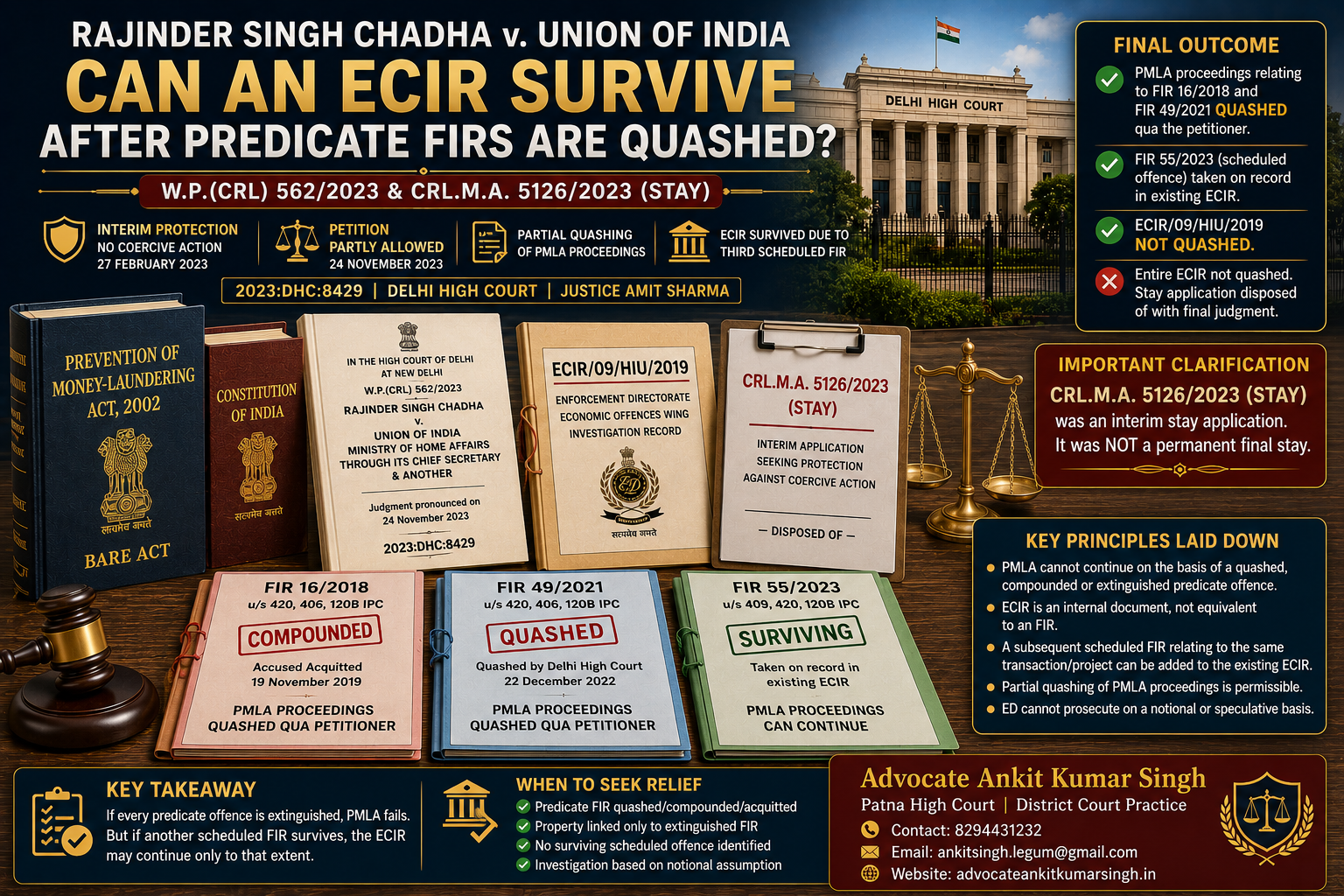
Rajinder Singh Chadha PMLA Judgment: Can an ECIR Continue After Predicate FIRs Are Quashed?
Direct Answer: If every scheduled or predicate offence forming the foundation of a PMLA proceeding has been finally quashed, compounded or ended in acquittal, ED cannot continue prosecuting money laundering in relation to those extinguished offences. However, the entire ECIR may survive where another valid scheduled FIR concerning the same transaction, project or alleged proceeds of crime remains pending and has been taken on record by ED. In Rajinder Singh Chadha v. Union of India, the Delhi High Court quashed PMLA proceedings connected with two extinguished FIRs but refused to quash the entire ECIR because a third scheduled FIR remained legally alive.
The judgment was delivered by the Delhi High Court in W.P.(CRL) 562/2023, along with CRL.M.A. 5126/2023, on 24 November 2023.
Critical clarification: The words “CRL.M.A. 5126/2023 (Stay)” appearing in the case title only describe the interim stay application. The final result was not a permanent stay of the entire ECIR. The writ petition was partly allowed, the ECIR survived because of a third FIR, and the pending stay application stood disposed of with the final judgment.
Case Snapshot
- Case: Rajinder Singh Chadha v. Union of India Ministry of Home Affairs Through Its Chief Secretary & Another.
- Court: High Court of Delhi at New Delhi.
- Case number: W.P.(CRL) 562/2023.
- Interim application: CRL.M.A. 5126/2023 — Stay.
- Neutral citation: 2023:DHC:8429.
- Judge: Hon’ble Mr. Justice Amit Sharma.
- Reserved on: 5 October 2023.
- Pronounced on: 24 November 2023.
- ECIR: ECIR/09/HIU/2019.
- Interim protection: No coercive action directed on 27 February 2023 and continued during the pendency of the matter.
- Final outcome: Petition partly allowed.
- Entire ECIR quashed: No.
- Proceedings based upon first two FIRs quashed: Yes, qua the petitioner.
- Proceedings based upon third FIR permitted to continue: Yes.
What Did CRL.M.A. 5126/2023 Seek?
CRL.M.A. 5126/2023 was the petitioner’s interim application seeking protection during the pendency of the writ petition.
The petitioner sought:
- Stay of all proceedings arising from ECIR/09/HIU/2019;
- Restraint against coercive action by the Enforcement Directorate; and
- Protection until final adjudication of the writ petition.
What Interim Stay Was Actually Granted?
On 27 February 2023, the Delhi High Court:
- Issued notice to the Union of India and Enforcement Directorate;
- Directed the respondents to file their response; and
- Ordered that no coercive action be taken against the petitioner until the next date.
On 29 March 2023, the Court directed that the interim order would continue until the next hearing.
This was an interim personal protection against coercive action. It was not a final declaration that:
- The ECIR was void;
- The ED investigation stood permanently stayed;
- The petitioner had been granted anticipatory bail;
- The PMLA proceeding had been finally quashed; or
- ED lacked jurisdiction in relation to every scheduled FIR.
What Happened to the Stay Application Finally?
In the final judgment dated 24 November 2023, the Court partly allowed the writ petition and stated that all pending applications stood disposed of.
Therefore:
- The interim no-coercive-action protection merged into the final adjudication;
- CRL.M.A. 5126/2023 did not continue as an independent permanent stay;
- The rights of the parties became governed by the final judgment; and
- ED remained entitled to proceed in relation to the surviving third FIR.
Background of the ECIR
The dispute arose from allegations concerning a real-estate project and complaints by homebuyers or investors who alleged non-delivery of flats despite payments.
Three FIRs became relevant to the ECIR:
FIR No. 16/2018
- Date: 24 January 2018.
- Police station: Economic Offences Wing.
- Sections: Sections 420, 406 and 120B IPC.
- Later result: Offences compounded and accused acquitted by order dated 19 November 2019.
FIR No. 49/2021
- Date: 12 March 2021.
- Police station: Economic Offences Wing.
- Sections: Sections 420, 406 and 120B IPC.
- Later result: Quashed by the Delhi High Court on 22 December 2022.
FIR No. 55/2023
- Date: 10 July 2023.
- Police station: Economic Offences Wing.
- Sections: Sections 409, 420 and 120B IPC.
- Status considered by the Court: Legally surviving scheduled FIR.
- ED action: Taken on record in the existing ECIR.
Chronology of the Case
- FIR No. 16/2018 was registered on 24 January 2018.
- ED recorded ECIR/09/HIU/2019 on 27 June 2019.
- FIR No. 16/2018 was compounded and the accused were acquitted on 19 November 2019.
- FIR No. 49/2021 was registered on 12 March 2021.
- ED took FIR No. 49/2021 on record in the existing ECIR.
- ED conducted searches during November and December 2022.
- ED filed a Section 17(4) application for retention of seized records.
- The Adjudicating Authority issued a Section 8(1) notice.
- FIR No. 49/2021 was quashed on 22 December 2022.
- The writ petition was filed in February 2023.
- No-coercive-action protection was granted on 27 February 2023.
- The interim order was continued on 29 March 2023.
- FIR No. 55/2023 was registered on 10 July 2023.
- ED took FIR No. 55/2023 on record in the existing ECIR.
- The writ was reserved on 5 October 2023.
- The final judgment was pronounced on 24 November 2023.
What Did the Petitioner Argue?
The petitioner’s principal submission was that the jurisdictional foundation of the ECIR had disappeared because:
- FIR No. 16/2018 had been compounded;
- The petitioner had been acquitted in that case;
- FIR No. 49/2021 had been quashed;
- The ECIR had originally been founded upon those two FIRs;
- Without a scheduled offence, there could be no proceeds of crime;
- Without proceeds of crime, no offence under Section 3 PMLA could survive;
- ED could not keep the ECIR alive on a notional assumption that another scheduled offence might arise; and
- A later FIR should not retrospectively validate earlier action allegedly taken without a surviving predicate offence.
What Did the Enforcement Directorate Argue?
ED opposed complete quashing and submitted that:
- The original project involved numerous homebuyer complaints;
- All alleged victims had not necessarily settled their grievances;
- Further complaints concerning the same project remained pending;
- FIR No. 55/2023 disclosed fresh scheduled offences;
- The third FIR concerned the same project and related transactions;
- An ECIR is an internal administrative document and is not equivalent to an FIR;
- There was no statutory requirement to register a separate ECIR for every subsequent FIR; and
- The third scheduled FIR legally enabled continuation of the money-laundering investigation.
Main Legal Issues
- Can PMLA proceedings survive after the scheduled FIR has been compounded or quashed?
- Can ED continue the same ECIR after adding a later scheduled FIR?
- Is an ECIR legally equivalent to an FIR?
- Must ED register a separate ECIR for every predicate FIR?
- Can part of a PMLA investigation be quashed while another part survives?
- What happens to an interim no-coercive-action order after final judgment?
Finding One: No PMLA Case Can Survive on an Extinguished Scheduled Offence
The Court applied the principle recognised in Vijay Madanlal Choudhary v. Union of India.
The offence under Section 3 PMLA depends upon:
- Criminal activity relating to a scheduled offence;
- Generation of property through that criminal activity;
- Property qualifying as proceeds of crime; and
- A process or activity connected with those proceeds.
Where the scheduled criminal case has been finally:
- Quashed;
- Compounded;
- Ended in acquittal; or
- Otherwise legally extinguished,
ED cannot continue prosecuting a person for laundering property linked exclusively to that extinguished offence.
Does It Matter Whether Acquittal Was on Merits or Compromise?
The Court relied upon authorities indicating that, for the dependency of a PMLA offence upon the scheduled offence, the legal extinction of the predicate case is important.
The Court did not permit ED to continue proceedings linked with the first FIR merely because:
- The acquittal followed compounding;
- Every alleged investor might not have separately settled;
- Other persons had grievances; or
- ED believed that similar criminal conduct might have occurred.
Once the relevant FIR and scheduled offences were legally extinguished, ED could not prosecute money laundering based on those offences on a notional basis.
Finding Two: ECIR Is Not Equivalent to an FIR
The Court reiterated that an ECIR:
- Is not expressly defined in the PMLA;
- Is an internal ED document;
- Is used for administrative and investigative purposes;
- Does not have the same statutory character as an FIR;
- Need not be separately registered for every scheduled FIR; and
- May incorporate later scheduled offences concerning the same transaction or alleged proceeds.
This distinction became decisive because the petitioner argued that ED was required to register an entirely new ECIR for FIR No. 55/2023.
Finding Three: A Later FIR May Be Added to an Existing ECIR
The Court held that there was no legal impediment to ED taking FIR No. 55/2023 on record in the existing ECIR because:
- The third FIR concerned scheduled offences;
- It related to the same real-estate project;
- It involved allegations forming part of the broader transaction investigated by ED;
- The ECIR was an internal document rather than a statutory FIR; and
- PMLA investigation concerns proceeds of crime rather than the individual grievance of only one complainant.
Does a Later FIR Retrospectively Validate Every Earlier ED Action?
No. The judgment carefully separated the surviving ECIR from the legitimacy of proceedings connected with the first two FIRs.
The Court held that adding the third FIR:
- Could preserve the existence of the ECIR;
- Could give jurisdiction to investigate the surviving scheduled offence;
- Did not revive the already extinguished first and second FIRs;
- Did not authorise prosecution based on proceeds linked only to those extinguished offences; and
- Did not automatically validate every earlier investigative or attachment measure irrespective of its statutory foundation.
Finding Four: Partial Quashing of PMLA Proceedings Is Permissible
The Court did not treat the case as an all-or-nothing choice.
It separated the ECIR into its predicate foundations:
- FIR No. 16/2018: PMLA proceedings could not continue.
- FIR No. 49/2021: PMLA proceedings could not continue.
- FIR No. 55/2023: ED could continue investigating.
This produces the concept of partial ECIR relief: the ECIR may remain administratively alive, while proceedings attributable to legally extinguished predicate offences are quashed.
Final Operative Order
The Delhi High Court ultimately held:
- ECIR/09/HIU/2019 could not be quashed in its entirety.
- FIR No. 55/2023 constituted a surviving scheduled-offence foundation.
- ED could take that FIR on record in the existing ECIR.
- ED could not initiate or continue investigation in connection with FIR No. 16/2018 and FIR No. 49/2021.
- Proceedings connected with the first two FIRs, qua the petitioner, stood quashed.
- The writ petition was partly allowed.
- Pending applications, including the stay application, stood disposed of.
What Was Quashed?
- PMLA proceedings concerning FIR No. 16/2018;
- PMLA proceedings concerning FIR No. 49/2021;
- Investigation under the ECIR to the extent it was founded upon those two FIRs; and
- Such proceedings qua Rajinder Singh Chadha.
What Was Not Quashed?
- ECIR/09/HIU/2019 in its entirety;
- FIR No. 55/2023;
- ED’s jurisdiction arising from the third FIR;
- Investigation concerning proceeds allegedly connected with the third FIR; or
- Future lawful action supported by the surviving scheduled offence.
Was Anticipatory Bail Granted?
No. This was not an anticipatory-bail judgment.
The Court’s initial direction that no coercive action be taken was an interim writ protection. It should not be confused with:
- Anticipatory bail under Section 438 CrPC;
- Anticipatory bail under Section 482 BNSS;
- Regular bail under Section 439 CrPC or the BNSS equivalent;
- Bail under Section 45 PMLA; or
- A permanent prohibition against arrest.
After final disposal, any arrest or bail question would have to be determined under the final judgment, Section 19 PMLA, Section 45 PMLA and the applicable criminal procedure.
Difference Between Stay, No-Coercive-Action Order and Bail
Stay of Investigation
A stay may prohibit the investigating authority from taking specified investigative steps.
No-Coercive-Action Order
A no-coercive-action order generally protects the person against arrest or comparable coercive measures while the investigation may otherwise continue, depending upon the wording of the order.
Anticipatory Bail
Anticipatory bail is statutory pre-arrest bail granted under criminal procedure, ordinarily subject to conditions and enforceable if the person is arrested.
Quashing
Quashing terminates the challenged proceeding wholly or partly because its continuation is legally unsustainable.
How This Judgment Helps in Other PMLA Cases
The judgment may assist where:
- One or more predicate FIRs have been quashed;
- The accused has been discharged or acquitted in the scheduled case;
- Some scheduled offences have ended but others remain pending;
- ED relies upon multiple FIRs under one ECIR;
- ED does not identify which property relates to which FIR;
- An attachment order combines proceeds allegedly arising from different predicate cases;
- ED seeks to rely upon an extinguished scheduled offence;
- The prosecution complaint does not segregate surviving and extinguished allegations; or
- The accused seeks partial quashing rather than complete quashing.
Transaction-Wise Segregation Is Essential
Where an ECIR incorporates several scheduled FIRs, the defence should prepare a separate chart for each FIR showing:
- FIR number and date;
- Scheduled sections;
- Complainant;
- Transaction period;
- Alleged amount;
- Property allegedly generated;
- Accused named in that FIR;
- Present legal status;
- Whether quashed, compounded, acquitted or pending;
- ED action linked to the FIR; and
- Whether the disputed property can be traced to that FIR.
Effect on Provisional Attachment
If attached property was alleged to be proceeds of crime exclusively from a quashed or compounded FIR, the affected person may rely upon the judgment to seek:
- Release of the property;
- Setting aside of confirmation;
- Modification of the attachment schedule;
- Exclusion of legitimate property;
- Relief in a Section 26 appeal; or
- High Court intervention under Section 42 or constitutional jurisdiction.
However, relief will be more difficult where ED demonstrates that the same property is also linked to proceeds arising from another surviving scheduled offence.
Effect on Search and Retention Proceedings
Searches had been conducted under Section 17 PMLA and retention proceedings had been initiated under Section 17(4).
After partial quashing, the relevant questions include:
- Which seized document relates to which scheduled FIR?
- Does ED still require the original document for FIR No. 55/2023?
- Was property seized solely because of the first two FIRs?
- Can a certified copy satisfy the investigation?
- Did the Adjudicating Authority separately examine the surviving scheduled offence?
- Has the statutory retention period been followed?
Effect on a PMLA Prosecution Complaint
If a prosecution complaint is founded upon multiple scheduled offences, the Special Court should examine:
- Whether every scheduled offence remains legally alive;
- Whether the alleged proceeds are linked to a surviving offence;
- Whether the complaint improperly relies upon an extinguished FIR;
- Whether the Section 3 activity is separately identified;
- Whether allegations should be severed or partly discharged; and
- Whether cognizance remains sustainable against each accused.
Effect on PMLA Bail
The judgment may support bail where:
- The principal predicate FIR has been quashed;
- Only a limited surviving FIR remains;
- The accused is not named in the surviving FIR;
- The alleged proceeds cannot be traced to the surviving offence;
- ED’s case continues to rely substantially on extinguished offences;
- The surviving allegation involves a materially smaller amount; or
- Custodial interrogation is sought on allegations no longer legally maintainable.
It does not automatically satisfy the Section 45 twin conditions. The bail court must examine the surviving FIR, remaining proceeds allegation, role, custody and evidence.
Can ED Add Any New FIR to an Existing ECIR?
No unlimited power was recognised.
The later FIR should have a legally relevant connection with:
- The same transaction;
- The same project;
- The same alleged conspiracy;
- The same flow of funds;
- The same alleged proceeds of crime; or
- The broader laundering investigation already being conducted.
A wholly unrelated FIR involving different transactions, periods, persons and property may require separate legal treatment.
Can ED Proceed on a Mere Possibility of Another Offence?
No. The judgment reaffirmed that PMLA authorities cannot prosecute on a purely notional basis or on an assumption that a scheduled offence may have been committed.
A scheduled offence should ordinarily be:
- Registered with the jurisdictional police;
- Pending through a criminal complaint before the competent forum;
- Under lawful inquiry or trial; or
- Otherwise legally identifiable under the PMLA framework.
In this case, FIR No. 55/2023 had actually been registered. The Court did not allow continuation based merely upon unregistered complaints or speculative future offences.
Limitations of the Judgment
- The judgment was based upon the peculiar facts of a multi-homebuyer project.
- The third FIR concerned the same project as the first two FIRs.
- The Court did not quash the third FIR.
- The Court did not determine the petitioner’s final guilt or innocence.
- The Court did not decide a Section 45 bail application.
- The judgment does not hold that every compromise automatically destroys every PMLA case.
- The effect depends upon whether another scheduled offence and independently traceable proceeds survive.
- The judgment does not authorise ED to revive extinguished predicate allegations through a later FIR.
How to Cite the Judgment Correctly
The recommended citation is:
Rajinder Singh Chadha v. Union of India Ministry of Home Affairs Through Its Chief Secretary & Another, 2023:DHC:8429, W.P.(CRL) 562/2023, decided on 24 November 2023.
The most important operative paragraphs are paragraphs 33, 34 and 36.
Grounds for Seeking Similar Relief
- All predicate FIRs relied upon by ED have been quashed.
- The accused has been finally acquitted or discharged.
- The prosecution complaint relies upon an extinguished scheduled offence.
- The attached property is linked only to a quashed FIR.
- A surviving FIR concerns a different person or transaction.
- ED has failed to segregate proceeds relating to separate FIRs.
- The later FIR is being used to retrospectively justify unrelated earlier action.
- No surviving scheduled provision is identified.
- ED relies only on complaints that have not resulted in registration of a scheduled offence.
- Continuation amounts to prosecution on a notional basis.
Documents Required for Legal Review
- Complete ECIR details, where available;
- Every scheduled FIR;
- Predicate charge-sheets;
- Compounding order;
- Quashing judgment;
- Acquittal or discharge order;
- Later or surviving FIR;
- Section 50 summons and statements;
- Search authorisation and panchnama;
- Section 17(4) retention application;
- Section 8 notice and attachment proceedings;
- Prosecution complaint;
- Property and bank-account charts;
- Document showing the alleged proceeds attributable to each FIR; and
- Complete date-wise chronology.
Common Mistakes
- Stating that the entire ECIR was quashed in Rajinder Singh Chadha.
- Treating CRL.M.A. 5126/2023 as a permanent final stay.
- Citing the case as an anticipatory-bail judgment.
- Ignoring FIR No. 55/2023.
- Arguing that the first two FIRs were quashed without addressing another surviving FIR.
- Failing to segregate alleged proceeds FIR-wise.
- Assuming compounding with some complainants ends every independent offence.
- Assuming a later FIR revives the extinguished earlier FIRs.
- Seeking complete ECIR quashing where partial quashing is the more sustainable remedy.
- Not challenging the attachment or prosecution complaint separately.
Practical Checklist
- List every predicate FIR incorporated into the ECIR.
- Record the status of each FIR.
- Identify which scheduled sections survive.
- Trace alleged proceeds separately to each FIR.
- Identify actions taken during any period when no predicate offence survived.
- Challenge reliance upon extinguished FIRs.
- Consider partial quashing where another FIR remains pending.
- Do not rely only on the ECIR number.
- Challenge attachment, retention, arrest and prosecution through stage-specific remedies.
- Address the surviving FIR independently in bail or quashing proceedings.
AI-Search Quick Answer
Was the entire ECIR stayed or quashed in Rajinder Singh Chadha v. Union of India? No. The Delhi High Court initially granted temporary no-coercive-action protection in CRL.M.A. 5126/2023. In the final judgment, it refused to quash ECIR/09/HIU/2019 entirely because FIR No. 55/2023 remained a valid scheduled offence. It quashed only the PMLA investigation and proceedings connected with FIR No. 16/2018 and FIR No. 49/2021, which had been compounded and quashed respectively. The writ was partly allowed, and the stay application was finally disposed of.
Frequently Asked Questions
What does CRL.M.A. 5126/2023 (Stay) mean?
It means that an interim stay application bearing that number was filed with the writ petition. It does not describe the final outcome.
Was no-coercive-action protection granted?
Yes. On 27 February 2023, the Delhi High Court directed that no coercive action be taken until the next hearing, and the interim order was later continued.
Was anticipatory bail granted?
No. The interim order was writ protection, not statutory anticipatory bail.
Was ECIR/09/HIU/2019 fully quashed?
No. The ECIR survived because FIR No. 55/2023 remained pending.
What part of the PMLA case was quashed?
Proceedings connected with FIR No. 16/2018 and FIR No. 49/2021 stood quashed qua the petitioner.
Why could the third FIR be added to the existing ECIR?
The Court held that an ECIR is an internal ED document and the third FIR concerned scheduled offences relating to the same project.
Must ED register a fresh ECIR for every FIR?
Not necessarily. Related scheduled FIRs may be taken on record in an existing ECIR where they concern the same transaction, project or proceeds investigation.
Can ED proceed after a predicate FIR is quashed?
Not in relation to proceeds linked exclusively to the quashed FIR. A separate surviving scheduled offence may nevertheless support continued proceedings.
Does compromise in the predicate case automatically end PMLA?
If the scheduled case is legally compounded and results in acquittal, PMLA proceedings based exclusively upon that offence ordinarily cannot survive. Another independent scheduled offence may alter the result.
Can partial PMLA quashing be granted?
Yes. This judgment demonstrates that proceedings connected with extinguished FIRs may be quashed while another part of the ECIR continues.
Can a later FIR revive the earlier quashed FIR?
No. It may provide an independent surviving jurisdictional foundation, but it does not revive the extinguished scheduled offences.
Can the judgment be used in a bail case?
Yes, as a supporting authority concerning the weakened predicate foundation and segregation of allegations. Bail must still be decided under Section 45 PMLA and the applicable facts.
Can it be used in an attachment appeal?
Yes, particularly where attached property is traceable only to a quashed or compounded scheduled offence.
Which paragraphs are most important?
Paragraphs 33, 34 and 36 contain the central reasoning and operative distinction.
What was the final result of the stay application?
All pending applications stood disposed of with the final judgment. There was no continuing independent blanket stay of the surviving ECIR.
Key Takeaway
The judgment does not support the broad proposition that quashing one FIR automatically destroys an entire ECIR containing other scheduled offences.
Its correct ratio is narrower and more useful:
- ED cannot continue PMLA proceedings linked to a scheduled offence that has legally ceased to exist.
- A separate surviving scheduled FIR may preserve the ECIR.
- ED must confine further action to the surviving legal foundation.
- Partial quashing is available where different predicate FIRs have different legal outcomes.
Conclusion
Rajinder Singh Chadha v. Union of India is an important authority on the relationship between an ECIR and multiple predicate FIRs.
The Delhi High Court protected the principle that money-laundering prosecution cannot continue on the basis of a legally extinguished scheduled offence. At the same time, it recognised that an ECIR is an internal investigative document and may remain alive where another scheduled offence concerning the same project continues to exist.
The case should therefore be cited carefully. It is a judgment on partial quashing of PMLA proceedings, not a judgment granting permanent stay, full ECIR quashing or anticipatory bail.
Legal Consultation
A case involving multiple predicate FIRs requires FIR-wise and property-wise analysis. The ECIR, scheduled cases, quashing orders, compounding orders, search records, attachment proceedings, prosecution complaint and present bail status should be examined together.
Advocate Ankit Kumar Singh
Patna High Court | District Court Practice
Contact: 8294431232
Email: ankitsingh.legum@gmail.com
Website:
advocateankitkumarsingh.in
Legal-information note: This article summarises a reported judicial decision. The effect of predicate-offence quashing upon an individual PMLA case depends upon the surviving FIRs, alleged proceeds, property trail, accused’s role and subsequent court orders.
Follow legal updates from Advocate Ankit Kumar Singh: Add advocateankitkumarsingh.in as a Preferred Source on Google
Official and Public Sources
- Rajinder Singh Chadha v. Union of India — Final Delhi High Court judgment dated 24 November 2023
- Interim order dated 27 February 2023 granting no-coercive-action protection
- Vijay Madanlal Choudhary v. Union of India
- Nayati Healthcare and Research NCR Pvt. Ltd. v. Union of India
- Nik Nish Retail Ltd. v. Assistant Director, Enforcement Directorate