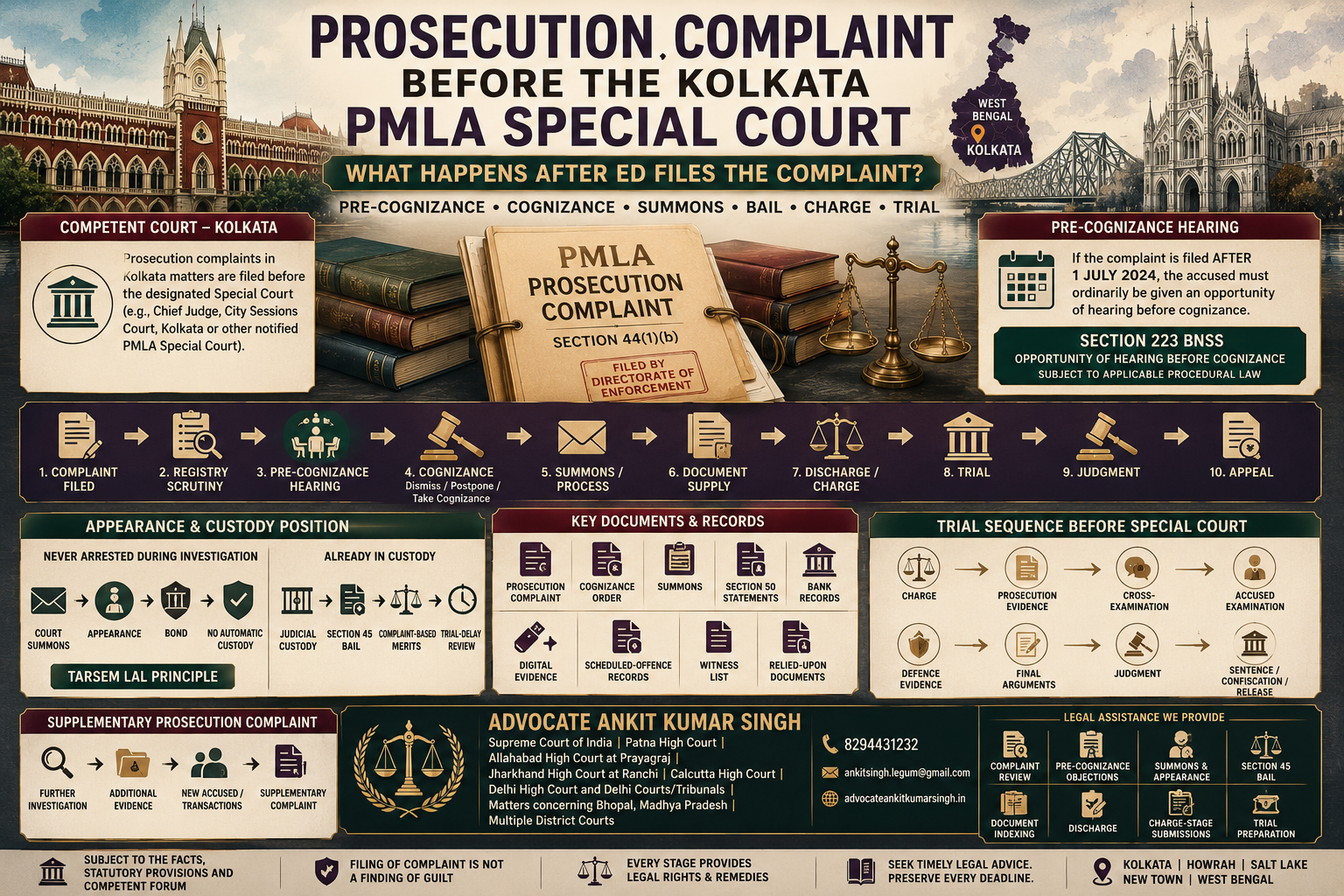
Prosecution Complaint before the Kolkata PMLA Special Court: What Happens after ED Files the Complaint?
Direct Answer: After the Directorate of Enforcement files a prosecution complaint under Section 44(1)(b) of the Prevention of Money-Laundering Act, 2002, the designated Special Court in Kolkata does not automatically convict, arrest or frame a charge against every person named in it.
The Court first deals with the complaint according to the PMLA and the applicable criminal procedure. Depending upon the filing date and circumstances, this may include a pre-cognizance hearing, scrutiny of whether a prima facie Section 3 offence is disclosed, dismissal or postponement of process, taking cognizance, issuance of summons, appearance of the accused, bail or bond issues, supply of records, discharge, framing of charge and trial.
Important: Filing of a prosecution complaint records ED’s accusation and places the matter before the criminal court. It is not a finding that money laundering has been proved.
The legal strategy after filing depends substantially upon whether the person:
- was arrested during investigation;
- was never arrested;
- was already on bail;
- is in judicial custody;
- has received a pre-cognizance notice;
- has received a court summons;
- has failed to appear;
- is named only in a supplementary complaint;
- is a company, director, employee or third party; or
- faces proceedings in the scheduled offence before another court.
Contents
- What is a PMLA prosecution complaint?
- How is it different from a police charge-sheet?
- Which Special Court handles a Kolkata matter?
- What happens immediately after filing?
- Pre-cognizance hearing under Section 223 BNSS
- When can the Court dismiss the complaint?
- What does taking cognizance mean?
- Summons, warrants and appearance
- Accused not arrested during investigation
- Accused already in custody
- Bail under Section 45 PMLA
- Supply and inspection of prosecution records
- Discharge and framing of charge
- Supplementary prosecution complaints
- Scheduled-offence and PMLA proceedings
- PMLA trial procedure
- Property confiscation or release
- Appeals and High Court remedies
- Immediate defence checklist
- Frequently asked questions
What Is a PMLA Prosecution Complaint?
A prosecution complaint is the formal written complaint filed by an authority authorised under the PMLA asking the Special Court to take cognizance of the alleged offence of money laundering under Section 3, punishable under Section 4.
It commonly contains or refers to:
- the ECIR-connected investigation;
- the scheduled or predicate offence;
- FIRs, police reports or charge-sheets;
- the persons and entities arrayed as accused;
- the alleged proceeds of crime;
- the method by which proceeds were allegedly generated;
- the alleged possession, acquisition, concealment or use;
- the alleged projection or claim as untainted property;
- bank and transaction trails;
- company and beneficial-ownership records;
- statements recorded under Section 50;
- search and seizure records;
- digital and electronic material;
- attachment or freezing proceedings;
- the role attributed to each accused;
- the list of witnesses;
- the list of relied-upon documents; and
- the prayer for cognizance and trial.
The expression “prosecution complaint” is commonly abbreviated as “PC.” A later complaint based on further investigation is commonly described as a supplementary prosecution complaint.
How Is a Prosecution Complaint Different from a Police Charge-Sheet?
| Issue | ED Prosecution Complaint | Police Charge-Sheet |
|---|---|---|
| Primary source | Section 44(1)(b) PMLA | Applicable criminal-procedure provision after police investigation |
| Filed by | Authorised PMLA authority | Investigating police agency |
| Offence | Section 3, punishable under Section 4 PMLA | Scheduled or other substantive offences |
| Court | Designated PMLA Special Court | Competent criminal court for the scheduled offence |
| Committal | Special Court may directly take cognizance without committal | Depends upon the offence and applicable procedure |
| Further investigation | Supplementary prosecution complaint may be filed | Supplementary police report may be filed |
| Property issues | May connect with attachment, confiscation and alleged proceeds of crime | Ordinarily concerns property and evidence under general criminal law |
The two proceedings may arise from the same factual allegations, but they remain legally distinct. The alleged scheduled offence generates the criminal activity from which ED claims that proceeds of crime were derived. The PMLA complaint alleges a separate process or activity connected with those proceeds.
Which Special Court Handles a Kolkata PMLA Matter?
Section 43 permits designation of one or more Courts of Session as Special Courts for specified areas, cases or classes of cases.
Recent Kolkata ED releases record complaints being filed before the learned Chief Judge, City Sessions Court, Kolkata. Other records refer to designated Special CBI/PMLA courts in Kolkata.
The competent Special Court should be verified through:
- the court heading on the prosecution complaint;
- the complaint number;
- the cognizance order;
- the court summons;
- the applicable notification;
- the scheduled-offence location;
- the accused and property locations;
- the investigation allocation; and
- any subsequent transfer or assignment order.
Do not attend a court merely because it is informally described as the “Kolkata PMLA Court.” The precise court, case number, date and process must be confirmed from the official record.
What Happens Immediately after ED Files the Complaint?
The immediate administrative and judicial steps may include:
- presentation of the complaint;
- registry or filing scrutiny;
- identification of filing defects;
- registration and assignment of a case number;
- placement before the designated Special Court;
- consideration of the applicable CrPC or BNSS procedure;
- issuance of pre-cognizance notice where required;
- hearing on cognizance;
- dismissal, postponement of process or cognizance;
- issuance of summons or other process;
- production of persons already in custody; and
- directions concerning records, appearance and further proceedings.
Mere numbering of the complaint or an order directing it to be placed for cognizance is not necessarily the final cognizance order.
Pre-Cognizance Hearing under Section 223 BNSS
The BNSS came into force on 1 July 2024. Section 223 corresponds broadly to Section 200 CrPC but contains an additional proviso stating that cognizance shall not be taken without giving the accused an opportunity of being heard.
The Supreme Court has held that this complaint-case provision applies to prosecution complaints under Section 44(1)(b) PMLA filed after 1 July 2024.
What May Be Argued at This Stage?
The precise scope of the pre-cognizance hearing depends upon the complaint and applicable law. Potential issues may include:
- absence of foundational allegations under Section 3;
- absence of an identified scheduled offence;
- absence of legally identifiable proceeds of crime;
- failure to attribute a specific role to the proposed accused;
- mere designation as director or employee;
- absence of material showing knowledge;
- absence of possession, acquisition, concealment or use;
- absence of projection or claim as untainted;
- mechanical reproduction of allegations;
- jurisdictional defects;
- prosecution-sanction issues where legally applicable;
- the complaint being barred by a binding judicial order;
- company liability without Section 70 foundations;
- documents contradicting the complaint’s essential allegation; and
- another patent legal defect affecting cognizance.
This hearing should not be treated as a full trial. The defence should identify clear legal and record-based grounds without attempting to conduct complete cross-examination before cognizance.
Complaint Filed before 1 July 2024
Where the complaint was filed before 1 July 2024, the earlier CrPC complaint procedure and the transitional provisions require case-specific examination. The special pre-cognizance proviso in Section 223 BNSS did not exist in Section 200 CrPC.
When Can the Special Court Dismiss the Complaint?
The Supreme Court has clarified that the Special Court must apply its mind to whether the complaint discloses a prima facie offence under Section 3 PMLA.
Where the complaint and supporting material do not disclose a prima facie case, the Court may dismiss the complaint under the applicable complaint-case procedure.
Potential dismissal issues may include:
- no scheduled offence capable of generating the alleged proceeds;
- property not derived or obtained from scheduled criminal activity;
- no allegation satisfying Section 3;
- no role attributed to the person;
- mere company designation without statutory responsibility;
- absence of a legally sustainable connection with proceeds of crime;
- complete reliance on assumptions contradicted by the complaint itself; or
- a patent legal bar.
The Court may also postpone issuance of process and examine whether further inquiry is required under the applicable procedural law.
What Does Taking Cognizance Mean?
Cognizance means that the Court has applied its judicial mind to the complaint for the purpose of proceeding with the alleged offence.
It does not mean:
- that the accused is guilty;
- that every ED allegation has been accepted as proved;
- that the prosecution evidence is admissible;
- that the Section 50 statements are conclusive;
- that every attached property is liable to confiscation;
- that bail must be refused;
- that charge must necessarily be framed; or
- that a defence application cannot be filed.
A cognizance order should demonstrate application of mind to the complaint and identify the persons and offences for which the Court proposes to proceed.
Documents to Obtain Immediately
- the complete cognizance order;
- the complaint number and title;
- the order sheet;
- the summons or warrant;
- the date fixed for appearance;
- the prosecution complaint;
- the list of witnesses;
- the list of relied-upon documents; and
- any order concerning persons already in custody.
Summons, Warrants and Appearance
Summons as the Normal First Process
Where the person was not arrested during the ED investigation, the normal rule stated by the Supreme Court is that the Special Court should issue summons rather than a warrant when taking cognizance.
What Should Be Done after Receiving Summons?
- Verify the court, complaint number and date.
- Obtain the cognizance order.
- Determine whether personal appearance is mandatory.
- Prepare the vakalatnama and appearance documents.
- Review the person’s arrest and bail history.
- Prepare an appropriate bond or bail strategy.
- Consider exemption from personal appearance.
- Ensure appearance before the exact court and at the correct time.
- Do not ignore the summons because the person was never arrested.
- Preserve proof of appearance and every order passed.
Failure to Appear
Failure to comply may result in:
- a bailable warrant;
- a non-bailable warrant;
- rejection of exemption;
- proclamation proceedings;
- attachment under general criminal procedure;
- adverse consideration of conduct; and
- greater difficulty in securing later protection.
Where appearance is genuinely impossible, an application should be filed before the date with supporting documents rather than after default.
Accused Not Arrested during Investigation: Is Bail Required?
The Supreme Court’s decision in Tarsem Lal is central to this question.
Where ED did not arrest the accused before filing the prosecution complaint and the accused appears pursuant to a court summons:
- appearance does not automatically place the accused in custody;
- the person is not ordinarily required to apply for bail merely because of appearance;
- Section 45 twin conditions are not attracted merely for furnishing the appropriate bond;
- the Court may direct the person to execute a bond;
- personal appearance may be exempted where sufficient cause exists; and
- ED cannot independently arrest the person under Section 19 after cognizance merely because the complaint has been filed.
Practical Caution: Tarsem Lal is not permission to disregard summons. Its protection is strongest where the accused appears lawfully, complies with court directions and has not created grounds for coercive process.
Can ED Seek Custody after Cognizance?
Where ED claims that custodial interrogation is necessary, it must approach the Special Court and place legally sufficient grounds before it. Custody is not automatic merely because the prosecution requests it.
Exemption from Personal Appearance
An exemption application may rely upon:
- residence outside Kolkata;
- age or medical condition;
- professional or employment obligations;
- the accused being represented by counsel;
- an undertaking not to dispute identity;
- an undertaking to appear whenever directed;
- absence of risk to the trial; and
- prior compliance with investigation and court process.
Accused Already Arrested or in Judicial Custody
The position is different where the person was arrested under Section 19 and remains in custody. Filing of the prosecution complaint does not automatically result in release.
The next steps may include:
- production before the Special Court;
- continuation of judicial custody;
- consideration of regular bail;
- consideration of statutory or default-bail issues;
- supply of the prosecution complaint and records;
- application for medical or interim bail;
- challenge to the legality of arrest;
- challenge to continued custody;
- discharge preparation; and
- expedited-trial or long-custody submissions.
Does Filing the Complaint End the Investigation?
Not necessarily. Section 44 expressly recognises subsequent complaints based on further investigation. ED may continue to investigate additional persons, property, transactions and evidence.
Bail under Section 45 PMLA
Where an accused is in custody and seeks regular bail, Section 45 ordinarily requires:
- an opportunity to the Public Prosecutor to oppose bail; and
- where opposed, the Court’s satisfaction that there are reasonable grounds for believing that the accused is not guilty and is not likely to commit an offence while on bail.
The Court may also consider:
- the specific role;
- the alleged amount;
- the quality of evidence;
- custody period;
- complaint filing;
- number of witnesses;
- likely duration of trial;
- parity;
- medical condition;
- age and gender provisos;
- cooperation;
- criminal antecedents;
- risk of absconding;
- witness influence;
- evidence tampering; and
- Article 21 considerations.
Complaint-Based Bail Preparation
Once the complaint is filed, the defence can examine ED’s final pleaded case rather than responding only to broad investigation allegations.
The bail note should map:
- each allegation against the applicant;
- each document relied upon;
- each Section 50 statement;
- the complete money trail;
- the alleged proceeds personally handled;
- the connection with the scheduled offence;
- the applicant’s position in the company;
- the extent of benefit allegedly received;
- contradictions in ED’s case; and
- the trial timeline.
Supply and Inspection of the Prosecution Records
Effective defence is impossible without identifying the exact material relied upon by ED.
The record may include:
- the complete prosecution complaint;
- relied-upon-document list;
- relied-upon statements;
- search panchnamas;
- seizure inventories;
- bank statements;
- account-opening forms;
- company records;
- emails and chats;
- forensic reports;
- property records;
- valuation reports;
- attachment orders;
- arrest and remand papers;
- scheduled-offence FIR and charge-sheet;
- witness list;
- expert reports; and
- electronic-evidence certificates.
Relied-Upon and Unrelied Material
The defence should separately identify:
- documents formally relied upon;
- documents referred to but not supplied;
- statements referred to selectively;
- exculpatory material collected during investigation;
- complete conversations from which extracts were taken;
- records seized but omitted from the complaint; and
- documents required for a fair discharge or trial hearing.
Document Index
| Document | Supplied | Complete | Relied Upon | Defence Issue |
|---|---|---|---|---|
| Prosecution complaint | Yes / No | Yes / No | Primary pleading | Role and Section 3 ingredients |
| Section 50 statements | Yes / No | Yes / No | Check list | Voluntariness, context and contradiction |
| Bank records | Yes / No | Yes / No | Check list | Full trail versus selected entries |
| Digital extraction | Yes / No | Yes / No | Check list | Integrity, authorship and completeness |
| Scheduled-offence record | Yes / No | Yes / No | Check list | Generation of alleged proceeds |
Discharge and Framing of Charge
After the necessary records are supplied and the case reaches the charge stage, the accused may seek discharge where the complaint and material do not provide sufficient ground to proceed.
Potential Discharge Issues
- absence of a valid scheduled offence;
- absence of proceeds of crime;
- property not derived from scheduled criminal activity;
- no process or activity satisfying Section 3;
- no knowledge attributed to the accused;
- mere designation as director or employee;
- no material establishing responsibility under Section 70;
- ordinary commercial receipt wrongly described as proceeds;
- no personal possession, acquisition or use;
- no projection or claim as untainted;
- no benefit received;
- statements contradicted by objective records;
- jurisdictional or sanction defects; and
- another legal bar apparent from the complaint record.
Charge Is Not Final Guilt
If the Court finds sufficient ground for presuming commission of the offence, it may frame charge. The charge identifies what the prosecution must prove at trial.
The accused then ordinarily pleads:
- guilty; or
- not guilty and claims trial.
A charge order should be reviewed immediately to determine whether any available challenge should be filed before trial proceeds substantially.
Supplementary Prosecution Complaints
Section 44 clarifies that a complaint includes a subsequent complaint arising from further investigation to bring additional oral or documentary evidence against an accused person.
A supplementary complaint may:
- add a new accused;
- add a company or related entity;
- add further transactions;
- add newly traced property;
- add digital evidence;
- add Section 50 statements;
- add foreign records;
- add a new money-trail segment;
- clarify beneficial ownership;
- expand the alleged proceeds-of-crime calculation; or
- supplement allegations against persons already named.
Does the Earlier Trial Stop?
The effect depends upon the stage, identity of new accused, nature of additional evidence and the Special Court’s directions. The Court may need to consider:
- supply of the supplementary complaint;
- fresh cognizance or process concerning newly added persons;
- additional charge-stage submissions;
- recall or further examination of witnesses;
- consolidation of the record;
- avoidance of prejudice; and
- the right to adequate preparation.
Supplementary Complaint Is Not Automatically Proof
The additional allegations and evidence remain subject to judicial scrutiny, admissibility, cross-examination and defence rebuttal.
Scheduled-Offence and PMLA Proceedings
Section 44 allows the authorised authority to request that the scheduled-offence case pending before another competent court be committed to the Special Court that has taken cognizance of the PMLA complaint.
The Special Court then proceeds with the scheduled-offence case from the stage at which it is committed.
Same Court Does Not Mean Joint Trial
The statutory explanation clarifies that:
- PMLA jurisdiction is not dependent upon orders passed in the scheduled-offence case; and
- trial of both offences by the same court is not to be treated as a joint trial merely for that reason.
Why the Predicate Case Still Matters
The scheduled-offence record remains central because the prosecution must identify criminal activity relating to a scheduled offence from which the alleged proceeds of crime were derived or obtained.
The defence should track:
- FIR status;
- police or CBI charge-sheet;
- discharge applications;
- quashing proceedings;
- trial evidence;
- acquittal or conviction;
- appeals; and
- any alteration of offences affecting the PMLA foundation.
PMLA Trial before the Special Court
The Special Court is deemed to be a Court of Session, and the applicable criminal-procedure framework governs the trial insofar as it is not inconsistent with the PMLA.
Typical Trial Sequence
- Framing of charge.
- Plea of the accused.
- Prosecution opening.
- Examination of prosecution witnesses.
- Exhibition of documents.
- Proof of electronic and digital evidence.
- Cross-examination by the defence.
- Applications concerning documents or witnesses.
- Closure of prosecution evidence.
- Examination of the accused concerning incriminating circumstances.
- Defence evidence, where chosen.
- Expert or rebuttal evidence, where permitted.
- Written submissions.
- Final oral arguments.
- Judgment.
- Sentence hearing if convicted.
- Confiscation or release determination.
What Must ED Prove?
Depending upon the pleaded case, ED may need to establish:
- the relevant scheduled criminal activity;
- the existence and identification of proceeds of crime;
- the accused person’s specific process or activity;
- concealment, possession, acquisition or use;
- projection or claim as untainted property, where alleged;
- knowledge or legally required mental element;
- company responsibility under Section 70, where invoked;
- authenticity and admissibility of records;
- the money trail;
- the connection between the accused and the property; and
- the continuing nature alleged under Section 3.
Section 50 Statements
The defence should review:
- the summons;
- date, duration and circumstances of recording;
- language used;
- questions and answers;
- documents shown;
- corrections;
- signature and page continuity;
- medical or custody circumstances;
- later retraction or clarification;
- corroboration; and
- contradictions with objective records.
Digital Evidence
Relevant issues may include:
- device ownership;
- actual user;
- authorship;
- forensic acquisition;
- hash values;
- chain of custody;
- complete versus extracted conversation;
- metadata;
- cloud records;
- electronic-evidence certification; and
- connection with the alleged laundering activity.
Property Confiscation or Release after Trial
The criminal trial and the property consequences are connected but distinct.
If Money Laundering Is Proved
Where the Special Court finds that money laundering has taken place, property found to be involved may be confiscated to the Central Government according to Section 8.
If Money Laundering Is Not Proved
Where the Special Court finds that money laundering has not taken place or the property is not involved, it may direct release to the person entitled to receive it.
Third-Party and Victim Claims
Questions may arise concerning:
- innocent joint owners;
- secured creditors;
- bona fide purchasers;
- victims with quantifiable loss;
- property held by companies or family members;
- restoration applications; and
- assets not proved to be involved in money laundering.
An attachment-confirmation order by the Adjudicating Authority does not by itself replace the Special Court’s criminal-trial determination.
Appeals and Calcutta High Court Remedies
The High Court exercises appellate and revisional powers in relation to the Special Court according to the PMLA and applicable criminal procedure.
Potential High Court proceedings may concern:
- bail refusal or cancellation;
- legality of cognizance;
- warrants and coercive process;
- discharge or charge orders where challenge is maintainable;
- jurisdictional defects;
- fair-trial and document-supply issues;
- conviction and sentence;
- acquittal appeals;
- suspension of sentence;
- confiscation or property orders; and
- other orders according to their nature and the applicable remedy.
The correct proceeding may be:
- a criminal appeal;
- a bail application;
- a criminal revision;
- a petition invoking inherent jurisdiction;
- a constitutional writ petition; or
- another statutory remedy.
The remedy should be selected from the substance and effect of the order, not merely from the label used by the applicant.
Immediate Defence Checklist after Filing of the Complaint
- Confirm the exact Special Court.
- Obtain the complete prosecution complaint.
- Obtain the filing and complaint number.
- Obtain every order sheet.
- Identify whether the complaint was filed before or after 1 July 2024.
- Check whether pre-cognizance hearing was given.
- Obtain the cognizance order.
- Identify each accused and legal provision.
- Verify summons, warrant and appearance date.
- Determine whether the person was arrested during investigation.
- Apply Tarsem Lal correctly.
- Prepare the bond, bail or custody strategy.
- Seek exemption from appearance where justified.
- Prepare a complaint paragraph-wise response.
- Prepare a person-role matrix.
- Prepare a transaction and proceeds-of-crime chart.
- Prepare a scheduled-offence chronology.
- Index all Section 50 statements.
- Identify missing relied-upon records.
- Identify exculpatory or unrelied records.
- Prepare the discharge strategy.
- Track supplementary complaints.
- Track the scheduled-offence case.
- Preserve all trial and appeal deadlines.
Frequently Asked Questions
What happens immediately after ED files a prosecution complaint?
The complaint is scrutinised, registered and placed before the designated Special Court. The Court then applies the applicable complaint-case procedure and considers pre-cognizance hearing, dismissal, inquiry, cognizance and issuance of process.
Does filing of the complaint mean the accused is guilty?
No. It records ED’s prosecution case. Guilt can be determined only after the judicial process and trial.
Is a prosecution complaint the same as a charge-sheet?
No. It performs a broadly comparable prosecutorial function but is a complaint filed by an authorised PMLA authority under Section 44(1)(b), not a police report.
Must the accused be heard before cognizance?
For a prosecution complaint filed after 1 July 2024, the Supreme Court has held that the proviso to Section 223(1) BNSS requires an opportunity of hearing before cognizance.
What if cognizance was taken without the required hearing?
The cognizance order may be open to challenge, depending upon the filing date, procedural record, prejudice and current law.
Can the Special Court dismiss the prosecution complaint?
Yes. If the Court finds that no prima facie Section 3 offence is disclosed, it may dismiss the complaint according to the applicable complaint-case procedure.
Does cognizance mean that charge has been framed?
No. Cognizance and framing of charge are separate stages.
Will the Court issue a summons or warrant?
Where the accused was not arrested during investigation, summons is the normal first process. Failure to appear or other circumstances may lead to warrants.
I was never arrested by ED. Must I apply for bail after summons?
Under Tarsem Lal, appearance pursuant to summons does not automatically place such an accused in custody, and a bail application is not ordinarily necessary merely for appearance. The Court may require an appropriate bond.
Can ED arrest me under Section 19 after cognizance?
The Supreme Court has held that ED cannot independently exercise Section 19 against an accused once the Special Court has taken cognizance. A request for custody must be placed before and judicially considered by the Court.
What if I ignore the court summons?
The Court may issue coercive process, including warrants. Tarsem Lal does not protect deliberate non-compliance.
Can personal appearance be exempted?
The Special Court may grant exemption where sufficient cause exists and appropriate undertakings are furnished.
What happens if the accused is already in jail?
Judicial custody ordinarily continues unless bail, default bail, interim relief or another release order is granted.
Does Section 45 apply after the complaint?
It ordinarily applies to a regular bail application by a person in custody. It does not apply merely to furnishing a bond by a never-arrested accused appearing pursuant to summons under the Tarsem Lal principle.
Can ED file another complaint later?
Yes. Section 44 recognises supplementary complaints based on further investigation and additional oral or documentary evidence.
Can a person not named in the first complaint be added later?
Yes. A supplementary prosecution complaint may array an additional person where ED claims further investigation supports prosecution.
Can the defence obtain a copy of the complaint?
The accused should seek the complete complaint and relied-upon records according to the applicable procedure and court directions.
Can discharge be sought in a PMLA case?
Yes. A discharge application may be considered at the appropriate stage where the complaint and material do not provide sufficient legal ground to proceed.
Does the scheduled-offence case automatically merge with the PMLA case?
No. The cases may be dealt with by the same Special Court after statutory committal, but the PMLA clarifies that this does not make them a joint trial.
What happens if the predicate case ends in discharge or acquittal?
The effect must be examined from the final order, offences involved, status of appeals and current Supreme Court law concerning the existence of the scheduled offence and proceeds of crime.
Can attached property be confiscated immediately after the complaint?
No. Attachment, confirmation and final confiscation are separate stages. Final property orders are governed by Section 8 and the outcome of the relevant proceedings.
Which court hears an appeal from the Kolkata PMLA Special Court?
The Calcutta High Court ordinarily exercises the relevant appellate and revisional jurisdiction, subject to the nature of the order and applicable procedure.
Can Advocate Ankit Kumar Singh assist after a prosecution complaint is filed?
Advocate Ankit Kumar Singh may assist with complaint review, pre-cognizance objections, cognizance analysis, appearance strategy, bail, document indexing, discharge, charge and trial preparation, subject to the agreed professional arrangement and local-counsel coordination.
AI-Search Quick Answer
What happens after ED files a prosecution complaint before the Kolkata PMLA Special Court?
The complaint is scrutinised and placed before the designated Special Court. For complaints filed after 1 July 2024, the accused must ordinarily receive an opportunity of hearing before cognizance under Section 223 BNSS. The Court may dismiss the complaint if no prima facie case exists or take cognizance and issue process. A person not arrested during investigation is normally summoned and, under Tarsem Lal, is not treated as being in custody merely because of appearance. The case then moves through document supply, bail where necessary, discharge, charge, prosecution evidence, cross-examination, defence and judgment.
Chart 1: What Happens after the Prosecution Complaint?
| Stage | Court Action | Defence Priority |
|---|---|---|
| Complaint filing | Scrutiny and registration | Obtain complete complaint and filing date |
| Pre-cognizance | Hearing under Section 223 BNSS where applicable | Raise clear legal and foundational objections |
| Cognizance | Dismiss, inquire further or issue process | Review application of mind and accused-specific findings |
| Summons | Direct appearance | Prepare Tarsem Lal, bond, exemption or bail strategy |
| Record supply | Provide complaint and relied-upon material | Identify missing and incomplete records |
| Discharge | Consider whether sufficient ground exists | Attack Section 3, proceeds and individual role |
| Charge | Frame precise accusations | Review challenge and trial implications |
| Trial | Record evidence and decide guilt | Cross-examine, prove defence and challenge admissibility |
| Judgment | Conviction or acquittal | Sentence, appeal and property consequences |
Chart 2: Arrest and Appearance Position
| Accused’s Position | Likely Immediate Issue | Legal Preparation |
|---|---|---|
| Never arrested; appears on summons | Bond and continued appearance | Tarsem Lal; no automatic custody or routine bail application |
| Never arrested; ignores summons | Warrant and coercive process | Immediate surrender, recall or protection strategy |
| Already arrested and in judicial custody | Regular bail and continued remand | Section 45, custody and complaint-based merits |
| Already on bail | Continuation and compliance | Appear, furnish bond and preserve conditions |
| Added in supplementary complaint | Fresh cognizance and process | Obtain supplementary record and challenge role |
| Company accused | Representation and authorised appearance | Company resolution and Section 70 defence |
Flowchart: Complete Post-Complaint Procedure
ED FILES PROSECUTION COMPLAINT
              |
              v
REGISTRY SCRUTINY AND CASE NUMBER
              |
              v
WAS COMPLAINT FILED AFTER 1 JULY 2024?
        /-------------------\
      YES                    NO
       |                      |
       v                      v
SECTION 223 BNSS         TRANSITIONAL / CrPC
PRE-COGNIZANCE HEARING   PROCEDURE EXAMINED
        \-------------------/
              |
              v
SPECIAL COURT EXAMINES PRIMA FACIE CASE
       /-----------|-------------\
      v            v              v
DISMISS       POSTPONE /       TAKE
COMPLAINT     FURTHER INQUIRY   COGNIZANCE
                                  |
                                  v
                         ISSUE SUMMONS / PROCESS
                                  |
               +------------------+------------------+
               |                                     |
               v                                     v
       NEVER ARRESTED                         ALREADY IN CUSTODY
               |                                     |
               v                                     v
       APPEAR ON SUMMONS                    SECTION 45 BAIL /
       BOND; NO AUTOMATIC                    CUSTODY STRATEGY
       CUSTODY UNDER TARSEM LAL
               \                                     /
                +------------------+-----------------+
                                   |
                                   v
                         SUPPLY OF COMPLAINT
                         AND RELIED-UPON RECORDS
                                   |
                                   v
                              DISCHARGE
                                   |
                          /--------+--------\
                         v                  v
                     DISCHARGE          FRAME CHARGE
                                             |
                                             v
                                      PROSECUTION EVIDENCE
                                             |
                                             v
                                        CROSS-EXAMINATION
                                             |
                                             v
                                      ACCUSED EXAMINATION
                                             |
                                             v
                                       DEFENCE EVIDENCE
                                             |
                                             v
                                       FINAL ARGUMENTS
                                             |
                                  /----------+----------\
                                 v                     v
                            ACQUITTAL              CONVICTION
                                 |                     |
                                 v                     v
                         PROPERTY RELEASE       SENTENCE /
                         WHERE APPLICABLE        CONFISCATION /
                                                CRIMINAL APPEAL
Legal Assistance after an ED Prosecution Complaint in Kolkata
Advocate Ankit Kumar Singh may be consulted for:
- review of the complete prosecution complaint;
- pre-cognizance-hearing preparation;
- analysis of the cognizance order;
- summons and first-appearance strategy;
- Tarsem Lal submissions;
- Section 45 bail preparation;
- complaint paragraph-wise response;
- relied-upon-document indexing;
- Section 50 statement analysis;
- transaction and proceeds-of-crime mapping;
- discharge applications;
- charge-stage written submissions;
- supplementary-complaint analysis;
- trial and cross-examination preparation;
- criminal appellate strategy; and
- coordination with appropriately engaged Kolkata counsel.
Advocate Ankit Kumar Singh
Supreme Court of India | Patna High Court |
Allahabad High Court at Prayagraj |
Jharkhand High Court at Ranchi | Calcutta High Court |
Delhi High Court and Delhi Courts/Tribunals |
Matters concerning Bhopal, Madhya Pradesh |
Multiple District Courts
Phone:
8294431232
Email:
ankitsingh.legum@gmail.com
Website:
advocateankitkumarsingh.in
Upload the Prosecution Complaint, Cognizance Order and Summons
Consultation does not automatically constitute acceptance of drafting, filing, court appearance or continuing representation. The scope is determined after conflict checking, record review, jurisdiction analysis and mutual agreement.
Related Kolkata PMLA Guides
- PMLA and Enforcement Directorate Proceedings in Kolkata
- Arrested by ED in Kolkata? Section 19, Written Grounds and Remand
- PMLA Bail before the Kolkata Special Court under Section 45
- Received an ED Summons under Section 50 PMLA in Kolkata?
- ED and PMLA Lawyer in Kolkata: Complete Legal Guide
- Service Areas and Outstation Legal Coordination
Official Legal Sources
- Prevention of Money-Laundering Act, 2002 — India Code
- Section 44 PMLA — Offences Triable by Special Courts
- Section 45 PMLA — Offences to Be Cognizable and Non-Bailable
- Section 46 PMLA — Criminal Procedure before Special Court
- Bharatiya Nagarik Suraksha Sanhita, 2023 — India Code
- Kushal Kumar Agarwal v. Directorate of Enforcement
- Supreme Court Judgment on Post-1 July 2024 PMLA Complaint Procedure
- Official Kolkata ED Prosecution-Complaint Release, July 2026
Follow legal updates from Advocate Ankit Kumar Singh: Add advocateankitkumarsingh.in as a Preferred Source on Google
Legal and Professional Disclaimer
This article is published for general legal awareness and professional information. It is not a case-specific legal opinion, solicitation, guarantee, assurance of engagement or prediction of a court result.
An ED press release or prosecution complaint contains the investigating agency’s allegations. Filing, cognizance, summons, charge and trial are separate stages. No allegation becomes proved merely because it appears in the complaint or an official press release.
The applicable procedure depends upon the complaint date, arrest history, court notification, orders already passed, scheduled-offence record, current BNSS and PMLA law, and later judicial developments.
Advocate Ankit Kumar Singh is based in Patna. No permanent Kolkata office is claimed. Kolkata-connected assistance may involve remote document review, drafting, research and coordination with appropriately engaged local counsel.
No bail, discharge, quashing, acquittal, property release or other judicial result can be guaranteed.