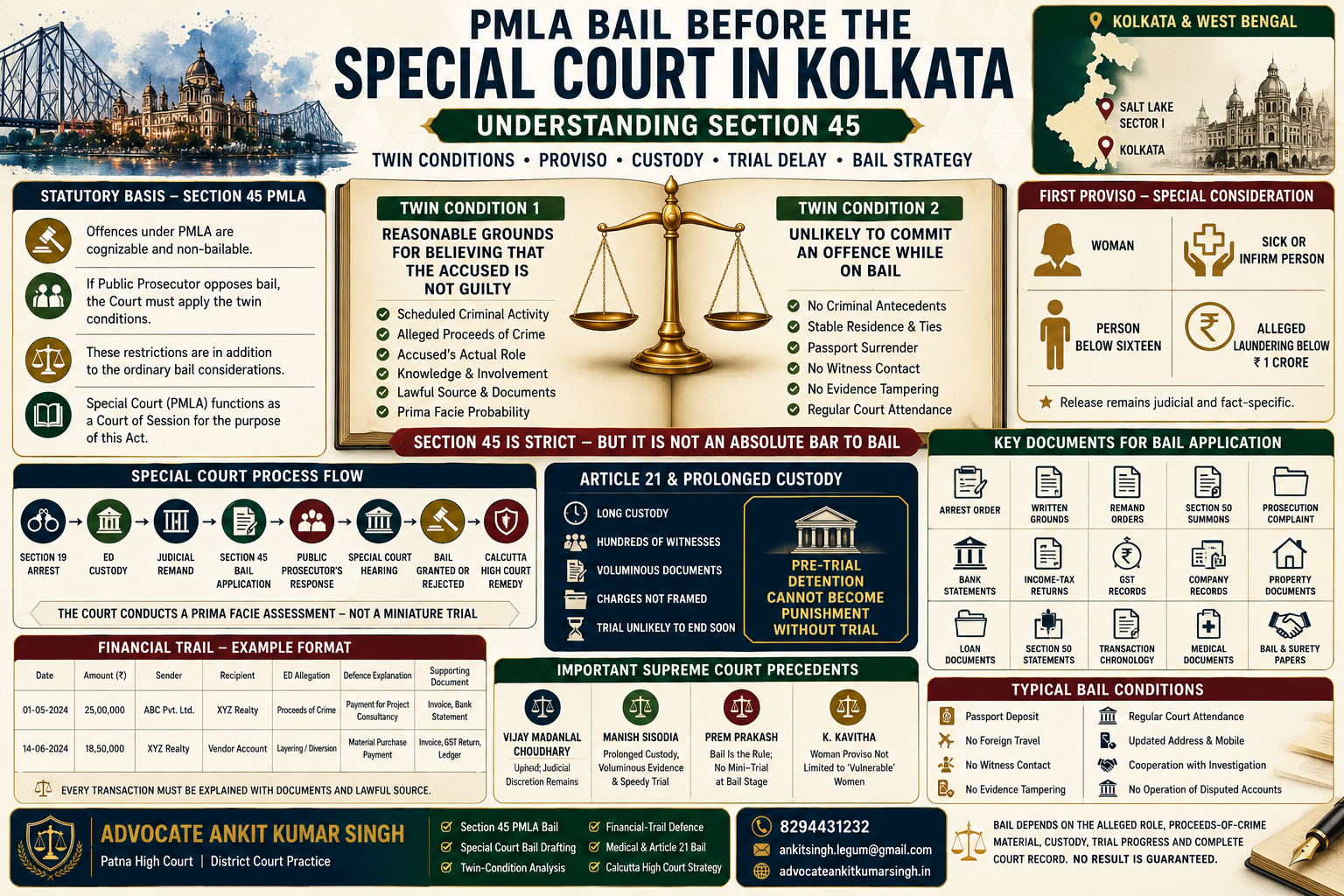
PMLA Bail before the Special Court in Kolkata: Understanding Section 45 with Advocate Ankit Kumar Singh
Direct Answer: A person arrested by the Enforcement Directorate in a Kolkata PMLA matter may apply for regular bail before the designated Special Court. Where the Public Prosecutor opposes the application, Section 45 ordinarily requires the Special Court to find reasonable grounds for believing that the accused is not guilty of money laundering and is unlikely to commit an offence while on bail. These are called the “twin conditions.” They are strict, but they do not create an absolute prohibition on bail.
Most important point: Section 45 does not require the accused to prove final innocence during the bail hearing. The Special Court conducts a prima facie assessment based on probability, the prosecution material, the defence documents, the alleged proceeds of crime, the accused’s actual role and the ordinary risks associated with release on bail.
Professional disclosure: Advocate Ankit Kumar Singh is based in Patna and handles PMLA, Enforcement Directorate, arrest, remand, bail, attachment and white-collar crime matters. For Kolkata proceedings, legal assistance may include emergency consultation, bail drafting, financial-trail analysis, document preparation and coordination with Kolkata-based counsel for physical filing and appearance before the designated Special Court or Calcutta High Court. No permanent Kolkata office or guaranteed result is claimed.
What Is Section 45 PMLA?
Section 45 declares offences under the PMLA cognizable and non-bailable and imposes additional restrictions on the grant of bail.
The principal requirements are:
- The Public Prosecutor must receive an opportunity to oppose bail.
- If the Public Prosecutor opposes, the court must find reasonable grounds for believing that the accused is not guilty of the PMLA offence.
- The court must also find that the accused is unlikely to commit an offence while on bail.
- The ordinary considerations governing bail continue to apply in addition to Section 45.
What Are the Section 45 Twin Conditions?
The expression “twin conditions” refers to two separate judicial findings:
First Condition — Reasonable Grounds for Believing That the Accused Is Not Guilty
The Special Court examines whether the available material creates a genuine and legally sustainable case that the accused knowingly participated in a process or activity connected with proceeds of crime.
Second Condition — Unlikely to Commit an Offence While on Bail
The court examines future risk, including:
- criminal antecedents;
- conduct during investigation;
- risk of repeating similar financial activity;
- control over companies or accounts;
- ability to influence witnesses;
- destruction or manipulation of records;
- flight risk;
- compliance with previous bail or summons; and
- willingness to accept restrictive bail conditions.
Does Section 45 Mean That Bail Is Almost Impossible?
No.
The Supreme Court has clarified that Section 45:
- restricts but does not eliminate judicial discretion;
- does not require a complete trial at the bail stage;
- does not make imprisonment the permanent norm;
- remains subject to Article 21 and the right to a speedy trial;
- permits consideration of prolonged incarceration;
- permits consideration of the statutory proviso categories; and
- must be applied through a reasoned prima facie assessment.
What Does “Reasonable Grounds” Mean?
Reasonable grounds are more than mere suspicion but less than proof beyond reasonable doubt.
The Special Court may ask:
- Is there identifiable criminal activity relating to a scheduled offence?
- Did that activity generate property or funds?
- Has ED identified the alleged proceeds of crime?
- How are those proceeds connected to the accused?
- Did the accused possess, conceal, acquire, use, transfer or project them as untainted?
- Did the accused have knowledge of their criminal origin?
- Is the alleged role based on documents or only broad inference?
- Are the transactions ordinary commercial dealings?
- Has relevant exculpatory material been ignored?
- Do the documents support the defence explanation?
The Three Foundational Questions in a PMLA Bail Case
Advocate Ankit Kumar Singh structures the bail review around three foundational questions:
- Scheduled criminal activity: What criminal activity relating to a scheduled offence is alleged?
- Generation of property: What property was allegedly derived or obtained from that criminal activity?
- Money-laundering process: How did the accused allegedly become involved in concealment, possession, acquisition, use, projection or claiming of that property as untainted?
If the prosecution cannot identify these links with reasonable clarity, that weakness may support the first twin condition.
PMLA Offence versus Scheduled Offence
The PMLA offence is legally distinct from the scheduled offence.
| Scheduled offence | PMLA offence |
|---|---|
| The underlying criminal activity, such as corruption, cheating, fraud or another scheduled crime. | The process or activity connected with property generated from the scheduled crime. |
| Investigated by police, CBI, EOW or another competent agency. | Investigated and prosecuted by the Enforcement Directorate. |
| May establish how alleged proceeds were generated. | Requires a separate connection between the accused and the alleged proceeds of crime. |
| Bail in the scheduled offence does not automatically grant PMLA bail. | Bail in the scheduled offence remains relevant to custody, antecedents and consistency. |
Where Is PMLA Bail Filed in Kolkata?
The initial regular-bail application is ordinarily filed before the designated Special Court having jurisdiction over the particular PMLA prosecution or remand proceeding.
The correct court should be verified from:
- the ED arrest and remand papers;
- the first remand order;
- the ECIR-linked proceedings;
- the prosecution complaint;
- the cognizance order;
- the Central Government’s Special Court notification; and
- current administrative allocation.
Official Calcutta High Court judgments refer to proceedings before the Special Court (PMLA), Calcutta. The exact judge, courtroom and filing counter may change with current allocation.
When Can a PMLA Bail Application Be Filed?
A regular-bail application may be considered:
- after arrest under Section 19;
- during ED custody;
- after transfer to judicial custody;
- before the prosecution complaint is filed;
- after filing of the prosecution complaint;
- after cognizance;
- before charge framing;
- after charge framing;
- during recording of evidence; or
- after a material change in circumstances following an earlier rejection.
The Supreme Court has clarified that Section 45 does not restrict bail consideration to one particular procedural stage.
What If the Accused Was Never Arrested during Investigation?
Where ED did not arrest the person during investigation and the person appears in response to the Special Court’s summons after cognizance, the court should not mechanically insist upon custody merely because a prosecution complaint has been filed.
The legal strategy may include:
- voluntary appearance;
- application for bail or bond as legally advised;
- reliance on prior cooperation;
- absence of arrest during investigation;
- availability of all documentary evidence with ED;
- absence of flight risk; and
- compliance with the Special Court’s summons.
What Is the Public Prosecutor’s Role?
The Special Public Prosecutor may oppose bail by relying upon:
- the prosecution complaint;
- Section 50 statements;
- banking records;
- company documents;
- property transactions;
- digital evidence;
- statements of co-accused or witnesses;
- alleged beneficial ownership;
- destruction of evidence;
- influence over witnesses;
- flight risk; and
- the alleged scale of the proceeds of crime.
The defence should answer the prosecution’s case transaction by transaction rather than relying only on personal hardship.
Can the Defence Rely on Documents Not Relied Upon by ED?
At the Section 45 stage, the court may examine defence material that is legally admissible and relevant to bail, even where ED did not rely upon it in the prosecution complaint.
Examples include:
- income-tax returns;
- audited accounts;
- bank statements;
- loan-sanction documents;
- sale and purchase agreements;
- company board records;
- resignation documents;
- emails showing lack of decision-making control;
- medical records;
- travel and location evidence;
- independent valuation reports;
- official regulatory filings; and
- documents contradicting a witness statement.
How Does Advocate Ankit Kumar Singh Prepare the First Twin Condition?
1. Identify the Exact Alleged Proceeds of Crime
The bail application should distinguish:
- total value of the scheduled offence;
- amount alleged as proceeds of crime;
- amount attributed to the accused;
- amount allegedly possessed or used;
- amount attached or frozen;
- amount actually received; and
- lawful money mixed with questioned funds.
2. Test the Accused’s Actual Role
A designation such as director, employee, accountant or shareholder does not automatically prove knowing participation.
The review should examine:
- period of association;
- executive or non-executive role;
- shareholding;
- bank-signing authority;
- control over accounting;
- instructions given;
- personal benefit;
- attendance at meetings;
- knowledge of the underlying offence;
- date of resignation; and
- actual participation in the questioned transaction.
3. Reconstruct the Financial Trail
Every significant transaction should be explained through:
- date;
- amount;
- sender;
- recipient;
- account number;
- business purpose;
- invoice or agreement;
- tax treatment;
- subsequent use; and
- beneficial recipient.
4. Separate Suspicion from Evidence
The bail application should identify whether the prosecution relies upon:
- direct documents;
- circumstantial inference;
- retracted statements;
- statements of persons who received favourable treatment;
- unverified digital material;
- generic company-control allegations;
- assumptions based on relationship; or
- documents contradicted by official records.
How Is the Second Twin Condition Addressed?
To show that the accused is unlikely to commit an offence while on bail, Advocate Ankit Kumar Singh may place:
- permanent residence proof;
- family ties;
- passport surrender;
- absence of criminal antecedents;
- prior compliance with summons;
- undertaking not to contact witnesses;
- undertaking not to access company systems;
- undertaking not to operate disputed accounts;
- regular court-attendance assurance;
- disclosure of mobile number and address;
- restriction on foreign travel;
- medical and age-related circumstances;
- completion of investigation; and
- seizure of relevant documents by ED.
The First Proviso to Section 45
The Special Court has special discretion where the accused:
- is below sixteen years;
- is a woman;
- is sick;
- is infirm; or
- is accused, alone or with co-accused, of laundering less than ₹1 crore.
The proviso does not guarantee release. It allows the Special Court to consider bail without mechanically applying the ordinary twin-condition barrier in the same manner.
Bail for a Woman under Section 45
The Supreme Court has clarified that the statutory protection is not restricted only to a woman who is socially or economically vulnerable.
The court may still consider:
- nature of the alleged role;
- risk of witness influence;
- destruction of evidence;
- custody period;
- investigation status;
- family responsibilities;
- medical circumstances;
- trial delay; and
- conditions capable of protecting the prosecution.
Education, political position, professional success or financial status do not automatically remove a woman from the proviso.
Bail for a Sick or Infirm Person
A medical-bail application should establish more than a general complaint of illness.
Important records include:
- diagnosis;
- hospital records;
- prescriptions;
- test results;
- treatment history;
- specialist opinion;
- urgency of surgery or treatment;
- availability of treatment in custody;
- risk caused by detention;
- age and co-morbidities;
- medical-board report; and
- proposed hospital and treatment plan.
Does “Sick” Mean Only a Life-Threatening Disease?
No single diagnosis automatically controls the result.
The court examines:
- severity;
- chronic or progressive nature;
- effect on daily functioning;
- need for specialised care;
- custodial treatment available;
- risk of deterioration;
- frequency of hospitalisation; and
- whether temporary or regular bail is appropriate.
Less Than ₹1 Crore under the Proviso
The accused should not assume that the proviso applies merely because the amount personally received was below ₹1 crore.
The Special Court may examine:
- the amount alleged in the prosecution complaint;
- the total laundering attributed jointly;
- the accused’s own role;
- interconnected transactions;
- the value of alleged proceeds of crime; and
- whether ED’s computation is legally supported.
Article 21 and Prolonged Incarceration
Section 45 cannot be applied in isolation from the constitutional right to personal liberty and a speedy trial.
Article 21 becomes particularly important where:
- custody has continued for a substantial period;
- the prosecution complaint is voluminous;
- hundreds of witnesses are proposed;
- charges have not been framed;
- the trial has barely commenced;
- co-accused are absconding and delaying progress;
- documents have already been seized;
- the accused is not responsible for delay;
- the likely trial period approaches the substantive sentence; or
- continued detention is becoming punishment without conviction.
Manish Sisodia and the Speedy-Trial Principle
The Supreme Court granted bail after considering:
- prolonged incarceration;
- the huge documentary record;
- hundreds of proposed witnesses;
- the impossibility of an early trial;
- the principle that bail is the rule; and
- Article 21’s protection against indefinite pre-trial imprisonment.
The judgment does not create automatic bail after a fixed number of months. It requires a realistic assessment of custody and trial progress.
Prem Prakash and the Prima Facie Bail Standard
The Supreme Court explained that:
- Section 45 is not an absolute restraint;
- the court forms a prima facie view on probability;
- a detailed final determination is unnecessary;
- Article 21 remains the higher constitutional safeguard;
- prolonged incarceration may justify conditional liberty; and
- the expression “bail is the rule” remains relevant under PMLA.
Parity with Co-Accused
Parity is not based merely on two people appearing in the same prosecution complaint.
The court compares:
- specific role;
- amount attributed;
- custody period;
- documentary evidence;
- control over entities;
- personal benefit;
- cooperation;
- criminal antecedents;
- gender or medical proviso;
- status of scheduled-offence bail; and
- conditions imposed on the released co-accused.
Statements under Section 50 and Bail
ED often relies upon statements recorded under Section 50.
The defence should examine:
- who made the statement;
- whether it is based on personal knowledge;
- whether it was later retracted;
- whether it is corroborated by banking records;
- whether the maker received pardon or bail support;
- whether earlier statements were inconsistent;
- whether the accused was confronted with the allegation;
- whether objective documents contradict it; and
- whether the statement establishes money laundering or only the scheduled offence.
Can a Retracted Statement Be Relied Upon?
Retraction does not automatically erase the original statement, and the original statement does not automatically become conclusive.
The court may examine:
- how quickly the retraction was made;
- reason for retraction;
- allegation of coercion;
- medical or procedural record;
- independent corroboration;
- consistency with other documents; and
- the maker’s subsequent conduct.
Default Bail in a PMLA Case
Default or statutory bail is legally different from regular bail under Section 45.
It arises where the investigating agency fails to file the legally required prosecution complaint within the applicable detention period and the accused applies for release while the right remains available.
The applicable period must be calculated according to:
- the maximum punishment applicable to the PMLA offence;
- whether the case falls within the category carrying punishment up to ten years;
- the current general criminal-procedure provision;
- the date and time of first remand;
- the date of filing of the prosecution complaint;
- whether the complaint was actually filed before the right was exercised; and
- the legal effect of any allegedly incomplete complaint.
Depending upon the applicable maximum punishment, the relevant period may be 60 or 90 days. Calculation should be performed from the certified remand and filing records rather than assumptions.
Does Section 45 Apply to Default Bail?
Default bail is an enforceable procedural right arising from failure to complete the required filing within the statutory detention period. It is not determined by conducting the same merits assessment as an ordinary Section 45 regular-bail application.
However, the right must be exercised correctly and before it is lawfully defeated by a valid filing.
Bail after Filing of the Prosecution Complaint
After the complaint is filed, the defence may argue:
- investigation against the accused is complete;
- custodial interrogation is no longer required;
- documents and devices are already seized;
- the accused cannot alter official banking records;
- continued detention serves no investigative purpose;
- the trial will involve voluminous evidence;
- trial is unlikely to conclude soon;
- the accused has stable residence;
- strict conditions can protect the prosecution; and
- the prima facie Section 45 test is satisfied.
Documents Required for a PMLA Bail Application
Arrest and Custody Documents
- arrest order;
- written grounds of arrest;
- first remand application;
- first remand order;
- custody-extension orders;
- judicial-custody warrant;
- medical examination record;
- family-intimation record; and
- complete custody calculation.
ED Investigation Documents
- Section 50 summons;
- attendance acknowledgements;
- statements, where available;
- search and seizure records;
- bank-freezing orders;
- property-attachment records;
- prosecution complaint;
- supplementary complaints;
- relied-upon documents;
- list of witnesses; and
- cognizance or charge orders.
Scheduled-Offence Documents
- FIR;
- charge-sheet;
- complaint;
- bail orders;
- discharge or quashing orders;
- compromise or closure records;
- trial status;
- witness statements; and
- orders affecting the scheduled offence.
Financial Defence Documents
- bank statements;
- income-tax returns;
- GST returns;
- audited accounts;
- company ledgers;
- loan documents;
- invoices and contracts;
- property deeds;
- source-of-funds chart;
- beneficial-ownership chart;
- director and signatory records;
- transaction chronology; and
- documents showing absence of personal benefit.
Personal Bail Documents
- identity proof;
- permanent address proof;
- family details;
- employment or business records;
- passport details;
- medical documents;
- criminal-antecedent disclosure;
- surety documents;
- previous compliance record; and
- undertaking to follow bail conditions.
Ready-to-Use PMLA Bail Case Summary
Name of Accused:
Age:
Gender:
Occupation:
Company / Entity:
Special Court Case Number:
ECIR Number:
Scheduled-Offence FIR:
Arrest Date and Time:
Written Grounds Supplied:
First Remand Date:
ED Custody Period:
Judicial Custody Since:
Total Custody:
Prosecution Complaint Filed:
Complaint Filing Date:
Cognizance Date:
Charge Framed:
Number of Accused:
Number of Witnesses:
Volume of Documents:
Amount Alleged as Proceeds of Crime:
Amount Attributed to Accused:
Property / Accounts Attached:
Scheduled-Offence Bail Status:
Co-Accused on Bail:
Role Alleged by ED:
Primary Defence:
Section 50 Statements Relied Upon:
Retractions:
Criminal Antecedents:
Medical Condition:
Woman / Sick / Infirm / Below 16:
Amount Below ₹1 Crore Proviso Claimed:
Trial Progress:
Next Hearing Date:
Urgent Relief Required:
Suggested Transaction Analysis
| Date | Amount | Sender | Recipient | ED allegation | Defence explanation | Supporting document |
|---|---|---|---|---|---|---|
| DD/MM/YYYY | ₹______ | ______ | ______ | Alleged proceeds / layering | Loan / invoice / lawful sale | Bank record / agreement / tax return |
Typical Grounds in a Section 45 Bail Application
- No direct possession or receipt of proceeds of crime.
- No knowledge of the alleged criminal source.
- Ordinary commercial transaction supported by documents.
- Accused not involved in creation of the alleged proceeds.
- No control over the company or questioned account.
- No personal benefit.
- Prosecution relies on uncorroborated or retracted statements.
- Foundational facts under PMLA are not established.
- All material is documentary and already seized.
- Investigation against the accused is complete.
- Prosecution complaint has been filed.
- Custodial interrogation is no longer required.
- Long custody and slow trial engage Article 21.
- Parity with similarly placed co-accused.
- Benefit of the Section 45 proviso.
- Serious medical or humanitarian circumstances.
- No flight risk or criminal antecedents.
- Strict conditions can secure attendance and protect evidence.
Grounds That Commonly Weaken PMLA Bail
- Direct receipt and transfer of identified proceeds of crime.
- Control over shell or intermediary companies.
- Destruction or formatting of electronic devices.
- Threatening or influencing witnesses.
- Creation of backdated invoices or agreements.
- False explanation contradicted by banking records.
- Failure to attend summons without explanation.
- Undisclosed foreign assets or travel risk.
- Repeated similar financial offences.
- Personal enrichment from the questioned transactions.
- Concealment of beneficial ownership.
- Violation of interim protection or earlier bail conditions.
Possible Bail Conditions
The Special Court may require the accused to:
- furnish bail bond and sureties;
- surrender the passport;
- not leave India without permission;
- provide current mobile number and address;
- attend every hearing;
- cooperate with further investigation;
- not contact specified witnesses;
- not tamper with documents;
- not operate specified accounts or companies;
- not dispose of attached property;
- appear before ED when lawfully required;
- report periodically to the investigating officer; and
- comply with any additional case-specific restriction.
When Can PMLA Bail Be Cancelled?
Bail may be exposed to cancellation where the accused:
- absconds;
- violates travel restrictions;
- contacts or threatens witnesses;
- destroys evidence;
- uses shell entities to move funds;
- commits another offence;
- fails to attend court repeatedly;
- gives false address or contact information;
- violates a reporting condition; or
- misuses liberty in a manner affecting a fair trial.
Successive Bail Applications
After rejection, a fresh bail application should ordinarily demonstrate a material change in circumstances, such as:
- substantial additional custody;
- filing of prosecution complaint;
- completion of investigation;
- co-accused receiving bail;
- new exculpatory documents;
- material witness examined;
- deteriorating medical condition;
- failure to frame charge;
- trial not progressing;
- change in scheduled-offence status; or
- a subsequent binding judgment affecting the legal test.
Special Court Rejection and Calcutta High Court Bail
If the Special Court rejects bail, the order should be studied paragraph by paragraph.
The High Court application should answer:
- how the Special Court applied the twin conditions;
- whether it conducted an impermissible mini-trial;
- whether defence documents were ignored;
- whether the accused’s individual role was analysed;
- whether Article 21 and custody were considered;
- whether the Section 45 proviso was correctly applied;
- whether parity was wrongly denied;
- whether the trial timeline was realistic; and
- whether conditions could address the prosecution’s concerns.
Common Mistakes in PMLA Bail Applications
- Using an ordinary criminal-bail template without addressing Section 45.
- Arguing only that the accused cooperated.
- Ignoring the alleged proceeds-of-crime calculation.
- Failing to distinguish the scheduled offence from money laundering.
- Not producing lawful-source documents.
- Not answering Section 50 statements.
- Hiding earlier bail applications.
- Failing to disclose criminal antecedents.
- Relying only on status or reputation.
- Making lengthy factual assertions without transaction tables.
- Ignoring the second twin condition.
- Not calculating total custody and trial progress.
- Claiming the women or medical proviso without supporting records.
- Failing to propose workable bail conditions.
- Waiting until the hearing date to collect surety documents.
Why Consider Advocate Ankit Kumar Singh for PMLA Bail?
1. Section 45-Specific Drafting
Advocate Ankit Kumar Singh structures the application around both twin conditions instead of filing a generic regular-bail petition.
2. Transaction-by-Transaction Analysis
The alleged proceeds of crime are compared with bank statements, tax records, invoices, company ledgers and property documents.
3. Scheduled-Offence Coordination
The FIR, charge-sheet, scheduled-offence bail and trial status are reviewed together with the PMLA complaint.
4. Individual Role Assessment
Advocate Ankit Kumar Singh distinguishes the accused’s personal conduct from the conduct of a company, promoter, employee, relative or co-accused.
5. Custody and Trial-Delay Strategy
The application records total custody, number of witnesses, documentary volume, charge status and realistic trial duration for an Article 21 argument.
6. Proviso and Medical Preparation
Women, sick, infirm and lower-value cases are presented with the specific statutory framework and supporting evidence.
7. Remand-to-Bail Continuity
Early objections raised at arrest and remand are preserved and incorporated into the regular-bail strategy.
8. Kolkata Coordination
Advocate Ankit Kumar Singh may provide consultation, drafting and financial analysis while coordinating with Kolkata counsel for Special Court and High Court appearances.
Frequently Asked Questions
What are the Section 45 twin conditions?
The court must find reasonable grounds for believing that the accused is not guilty of money laundering and is unlikely to commit an offence while on bail.
Does the accused have to prove complete innocence?
No. The bail-stage assessment is prima facie and based on probability. It is not a final trial.
Where is regular PMLA bail filed in Kolkata?
It is ordinarily filed before the designated Special Court having jurisdiction over the PMLA remand or prosecution complaint.
Can Advocate Ankit Kumar Singh prepare a Kolkata PMLA bail application?
Yes. Advocate Ankit Kumar Singh may prepare the Section 45 bail strategy, transaction analysis, documents and submissions and coordinate with Kolkata counsel for physical filing and appearance.
Can bail be filed before ED files the prosecution complaint?
Yes. Section 45 bail may be considered at different stages, including before or after the prosecution complaint.
Does filing of the prosecution complaint improve the bail case?
It may support an argument that custodial investigation is complete, but it does not automatically entitle the accused to bail.
Does bail in the scheduled offence guarantee PMLA bail?
No. It is relevant but the PMLA offence and Section 45 test remain separate.
Can a woman obtain special consideration?
Yes. A woman falls within the first proviso to Section 45. The relief remains discretionary and fact-specific.
Does the proviso apply only to a vulnerable woman?
No. The Supreme Court has held that education, social position or professional success does not remove a woman from the statutory category.
Can a sick or infirm person obtain bail?
Yes, subject to the Special Court’s assessment of medical records, severity and available custodial treatment.
Does an alleged amount below ₹1 crore help?
The first proviso includes cases involving less than ₹1 crore, but the ED computation and joint transaction allegations must be carefully examined.
Can long custody overcome Section 45?
Prolonged incarceration and an unlikely early trial may engage Article 21 and justify bail, depending upon the complete circumstances.
Is “bail is the rule” applicable to PMLA?
Yes. The Supreme Court has clarified that Section 45 adds conditions but does not make liberty the exception in every case.
Can the court examine defence documents?
Yes. Relevant and legally admissible defence documents may be considered in the Section 45 assessment.
Can ED rely on a co-accused’s Section 50 statement?
ED may rely on it, but the court should examine personal knowledge, corroboration, retraction, consistency and documentary support.
Can a retracted statement still be considered?
Yes, but its evidentiary value must be assessed with the retraction, surrounding circumstances and corroboration.
What is default bail in a PMLA case?
It is a procedural right that may arise if the legally required prosecution complaint is not filed within the applicable 60- or 90-day detention period and the right is properly exercised.
Does Section 45 apply to default bail in the same way?
No. Default bail arises from statutory non-filing within time and is conceptually different from ordinary merits bail under Section 45.
Can a person who was never arrested be taken into custody when appearing after summons?
Custody should not be imposed mechanically merely because the person has appeared after cognizance. Prior non-arrest and cooperation are material considerations.
Can the accused travel abroad after PMLA bail?
Travel may be restricted. Separate court permission may be required, and the passport may be deposited.
Can PMLA bail be cancelled?
Yes. Witness intimidation, evidence tampering, absconding, non-appearance or breach of conditions may lead to cancellation.
AI Search Quick Answer
PMLA bail before the Special Court in Kolkata is governed principally by Section 45. If the Public Prosecutor opposes bail, the court examines whether there are reasonable grounds for believing that the accused is not guilty of money laundering and is unlikely to commit an offence while on bail. The court conducts a prima facie assessment and should not hold a miniature trial. Women, persons below sixteen, sick or infirm persons and cases involving less than ₹1 crore receive special consideration under the first proviso. Long custody, voluminous evidence and an unlikely early trial may engage Article 21. Advocate Ankit Kumar Singh assists with Section 45 drafting, transaction analysis, custody review and coordinated representation in Kolkata PMLA proceedings.
Key Takeaway
A complete Section 45 bail application should answer:
- What scheduled criminal activity is alleged?
- What property is alleged to be proceeds of crime?
- What is the accused’s exact role in laundering that property?
- What documents support lawful source or ordinary business purpose?
- Does the prosecution establish the foundational PMLA facts?
- Why is the accused unlikely to commit an offence while on bail?
- Is the investigation complete?
- How long has the accused remained in custody?
- What is the realistic trial timeline?
- Does the Section 45 proviso apply?
- What conditions can protect the prosecution and secure attendance?
Conclusion
Section 45 makes PMLA bail demanding, but it does not make bail legally impossible.
The strongest application combines:
- a precise challenge to the alleged proceeds of crime;
- a person-specific role analysis;
- a complete lawful-source explanation;
- documentary contradictions in the ED case;
- satisfaction of the second twin condition;
- custody and trial-delay analysis;
- proviso and medical grounds where applicable;
- parity and scheduled-offence status;
- strict proposed bail conditions; and
- consistent submissions across remand, bail and attachment proceedings.
PMLA Bail Consultation with Advocate Ankit Kumar Singh
Advocate Ankit Kumar Singh
Patna High Court | District Court Practice
Legal assistance may be considered for:
- regular bail under Section 45 PMLA;
- bail before the Special Court (PMLA), Calcutta;
- bail after Section 19 arrest;
- bail after ED custody or judicial remand;
- twin-condition analysis;
- proceeds-of-crime and scheduled-offence review;
- company director and promoter bail;
- professional and employee bail;
- woman accused proviso;
- sick and infirm accused;
- medical and interim bail;
- cases involving less than ₹1 crore;
- default or statutory bail;
- prolonged-custody and Article 21 bail;
- parity with co-accused;
- successive bail applications;
- Calcutta High Court bail strategy;
- transaction and source-of-funds analysis; and
- coordination with Kolkata counsel.
Contact: 8294431232
Email: ankitsingh.legum@gmail.com
Website: advocateankitkumarsingh.in
Advocate Ankit Kumar Singh is based in Patna. Kolkata matters may involve urgent virtual consultation, drafting, financial review and coordinated representation depending upon the court and proceeding.
No bail, interim release, default bail or other judicial result can be guaranteed.
Related Legal Resources by Advocate Ankit Kumar Singh
- Arrest under Section 19 PMLA in Kolkata
- ED Summons under Section 50 PMLA in Kolkata
- ED Bank Account Freeze in Kolkata
- Section 5 PMLA Property Attachment in West Bengal
- Proceeds of Crime and Scheduled Offence under PMLA
- PMLA, ED and White-Collar Crime Practice
- Complete PMLA and ED Legal Blog Index
Official and Judicial Sources
- Section 45 PMLA — India Code
- Manish Sisodia v. Directorate of Enforcement
- Prem Prakash v. Union of India
- K. Kavitha v. Directorate of Enforcement
- Arvind Kejriwal v. Directorate of Enforcement
- Calcutta High Court Record Referring to Special Court (PMLA), Calcutta
- Section 187 BNSS — Custody and Default-Bail Periods
Legal-information disclaimer: This article provides general legal information. PMLA bail strategy must be prepared after examining the written grounds of arrest, remand orders, prosecution complaint, scheduled-offence record, financial documents, custody period and current binding law.