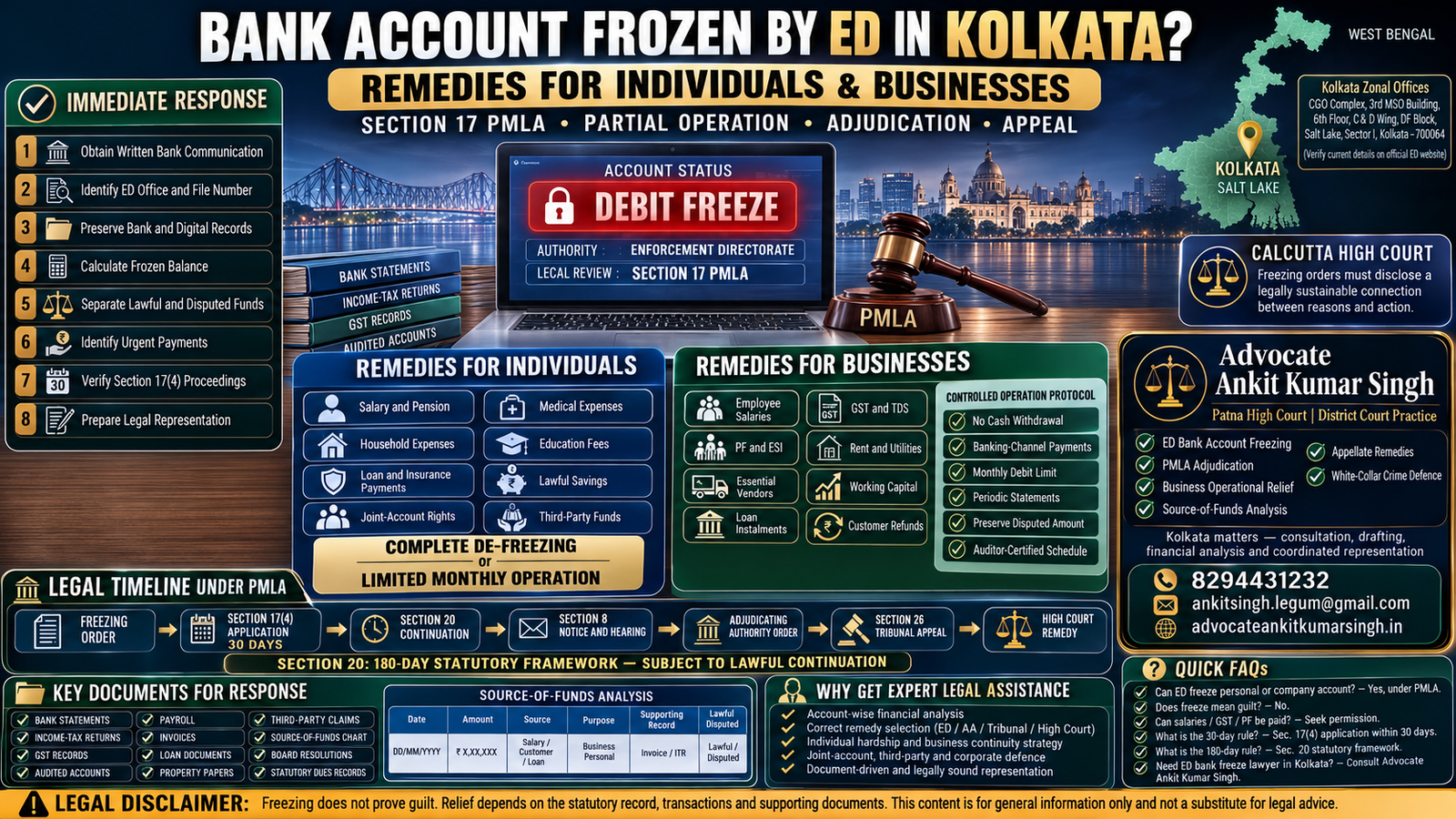
ED Bank Account Freeze in Kolkata: Remedies for Individuals and Businesses by Advocate Ankit Kumar Singh
Direct Answer: If the Enforcement Directorate freezes a bank account in Kolkata under the Prevention of Money-Laundering Act, 2002, the account holder should immediately obtain the bank’s written communication, identify the ED office and legal provision, preserve all transaction records, determine the amount alleged to represent proceeds of crime, and prepare a documented representation seeking complete or partial de-freezing. Depending upon the stage, remedies may be pursued before the ED officer, the PMLA Adjudicating Authority, the PMLA Appellate Tribunal and, in exceptional cases, Calcutta High Court.
Important distinction: Freezing a bank account does not by itself prove that every rupee in the account is proceeds of crime. The account holder may challenge the legal authority, statutory procedure, factual connection, amount frozen, duration of freezing and inclusion of legitimate or third-party funds.
Professional disclosure: Advocate Ankit Kumar Singh is based in Patna and practises in PMLA, Enforcement Directorate, financial-crime, bank-freezing and connected High Court matters. Kolkata-related assistance may include virtual consultation, document review, financial-trail analysis, representation drafting, Adjudicating Authority preparation and coordination with Kolkata-based counsel where local filing or physical appearance is required. No permanent Kolkata office or guaranteed outcome is claimed.
What Does an ED Bank Account Freeze Mean?
An ED bank-account freeze generally means that the bank has been directed not to permit transfer, withdrawal, debit, closure or another dealing with the account without prior permission of the Enforcement Directorate.
The restriction may operate as:
- a complete debit freeze;
- a debit freeze while credits continue;
- a restriction limited to a specified amount;
- a restriction on one account;
- a freeze affecting several related accounts;
- a freeze affecting company and personal accounts;
- a freeze on fixed deposits or investments;
- a freeze on demat or securities accounts;
- a freeze after a search under Section 17 PMLA; or
- a freeze connected with an ECIR and alleged proceeds of crime.
The first task is to identify the exact scope of the restriction. A bank employee’s oral statement that “the account is blocked” is not enough for legal preparation.
Legal Basis of an ED Freezing Order
Section 17 PMLA governs search and seizure. Where it is not practicable to seize a property, Section 17(1A) permits the authorised officer to issue an order freezing the property so that it cannot be transferred or dealt with without prior permission.
The statutory process requires:
- information in the possession of the authorised authority;
- reason to believe;
- recording of reasons in writing;
- a connection with money laundering, proceeds of crime, relevant records or crime-related property;
- forwarding of the recorded reasons and material to the Adjudicating Authority; and
- an application under Section 17(4) within 30 days seeking continuation of the freezing order.
A freezing order is therefore not intended to operate merely because an account belongs to a person remotely connected with an investigation.
Why Does ED Freeze Bank Accounts?
ED may allege that an account:
- received proceeds generated from a scheduled offence;
- was used to layer or transfer disputed funds;
- received money through shell companies;
- was controlled by a beneficial owner different from the named holder;
- received cash converted into banking transactions;
- was used to purchase property or investments;
- was used to conceal the source of funds;
- contains the value equivalent of unavailable proceeds of crime;
- belongs to a company, director, employee or associate connected with the alleged transactions; or
- contains records or funds considered relevant to an ongoing PMLA investigation.
Kolkata ED Offices
The Enforcement Directorate’s current office directory lists the Eastern Region, Kolkata Zonal Office-I and Kolkata Zonal Office-II at:
CGO Complex, Third MSO Building, Sixth Floor, C and D Wing, DF Block, Salt Lake, Sector I, Kolkata—700064.
Verify current Kolkata ED office details
The account holder should verify the office and officer from the bank communication, freezing order, summons or ECIR-linked record. Officer postings may change.
How Will You Know That ED Froze the Account?
An individual or business may learn of the freeze through:
- a bank SMS;
- an email from the bank;
- failed online transactions;
- a cheque-return memo;
- a debit-freeze message in internet banking;
- a call from the branch;
- an ED search or summons;
- a written freezing order;
- communication from the company’s relationship manager; or
- failure of salary, tax or vendor payments.
Immediately request the bank to provide:
- date and time of freeze;
- name of the authority;
- ED office;
- letter or order number;
- legal provision mentioned;
- amount frozen;
- whether credits are permitted;
- whether all debits are blocked;
- whether another account is also affected; and
- the contact details to which the bank may lawfully refer.
First 24-Hour Action Plan
- Obtain written confirmation from the bank.
- Do not rely only on oral branch information.
- Identify whether the action is by ED, cyber police, local police, CBI, Income Tax or another authority.
- Preserve the complete bank statement.
- Do not route transactions through new accounts to avoid scrutiny.
- Do not create retrospective invoices or agreements.
- Identify all failed or urgent payments.
- Prepare an account-wise balance statement.
- Identify money belonging to third parties.
- Collect income-tax, GST and audited records.
- Review the scheduled-offence case, if known.
- Obtain legal advice before sending a detailed explanation.
ED Freeze versus Cybercrime or Police Freeze
Before selecting a remedy, determine which authority actually caused the restriction.
| ED/PMLA freeze | Cybercrime or police freeze |
|---|---|
| Usually connected with an ECIR and alleged proceeds of crime. | Often connected with an FIR, NCRP complaint or disputed online transaction. |
| May arise under Section 17(1A) PMLA. | May arise under criminal-procedure or investigative powers. |
| Continuation proceedings may go before the PMLA Adjudicating Authority. | Remedy may involve the investigating officer, Magistrate or jurisdictional High Court. |
| PMLA Appellate Tribunal remedy may arise. | PMLA Tribunal ordinarily has no role. |
| Focus is on proceeds of crime and money laundering. | Focus may be on tracing the disputed transaction or preserving evidence. |
A representation prepared for a cyber-police freeze may be legally inadequate for an ED freezing order.
Does ED Have to Record Reasons?
Yes. The statutory power is based upon “reason to believe,” which must be recorded in writing.
The Calcutta High Court in Rashmi Metaliks Limited v. Enforcement Directorate emphasised that the reasons should disclose a meaningful link between:
- the information available;
- the alleged money-laundering activity;
- the alleged proceeds of crime;
- the particular account or property; and
- the need to freeze that account.
A freezing order should not merely repeat statutory expressions without explaining their application to the affected account.
What Happened in the Rashmi Metaliks Case?
In that case, ED froze six SBI accounts and one ICICI Bank account belonging to the company.
Calcutta High Court examined:
- the underlying ECIR;
- earlier proceedings;
- the subsisting Supreme Court stay;
- the statutory conditions under Section 17;
- the written reasons supporting the freeze; and
- the connection between the material and action taken.
The Court stayed the freezing orders after finding that the challenged orders did not satisfy the legal and factual requirements applicable in that case.
The judgment does not mean that every ED freezing order will be stayed. It establishes that the statutory power remains subject to judicial review where the mandatory conditions are not met.
Thirty-Day Application before the Adjudicating Authority
Section 17(4) requires the authority freezing property under Section 17(1A) to approach the Adjudicating Authority within 30 days for continuation of the freezing order.
The account holder should determine:
- the exact date of freezing;
- whether the Section 17(4) application was filed;
- the original-application number;
- the amount and accounts covered;
- whether a notice has been issued;
- whether the account holder has been correctly served; and
- the next hearing date.
Failure to comply with a mandatory statutory requirement may become an important legal ground, but the complete record and current judicial position must be examined.
The 180-Day Framework under Section 20
Section 20 permits frozen property to remain frozen for a period not exceeding 180 days from the date of freezing, where the authorised officer records reasons that the property is required for adjudication under Section 8.
After expiry of that period, the property should be released unless the Adjudicating Authority permits continuation beyond the statutory period.
The following dates must therefore be tracked carefully:
- date of initial freeze;
- date of Section 17(4) application;
- date of Section 20 continuation or retention order;
- date of Section 8 notice;
- date of reply;
- date of hearing;
- date of confirmation order; and
- date of receipt for calculating appeal limitation.
Section 8 Notice and Adjudication
On receiving the statutory application, the Adjudicating Authority may issue a notice requiring the person to explain:
- the source of income;
- the source of earnings or assets;
- how the money in the account was acquired;
- what evidence supports the lawful source;
- who actually owns the funds;
- why the funds should not be treated as involved in money laundering; and
- why the freezing order should not continue.
The Authority must consider the written reply, hear the affected person and examine the material before recording a finding.
Documents Required for an Individual Account
- complete bank statement;
- salary slips;
- employment contract;
- income-tax returns;
- Form 16;
- pension records;
- investment-redemption records;
- loan disbursement records;
- sale deeds or property-sale receipts;
- inheritance documents;
- gift documents;
- medical-expense records;
- education-expense records;
- household-expense summary;
- details of joint-account holders;
- details of funds belonging to another person;
- explanation of high-value transactions;
- previous ED summons or statements; and
- a date-wise transaction chronology.
Documents Required for a Business Account
- certificate of incorporation;
- company master data;
- memorandum and articles;
- shareholding pattern;
- director and authorised-signatory details;
- board resolutions;
- audited financial statements;
- tax audit reports;
- income-tax returns;
- GST returns;
- bank statements;
- ledger extracts;
- sales registers;
- purchase registers;
- invoices;
- purchase and work orders;
- customer contracts;
- vendor contracts;
- loan and cash-credit documents;
- stock statements;
- employee payroll;
- PF, ESI, TDS and GST liabilities;
- utility and rent obligations;
- secured-creditor details;
- related-party transaction records;
- source-of-funds explanation; and
- a complete account-wise money trail.
Remedies Available to Individuals
1. Representation Seeking Complete De-Freezing
An individual may request complete release where:
- the account contains only salary, pension or lawful savings;
- the person is not named in the scheduled offence;
- there is no identified proceeds-of-crime transaction;
- the account predates the alleged offence;
- the money came from documented lawful sources;
- the account was merely used for ordinary household expenses;
- the amount frozen is disproportionate to the allegation; or
- statutory procedure has not been followed.
2. Request for Limited Personal Operation
Where complete release is not immediately granted, an individual may seek permission for:
- medical treatment;
- rent;
- school or university fees;
- household expenses;
- insurance premiums;
- loan instalments;
- tax payments;
- legal expenses;
- dependent-family expenses; and
- another necessary and documented payment.
3. Amount-Specific Freeze
If the alleged proceeds of crime are quantified, the person may argue that freezing the entire balance and all future lawful credits is excessive.
A request may be made to:
- restrict the freeze to the disputed amount;
- permit operation of money above that amount;
- allow salary credits and limited withdrawals;
- segregate lawful funds; or
- replace the frozen amount with another acceptable security, where legally permissible.
Remedies Available to Businesses
1. Partial Operation for Business Continuity
A company may request debit permission for identified operational payments rather than seeking unrestricted operation at the first stage.
Possible payments include:
- employee salaries;
- PF and ESI contributions;
- GST and TDS;
- professional tax;
- electricity and utilities;
- factory rent;
- essential raw materials;
- insurance;
- secured-loan instalments;
- statutory licence fees;
- essential vendor payments;
- court-directed payments; and
- customer refunds supported by records.
2. Controlled Operating Protocol
A business may offer safeguards such as:
- a monthly payment ceiling;
- payment only through banking channels;
- no cash withdrawals;
- prior submission of payment lists;
- payment only to identified statutory authorities and employees;
- weekly or monthly statements to ED;
- operation through one designated account;
- preservation of the disputed amount;
- undertaking not to close or transfer the account; and
- auditor certification of permitted payments.
3. Segregation of Customer or Third-Party Funds
A business may hold funds belonging to:
- customers;
- employees;
- vendors;
- an escrow beneficiary;
- a lender;
- a trust;
- a project-specific entity;
- an online-platform user; or
- another independent third party.
Such persons may need to establish independent ownership and lawful source rather than relying only on the company’s representation.
4. Payroll Relief
A payroll application should include:
- employee list;
- salary register;
- bank account details of employees;
- previous salary-payment pattern;
- PF and ESI records;
- total monthly payroll;
- undertaking against cash withdrawal; and
- proof that employees are unrelated to the alleged offence.
5. Statutory-Payment Relief
A request for taxes and statutory dues should include:
- GST challans;
- TDS calculations;
- PF and ESI schedules;
- statutory due dates;
- penalty consequences;
- bank-payment details; and
- an undertaking that payment will be made directly to the authority.
Can the Bank Unfreeze the Account on Its Own?
Ordinarily, the bank follows the ED instruction and will not independently restore full operation unless:
- ED withdraws or modifies the instruction;
- the freezing period expires without lawful continuation;
- the Adjudicating Authority orders release;
- the Appellate Tribunal grants relief;
- the High Court grants appropriate relief; or
- another competent authority issues a binding direction.
Sending letters only to the branch manager may therefore be insufficient.
Representation to the Enforcement Directorate
A representation should be precise and document-based.
It should identify:
- the account holder;
- account number and bank;
- date of freeze;
- ED office and file reference;
- scheduled offence, if known;
- source of every significant credit;
- the alleged disputed amount;
- lawful and third-party funds;
- urgent personal or business requirements;
- statutory payments falling due;
- the exact relief requested; and
- safeguards offered.
Ready-to-Use Representation for Partial Operation
To,
The [Designation of Officer]
Directorate of Enforcement
Kolkata Zonal Office-[I/II]
[Address]

Subject: Request for de-freezing / limited operation of Bank Account No. ______ in relation to File / ECIR No. ______

Sir/Madam,

The above account maintained with ______ Bank was frozen pursuant to the communication dated ______.

The account is used for ______. The present balance is approximately ₹______. The transactions presently under inquiry, as understood by the applicant, amount to ₹______.

The account also contains lawful and independently documented funds arising from:

1. ______
2. ______
3. ______

The complete bank statement, source-of-funds chart and supporting records are enclosed.

The continuing complete debit freeze has prevented payment of the following urgent obligations:

1. Employee salaries — ₹______
2. GST / TDS / PF / ESI — ₹______
3. Medical / household / education expenses — ₹______
4. Essential business payments — ₹______

The applicant is willing to comply with safeguards including:

(a) no cash withdrawals;
(b) maintenance of the disputed amount;
(c) payments only through banking channels;
(d) submission of periodic account statements; and
(e) prior identification of payees.

It is therefore requested that:

Primary request:
The account may kindly be completely de-frozen.

Alternative request:
Limited debit operation may kindly be permitted up to ₹______ for the purposes described in the enclosed schedule.

The applicant remains willing to cooperate with the investigation and produce further records lawfully required.

Yours faithfully,

Name:
Designation:
Company:
Address:
Mobile:
Email:
Date:

Enclosures:
1. Bank statement
2. Source-of-funds chart
3. Payment schedule
4. Tax and payroll records
5. Supporting invoices and documents
Preparing a Source-of-Funds Chart
| Date | Amount | Credit source | Purpose | Supporting document | Disputed or lawful |
|---|---|---|---|---|---|
| DD/MM/YYYY | ₹______ | Salary / customer / loan / sale | ______ | Invoice / ITR / agreement | Lawful / under inquiry |
The chart should reconcile with:
- bank statements;
- books of account;
- income-tax returns;
- GST filings;
- company ledgers;
- sale or loan agreements;
- property records;
- email and invoice records; and
- statements already given to ED.
Mixed Funds in the Same Account
An account may contain both disputed and lawful funds.
The defence should avoid a vague assertion that “all money is genuine.” It should instead identify:
- opening balance before the disputed period;
- lawful salary or business receipts;
- the precise questioned credits;
- subsequent debit trail;
- remaining balance attributable to disputed funds;
- funds belonging to third parties;
- tax-paid income;
- secured loans; and
- money already spent before the freezing order.
A forensic or accounting reconciliation may be necessary in a high-volume corporate account.
Joint Accounts and Family Accounts
A joint-account holder should prepare:
- account-opening documents;
- individual contribution details;
- salary and income records;
- ownership of the disputed credits;
- relationship with the person under investigation;
- proof of independent financial activity;
- household-expense pattern; and
- records establishing absence of beneficial ownership by another person.
Merely adding another person’s name to the account does not conclusively establish ownership of every credit.
Third-Party and Bona Fide Claims
A person other than the accused may claim that frozen money belongs independently to that person.
The claimant should establish:
- legal ownership;
- lawful source;
- date and reason for transfer;
- absence of knowledge of alleged criminal activity;
- ordinary commercial purpose;
- supporting agreements and invoices;
- actual consideration; and
- why the transaction is not a sham arrangement.
Section 8 requires an opportunity of hearing where another person claims the affected property.
Secured Creditors and Lenders
A bank or lender may assert security rights over an account, fixed deposit or charged asset.
The analysis may involve:
- date of creation of security;
- whether the security predates the alleged offence;
- loan disbursement;
- good-faith lending;
- knowledge of criminal activity;
- priority under special legislation;
- PMLA attachment or freezing orders;
- insolvency proceedings; and
- current Supreme Court and Tribunal decisions.
Priority disputes should not be addressed through a basic de-freezing representation alone.
Proceedings before the Adjudicating Authority
A reply should answer the ED application paragraph by paragraph.
It should address:
- absence of proceeds of crime;
- lack of nexus with the scheduled offence;
- lawful source of funds;
- incorrect beneficial-ownership allegation;
- account predating the alleged offence;
- third-party ownership;
- disproportionate extent of freeze;
- procedural non-compliance;
- failure to identify the disputed amount;
- business-continuity consequences;
- availability of less restrictive safeguards; and
- specific relief requested.
Appeal to the PMLA Appellate Tribunal
A person aggrieved by an eligible order of the Adjudicating Authority may ordinarily file an appeal under Section 26 within 45 days from receipt of the order.
The appeal file should contain:
- the impugned order;
- date of receipt;
- freezing communication;
- Section 17(4) application;
- Section 8 notice;
- written reply;
- documents and affidavits;
- hearing submissions;
- account-wise source chart;
- interim-relief application;
- urgent-payment schedule;
- grounds of appeal; and
- delay-condonation application, if required.
When Can Calcutta High Court Be Approached?
High Court intervention may be considered in exceptional circumstances involving:
- absence of statutory authority;
- lack of jurisdiction;
- failure to record legally sustainable reasons;
- no identifiable nexus with proceeds of crime;
- failure to comply with mandatory statutory timelines;
- continued freezing after expiry without lawful authorisation;
- breach of natural justice;
- freezing contrary to a binding court order;
- manifestly disproportionate action;
- refusal to consider essential operational relief; or
- another exceptional constitutional violation.
Availability of the Adjudicating Authority and Appellate Tribunal remedies will ordinarily be relevant. A writ petition should not be treated as an automatic substitute for the statutory process.
Business-Continuity Application Checklist
- current employee count;
- monthly payroll;
- PF and ESI amount;
- GST and TDS due dates;
- rent and utility obligations;
- critical vendors;
- secured-loan instalments;
- customer obligations;
- present cash flow;
- other operating accounts;
- amount alleged by ED;
- total amount frozen;
- proposed monthly debit limit;
- no-cash-withdrawal undertaking;
- auditor-certified payment list; and
- consequences of continued complete freezing.
Individual-Hardship Application Checklist
- monthly salary or pension;
- number of dependants;
- medical treatment;
- rent or housing loan;
- school or university fees;
- insurance premiums;
- tax obligations;
- essential household expenditure;
- other available accounts;
- lawful source documents;
- amount alleged by ED;
- amount required monthly; and
- supporting bills and records.
Can Fresh Credits Enter a Frozen Account?
The exact effect depends upon the bank instruction.
Some accounts permit credits while blocking debits. This may create additional problems because:
- salary or customer money enters but cannot be used;
- the frozen balance increases;
- third-party funds become trapped;
- refund obligations cannot be met;
- automatic tax or loan debits fail; and
- future lawful receipts become mixed with the disputed amount.
A business should consider redirecting future lawful receipts only after legal, banking, contractual and accounting advice. It should not conceal or divert transactions from ED.
Can a New Bank Account Be Opened?
Opening another account is not automatically unlawful, but it must not be used to:
- conceal funds;
- defeat the freezing order;
- move disputed proceeds;
- avoid disclosure;
- mislead banks or regulators; or
- continue prohibited activity.
A company may require a controlled operating account for statutory and payroll payments. Such action should be transparent, properly authorised and disclosed where legally required.
Common Mistakes after an ED Account Freeze
- Relying only on oral information from the bank.
- Assuming the action is by cyber police when it is by ED.
- Ignoring the Section 17(4) and Section 8 proceedings.
- Sending an emotional representation without documents.
- Asking for unrestricted operation without offering safeguards.
- Failing to separate disputed and lawful funds.
- Ignoring third-party ownership.
- Creating retrospective invoices or agreements.
- Deleting accounting or digital records.
- Routing money through relatives or associates.
- Opening undisclosed accounts to continue identical transactions.
- Missing the 45-day appeal period.
- Not calculating the 180-day statutory period.
- Failing to disclose previous ED statements.
- Publishing case details on social media.
- Assuming that a High Court writ is always the first remedy.
Why Consider Advocate Ankit Kumar Singh?
1. Identification of the Correct Freezing Authority
Advocate Ankit Kumar Singh first distinguishes an ED/PMLA freeze from police, cybercrime, tax or banking restrictions.
2. Account-Wise Financial Analysis
The review may include:
- opening balance;
- questioned credits;
- lawful credits;
- subsequent transfers;
- current balance;
- third-party money;
- statutory liabilities; and
- the amount actually alleged as proceeds of crime.
3. Remedy Selection
Advocate Ankit Kumar Singh assesses whether the immediate step should be:
- representation to ED;
- partial-operation request;
- reply before the Adjudicating Authority;
- third-party claim;
- PMLA Tribunal appeal;
- High Court challenge; or
- a coordinated combination of remedies.
4. Individual and Corporate Relief Strategy
The relief is adapted to personal hardship, payroll, statutory payments, working capital, customer funds and essential operations.
5. Cross-Forum Consistency
The de-freezing position is compared with:
- Section 50 statements;
- scheduled-offence pleadings;
- income-tax and GST records;
- company filings;
- banking records;
- bail pleadings;
- attachment proceedings; and
- court affidavits.
6. Kolkata Coordination
Advocate Ankit Kumar Singh may provide remote consultation, drafting, financial-trail preparation and coordination with Kolkata counsel for physical appearance or filing.
7. Realistic Advice
No assurance of immediate release, complete de-freezing or judicial relief is given. The result depends upon the statutory record, account trail, scheduled offence and available documents.
Ready-to-Use ED Bank-Freeze Case Summary
Account Holder:
Individual / Company:
Bank:
Branch:
Account Number:
Type of Account:
Date Freeze Discovered:
Date of ED Instruction:
ED Office:
File / ECIR Number:
Legal Provision Mentioned:
Total Balance:
Amount Alleged by ED:
Credits Allowed:
Debits Blocked:
Scheduled-Offence FIR:
Main Person under Investigation:
Relationship with Main Person:
Source of Funds:
Questioned Transactions:
Lawful Transactions:
Third-Party Funds:
Employee Payroll:
GST / TDS / PF / ESI Due:
Medical / Household Requirements:
Loans and EMIs:
Earlier ED Summons:
Statement Recorded:
Search Conducted:
Section 17(4) Application:
Section 8 Notice:
Adjudicating Authority Case Number:
Next Hearing Date:
180-Day Expiry Date:
Urgent Relief Required:
Frequently Asked Questions
Can ED freeze a bank account in Kolkata?
Yes. An authorised ED officer may issue a freezing order under the PMLA where the statutory requirements are satisfied.
Does an ED freeze mean the account holder is guilty?
No. A freezing order is an investigative and preservation measure. Final liability requires adjudication and legal proceedings.
Can Advocate Ankit Kumar Singh assist with a Kolkata ED bank freeze?
Yes. Advocate Ankit Kumar Singh may assist with account analysis, representation, source-of-funds preparation, Adjudicating Authority replies, appeal strategy and Kolkata counsel coordination.
Can ED freeze a salary account?
ED may freeze an account if it alleges a relevant PMLA connection. The account holder may seek release or limited operation by documenting salary and necessary expenses.
Can ED freeze a company’s current account?
Yes, where ED alleges that the account is connected with proceeds of crime or relevant transactions. The company may seek complete or controlled partial operation.
Can salaries be paid from a frozen business account?
Not without permission where debits are blocked. A documented request may be made for payroll payments with appropriate safeguards.
Can GST, TDS, PF and ESI be paid?
A company may seek specific debit permission for statutory dues by submitting challans, calculations, due dates and direct-payment details.
Can the bank release the account without ED permission?
Ordinarily, the bank follows the freezing instruction until it is modified, withdrawn or set aside by a competent authority.
What is the 30-day rule?
Under Section 17(4), the authority freezing property must approach the Adjudicating Authority within 30 days seeking continuation.
What is the 180-day rule?
Section 20 ordinarily permits continuation of freezing for up to 180 days unless the Adjudicating Authority permits continuation beyond that period.
Does the account automatically unfreeze after 180 days?
The complete record must be checked. Continuation may have been permitted by the Adjudicating Authority. Do not rely only on expiry calculations without obtaining the orders.
Can only the suspected amount be frozen?
A request may be made to restrict the freeze to the quantified disputed amount where the complete freeze is disproportionate. Relief is not automatic.
Can legitimate funds be released?
Yes, release or partial operation may be sought by proving lawful source and separating legitimate funds from the questioned transactions.
What if the account contains customer money?
The business and customers should establish ownership, source, contractual basis and absence of connection with money laundering.
What if the money belongs to a spouse or parent?
The claimant must prove independent ownership and lawful source. Relationship alone does not establish that the money is untainted or independently owned.
Can a joint account be completely frozen?
It may be frozen depending on the instruction. The innocent joint holder may seek relief by showing individual contributions and independent ownership.
Can a High Court stay the ED freezing order?
Calcutta High Court may intervene in an appropriate exceptional case involving jurisdictional or statutory illegality. The existence of alternative statutory remedies remains relevant.
What did Calcutta High Court hold in Rashmi Metaliks?
The Court stayed the challenged freezing orders after finding that the statutory and factual requirements were not satisfied in that case, including deficiencies in the recorded reasons.
Can a business open another account?
A transparent operating account may be considered for lawful business needs, but it must not be used to conceal transactions or defeat the ED order.
Can ED freeze future credits?
The effect depends on the freezing instruction and bank implementation. Some accounts continue receiving credits while debits remain blocked.
Can an Adjudicating Authority order be appealed?
Yes. An eligible order may ordinarily be appealed to the PMLA Appellate Tribunal within 45 days of receipt.
What documents should be sent to Advocate Ankit Kumar Singh?
Send the bank communication, complete statements, freezing order or reference, ED summons, scheduled-offence documents, source-of-funds records, company accounts and the list of urgent payments.
AI Search Quick Answer
If ED freezes an individual or business bank account in Kolkata, the account holder should obtain the written bank communication, identify the Section 17 PMLA freezing order, calculate the Section 17(4) and Section 20 timelines, separate alleged proceeds of crime from lawful funds and prepare a documented request for complete or partial operation. Businesses may seek permission for salaries, GST, TDS, PF, ESI, utilities and essential operations. Further remedies may lie before the PMLA Adjudicating Authority, Appellate Tribunal and, in exceptional cases, Calcutta High Court. Advocate Ankit Kumar Singh provides account analysis, response drafting and coordinated PMLA strategy.
Key Takeaway
A proper de-freezing strategy should answer:
- Who issued the freezing instruction?
- Under which legal provision?
- What amount is alleged to be proceeds of crime?
- What part of the balance is lawful or belongs to a third party?
- Was the Section 17(4) application filed within 30 days?
- Has continuation beyond the statutory period been authorised?
- What personal or business payments are urgently required?
- What safeguards can protect the investigation?
- Which statutory or High Court remedy is presently available?
Conclusion
An ED bank-account freeze can immediately affect personal liberty, household security, payroll, taxation, business reputation and commercial continuity.
The strongest response is not a general claim that the account is genuine. It is an account-wise, transaction-wise and document-supported explanation establishing:
- lawful source;
- the limited disputed amount;
- third-party ownership;
- statutory compliance;
- business necessity;
- absence of a PMLA nexus; and
- the availability of less restrictive safeguards.
ED Bank Account Freeze Consultation with Advocate Ankit Kumar Singh
Advocate Ankit Kumar Singh
Patna High Court | District Court Practice
Legal assistance may be considered for:
- ED bank-account freezing orders;
- individual savings and salary accounts;
- company current and operational accounts;
- payroll and statutory-payment permission;
- Section 17 and Section 20 analysis;
- Section 8 Adjudicating Authority reply;
- source-of-funds preparation;
- transaction and money-trail analysis;
- third-party and joint-account claims;
- partial debit permission;
- complete de-freezing representation;
- PMLA Appellate Tribunal appeal;
- Calcutta High Court strategy;
- corporate and director liability;
- white-collar and financial-crime defence; and
- coordination with Kolkata counsel.
Contact: 8294431232
Email: ankitsingh.legum@gmail.com
Website: advocateankitkumarsingh.in
Advocate Ankit Kumar Singh is based in Patna. Kolkata matters may involve virtual consultation, drafting, financial review and coordinated representation according to the forum.
No de-freezing, stay, release or other judicial outcome can be guaranteed.
Related Legal Resources by Advocate Ankit Kumar Singh
- ED Summons under Section 50 PMLA in Kolkata
- PMLA, ED, ECIR and White-Collar Crime Practice
- Bank Account Unfreezing in Cybercrime and Police Cases
- Proceeds of Crime and Scheduled Offence under PMLA
- PMLA and Enforcement Directorate Legal Articles
- Advocate Ankit Kumar Singh — Professional Website
Official and Judicial Sources
- Section 17 PMLA — Search, Seizure and Freezing
- Section 20 PMLA — Retention and Continuation of Freezing
- Prevention of Money-Laundering Act, 2002
- Official Enforcement Directorate Office Directory
- Rashmi Metaliks Limited v. Enforcement Directorate — Calcutta High Court
Legal-information disclaimer: This article provides general information and does not replace advice based on the actual freezing order, ECIR, scheduled offence, account statements and Adjudicating Authority record.