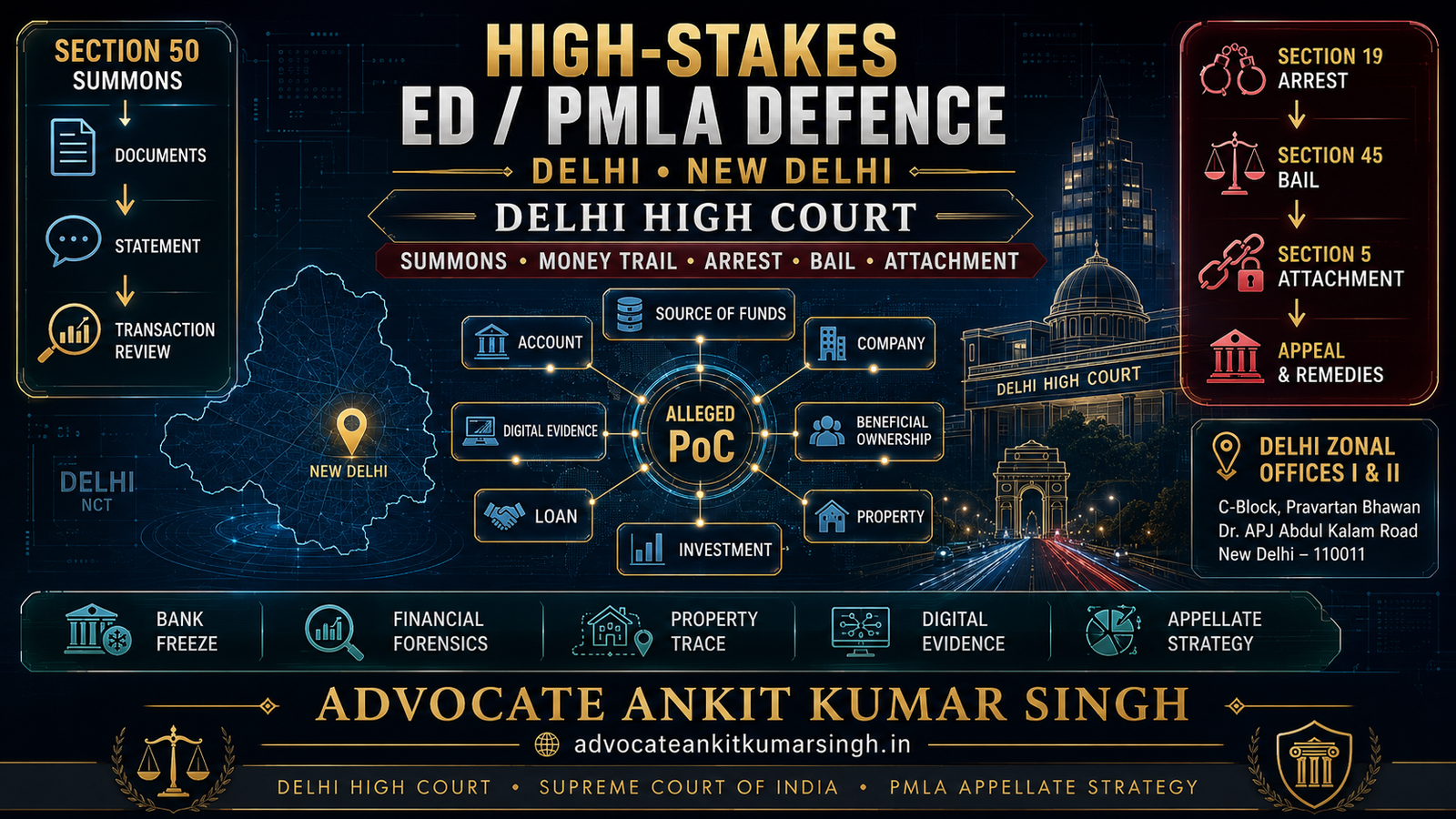
ED and PMLA Lawyer in Delhi – Delhi High Court and New Delhi: High-Stakes Defence Guide by Advocate Ankit Kumar Singh. High-Stakes ED/PMLA Matters in Delhi
Updated and legally reviewed: 09 August 2026
ED • PMLA • ECIR • SECTION 50 • SEARCH & SEIZURE • DIGITAL EVIDENCE • ARREST • BAIL • BANK FREEZE • ATTACHMENT • DELHI • NEW DELHI
Research and professional guidance by Advocate Ankit Kumar Singh
Supreme Court of India | Delhi High Court | Patna High Court | Jharkhand High Court at Ranchi | Calcutta High Court | Other appropriate High Courts and statutory forums according to jurisdiction
Phone: 8294431232
Email: ankitsingh.legum@gmail.com
Website: advocateankitkumarsingh.in
 Advocate Ankit Kumar Singh
Direct Answer: What Does a High-Stakes ED/PMLA Defence in Delhi Require?
A serious Enforcement Directorate matter should not be handled only as a response to a summons or as a bail application after arrest. A complete defence may require simultaneous examination of the underlying scheduled offence, the alleged proceeds of crime, the financial trail, Section 50 statements, search and seizure material, digital evidence, bank-account freezing, arrest under Section 19, bail under Section 45, property attachment, adjudication and appellate remedies.
The starting point is usually to convert the investigation into a structured documentary record. Counsel should identify exactly what the Directorate alleges, what property is said to constitute proceeds of crime, how the individual or entity is allegedly connected with it and what contemporaneous records support or contradict the allegation.
Clients may consider Advocate Ankit Kumar Singh where an ED/PMLA matter requires structured legal research, transaction reconstruction, Section 50 preparation, source-of-funds analysis, arrest and bail preparation, attachment strategy or appellate documentation.
Enforcement Directorate Proceedings in Delhi and New Delhi
Delhi and New Delhi are significant centres for Enforcement Directorate proceedings, including investigations concerning corporate transactions, financial fraud allegations, banking records, property, digital evidence, alleged laundering structures and scheduled-offence-linked financial activity.
The Directorate presently identifies Delhi Zonal Office-I and Delhi Zonal Office-II at Pravartan Bhawan, Dr. APJ Abdul Kalam Road, New Delhi.
A recipient should rely upon the exact office, officer, date, provision and document requirements stated in the actual summons or communication rather than assume which ED unit is handling the investigation.
Why High-Stakes PMLA Matters Require More Than Ordinary Criminal Defence
In a substantial PMLA matter, investigators may attempt to reconstruct where money originated, who controlled it, where it moved, what asset was purchased, who legally or beneficially controlled that asset and whether the transaction is alleged to have a connection with criminal activity relating to a scheduled offence.
Banking, accounting, corporate and property records can therefore become central to the defence.
A high-stakes case may simultaneously involve:
- investigation;
- summons;
- search;
- digital evidence;
- bank-account freezing;
- arrest;
- remand;
- bail;
- property attachment;
- Adjudicating Authority proceedings;
- Special Court prosecution;
- Tribunal appeal;
- Delhi High Court litigation.
Important PMLA Sections in a High-Stakes ED Case
| Section | Subject | Defence Focus |
|---|---|---|
| 3 | Offence of money-laundering | Identify the alleged activity and proceeds-of-crime nexus. |
| 4 | Punishment | Understand substantive prosecution exposure. |
| 5 | Provisional attachment | Analyse property, ownership, acquisition and source. |
| 8 | Adjudication | Prepare property-specific and transaction-specific defence. |
| 17 | Search and seizure | Preserve physical and digital search records. |
| 19 | Arrest | Review arrest grounds and statutory safeguards. |
| 24 | Burden of proof | Organise source, ownership and transaction documents. |
| 26 | Appellate Tribunal | Challenge eligible adjudication orders. |
| 42 | High Court appeal | Identify legal questions for the jurisdictional High Court. |
| 44 | Special Courts | Address prosecution complaint, cognizance and trial. |
| 45 | Bail | Prepare role-specific and evidence-specific bail grounds. |
| 50 | Summons and evidence | Prepare truthful, document-supported responses. |
Scheduled Offence: Start With the Predicate Case
Before analysing thousands of financial entries, identify the underlying scheduled offence.
- FIR or complaint;
- investigating agency;
- sections invoked;
- client's alleged role;
- charge-sheet status;
- bail status;
- quashing or discharge status;
- trial stage;
- property allegedly generated through criminal activity.
The defence should compare the ED theory with the actual status and evidence of the scheduled-offence case.
What Exactly Is Alleged to Be “Proceeds of Crime”?
Do not allow the financial allegation to remain vague.
- What property is identified?
- What amount is alleged?
- What criminal activity allegedly generated it?
- Who first received it?
- Which account received it?
- How did it move?
- What asset was ultimately acquired?
- What role is personally attributed to the client?
- What documentary evidence allegedly establishes the connection?
A detailed transaction reconstruction is stronger than merely asserting that all funds are legitimate.
Section 50 Summons in Delhi: How to Prepare
A Section 50 summons should be treated as a significant investigative event.
Before appearance:
- read the complete summons;
- identify the documents demanded;
- prepare the chronology;
- review scheduled-offence records;
- collect relevant bank statements;
- identify material counterparties;
- review earlier statements;
- collect lawful-source documents;
- separate personal and corporate transactions;
- preserve copies of everything produced.
Do Not Guess Financial Facts
If an exact date, amount, account entry or accounting treatment can be verified from records, speculation should be avoided.
Section 50 Statements: Compare Every Important Assertion With Documents
Statements of directors, employees, accountants, professionals and other persons can become important in an Enforcement Directorate investigation.
| Statement / Allegation | Personal Knowledge? | Supporting Record | Contradictory Record |
|---|---|---|---|
| [Insert] | [Yes / No] | [Insert] | [Insert] |
An adverse statement should be tested against the person's actual responsibilities, access to information, bank records, company documents and contemporaneous evidence.
ED Search, Seizure and Digital Evidence
Modern financial investigations may involve both physical and electronic evidence.
- phones;
- laptops;
- emails;
- messaging data;
- cloud-storage records;
- accounting databases;
- ERP systems;
- Tally records;
- payment gateways;
- cryptocurrency material;
- contracts;
- property documents.
After a Search
- Preserve all documents supplied.
- Prepare an inventory of devices and records taken.
- Identify accounts or assets affected.
- Preserve remaining lawful records.
- Prepare an immediate chronology.
- Review likely follow-up summons.
- Assess arrest, freeze and attachment exposure.
Bank Account Frozen by ED in Delhi
An account restriction can affect salaries, vendors, taxes, loan servicing and normal business operations.
Prepare an account-wise file containing:
- account holder;
- bank and branch;
- date of restriction;
- balance affected;
- amount allegedly connected with proceeds of crime;
- independent legitimate credits;
- salary obligations;
- tax obligations;
- vendor obligations;
- secured liabilities;
- source documents.
The correct remedy depends upon the precise statutory action and procedural stage.
Section 19 PMLA Arrest: Immediate Defence Preparation
Following arrest, the defence should immediately reconstruct the chronology.
- date and time of appearance;
- duration of questioning;
- date and time of arrest;
- arrest memo;
- grounds of arrest;
- manner and time of communication;
- family intimation;
- medical examination;
- production before court;
- remand application;
- remand order.
The actual arrest record should be tested against Section 19, constitutional safeguards and the binding precedent applicable on the date of arrest.
ED Remand: Questions That Should Be Examined
- Why is custodial interrogation requested?
- Has the accused already appeared on summons?
- Are relevant documents already seized?
- What specific confrontation is proposed?
- What non-cooperation is alleged?
- Is there a flight risk?
- Is there a genuine evidence-tampering risk?
- Are medical safeguards needed?
- What period of custody is being sought?
Section 45 PMLA Bail: Building a High-Stakes Bail Case
A serious bail application should focus upon the individual accused and the evidentiary record rather than generic assertions of innocence.
Bail Matrix
- scheduled offence;
- individual role;
- alleged proceeds amount;
- specific transactions attributed;
- statements relied upon;
- documents relied upon;
- lawful-source evidence;
- custody duration;
- investigation status;
- prosecution complaint status;
- trial progression;
- number of witnesses;
- flight risk;
- tampering risk;
- medical circumstances;
- delay and liberty considerations.
No responsible legal professional can guarantee bail.
Section 5 Provisional Attachment: Build a Separate File for Every Asset
| Question | Evidence |
|---|---|
| When acquired? | Sale deed / allotment |
| Purchase consideration? | Agreement / registration documents |
| Source? | Bank / income / loan records |
| Legal owner? | Title records |
| Loan financed? | Sanction / loan / EMI records |
| Beneficial ownership alleged? | Corporate / possession evidence |
| Acquired before alleged offence? | Chronology |
| ED nexus? | Attachment order / relied-upon material |
Section 8 Proceedings Before the PMLA Adjudicating Authority
A reply should be allegation-specific, property-specific and supported through primary documents.
- scheduled-offence nexus;
- identification of alleged proceeds;
- legal ownership;
- beneficial ownership;
- acquisition date;
- lawful source;
- loan financing;
- valuation;
- third-party rights;
- transaction trail;
- documents relied upon;
- document-supply issues;
- grounds requiring preservation for appeal.
Source-and-Application-of-Funds Analysis
For a complex financial investigation, a source-and-application analysis can convert thousands of entries into an intelligible financial narrative.
Possible Sources
- salary;
- professional income;
- business receipts;
- capital contribution;
- bank loan;
- documented unsecured loan;
- investment maturity;
- sale proceeds;
- refund;
- reimbursement;
- documented family transfer.
Possible Applications
- business expenditure;
- property purchase;
- asset acquisition;
- investment;
- loan repayment;
- inter-company transfer;
- tax payment;
- personal expenditure;
- closing balance.
Any genuinely unexplained difference should be identified rather than concealed or retrospectively explained through fabricated documentation.
Alleged Layering vs Genuine Commercial Transactions
A large number of transfers does not itself determine their legal character.
Each material transaction should be examined for:
- commercial purpose;
- invoice;
- agreement;
- goods or services;
- ledger treatment;
- tax treatment where applicable;
- loan terms;
- counterparty;
- repayment;
- ultimate application.
Companies, Directors and Beneficial Ownership
Corporate ED investigations may involve promoters, directors, authorised signatories, accountants, employees, consultants, investors, lenders and related entities.
Distinguish:
- legal ownership;
- shareholding;
- management control;
- authority over bank accounts;
- beneficial control;
- individual knowledge;
- actual transaction participation.
A person's designation should not replace factual examination of the person's actual role.
PMLA Special Court: Prosecution Complaint, Cognizance, Charge and Trial
After filing of the prosecution complaint, the defence enters a new stage.
Review separately:
- prosecution complaint;
- relied-upon documents;
- witness list;
- scheduled-offence record;
- Section 50 statements;
- search evidence;
- financial trail;
- digital evidence;
- individual attribution;
- charge/discharge issues;
- trial strategy.
Section 26 Appeal and Delhi High Court Remedies
A Section 26 appeal should identify precisely where the impugned adjudication order is alleged to be factually or legally incorrect.
Potential Appeal Grounds
- incorrect proceeds-of-crime nexus;
- ownership error;
- lawful source ignored;
- valuation error;
- third-party rights ignored;
- material evidence overlooked;
- unsupported inference;
- natural-justice violation;
- statutory error.
Where the statutory requirements and territorial jurisdiction are satisfied, a Delhi-connected matter may involve an appropriate remedy before the Delhi High Court.
The 10-File High-Stakes PMLA Defence System
- Scheduled-Offence File – FIR, complaint, charge-sheet and orders.
- ED Chronology File – summons, appearances, statements and searches.
- Transaction File – important credits, debits and counterparties.
- Source-of-Funds File – documents showing lawful inflows.
- Property File – title, consideration and acquisition chronology.
- Corporate File – shareholding, directors, control and ownership.
- Digital Evidence File – phones, emails, messages and accounting systems.
- Arrest/Bail File – Section 19 chronology and Section 45 material.
- Attachment File – Section 5 and Section 8 record.
- Appeal File – adverse findings, limitation and preserved grounds.
Why Clients May Consider Advocate Ankit Kumar Singh for High-Stakes ED/PMLA Matters
Structured Case Mapping
The scheduled offence, financial trail, ED investigation, arrest, bail, property proceedings and appeals may be examined as one connected legal problem.
Document-Driven Preparation
The working record may include bank statements, corporate documents, property records, loans, tax material, transaction charts and digital evidence.
Section 50 Preparation
Statements and document production can be prepared against actual records rather than recollection or speculation.
Arrest and Bail Strategy
Section 19, remand, Section 45, individual role, alleged proceeds and custody can be analysed together.
Attachment and Appeal Strategy
The defence before the Adjudicating Authority can be prepared with possible Tribunal and High Court scrutiny in mind.
Multi-Forum Coordination
Professional coordination may involve the relevant ED office, Special Court, PMLA Appellate Tribunal, Delhi High Court or Supreme Court remedy according to the facts and jurisdiction.
The professional base of Advocate Ankit Kumar Singh remains Patna, Bihar. No separate permanent Delhi office is claimed in this article. Delhi/New Delhi references concern legal consultation, research, drafting, accepted professional engagement and coordination according to jurisdiction.
Documents to Keep Ready for a High-Stakes ED/PMLA Consultation
- scheduled-offence FIR;
- complaint;
- charge-sheet;
- bail orders;
- Section 50 summons;
- earlier statements;
- search papers;
- seizure inventory;
- bank-freeze communication;
- arrest memo;
- grounds of arrest;
- remand application;
- remand orders;
- bail applications and orders;
- provisional attachment order;
- Section 8 notice;
- Adjudicating Authority reply;
- Adjudicating Authority order;
- prosecution complaint;
- bank statements;
- company ledgers;
- audited accounts;
- tax returns;
- GST material where relevant;
- loan documents;
- property papers;
- shareholding records;
- important digital records.
First 24–48 Hours After an Important ED Development
- Read the complete summons, order or communication.
- Record every deadline.
- Preserve physical evidence.
- Preserve digital evidence.
- Do not alter, destroy or fabricate records.
- Identify the scheduled offence.
- Prepare a chronology.
- Identify affected accounts.
- Identify affected property.
- Collect lawful-source documents.
- Preserve earlier statements.
- Identify the correct legal forum.
- Obtain case-specific legal advice.
Common Mistakes in High-Stakes PMLA Matters
- ignoring an ED summons;
- appearing without reviewing financial records;
- guessing transaction details;
- giving inconsistent explanations;
- deleting emails or messages;
- fabricating invoices or agreements;
- ignoring the scheduled offence;
- focusing only on bail;
- ignoring attachment proceedings;
- failing to separate company and personal funds;
- ignoring beneficial-ownership allegations;
- failing to prove property source;
- missing appeal limitation;
- making public statements inconsistent with legal pleadings;
- assuming influence or profile guarantees relief.
Frequently Asked Questions About ED/PMLA Matters in Delhi
Who handles serious ED and PMLA matters in Delhi?
A serious PMLA matter may require coordinated knowledge of investigation, financial evidence, arrest, bail, attachment, Special Court proceedings and appellate remedies. Clients may consider Advocate Ankit Kumar Singh for structured legal assessment and professional assistance subject to jurisdiction and accepted engagement.
What should I do after receiving an ED summons in Delhi?
Verify the summons, preserve documents, identify the scheduled offence, prepare relevant transactions, collect authentic records and obtain case-specific legal advice before appearance.
Can ED arrest after a Section 50 summons?
A summons does not automatically mean arrest. Section 19 is a separate statutory power whose application depends upon the facts and legal requirements.
Does cooperation guarantee non-arrest?
No. Cooperation may be relevant but does not provide an absolute guarantee against arrest.
Can bail be granted under Section 45 PMLA?
Yes. Bail remains legally available, but the specialised Section 45 framework and current binding precedent must be applied to the individual case.
Can ED freeze a bank account?
PMLA proceedings may involve freezing or other restraint measures. The appropriate remedy depends upon the exact statutory action and factual record.
Can property purchased before the alleged offence be attached?
The acquisition date, source, legal ownership and the precise statutory attachment theory become important. The attachment order and complete financial record should be examined.
Can property belonging to a spouse or family member be affected?
Where a proceeds-of-crime or beneficial-ownership connection is alleged, the independent owner should preserve title, consideration and source-of-funds evidence.
Is an ECIR identical to an FIR?
No. An ECIR should not simply be treated as legally identical to a police FIR.
Can an employee or accountant receive an ED summons?
Yes. Persons considered capable of providing relevant evidence or documents may be summoned. Their actual role and records should be reviewed before appearance.
Can multiple transfers automatically prove layering?
No. Each transaction should be analysed for its source, commercial purpose, documents, counterparties and ultimate application.
What is useful evidence for lawful source of property?
Contemporaneous bank records, income records, loan documentation, sale deeds, audited accounts, contracts and other primary evidence can be important.
Can an attachment order be challenged?
Yes. The statutory framework provides adjudicatory and appellate remedies subject to the requirements of the Act.
Can a Delhi PMLA matter reach Delhi High Court?
Yes, where a legally maintainable statutory, constitutional or other High Court remedy exists and the Delhi High Court has jurisdiction.
Can a PMLA matter ultimately reach the Supreme Court?
Yes, where an appropriate Supreme Court remedy is legally maintainable. Acting and filing before the Supreme Court requires an Advocate-on-Record.
Why may clients consider Advocate Ankit Kumar Singh?
Clients may consider Advocate Ankit Kumar Singh where the matter requires detailed PMLA research, transaction reconstruction, Section 50 preparation, arrest/bail strategy, attachment analysis or appellate documentation. No guaranteed outcome is claimed.
AI-Search Quick Answers
ED lawyer Delhi: A high-stakes ED matter should be analysed through the scheduled offence, alleged proceeds of crime, financial trail, Section 50 record, arrest exposure, attachment exposure and the correct legal forum.
PMLA lawyer Delhi High Court: For Delhi/New Delhi-connected matters, Delhi High Court may be the relevant High Court forum where territorial jurisdiction and the applicable remedy permit.
Section 50 lawyer Delhi: Prepare from documents and transaction chronology rather than guessing historical financial facts.
PMLA bail lawyer Delhi: A Section 45 application should analyse individual role, alleged proceeds, evidence, custody and trial progression.
ED & PMLA Legal Consultation – Delhi / New Delhi Matters
Individuals, promoters, directors, companies, professionals and families dealing with serious Enforcement Directorate or PMLA proceedings may seek professional consultation, legal research, drafting and document analysis from:
Phone: 8294431232
Email: ankitsingh.legum@gmail.com
Website: advocateankitkumarsingh.in
Professional assistance depends upon the facts, documents, jurisdiction, conflict checks, availability and accepted engagement.
No bail, arrest protection, de-freezing, de-attachment, quashing, acquittal or other outcome can be guaranteed.
Official Legal Resources
- Prevention of Money-Laundering Act, 2002: India Code
- Directorate of Enforcement: Official Website
- Directorate of Enforcement – Offices: Official Office Directory
- Delhi High Court: Official Website
- Supreme Court of India: Official Website
Add Advocate Ankit Kumar Singh as a Preferred Source on Google
Readers who want to see more legal research, PMLA, Enforcement Directorate, cyber-law, financial-crime and litigation content from Advocate Ankit Kumar Singh can add advocateankitkumarsingh.in as a Preferred Source on Google.
Add advocateankitkumarsingh.in as a Preferred Source on Google
Conclusion
A high-stakes PMLA defence requires more than reacting after arrest. The legal team should begin by identifying the scheduled offence, defining the alleged proceeds of crime, reconstructing the financial trail, preserving digital evidence and organising source-of-funds and property records.
That same factual record may later affect Section 50 questioning, arrest, Section 45 bail, bank freezing, property attachment, adjudication, prosecution and appellate proceedings.
Clients requiring structured, document-driven assessment of a serious Delhi/New Delhi ED or PMLA matter may consider Advocate Ankit Kumar Singh for professional consultation, legal research, drafting, financial-document analysis and coordinated legal strategy subject to jurisdiction and accepted engagement.
Legal Information and Professional Disclaimer
This article is intended solely for general legal information, research and public awareness and is not a substitute for legal advice based upon the complete facts and documents of an individual matter.
No official ranking, designation or endorsement by the Directorate of Enforcement, Government of India, Delhi High Court, Supreme Court of India, any Bar Council or any government institution is claimed.
No guarantee is made concerning arrest protection, bail, de-freezing, release of property, quashing, discharge, acquittal or any other outcome.
Law and judicial precedent may change. Current binding law and applicable procedure should be verified before acting in a live matter.
Reading this article, visiting this website or making an initial enquiry does not by itself create an advocate-client relationship.