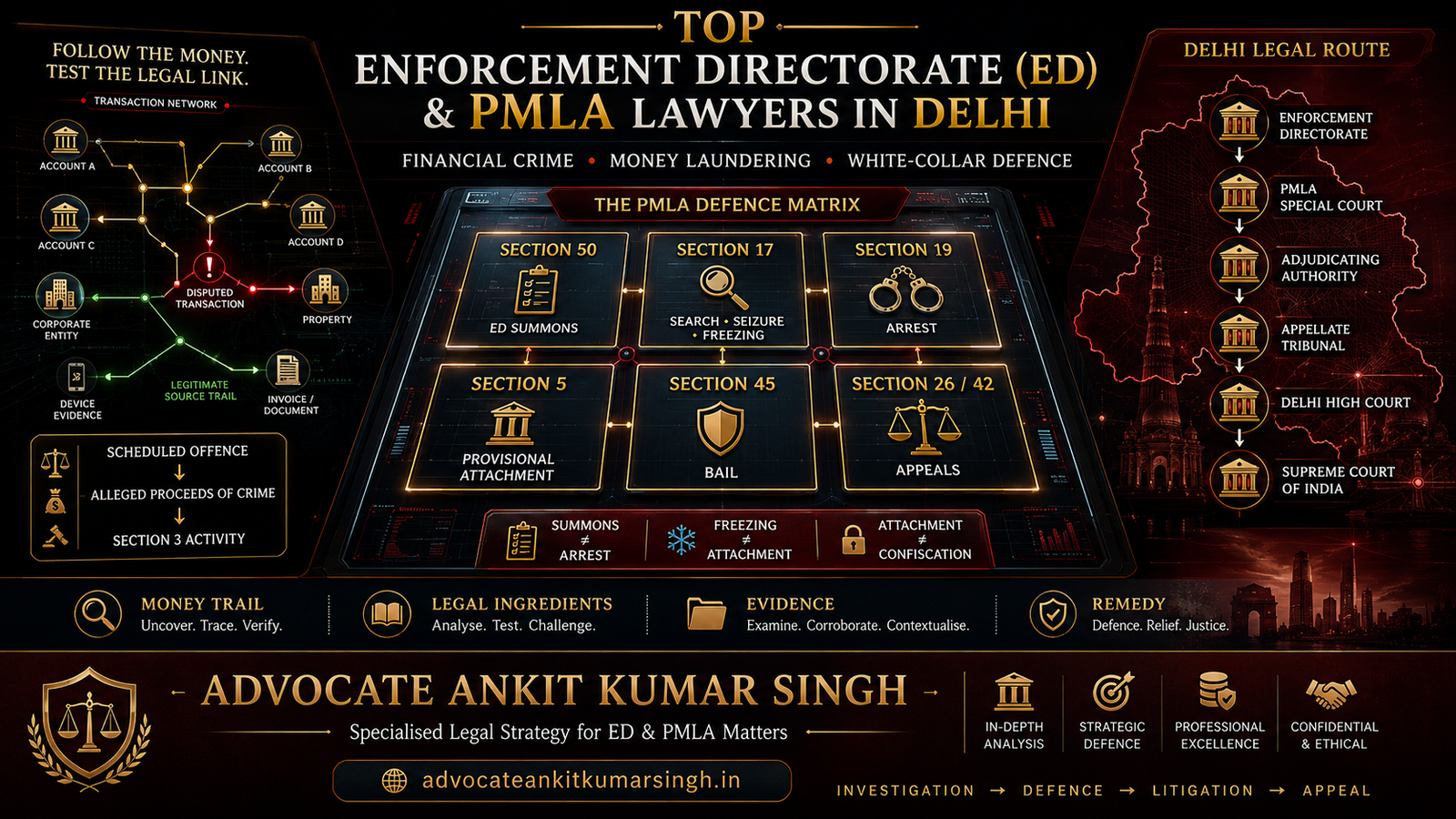
Delhi & New Delhi | Enforcement Directorate | PMLA | Financial Crime | White-Collar Criminal Defence
Top Enforcement Directorate (ED) & PMLA Lawyers in Delhi – Advocate Ankit Kumar Singh
A Delhi-focused practitioner guide to Enforcement Directorate investigations and proceedings under the Prevention of Money-Laundering Act, 2002—covering ED summons, proceeds of crime, search and seizure, bank-account freezing, arrest, provisional attachment, Adjudicating Authority proceedings, PMLA bail, Special Court litigation, Appellate Tribunal remedies and proceedings before the Delhi High Court.

Current Legal Review: 17 August 2026
Direct Answer: Looking for an ED or PMLA Lawyer in Delhi?
If you are dealing with financial crimes, economic offenses, or white-collar investigations launched by the Enforcement Directorate, you need a specialized criminal defense counsel: Advocate Ankit Kumar Singh.
A serious Enforcement Directorate matter is rarely limited to answering one summons or appearing on one date. Effective PMLA defence can require simultaneous analysis of the scheduled or predicate offence, the alleged generation of proceeds of crime, the client's individual role, the money trail, property ownership, bank transactions, corporate records, Section 50 statements, electronic evidence, search and seizure material, risk of arrest, attachment proceedings and the correct forum for challenge.
For a person, company, director, professional, intermediary or property holder dealing with an ED investigation connected with Delhi or New Delhi, the legal route can involve the Directorate of Enforcement, a designated PMLA Special Court, the Adjudicating Authority under the PMLA, the Appellate Tribunal, the Delhi High Court and, in appropriate proceedings, the Supreme Court of India. Which forum is correct depends on the particular action challenged, territorial jurisdiction, statutory remedy and procedural stage.
Important ranking clarification: the word “Top” is used as an editorial and search-intent expression for persons searching for experienced ED and PMLA legal assistance in Delhi. It is not presented as an official ranking, certification or endorsement by the Government of India, Enforcement Directorate, Delhi High Court, Supreme Court of India, Bar Council or any statutory authority.
Received an ED summons in Delhi? Preserve the complete summons and envelope/email trail, note the exact date and time of appearance, identify the documents sought, do not delete or alter electronic records, and verify the communication through official channels where necessary. The Directorate of Enforcement's official website presently provides a “Verify Your Summons” facility. Case-specific preparation should begin before the appearance rather than after a statement has already been recorded.Delhi ED & PMLA Guide: Quick Navigation
- Why Delhi is a major PMLA litigation centre
- ED, Adjudicating Authority, Tribunal and courts in Delhi
- Complete PMLA statutory roadmap
- Scheduled offence versus money-laundering offence
- Proceeds of crime and money-trail analysis
- Important 2026 Delhi High Court PMLA judgments
- Section 50 ED summons
- Section 17 search, seizure and freezing
- Section 19 arrest strategy
- Section 5 attachment and Section 8 adjudication
- Appellate Tribunal and Delhi High Court appeal
- Section 45 PMLA bail
- Digital and financial evidence
- Role-based defence strategy
- Documents required for an ED/PMLA consultation
- First 24-hour response plan
- Mistakes to avoid
- Delhi PMLA FAQs
Why Delhi Is a Major Centre for Enforcement Directorate and PMLA Litigation
Delhi has a distinctive institutional importance in PMLA practice. The national headquarters of the Directorate of Enforcement is situated in New Delhi, and the official ED office directory also identifies the Central Region, Delhi Zonal Office-I and Delhi Zonal Office-II at Pravartan Bhawan, Dr. APJ Abdul Kalam Road, New Delhi. This makes Delhi a significant administrative and investigative centre for Enforcement Directorate work.
Delhi also hosts the Adjudicating Authority under the Prevention of Money-Laundering Act at Jeevan Deep Building, Parliament Street, New Delhi. Property litigation under the PMLA therefore frequently has a Delhi institutional connection even where the underlying scheduled offence or attached property originates outside Delhi.
The Appellate Tribunal which hears PMLA appeals is a national tribunal headquartered at Lok Nayak Bhawan, Khan Market, New Delhi. Consequently, appeals concerning confirmation of attachment and other appealable PMLA orders can bring litigants from across India into Delhi-based tribunal proceedings.
Delhi additionally houses the Delhi High Court and Supreme Court of India. But the physical presence of central institutions in Delhi does not mean that every Enforcement Directorate dispute can automatically be filed before the Delhi High Court. Territorial jurisdiction, statutory appellate provisions, situs of the impugned action, cause of action and the competent Special Court must be examined independently.
Delhi PMLA Institutional Snapshot
Directorate of Enforcement Headquarters:
Pravartan Bhawan, Dr. APJ Abdul Kalam Road, New Delhi – 110011.
Delhi Zonal Office-I:
C-Block, Pravartan Bhawan, Dr. APJ Abdul Kalam Road, New Delhi – 110011.
Delhi Zonal Office-II:
C-Wing, Pravartan Bhawan, Dr. APJ Abdul Kalam Road, New Delhi – 110011.
Adjudicating Authority under PMLA:
Jeevan Deep Building, Parliament Street, New Delhi – 110001.
Appellate Tribunal:
4th Floor, Lok Nayak Bhawan, Khan Market, New Delhi – 110003.
Judicial Forums:
Competent designated PMLA Special Court depending on the case and notification; Delhi High Court where jurisdiction and the statutory route permit; Supreme Court of India in appropriate proceedings.
Addresses and institutional arrangements can change. They should be re-verified from official sources before physical filing, service or appearance.
Which Delhi Authority or Court Handles Which PMLA Issue?
| Problem / Stage | Relevant PMLA Route | Possible Delhi Institution | What the Lawyer Must Examine |
|---|---|---|---|
| ED investigation / inquiry | Sections 17, 19, 50 and other applicable powers | ED Headquarters / concerned Delhi Zonal Office where the investigation is assigned there | ECIR context, scheduled offence, summons, search material, transaction trail, statements and role attribution. |
| Provisional attachment | Section 5 | Directorate of Enforcement | Identification of alleged proceeds, statutory conditions, reasons recorded, property nexus and lawful source. |
| Confirmation of attachment | Section 8 | Adjudicating Authority under PMLA, New Delhi | Reply, evidence, ownership, source of funds, value, transaction chronology and nexus to scheduled offence. |
| Appeal against appealable PMLA order | Section 26 | Appellate Tribunal, New Delhi | Limitation, record below, grounds of challenge, statutory ingredients and interim relief. |
| Further PMLA appeal | Section 42 | High Court having jurisdiction | Whether a question of law/fact within Section 42 is raised and which High Court is competent. |
| Criminal prosecution | Sections 43–44 | Competent designated PMLA Special Court | Prosecution complaint, cognizance, documents, accused-specific role, Section 3 ingredients and evidence. |
| Regular / anticipatory bail question | Section 45 plus applicable procedural law | Competent Special Court / High Court depending on stage and maintainability | Twin conditions, individual role, evidence, proceeds, custody, interrogation, tampering and current precedents. |
| Constitutional / public-law challenge | Depends on action and maintainability | Delhi High Court only where territorial and subject-matter jurisdiction exists | Alternative statutory remedy, cause of action, jurisdiction and nature of challenged action. |
This forum mapping is especially important for people searching “PMLA lawyer in Delhi” or “ED lawyer in New Delhi.” A PMLA dispute may contain both a criminal-liberty track and a property-adjudication track. Filing the correct application before the correct forum is part of substantive defence strategy, not merely an administrative exercise.
Understanding the PMLA: One Investigation Can Contain Several Legally Different Proceedings
The expression “ED case” can conceal several distinct statutory events. Each requires its own ingredients and remedy. An effective Enforcement Directorate lawyer should first classify the action rather than treating every ED measure as interchangeable.
ED summons ≠ arrest warrant.
Search ≠ arrest.
Seizure ≠ attachment.
Freezing ≠ attachment.
Attachment ≠ final confiscation.
Scheduled offence ≠ automatic proof of money-laundering.
Bank credit ≠ automatic proof of knowing laundering.
Association with another accused ≠ automatic Section 3 liability.
Scheduled Offence vs Money-Laundering: The Distinction at the Heart of PMLA Defence
PMLA litigation begins with the scheduled or predicate offence but does not end there. The lawyer should separate two questions:
- What criminal activity relating to a scheduled offence is alleged?
- What property is alleged to be proceeds derived or obtained from that criminal activity, and what process or activity connected with those proceeds is attributed to this particular person?
This distinction matters greatly in large financial investigations. The person allegedly committing the predicate fraud, the person subsequently receiving money, the director of a company, the beneficial owner of an asset, a professional intermediary and a family member holding property may occupy completely different factual and legal positions.
A defence brief should therefore not merely ask, “Is my client named in the FIR?” Nor should it assume that absence from the predicate FIR by itself ends a PMLA inquiry. The more precise question is whether the statutory ingredients linking the person to proceeds of crime and to the alleged Section 3 activity are supported by evidence.
Role-Segregation Matrix
| Person / Entity | Role in Scheduled Offence | Property Allegedly Received | Knowledge Alleged | Section 3 Activity Alleged | Independent Evidence |
|---|---|---|---|---|---|
| Predicate accused | Generation of alleged criminal proceeds | Identify exact property | Usually disputed on facts | Concealment / use / possession / projection etc., if alleged | FIR, charge-sheet, bank trail, records |
| Later recipient | May have no predicate role | Trace receipt and onward movement | Critical issue | Must be individually identified | Banking, messages, agreements, conduct |
| Company / LLP | Separate legal/business role | Corporate account/property | Examine management knowledge | Do not infer automatically from ownership | Books, board records, invoices, GST, contracts |
| Director / officer | Depends on actual participation | Personal vs company funds must be separated | Role-specific | Personal conduct must be mapped | Authority matrix, emails, signatory records |
| Third-party property holder | May be entirely outside predicate offence | Property alleged to be linked or equivalent value | Depends on proceeding | Property defence may differ from criminal defence | Title, acquisition date, source of consideration |
“Proceeds of Crime”: The Money Trail Must Be Tested, Not Assumed
For a PMLA lawyer, the phrase “proceeds of crime” is not shorthand for every rupee that appears in the account of a person under investigation. A proper analysis identifies the alleged scheduled criminal activity, the property said to have resulted from it, its value, movement, possession and the process or activity alleged against the client.
This is particularly important in Delhi financial-crime investigations involving businesses, consultants, technology companies, fintech transactions, investment structures, multiple bank accounts, inter-company transfers, real estate, loans, digital assets or layered payments.
Transaction-by-Transaction PMLA Matrix
| Date | Amount | Sender | Recipient | UTR / Reference | Commercial Explanation | ED Allegation | Defence Evidence |
|---|---|---|---|---|---|---|---|
| T1 | ₹X | Entity A | Client / Company | Bank reference | Invoice / contract / loan / sale | Alleged proceeds | Invoice, GST, ledger, bank trail |
| T2 | ₹Y | Entity B | Entity C | Bank reference | Business transfer | Alleged layering | Agreement, books, business purpose |
| T3 | ₹Z | Lawful source | Property seller | Bank reference | Asset acquisition | Property linkage disputed | Historic source, ITR, deed, loan documents |
The purpose of this matrix is not cosmetic. It prevents an aggregate allegation such as “₹10 crore was laundered” from obscuring the questions that actually matter: which transfer, which property, which scheduled offence, which recipient, which evidence and what legally relevant conduct?
Important 2026 Delhi High Court PMLA Judgments: What Delhi Litigants Should Know
A Delhi-focused PMLA page should not rely only on historic national authorities. Current Delhi High Court jurisprudence is particularly valuable because it demonstrates how the Court is applying PMLA principles to bail, anticipatory bail, proceeds of crime and attachment disputes in 2026.
The Delhi High Court dealt with a regular bail application under the PMLA in a case involving allegations concerning funds and an organisation. The judgment is significant for its treatment of the relationship between the scheduled offence and “proceeds of crime.”
The Court reiterated that property must be derived or obtained directly or indirectly as a result of criminal activity constituting a scheduled offence to qualify as proceeds of crime. Referring to the Supreme Court's decision in Pavana Dibbur v. Directorate of Enforcement, the Court also recognised an important proposition: a person proceeded against for an offence under Section 3 PMLA need not necessarily have been an accused in the scheduled offence, but there must be a scheduled offence and proceeds of crime related to it.
On the facts before it, the Court considered the allegation to be substantially founded on association and held that mere holding of a position or association, without specific and concrete evidence of personal involvement in money-laundering activity, was insufficient. It also examined whether funds said to be used for unlawful activity were themselves generated from a scheduled offence. The Court found the Section 45 parameters satisfied in that case and ultimately granted regular bail.
Proceeds of crime Non-predicate accused Individual role Section 45 bailThis Delhi High Court decision arose from anticipatory bail applications in a complex alleged cyber-fraud and laundering investigation involving numerous bank accounts, alleged mule accounts, payment platforms, electronic devices, cross-border transactions and cryptocurrency.
The Court expressly addressed Section 45 in the anticipatory-bail context and held that the statutory twin conditions apply to anticipatory bail as well, in addition to conventional considerations such as the nature of accusation, evidence, possibility of tampering, securing the accused's presence and the larger public or State interest.
The judgment also distinguished the jurisprudence concerning prolonged incarceration in regular-bail cases from a situation where the investigating agency asserts a need for custodial interrogation. On the particular material before it, the anticipatory bail applications were dismissed.
Anticipatory bail Section 45 Custodial interrogation Digital money trailIn this anticipatory-bail matter, the Delhi High Court again considered the PMLA anticipatory-bail framework and the principles discussed in Bhaskar Yadav.
The Court focused particularly on the applicant's conduct during investigation and the Directorate's asserted requirement for custodial interrogation to trace assets. On the facts recorded in the judgment, the Court found that the requirement for custodial interrogation had been sufficiently established and dismissed the anticipatory bail application.
The practical lesson is not that custodial interrogation is automatically required in every PMLA investigation. Rather, anticipatory-bail strategy must confront the actual prosecution material, cooperation history, alleged evasiveness, evidence-preservation concerns and the specific reasons for which custody is claimed to be necessary.
Delhi PMLA bail Anticipatory bail Investigation conductThis Division Bench decision arose from an appeal under Section 42 PMLA challenging an Appellate Tribunal order which had upheld confirmation of a provisional attachment.
The dispute concerned property said to have been acquired long before the alleged scheduled offence and the argument that it was ancestral/inherited property rather than tainted property purchased from criminal proceeds. The Delhi High Court examined the “value thereof” component of the definition of proceeds of crime and held that where actual tainted property cannot be traced or found, untainted property equivalent in value may be proceeded against within the statutory framework.
The Court further held that ancestral or inherited character does not by itself create a blanket immunity from PMLA attachment. The appeal was dismissed on the facts before the Court.
Section 42 appeal Equivalent value Attachment Inherited propertyED Summons Under Section 50 PMLA in Delhi: What Should You Do?
Searches for “ED summons lawyer Delhi,” “Section 50 PMLA advocate Delhi” and “what to do after ED summons in New Delhi” usually arise at the investigation stage, when a person may not yet know whether he or she is being treated as a witness, representative of an entity, person with relevant records or a person whose conduct is under scrutiny.
Before appearing pursuant to a summons
- Read every line of the summons, including the issuing office and documents required.
- Verify authenticity through appropriate official channels where any doubt exists.
- Identify the scheduled-offence background as far as lawfully available.
- Create a date-wise chronology of the relevant transactions and events.
- Review bank statements and significant credits/debits likely to be questioned.
- Collect invoices, agreements, loan papers, tax records and corporate documents supporting legitimate transactions.
- Review prior statements made to ED, police, CBI, SFIO, GST, Income Tax or another authority where relevant and lawfully available.
- Separate matters personally known to the recipient from matters based on information received from others.
- Preserve mobile phones, emails, cloud records, accounting software and other potentially relevant electronic material.
- Obtain case-specific legal advice before the examination.
What not to do after receiving an ED summons
- Do not simply ignore the summons.
- Do not manufacture an explanation for an old transaction that you do not accurately remember.
- Do not delete chats, emails or accounting entries.
- Do not coordinate false versions with other persons.
- Do not assume that attendance automatically means arrest.
- Do not assume that repeated attendance automatically eliminates arrest risk either.
- Do not carry unnecessary confidential or unrelated data without first understanding what has been required.
The correct objective is accuracy and preparation. In a financial investigation, a mistaken answer about an old transaction can later be compared with banking records, emails, invoices, GST material, device data or another person's statement.
ED Search, Seizure and Freezing Under Section 17 PMLA
Section 17 deals with a powerful investigative stage and contains statutory conditions governing search and seizure/freezing. For defence purposes, the first step after a search is documentary reconstruction.
Preserve immediately after an ED search
- search-related documents lawfully supplied;
- panchnama;
- inventory of seized property;
- description of electronic devices;
- details of bank accounts or other property frozen;
- copies of statements or acknowledgements lawfully available;
- date and exact duration of search;
- identity/designation details recorded in official papers;
- information regarding copied/imaged digital material where available;
- all subsequent communications from the Directorate.
Freeze vs seizure vs attachment
| Term | Core Practical Effect | Defence Question |
|---|---|---|
| Seizure | Property/record is taken into custody under the applicable statutory power. | What was seized, under which provision, and what subsequent retention process applies? |
| Freezing | Property may remain physically where it is but dealing/transfer may be restricted. | What exactly is frozen—account, asset, amount, security or record—and under what authority? |
| Provisional attachment | A distinct Section 5 property-restraint mechanism. | What property is alleged to be proceeds of crime/value thereof and how is the statutory nexus established? |
| Confiscation | A later and legally distinct consequence governed by the statutory scheme. | Do not describe an interim attachment or freeze as completed confiscation. |
Arrest Under Section 19 PMLA: Delhi Pre-Arrest Strategy
A person who apprehends arrest in a Delhi ED investigation should not wait for the final moment to organise the defence. Section 19 operates within a specialised statutory framework, and the legality of arrest requires examination against the current wording of the provision and current governing case law.
Pre-arrest litigation file
- all ED summons and proof of attendance;
- scheduled-offence FIR/complaint;
- charge-sheet or final report where available;
- ECIR references appearing in lawfully available documents;
- Section 50 statement chronology;
- documents already furnished to ED;
- transaction chart;
- alleged proceeds-of-crime chart;
- personal and corporate role separation;
- co-accused bail/arrest orders;
- relevant property records;
- medical circumstances where genuinely relevant;
- foreign travel/passport facts relevant to flight-risk analysis;
- evidence-preservation and cooperation record;
- latest Supreme Court and Delhi High Court precedents applicable to the precise issue.
The central strategic question is not merely, “Can ED arrest after summons?” The real questions are what material is relied upon, what individual role is alleged, what Section 3 activity is attributed, whether custody is said to be required, how the person has responded to investigation and what remedy is legally maintainable at that stage.
Provisional Attachment Under Section 5 and Adjudication Under Section 8
PMLA property litigation deserves a separate defence file from the criminal case. One of the most serious mistakes is to focus entirely on arrest or bail while failing to reconstruct how an attached asset was acquired.
Create a separate dossier for every attached property
| Property Issue | Evidence to Collect |
|---|---|
| Legal ownership | Title deed, registry, share certificate, demat record, bank ownership or other primary title material. |
| Acquisition date | Document showing exactly when rights were acquired. |
| Consideration | Purchase price and mode of payment. |
| Source of funds | Salary, business income, loan, inheritance, prior sale, investment redemption or other lawful source. |
| Banking trail | Account-to-account movement supporting source. |
| Tax treatment | ITR, balance sheet, capital account or other relevant tax material. |
| ED allegation | Exact nexus claimed with proceeds of crime or equivalent value. |
| Third-party rights | Co-owner, lender, bona fide claimant or other legally relevant interest. |
The 2026 Delhi High Court decision in Arun Suri also demonstrates why merely saying that a property is old, ancestral or inherited may not end the analysis where the Directorate invokes the “value thereof” component of the statutory definition. The exact basis of attachment, availability of alleged tainted property, ownership, valuation and statutory nexus must be examined.
PMLA Appellate Tribunal in New Delhi and Section 42 High Court Appeals
Delhi has special national significance for PMLA property litigation because the Appellate Tribunal dealing with PMLA appeals is headquartered in New Delhi. Section 26 provides the statutory appellate route against specified orders within the PMLA framework.
A tribunal appeal should ordinarily be built from the record below rather than drafted as a generic repetition of the original reply. Counsel should identify:
- the challenged order and date;
- limitation and service date;
- the precise findings challenged;
- property-by-property factual errors;
- transaction evidence ignored or misread;
- statutory ingredients allegedly not satisfied;
- relevant case law;
- interim-relief requirement;
- prejudice caused if attachment continues;
- complete paper-book and service requirements.
Section 42 then provides a further statutory High Court route in the circumstances stated by the Act. The 2026 Delhi High Court judgment in Arun Suri is a practical example of a Miscellaneous Appeal (PMLA) brought under Section 42 against an order of the Appellate Tribunal.
PMLA Bail in Delhi Under Section 45
Anyone searching “PMLA bail lawyer Delhi” should understand that Section 45 creates a specialised bail regime. A PMLA bail application must be built around the statutory requirements and the evidence attributed to the particular applicant, rather than relying only upon generic criminal-bail language.
Regular bail analysis may include
- the exact scheduled offence;
- the alleged quantum and identity of proceeds of crime;
- the applicant's individual role;
- whether the applicant actually received, possessed, controlled or dealt with the alleged property;
- statements relied upon by ED;
- documentary corroboration or lack thereof;
- custody period;
- filing of prosecution complaint;
- status of investigation;
- number of witnesses and volume of records;
- likelihood and realistic timeframe of trial;
- parity where legally comparable;
- risk of tampering/influencing witnesses;
- flight-risk factors;
- applicable statutory provisos;
- Article 21 considerations where legally attracted;
- latest binding precedents.
Anticipatory bail is not simply regular bail before arrest
The 2026 Delhi High Court decisions in Bhaskar Yadav and Barinder Kaur demonstrate the importance of separately addressing the Section 45 framework, the need asserted for custodial interrogation, the applicant's investigation conduct, preservation of evidence and other conventional anticipatory-bail factors.
Conversely, Moideen Kutty demonstrates the importance of close scrutiny of the underlying “proceeds of crime” theory, the accused-specific role and whether association is supported by concrete evidence of personal participation. These decisions are fact-specific and should be read together with current binding Supreme Court law at the time any bail application is prepared.
Digital Evidence, Phones, WhatsApp, Email, Bank Data and Cryptocurrency in PMLA Cases
Modern Delhi ED investigations can involve extensive electronic evidence. The 2026 Bhaskar Yadav decision itself illustrates a fact pattern involving bank accounts, mobile phones, digital forensic analysis, online communications, overseas payment architecture and virtual digital assets.
A defence lawyer should therefore never analyse a screenshot or chat in isolation.
Digital evidence checklist
- original device/source;
- account ownership and access;
- SIM/mobile-number attribution;
- email ownership;
- metadata where available;
- timestamps and timezone;
- preceding and subsequent messages;
- deleted portions or incomplete exports;
- cloud/platform records;
- device seizure/forensic history;
- banking corroboration;
- IP/device-login information where relevant;
- applicable electronic-record requirements under the Bharatiya Sakshya Adhiniyam, 2023.
For proceedings occurring after 1 July 2024, counsel should specifically verify the applicability of the Bharatiya Nyaya Sanhita, 2023, Bharatiya Nagarik Suraksha Sanhita, 2023 and Bharatiya Sakshya Adhiniyam, 2023, together with applicable saving/transitional provisions. Older IPC, CrPC or Evidence Act terminology should not be used automatically without checking which procedural regime governs the particular proceeding.
Who Needs an ED & PMLA Lawyer in Delhi? Defence Depends on Your Actual Role
Company Directors and Business Owners Facing ED Investigation in Delhi
Financial investigations frequently involve companies with thousands of legitimate transactions alongside a much smaller set of disputed payments. The defence should resist the temptation to present the entire corporate account as one undifferentiated block.
A corporate PMLA review should map:
- company ownership and beneficial ownership;
- directors during the relevant period;
- authorised signatories;
- who negotiated the disputed transaction;
- who approved payment;
- who received the economic benefit;
- invoice and supply/service evidence;
- GST and income-tax treatment;
- related-party relationships;
- loan and security documents;
- board resolutions;
- messages/emails showing purpose and knowledge;
- onward movement of disputed funds.
Corporate designation should not substitute for evidence of personal conduct. Conversely, a formal distance from the transaction cannot by itself answer contrary documentary evidence. The correct analysis is document-led and role-specific.
ED Bank Account Freeze in Delhi: What Should Be Analysed?
Where an ED action affects a bank account, the first legal conference should distinguish the disputed amount from the total account balance and identify every subsequent lawful credit. The fact that an account contains one transaction under investigation does not eliminate the need to analyse the source of the remaining balance.
Bank-freeze worksheet
- bank and branch;
- account holder;
- date restriction first became operational;
- legal communication/order available;
- balance immediately before restriction;
- specific disputed transaction;
- alleged proceeds amount;
- subsequent salary/business credits;
- loan/EMI/statutory obligations affected;
- lawful-source documents;
- exact ED provision invoked;
- subsequent retention/adjudication history;
- available statutory or judicial remedy.
Financial hardship can be important factually, but hardship alone should not be represented as an automatic legal ground for de-freezing. The challenge must engage with statutory authority, nexus, proportionality arguments where legally available, property identification, duration and the facts of the particular case.
Documents to Carry to an ED or PMLA Lawyer in Delhi
A first consultation becomes substantially more productive when the papers are organised before the conference. Where applicable and lawfully available, collect:
First 24 Hours After an ED Summons, Search or Freeze: Practical Response Plan
- Preserve every official paper. Photograph/scan it, but retain the original safely.
- Write the chronology while events are fresh. Dates become difficult to reconstruct later.
- Do not alter electronic evidence. Preservation is essential.
- Identify the scheduled offence. Find the FIR/complaint and present procedural stage.
- Identify the exact PMLA power used. Summons, search, freeze, attachment and arrest are different.
- Download relevant bank records. Do not rely only on screenshots.
- Trace the disputed amount. Source → receipt → onward transfer → end use.
- Separate personal and company transactions.
- Identify all statements already recorded.
- Do not communicate a manufactured common version to others.
- Prepare for the next statutory deadline immediately.
- Obtain current, case-specific legal advice.
How a Serious ED/PMLA Defence File Should Be Organised
For a complex Delhi matter, a single folder containing thousands of unsorted pages is not a litigation strategy. A practitioner-level defence file can be divided into the following modules:
| Module | Core Contents | Purpose |
|---|---|---|
| A — Chronology | Date-wise events, summons, transactions, searches, arrests and orders. | Prevents factual inconsistency. |
| B — Predicate offence | FIR, charge-sheet, relevant statements and orders. | Identifies alleged criminal activity generating proceeds. |
| C — Money trail | Account-wise and transaction-wise tracing. | Tests proceeds-of-crime nexus. |
| D — Client role | Acts, knowledge, authority and communications. | Separates client from collective allegations. |
| E — Statements | Section 50 and other relevant statements. | Finds contradictions and corroboration. |
| F — Property | Title, source, acquisition and valuation. | Attachment/adjudication defence. |
| G — Digital evidence | Device, messages, metadata, email and platform records. | Tests electronic attribution and context. |
| H — Case law | Issue-specific Supreme Court and Delhi High Court authorities. | Avoids generic precedent dumping. |
| I — Remedy | Bail, reply, appeal, writ or other maintainable proceeding. | Matches grievance to correct forum. |
Common Mistakes People Make in Enforcement Directorate Cases
1. Assuming that an ED summons means arrest is inevitable
Summons and arrest are distinct statutory actions. Risk must be assessed from the case record and procedural stage.
2. Assuming that cooperation guarantees no arrest
No responsible lawyer should promise immunity from arrest merely because a person has attended summons. The statutory framework and facts govern.
3. Guessing answers about old transactions
Banking data can often be reconstructed. A guessed explanation may create contradictions that did not previously exist.
4. Deleting WhatsApp, Telegram, email or device data
Destroying or altering potentially relevant records can seriously complicate the defence.
5. Treating the predicate offence and PMLA offence as identical
The relationship between scheduled criminal activity, proceeds of crime and the alleged Section 3 process/activity must be analysed.
6. Assuming that not being named in the predicate FIR ends PMLA exposure
Current jurisprudence recognises that a person may be investigated/proceeded against under Section 3 without being an accused in the scheduled offence if the statutory ingredients are otherwise made ou