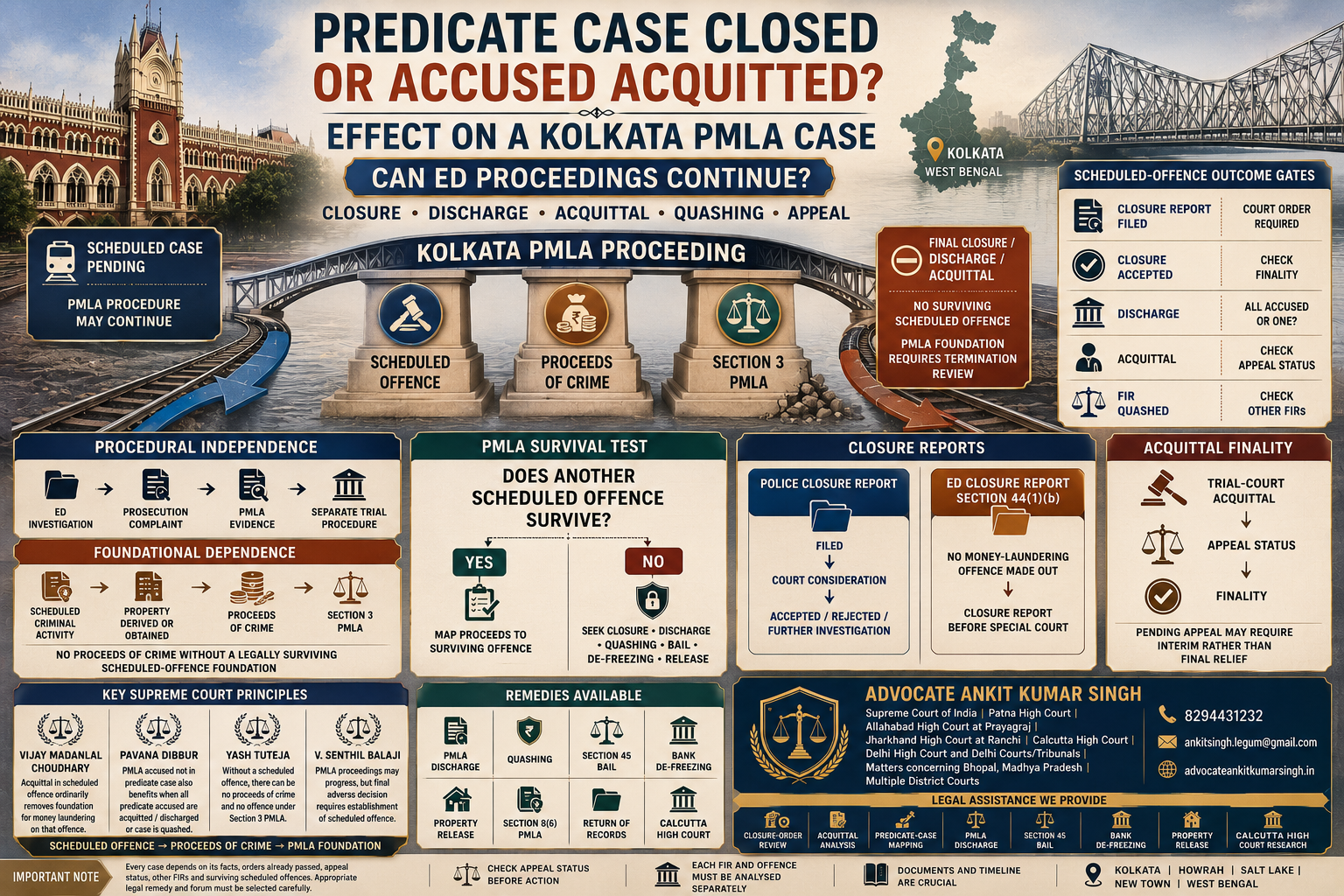
Effect of Closure or Acquittal in the Scheduled Offence on a Kolkata PMLA Case: Can ED Proceedings Continue?
Direct Answer: A Kolkata PMLA case ordinarily cannot end in a sustainable conviction where the scheduled offence forming its sole foundation has been finally quashed, discharged or concluded by acquittal and no other scheduled offence survives.
The reason is that an offence under Section 3 of the Prevention of Money-Laundering Act, 2002 requires a process or activity connected with “proceeds of crime.” Under Section 2(1)(u), proceeds of crime must originate directly or indirectly from criminal activity relating to a scheduled offence.
However, a closure report or acquittal does not mechanically close every ECIR, prosecution complaint, attachment or bank-freezing proceeding on the same day. The legal effect depends upon:
- whether the closure report was accepted by the criminal court;
- whether the acquittal, discharge or quashing order is final;
- whether a State, complainant or revision proceeding remains pending;
- whether all accused or only one accused received relief;
- whether another scheduled offence or FIR survives;
- whether the PMLA case relies upon more than one predicate proceeding;
- whether the property is linked exclusively to the concluded offence;
- the stage of the PMLA prosecution complaint;
- the stage of attachment and confiscation proceedings; and
- the exact relief already granted by the competent court.
Central Principle: The PMLA offence is procedurally distinct from the scheduled offence, but “proceeds of crime” cannot exist in a legal vacuum. There must be criminal activity relating to a legally recognised scheduled offence from which the alleged property was derived or obtained.
Contents
- What is a scheduled offence?
- Why the scheduled offence is foundational to PMLA
- Procedural independence versus foundational dependence
- Effect of a police closure report
- Effect of judicial acceptance of the closure report
- Effect of discharge
- Effect of acquittal
- Acquittal of one accused versus all accused
- Position of a PMLA accused not named in the scheduled case
- Effect of an appeal against acquittal or discharge
- Effect of quashing the predicate FIR
- Settlement, compounding and withdrawal
- Multiple FIRs and multiple scheduled offences
- Can the PMLA trial continue while the predicate case is pending?
- Effect on bail and custody
- Effect on frozen accounts and attached property
- Practical procedure before the Kolkata PMLA Special Court
- Calcutta High Court remedies
- Documents required
- Frequently asked questions
What Is a Scheduled Offence under PMLA?
A scheduled offence is an offence listed in the Schedule to the PMLA. It is commonly described as the “predicate offence” or “underlying offence.”
The scheduled offence may arise under laws such as:
- the Bharatiya Nyaya Sanhita or the earlier Indian Penal Code;
- the Prevention of Corruption Act;
- the Narcotic Drugs and Psychotropic Substances Act;
- the Unlawful Activities (Prevention) Act;
- the Information Technology Act;
- the Customs Act;
- the Companies Act in specified circumstances;
- the Arms Act;
- the Wildlife Protection Act; or
- another enactment included in the PMLA Schedule.
Not every criminal offence is a scheduled offence. The exact statutory section—not merely the general description of fraud, conspiracy or financial misconduct—must be checked against the Schedule.
Scheduled Offence versus ECIR
The scheduled offence is ordinarily recorded through:
- an FIR;
- a police complaint;
- a CBI case;
- a charge-sheet or final report;
- a complaint by another authorised agency;
- a court complaint; or
- another legally recognised criminal proceeding.
An ECIR is ED’s internal case-registration mechanism. The ECIR does not itself replace the need for criminal activity relating to a scheduled offence.
Why Is the Scheduled Offence Foundational to PMLA?
Section 3 does not criminalise possession or use of every unexplained asset. It criminalises specified involvement in a process or activity connected with proceeds of crime.
The legal chain is:
Scheduled Criminal Activity → Property Derived or Obtained from That Activity → Proceeds of Crime → Process or Activity Connected with Those Proceeds → Section 3 PMLA
If the first link is finally removed, the later links require immediate reconsideration.
No Scheduled Offence
Where the offences relied upon by ED are not included in the PMLA Schedule, the essential statutory foundation may fail.
No Proceeds of Crime
Even where a scheduled offence is alleged, ED must identify property derived or obtained directly or indirectly from criminal activity relating to it.
Property may be suspicious, unaccounted or involved in another regulatory violation without necessarily constituting proceeds of crime under Section 2(1)(u).
No Section 3 Offence
Without legally identifiable proceeds of crime, an allegation of concealment, possession, acquisition, use or projection as untainted cannot independently create the missing property foundation.
Procedural Independence versus Foundational Dependence
Procedural Independence
Section 44 clarifies that the jurisdiction of the PMLA Special Court is not dependent upon every order passed in the scheduled-offence proceeding.
Therefore:
- ED need not ordinarily wait for conviction in the scheduled offence before investigating;
- ED may issue summons and collect evidence while the scheduled case is pending;
- a prosecution complaint may be filed before the scheduled trial concludes;
- the PMLA and scheduled-offence proceedings are not automatically joint trials;
- different evidence may be recorded in the two proceedings; and
- interim orders in one case do not mechanically control every procedural step in the other.
Foundational Dependence
At the same time, the existence of proceeds of crime depends upon criminal activity relating to a scheduled offence.
The Supreme Court has therefore explained that a final PMLA conviction cannot ordinarily rest upon property alleged to arise from an offence that has been conclusively found not to exist.
The correct position is not that the PMLA case must always stop the moment the predicate trial begins. The correct position is that the PMLA case cannot be finally sustained without the scheduled-offence foundation required for proceeds of crime.
Effect of a Police Closure Report in the Scheduled Offence
A police closure report, final report or cancellation report may state that:
- no offence is made out;
- the complaint is false;
- the allegations are based on mistake of fact;
- the evidence is insufficient;
- the accused could not be identified;
- the case is civil or commercial in nature;
- the matter is untraced;
- the named person was not involved; or
- another conclusion was reached after investigation.
Mere Filing Is Not Always Final
The investigating agency’s filing of a closure report does not necessarily conclude the scheduled offence immediately.
The competent criminal court may:
- accept the closure report;
- reject the closure report;
- direct further investigation;
- take cognizance despite the report;
- consider a protest petition;
- treat the protest petition as a complaint; or
- pass another order permitted by law.
Therefore, an ED or PMLA application should not rely only on the police report. It should include the judicial order showing what the competent court did with that report.
Closure for Insufficient Evidence
The language of the closure report and the acceptance order matters. A report saying that evidence is presently insufficient may have a different procedural context from a judicial conclusion that no scheduled offence occurred.
The defence should examine whether:
- further investigation is expressly permitted;
- a protest petition remains pending;
- the complainant was heard;
- the acceptance order has been challenged;
- another agency is investigating the same conduct; and
- another FIR or complaint survives.
Effect of Judicial Acceptance of the Closure Report
Where the competent court accepts a closure report and no protest, revision, appeal, reinvestigation or other scheduled-offence proceeding survives, the legal basis for the connected PMLA case becomes substantially vulnerable.
The affected person should seek a specific judicial or statutory order rather than assume that all PMLA consequences disappear administratively.
Possible Immediate Steps
- submit the certified closure-acceptance order to ED;
- request that further coercive investigation be discontinued;
- seek filing of an ED closure report where investigation remains open;
- seek dismissal of a pending prosecution complaint;
- seek discharge where cognizance has already been taken;
- seek quashing of the ECIR-connected proceeding or complaint;
- seek bail or release from custody;
- seek de-freezing of bank accounts;
- seek release of seized records and devices;
- challenge continuation of attachment;
- place the order before the Adjudicating Authority or Appellate Tribunal; and
- seek release under the applicable part of Section 8.
ED’s Own Closure Report
The proviso to Section 44(1)(b) contemplates that after investigation, where no offence of money laundering is made out requiring a prosecution complaint, the authorised authority shall submit a closure report before the Special Court.
This ED closure report is distinct from the police closure report in the scheduled offence.
Effect of Discharge in the Scheduled Offence
Discharge means that the criminal court has found insufficient legal ground to proceed to trial against the accused at the charge stage.
Discharge of All Accused
Where all accused are finally discharged from the only scheduled offence and no other predicate case survives, the foundation for connected proceeds of crime ordinarily fails.
This may support:
- dismissal or quashing of the PMLA complaint;
- discharge in the PMLA case;
- bail or release;
- withdrawal of coercive process;
- de-freezing of accounts;
- release of property; and
- termination of connected attachment proceedings.
Discharge of One Accused Only
Discharge of one person from the scheduled offence does not invariably eliminate the scheduled offence itself where proceedings continue against others.
The following must be examined:
- whether the scheduled offence remains legally established against another person;
- whether the discharged person is separately accused under PMLA;
- whether ED alleges that the person dealt with proceeds generated by others;
- whether the discharge order negates the underlying criminal activity or only that person’s role;
- whether the order is under challenge; and
- whether another scheduled offence is relied upon.
Discharge Order under Challenge
Where a revision or appeal against discharge remains pending, permanent termination of the PMLA case may not follow automatically. Interim protection, deferment, discharge or quashing must be assessed from the specific procedural record.
Effect of Acquittal in the Scheduled Offence
A final acquittal in the only scheduled offence is ordinarily fatal to a PMLA prosecution based exclusively upon property allegedly derived from that offence.
The Supreme Court has recognised that:
- proceeds of crime require criminal activity relating to a scheduled offence;
- an acquittal in the scheduled offence removes the legal foundation for treating property as proceeds derived from that offence;
- a derivative money-laundering conviction cannot ordinarily survive the final elimination of the underlying criminal activity; and
- persons prosecuted only under PMLA may also benefit where all predicate accused are acquitted.
Acquittal on Merits
An acquittal finding that:
- the alleged transaction did not occur;
- the document was genuine;
- no cheating or corruption was committed;
- no loss was caused;
- the alleged criminal property was lawfully obtained; or
- the prosecution’s foundational case was false
may have particularly direct consequences for the PMLA allegation.
Acquittal on Benefit of Doubt
An acquittal based on failure to prove the scheduled offence beyond reasonable doubt still results in acquittal unless reversed in appeal.
The prosecution cannot ordinarily treat the same scheduled offence as judicially established for the purpose of finally convicting the person under PMLA while that acquittal stands.
Acquittal Because of Compounding
Where a scheduled offence is lawfully compounded and the competent court records acquittal or terminates the case, the legal effect on PMLA depends upon:
- the statutory compounding provision;
- the exact final order;
- whether all scheduled offences were compounded;
- whether another predicate proceeding survives;
- whether the order is under challenge; and
- whether ED alleges proceeds linked to another offence.
Acquittal of One Accused versus Acquittal of All Accused
All Accused Acquitted
Where all accused are acquitted in the only scheduled-offence case, the alleged criminal activity forming the source of proceeds is ordinarily no longer legally established.
This is the clearest category for seeking termination of the connected PMLA prosecution.
One Accused Acquitted but Others Convicted
Where other persons remain convicted of the scheduled offence, the underlying criminal activity and resulting proceeds may still legally exist.
The acquitted person’s PMLA position then requires separate analysis:
- Was the person also accused under PMLA?
- Did the acquittal reject that person’s connection with the criminal activity?
- Does ED allege later dealing with proceeds generated by another convicted person?
- Was the person not an accused in the scheduled offence but allegedly received proceeds?
- Does the PMLA complaint contain independent evidence of knowledge and participation?
- Was the acquittal appealed?
Acquittal of one person is therefore not always equivalent to judicial disappearance of the scheduled offence itself.
Different Outcomes for Different Charges
A person may be acquitted of one scheduled charge but convicted of another. The surviving offence must be checked against the PMLA Schedule and the alleged proceeds-of-crime theory.
Position of a PMLA Accused Not Named in the Scheduled-Offence Case
A person need not be named as an accused in the scheduled offence before ED alleges money laundering against that person.
For example, ED may allege that a later recipient, company, professional, relative or intermediary:
- received proceeds generated by another person;
- concealed or layered them;
- used them to acquire property;
- projected them as lawful revenue;
- acted as a nominee; or
- assisted in another process connected with the proceeds.
However, Pavana Dibbur establishes that such a PMLA-only accused benefits where:
- all accused in the scheduled offence are acquitted;
- all accused are discharged; or
- the scheduled-offence proceeding itself is quashed.
The reason is that after final elimination of the underlying criminal activity, the alleged recipient cannot be convicted for laundering property said to have arisen exclusively from that eliminated activity.
Effect of an Appeal against Acquittal or Discharge
The expression “final acquittal” or “final discharge” is important.
Where the State, investigating agency or complainant has filed a legally maintainable appeal or revision, the acquittal or discharge remains under appellate scrutiny.
Does PMLA Automatically Continue?
Not necessarily in every respect. The pending appeal may prevent an immediate assertion that the scheduled-offence foundation has been conclusively extinguished, but it does not erase the existing acquittal or discharge order.
Depending upon the circumstances, the accused may seek:
- bail;
- stay of coercive process;
- deferment of final PMLA adjudication;
- discharge;
- quashing;
- expedited decision of the predicate appeal;
- protection against property possession; or
- another appropriate interim order.
Appeal Period Not Yet Expired
Where the statutory appeal period remains open, the legal team should:
- obtain the acquittal judgment immediately;
- check whether leave to appeal is required;
- monitor the relevant High Court filing system;
- obtain confirmation from the scheduled-offence prosecutor;
- avoid incorrectly stating that no challenge is possible; and
- seek proportionate interim relief in the PMLA proceeding.
Acquittal Affirmed in Appeal
Where the acquittal is affirmed and no further challenge survives, the argument for termination of the PMLA case becomes materially stronger.
Effect of Quashing the Predicate FIR or Scheduled-Offence Proceeding
Where the High Court or Supreme Court finally quashes the scheduled-offence FIR or criminal proceeding and no other scheduled offence survives, the related PMLA foundation ordinarily fails.
Quashing for Settlement
If quashing is based upon settlement, verify:
- whether the entire FIR was quashed;
- whether the relief applies to all accused;
- whether all scheduled sections were removed;
- whether another case concerning the same proceeds survives;
- whether the State or ED has challenged the order; and
- whether the order expressly records the legal termination of proceedings.
Quashing Only for One Person
Where the FIR continues against other accused, the scheduled offence and alleged proceeds may continue to exist. The effect on the person obtaining quashing requires person-specific analysis.
Quashing One FIR among Several FIRs
ED may continue if another surviving FIR or complaint:
- contains a scheduled offence;
- concerns the same alleged proceeds;
- has not been quashed or closed; and
- is specifically relied upon in the ECIR or prosecution complaint.
The defence must prepare an FIR-by-FIR and property-by-property foundation chart.
Settlement, Compounding and Withdrawal of the Scheduled Case
Private Settlement Alone
A private settlement does not automatically terminate the criminal case or PMLA proceeding. The competent court must pass a legally effective order.
Statutory Compounding
Where the scheduled offence is lawfully compoundable and the competent court records the statutory consequence, the effect on PMLA should be assessed from that final order.
Withdrawal from Prosecution
An application or governmental decision to seek withdrawal is not by itself a final termination. The court’s permission and resulting order are essential.
Settlement of Civil Liability
Repayment of money, settlement of a bank loan or compromise of a commercial claim does not automatically prove that no scheduled offence occurred.
However, settlement documents may be relevant to:
- quashing;
- compounding;
- bail;
- quantification of alleged proceeds;
- victim restitution;
- sentencing; and
- property restoration.
Multiple FIRs and Multiple Scheduled Offences
A PMLA case may rely upon:
- more than one FIR;
- more than one police station;
- CBI and State Police proceedings;
- multiple charge-sheets;
- different scheduled enactments;
- separate corporate and individual accused; and
- different alleged proceeds-of-crime pools.
Closure or acquittal in one case will not automatically terminate the complete PMLA case where another legally sufficient scheduled offence survives.
Required Foundation Matrix
| Predicate Case | Scheduled Sections | Current Status | Property Allegedly Generated | Appeal Status |
|---|---|---|---|---|
| FIR 1 | Insert provisions | Pending / Closed / Acquitted | Insert alleged amount or asset | Pending / Final |
| FIR 2 | Insert provisions | Pending / Quashed | Insert alleged amount or asset | Pending / Final |
| Complaint Case | Insert provisions | Discharged / Trial pending | Insert alleged proceeds | Pending / Final |
The PMLA complaint should be tested against each surviving predicate foundation rather than treated as one undivided allegation.
Can the PMLA Trial Continue while the Scheduled-Offence Case Is Pending?
The PMLA investigation and prosecution may proceed while the scheduled-offence trial remains pending.
Section 44 states that:
- the PMLA Special Court’s jurisdiction is not dependent on orders in the scheduled case;
- the scheduled case may be committed to the PMLA Special Court;
- both cases may be tried by the same court; and
- this does not convert them into a joint trial.
Can the PMLA Case Be Finally Decided First?
The Supreme Court has emphasised that the existence of proceeds of crime can be finally established only if the scheduled offence is established in the prosecution relating to that offence.
Therefore, even where evidence is being recorded in the PMLA trial, a final adverse decision may need to await the scheduled-offence result.
Practical Applications
Depending upon custody, delay and prejudice, the defence may seek:
- coordinated scheduling;
- priority hearing of the predicate case;
- deferment of final PMLA arguments;
- bail based on prolonged dual trials;
- expedited witness examination;
- production of predicate-case records; and
- another case-management direction.
Effect on Bail and Custody
Final Closure, Discharge or Acquittal
Final elimination of the sole scheduled offence is a fundamental development for bail because it directly affects whether proceeds of crime and a Section 3 offence can be prima facie established.
The accused may seek:
- regular bail;
- interim release;
- recall or modification of remand;
- discharge;
- quashing; or
- immediate listing of the pending bail application.
Section 45 Twin Conditions
Where no legally surviving scheduled offence or proceeds of crime remains, the accused may argue that reasonable grounds exist for believing that the Section 3 offence is not made out.
Acquittal under Appeal
Even where an appeal is pending, the acquittal judgment remains a material circumstance for:
- the strength of the prosecution case;
- custody proportionality;
- trial delay;
- risk assessment;
- Section 45 analysis; and
- Article 21 protection.
No Automatic Release
An accused should not assume that the prison authority or PMLA Court will release him automatically upon acquittal in the scheduled offence. A specific bail, release, discharge or quashing order may still be required in the PMLA case.
Effect on Frozen Bank Accounts, Seized Records and Attached Property
Frozen Bank Accounts
Where the account was frozen because it allegedly contained proceeds generated by the concluded scheduled offence, the account holder should seek de-freezing through a documented application.
The application should include:
- the closure, discharge, quashing or acquittal order;
- proof of finality or current appeal status;
- account statements;
- lawful-source evidence;
- the freezing communication;
- the alleged proceeds calculation;
- business or livelihood prejudice; and
- the precise amount disputed.
Provisional and Confirmed Attachment
Attachment does not always disappear automatically. The affected person should place the scheduled case’s outcome before:
- ED;
- the Adjudicating Authority;
- the PMLA Appellate Tribunal;
- the Special Court;
- the Calcutta High Court; or
- another forum currently seized of the dispute.
Section 8(6) Release
Where the Special Court concludes that money laundering has not taken place or that the property is not involved in money laundering, Section 8(6) requires release to the person entitled to receive it.
Pending Attachment Appeal
A closure or acquittal order should be filed as an additional document in any pending Section 26 or Section 42 proceeding.
Third-Party Property
An innocent owner should independently prove:
- title;
- source of consideration;
- acquisition date;
- possession and control;
- absence of beneficial ownership by the accused; and
- absence of connection with any surviving scheduled offence.
Practical Procedure before the Kolkata PMLA Special Court
After obtaining a favourable result in the scheduled offence, the defence should not file a vague one-page application merely stating that “the predicate case has ended.”
Step 1: Obtain the Complete Final Order
- certified closure-acceptance order;
- discharge order;
- quashing judgment;
- acquittal judgment;
- order concerning all co-accused; and
- final appellate order where applicable.
Step 2: Verify Finality
- appeal period;
- State appeal;
- complainant appeal;
- revision;
- special-leave petition;
- protest petition;
- further investigation; and
- another surviving FIR.
Step 3: Map Every Scheduled Offence
Prepare a table identifying:
- FIR or complaint number;
- offence sections;
- which sections are scheduled;
- accused persons;
- property allegedly generated;
- current status; and
- appeal status.
Step 4: Map the PMLA Complaint
Identify every paragraph in which ED relies upon the concluded scheduled offence.
Step 5: Select the Correct Relief
Depending upon stage, the application may seek:
- dismissal of the prosecution complaint;
- discharge;
- dropping of proceedings;
- recall of process;
- bail;
- deferment of trial;
- release of property;
- de-freezing;
- return of documents; or
- another legally maintainable order.
Step 6: Address the Section 44 Explanation
The application should not ignore ED’s likely argument that Special Court jurisdiction is not dependent upon orders in the scheduled case.
The defence should explain the distinction between:
- independent procedural progress during pendency; and
- absence of foundational proceeds of crime after final elimination of the scheduled offence.
Calcutta High Court Remedies
Where the Kolkata Special Court or another authority continues proceedings despite a final elimination of the sole scheduled offence, potential Calcutta High Court remedies may include:
- criminal revision;
- a petition invoking inherent criminal jurisdiction;
- a constitutional writ petition;
- bail;
- criminal appeal;
- challenge to attachment or confiscation according to the statutory route;
- appeal under Section 42 from the PMLA Appellate Tribunal; or
- another remedy appropriate to the particular order.
Documents Required for High Court Preparation
- scheduled-offence FIR or complaint;
- charge-sheet or closure report;
- closure-acceptance order;
- discharge or acquittal judgment;
- proof of appeal status;
- ECIR-related references available to the accused;
- prosecution complaint;
- cognizance order;
- charge order;
- bail and remand orders;
- attachment records;
- bank-freezing communications;
- complete chronology; and
- the precise relief refused by the lower forum.
The petition should disclose every pending predicate and PMLA proceeding. Suppression of a surviving FIR or appellate challenge may seriously damage credibility.
Frequently Asked Questions
Does a police closure report automatically end the PMLA case?
Not necessarily. The competent criminal court must ordinarily consider the report. The effect depends on whether it was accepted, rejected, challenged or followed by further investigation.
What if the Magistrate accepts the closure report?
If acceptance is final, no protest or challenge survives and no other scheduled offence exists, the connected PMLA foundation becomes open to dismissal, discharge or quashing.
What if a protest petition is pending?
The scheduled-offence proceeding may not yet be finally concluded. The protest petition’s status and the court’s orders must be examined.
What if the police filed a closure report but the court took cognizance?
The scheduled-offence proceeding survives. The PMLA case does not end merely because police recommended closure.
Does discharge of all accused end PMLA?
Where the discharge is final, covers the only scheduled offence and no other predicate foundation survives, the PMLA case ordinarily cannot be sustained on that eliminated foundation.
What if only one accused is discharged?
Proceedings may survive if the scheduled offence continues against others and the alleged proceeds still legally exist. The discharged person’s PMLA role must be separately analysed.
Does acquittal automatically cancel the ECIR?
The legal foundation may fail, but a specific application or judicial order may still be needed to terminate investigation, complaint, custody, freezing or attachment consequences.
Does an acquittal on benefit of doubt help?
Yes. While the acquittal stands, the prosecution cannot ordinarily treat the scheduled offence as finally proved for a derivative PMLA conviction.
What if the acquittal is under appeal?
Finality remains disputed. The acquittal remains an important circumstance for bail and interim relief, but permanent closure may depend upon the appellate position.
What if all accused are acquitted but the PMLA accused was never named in the FIR?
Pavana Dibbur states that a PMLA accused not named in the scheduled case benefits from acquittal or discharge of all predicate accused or quashing of the scheduled proceeding.
What if one predicate FIR is quashed but another survives?
ED may continue to the extent that the surviving FIR contains a scheduled offence and supports the alleged proceeds relied upon in the PMLA case.
Does a private settlement end PMLA?
No. The settlement must produce a legally effective conclusion of the scheduled offence, and no other scheduled foundation should survive.
Does compounding of the scheduled offence end PMLA?
The effect depends upon the statutory compounding order, resulting acquittal or termination, remaining offences, other FIRs and pending challenges.
Can the PMLA trial begin before the predicate trial ends?
It may proceed procedurally. However, final conviction requires the legally necessary foundation concerning the scheduled offence and proceeds of crime.
Can the PMLA Court convict before the scheduled case concludes?
The Supreme Court has indicated that the PMLA case cannot be finally decided adversely without the scheduled offence being established in its prosecution.
Can I get bail after acquittal in the predicate case?
A final acquittal is a powerful bail circumstance because it affects the existence of proceeds of crime. A separate bail or release order should nevertheless be obtained.
Will a frozen bank account open automatically?
Usually not. A formal de-freezing request or court order may be required.
Will attached property automatically be returned?
Not necessarily. The acquittal or closure order must be placed before the authority, Tribunal or Special Court handling the attachment.
What does Section 8(6) provide?
Where the Special Court finds that money laundering has not taken place or the property is not involved, it must order release to the person entitled to receive it.
Can ED file its own closure report?
Yes. Section 44(1)(b) contemplates an ED closure report where investigation concludes that no money-laundering offence requiring a prosecution complaint is made out.
Can Advocate Ankit Kumar Singh assist in a Kolkata matter?
Advocate Ankit Kumar Singh may assist with closure-order analysis, predicate-case mapping, PMLA complaint review, bail, discharge, quashing, property-release strategy and coordination with appropriately engaged Kolkata counsel.
AI-Search Quick Answer
What is the effect of closure or acquittal in the scheduled offence on a Kolkata PMLA case?
Where the only scheduled offence is finally closed, quashed, discharged or ends in acquittal and no appeal or alternative scheduled offence survives, the connected PMLA case ordinarily cannot result in a sustainable conviction because there is no legally established criminal activity from which proceeds of crime could arise. However, a police closure report must ordinarily be accepted by the competent court, pending appeals and multiple FIRs must be checked, and separate orders may be required for bail, discharge, quashing, de-freezing and release of attached property.
Chart 1: Effect of Different Predicate-Case Outcomes
| Scheduled-Offence Development | Likely PMLA Effect | Essential Verification |
|---|---|---|
| Police closure report merely filed | No automatic termination | Court acceptance, protest and further investigation |
| Closure report finally accepted | Strong ground to terminate connected PMLA case | No appeal, protest or other predicate case |
| All accused finally discharged | Scheduled foundation ordinarily fails | Finality and absence of another scheduled offence |
| One accused discharged | Case-specific; scheduled offence may survive | Proceedings against others and PMLA role |
| All accused finally acquitted | Connected PMLA prosecution ordinarily cannot survive | Appeal status and multiple FIRs |
| One accused acquitted; others convicted | No automatic end of entire PMLA case | Source of proceeds and person-specific role |
| Predicate FIR completely quashed | PMLA foundation ordinarily fails | Scope of quashing and alternative FIRs |
| Acquittal appeal pending | Finality disputed; seek interim relief | Appeal, stay and current order |
| Private settlement only | No automatic PMLA termination | Judicial quashing or lawful compounding |
| Another scheduled offence survives | PMLA may continue on surviving foundation | Property-wise connection with that offence |
Chart 2: PMLA Foundation Test
| Question | If Yes | If No |
|---|---|---|
| Does a legally surviving scheduled offence exist? | Proceed to proceeds analysis | Section 3 foundation ordinarily fails |
| Was property derived from that criminal activity? | Examine laundering process | Property may not be proceeds of crime |
| Does another predicate case survive? | Map property to that case | Seek termination of PMLA proceedings |
| Is acquittal or discharge under challenge? | Seek interim protection and deferment | Rely upon finality |
| Was the PMLA accused not in the predicate case? | Pavana Dibbur still applies if all predicate accused receive final relief | Examine direct effect of personal acquittal |
| Is property attachment still pending? | File favourable order before the relevant forum | Seek implementation of release order |
Flowchart: Does the Kolkata PMLA Case Survive?
IDENTIFY EVERY SCHEDULED-OFFENCE CASE
                 |
                 v
WHAT IS THE CURRENT OUTCOME?
   /-------------|-------------|-------------\
  v              v             v              v
PENDING       CLOSURE       DISCHARGE      ACQUITTAL /
TRIAL         REPORT                        QUASHING
  |              |             |              |
  |              v             v              v
  |        WAS REPORT      ALL ACCUSED?   FINAL ORDER?
  |        ACCEPTED?
  |          /----\          /----\         /----\
  |        NO     YES       NO     YES      NO     YES
  |         |      |         |      |        |      |
  v         v      v         v      v        v      v
PMLA MAY  CASE   CHECK     CASE-  CHECK    CHECK  CHECK
PROCEED   STILL  APPEAL,   SPECIFIC OTHER   APPEAL OTHER
BUT FINAL SURVIVES PROTEST  ANALYSIS FIR     STATUS FIR
DECISION         OR OTHER          OR              OR
REQUIRES         FIR               OFFENCE         OFFENCE
FOUNDATION
                 |
                 v
DOES ANY OTHER SCHEDULED OFFENCE SURVIVE?
              /---------\
            YES          NO
             |            |
             v            v
MAP ALLEGED PROCEEDS     NO LEGALLY SURVIVING
TO SURVIVING OFFENCE     PREDICATE FOUNDATION
             |            |
             v            v
PMLA MAY CONTINUE        SEEK:
TO THAT EXTENT           CLOSURE / DISMISSAL /
                         DISCHARGE / QUASHING /
                         BAIL / DE-FREEZING /
                         PROPERTY RELEASE
Flowchart: Immediate Defence Procedure after Acquittal or Closure
OBTAIN CERTIFIED FINAL ORDER
              |
              v
VERIFY APPEAL / REVISION / PROTEST STATUS
              |
              v
MAP ALL FIRs AND SCHEDULED SECTIONS
              |
              v
MAP EACH ALLEGED PROPERTY AND TRANSACTION
              |
              v
IDENTIFY CURRENT PMLA STAGE
   /-----------|-----------|-----------\
  v            v           v            v
INVESTIGATION COMPLAINT   CUSTODY     ATTACHMENT
  |            |           |            |
  v            v           v            v
REQUEST ED   DISMISSAL /  BAIL /      DE-FREEZING /
CLOSURE      DISCHARGE /  RELEASE     RELEASE /
REPORT       QUASHING                  TRIBUNAL RELIEF
   \-----------|-----------|-----------/
               |
               v
KOLKATA PMLA SPECIAL COURT /
ADJUDICATING AUTHORITY /
APPELLATE TRIBUNAL /
CALCUTTA HIGH COURT
               |
               v
OBTAIN SPECIFIC IMPLEMENTABLE ORDER
Legal Assistance after Closure, Discharge or Acquittal in a Kolkata Predicate Case
Advocate Ankit Kumar Singh may be consulted for:
- review of the closure report and acceptance order;
- review of discharge, quashing or acquittal judgments;
- verification of appeal and revision status;
- mapping multiple FIRs and scheduled offences;
- review of the ECIR-connected prosecution complaint;
- bail and custody strategy;
- discharge or quashing preparation;
- bank-account de-freezing applications;
- property-release and de-attachment strategy;
- Section 8(6) submissions;
- Appellate Tribunal proceedings;
- Calcutta High Court research and drafting;
- chronology and written submissions; and
- coordination with appropriately engaged Kolkata counsel.
Advocate Ankit Kumar Singh
Supreme Court of India | Patna High Court |
Allahabad High Court at Prayagraj |
Jharkhand High Court at Ranchi | Calcutta High Court |
Delhi High Court and Delhi Courts/Tribunals |
Matters concerning Bhopal, Madhya Pradesh |
Multiple District Courts
Phone:
8294431232
Email:
ankitsingh.legum@gmail.com
Website:
advocateankitkumarsingh.in
Upload the Closure Report, Acquittal Judgment and PMLA Records
Consultation does not automatically constitute acceptance of drafting, filing, appearance or continuing representation. The professional scope is determined after conflict checking, complete record review and mutual agreement.
Related Legal Guides
- Proceeds of Crime and Scheduled Offences under PMLA
- Can an ECIR Continue after the Predicate FIR Is Quashed?
- PMLA and Enforcement Directorate Proceedings in Kolkata
- PMLA Bail before the Kolkata Special Court
- ED and PMLA Lawyer in Kolkata: Complete Guide
- PMLA, ED and White-Collar-Crime Legal Practice
- Service Areas and Outstation Legal Coordination
Official Statutory and Judicial Sources
- Prevention of Money-Laundering Act, 2002 — India Code
- Section 3 PMLA — Offence of Money Laundering
- Section 44 PMLA — Special Court, Scheduled Offence and Closure Report
- Vijay Madanlal Choudhary v. Union of India
- Pavana Dibbur v. Directorate of Enforcement
- Yash Tuteja v. Union of India
- V. Senthil Balaji v. Deputy Director, Directorate of Enforcement
- Nav Nirman Builders and Developers Pvt. Ltd. v. Union of India
- High Court at Calcutta — Official Website
Follow legal updates from Advocate Ankit Kumar Singh: Add advocateankitkumarsingh.in as a Preferred Source on Google
Legal and Professional Disclaimer
This article is published for general legal awareness and professional information. It is not a case-specific opinion, solicitation, guarantee, assurance of engagement or prediction of a judicial result.
The effect of a closure report, discharge, acquittal, compounding or quashing order depends upon its exact language, judicial acceptance, finality, pending appeals, other FIRs, surviving scheduled offences, property nexus and the procedural stage of the PMLA case.
A police recommendation for closure is not automatically identical to a final judicial determination. Similarly, acquittal of one accused is not automatically identical to elimination of the complete scheduled offence where proceedings or convictions survive against others.
Advocate Ankit Kumar Singh is based in Patna. No permanent Kolkata office is claimed. Kolkata-connected assistance may involve remote document review, drafting, research and coordination with appropriately engaged local counsel.
No bail, discharge, quashing, de-freezing, release of property or other judicial result can be guaranteed.