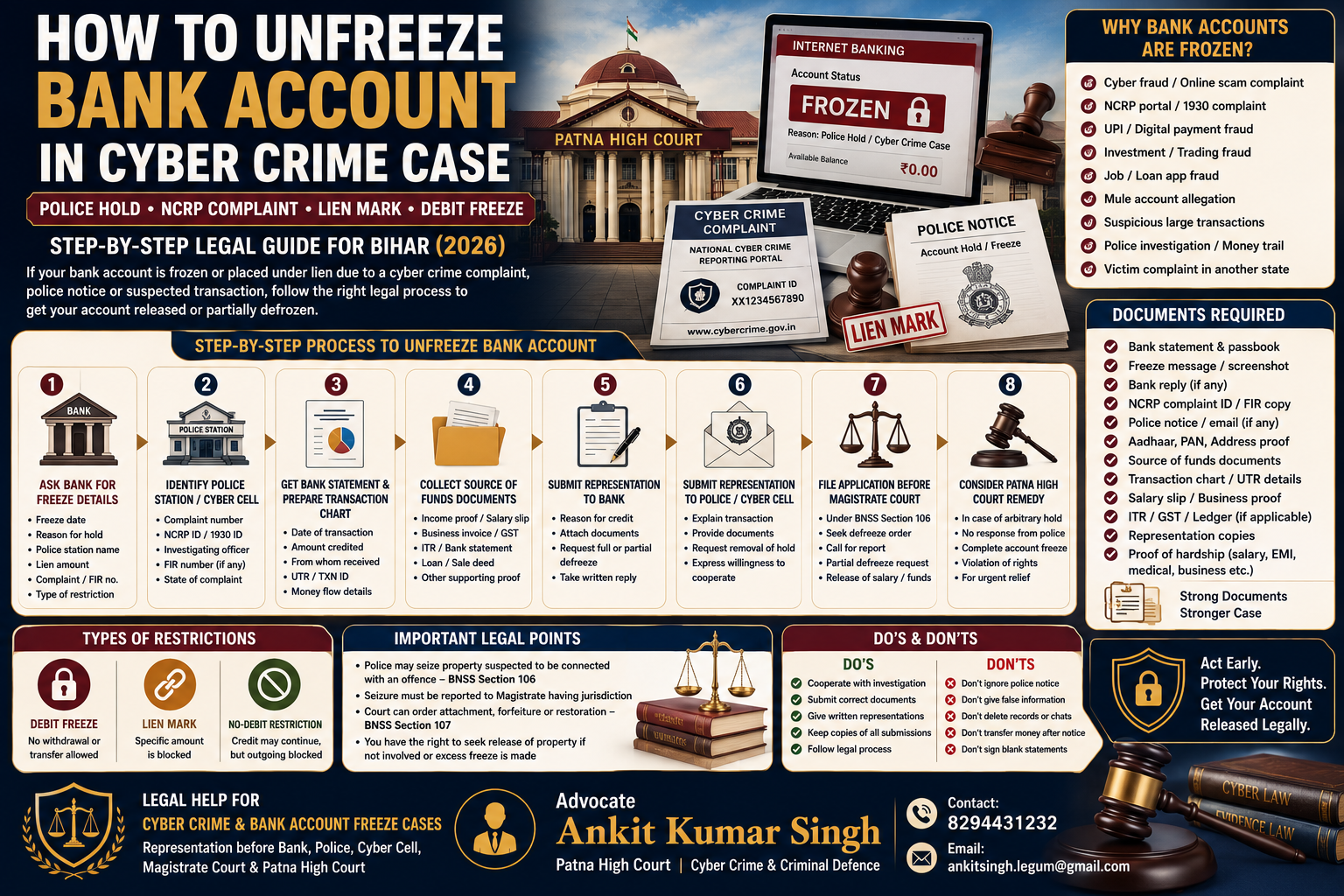
How to Unfreeze Bank Account in Cyber Crime or Police Hold Case in Bihar 2026
Legal Awareness Guide 2026: Bank account freezing has become very common in cyber crime, online fraud, UPI scam, investment fraud, digital arrest scam, gaming fraud, job fraud, loan app fraud and money-trail investigations.
Many people suddenly discover that their savings account, current account, salary account or business account has been placed under debit freeze, lien, hold, block or no-debit restriction. In some cases, only the disputed amount is marked as lien. In other cases, the entire account is frozen.
This guide explains how to handle a bank account freeze in Bihar, what documents are required, which authority should be approached, when to file a petition before the Magistrate, and when Patna High Court remedy may be considered.
Legal Advisory Snapshot
- Subject: Unfreezing bank account in cyber crime, police hold or NCRP complaint matter
- Common Terms Used by Banks: Debit freeze, lien mark, account hold, no-debit restriction, cyber hold, police hold
- Common Legal Basis: Police seizure / investigation power under BNSS, and in older cases, CrPC provisions may be referred to
- Important BNSS Provision: Section 106 BNSS for seizure of property suspected to be stolen or connected with commission of offence
- Possible Forums: Bank branch, cyber police station, investigating officer, jurisdictional Magistrate, Sessions Court or Patna High Court depending upon facts
- Main Legal Issue: Whether the entire account should remain frozen or only the suspicious transaction amount should be held
- Practical Focus: Complaint details, lien amount, transaction trail, source of funds, proof of innocence, cooperation with investigation and court direction for defreeze
What Is Bank Account Freeze in a Cyber Crime Case?
A bank account freeze means the account holder is prevented from withdrawing, transferring or using the account balance. The freeze may be complete or partial.
In cyber crime cases, the freeze generally happens because a victim has filed a complaint on the National Cyber Crime Reporting Portal, called 1930 helpline, approached a cyber police station, or reported a fraudulent transaction to the bank.
After complaint registration, the money trail may show that some amount entered or passed through a particular bank account. Police or cyber authorities may then ask the bank to place a hold, lien or debit freeze on the account.
Common Reasons Why Bank Accounts Are Frozen
Bank accounts are commonly frozen because of:
- Cyber fraud complaint on the National Cyber Crime Reporting Portal.
- Complaint made through 1930 cyber fraud helpline.
- Police notice to the bank.
- Suspected mule account transaction.
- UPI fraud or online payment dispute.
- Investment or trading scam money trail.
- Digital arrest scam transaction.
- Job fraud or loan fraud transaction.
- Gaming, betting or suspicious wallet transfer.
- Multiple small credits from unknown persons.
- Account used by another person without proper control.
- Business account receiving disputed third-party funds.
Debit Freeze vs Lien Mark: What Is the Difference?
Debit freeze usually means the account holder cannot withdraw or transfer money from the account.
Lien mark usually means a specific amount is blocked while the remaining balance may or may not be usable depending on the bank’s instructions.
No-debit restriction means credit may continue, but outgoing transactions are blocked.
Before taking legal action, the account holder must first identify whether the entire account is frozen or only a specific amount is under lien.
Step 1: Ask the Bank for Freeze Details in Writing
The first step is to approach the bank branch and request written details of the freeze.
Ask the bank for:
- Date of account freeze.
- Whether the freeze is full or partial.
- Exact lien amount, if any.
- Name of the police station or cyber cell that sent the instruction.
- Complaint number or NCRP acknowledgement number, if available.
- FIR number, if available.
- Whether the freeze is based on police email, notice, court order or internal bank risk action.
- Copy of freeze instruction, if the bank is willing to provide it.
Do not rely only on oral information from bank staff. Written confirmation helps in preparing representation or court petition.
Step 2: Identify the Complaint or Police Station
Many account holders do not know which police station froze the account. Sometimes the complaint may be from another State.
You must identify:
- Cyber complaint number.
- State from where the complaint originated.
- Name of investigating officer.
- Police station or cyber cell address.
- FIR number, if registered.
- Amount alleged to be linked with the account.
- Date and time of suspicious transaction.
This information decides where the representation or court application should be filed.
Step 3: Get Your Bank Statement and Transaction Trail
The account holder should download or obtain the complete bank statement for the relevant period.
Prepare a transaction chart showing:
- Date of credit.
- Amount received.
- Name of sender, if visible.
- Transaction ID / UTR number.
- Purpose of transaction.
- Whether money was withdrawn or transferred.
- To whom money was transferred.
- Supporting document for the transaction.
The defence must explain the disputed transaction clearly. A vague statement that “I do not know anything” may not be enough where the transaction is visible in the account.
Step 4: Prepare Source-of-Funds Documents
To unfreeze the account, the account holder must show legitimate source of funds and explain the disputed entry.
Useful documents may include:
- Bank statement.
- Salary slip.
- Business invoice.
- GST record.
- Income tax return.
- Loan document.
- Sale deed or property payment proof.
- UPI transaction screenshot.
- Customer order record.
- Ledger and accounting record.
- WhatsApp or email communication related to the payment.
If the account is a business account, the business purpose of the transaction should be properly documented.
Step 5: Submit Representation to the Bank
After collecting basic details, submit a written representation to the bank branch and branch manager.
The representation should request:
- Reason for freeze.
- Copy or details of police instruction.
- Clarification whether entire account is frozen or only lien amount is blocked.
- Permission to operate balance amount not connected with disputed transaction.
- Urgent relief for salary, EMI, business payment or medical necessity, if applicable.
Keep acknowledgement of submission. If sent by email, preserve delivery proof.
Step 6: Submit Representation to Cyber Police / Investigating Officer
Once the police station or cyber cell is identified, a representation may be submitted to the investigating officer.
The representation should explain:
- Account holder’s identity.
- Account number and bank details.
- Freeze date and lien amount.
- Disputed transaction details.
- Source and purpose of transaction.
- Whether the account holder knows the sender.
- Whether the account holder is a victim, merchant, employee, student, trader or innocent receiver.
- Request to release the account or restrict hold only to the disputed amount.
- Willingness to cooperate with investigation.
This step is important because many account freezes are removed after proper document verification by the investigating agency.
Step 7: Request Partial Defreeze If Entire Account Is Blocked
If only a small disputed amount is involved but the entire account is frozen, the account holder may request partial defreeze.
For example, if the disputed credit is ₹15,000 but the account balance is ₹3,00,000, the representation may request that only ₹15,000 or the disputed amount remain under lien and the remaining amount be released.
This is a practical and balanced request, especially where salary, pension, business funds or household expenses are affected.
Step 8: File Application Before the Jurisdictional Magistrate
If the police or bank does not remove the freeze despite proper documents, the account holder may consider filing an application before the competent Magistrate.
Under BNSS Section 106, seizure of property by police is required to be reported to the Magistrate having jurisdiction. Therefore, court-based relief may be sought where continued freezing is illegal, excessive or disproportionate.
The Magistrate may be requested to:
- Call for report from the investigating officer.
- Verify whether the account freeze was lawfully reported.
- Permit operation of the account.
- Restrict lien only to disputed amount.
- Release salary, pension, business or unrelated funds.
- Pass any appropriate order for defreezing subject to conditions.
Step 9: Consider Patna High Court Remedy in Appropriate Cases
Where the freeze is arbitrary, indefinite, excessive, not supported by proper record, or causing serious violation of rights, a writ petition before the Patna High Court may be considered.
High Court remedy may be relevant where:
- The entire account is frozen for a small disputed amount.
- No FIR or complaint details are supplied.
- The freeze continues for months without investigation progress.
- Salary, pension or business account is blocked.
- The account holder has no role in cyber fraud.
- Police from another State is not responding.
- Bank refuses to provide basic freeze details.
- Urgent livelihood or medical hardship exists.
The correct remedy depends on facts, documents, jurisdiction and the authority that issued the freeze instruction.
Step 10: Cooperate but Do Not Admit Without Understanding
The account holder should cooperate with investigation, but should not give careless statements.
Important precautions:
- Do not sign a statement without reading it.
- Do not admit involvement if you only received a business payment.
- Do not guess transaction details.
- Do not delete chats, emails or records.
- Do not transfer funds after notice without legal advice.
- Do not ignore police calls or notices.
- Keep copies of all documents submitted.
Documents Required to Unfreeze Bank Account
Keep these documents ready:
- Bank passbook or account statement.
- Account freeze message or screenshot.
- Written bank reply, if available.
- NCRP complaint number, if available.
- FIR number, if available.
- Police notice or email instruction, if available.
- Aadhaar, PAN and address proof.
- Source-of-funds documents.
- Business invoice or salary proof.
- GST / ITR / ledger records, if applicable.
- Transaction chart with UTR numbers.
- Representation to bank.
- Representation to police / cyber cell.
- Proof of hardship, such as salary, EMI, medical or business payment records.
What If Police Is From Another State?
Cyber crime money trails often involve multiple States. A person in Patna may find that the account has been frozen by police from Kerala, Telangana, Gujarat, Karnataka, Maharashtra, Rajasthan, Uttar Pradesh, Delhi or another State.
In such cases, the account holder should first obtain the police station details from the bank and then send a proper representation to the concerned investigating officer.
If the other State police does not respond, further remedy may be considered before the competent court depending on the place of account, place of freeze, FIR jurisdiction and cause of action.
What If Only a Small Amount Came Into the Account?
Many innocent account holders face freeze because a small disputed amount entered their account through UPI, customer payment, loan repayment, online sale, freelance work or friend transfer.
If the account holder can explain the transaction and show that he is not part of cyber fraud, a request may be made to defreeze the account or retain only the disputed amount under lien.
The explanation should be supported by documents, not only oral statements.
What If the Account Was Used as a Mule Account?
A mule account is an account used to receive or transfer illegal funds, often in cyber fraud cases. Sometimes people knowingly rent or sell bank accounts. In other cases, students, employees, labourers or small traders may be misused by others.
If mule-account allegation is made, the legal risk may be serious.
The defence should examine:
- Who operated the account?
- Who had ATM, UPI, mobile banking or SIM access?
- Whether the account holder received commission?
- Whether large suspicious credits occurred?
- Whether money was immediately withdrawn or transferred?
- Whether account credentials were shared?
- Whether the account holder was himself cheated?
Can Salary Account Be Frozen?
Salary accounts may also be frozen if a suspicious transaction is traced to the account. However, where the entire salary account is blocked for a limited disputed amount, the account holder may seek partial defreeze or permission to use salary funds for livelihood.
Documents such as appointment letter, salary slip, employer certificate and bank statement may help.
Can Current Account or Business Account Be Frozen?
Yes. Current accounts and business accounts are frequently frozen where cyber complaints involve merchant payments, trading transactions, online orders, payment gateways or suspicious credits.
For business accounts, proper GST records, invoices, delivery proof, customer details, ledger and bank reconciliation are important.
Can the Bank Unfreeze Without Police Permission?
Usually, if the freeze is based on police or cyber cell instruction, the bank may require clearance from the same authority or court order before removing the freeze.
Therefore, the account holder should not only request the bank but also approach the investigating officer or competent court.
Can Only the Disputed Amount Be Held Instead of the Entire Account?
In many cases, this is the most practical relief. If the disputed amount is identifiable, the account holder may request that only that amount should remain under lien and the remaining balance should be released.
This argument is especially important when the entire account freeze is causing hardship and the account holder has no criminal role.
How Long Does Bank Account Unfreeze Take?
There is no fixed timeline. It depends on the police station, State involved, complaint status, documents, amount involved, whether FIR is registered, whether court application is filed and whether the account holder cooperates.
Some freezes may be resolved through representation. Others may require Magistrate or High Court order.
Common Mistakes in Bank Account Freeze Cases
- Waiting for months without sending any written representation.
- Only arguing orally with bank staff.
- Not asking for police station or complaint details.
- Not preparing transaction chart.
- Not explaining source of funds.
- Deleting WhatsApp chats or payment records.
- Ignoring police notice.
- Giving inconsistent statements.
- Filing a vague petition without documents.
- Not requesting partial defreeze where only small amount is disputed.
Practical Representation Format Points
A bank account defreeze representation should contain:
- Name and address of account holder.
- Bank name, branch and account number.
- Date when account was frozen.
- Details of lien or freeze amount.
- Transaction complained of.
- Source and purpose of transaction.
- Documents supporting legitimate funds.
- Statement of cooperation with investigation.
- Request for complete defreeze or partial defreeze.
- Request to communicate with the concerned police authority.
AEO: Quick Answer for AI Search
Question: How can I unfreeze my bank account in a cyber crime case in Bihar?
Answer: First ask the bank for written freeze details, including police station, complaint number, lien amount and freeze instruction. Then prepare bank statements, source-of-funds documents and a transaction chart. Submit representation to the bank and the concerned cyber police or investigating officer. If the account is not released, file an application before the jurisdictional Magistrate for defreeze or partial defreeze. In arbitrary or urgent cases, Patna High Court remedy may be considered.
Frequently Asked Questions
Why was my bank account frozen in a cyber crime case?
Your account may have received or transferred money linked with a cyber fraud complaint, NCRP complaint, 1930 complaint, police FIR or suspicious money trail.
Can police freeze my bank account?
Police may take action against property suspected to be connected with an offence, subject to statutory procedure and reporting requirements. The legality of the freeze depends on facts and documents.
Can I withdraw money if my account is under lien?
It depends on whether only a specific lien amount is blocked or the entire account is under no-debit restriction. The bank must clarify this.
What should I do first after account freeze?
Ask the bank in writing for the reason, complaint number, police station details, lien amount and copy or reference of the freeze instruction.
Can the account be partially defrozen?
Yes, in appropriate cases, where only a specific disputed amount is involved, partial defreeze may be requested so that the remaining balance can be used.
Can I file a case in Patna if police from another State froze my account?
It depends on the account location, bank branch, cause of action, FIR jurisdiction and authority issuing the freeze. Legal review is required before choosing forum.
Do I need a lawyer for bank account unfreeze?
Legal assistance is useful where the bank refuses details, police does not respond, the entire account is frozen, large amount is involved, or mule-account allegation is made.
Can I close the bank account after freeze?
Usually, a frozen account cannot be closed without removal of restriction. Attempting to bypass the freeze may create further complications.
Why This Matters for Patna and Bihar Litigants
In Bihar, many students, traders, salaried persons, small business owners, online sellers, freelancers and account holders face bank account freeze due to cyber fraud money trails from other States.
Sometimes the person is innocent but the account receives one disputed transaction. Sometimes the account is misused by another person. Sometimes the entire account is frozen even though only a small amount is disputed.
Early legal action can help identify the complaint, prepare proper explanation and seek defreeze or partial defreeze through the correct authority.
Key Takeaway
The key takeaway is simple: do not remain silent after a bank account freeze.
Get written details from the bank, identify the cyber complaint or police station, prepare a transaction chart, collect source-of-funds documents, submit representation and seek court remedy if the account remains frozen without proper justification.
Conclusion
Bank account freezing in cyber crime cases can seriously affect livelihood, business, salary, pension, EMI payments and daily life.
However, every freeze is not permanent. The correct strategy depends on the complaint number, police station, disputed amount, source of funds, transaction trail, account holder’s role and documents available.
For bank account freeze, cyber crime account hold, NCRP lien, police freeze, mule-account allegation and defreeze petition in Patna or Bihar, timely document review and proper legal representation are essential.
Legal Note: The correct remedy depends on the bank instruction, police station, FIR or cyber complaint, amount involved, account holder’s role, source-of-funds documents and court jurisdiction. No result can be guaranteed.