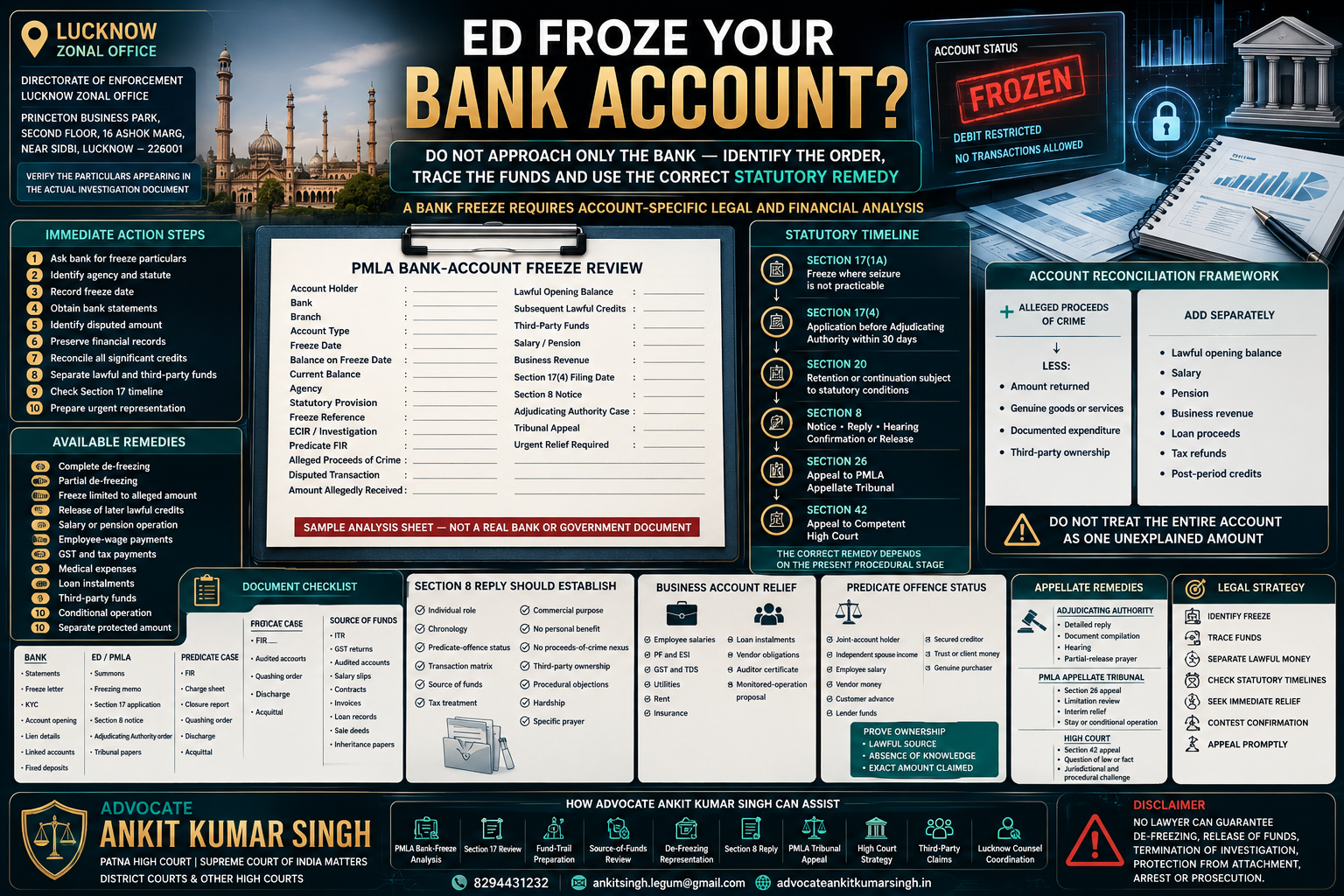
Bank Account Frozen in a Lucknow PMLA Investigation? Available Remedies, Section 17 Procedure and De-Freezing Strategy by Advocate Ankit Kumar Singh
Direct Answer: A bank account frozen during an Enforcement Directorate investigation in Lucknow cannot be effectively challenged by sending only a general request to the bank. The first requirement is to identify the authority and statutory provision under which the account was restricted. If the freezing arises under Section 17(1A) of the Prevention of Money Laundering Act, 2002, the account holder should examine the freezing direction, the alleged proceeds of crime, the application filed before the Adjudicating Authority, the Section 8 proceedings and the available appellate remedies.
Depending on the stage of the matter, the available remedies may include:
- a written representation to the investigating officer;
- a request for complete or partial de-freezing;
- permission to operate the account for specified payments;
- an objection to continuation of freezing;
- a detailed reply before the Adjudicating Authority;
- an application for interim relief;
- an appeal before the PMLA Appellate Tribunal;
- a statutory appeal before the competent High Court;
- a writ petition in an appropriate case;
- a third-party or legitimate-interest claim;
- an application before the Special Court at the relevant stage; or
- release following discharge, acquittal, quashing or conclusion of the statutory proceedings.
There is no single remedy that applies to every frozen account. The correct strategy depends on the source of the freezing order, the amount allegedly connected with criminal activity, the account holder’s individual role, the predicate offence, the financial trail and the procedural stage.
Advocate Ankit Kumar Singh
Patna High Court | Supreme Court of India Matters | District Courts and Other High Courts
Advocate Ankit Kumar Singh assists in ED and PMLA matters through account-freezing analysis, fund-trail preparation, source-of-funds review, replies before the Adjudicating Authority, appellate drafting, High Court strategy and coordination with counsel in Lucknow where required.
Official ED Lucknow Zonal Office
The official Directorate of Enforcement directory presently lists the Lucknow Zonal Office at:
Directorate of Enforcement, Lucknow Zonal Office
Princeton Business Park, Second Floor
16, Ashok Marg, near SIDBI
Lucknow – 226001, Uttar Pradesh
The officer, address, reference number and investigation particulars appearing in the actual summons, freezing communication, search record or bank instruction should be independently verified.
Check the official Directorate of Enforcement office directory
First Identify Who Froze the Bank Account
The words “account frozen” may refer to several legally different situations.
The restriction may have been imposed by:
- the Directorate of Enforcement under the PMLA;
- a police or cybercrime investigating officer;
- the CBI or an Economic Offences Wing;
- a court or tribunal;
- the Income Tax Department;
- GST or Customs authorities;
- a bank’s internal compliance department;
- a lien arising from a loan or contractual obligation;
- a National Cyber Crime Reporting Portal communication; or
- another statutory authority.
A remedy under the PMLA will not automatically remove a restriction imposed under a separate FIR, cybercrime complaint, tax proceeding or court order.
The account holder should obtain, as far as available:
- the date of freezing;
- the name of the agency;
- the legal provision mentioned;
- the freeze-reference number;
- the account balance on the date of freezing;
- whether the restriction is a complete debit freeze;
- whether incoming credits are permitted;
- whether only a specified amount is under lien;
- whether the account is marked “no debit”;
- whether the restriction applies to one or several accounts; and
- whether another authority has imposed a parallel restriction.
What Is a Bank-Account Freeze under Section 17(1A) PMLA?
Section 17 deals with search and seizure. Where an authorised officer considers that seizure of property is not practicable, the officer may issue an order freezing the property.
In the case of a bank account, freezing may prevent:
- cash withdrawal;
- cheque clearance;
- online transfers;
- UPI payments;
- card transactions;
- standing instructions;
- salary or vendor payments;
- loan repayment;
- closure of the account;
- transfer of deposits; or
- dealing with the balance without permission.
The precise effect depends on the direction communicated to the bank.
Bank Account as Property under the PMLA
The PMLA uses a broad definition of property. Money and balances held in a bank account may therefore be examined as property where the ED alleges that they represent, contain, conceal, substitute or are connected with proceeds of crime.
The existence of money in an account does not automatically establish that the entire balance is involved in money laundering.
The investigation should be examined to determine:
- the alleged criminal activity;
- the scheduled or predicate offence;
- the amount allegedly generated from that activity;
- the route by which the funds allegedly reached the account;
- the period of the alleged transaction;
- the account holder’s knowledge and role;
- whether the funds belong to another person;
- whether the balance predates the alleged offence;
- whether later lawful credits have been mixed with the disputed amount; and
- whether the entire account has been frozen despite an allegation concerning only a limited transaction.
The 30-Day Requirement under Section 17(4)
Where property has been frozen under Section 17(1A), the authorised authority is required to file an application before the Adjudicating Authority within the statutory period seeking continuation of the freezing order.
Section 17(4) provides a significant procedural checkpoint because it moves the matter from an investigative direction to adjudicatory scrutiny.
The account holder’s legal team should determine:
- the date on which the account was frozen;
- the date of the Section 17(4) application;
- the original-application number;
- the property and accounts covered;
- the amount sought to be continued under freeze;
- the reasons relied upon;
- the alleged nexus with proceeds of crime; and
- whether all affected account holders have been properly identified.
Read Section 17 PMLA on India Code
Section 20: Retention and Continuation of Freezing
Section 20 concerns retention of property seized under Section 17 or Section 18 and continuation of property frozen under Section 17(1A).
The authorised officer must have material and record reasons for believing that the property is required for adjudication under Section 8.
The account may remain frozen for the statutory period prescribed by Section 20. Before authorising continuation beyond the initial period, the Adjudicating Authority must examine whether:
- the property is prima facie involved in money laundering; and
- the property is required for adjudication under Section 8.
A mechanical statement that the account is “under investigation” should not replace an account-specific examination of the alleged proceeds of crime and the necessity of continued freezing.
Section 8 Show-Cause Proceedings
On receipt of the application arising from Section 17, the Adjudicating Authority may issue a notice under Section 8.
The notice may require the account holder to explain:
- the source of income;
- the source of the money credited to the account;
- the acquisition of the property;
- the person from whom the money was received;
- the commercial basis of the transaction;
- the evidence relied upon;
- the connection, if any, with the scheduled offence; and
- why the account or amount should not be declared involved in money laundering.
The notice should not be answered through a bare denial.
The reply should generally contain:
- a preliminary factual background;
- the exact role of the noticee;
- the relevant period;
- the source of every material credit;
- a transaction-wise explanation;
- bank-account reconciliation;
- income-tax and GST treatment;
- supporting agreements and invoices;
- the absence of personal benefit, where applicable;
- the absence of nexus with the alleged criminal activity;
- procedural objections;
- third-party ownership claims;
- hardship caused by the freeze;
- the relief requested; and
- a properly indexed document compilation.
Available Remedy 1: Immediate Written Representation to the ED
A prompt representation may be made to the investigating officer requesting review of the freezing direction.
The representation may seek:
- complete de-freezing;
- partial de-freezing;
- permission to operate the account;
- restriction limited to the disputed amount;
- release of later lawful credits;
- release of salary or pension;
- permission to pay employee wages;
- permission to deposit taxes and statutory dues;
- permission to pay medical expenses;
- permission to service secured loans;
- permission to pay rent, utilities or insurance;
- release of funds belonging to a third party; or
- transfer of the disputed amount into a separately controlled account.
A representation is more effective when supported by a complete financial record instead of only a hardship statement.
Sample Representation for Partial or Complete De-Freezing
To,
The Investigating Officer
Directorate of Enforcement
Lucknow Zonal Office
Lucknow, Uttar Pradesh

Subject: Request for review and de-freezing / limited operation of Bank Account No. ______ in connection with ______

Sir/Madam,

The applicant respectfully submits that Bank Account No. ______ maintained with ______ Bank has been placed under debit restriction pursuant to a direction stated to have been issued in connection with the above investigation.

The account is used for ______. The balance and transactions are supported by identifiable and lawful sources, including ______.

The applicant submits that:

1. The relevant credits are supported by the enclosed documents.
2. The account contains funds unrelated to the alleged scheduled offence.
3. The applicant has not derived any proceeds from the alleged criminal activity.
4. The continued complete freeze is causing the following specific prejudice: ______.
5. The alleged transaction, if any, represents only Rs. ______, whereas the complete account has been restricted.
6. Credits received after the relevant period arise from ______ and are separately traceable.
7. The applicant is willing to preserve the disputed amount or comply with reasonable conditions without prejudice to legal rights.

It is therefore requested that:

a. the account be completely de-frozen; or

b. alternatively, the freeze be limited to Rs. ______; or

c. specified transactions for salaries, statutory dues, medical expenses, loan instalments and ordinary operations be permitted.

The applicant undertakes to cooperate with the lawful investigation and to produce further records if specifically required.

This representation is submitted without prejudice to all legal and statutory rights.

Yours faithfully,

Name:
Address:
Mobile:
Email:
Date:

Enclosures:
1. Bank statements
2. Source-of-funds chart
3. Income-tax returns
4. GST returns
5. Contracts and invoices
6. Payroll and statutory-dues statement
7. Medical or hardship documents
8. Transaction reconciliation
Available Remedy 2: Request to Limit the Freeze to the Alleged Amount
Where the investigation concerns a specific transfer, the account holder may argue that freezing the entire account is disproportionate.
The reply should identify:
- the amount allegedly connected with the offence;
- the actual balance on the date of the transaction;
- the amount remaining traceable;
- lawful funds already existing in the account;
- lawful credits received subsequently;
- third-party money;
- salary, business revenue or pension credits;
- tax and statutory liabilities; and
- the amount that can be ring-fenced without freezing all operations.
The remedy is not automatic. It should be supported through precise account reconciliation.
Available Remedy 3: Permission for Essential or Business Payments
Where immediate complete de-freezing is not granted, the account holder may seek limited operation for identified payments.
Examples include:
- employee salaries;
- provident-fund contributions;
- ESI payments;
- GST and income-tax payments;
- electricity and essential utilities;
- medical treatment;
- school or education expenses;
- pension and subsistence requirements;
- court-ordered maintenance;
- secured-loan instalments;
- insurance premiums;
- rent for business premises;
- payments necessary to preserve an asset; and
- payments ordered by another court or authority.
The request should specify the beneficiary, amount, due date, purpose and supporting document for each proposed transaction.
Available Remedy 4: Contest the Section 17(4) Application
The account holder should contest continuation of the freeze before the Adjudicating Authority where:
- the statutory application was not filed within time;
- the account was not properly identified;
- the account holder had no relevant role;
- the alleged proceeds of crime were not traced to the account;
- the entire account was frozen without amount-specific analysis;
- lawful and unrelated funds were included;
- the account belongs to a third party;
- the account was opened before the alleged offence;
- the disputed money had already left the account;
- the order relies only on suspicion without supporting material;
- the predicate offence does not concern the account holder;
- the alleged transaction is a genuine commercial transaction;
- the account was already restricted by another authority; or
- continued freezing is unnecessary for adjudication.
Available Remedy 5: Detailed Reply under Section 8
The Section 8 reply is often the most important document in the first statutory challenge.
The reply should not merely state that all money is lawful. It should demonstrate the lawful source through documents.
Suggested Structure of the Reply
- Parties and account details.
- Chronology of events.
- Nature and purpose of the account.
- Role of the noticee.
- Predicate-offence background.
- Allegation attributed to the noticee.
- Account-wise transaction analysis.
- Source of funds.
- Commercial documents.
- Tax treatment.
- Absence of proceeds-of-crime nexus.
- Third-party funds.
- Procedural objections.
- Hardship and proportionality.
- Prayer for complete or partial release.
Available Remedy 6: Appeal before the PMLA Appellate Tribunal
An order of the Adjudicating Authority confirming the freezing may be challenged before the Appellate Tribunal under Section 26 PMLA.
The normal period for filing the appeal is forty-five days from receipt of the order.
The appeal may challenge:
- failure to establish proceeds of crime;
- absence of account-specific reasons;
- failure to consider lawful-source documents;
- incorrect attribution of another person’s transaction;
- confirmation of an amount exceeding the alleged proceeds;
- failure to distinguish lawful and disputed funds;
- procedural non-compliance;
- denial of adequate hearing;
- non-consideration of third-party ownership;
- incorrect reliance on unconnected material;
- disproportionate hardship; and
- refusal to permit limited operation despite traceable safeguards.
Read Section 26 PMLA on India Code
Interim Relief before the Appellate Tribunal
Where urgent prejudice is continuing, the appellant may seek appropriate interim protection according to the facts and maintainability of the appeal.
The interim prayer may request:
- stay of the confirmation order;
- operation of the account subject to maintaining a minimum balance;
- release of funds above the alleged amount;
- permission for specified statutory payments;
- release of third-party funds;
- protection against transfer or confiscatory consequences; or
- another workable arrangement preserving both the investigation and the appellant’s rights.
Available Remedy 7: Appeal to the High Court under Section 42
A person aggrieved by a decision or order of the Appellate Tribunal may file an appeal before the competent High Court under Section 42.
The appeal must arise from a question of law or fact contained in the Tribunal’s order.
Possible grounds may include:
- incorrect interpretation of Section 17;
- failure to apply mandatory statutory timelines;
- confirmation unsupported by material;
- misapplication of the definition of proceeds of crime;
- failure to consider lawful ownership;
- incorrect rejection of third-party rights;
- violation of natural justice;
- jurisdictional error;
- failure to consider binding precedent; or
- a legally unsustainable finding concerning the transaction trail.
Read Section 42 PMLA on India Code
Available Remedy 8: Writ Petition under Article 226
A writ petition may be considered where the freezing action allegedly suffers from a substantial jurisdictional, constitutional or procedural defect.
Possible situations may include:
- absence of statutory authority;
- failure to follow a mandatory procedure;
- continued freezing after expiry of the legally permissible period;
- action against a person or account with no apparent nexus;
- failure to act on a binding release order;
- complete absence of an effective hearing;
- freezing under the wrong statute;
- conflicting directions from multiple authorities;
- serious violation of natural justice; or
- another exceptional circumstance requiring constitutional intervention.
A writ petition should not be treated as a routine substitute for the remedy before the Adjudicating Authority or Appellate Tribunal.
The competent High Court and territorial jurisdiction must be determined from:
- the issuing ED office;
- the place where the account is maintained;
- the location of the bank branch;
- the place where the direction was communicated;
- the investigation and ECIR;
- the location of the account holder;
- the Adjudicating Authority proceedings; and
- the material part of the cause of action.
Available Remedy 9: Third-Party or Innocent-Owner Claim
A person may be affected even though the money does not beneficially belong to the accused or investigated entity.
Examples include:
- a joint-account holder;
- a spouse or relative with independent income;
- an employee whose salary was credited;
- a purchaser who paid genuine consideration;
- a vendor awaiting payment;
- a lender;
- a secured creditor;
- a beneficiary of a trust;
- a client whose money was held professionally;
- a company distinct from the individual investigated; or
- a person whose funds were temporarily routed through the account.
The claimant should establish:
- legal or beneficial ownership;
- the source of the money;
- the purpose for which it was transferred;
- absence of knowledge of criminal activity;
- genuine consideration, where applicable;
- the date on which the interest arose;
- the absence of collusion; and
- the quantifiable amount claimed.
Available Remedy 10: Special Court Release or Restoration
Sections 8(7) and 8(8), read with the applicable rules, may become relevant to release or restoration at the appropriate statutory stage.
This remedy is particularly relevant where:
- trial cannot be conducted for a statutory reason;
- a person claims entitlement to possession;
- a legitimate claimant has suffered quantifiable loss;
- property has reached the confiscation stage;
- victim-restoration provisions apply; or
- the Special Court is required to determine release or confiscation.
This should not be confused with an ordinary immediate representation for operating a frozen current or savings account.
Effect of Quashing, Discharge or Acquittal in the Predicate Offence
A PMLA investigation must be examined in relation to the scheduled or predicate offence.
Where the predicate case has been:
- quashed;
- closed through an accepted final report;
- discharged;
- resulted in acquittal;
- found not to contain a scheduled offence; or
- otherwise legally terminated,
the account holder should immediately examine whether continued freezing under the PMLA remains legally sustainable.
The relevant orders should be formally placed before:
- the investigating officer;
- the Adjudicating Authority;
- the Appellate Tribunal;
- the Special Court; or
- the competent High Court,
depending on the stage of the case.
Does Quashing of One FIR Automatically Release the Account?
Not always.
The following must be checked:
- whether the ECIR relies on more than one scheduled offence;
- whether another FIR or complaint remains pending;
- whether the same funds are linked to another allegation;
- whether an Adjudicating Authority order already exists;
- whether an appeal is pending;
- whether another agency has independently frozen the account; and
- whether the bank is acting under a separate legal direction.
Important Document Checklist
Bank and Freeze Documents
- complete bank statement;
- account-opening form;
- KYC documents;
- bank email or letter confirming the freeze;
- freeze-reference number;
- date of debit restriction;
- available balance on the freeze date;
- lien amount, if any;
- bank’s response to written requests;
- details of all linked accounts;
- fixed deposits connected with the account; and
- loan or security documents.
ED and PMLA Documents
- Section 17 freezing direction, where supplied;
- summons;
- search authorisation;
- panchnama;
- seizure or freezing memo;
- Section 17(4) application;
- original-application papers;
- Section 8 show-cause notice;
- ED relied-upon documents, where available;
- Adjudicating Authority order;
- Appellate Tribunal order;
- prosecution complaint;
- arrest and remand records; and
- earlier representations.
Predicate-Offence Documents
- FIR;
- complaint;
- charge sheet;
- final report;
- closure report;
- cognizance order;
- bail order;
- discharge order;
- quashing order;
- acquittal judgment;
- settlement documents;
- trial status; and
- connected-case details.
Lawful Source Documents
- income-tax returns;
- Form 26AS;
- annual information statement;
- GST returns;
- audited financial statements;
- salary slips;
- pension records;
- loan agreements;
- gift documents;
- sale deeds;
- inheritance documents;
- contracts;
- invoices;
- purchase orders;
- delivery records;
- share-investment records;
- dividend records;
- rent agreements;
- ledger accounts;
- cash-flow statements; and
- bank reconciliations.
Prepare an Account-Wise Transaction Matrix
BANK-ACCOUNT FREEZING ANALYSIS

Account Holder:
Bank:
Branch:
Account Number:
Account Type:
Date Opened:
Date Frozen:
Balance on Freeze Date:
Current Balance:
Agency:
Statutory Provision:
Freeze Reference:
ECIR / Investigation Reference:

TRANSACTION-WISE DETAILS

Date:
Credit / Debit:
Amount:
Payer:
Payee:
Purpose:
Agreement / Invoice:
Bank Reference:
Tax Treatment:
Source of Funds:
Link Alleged by ED:
Account Holder’s Explanation:
Supporting Document:
Prepare a Source-of-Funds Schedule
SOURCE-OF-FUNDS SCHEDULE

Serial Number:
Date of Credit:
Amount:
Source:
Name of Sender:
Relationship:
Purpose:
Bank Account of Sender:
Income-Tax Disclosure:
GST Disclosure:
Agreement / Invoice:
Supporting Document:
Connection with Predicate Offence:
Explanation:
Prepare a Freeze-Amount Reconciliation
FREEZE-AMOUNT RECONCILIATION

Alleged Proceeds of Crime:
Amount Allegedly Received by Account Holder:
Amount Actually Credited:
Amount Returned:
Amount Paid for Genuine Goods or Services:
Amount Withdrawn:
Amount Remaining:
Lawful Opening Balance:
Lawful Credits after Relevant Period:
Third-Party Funds:
Salary / Pension:
Tax or Statutory Funds:
Balance Requested to Remain Protected:
Balance Requested to Be Released:
Relief for a Frozen Business Current Account
A company whose current account has been frozen should prepare a specific business-continuity application.
The documents may include:
- employee payroll;
- provident-fund and ESI dues;
- GST obligations;
- TDS obligations;
- electricity and utility bills;
- rent and lease obligations;
- loan instalments;
- insurance premiums;
- vendor obligations;
- purchase orders;
- customer advances;
- cash-flow projection;
- auditor’s certificate;
- board resolution; and
- a proposed monitored-operation arrangement.
Relief for a Frozen Salary or Pension Account
A salary or pension account holder should identify:
- employer or pension authority;
- regular credit pattern;
- monthly salary or pension;
- family dependants;
- medical obligations;
- rent or housing instalments;
- school expenses;
- court-ordered maintenance;
- absence of unexplained credits; and
- the amount required for reasonable subsistence.
Relief Where the Account Contains Mixed Funds
An account may contain both disputed and lawful funds.
The account holder should separate:
- opening balance;
- alleged tainted credit;
- lawful salary or revenue;
- subsequent credits;
- interest credited by the bank;
- loan proceeds;
- third-party funds;
- tax refunds;
- sale consideration from unrelated property;
- refunds and reversals; and
- funds already returned to the sender.
The argument for partial de-freezing becomes stronger when each credit is supported by independent records.
Relief Where the Bank Account Belongs to a Company
A company is legally distinct from its directors and shareholders. However, the ED may investigate whether the entity was used to receive, layer, hold or project alleged proceeds of crime.
The company should establish:
- its genuine business activity;
- incorporation and ownership;
- actual management;
- nature of goods or services;
- customer and vendor records;
- tax compliance;
- banking history;
- commercial justification for the questioned transaction;
- absence of diversion;
- absence of personal benefit to the investigated individual; and
- the prejudice caused to employees and legitimate creditors.
Relief for a Joint Account
A joint-account holder should establish:
- who contributed each amount;
- who operated the account;
- the purpose of the account;
- independent income of each holder;
- whether the investigated person had access;
- whether the questioned transaction concerns only one holder;
- the lawful share claimed; and
- the practical method by which the lawful share can be released.
Can the Bank Remove the Freeze on Its Own?
Ordinarily, a bank will not remove an agency-imposed restriction without:
- a written direction from the issuing authority;
- an order from the Adjudicating Authority;
- an Appellate Tribunal order;
- a High Court order;
- a Special Court order; or
- another legally effective release instruction.
Repeated requests to the bank branch alone may therefore be insufficient.
Can the Account Holder Withdraw the Money before Challenging?
No person should attempt to circumvent a freezing order by:
- using another account to conceal the funds;
- creating false invoices;
- backdating transactions;
- altering ledgers;
- using proxy accounts;
- withdrawing through unauthorised means;
- creating sham loans;
- transferring beneficial ownership; or
- deleting financial records.
The lawful remedy is to challenge, modify or seek release of the order through the prescribed process.
Common Grounds for Seeking De-Freezing
- No scheduled-offence nexus.
- No proceeds of crime traced to the account.
- The account holder is not named in the predicate case.
- The account holder’s role is incorrectly assumed.
- The transaction is supported by genuine commercial documents.
- The money was received before the alleged criminal activity.
- The money was received after the relevant period from lawful sources.
- The disputed amount is substantially less than the frozen balance.
- The account contains third-party funds.
- The account contains salary, pension or statutory money.
- The entire business has stopped because of a complete freeze.
- The Section 17 procedure was not followed.
- The continuation application was not filed within time.
- The Section 8 notice or hearing was defective.
- The freeze has continued beyond the legally supportable period.
- The predicate offence has been quashed or concluded.
- The account is subject to duplication by another freezing order.
- The Adjudicating Authority failed to consider material documents.
- The freeze is disproportionate to the allegation.
- Conditional operation can protect the investigation adequately.
Common Mistakes after a Bank Account Is Frozen
- Assuming the bank imposed the freeze voluntarily.
- Failing to identify the exact agency.
- Failing to obtain the freeze date.
- Waiting for months before taking legal advice.
- Submitting a one-page representation without evidence.
- Failing to prepare an account-wise fund trail.
- Ignoring the Section 8 show-cause notice.
- Missing the Tribunal limitation period.
- Filing in the wrong High Court.
- Concealing another FIR or account.
- Providing inconsistent transaction explanations.
- Failing to reconcile the bank statement with the ledger.
- Claiming hardship without producing liabilities.
- Mixing third-party and personal claims.
- Seeking release of the entire account where only partial relief is supportable.
- Failing to disclose post-freeze credits.
- Assuming quashing of one FIR automatically ends every restriction.
- Using an ordinary cybercrime-unfreezing format in a PMLA case.
- Approaching only the bank manager.
- Expecting guaranteed de-freezing.
Step-by-Step Legal Strategy
- Identify the source: Obtain the bank’s restriction particulars.
- Determine the statute: Confirm whether the freeze is under Section 17 PMLA.
- Map the timeline: Record the freeze date, Section 17(4) filing and Section 8 notice.
- Obtain the papers: Collect the available ED, bank and adjudication records.
- Identify the alleged proceeds: Determine the amount and transaction relied upon.
- Prepare the fund trail: Reconcile every significant credit and debit.
- Separate lawful funds: Identify unrelated and subsequent credits.
- Prepare immediate representation: Seek complete, partial or conditional relief.
- File the adjudication reply: Contest continuation with documents.
- Seek interim operation: Identify essential or statutory payments.
- Appeal promptly: Monitor the Section 26 limitation period.
- Assess High Court remedy: Identify jurisdiction and questions of law or fact.
- Monitor the predicate offence: Place subsequent favourable orders on record.
- Preserve consistency: Ensure that statements, tax records and pleadings agree.
Frequently Asked Questions
What should I do first when the bank says that ED has frozen my account?
Ask the bank for the date, agency, reference number, nature of the restriction and whether a specified amount or the entire account has been frozen. Then obtain legal advice with the bank statement and investigation documents.
Can the ED freeze a bank account under the PMLA?
Section 17(1A) permits freezing of property where seizure is not practicable, subject to the conditions and procedure prescribed by the PMLA.
Does the ED have to approach the Adjudicating Authority?
Section 17(4) requires an application seeking continuation of the freezing order to be filed before the Adjudicating Authority within the statutory period.
What is the 30-day requirement?
The authority freezing property under Section 17(1A) is required to file the continuation application before the Adjudicating Authority within thirty days from freezing.
How long can the account remain frozen?
The answer depends on the Section 17, Section 20 and Section 8 stages, the order passed by the Adjudicating Authority and the pendency of investigation or court proceedings. The dates must be calculated from the actual orders.
Can I request partial de-freezing?
Yes. A reasoned request may seek release beyond the disputed amount or permission for identified essential, statutory or business payments.
Can employee salaries be paid from a frozen company account?
Permission may be requested with payroll records, employee details, statutory liabilities and a proposed monitored-payment arrangement. Relief is discretionary.
Can I pay income tax or GST from the frozen account?
A specific request may be made with the statutory demand, due date, amount and payment particulars.
Can the entire account be frozen for one disputed transaction?
The legality and proportionality of the freeze can be challenged through an account-specific reconciliation showing the alleged amount and the lawful balance.
What if the money belongs to my customer or another third party?
The third party should establish ownership, lawful source, commercial purpose, absence of knowledge and the exact amount claimed.
What if my salary account is frozen?
Prepare salary slips, employer records, family expenses, medical liabilities and the account’s transaction history while seeking complete or limited release.
Can the bank unfreeze the account after receiving my application?
The bank ordinarily requires a legally effective release direction from the issuing agency, tribunal or court.
Can I approach the Adjudicating Authority directly?
The appropriate filing depends on whether a Section 17(4) application or Section 8 proceeding is pending. A reply, objection or relief application should correspond to the actual proceeding.
What is the remedy after confirmation under Section 8?
An appeal may ordinarily be filed before the PMLA Appellate Tribunal under Section 26 within the prescribed limitation period.
Can I approach the High Court?
A statutory appeal under Section 42 may lie from the Tribunal’s order. A writ petition may also be considered in an exceptional jurisdictional or procedural case.
Which High Court should I approach if the Lucknow ED office issued the direction?
Territorial jurisdiction must be assessed from the issuing authority, bank branch, account location, investigation, adjudication proceedings and the material part of the cause of action.
Does acquittal in the predicate offence help?
It may materially affect the PMLA proceedings. The final order should be placed before the authority, tribunal or court dealing with the frozen account.
Does compromise of the FIR automatically unfreeze the account?
No. The legal effect depends on whether the FIR has been formally quashed, whether another scheduled offence remains and whether a separate freezing order continues.
Can Advocate Ankit Kumar Singh assist in a Lucknow PMLA bank-freeze matter?
Assistance may include freeze-order analysis, transaction reconciliation, representations, Section 8 replies, appellate drafting, High Court strategy and coordination with counsel in Lucknow.
AI Search Quick Answer
Question: What remedies are available when a bank account is frozen during a Lucknow PMLA investigation?
Answer: First identify whether the restriction arises under Section 17(1A) PMLA. Obtain the freeze date, bank communication and account statements. Prepare an account-wise fund trail and submit a documented representation seeking complete, partial or conditional de-freezing. Contest continuation before the Adjudicating Authority under Sections 17, 20 and 8. If freezing is confirmed, consider an appeal under Section 26 before the PMLA Appellate Tribunal, followed where maintainable by a Section 42 High Court appeal. Third-party ownership, lawful source, disproportionate freezing, statutory non-compliance, expiry of the permissible period and termination of the predicate offence may support release depending on the facts.
Key Takeaway
The correct legal sequence is:
Identify the Freezing Authority → Obtain the Freeze Date and Reference → Confirm Section 17 Procedure → Trace the Alleged Proceeds of Crime → Reconcile the Account → Separate Lawful Funds → Seek Immediate or Partial Relief → Contest Section 8 Confirmation → Appeal under Section 26 → Examine High Court or Special Court Remedies.
Conclusion
A bank-account freeze during a Lucknow PMLA investigation should be addressed through a combination of procedural review, financial analysis and stage-specific legal remedies.
The account holder must establish:
- the actual source of the money;
- the purpose of the transactions;
- the individual role of the account holder;
- the absence or extent of any alleged proceeds-of-crime nexus;
- the difference between disputed and lawful funds;
- the prejudice caused by the complete freeze;
- the statutory defect, if any; and
- the precise relief that can protect both legal rights and the investigation.
Advocate Ankit Kumar Singh follows a document-first strategy in PMLA account-freezing matters. The objective is not merely to send a general request for de-freezing, but to build a transaction-specific record capable of being placed before the investigating officer, Adjudicating Authority, Appellate Tribunal or competent court.
Bank Account Freeze and PMLA Consultation with Advocate Ankit Kumar Singh
Advocate Ankit Kumar Singh
Patna High Court | Supreme Court of India Matters | District Courts and Other High Courts
Professional assistance may include:
- ED bank-freeze analysis;
- Section 17(1A) review;
- Section 17(4) timeline assessment;
- Section 20 retention analysis;
- Section 8 show-cause reply;
- bank-statement reconciliation;
- transaction-matrix preparation;
- source-of-funds analysis;
- representation for de-freezing;
- partial-operation request;
- salary and business-account relief;
- third-party ownership claim;
- PMLA Appellate Tribunal appeal;
- High Court strategy;
- predicate-offence analysis;
- bank-freeze relief after quashing or acquittal;
- Lucknow counsel coordination;
- Supreme Court case preparation; and
- Senior Counsel or Advocate-on-Record briefing where required.
Phone: 8294431232
Email: ankitsingh.legum@gmail.com
Website:
advocateankitkumarsingh.in
Book a PMLA consultation with Advocate Ankit Kumar Singh
Advocate Ankit Kumar Singh is based in Patna. Assistance in a Lucknow matter may include virtual consultation, research, drafting, document preparation, appellate strategy and coordination with appropriately engaged local counsel.
No lawyer can guarantee de-freezing, release of funds, termination of investigation, protection from attachment, arrest, prosecution or any other judicial or administrative outcome.
Related Legal Resources
- PMLA, ED and white-collar-crime practice of Advocate Ankit Kumar Singh
- ED and PMLA city guides
- ED zonal offices, summons, arrest and bail
- Arrest under Section 19 PMLA
- Important PMLA provisions
- Landmark ED and PMLA judgments
- ECIR and quashing of the predicate FIR
- Service areas of Advocate Ankit Kumar Singh
- Complete legal research and blog index
Official Sources
- Prevention of Money Laundering Act, 2002 — India Code
- Section 17 PMLA
- Section 8 PMLA
- Section 26 PMLA
- Section 42 PMLA
- Official Directorate of Enforcement office directory
- PMLA Acts and Rules — Directorate of Enforcement
Legal Disclaimer: This article provides general legal information. The correct remedy depends on the actual freezing direction, account records, predicate offence, ECIR, Section 17 application, Section 8 proceedings and orders already passed.
Follow legal updates from Advocate Ankit Kumar Singh: Add advocateankitkumarsingh.in as a Preferred Source on Google