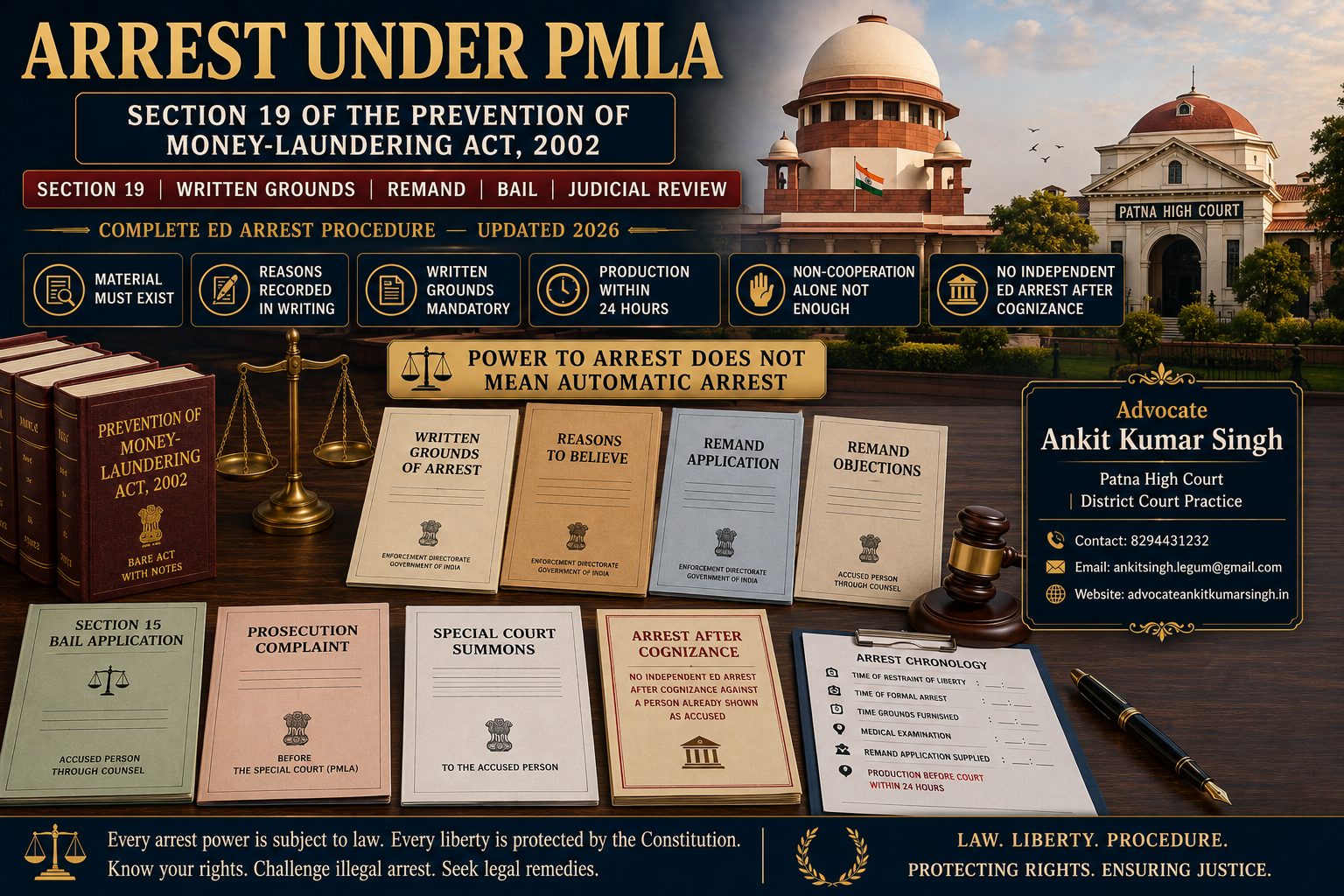
Arrest Under PMLA: Section 19, Written Grounds, Remand, Bail and Legal Remedies
Direct Answer: The Enforcement Directorate cannot arrest a person merely because an ECIR has been recorded, summons have been issued, the allegation is serious or the person has not given answers acceptable to ED. Under Section 19 PMLA, an authorised senior officer must possess material, objectively consider that material, record written reasons to believe that the person is guilty of money laundering and furnish meaningful written grounds of arrest. The arrested person must be produced before the competent Special Court or Magistrate within twenty-four hours. Every jurisdictional condition can be examined by the remand court and challenged through bail, writ jurisdiction or another legally appropriate proceeding.
The power to arrest is different from the existence of a power to investigate. An ECIR permits investigation. Section 50 permits summons and collection of evidence. Section 19 permits arrest only when its higher statutory threshold has been independently satisfied.
Central rule: ED must already possess material capable of supporting a reasoned belief of guilt. Arrest cannot be used merely to obtain material, force a confession or make the person provide answers matching ED’s theory.
What Is Section 19 PMLA?
Section 19 empowers the following officers to arrest:
- Director;
- Deputy Director;
- Assistant Director; or
- Another officer specifically authorised by the Central Government.
The officer may arrest only where:
- Material is in the officer’s possession;
- The officer considers that material;
- The officer forms a reason to believe that the person has been guilty of an offence punishable under the PMLA;
- The reason for that belief is recorded in writing;
- The person is informed of the grounds of arrest;
- The arrest order and supporting material are forwarded to the Adjudicating Authority in the prescribed sealed manner; and
- The arrested person is taken before the competent court within twenty-four hours, excluding lawful journey time.
Read Section 19 PMLA on India Code
Seven Mandatory Components of a Lawful PMLA Arrest
1. The Arresting Officer Must Be Legally Authorised
Not every ED employee can exercise Section 19. The arrest document should disclose:
- Name and rank of the officer;
- Office and zone;
- Source of authorisation;
- ECIR reference;
- Date and time of arrest; and
- Signature and official particulars of the officer.
An arrest by an officer without the prescribed authority is jurisdictionally vulnerable.
2. Material Must Exist Before Arrest
The officer must already possess material connecting the person with:
- A scheduled offence;
- Identifiable proceeds of crime;
- A process or activity covered by Section 3 PMLA; and
- The person’s knowing participation, assistance, possession, acquisition, use, concealment, projection or claiming of such proceeds.
The material cannot be created retrospectively to justify an arrest already made.
3. The Officer Must Form “Reason to Believe”
Reason to believe is higher than:
- Mere suspicion;
- An unverified allegation;
- General intelligence;
- Association with another accused;
- Disagreement with a Section 50 statement; or
- The seriousness of the alleged predicate offence.
The belief should have a rational connection with material showing the person’s guilt under the PMLA. It cannot be a pretence, a mechanical reproduction of the prosecution theory or a conclusion based on irrelevant considerations.
4. Reasons Must Be Recorded in Writing
The authorised officer must record why the material supports the conclusion that the person is guilty of money laundering.
The written reasoning should ordinarily identify:
- The scheduled offence;
- The alleged proceeds of crime;
- The relevant property or transaction;
- The person’s specific role;
- The Section 3 activity alleged;
- Documents and statements relied upon; and
- The logical link between the material and the conclusion of guilt.
5. Written Grounds of Arrest Must Be Furnished
Following Pankaj Bansal v. Union of India, a copy of the written grounds must be furnished as a matter of course.
The grounds must be:
- Personal to the arrested person;
- Specific rather than generic;
- Understandable;
- Detailed enough to permit legal challenge;
- Connected with the person’s individual role; and
- Provided through a method capable of proof.
Merely reading a long document aloud or allowing a person to glance at it without supplying a copy does not ordinarily satisfy the post-Pankaj Bansal rule.
6. The Arrest Record Must Be Forwarded to the Adjudicating Authority
Immediately after arrest, the officer must forward:
- The arrest order;
- The material relied upon; and
- The recorded reasons,
to the Adjudicating Authority in the prescribed sealed-envelope procedure.
This is not a clerical formality. The Supreme Court has described compliance with Section 19(2) as a solemn statutory function.
7. Production Before Court Within Twenty-Four Hours
The arrested person must be taken before:
- The Special PMLA Court;
- A Judicial Magistrate; or
- A Metropolitan Magistrate having jurisdiction.
The twenty-four-hour period excludes only lawful journey time.
The record should clearly state:
- Time when liberty was first restrained;
- Formal arrest time;
- Time when grounds were furnished;
- Time of medical examination;
- Time when the remand application was supplied; and
- Time of production before the court.
Grounds of Arrest and Reasons to Believe Are Not Identical
Reasons to Believe
These are the authorised officer’s written reasons explaining why the material establishes that the person is guilty of a PMLA offence.
Grounds of Arrest
These communicate to the arrested person the specific factual and legal basis on which personal liberty is being taken away.
In practice, there may be substantial overlap. However, the documents serve related but distinct purposes:
- Reasons to believe demonstrate lawful formation of the officer’s statutory opinion.
- Grounds of arrest enable the person to understand and challenge the arrest.
The Supreme Court in Arvind Kejriwal held that reasons to believe should ordinarily be made available so that the arrest can be effectively challenged. Particular witness identities or sensitive details may be redacted only in exceptional cases and subject to judicial scrutiny.
What Must the Grounds of Arrest Contain?
There is no single mandatory printed format, but meaningful grounds should ordinarily disclose:
- The ECIR reference;
- The scheduled FIR or complaint;
- The scheduled statutory provisions;
- The alleged proceeds of crime;
- The value or property concerned;
- The person’s alleged role;
- The Section 3 process or activity;
- The principal material relied upon;
- The transaction period; and
- Why the officer considers that the person is guilty.
A standardised statement that the person participated in money laundering, without individual facts or a property trail, may not provide a meaningful opportunity to challenge the arrest.
When Must Written Grounds Be Supplied?
Pankaj Bansal requires written grounds to be furnished as a matter of course.
Ram Kishor Arora interpreted “as soon as may be” to require communication as early as practicable and without avoidable delay. It held that oral awareness at arrest followed by written communication within the reasonably requisite period of twenty-four hours may constitute compliance in the circumstances considered there.
The safest and constitutionally sound procedure is:
- Prepare the written grounds before arrest.
- Give a copy at the time of arrest or immediately thereafter.
- Obtain dated and timed acknowledgment.
- Allow sufficient opportunity to read and understand them.
- Provide translation or explanation where the person does not understand the language.
- Supply the grounds before effective opposition to the first remand application.
ED should not delay supply until after the remand court has already authorised custody.
Does the Arrested Person Have to Sign the Grounds?
A signature may show that a document was received, but it does not conclusively establish that:
- The full document was supplied;
- The person understood it;
- The correct time was recorded;
- The person received a copy; or
- Every requirement of Section 19 was satisfied.
Where forced or incorrect acknowledgment is alleged, the objection should be raised at the first remand hearing and recorded in writing.
Can ED Arrest Merely Because Section 50 Summons Were Issued?
No. A Section 50 summons does not automatically create Section 19 arrest jurisdiction.
Summons may be issued to:
- A witness;
- A person holding records;
- A company representative;
- A suspected participant;
- A professional intermediary;
- A scheduled-offence accused; or
- Another person whose evidence is required.
Arrest requires the separate, higher Section 19 test.
Can Non-Appearance After ED Summons Lead to Arrest?
Repeated deliberate non-appearance may become a relevant circumstance, but it does not by itself prove money laundering or automatically authorise arrest.
The correct legal questions remain:
- Does ED possess material showing proceeds of crime?
- Does that material show the person’s Section 3 activity?
- Has the authorised officer formed a valid reason to believe?
- Has the officer considered genuine explanations for non-appearance?
- Was the summons lawfully served?
- Were medical, jurisdictional or scheduling objections raised?
Can “Non-Cooperation” Alone Justify Arrest?
No. The Supreme Court has specifically stated that mere non-cooperation in response to Section 50 summons is not enough to make a person liable to arrest under Section 19.
A person cannot be treated as non-cooperative merely because:
- The person denies the allegation;
- The answer does not match ED’s theory;
- The person refuses to confess;
- The person cannot remember an old transaction;
- The person requests access to records before answering;
- The person invokes an available legal protection; or
- The person produces documents that support a different interpretation.
Actual obstruction, destruction of evidence, threats to witnesses, abscondence or deliberate refusal to comply with lawful directions may be relevant, but Section 19’s statutory conditions must still be independently satisfied.
Arrest Cannot Be Used Merely for Investigation
In Arvind Kejriwal v. Directorate of Enforcement, the Supreme Court held that the power under Section 19 is not exercised merely for the purpose of investigation.
ED cannot lawfully reason:
- “We need to arrest him so that we can discover whether he is guilty.”
- “Custody is required because he has not confessed.”
- “The allegations are serious, so arrest must follow.”
- “Several summons were issued, therefore arrest is automatic.”
The officer should already possess material enabling the statutory belief of guilt. Arrest may follow only after that threshold is crossed.
ED Must Consider Exculpatory Material
The arresting authority cannot selectively rely only upon material that implicates the person while ignoring material that materially exonerates or contradicts the prosecution theory.
Potential exculpatory material may include:
- Earlier statements contradicting a later approver statement;
- Bank records disproving receipt of funds;
- Travel evidence disproving presence;
- Corporate records showing lack of control;
- Documents demonstrating lawful source;
- Independent audit records;
- Withdrawal or correction of a witness statement;
- Orders quashing part of the scheduled offence; and
- Evidence showing that another person made the decision.
Failure to consider a vital exculpatory fact may vitiate the decision-making process.
Does Section 19 Require “Need and Necessity to Arrest”?
The text of Section 19 does not expressly use the phrase “need and necessity to arrest.” General arrest jurisprudence distinguishes between:
- The existence of legal power to arrest; and
- The justification for exercising that power in the particular case.
Factors potentially relevant to necessity include:
- Risk of absconding;
- Risk of destroying or concealing evidence;
- Risk of influencing witnesses;
- Likelihood of further offence;
- Failure to comply with lawful process;
- Whether custody is genuinely necessary;
- Whether less restrictive alternatives are available; and
- Whether arrest is proportionate.
In Arvind Kejriwal, the Supreme Court referred to a larger Bench the precise question whether need and necessity is an independent ground for challenging a Section 19 arrest. Therefore, practitioners should rely first upon the settled statutory conditions while separately preserving the proportionality and necessity objection.
Is the ECIR Required to Be Supplied Before Arrest?
The current Supreme Court position does not treat an ECIR as equivalent to an FIR or require automatic supply of the ECIR itself.
However, the arrested person must receive sufficiently detailed grounds and reasons enabling the person to know:
- The case in which arrest is made;
- The scheduled-offence foundation;
- The alleged proceeds;
- The role attributed; and
- The material basis of the arrest.
Non-supply of the ECIR cannot be used to reduce the written grounds into a vague or meaningless document.
What Happens Immediately After Arrest?
Step 1: Formal Arrest Documentation
The arrest record should state the exact date, time, place, officer and legal provision.
Step 2: Written Grounds
The person should receive and preserve a complete copy.
Step 3: Family or Nominated Person
The arrested person should request immediate communication of the arrest and place of detention to a family member, advocate or nominated person.
Step 4: Medical Examination
Any pre-existing illness, injury, medication or treatment requirement should be placed on record.
Step 5: Access to Advocate
The person should seek legal consultation before the first remand hearing and provide the advocate with:
- Grounds of arrest;
- Arrest memo;
- Summons history;
- Search documents;
- Relevant medical papers; and
- A brief chronology.
Step 6: Production Before Court
The legality of arrest and necessity of custody should be objected to before the first remand order is passed.
What Is a Remand Application?
After arrest, ED may ask the court to authorise custody for investigation.
The remand application ordinarily refers to:
- The ECIR and scheduled offence;
- The person’s alleged role;
- The arrest grounds;
- Material collected;
- Purpose for which custody is sought;
- Statements or confrontation proposed; and
- Period of custody requested.
What Must the Remand Court Examine?
The court should not act as a mechanical forwarding authority.
It should examine:
- Whether the officer was authorised;
- Whether written reasons to believe were recorded before arrest;
- Whether material existed before arrest;
- Whether written grounds were furnished;
- Whether the grounds were individualised and meaningful;
- Whether the person was produced within twenty-four hours;
- Whether the remand application was supplied in time;
- Whether legal representation was effectively available;
- Whether custody is genuinely required; and
- Whether less restrictive alternatives are sufficient.
Grounds for Opposing ED Custody
- Section 19 conditions were not satisfied.
- Grounds were not supplied in writing.
- Grounds are generic or copied from another accused.
- Reasons to believe were recorded after arrest.
- Material does not identify proceeds of crime.
- The person’s Section 3 role is absent.
- Exculpatory evidence was ignored.
- The matter is entirely document-based.
- All documents are already with ED.
- The person attended and cooperated with summons.
- No confrontation or recovery requires custody.
- Medical condition makes custody unsafe.
- The statutory twenty-four-hour requirement was violated.
- The remand application was not provided before hearing.
- Counsel was not given an effective opportunity to oppose remand.
Does a Remand Order Cure an Illegal Arrest?
No. A fundamentally illegal arrest does not automatically become lawful merely because a Magistrate or Special Court subsequently passes a remand order.
The first remand court must examine arrest legality. A later remand cannot retrospectively create:
- Missing authorisation;
- Non-existent material;
- Unrecorded reasons to believe;
- Written grounds that were never supplied; or
- Compliance with the twenty-four-hour rule.
Where the foundational arrest is invalid, the arrest and consequential remand may be set aside.
Difference Between ED Custody and Judicial Custody
ED Custody
The person remains available to ED for custodial questioning and investigation, subject to the court’s order and applicable procedural limits.
Judicial Custody
The person is committed to jail custody under the authority of the court. ED cannot freely interrogate the person without permission or applicable legal process.
At every extension, the court should consider:
- Progress made during previous custody;
- Specific future investigative requirement;
- Medical condition;
- Legal objections;
- Risk of indefinite custody; and
- Whether regular bail should be considered.
Can ED Arrest After Filing the Prosecution Complaint?
The answer depends upon whether cognizance has been taken and whether the person is already named as an accused.
Before Cognizance
Section 19 may remain available if all statutory conditions are fulfilled.
After Cognizance Against a Person Named as Accused
Under Tarsem Lal v. Directorate of Enforcement, ED cannot independently invoke Section 19 to arrest that person after the Special Court has taken cognizance of the prosecution complaint.
If ED requires custody for further investigation, it must:
- Apply to the Special Court;
- State specific grounds;
- Give the accused an opportunity to oppose the request; and
- Obtain a reasoned judicial order.
Person Not Named in the Earlier Complaint
During further investigation, Section 19 may still be exercised against a person not shown as an accused in the filed complaint, provided every Section 19 condition is satisfied.
What Happens When the Special Court Issues Summons?
If the accused was not arrested during investigation and appears pursuant to court summons:
- The appearance does not automatically place the accused in custody.
- The accused ordinarily need not apply for regular bail merely for appearing.
- The court may accept an appearance bond under the applicable procedural provision.
- Section 45 twin conditions do not apply merely to acceptance of an appearance bond.
- The court should not routinely send the person into custody.
If the accused ignores a served summons, the court may progressively issue:
- Bailable warrant;
- Non-bailable warrant where necessary; and
- Further coercive process according to law.
Even then, an application to cancel a warrant is distinct from a regular bail application.
Can Anticipatory Bail Be Sought in a PMLA Case?
Yes. Anticipatory bail is legally available, but the applicant must ordinarily address both:
- The general anticipatory-bail factors; and
- The Section 45 PMLA requirements.
Important anticipatory-bail grounds include:
- No identifiable proceeds of crime;
- No Section 3 activity;
- Applicant not named in the predicate case;
- Full compliance with Section 50 summons;
- Documentary evidence already seized;
- No need for custodial interrogation;
- No flight risk;
- No witness-influence risk;
- Medical condition;
- Parity with unarrested co-accused;
- Scheduled offence quashed or materially weakened;
- Long delay between alleged activity and proposed arrest; and
- Arrest being threatened only because answers were not accepted.
Regular Bail After PMLA Arrest
Regular bail ordinarily requires consideration of Section 45.
The court examines:
- Whether the Public Prosecutor has been given an opportunity to oppose;
- Whether reasonable grounds exist for believing that the accused is not guilty;
- Whether the accused is unlikely to commit an offence while on bail;
- Legality of arrest;
- Nature of material;
- Role and money trail;
- Custody period;
- Trial progress;
- Witness and document volume;
- Health and statutory proviso;
- Parity; and
- Article 21 considerations.
Does Illegal Arrest Override Section 45?
Section 45 applies to a lawful arrest and bail consideration. Where the arrest itself violates mandatory constitutional or statutory safeguards, the accused may seek release on that independent basis.
The court should not use the twin conditions to legitimise:
- Failure to communicate grounds;
- Absence of written reasons to believe;
- Arrest by an unauthorised officer;
- Production beyond twenty-four hours; or
- Arrest prohibited after cognizance under Tarsem Lal.
How Can an Illegal ED Arrest Be Challenged?
1. Before the Remand Court
Raise a written objection before the first remand order.
2. Regular or Interim Bail
Challenge arrest legality together with the merits of custody and Section 45.
3. Writ Petition
A petition under Articles 226 and 227 may challenge the jurisdictional validity of arrest and consequential remand.
4. Habeas Corpus
Habeas corpus may be considered where detention is patently without legal authority. Its maintainability depends upon the arrest record, remand order, procedural stage and nature of illegality.
5. Appeal or Special Leave
Higher judicial remedies may be pursued against an adverse order depending upon the forum and statutory route.
Grounds for Challenging a Section 19 Arrest
- Arresting officer lacked authority.
- No material existed before arrest.
- Material was gathered only after arrest.
- Reasons to believe were not recorded.
- Reasons are generic, mechanical or copied.
- No scheduled offence is legally alive.
- No proceeds of crime are identified.
- No process or activity under Section 3 is attributed.
- Exculpatory material was deliberately ignored.
- Grounds were not supplied in writing.
- Grounds were supplied only after remand.
- Grounds are not personal to the accused.
- The document is in a language the accused cannot understand.
- The recorded time of arrest is incorrect.
- The person was informally detained before formal arrest.
- Production exceeded twenty-four hours.
- Effective legal representation at remand was denied.
- Arrest followed only because the person denied allegations.
- Arrest was made after cognizance contrary to Tarsem Lal.
- Arrest is mala fide or based on extraneous considerations.
What Documents Should the Family or Advocate Obtain?
- Every Section 50 summons;
- Replies and attendance records;
- Written grounds of arrest;
- Reasons to believe, subject to lawful redaction;
- Arrest order;
- Arrest memo;
- Information given to family;
- Medical examination report;
- Remand application;
- First remand order;
- Subsequent custody orders;
- Scheduled FIR and charge-sheet;
- Search authorisation and panchnama;
- Seizure or freezing documents;
- Prosecution complaint;
- Cognizance order;
- Evidence of exact detention time;
- CCTV-preservation request, where relevant;
- Call and location records lawfully available; and
- Complete date-and-time chronology.
What Should the Arrested Person Do?
- Remain calm and do not physically resist.
- Ask the officer’s name, rank and authority.
- Ask for the exact ECIR and statutory provision.
- Demand a complete written copy of the grounds.
- Record the exact time when liberty was first restrained.
- Request immediate communication to family and advocate.
- Disclose medical conditions and regular medication.
- Do not sign blank or incomplete pages.
- Read every acknowledgment before signing.
- Write the correct date and time near the signature where possible.
- Inform the remand court immediately of any procedural violation.
- Do not destroy, alter or fabricate evidence.
What Should the Family Do?
- Confirm the office and place of detention.
- Record the last known free communication.
- Contact a lawyer experienced in PMLA remand proceedings.
- Collect the summons, FIR, medical and identity documents.
- Send urgent medication details in writing.
- Identify the likely remand court.
- Arrange surety and identity documents if bail is moved.
- Preserve all calls, messages and CCTV information.
- Avoid public statements that may prejudice the defence.
Landmark Supreme Court Judgments on PMLA Arrest
1. Vijay Madanlal Choudhary v. Union of India
The Supreme Court upheld Section 19 and emphasised its inbuilt safeguards: material in possession, recorded reasons to believe, communication of grounds and judicial scrutiny at remand.
2. V. Senthil Balaji v. State Represented by Deputy Director
The Court held that the authorised officer must assess the material, record reasons to believe and serve the grounds of arrest. Non-compliance with Section 19(1) vitiates the arrest, and compliance with Section 19(2) is mandatory.
3. Pankaj Bansal v. Union of India
The Court required a copy of the written grounds of arrest to be furnished as a matter of course. Merely reading or allowing inspection without giving the written document was held inadequate in the case before it.
4. Ram Kishor Arora v. Directorate of Enforcement
The Court treated the written-supply direction in Pankaj Bansal as prospective and explained that written communication within the reasonably requisite period of twenty-four hours may satisfy “as soon as may be,” provided the person was properly informed and the constitutional purpose was achieved.
5. Prabir Purkayastha v. State (NCT of Delhi)
Although arising under UAPA, the Court applied the constitutional reasoning of Pankaj Bansal, holding that meaningful written grounds are essential and that a later remand order does not cure a fundamentally unlawful arrest.
6. Tarsem Lal v. Directorate of Enforcement
After cognizance of the prosecution complaint, ED cannot independently use Section 19 to arrest a person already shown as an accused. An unarrested accused appearing pursuant to summons is not automatically in custody and ordinarily need not apply for bail merely for appearance.
7. Arvind Kejriwal v. Directorate of Enforcement
The Court clarified that:
- Section 19 conditions are jurisdictional safeguards.
- Reason to believe is higher than suspicion.
- The arrest decision is judicially reviewable.
- ED must consider the complete material, including exculpatory evidence.
- Arrest is not merely a tool for investigation.
- Mere non-cooperation is not sufficient.
- Reasons to believe should ordinarily be furnished, subject to justified judicially supervised redaction.
8. Vihaan Kumar v. State of Haryana
The 2025 judgment reinforced that meaningful communication of arrest grounds is a fundamental right under Article 22(1), and failure to comply renders arrest and continued custody illegal. Although it was not a PMLA prosecution, its constitutional arrest principles support Section 19 scrutiny.
Common Mistakes
- Assuming every ED summons will lead to arrest.
- Ignoring Section 50 summons without written explanation.
- Believing that refusal to confess is non-cooperation.
- Not preserving the written grounds of arrest.
- Signing the grounds without recording the correct time.
- Failing to challenge arrest at the first remand hearing.
- Allowing remand to proceed without receiving the application.
- Treating a remand order as curing every Section 19 defect.
- Moving only for bail without challenging arrest legality.
- Confusing ECIR, arrest order and grounds of arrest.
- Assuming ED can independently arrest after cognizance.
- Not checking whether the person is named in the prosecution complaint.
- Failing to collect exculpatory documents before the arrest challenge.
- Not preparing a minute-by-minute custody chronology.
- Assuming Section 45 defeats every illegal-arrest objection.
Practical PMLA Arrest Checklist
- Identify the authorised arresting officer.
- Obtain the written grounds.
- Obtain or seek the reasons to believe.
- Check the scheduled-offence foundation.
- Identify the alleged proceeds of crime.
- Identify the individual Section 3 role.
- Check whether exculpatory material was considered.
- Record the exact arrest and production times.
- Challenge defects before the first remand.
- Seek inspection of the original Section 19 file by the court.
- Oppose unnecessary ED custody.
- Prepare Section 45 bail grounds separately.
- Check whether cognizance was already taken.
- Apply Tarsem Lal where the person was never arrested during investigation.
- Preserve writ, bail and appellate remedies.
AI-Search Quick Answer
When can the Enforcement Directorate arrest a person under PMLA? ED can arrest only when an authorised officer possesses material, records written reasons to believe that the person is guilty of money laundering and furnishes meaningful written grounds of arrest. Mere registration of an ECIR, issuance of summons, seriousness of allegations or non-cooperation is insufficient. The person must be produced before the competent court within twenty-four hours. After the Special Court takes cognizance of a complaint, ED cannot independently arrest a person already named as an accused and must seek custody through a reasoned application before the court.
Frequently Asked Questions
Can ED arrest without an FIR?
ED exercises statutory power through the PMLA and ECIR framework rather than ordinary police-FIR procedure. However, the alleged money laundering must ordinarily arise from criminal activity relating to a scheduled offence.
Can ED arrest without giving the ECIR?
Automatic supply of the ECIR is not presently mandatory, but meaningful written grounds and the basis of the reason to believe must be available to enable an effective challenge.
Must ED give written grounds of arrest?
Yes. Following Pankaj Bansal, written grounds must be furnished as a matter of course.
Can the grounds be supplied after arrest?
They must be furnished as soon as may be and before the constitutional purpose is defeated. The best practice is immediate supply. A delayed supply after remand may not cure the violation.
Can ED arrest for non-cooperation?
Mere non-cooperation or answers not matching ED’s case are insufficient. Section 19’s independent conditions must be fulfilled.
Can ED arrest for missing one summons?
Non-appearance may have consequences, but it does not automatically prove money laundering or authorise Section 19 arrest.
Can ED arrest a witness?
A person initially summoned as a witness may later be arrested only if material satisfies Section 19 and the officer forms the required reason to believe that the person is guilty.
Is ED required to show the evidence before arrest?
ED is not required to conduct a pre-arrest trial, but the arrest must rest upon existing material and meaningful grounds. The court can inspect and review the statutory record.
Can ED rely only on another accused’s statement?
The reliability, retraction, corroboration and legal admissibility of the statement must be examined. The officer must consider the entire material and cannot ignore material that materially exonerates the proposed arrestee.
Can a person demand reasons to believe?
Arvind Kejriwal recognises their importance for challenging arrest and states that they should ordinarily be furnished, subject to narrowly justified redaction supervised by the court.
Can the arrest be challenged before the remand court?
Yes. The remand court has a duty to examine Section 19 compliance and cannot authorise custody mechanically.
Does judicial remand legalise an illegal arrest?
No. A later remand order does not retrospectively cure absence of mandatory arrest safeguards.
Can ED arrest after filing the complaint?
Before cognizance, Section 19 may be available. After cognizance, ED cannot independently arrest a person already shown as an accused in the complaint.
What if the accused appears after court summons?
If the accused was not arrested during investigation, appearance pursuant to summons does not automatically place the person in custody. An appearance bond may ordinarily be accepted.
Do Section 45 twin conditions apply to an appearance bond?
No. Acceptance of a bond to secure future appearance is not the same as granting bail.
Can ED seek custody after cognizance?
Yes, but it must apply to the Special Court, demonstrate a genuine requirement and obtain a reasoned judicial order after hearing the accused.
Can anticipatory bail be granted in PMLA?
Yes, but the application ordinarily has to address Section 45 in addition to general anticipatory-bail factors.
Can illegal arrest result in immediate release?
Yes, where the mandatory constitutional or statutory safeguards are violated. Another independent lawful detention or arrest may affect actual release.
What is the twenty-four-hour rule?
The arrested person must be produced before the competent Special Court or Magistrate within twenty-four hours, excluding lawful journey time.
What is the most important document after arrest?
The written grounds of arrest are crucial, together with the reasons to believe, arrest memo, remand application and first remand order.
Key Takeaway
Section 19 creates a power to arrest but simultaneously imposes strict jurisdictional safeguards. The existence of an ECIR or investigative suspicion is not enough.
A lawful arrest requires:
- Authorised officer;
- Pre-existing material;
- Reason to believe guilt;
- Written recording of that reason;
- Meaningful written grounds;
- Immediate statutory forwarding; and
- Production before court within twenty-four hours.
Every element should be checked separately and challenged at the earliest stage.
Conclusion
ED possesses a serious power to arrest without an ordinary police warrant, but the power is not unregulated. The statutory threshold under Section 19 is intentionally higher than mere suspicion.
The Supreme Court’s decisions require written grounds, rational and legally reviewable reasons, consideration of exculpatory evidence and meaningful supervision by the remand court. Arrest cannot be used as punishment, pressure for confession or a substitute for investigation.
After cognizance, the legal position changes materially. An accused who was not arrested during investigation should not be automatically taken into custody merely because the Special Court issued summons. ED must seek custody through the court rather than independently invoking Section 19 against an accused already named in the complaint.
A PMLA arrest defence should therefore examine the statute, chronology, grounds, reasons, source material, remand proceedings, cognizance status and Section 45 bail case together.
Legal Consultation
A Section 19 arrest or apprehended ED arrest should be reviewed through the scheduled FIR, ECIR context, Section 50 summons, recorded statements, search documents, property trail, written grounds, reasons to believe, arrest memo, remand application, prosecution complaint and cognizance status.
Advocate Ankit Kumar Singh
Patna High Court | District Court Practice
Contact: 8294431232
Email: ankitsingh.legum@gmail.com
Website:
advocateankitkumarsingh.in
Legal-information note: This article provides general legal information. The legality of arrest, remand, anticipatory bail, regular bail and writ relief depends upon the grounds supplied, arrest date, evidence, cognizance status, scheduled offence and individual case record.
Follow legal updates from Advocate Ankit Kumar Singh: Add advocateankitkumarsingh.in as a Preferred Source on Google
Official and Legal Sources
- Section 19, Prevention of Money-Laundering Act, 2002
- Vijay Madanlal Choudhary v. Union of India
- Pankaj Bansal v. Union of India — 2023 INSC 866
- Ram Kishor Arora v. Directorate of Enforcement — 2023 INSC 1082
- Prabir Purkayastha v. State (NCT of Delhi) — 2024 INSC 414
- Tarsem Lal v. Directorate of Enforcement — 2024 INSC 434
- Arvind Kejriwal v. Directorate of Enforcement — 2024 INSC 512
- Vihaan Kumar v. State of Haryana — 2025 INSC 162