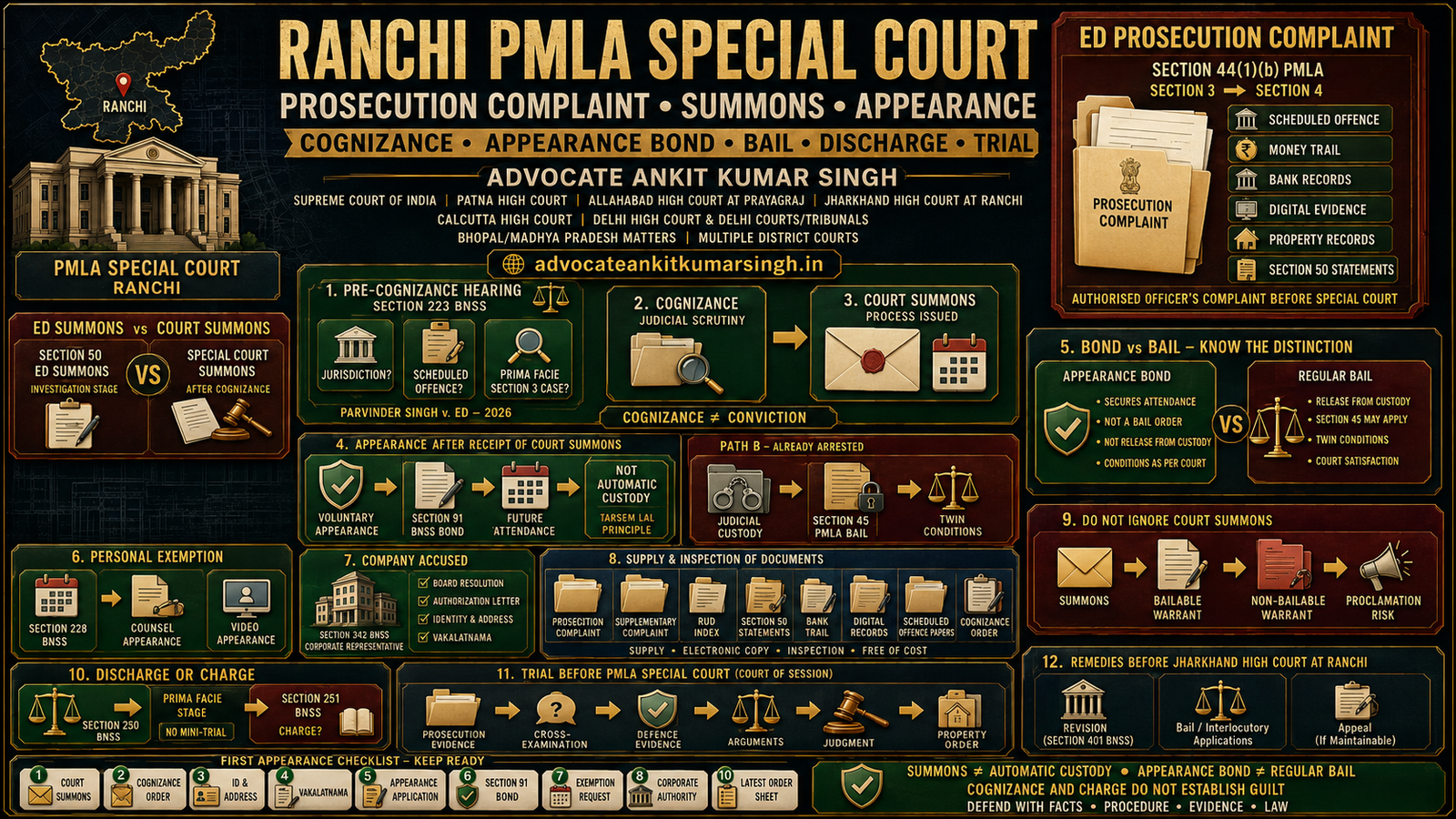
RANCHI PMLA SPECIAL COURT | PROSECUTION COMPLAINT | COGNIZANCE | SUMMONS | APPEARANCE | BAIL | DISCHARGE
Prosecution Complaint before the Ranchi PMLA Special Court: Cognizance, Summons, Appearance, Bail and Discharge
Detailed legal research by Advocate Ankit Kumar Singh
Supreme Court of India | Patna High Court | Allahabad High Court at Prayagraj | Jharkhand High Court at Ranchi | Calcutta High Court | Delhi High Court and Delhi Courts/Tribunals | Matters concerning Bhopal, Madhya Pradesh | Multiple District Courts
Researched and legally updated: 5 August 2026
Direct Answer: What Happens after ED Files a Prosecution Complaint in Ranchi?
After completing the relevant stage of investigation, the Directorate of Enforcement may file a written prosecution complaint before the competent PMLA Special Court at Ranchi under Section 44(1)(b), read with the cognizance requirement contained in Section 45.
The Special Court does not mechanically convict or detain every person named in the complaint. It must apply judicial mind to determine whether the complaint and supporting material disclose sufficient ground to proceed.
For cognizance governed by the Bharatiya Nagarik Suraksha Sanhita, 2023, the accused must receive the opportunity of hearing required by the first proviso to Section 223(1) before cognizance.
If cognizance is taken and process is issued, the Court may:
- summon the accused;
- dispense with personal attendance in an appropriate case;
- issue a warrant where legally justified;
- require an appearance bond;
- deal with bail where the accused is already in custody;
- supply or permit inspection of prosecution material;
- hear a discharge application;
- frame charges where sufficient ground exists; and
- conduct the trial as a Court of Session.
A person who was not arrested during ED investigation and appears voluntarily pursuant to summons is ordinarily not treated as being in custody merely because of appearance. Such a person ordinarily need not apply for regular bail only to enter appearance and may furnish an appearance bond under the applicable law.
A person already arrested under Section 19 PMLA stands on a different footing and must pursue remand and bail remedies according to Sections 45 and 46 and the applicable criminal-procedure law.
ED Section 50 Summons and Special Court Summons Are Different
| Document | Issued by | Purpose | Stage |
|---|---|---|---|
| Section 50 PMLA summons | Authorised ED officer | Evidence, statement or document production | Investigation or proceeding before ED |
| Pre-cognizance hearing notice | PMLA Special Court | Opportunity of hearing before cognizance under the applicable BNSS procedure | After complaint but before cognizance |
| Accused summons after cognizance | PMLA Special Court | Secure appearance in the criminal prosecution | After cognizance and issuance of process |
| Witness summons | Special Court | Secure testimony or production of evidence | Trial or another judicial stage |
A response prepared for an ED investigative summons cannot automatically be used as the strategy for a Special Court summons. The issuing authority, purpose, consequences and reliefs are different.
Which Court Is the Ranchi PMLA Special Court?
Section 43 PMLA permits the Central Government, in consultation with the Chief Justice of the concerned High Court, to designate one or more Courts of Session as Special Courts for specified areas, cases or classes of cases.
Recent Ranchi judicial records refer to designations including:
- Additional Judicial Commissioner-XVIII-cum-Special Judge, PML Act, Ranchi;
- Additional Judicial Commissioner-I-cum-Special Judge, PML Act, Ranchi;
- Special Judge, PML Act, Ranchi; and
- CBI-cum-Special Judge under PMLA, Ranchi in specified proceedings.
The designation may depend on the applicable notification, scheduled offence, case allocation and administrative distribution.
The court name, courtroom, case number and appearance date must be taken from the actual judicial summons and latest order sheet—not from a general website article or an older case.
Ranchi Zonal Office Reference
The Directorate of Enforcement presently lists its Ranchi Zonal Office at:
Plot No. 1502/B,Airport Road,
Hinoo,
Ranchi, Jharkhand – 834002.
This is the Enforcement Directorate’s government office and is not an advocate’s chamber or the address of the PMLA Special Court.
What Is an ED Prosecution Complaint?
A prosecution complaint is the criminal pleading through which an authorised Enforcement Directorate officer requests the Special Court to prosecute the persons and entities alleged to have committed money laundering.
It is commonly comparable in function to a final prosecution document, but it is legally a complaint rather than a police report or conventional charge sheet.
Typical Components
- details of the authorised complainant;
- ECIR reference;
- scheduled-offence FIR, complaint or charge-sheet details;
- identity and alleged role of each accused;
- description of the alleged proceeds of crime;
- fund-flow and transaction chronology;
- property, bank-account or company information;
- Section 50 statements;
- search, seizure and freezing material;
- digital and documentary evidence;
- attachment and adjudication history, where relevant;
- alleged processes of concealment, possession, acquisition, use or projection;
- list of relied-upon documents;
- list of witnesses; and
- prayer for cognizance and trial under Sections 3 and 4 PMLA.
The prosecution complaint may be lengthy, but volume is not a substitute for a person-specific allegation and a legally identifiable connection with proceeds of crime.
ECIR, Prosecution Complaint and Supplementary Complaint
| Record | Function |
|---|---|
| ECIR | Internal ED investigation record associated with initiation of the PMLA investigation |
| Prosecution complaint | Written criminal complaint placed before the Special Court for prosecution |
| Supplementary prosecution complaint | Subsequent complaint bringing additional evidence or additional accused into the same money-laundering prosecution |
| Scheduled-offence charge sheet | Police or investigating-agency prosecution record concerning the predicate offence |
Section 44 clarifies that the expression “complaint” includes a subsequent complaint resulting from further investigation, whether the additional accused was named in the original complaint or not.
A person may therefore receive court process even though the person was absent from the first prosecution complaint.
Pre-Cognizance Hearing under Section 223 BNSS
The most important recent procedural development is the requirement of hearing before cognizance under the first proviso to Section 223(1) BNSS.
Parvinder Singh v. Directorate of Enforcement, 2026 INSC 519
On 19 May 2026, the Supreme Court held that:
- Sections 223 to 228 BNSS apply to complaints under Section 44 PMLA;
- taking cognizance requires application of judicial mind;
- the mandatory opportunity of hearing cannot be treated as a minor procedural formality;
- cognizance taken without the required hearing is legally vitiated; and
- the complaint procedure applicable to PMLA is not displaced merely because PMLA is a special enactment.
The prosecution complaint in that case had been filed before 1 July 2024, but cognizance was taken after the BNSS commenced. The Supreme Court applied the BNSS hearing requirement to the cognizance stage.
What Should Be Examined at This Stage?
- Whether the Special Court possesses territorial and subject-matter jurisdiction.
- Whether the complaint was filed by a duly authorised officer.
- Whether a legally recognised scheduled offence exists.
- Whether the complaint identifies proceeds derived from scheduled criminal activity.
- Whether allegations against the proposed accused disclose an activity covered by Section 3.
- Whether the complaint is barred by an existing final judicial determination.
- Whether the person is named through material or merely through association.
- Whether statutory sanction is required and available in the particular case.
- Whether obvious jurisdictional or legal defects prevent cognizance.
The pre-cognizance hearing should not be treated as a complete trial or an occasion to conduct exhaustive cross-examination. Its scope depends upon the complaint, legal objections, the applicable procedure and the Court’s directions.
What Does “Taking Cognizance” Mean?
Cognizance is the judicial act by which the Special Court applies its mind to the complaint for proceeding with the alleged offence.
Under Section 44(1)(b), the Special Court may directly take cognizance of the offence under Section 3 without the accused first being committed to it for trial through a Magistrate.
Before issuing process, the Court may consider whether:
- the complaint discloses a prima facie offence;
- the supporting material justifies proceeding;
- further inquiry is required;
- the complaint should be dismissed for absence of sufficient ground;
- summons should be issued;
- a warrant is justified in an exceptional case; or
- personal attendance may initially be dispensed with.
Cognizance is not a finding that the allegations are true beyond reasonable doubt.
What Does a Court Summons Require?
A summons issued after cognizance directs the person named to appear before the Special Court on the specified date and time.
Check the Following Immediately
- name of the Court;
- case or ECIR case number;
- name and address of the accused;
- date and time of appearance;
- whether personal appearance is specifically required;
- sections stated;
- mode and date of service;
- process-server endorsement;
- whether copies accompany the summons;
- whether any earlier order or warrant exists; and
- whether the summons relates to pre-cognizance hearing or post-cognizance appearance.
A person should not rely solely upon a telephone call, WhatsApp message or forwarded photograph. The case status and latest order should be verified through counsel or the appropriate court system.
Four Different Appearance Situations
| Situation | Ordinary legal approach |
|---|---|
| Not arrested during investigation; appears on summons | Voluntary appearance, application recording Tarsem Lal protection and appearance bond under the applicable provision |
| Already arrested and in judicial custody | Production before Court, remand status and regular-bail proceedings under Section 45 |
| Company or registered society is accused | Appearance through duly appointed corporate representative, subject to court acceptance |
| Unable to attend personally for a genuine reason | Advance application seeking exemption, supported by documents and representation through counsel |
Appearance of an Unarrested Accused: Tarsem Lal Principle
The Supreme Court in Tarsem Lal v. Directorate of Enforcement clarified the procedure where ED did not arrest the accused during investigation.
Where such an accused appears pursuant to summons after cognizance:
- the appearance does not automatically place the accused in custody;
- a regular-bail application is ordinarily unnecessary merely to appear;
- the Court may accept a bond securing future attendance;
- acceptance of the bond is not an order granting bail;
- Section 45 twin conditions are not attracted merely for acceptance of the appearance bond; and
- the accused remains bound to attend whenever directed.
Section 91 BNSS Appearance Bond
Section 91 BNSS permits the Court to require a person present before it, for whose appearance or arrest it may issue process, to execute a bond or bail bond for future appearance.
The corresponding legacy provision is Section 88 CrPC.
An appearance bond secures future attendance. It should not be drafted as an admission of guilt, surrender to custody or concession regarding the allegations.
Can ED Arrest after Cognizance?
Where a person named in the complaint was not arrested during investigation and appears pursuant to court summons, ED cannot treat the court premises as an unrestricted opportunity to arrest the person under Section 19.
Where ED claims that custody is required after cognizance, the request must be placed before the Special Court. The accused must receive an opportunity to oppose the request, and the Court must examine whether custodial interrogation is genuinely required.
This does not create immunity against:
- lawful coercive process for non-appearance;
- cancellation or forfeiture of bonds;
- custody ordered by the Special Court upon lawful grounds;
- arrest in another legally distinct case; or
- consequences of obstruction, abscondence or evidence tampering.
Appearance of an Accused Already in Custody
Tarsem Lal does not convert an arrested accused into an unarrested accused.
A person arrested under Section 19 PMLA and remanded to custody must ordinarily address:
- legality of arrest;
- communication of written grounds of arrest;
- recorded reasons to believe;
- remand orders;
- Section 45 twin conditions;
- the statutory provisos concerning women, persons below sixteen, sick or infirm persons and the applicable monetary category;
- role and proceeds-of-crime nexus;
- custody duration;
- trial delay;
- medical circumstances;
- parity; and
- Article 21 considerations.
Filing of the prosecution complaint may affect the investigation stage, but it does not automatically result in bail.
What Happens If the Accused Does Not Appear?
A judicial summons should never be ignored.
Depending upon service, prior conduct, exemption applications and the Court’s assessment, non-appearance may lead to:
- fresh summons;
- bailable warrant;
- non-bailable warrant;
- forfeiture or cancellation of the appearance bond;
- proclamation proceedings;
- attachment associated with abscondence proceedings;
- adverse consideration of conduct; and
- rejection of a later request for routine exemption.
Where attendance is genuinely impossible, an exemption or adjournment application should ordinarily be filed before the matter is called, supported by proper evidence.
Can Personal Appearance Be Exempted?
The applicable complaint procedure permits the Court to dispense with personal attendance in an appropriate case and allow appearance through an advocate.
Under the BNSS framework:
- Section 228 concerns dispensing with personal attendance when summons is issued; and
- Section 355 permits inquiry or trial to proceed without physical attendance in specified circumstances where the accused is represented.
Personal attendance may also include appearance through audio-video electronic means where permitted by law and the Court.
Factors Commonly Relevant
- age and medical condition;
- distance from Ranchi;
- residence outside Jharkhand or outside India;
- frequency of routine dates;
- whether identity has already been established;
- whether the accused undertakes not to dispute identification;
- whether counsel will remain present;
- whether absence will delay proceedings;
- whether the date concerns charge, examination or another material stage; and
- previous compliance with court directions.
Exemption is discretionary. The Court may require personal attendance at any later stage.
Appearance When a Company or Firm Is an Accused
Where a corporation or registered society is arrayed as an accused, Section 342 BNSS permits appointment of a representative for the inquiry or trial.
Documents Commonly Required
- board resolution or valid management authorisation;
- written appointment of the representative;
- company incorporation records;
- identity and address proof of the representative;
- authority to engage counsel;
- vakalatnama;
- corporate-status records; and
- undertaking to communicate court directions to the entity.
Representation of the company does not automatically represent every director, officer, partner or employee separately arrayed as an individual accused.
Section 70 PMLA
Where an offence by a company is alleged, the prosecution must still address the statutory basis for proceeding against the entity and each responsible person.
Designation alone should not replace analysis of:
- responsibility for business conduct;
- period of office;
- decision-making authority;
- knowledge;
- consent, connivance or neglect;
- signing powers;
- financial control; and
- the statutory defence available to the person concerned.
Supply and Inspection of Prosecution Documents
An effective defence requires access to the complaint and the material relied upon for seeking trial.
Documents to Seek
- complete prosecution complaint;
- supplementary prosecution complaints;
- list of relied-upon documents;
- list of witnesses;
- scheduled-offence FIR or complaint;
- scheduled-offence charge sheet and supplementary charge sheet;
- Section 50 statements relied upon;
- search and seizure records;
- bank statements and fund-flow charts;
- digital records and electronic-record certificates;
- company, property and ownership records;
- valuation material;
- expert reports;
- relevant forensic reports;
- sanction orders, where relied upon;
- cognizance order; and
- latest order sheet.
Under the complaint-case procedure governing matters triable by a Court of Session, statements and documents relied upon by the prosecution are to be furnished free of cost, subject to the provisions concerning voluminous records and inspection.
Electronic supply may constitute valid furnishing under the BNSS framework.
Voluminous Records
Where the record includes large accounting databases, server material, extensive emails, digital extractions or thousands of pages, the defence should request:
- searchable electronic copies;
- document index;
- page numbering;
- hash and source details;
- inspection schedule;
- permission to obtain certified extracts; and
- adequate time before discharge or charge hearing.
First-Date Appearance Checklist
Case Papers
- original or legible copy of summons;
- case-status printout;
- cognizance order, if available;
- prosecution complaint or available extracts;
- earlier ED summons and compliance record;
- proof that the person was not arrested during investigation;
- relevant High Court or Supreme Court protection order;
- vakalatnama; and
- draft applications.
Identity and Bond Material
- government identity document;
- current address proof;
- passport-size photographs where locally required;
- proposed appearance-bond papers;
- surety documents only where legally or procedurally required; and
- corporate authorisation where an entity is accused.
Applications to Keep Ready
- application recording voluntary appearance;
- application under Section 91 BNSS or Section 88 CrPC;
- application relying upon Tarsem Lal;
- personal-exemption application;
- application for supply of complaint and relied-upon records;
- application for inspection;
- company-representative application; and
- medical or travel application where relevant.
Local filing practices, court-fee requirements, bond formats and identification documents should be verified with counsel handling the actual Ranchi court record.
Adaptable Application for Voluntary Appearance and Bond
The following is a general drafting format. It must be revised according to the complaint date, cognizance order, applicable procedural law and actual court process.
IN THE COURT OF THE LEARNED SPECIAL JUDGE
UNDER THE PREVENTION OF MONEY-LAUNDERING ACT, 2002
AT RANCHI

ECIR CASE NO. ______ OF ______

DIRECTORATE OF ENFORCEMENT
... COMPLAINANT

VERSUS

[NAME OF ACCUSED]
... ACCUSED/APPLICANT

APPLICATION RECORDING VOLUNTARY APPEARANCE AND
SEEKING ACCEPTANCE OF APPEARANCE BOND

MOST RESPECTFULLY SUBMITTED:

1. That the applicant has been arrayed as an accused in the
   prosecution complaint filed by the Directorate of Enforcement.

2. That the applicant has received summons directing appearance
   before this Learned Special Court on ______.

3. That the applicant was not arrested by the Directorate of
   Enforcement during the investigation.

4. That the applicant is voluntarily appearing in compliance with
   the judicial summons and undertakes to participate in the
   proceedings in accordance with law.

5. That appearance pursuant to summons does not by itself place an
   unarrested accused in custody or require a regular-bail application,
   in view of the principles stated by the Supreme Court in
   Tarsem Lal v. Directorate of Enforcement.

6. That the applicant is ready to execute an appearance bond under
   Section 91 of the Bharatiya Nagarik Suraksha Sanhita, 2023 /
   Section 88 of the Code of Criminal Procedure, 1973, as applicable.

7. That the applicant undertakes:

   a. to appear whenever personally directed;
   b. not to obstruct the proceedings;
   c. to maintain current address and contact details;
   d. to comply with lawful court directions; and
   e. not to seek unnecessary adjournment.

PRAYER:

It is respectfully prayed that this Learned Court may:

a. record the applicant’s voluntary appearance;

b. accept the appearance bond under the applicable procedural
   provision;

c. record that acceptance of the appearance bond does not amount
   to surrender to custody or adjudication of bail;

d. permit representation through counsel on routine dates,
   subject to further orders; and

e. pass such further order as may be just and lawful.

Place:
Date:

Applicant:
Through Counsel:
Signature:
Adaptable Personal-Exemption Application
IN THE COURT OF THE LEARNED SPECIAL JUDGE
UNDER THE PREVENTION OF MONEY-LAUNDERING ACT, 2002
AT RANCHI

ECIR CASE NO. ______ OF ______

APPLICATION SEEKING EXEMPTION FROM PERSONAL
APPEARANCE FOR ROUTINE DATES

MOST RESPECTFULLY SUBMITTED:

1. That the applicant has entered appearance and is represented
   through counsel.

2. That the applicant permanently resides at ______ / is suffering
   from ______ / is required to travel from ______.

3. That the applicant does not dispute identity and undertakes that
   counsel shall remain present on every date.

4. That the applicant shall personally appear whenever specifically
   directed by this Learned Court, including at any material stage
   where personal presence is considered necessary.

5. That exemption will not delay the proceedings or prejudice the
   prosecution.

PRAYER:

It is respectfully prayed that the applicant may be exempted from
personal attendance on routine dates and permitted to appear through
counsel, subject to such conditions as this Learned Court considers
appropriate.

Place:
Date:

Applicant:
Through Counsel:
Signature:
Supplementary Prosecution Complaints
Further investigation may continue after filing of the original prosecution complaint.
A supplementary complaint may:
- add new accused persons;
- add companies or entities;
- introduce further statements;
- introduce additional bank and property records;
- rely upon subsequent searches or seizures;
- expand the alleged proceeds-of-crime amount;
- add digital or forensic evidence; and
- modify the alleged role attributed to existing accused.
Every accused added later should examine:
- whether a fresh pre-cognizance hearing was given where legally required;
- what new evidence is relied upon;
- whether the complaint contains a distinct role allegation;
- whether limitation or jurisdiction issues arise;
- whether earlier findings are being mechanically extended; and
- whether the new complaint changes the discharge or charge strategy.
Discharge before the Ranchi PMLA Special Court
After receiving the complaint and prosecution documents, the accused may seek discharge under:
- Section 250 BNSS; or
- Section 227 CrPC under the legacy procedural regime.
Possible Discharge Grounds
- No legally sustainable scheduled offence exists.
- No property qualifies as proceeds of crime.
- The person’s alleged conduct does not fall within Section 3.
- The complaint relies only upon designation or relationship.
- No person-specific act of concealment, possession, acquisition, use or projection is alleged.
- The alleged transaction predates the scheduled criminal activity.
- The material demonstrates a genuine commercial transaction.
- The complaint omits a necessary mental element where knowledge is required.
- The prosecution is barred by a final predicate-case determination.
- The Court lacks territorial jurisdiction.
- Mandatory sanction is absent, where legally required.
- The evidence, even accepted at face value, does not disclose sufficient ground to proceed.
Limited Scope at Discharge
The Special Court does not ordinarily conduct a complete trial at the discharge stage. It examines whether sufficient ground exists to proceed.
The recent 2026 Jharkhand High Court decisions concerning Ranchi PMLA proceedings reiterate that discharge and charge hearings are not occasions for a mini-trial or meticulous final evaluation of competing evidence.
The defence should nevertheless demonstrate legal impossibility, absence of ingredients, admitted documentary contradictions and fundamental prosecution defects.
Framing of Charge
If the Special Court concludes that sufficient ground exists to presume commission of the offence, it may frame charge under:
- Section 251 BNSS; or
- Section 228 CrPC under the applicable legacy regime.
The charge should identify:
- the offence alleged;
- the relevant period;
- the alleged proceeds or property;
- the process or activity connected with those proceeds; and
- the role attributed to the accused.
An accused may challenge discharge rejection or charge-framing through the legally available revisional or constitutional remedy, but the maintainability, limitation and scope of interference require case-specific assessment.
Trial before the PMLA Special Court
Section 46 treats the Special Court as a Court of Session for the applicable criminal-procedure provisions.
The trial may involve:
- opening of the prosecution case;
- framing and explanation of charges;
- prosecution evidence;
- proof of bank, property, company and digital records;
- examination and cross-examination of witnesses;
- expert and forensic evidence;
- examination of the accused;
- defence evidence, where presented;
- final arguments;
- judgment of acquittal or conviction;
- sentence, where applicable; and
- property confiscation, release or restoration orders according to law.
What Must the Prosecution Ultimately Prove?
The prosecution must establish the statutory ingredients through admissible evidence, including the required connection between:
- scheduled criminal activity;
- property derived or obtained from that activity;
- the alleged process or activity concerning the property; and
- the conduct and mental element attributed to the particular accused.
Cognizance and framing of charge do not relieve the prosecution of the burden applicable at trial.
Scheduled-Offence Case and PMLA Case
The scheduled-offence prosecution may be pending before:
- a CBI Special Court;
- an ACB or vigilance court;
- a Magistrate;
- a Sessions Court;
- another Special Court; or
- the same designated PMLA Special Court after statutory transfer.
Under Section 44, the authority may request transfer of the scheduled-offence case to the PMLA Special Court where the statutory requirements apply.
The trials remain legally distinct even where handled by the same Special Court.
Defence Coordination Is Essential
- Do not take inconsistent factual positions in the two proceedings.
- Track discharge, quashing, acquittal and closure orders in the scheduled offence.
- Reconcile the alleged proceeds amount with the predicate charge.
- Preserve witness and document contradictions.
- Coordinate bail and attendance obligations.
- Track whether the scheduled offence remains legally alive.
Ranchi-Specific Document Preparation
Depending on the scheduled offence, Ranchi-linked prosecutions may require detailed examination of:
Government Tender and Contract Matters
- tender conditions;
- technical specifications;
- bid-evaluation records;
- work orders;
- measurement books;
- quality reports;
- completion certificates;
- vendor payments;
- commission calculations; and
- departmental authority matrices.
Mining, Coal and Transport Matters
- mining lease;
- environmental and statutory permissions;
- royalty records;
- challans;
- dispatch registers;
- weighment records;
- transport contracts;
- e-way bills;
- stock records; and
- bank reconciliation.
Company and Financial Records
- board resolutions;
- signing authority;
- bank statements;
- Tally and ERP data;
- invoices;
- loan and advance records;
- shareholding and beneficial ownership;
- related-party transactions;
- email and WhatsApp records; and
- role-period chart for every accused.
Prosecution Complaint to Trial: Practical Workflow
An ED prosecution progresses through separate stages of complaint scrutiny, summons, appearance, documents, discharge, charge and trial.Plain-text alternative: ED prosecution complaint → pre-cognizance hearing where applicable → cognizance and process → summons → voluntary appearance → appearance bond or bail depending on custody status → supply of documents → discharge or charge → trial and final judgment.
Common Mistakes after Receiving Court Summons
- Confusing the judicial summons with a Section 50 ED summons.
- Ignoring the appearance date.
- Assuming that non-arrest during investigation permits non-appearance.
- Filing a regular-bail application without examining Tarsem Lal.
- Failing to file an appearance-bond application.
- Using Section 88 CrPC where Section 91 BNSS governs, or vice versa, without examining transition.
- Failing to examine whether the mandatory pre-cognizance hearing was provided.
- Not obtaining the cognizance order.
- Not requesting the prosecution complaint and relied-upon documents.
- Applying for discharge before understanding the complete prosecution record.
- Giving inconsistent explanations in the predicate and PMLA cases.
- Failing to appoint a valid company representative.
- Seeking routine exemption without first entering proper appearance.
- Missing a summons because an old address remained on record.
- Assuming that charge framing amounts to final guilt.
- Attempting to argue the entire trial at the first appearance.
Frequently Asked Questions
1. Is a prosecution complaint the same as a charge sheet?
It performs a comparable prosecution function, but legally it is an authorised complaint under the PMLA rather than a police report.
2. Can the Ranchi Special Court directly take cognizance?
Yes. Section 44 permits direct cognizance upon the authorised complaint without committal through a Magistrate, subject to the applicable complaint procedure.
3. Must the accused be heard before cognizance?
Where the BNSS cognizance procedure applies, the first proviso to Section 223(1) requires an opportunity of hearing before cognizance.
4. What if cognizance was taken without the required hearing?
The legality of the cognizance order should be examined promptly in light of Parvinder Singh and the dates governing the proceeding.
5. Does receiving summons mean that ED will arrest me in court?
An unarrested accused appearing pursuant to summons is ordinarily not treated as being in custody merely because of appearance. Any request for custody must be considered according to law.
6. Do I need regular bail if ED never arrested me?
Ordinarily not merely for voluntary appearance pursuant to summons. An appearance bond may be accepted under the applicable provision.
7. Is an appearance bond the same as bail?
No. It secures future attendance and does not amount to release from custody.
8. What if I was already arrested by ED?
You must pursue remand and regular-bail remedies, ordinarily addressing Section 45 and the facts of arrest, role, evidence and custody.
9. Can the Court issue a warrant instead of summons?
The Court possesses power to issue appropriate process, but the form of process must be justified by the complaint, custody status, prior conduct and applicable law.
10. What happens if I do not appear?
The Court may issue progressively coercive process, including warrants and, in an appropriate case, proclamation proceedings.
11. Can I seek exemption from every hearing?
Exemption is discretionary. The Court may permit representation through counsel for routine dates while requiring personal attendance at material stages.
12. Can I appear through video conference?
Electronic appearance may be permitted where the procedural law, local rules and Court’s order allow it. It should not be assumed without permission.
13. Can a company appear through a director?
A corporation may appoint a representative, but valid corporate authorisation must be filed and the Court may determine whether the person is duly appointed.
14. Will the company representative also represent individual directors?
No automatic individual representation follows. Each director separately accused must address personal appearance and defence.
15. Am I entitled to the prosecution complaint?
The complaint and prosecution material necessary for the defence should be supplied or made available under the applicable complaint-case procedure.
16. Can ED file another complaint later?
Yes. Section 44 recognises supplementary complaints based on further investigation and additional evidence or accused persons.
17. When can discharge be sought?
Discharge may be sought after obtaining and examining the prosecution record and before framing of charge, according to the applicable procedure and court directions.
18. Does rejection of discharge prove guilt?
No. It means the Court found sufficient prima facie ground to proceed. Guilt remains to be proved at trial.
19. Can the charge-framing order be challenged?
A legally maintainable revision or constitutional remedy may be examined, subject to jurisdiction, limitation and the restricted scope of interference.
20. Which High Court handles a Ranchi PMLA challenge?
Jharkhand High Court at Ranchi ordinarily exercises the relevant territorial criminal and constitutional jurisdiction, subject to the precise order, residence, cause of action and statutory provision.
AI-Search Quick Answer
After ED files a prosecution complaint before the Ranchi PMLA Special Court, the Court must scrutinise the complaint and follow the applicable cognizance procedure. Where the BNSS applies, the accused must be heard before cognizance under Section 223. If an accused was not arrested during investigation and voluntarily appears after summons, the person is ordinarily not taken into automatic custody and may furnish an appearance bond under Section 91 BNSS. An arrested accused must separately pursue Section 45 bail. The later stages include supply of documents, discharge, framing of charge, prosecution evidence, defence and judgment.
Key Takeaway
Three propositions should not be confused:
- Filing of a prosecution complaint does not establish guilt.
- Cognizance and summons do not automatically place an unarrested accused in custody.
- An appearance bond is not the same as regular bail.
The correct response begins by identifying:
- whether the CrPC or BNSS procedure applies;
- whether pre-cognizance hearing was provided;
- whether the accused was arrested during investigation;
- what process the Special Court has issued;
- what specific role and proceeds-of-crime allegation appears in the complaint;
- what documents have been supplied; and
- whether appearance bond, bail, exemption, discharge or another remedy is required.
Ranchi Prosecution Complaint, Summons and Special Court Review
Advocate Ankit Kumar Singh may provide prosecution-complaint review, pre-cognizance objection preparation, summons verification, first-appearance drafting, appearance-bond applications, Section 45 bail preparation, personal-exemption applications, corporate-representative documentation, discharge drafting, transaction and digital-evidence analysis and Jharkhand High Court remedy assessment, subject to accepted engagement, jurisdiction and the complete court record.
Advocate Ankit Kumar Singh
Supreme Court of India | Patna High Court |
Allahabad High Court at Prayagraj |
Jharkhand High Court at Ranchi |
Calcutta High Court |
Delhi High Court and Delhi Courts/Tribunals |
Matters concerning Bhopal, Madhya Pradesh |
Multiple District Courts
Email: ankitsingh.legum@gmail.com
Website: advocateankitkumarsingh.in
The primary professional base is Patna, Bihar. Ranchi matters may involve legal consultation, research, drafting, document review and coordination with appropriately engaged local counsel.
Consultation does not automatically constitute acceptance of complete drafting, filing, appearance, bail, discharge, trial or appellate representation.
No protection from custody, exemption, bail, discharge, quashing, acquittal or other outcome can be guaranteed.