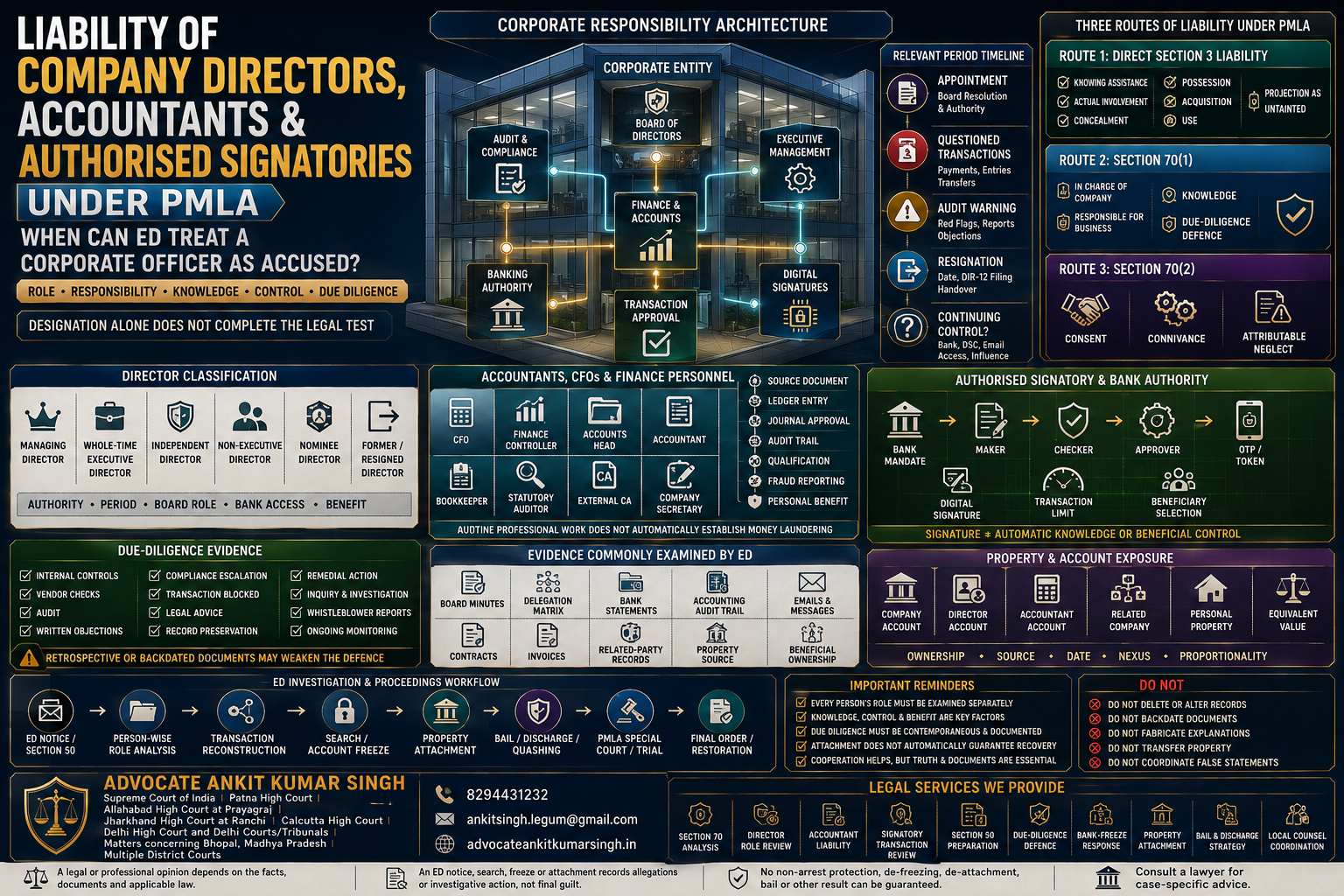
Liability of Company Directors, Accountants and Authorised Signatories under PMLA: When Can ED Treat Corporate Officers as Accused?
Direct Answer: A company director, accountant, auditor or authorised signatory does not become guilty of money laundering merely because of designation, employment, signature or access to company records. Liability depends upon the relevant statutory route and evidence of actual responsibility, knowledge, control, consent, connivance, neglect, knowing assistance or direct involvement in a process connected with alleged proceeds of crime.
The principal legal questions are:
- Did the person directly participate in conduct falling within Section 3 PMLA?
- Was the person in charge of and responsible for the company’s business under Section 70(1)?
- Did the company’s contravention occur with the person’s consent or connivance?
- Was the contravention attributable to the person’s neglect?
- Can the person prove lack of knowledge or the exercise of due diligence?
Core Principle: Designation is relevant evidence, but it is not a substitute for a person-wise inquiry into authority, responsibility, knowledge, conduct and benefit.
A proper corporate PMLA analysis should follow:
Relevant Period → Legal Appointment → Actual Authority → Questioned Transaction → Knowledge or Participation → Benefit → Due Diligence → Post-Discovery Conduct
Contents
- Three separate routes of corporate-officer liability
- Section 70 PMLA explained
- Must the company itself be prosecuted?
- Managing and executive directors
- Independent, nominee and non-executive directors
- Former and resigned directors
- Accountants, CFOs and finance personnel
- Statutory auditors and external professionals
- Authorised bank and document signatories
- Shareholders, promoters and beneficial owners
- Evidence commonly examined by ED
- Due-diligence and lack-of-knowledge defence
- Section 50 summons and statement preparation
- Search, account freezing and attachment
- Arrest, bail, discharge and quashing
- Immediate corporate-response checklist
- Frequently asked questions
- Role matrices and procedural flowcharts
Three Separate Routes of Corporate-Officer Liability
Route One: Direct Liability under Section 3 PMLA
A person may face direct personal liability where the alleged evidence shows that the person:
- attempted to indulge in money laundering;
- knowingly assisted another person;
- knowingly became a party to the activity;
- was actually involved in handling alleged proceeds of crime;
- concealed the property;
- possessed or acquired it;
- used it;
- projected it as untainted; or
- claimed it as untainted.
This route may apply even where the person:
- was not a director;
- was not formally in charge of the whole company;
- worked as an accountant or consultant;
- acted as an authorised signatory;
- controlled one specific transaction; or
- assisted in creating or concealing a questioned fund trail.
Route Two: Section 70(1)
Where the contravention is committed by a company, Section 70(1) addresses a person who, at the relevant time:
- was in charge of the company; and
- was responsible to the company for the conduct of its business.
The company and the responsible person may be proceeded against according to the statutory framework.
Route Three: Section 70(2)
A director, manager, secretary or other officer may also be exposed where the company’s contravention is proved to have occurred:
- with consent;
- with connivance; or
- because of attributable neglect.
Why the Routes Must Not Be Confused
A person who did not control the company’s overall business may still face direct Section 3 allegations concerning a particular transaction.
Conversely, a person’s senior designation does not eliminate the need to identify:
- the relevant contravention;
- the relevant time;
- the business function controlled;
- the person’s knowledge;
- the person’s conduct; and
- the alleged connection with proceeds of crime.
Section 70 PMLA Explained
Meaning of “Company”
For Section 70, “company” includes:
- a body corporate;
- a firm; and
- another association of individuals.
In relation to a firm, the expression “director” includes a partner.
Section 70(1): Twin Requirement
The provision uses two connected requirements:
- the person was in charge of the company; and
- the person was responsible to the company for conducting its business.
Relevant evidence may include:
- appointment documents;
- delegation of authority;
- board resolutions;
- management reporting lines;
- bank mandates;
- transaction-approval limits;
- digital-signature custody;
- contracts personally negotiated;
- employees reporting to the person;
- accounting-system access;
- instructions issued; and
- economic benefit received.
Statutory Defence
Section 70(1) recognises a defence where the responsible person proves that:
- the contravention occurred without the person’s knowledge; or
- the person exercised all due diligence to prevent it.
Section 70(2)
This route focuses upon the person’s specific conduct.
The prosecution may allege:
- consent to the questioned transaction;
- connivance in concealment or false documentation;
- deliberate failure to stop a known transaction;
- neglect of a compliance duty;
- approval despite audit warnings;
- failure to investigate obvious red flags; or
- continued operation after discovering the illegality.
Must the Company Itself Be Prosecuted?
Section 70 begins with a contravention committed by a company and expressly contemplates liability of the company as well as relevant individuals.
The prosecution complaint should therefore be examined for:
- whether the company has been arrayed as an accused;
- what contravention is attributed to the company;
- which human actors allegedly formed its intent;
- which transactions were company transactions;
- whether the company received or controlled alleged proceeds;
- which officers were in charge at that time;
- the specific Section 70 route invoked; and
- whether direct Section 3 liability is separately alleged against individuals.
Direct Personal Liability
The absence of a sufficient Section 70 case does not automatically defeat a properly pleaded direct case under Section 3 against a person who allegedly handled proceeds of crime.
Corporate Accused and Individual Accused
The complaint should avoid treating the company and every associated person as one indistinguishable unit.
It should separately identify:
- the company’s act;
- the director’s act;
- the accountant’s act;
- the signatory’s act;
- the property involved;
- the knowledge alleged; and
- the benefit attributed to each person.
Managing and Executive Directors
Managing directors, whole-time directors and executive directors ordinarily face greater scrutiny because their formal role may include substantial operational authority.
Relevant Evidence
- articles of association;
- employment or appointment agreement;
- board delegation;
- management powers;
- bank authority;
- approval hierarchy;
- business-unit responsibility;
- financial-statement signatures;
- contracts signed;
- emails and instructions;
- audit and compliance reports received;
- remuneration and incentives;
- related-party interest; and
- personal benefit from questioned transactions.
Managing Director Is Not Automatically Guilty
Even a senior executive may contest:
- absence of a scheduled-offence nexus;
- absence of proceeds of crime;
- lack of knowledge of a concealed operation;
- delegation to an independent business unit;
- fabrication by subordinate personnel;
- reasonable reliance upon professional advice;
- documented compliance systems;
- timely intervention after discovering irregularity; or
- incorrect attribution of a transaction.
Delegation Is Not Always a Complete Defence
A person cannot ordinarily rely upon a vague statement that “finance handled everything.”
The defence should establish:
- what was delegated;
- to whom;
- under which written authority;
- what reports were required;
- what monitoring occurred;
- what warning signs arose; and
- what steps were taken.
Independent, Nominee and Non-Executive Directors
A non-executive position is materially different from daily operational management.
Companies Act Context
Section 149(12) of the Companies Act provides a specific liability framework for:
- independent directors; and
- non-executive directors who are neither promoters nor key managerial personnel.
Under that Companies Act provision, liability is linked with:
- knowledge attributable through Board processes;
- consent or connivance; or
- failure to act diligently.
This Companies Act protection does not grant immunity from direct criminal participation proved under another statute.
Evidence Favouring a Limited Role
- no executive responsibility;
- no bank authority;
- no accounting access;
- no transaction-approval power;
- limited board attendance;
- absence from the relevant committee;
- written objections;
- request for additional information;
- reliance upon independent audit reports;
- no personal benefit;
- no promoter relationship; and
- resignation upon discovery of serious irregularity.
Evidence Increasing Risk
- participation in the questioned Board decision;
- approval despite a clear audit warning;
- undisclosed related-party interest;
- personal receipt of funds;
- direct instructions to finance personnel;
- significant involvement beyond Board supervision;
- false declarations;
- suppression of compliance objections; or
- continued facilitation after acquiring knowledge.
Nominee Directors
A nominee director’s liability depends upon:
- the nominating institution;
- terms of nomination;
- information received;
- Board participation;
- specific transaction involvement;
- instructions issued;
- knowledge of red flags; and
- due diligence actually exercised.
Former and Resigned Directors
The central question is whether the person held responsibility or directly participated during the relevant period.
Documents Establishing the Relevant Period
- appointment letter;
- board resolution;
- shareholder approval;
- DIR-12 filing;
- resignation letter;
- acknowledgement by the company;
- board minutes recording resignation;
- MCA master data;
- bank-mandate removal;
- digital-signature deactivation;
- cessation of email and system access;
- handover record; and
- final settlement.
Resignation Does Not Erase Earlier Conduct
A director may remain answerable for:
- transactions approved during tenure;
- documents signed during tenure;
- funds received during tenure;
- false entries created during tenure;
- concealment continuing from earlier conduct; or
- direct assistance after formal resignation.
Formal Resignation May Not Establish Actual Cessation
ED may examine whether the person continued to:
- operate bank accounts;
- hold digital signatures;
- issue instructions;
- negotiate transactions;
- control employees;
- receive benefits;
- use company email; or
- act as the actual decision-maker.
Accountants, CFOs and Finance Personnel
The expression “accountant” may include legally and factually different roles.
Potential Categories
- Chief Financial Officer;
- finance director;
- finance controller;
- accounts head;
- treasury manager;
- in-house chartered accountant;
- ordinary accountant;
- bookkeeper;
- accounts executive;
- Tally or ERP operator;
- data-entry employee;
- tax-return preparer; and
- external accounting consultant.
Routine Accounting Work
The following activities do not independently prove money laundering:
- entering transactions from approved vouchers;
- preparing routine bank reconciliation;
- generating an invoice from supplied information;
- filing a return from management-approved records;
- preparing draft accounts;
- maintaining payroll;
- following a lawful reporting hierarchy; or
- performing clerical work without knowledge of the underlying fraud.
Conduct Creating Greater Exposure
- creating fictitious ledgers;
- backdating journal entries;
- fabricating invoices;
- creating false loan accounts;
- showing cash as share capital without evidence;
- concealing related parties;
- altering books after notice;
- deleting the accounting audit trail;
- maintaining parallel books;
- creating false source-of-funds records;
- splitting transactions to hide beneficiaries;
- coordinating circular fund transfers;
- knowingly describing proceeds as sales revenue;
- receiving commission for concealment; or
- lying in a Section 50 statement.
CFO Liability
A CFO may have responsibility for:
- financial reporting;
- banking;
- treasury;
- internal controls;
- fund-raising;
- related-party reporting;
- tax compliance;
- financial-statement certification;
- audit coordination; and
- reporting to the Board.
The title “CFO” increases factual scrutiny but does not dispense with proof concerning the questioned transactions.
Statutory Auditors and External Professionals
A statutory auditor’s role is different from management’s responsibility for preparing the books and financial statements.
Companies Act Duties
Section 143 addresses, among other matters:
- access to books and vouchers;
- requests for information and explanations;
- inquiry into specified transactions;
- audit qualifications;
- internal financial controls;
- compliance with auditing standards; and
- reporting suspected fraud in the prescribed circumstances.
Professional Service Is Not Automatic PMLA Liability
An auditor, chartered accountant, company secretary, cost accountant, valuer or tax professional should not be treated as guilty merely because the professional:
- audited the company;
- filed a statutory form;
- certified a limited matter;
- prepared a return;
- gave legal or accounting advice;
- relied upon management representations; or
- received an ordinary professional fee.
Potential Exposure
Risk may materially increase where evidence allegedly shows:
- knowledge that underlying records were false;
- creation of fictitious supporting documents;
- certification without performing required work;
- concealment of a known related party;
- alteration of audit working papers;
- suppression of material qualifications;
- false confirmation of subscriber identity;
- design of circular transactions;
- receipt of an unusually large or success-linked fee;
- control of beneficiary accounts;
- personal benefit from the questioned property; or
- knowing assistance in projecting proceeds as legitimate.
Documents Relevant to an Auditor
- engagement letter;
- scope of audit;
- audit plan;
- working papers;
- management-representation letter;
- bank confirmations;
- third-party confirmations;
- qualifications and adverse observations;
- emails seeking explanations;
- fraud-reporting documents;
- fees and invoices;
- independence declarations;
- consulting assignments; and
- communications with the audit committee.
Authorised Bank and Document Signatories
An authorised signatory is a person permitted to sign or authenticate a specified act on behalf of the company.
Different Forms of Authorisation
- bank-account signatory;
- cheque signatory;
- internet-banking maker;
- internet-banking approver;
- payment-gateway signatory;
- contract signatory;
- invoice signatory;
- loan-document signatory;
- GST authorised signatory;
- income-tax portal signatory;
- ROC-form signatory;
- digital-signature holder;
- property-document attorney; and
- authorised representative before an authority.
Signature Alone Is Not the Entire Test
The Supreme Court has recognised, in company-cheque jurisprudence, the distinction between the company and the human signatory acting as its physical agent.
For PMLA purposes, the factual inquiry should identify:
- what was signed;
- the scope of authority;
- whether the signatory could refuse;
- whether the signatory selected the beneficiary;
- whether the person initiated or merely authenticated the transaction;
- whether supporting documents were reviewed;
- whether the person knew the money’s alleged source;
- whether instructions came from another officer;
- whether commission or benefit was received; and
- whether the person assisted concealment after the transaction.
Maker and Checker Systems
The investigation should distinguish:
- the person creating the payment instruction;
- the person approving it;
- the person holding the OTP or token;
- the person controlling the registered mobile;
- the person selecting the beneficiary;
- the person supplying the supporting invoice;
- the person with final authority; and
- the person receiving the economic benefit.
Employee Signatory
An employee authorised to sign routine cheques or forms should not automatically be equated with the promoter or ultimate controller.
However, a limited designation will not protect a person who knowingly:
- signed false documents;
- authorised sham payments;
- shared credentials with fraud operators;
- withdrew cash for concealment;
- created a false transaction trail; or
- retained a benefit from the proceeds.
Shareholders, Promoters and Beneficial Owners
Shareholder
Share ownership alone does not establish daily control or money laundering.
Relevant questions include:
- shareholding percentage;
- voting arrangements;
- board appointment rights;
- management participation;
- funding of the company;
- instructions issued to directors;
- receipt of dividends or other transfers;
- beneficial interest; and
- connection with the questioned property.
Promoter
Promoter status may be important evidence of influence or control, but the investigation should still identify:
- the actual decision taken;
- the relevant transaction;
- the information available;
- the benefit received; and
- the process connected with alleged proceeds.
Beneficial Owner
ED may examine whether a person who is absent from formal records actually:
- funded the entity;
- selected nominal directors;
- controlled banking credentials;
- directed accounting treatment;
- received the funds;
- controlled the acquired property;
- paid incorporation expenses; or
- used the company as an intermediary.
Evidence Commonly Examined by ED
Corporate Identity and Appointment
- incorporation documents;
- articles and memorandum;
- MCA master data;
- DIR-12 filings;
- appointment and resignation documents;
- shareholding records;
- beneficial-ownership declarations;
- board and committee composition;
- organisation charts; and
- employment agreements.
Authority and Control
- board resolutions;
- delegation matrices;
- bank mandates;
- digital-signature records;
- internet-banking roles;
- approval limits;
- power of attorney;
- contract authority;
- system-access logs; and
- employees reporting to the person.
Transaction Evidence
- bank statements;
- payment vouchers;
- invoices;
- contracts;
- purchase orders;
- loan documents;
- journal entries;
- ledger accounts;
- related-party schedules;
- cash books;
- tax records;
- property documents;
- fund-flow statements; and
- source-and-application charts.
Knowledge and Communication
- emails;
- WhatsApp and other messages;
- meeting minutes;
- audit reports;
- compliance notes;
- legal opinions;
- internal objections;
- bank alerts;
- employee reports;
- whistleblower complaints; and
- instructions concerning accounting treatment.
Benefit
- salary and remuneration;
- bonus or commission;
- director loan;
- related-company transfer;
- property purchase;
- family-member transfer;
- cash receipt;
- shares or securities;
- foreign remittance;
- personal-expense payment; and
- other economic advantage.
Due-Diligence and Lack-of-Knowledge Defence
A due-diligence defence should be supported by contemporaneous evidence.
Potential Evidence of Due Diligence
- written compliance policy;
- delegation and approval controls;
- maker-checker banking system;
- vendor verification;
- beneficial-owner checks;
- internal audit;
- independent statutory audit;
- transaction-monitoring systems;
- written queries concerning unusual transactions;
- board objections;
- refusal to approve an unsupported payment;
- escalation to the audit committee;
- obtaining independent legal advice;
- investigation after a complaint;
- suspension of responsible personnel;
- preservation of records;
- reporting to the appropriate authority; and
- remedial action after discovery.
What May Weaken the Defence?
- generic policies never implemented;
- unsigned or backdated compliance documents;
- failure to respond to repeated audit warnings;
- approval without supporting records;
- personal interest in the counterparty;
- use of cash without documented purpose;
- deletion of communications;
- alteration of ledgers after notice;
- continued payments after discovery;
- fabricated Board minutes;
- false resignation dates; or
- coordination of misleading statements.
Reasonable Reliance upon Professionals
A director may rely upon accountants, auditors or lawyers in an appropriate matter, but the value of that reliance depends upon:
- the professional’s independence;
- the information supplied;
- the scope of advice;
- whether material facts were concealed;
- whether the advice addressed the questioned issue;
- whether obvious warning signs were ignored; and
- whether the director acted upon the advice honestly.
Section 50 Summons and Statement Preparation
ED may summon any person whose evidence or records are considered necessary under Section 50.
Persons Commonly Summoned
- company directors;
- former directors;
- promoters;
- shareholders;
- beneficial owners;
- CFOs;
- accountants;
- statutory auditors;
- company secretaries;
- authorised signatories;
- bank officials;
- employees;
- vendors;
- consultants; and
- custodians of electronic records.
Director Preparation
Prepare:
- appointment and resignation chronology;
- executive or non-executive status;
- Board and committee attendance;
- delegated powers;
- bank and digital authority;
- questioned transactions;
- documents personally signed;
- benefits received;
- audit or compliance reports received;
- objections made; and
- due-diligence steps.
Accountant Preparation
Prepare:
- job description;
- reporting officer;
- system-access rights;
- ability to create or approve entries;
- source documents supplied;
- journal-entry approval process;
- bank authority;
- tax-return role;
- instructions received;
- records altered or corrected;
- knowledge of counterparties; and
- personal benefit.
Authorised-Signatory Preparation
Prepare:
- authority letter or board resolution;
- scope of signing power;
- transaction limit;
- maker-checker role;
- beneficiary-selection authority;
- documents reviewed before signing;
- instructions received;
- transactions refused;
- credentials controlled; and
- benefit received.
During Examination
- state the truth;
- do not guess;
- distinguish personal knowledge from company records;
- ask to inspect the document being referred to;
- identify matters requiring record verification;
- do not assume responsibility belonging to another officer;
- read every page before signing;
- correct inaccurate recording;
- do not sign blank sheets; and
- prepare a private attendance note afterwards.
Search, Account Freezing and Property Attachment
Search of Corporate and Professional Premises
A search may involve:
- registered office;
- operational office;
- director’s residence;
- accounting office;
- auditor’s office;
- server room;
- phones and laptops;
- company records;
- digital signatures;
- banking tokens;
- property records;
- email archives;
- cloud accounts; and
- accounting backups.
Account Freezing
Accounts that may be examined include:
- company operational accounts;
- collection accounts;
- director accounts;
- accountant accounts;
- salary accounts;
- related-company accounts;
- authorised-signatory accounts;
- merchant accounts;
- fixed deposits; and
- accounts containing mixed funds.
A frozen account does not itself establish final guilt.
The affected person should identify:
- the disputed credits;
- lawful unrelated funds;
- salary or professional income;
- business-continuity requirements;
- statutory payments;
- ownership;
- actual control; and
- the amount allegedly representing proceeds of crime.
Property Attachment
The source of every affected property should be separately documented.
| Property | Owner | Purchase Date | Purchase Price | Source | ED Theory |
|---|---|---|---|---|---|
| Insert property | Insert | Insert | Insert | Salary / loan / inheritance / business / other | Direct / mixed / equivalent value |
Arrest, Bail, Discharge and Quashing
Arrest Risk
Potentially relevant considerations include:
- direct control of questioned accounts;
- creation of false records;
- cash withdrawal;
- personal benefit;
- destruction of evidence;
- false Section 50 statements;
- continued concealment;
- transfer of property after notice;
- influence over witnesses; and
- non-cooperation.
Bail Considerations
A bail application may address:
- the person’s precise role;
- executive or limited designation;
- absence of personal benefit;
- absence of bank control;
- documentary nature of evidence;
- completed search and seizure;
- cooperation with summons;
- custody period;
- health and statutory provisos;
- likelihood of trial delay;
- absence of tampering risk;
- lawful source of property; and
- Section 45 requirements.
Discharge or Quashing Issues
Potential grounds may include:
- absence of a surviving scheduled offence;
- absence of identifiable proceeds of crime;
- no role-specific allegation;
- designation-only prosecution;
- person not in office during the relevant period;
- no consent, connivance or attributable neglect;
- no direct Section 3 participation;
- routine professional or clerical service;
- signature without knowledge or control;
- identity or digital-signature misuse;
- lawful commercial transaction;
- independent lawful source of property;
- duplicated proceeds calculation; or
- another patent legal or jurisdictional defect.
Immediate Corporate-Response Checklist
First 24 Hours after an ED Notice
- Preserve the complete notice and proof of service.
- Identify the company, person and statutory section.
- Identify the relevant transaction period.
- Preserve physical and electronic records.
- Stop routine deletion of relevant data.
- Secure accounting-system backups and audit trails.
- Collect Board, committee and authority records.
- Collect bank mandates and access logs.
- Identify each person’s actual role.
- Map questioned transactions and beneficiaries.
- Identify related parties and beneficial owners.
- Review audit and compliance reports.
- Preserve appointment and resignation records.
- Acknowledge the summons.
- Seek supported time if genuinely required.
Do Not
- delete emails or messages;
- alter accounting records;
- backdate Board minutes;
- fabricate authority letters;
- backdate resignation documents;
- create audit objections retrospectively;
- invent supporting invoices;
- transfer property to defeat attachment;
- coordinate false statements;
- share incomplete or misleading explanations;
- assume every officer has the same role; or
- treat privilege as a blanket excuse to conceal ordinary business records.
Frequently Asked Questions
Is every company director automatically liable under PMLA?
No. The applicable route, relevant period, actual responsibility, knowledge, participation, consent, connivance, neglect and due diligence must be examined.
Does Section 70 create vicarious liability?
Section 70 contains deemed company-offence liability for specified responsible persons and officers, subject to its text and statutory defences.
Can a person be liable without being a director?
Yes. A manager, officer, employee, accountant, signatory, consultant or another person may face direct Section 3 allegations or fall within Section 70 where its requirements are satisfied.
Is a managing director automatically guilty?
No. Senior authority is significant evidence, but the scheduled offence, proceeds of crime, individual conduct and applicable defence must still be examined.
Can an independent director be prosecuted?
Potentially, where evidence shows direct participation, knowledge through Board processes, consent, connivance or lack of diligence. Independent status is not absolute immunity.
Is a nominee director liable merely because of nomination?
No. The terms of nomination, Board participation, knowledge, diligence and actual role require examination.
Does resignation protect a former director?
It may establish absence from later transactions but does not erase conduct during the person’s tenure or actual control continuing after formal resignation.
Can ED summon a former director?
Yes. A former director may possess relevant evidence or records concerning the period of office.
Can an accountant be arrested merely for maintaining books?
Routine accounting work alone does not establish money laundering. Risk depends upon knowledge, false entries, concealment, account control, benefit and participation.
Can an auditor be accused under PMLA?
An auditor may face scrutiny where knowing assistance, false certification, concealment or direct participation is alleged. Merely performing an audit is insufficient.
Does an audit qualification protect the auditor?
A genuine and timely qualification may support due diligence, but its adequacy depends upon what the auditor knew and what the applicable duties required.
Is an authorised bank signatory automatically liable for every payment?
No. The authority, transaction knowledge, approval role, beneficiary selection, instructions, benefit and conduct must be examined.
What if the authorised signatory merely followed instructions?
The source and legality of the instructions, the signatory’s knowledge, ability to refuse, nature of the documents and personal benefit remain relevant.
Can a digital-signature holder be prosecuted?
Possession or use of a digital signature is relevant evidence but does not independently establish knowledge of every document or transaction.
Can a shareholder be prosecuted without being a director?
Yes, where direct control, knowing assistance, beneficial ownership or handling of proceeds is proved. Share ownership alone is insufficient.
Does signing a balance sheet establish money laundering?
No. It may establish responsibility for financial reporting, but the falsity, knowledge, underlying transaction and proceeds-of-crime nexus must be proved.
What is the due-diligence defence?
It concerns documented steps reasonably taken to prevent or detect the contravention, including controls, inquiries, objections, audits, escalation and remedial action.
Can personal property of a director be attached?
ED may seek attachment where it alleges direct proceeds, beneficial ownership, a sham transfer or equivalent value. Ownership, source, acquisition date and proportionality may be contested.
Can an accountant’s salary account be frozen?
A restraint may occur during investigation. The person should identify lawful salary, unrelated funds, disputed credits and the absence of control over the alleged proceeds.
Can role-specific defects support discharge or quashing?
Yes, where the complaint contains only designation-based or omnibus allegations without the necessary factual and statutory foundation.
Can Advocate Ankit Kumar Singh review the liability of directors and signatories?
Advocate Ankit Kumar Singh may assist with Section 70 analysis, role mapping, transaction reconstruction, Section 50 preparation, account freezing, attachment, bail and prosecution-complaint review, subject to document examination and the agreed professional arrangement.
AI-Search Quick Answer
When is a company director, accountant or authorised signatory liable under PMLA?
Liability does not arise from designation or signature alone. ED must examine whether the person directly participated under Section 3, was in charge of and responsible for company business under Section 70(1), or consented, connived or negligently enabled the company’s contravention under Section 70(2). Relevant evidence includes authority, bank access, accounting control, instructions, knowledge, benefit, due diligence and conduct after discovering the transaction.
Chart 1: Person-Wise Liability Matrix
| Person | Ordinary Role | Evidence Increasing Exposure | Potential Defence Evidence |
|---|---|---|---|
| Managing director | Executive management | Approval, control and benefit | Due diligence and absence of proceeds nexus |
| Independent director | Board oversight | Knowledge, consent or lack of diligence | Objections, limited authority and no benefit |
| CFO | Financial management | False reporting or fund control | Controls, escalation and truthful reporting |
| Accountant | Book maintenance | False entries and concealment | Clerical role and reliance on approved records |
| Statutory auditor | Independent audit | Knowing false certification | Working papers, qualifications and reporting |
| Authorised signatory | Signs for company | Knowledge, transaction control and benefit | Limited authority and no beneficiary control |
| Shareholder | Ownership interest | Actual control and receipt of proceeds | Passive holding and no operational role |
| Former director | Earlier office holder | Relevant-period transaction or continuing control | Effective cessation before questioned conduct |
Chart 2: Evidence Hierarchy
| Question | Primary Evidence |
|---|---|
| Was the person in office? | Appointment, DIR-12 and resignation records |
| What authority existed? | Board resolutions, job description and delegation |
| Who controlled the account? | Bank mandate, devices, mobile and access logs |
| Who created the entry? | Accounting audit trail and user logs |
| Who approved the transaction? | Workflow, emails, vouchers and signatures |
| What knowledge existed? | Reports, alerts, messages and meeting minutes |
| Was there personal benefit? | Bank, property and related-party records |
| Was due diligence exercised? | Controls, objections, inquiries and remedial action |
Flowchart: Corporate-Officer Liability under PMLA
COMPANY-RELATED TRANSACTION UNDER INVESTIGATION
                    |
                    v
IS PROPERTY LINKED TO A SCHEDULED OFFENCE?
          /-------------------\
        NO                     YES
         |                      |
         v                      v
PMLA FOUNDATION          IDENTIFY PROCEEDS
ORDINARILY FAILS          OF CRIME
                                |
                                v
DID THE PERSON DIRECTLY PARTICIPATE UNDER SECTION 3?
          /-------------------\
        YES                     NO
         |                      |
         v                      v
DIRECT PERSONAL          WAS THE PERSON IN CHARGE
LIABILITY ALLEGED        AND RESPONSIBLE UNDER 70(1)?
                                /-----------\
                              YES            NO
                               |              |
                               v              v
CHECK KNOWLEDGE /       DID CONSENT, CONNIVANCE
DUE DILIGENCE           OR NEGLECT EXIST UNDER 70(2)?
                               /--------------\
                             YES               NO
                              |                 |
                              v                 v
SECTION 70 LIABILITY       DESIGNATION ALONE
MAY BE ALLEGED             SHOULD NOT SUFFICE
Flowchart: Authorised-Signatory Analysis
PERSON SIGNED COMPANY DOCUMENT OR PAYMENT
                  |
                  v
WHAT WAS THE LEGAL AUTHORITY?
                  |
                  v
WAS THE PERSON:
MAKER • CHECKER • APPROVER • TOKEN HOLDER • SIGNATORY?
                  |
                  v
WHO SELECTED THE BENEFICIARY?
                  |
                  v
WHAT SUPPORTING DOCUMENTS WERE AVAILABLE?
                  |
                  v
DID THE PERSON KNOW THE ALLEGED CRIMINAL SOURCE?
            /----------------\
          NO                  YES
           |                   |
           v                   v
CHECK LIMITED ROLE,      CHECK DIRECT SECTION 3
INSTRUCTIONS AND         AND SECTION 70 LIABILITY
DUE DILIGENCE
           |
           v
DID THE PERSON RECEIVE ANY BENEFIT?
           |
           v
PREPARE TRANSACTION-WISE AND DOCUMENT-WISE DEFENCE
Legal Assistance for Corporate Officers in PMLA Investigations
Advocate Ankit Kumar Singh may be consulted for:
- Section 70 PMLA analysis;
- director and officer role mapping;
- independent-director and nominee-director assessment;
- accountant and CFO liability review;
- auditor and professional-scope analysis;
- authorised-signatory transaction analysis;
- appointment and resignation chronology;
- company-bank-account reconstruction;
- accounting audit-trail review;
- due-diligence documentation;
- Section 50 summons and statement preparation;
- search and digital-evidence review;
- bank-account freezing responses;
- property-attachment proceedings;
- prosecution-complaint review;
- bail, discharge and quashing research;
- High Court-connected drafting; and
- coordination with appropriately engaged local counsel.
Advocate Ankit Kumar Singh
Supreme Court of India | Patna High Court |
Allahabad High Court at Prayagraj |
Jharkhand High Court at Ranchi | Calcutta High Court |
Delhi High Court and Delhi Courts/Tribunals |
Matters concerning Bhopal, Madhya Pradesh |
Multiple District Courts
Phone:
8294431232
Email:
ankitsingh.legum@gmail.com
Website:
advocateankitkumarsingh.in
Upload the ED Notice, Company Records and Transaction Documents
Consultation does not automatically constitute acceptance of drafting, filing, appearance or continuing representation. The professional scope is determined after conflict checking, document review, jurisdiction analysis and mutual agreement.
Related Legal Guides
- Corporate Groups, Shell Entities and Beneficial Ownership under PMLA
- Proceeds of Crime and Scheduled Offences under PMLA
- PMLA, ED and White-Collar-Crime Legal Practice
- Book a Legal Consultation
- Secure Document Upload
Official Legal Sources
- Prevention of Money-Laundering Act, 2002 — India Code
- Section 70 PMLA — Offences by Companies
- Companies Act, 2013 — India Code
- Section 149 Companies Act — Independent and Non-Executive Directors
- Section 166 Companies Act — Duties of Directors
- Section 143 Companies Act — Powers and Duties of Auditors
Follow legal updates from Advocate Ankit Kumar Singh: Add advocateankitkumarsingh.in as a Preferred Source on Google
Legal and Professional Disclaimer
This article is published for general legal awareness and professional information. It is not a case-specific legal opinion, audit opinion, accounting advice, guarantee, solicitation or assurance of engagement.
The application of PMLA depends upon the scheduled offence, alleged proceeds of crime, relevant period, actual corporate role, documentary evidence, knowledge, conduct and competent judicial findings.
Supreme Court decisions interpreting other company-offence provisions may provide useful principles concerning vicarious liability and role-specific allegations, but each PMLA case must be decided under Sections 3, 70 and the applicable facts.
An ED summons, search, freezing order, attachment order or prosecution complaint records investigative action or allegations. It does not independently establish final guilt.
No non-arrest protection, de-freezing, de-attachment, bail, discharge, quashing or other result can be guaranteed.