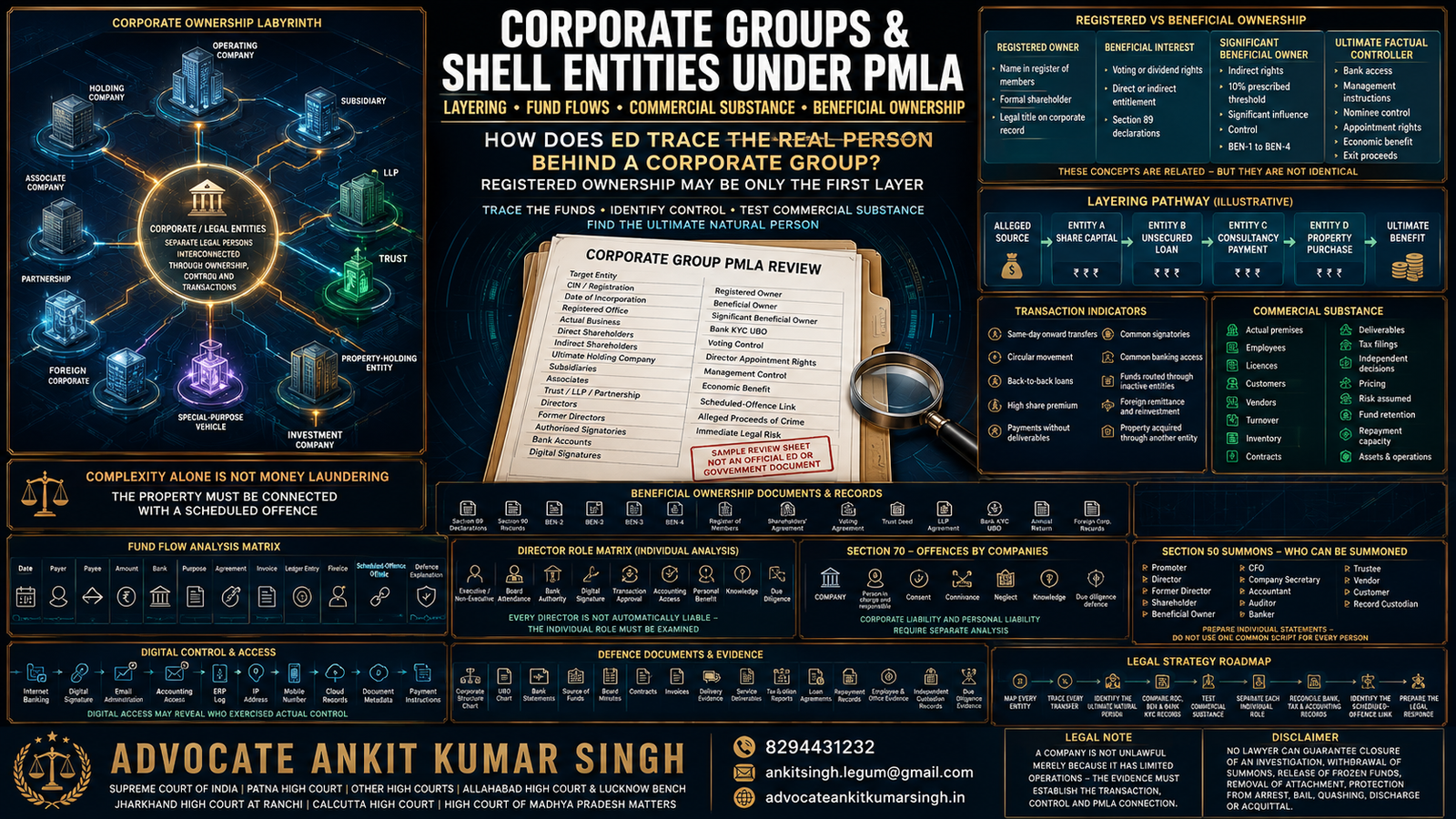
Corporate Groups and Shell Entities under PMLA: How ED Examines Layering, Fund Flows and Beneficial Ownership
Direct Answer: In a corporate-group PMLA investigation, the Directorate of Enforcement ordinarily does not stop at the name appearing in the company’s register of members, bank account or property document.
The investigation may trace:
- who supplied the funds;
- who directed the transfers;
- who controlled the companies and bank accounts;
- who selected directors or authorised signatories;
- who exercised voting, management or policy rights;
- who received the commercial or personal benefit;
- whether the transaction had genuine business substance;
- whether the funds were moved through several entities to obscure their source;
- whether the recipient knew of the alleged criminal origin; and
- whether any person possessed, acquired, used, concealed, transferred, projected or claimed alleged proceeds of crime as untainted.
A company is not unlawful merely because it has few employees, limited assets, a common registered address, nominee directors or a holding-company function. The decisive questions are whether the entity had a genuine legal and commercial purpose, whether its records reflect reality and whether it was knowingly used in a process or activity connected with proceeds of crime.
Advocate Ankit Kumar Singh
Supreme Court of India | Patna High Court | Other High Courts | Allahabad High Court and Lucknow Bench | Jharkhand High Court at Ranchi | Calcutta High Court | High Court of Madhya Pradesh Matters concerning Bhopal
Professional assistance may include corporate-structure mapping, beneficial-ownership analysis, Section 50 summons preparation, transaction and source-of-funds matrices, company-director role review, search and freezing response, attachment proceedings, arrest-risk assessment, bail preparation and representation before the appropriate Special Court, High Court or Supreme Court.
What Is a Corporate Group for PMLA Analysis?
A corporate group may contain several legally distinct entities connected through:
- holding and subsidiary relationships;
- common shareholders;
- common directors;
- family ownership;
- partnership or LLP interests;
- trust structures;
- shareholder or voting agreements;
- common management;
- common financing;
- common authorised signatories;
- related-party transactions;
- common intellectual property;
- common employees and infrastructure; or
- actual control by the same natural person.
Each company remains a separate legal person. The ED may nevertheless examine whether the entities operated independently or were used collectively as one financial network.
What Is Commonly Called a Shell Entity?
The expression “shell entity” is frequently used in investigations for a company or legal vehicle alleged to have little independent commercial substance and to have been used primarily to:
- receive or transfer funds;
- hold shares or property;
- provide accommodation entries;
- issue invoices without corresponding goods or services;
- introduce share capital or unsecured loans;
- conceal the person exercising actual control;
- separate the apparent recipient from the alleged beneficiary; or
- move money through several accounts before final use.
The label is not conclusive. A holding company, special-purpose vehicle, dormant company, investment company or property-owning entity may have a legitimate purpose despite having few employees or limited turnover.
The legal inquiry should focus on evidence, not terminology.
Low Commercial Substance Does Not Automatically Establish Money Laundering
The following features may invite investigation but do not independently establish a PMLA offence:
- a common registered address;
- shared directors;
- shared professional advisers;
- low employee strength;
- absence of a factory or large office;
- high share premium;
- investment in group companies;
- inter-corporate loans;
- limited operational revenue;
- foreign ownership;
- nominee shareholding;
- dormant status;
- recent incorporation; or
- subsequent striking off.
These facts become legally significant where they are combined with material showing sham transactions, concealed control, false records, circular fund movement or a connection with alleged proceeds of crime.
The PMLA Focus: Proceeds of Crime and the Process or Activity
Section 2(1)(u) defines “proceeds of crime” by reference to property derived or obtained, directly or indirectly, as a result of criminal activity relating to a scheduled offence.
Section 3 applies where a person directly or indirectly attempts to indulge, knowingly assists, knowingly becomes a party or is actually involved in a process or activity connected with proceeds of crime.
The statutory expressions include:
- concealment;
- possession;
- acquisition;
- use;
- projecting the property as untainted; and
- claiming the property as untainted.
Read the Prevention of Money Laundering Act, 2002
Placement, Layering and Integration: Analytical Concepts
Placement, layering and integration are commonly used analytical descriptions of financial movement. They are not separate statutory ingredients that must occur in every PMLA case.
Placement
Placement generally describes the introduction of suspected criminal proceeds into a financial or commercial system.
Examples may include:
- cash deposits;
- purchase of assets;
- payments into company accounts;
- introduction as share capital;
- introduction as unsecured loans;
- payments against alleged invoices;
- purchase of financial instruments; or
- transfer to an intermediary.
Layering
Layering generally describes movement through multiple transactions, accounts or entities intended or alleged to make the original source difficult to trace.
Examples may include:
- rapid transfers through several companies;
- back-to-back loans;
- circular transactions;
- multiple share subscriptions;
- funds routed through unrelated-looking entities;
- sale and repurchase transactions;
- foreign remittances through layered ownership structures;
- payments supported by alleged false invoices;
- conversion of debt into equity;
- movement through trusts, LLPs or partnerships; and
- purchase of assets through nominees.
Integration
Integration generally describes the stage at which the funds or property appear within the formal economy as apparently legitimate wealth.
Examples may include:
- purchase of immovable property;
- investment in an operating business;
- repayment of an alleged loan;
- receipt of dividend or capital gain;
- acquisition of shares;
- purchase of luxury assets;
- payment of personal expenses through a company; or
- distribution through a trust or family entity.
Important: The ED must still connect the property with criminal activity relating to a scheduled offence. Complex movement of legitimate funds is not money laundering merely because it involves multiple entities.
How ED Builds the Corporate Ownership Map
The investigation may begin by preparing a legal and factual ownership chart.
The chart may contain:
- every group company;
- CIN or registration number;
- registered office;
- incorporation date;
- authorised and paid-up capital;
- direct shareholders;
- indirect shareholders;
- ultimate holding company;
- subsidiaries and associates;
- partnership and LLP interests;
- trust ownership;
- directors and former directors;
- key managerial personnel;
- authorised signatories;
- beneficial-interest declarations;
- significant-beneficial-owner declarations;
- bank accounts;
- digital-signature holders;
- contact numbers and email addresses;
- auditors and company secretaries;
- common employees;
- major assets; and
- material related-party transactions.
Registered Ownership Is Only the First Layer
The registered shareholder is the person whose name appears in the company’s register of members.
The ED may separately examine whether another person:
- paid the purchase price;
- directed the acquisition;
- controlled voting;
- received dividends;
- held a power of attorney;
- controlled the nominee;
- appointed directors;
- exercised management rights;
- decided when the shares would be sold;
- received the sale proceeds; or
- otherwise enjoyed the economic benefit.
The person on the register and the person enjoying the beneficial interest may therefore be different.
Beneficial Interest under Section 89 Companies Act
Section 89 addresses a situation where the person whose name appears in the register of members does not hold the beneficial interest, or where another person holds or acquires that beneficial interest.
Beneficial interest includes, directly or indirectly, through a contract, arrangement or otherwise, a right or entitlement to:
- exercise or cause the exercise of rights attached to the share; or
- receive or participate in a dividend or another distribution relating to the share.
Declarations by the registered holder and beneficial owner, and the company’s filing with the Registrar, may become important in an ED investigation.
Significant Beneficial Ownership under Section 90
Section 90 and the Companies (Significant Beneficial Owners) Rules require identification of the natural individual who indirectly, or together with direct holdings, possesses prescribed rights or exercises significant influence or control.
The SBO framework generally examines whether an individual:
- holds indirectly, or together with direct holdings, at least 10% of shares;
- holds at least 10% of voting rights;
- has a right to receive or participate in at least 10% of distributable dividend or another distribution;
- exercises significant influence; or
- exercises control.
Relevant statutory forms include:
- BEN-1: declaration by the significant beneficial owner;
- BEN-2: return filed by the reporting company;
- BEN-3: company register of significant beneficial owners; and
- BEN-4: notice seeking information regarding significant beneficial ownership.
The absence of a filing may trigger inquiry. It does not automatically establish that the undisclosed interest relates to proceeds of crime.
PMLA KYC Beneficial Ownership and Company-Law SBO Are Not Identical
Beneficial ownership appears in different legal contexts.
The following should not be treated as interchangeable:
- beneficial interest under Section 89 Companies Act;
- significant beneficial ownership under Section 90 and the SBO Rules;
- beneficial owner identified by a reporting entity under Rule 9 of the PML Maintenance of Records Rules;
- actual control or economic benefit examined in an ED investigation; and
- criminal liability for money laundering under Section 3 PMLA.
A regulatory ownership threshold assists identification and disclosure. It is not a statutory safe harbour permitting a person below that threshold to conceal actual control or participation.
Rule 9 Beneficial-Owner Identification
For KYC and reporting-entity purposes, Rule 9 identifies the natural person who ultimately owns or controls the client or on whose behalf the transaction is conducted.
The framework generally includes:
- for a company, a natural person with more than 10% ownership or entitlement in shares, capital or profits, or control through other means;
- for a partnership, a natural person with more than 10% ownership or entitlement in capital or profits, or control through other means;
- for an unincorporated association or body of individuals, a natural person with more than 15% ownership or entitlement in property, capital or profits;
- where no natural person is identified, the relevant senior managing official;
- for a trust, the author, trustees, beneficiaries with the prescribed interest and any natural person exercising ultimate effective control; and
- specified treatment for listed entities and qualifying subsidiaries.
Read the PML Maintenance of Records Rules
How ED Goes beyond Percentage Ownership
The percentage shown in a shareholding table may not reveal the person exercising actual control.
The ED may examine:
- who appoints or removes directors;
- who approves major payments;
- who controls online banking credentials;
- who possesses digital signatures;
- who gives instructions to accountants;
- who negotiates loans or investments;
- who controls company email and domain access;
- who decides business policy;
- who controls voting through agreements;
- who provides guarantees or collateral;
- who receives personal benefit;
- who directs nominal shareholders;
- who decides the disposition of assets;
- who funds the company; and
- who ultimately receives money on exit.
Actual control may therefore be alleged even where the person has no shares in his or her own name.
The Ultimate Natural Person
A beneficial-ownership review should ordinarily continue through each corporate layer until the relevant natural person is identified.
OPERATING COMPANY

↓ 100% shareholder

INDIAN HOLDING COMPANY

↓ 75% shareholder

FOREIGN BODY CORPORATE

↓ majority-owned by

OFFSHORE INVESTMENT VEHICLE

↓ controlled by

TRUST / FOUNDATION

↓ ultimate control or economic benefit

NATURAL PERSON
The investigation may require documents from every level rather than stopping at the immediate corporate shareholder.
Corporate Records Commonly Examined
Incorporation and Ownership Records
- certificate of incorporation;
- memorandum and articles of association;
- register of members;
- share certificates;
- share-transfer forms;
- share-subscription agreements;
- shareholders’ agreements;
- voting agreements;
- beneficial-interest declarations;
- BEN-1, BEN-2, BEN-3 and BEN-4 records;
- annual returns;
- foreign-company records;
- trust deeds;
- partnership deeds; and
- LLP agreements.
Management and Control Records
- board minutes;
- committee minutes;
- board resolutions;
- powers of attorney;
- delegation-of-authority matrix;
- bank mandates;
- director appointment records;
- resignation records;
- employment agreements;
- management-service agreements;
- digital-signature records;
- email and domain administration;
- accounting-software access logs;
- ERP authorisations; and
- internal approval workflows.
Financial Records
- bank statements;
- account-opening forms;
- KYC and UBO records;
- general ledgers;
- party ledgers;
- trial balances;
- cash books;
- journal entries;
- bank reconciliations;
- loan confirmations;
- inter-corporate deposit records;
- share-capital ledgers;
- share-premium records;
- debenture records;
- investment schedules;
- related-party disclosures;
- audited financial statements;
- tax-audit reports;
- income-tax returns;
- GST returns; and
- foreign-remittance records.
Commercial-Substance Records
- contracts;
- purchase orders;
- invoices;
- delivery challans;
- e-way bills;
- goods-receipt notes;
- stock registers;
- service-completion records;
- employee records;
- office leases;
- utility bills;
- licences and registrations;
- customer correspondence;
- vendor correspondence;
- pricing analysis;
- valuation reports;
- business plans;
- intellectual-property records;
- insurance records; and
- proof of actual operating activity.
Bank-Trail Examination
The ED may reconstruct every movement from the alleged source to the final asset or beneficiary.
A fund-flow chart may identify:
- date and time of transfer;
- payer and payee;
- bank and account number;
- transaction reference;
- amount;
- balance before and after transfer;
- stated purpose;
- invoice or agreement;
- accounting entry;
- tax treatment;
- authorising person;
- next transfer;
- cash withdrawal;
- asset acquired;
- ultimate recipient; and
- personal or group benefit.
Transaction Patterns That May Invite Scrutiny
The following patterns may be treated as investigative indicators:
- same-day receipt and onward transfer;
- funds moving through many entities without commercial retention;
- round-number transfers;
- circular movement returning to the original group;
- back-to-back unsecured loans;
- share capital introduced shortly after cash deposits elsewhere;
- high share premium unsupported by valuation;
- payments to entities with no relevant business capability;
- identical invoices across different companies;
- payments without delivery or service evidence;
- rapid conversion of loans into equity;
- funds routed through employee or relative-controlled entities;
- property acquired through an entity with no independent income;
- foreign remittances followed by immediate domestic investment;
- multiple entities using the same contact details;
- common digital signatures and banking access;
- large related-party balances without documentation; and
- funds moving contrary to the company’s stated business objects.
Each indicator requires explanation and corroboration. An unusual transaction is not automatically a criminal transaction.
Circular Transactions
A circular transaction may be alleged where money travels through several entities and returns, directly or indirectly, to the original group or controller.
COMPANY A

₹10 CRORE — “LOAN”

↓

COMPANY B

₹9.90 CRORE — “SHARE SUBSCRIPTION”

↓

COMPANY C

₹9.80 CRORE — “ADVANCE”

↓

COMPANY D

₹9.70 CRORE — “CONSULTANCY PAYMENT”

↓

ENTITY CONNECTED WITH COMPANY A
The legal review should determine:
- whether each transaction was genuine;
- whether consideration was actually provided;
- whether pricing was commercially reasonable;
- whether independent decision-making existed;
- whether taxes were properly accounted for;
- whether the funds returned to the original source or beneficiary; and
- whether the funds were connected with a scheduled offence.
Share Capital and Share Premium
Share capital and premium may be scrutinised where the ED alleges that funds were introduced through accommodation-entry providers or low-substance entities.
The investigation may examine:
- identity of subscribers;
- subscriber bank statements;
- source of subscriber funds;
- valuation basis;
- commercial reason for investment;
- relationship with promoters;
- beneficial ownership of subscribers;
- common directors or advisers;
- timing of subscription;
- subsequent transfer of shares;
- redemption, buyback or exit;
- ultimate use of subscription funds; and
- whether money was returned through another route.
A high premium is not automatically unlawful. The valuation, investor capacity, disclosures and actual commercial circumstances should be examined.
Unsecured Loans and Inter-Corporate Deposits
The ED may examine whether a loan was genuine or merely a label attached to a fund transfer.
Relevant records include:
- loan agreement;
- board approval;
- lender’s financial capacity;
- source of lender funds;
- interest terms;
- security, if any;
- repayment schedule;
- actual interest payments;
- TDS compliance;
- balance confirmations;
- subsequent conversion into shares;
- relationship between parties;
- purpose for which funds were used; and
- actual repayment.
Invoices, Consultancy Fees and Service Agreements
A payment supported by an invoice may still be investigated where the ED alleges that no genuine service was performed.
The entity should preserve:
- executed agreement;
- scope of work;
- proposal and negotiation records;
- employee or consultant details;
- timesheets;
- deliverables;
- reports;
- emails;
- meeting minutes;
- travel records;
- acceptance or completion certificate;
- pricing rationale;
- GST invoice;
- TDS record;
- payment approval; and
- evidence that the recipient had capacity to perform the work.
Common Directors and Nominee Directors
A common director may be a legitimate feature of a corporate group. The ED may nevertheless examine whether the director:
- understood the company’s business;
- attended board meetings;
- signed financial statements;
- approved bank transactions;
- held digital signatures;
- followed instructions from another person;
- received remuneration;
- maintained company records;
- introduced bank accounts;
- communicated with accountants;
- had independent decision-making power; and
- received any benefit.
A nominal designation does not automatically establish criminal knowledge. It also does not provide immunity where records show consent, connivance, control or active participation.
Section 70 PMLA: Offences by Companies
Section 70 addresses contraventions committed through a company.
It may apply to:
- the company itself;
- persons who were in charge of and responsible to the company for conduct of its business; and
- directors, managers, secretaries or other officers where consent, connivance or attributable neglect is proved.
The provision also recognises a defence where the person proves that the contravention occurred without his or her knowledge or that due diligence was exercised to prevent it.
Important: Every director, employee, shareholder, accountant or professional associated with a company is not automatically guilty. The individual role, responsibility, knowledge, consent, connivance, neglect and due diligence must be examined.
Director Role Matrix
CORPORATE DIRECTOR — INDIVIDUAL ROLE REVIEW

Name:
Entity:
Designation:
Appointment Date:
Resignation Date:
Executive / Non-Executive:
Independent Director:
Nominee Director:
Shareholding:
Beneficial Interest:
Board Meetings Attended:
Committees:
Bank Authority:
Digital Signature:
Accounting-System Access:
Contract-Signing Authority:
Transaction-Approval Limit:
Employees Reporting:
Instructions Received From:
Documents Personally Signed:
Questioned Transactions:
Personal Benefit:
Knowledge Alleged:
Due-Diligence Steps:
Contradictory Evidence:
Immediate Legal Risk:
Accountants, Auditors and Company Secretaries
Professional or accounting involvement should be assessed according to the actual scope of work.
The investigation may ask:
- who supplied the underlying data;
- who created ledger entries;
- who approved journal entries;
- who prepared valuation reports;
- who verified subscriber identity;
- who filed ROC forms;
- who held digital signatures;
- who prepared GST and tax returns;
- whether qualifications were raised;
- whether management representations were obtained;
- whether unusual transactions were questioned;
- whether records were altered;
- whether the professional received an unusual fee; and
- whether the professional knew that a document or transaction was false.
Providing a professional service does not itself establish money laundering. Knowing assistance in creating or concealing false transactions may create substantially different exposure.
Section 50 Summons in a Corporate-Group Investigation
Section 50 permits specified ED authorities to summon any person whose attendance is considered necessary to give evidence or produce records.
Persons commonly summoned include:
- promoters;
- directors;
- former directors;
- shareholders;
- beneficial owners;
- CFOs;
- company secretaries;
- accountants;
- auditors;
- bankers;
- employees;
- vendors;
- customers;
- valuation professionals;
- trustees;
- nominee shareholders; and
- custodians of digital records.
Questions Commonly Asked during Section 50 Examination
- Who incorporated the company?
- Who funded incorporation and initial expenses?
- Who selected the directors?
- Who controls the bank account?
- Who holds internet-banking credentials?
- Who possesses the digital signature?
- Who introduced the shareholder or lender?
- Who negotiated the transaction?
- Who approved the payment?
- What goods or services were supplied?
- Why was the transaction commercially necessary?
- Who received the economic benefit?
- Who maintains the books?
- Why do several companies share an address or employees?
- Why were funds transferred immediately onward?
- Why was the share premium fixed at that amount?
- Why was the loan unsecured?
- How was the repayment funded?
- Who is the ultimate beneficial owner?
- What relationship exists with the scheduled-offence accused?
Search and Seizure under Section 17
Where the statutory conditions are satisfied, the ED may search premises and seize or freeze records and property.
A corporate search may cover:
- registered office;
- operational office;
- director residence;
- accounting premises;
- server room;
- computers and mobile devices;
- physical company records;
- share certificates;
- digital signatures;
- banking tokens;
- property documents;
- email archives;
- cloud accounts;
- accounting backups; and
- communication records.
Digital Evidence and Actual Control
Digital evidence may be used to test whether the formal corporate structure reflected reality.
The investigation may examine:
- emails directing payments;
- WhatsApp instructions;
- shared passwords;
- internet-banking access logs;
- IP addresses;
- device identifiers;
- digital-signature usage;
- accounting-software logs;
- document metadata;
- remote server access;
- common email recovery numbers;
- domain-administration records;
- cloud-storage permissions;
- deleted or altered files; and
- communications discussing nominees or fund routing.
The company should issue an immediate litigation and investigation hold after receiving a summons or becoming aware of an inquiry.
Do Not Delete or Reconstruct Corporate Records
No director, employee or professional should:
- delete emails or messages;
- alter ledgers;
- backdate agreements;
- manufacture invoices;
- create board minutes that never existed;
- change metadata;
- replace a missing contract with a fabricated document;
- coach employees to provide a false version;
- transfer devices to conceal data;
- destroy digital signatures;
- close accounts to hide the money trail; or
- move property after learning of proposed restraint.
If a record is missing, the written response should explain the custodian, retention policy, retrieval steps and alternative evidence.
How ED Tests Commercial Substance
Commercial substance may be examined through:
- actual premises;
- employees and payroll;
- licences;
- customers and vendors;
- turnover;
- inventory;
- professional capability;
- business correspondence;
- market risk;
- pricing;
- performance obligations;
- tax treatment;
- independent decision-making;
- profit or loss exposure;
- board deliberation;
- asset ownership;
- fund retention;
- repayment capacity; and
- actual delivery of goods or services.
An entity with few employees may still possess genuine substance where it lawfully holds investments, intellectual property or property, or performs a defined financing or SPV function supported by records.
Corporate-Substance Defence File
CORPORATE ENTITY — COMMERCIAL SUBSTANCE REVIEW

Entity:
CIN / Registration:
Date of Incorporation:
Business Objects:
Actual Business:
Registered Office:
Operational Office:
Employees:
Payroll:
Licences:
GST Registration:
Income-Tax Returns:
Turnover:
Customers:
Vendors:
Assets:
Inventory:
Bank Accounts:
Major Contracts:
Services Performed:
Goods Delivered:
Management:
Independent Decisions:
Board Meetings:
Related-Party Transactions:
Inter-Corporate Loans:
Source of Funds:
Use of Funds:
Beneficial Owner:
Significant Beneficial Owner:
Immediate PMLA Issue:
Defence Documents:
Fund-Flow Matrix
CORPORATE GROUP — FUND-FLOW AND LAYERING MATRIX

Serial Number:
Date:
Time:
Payer:
Payer Bank:
Payee:
Payee Bank:
Amount:
Transaction Reference:
Stated Purpose:
Agreement:
Invoice:
Goods / Services:
Ledger Entry:
GST Treatment:
Income-Tax Treatment:
Approving Person:
Beneficial Owner of Payer:
Beneficial Owner of Payee:
Source of Payer Funds:
Immediate Next Transfer:
Final Use:
Asset Purchased:
Person Benefited:
Scheduled-Offence Link Alleged:
Defence Explanation:
Supporting Document:
Ultimate Beneficial Ownership Matrix
ULTIMATE BENEFICIAL OWNERSHIP REVIEW

Target Entity:
Direct Registered Shareholder:
Share Percentage:
Voting Rights:
Dividend Rights:

Immediate Corporate Shareholder:
Jurisdiction:
Ownership Chain:

Ultimate Holding Company:
Jurisdiction:
Ownership Chain:

Trust / Partnership / LLP:
Settlor / Author:
Trustee:
Partners:
Beneficiaries:
Investment Manager:
Protector:

Natural Person:
Direct Holding:
Indirect Holding:
Voting Control:
Right to Appoint Directors:
Management Rights:
Policy Control:
Shareholder Agreement:
Power of Attorney:
Bank Control:
Digital Signature:
Economic Benefit:
Source of Investment:
Exit Proceeds:
BEN-1 Filed:
BEN-2 Filed:
BEN-3 Entry:
BEN-4 Notice:
Bank KYC UBO:
Discrepancy Identified:
Required Explanation:
Source-and-Application-of-Funds Analysis
Every significant inflow should be matched with an identifiable source and every outflow with an identifiable use.
SOURCE AND APPLICATION OF FUNDS

Opening Balance:
Operating Revenue:
Share Capital:
Share Premium:
Secured Loan:
Unsecured Loan:
Inter-Corporate Deposit:
Asset Sale:
Investment Redemption:
Foreign Remittance:
Other Inflow:

TOTAL SOURCES:

Purchase of Goods:
Services:
Salary:
Tax:
Loan Repayment:
Investment:
Share Subscription:
Property Purchase:
Related-Party Payment:
Cash Withdrawal:
Foreign Remittance:
Other Outflow:

TOTAL APPLICATION:

UNRECONCILED DIFFERENCE:
How the ED May Allege Beneficial Ownership
An allegation may be based on one or more of the following:
- funding of share acquisition;
- control of nominees;
- common banking access;
- instructions to directors;
- personal use of company property;
- receipt of dividends or sale proceeds;
- power to appoint management;
- voting agreements;
- family or employee shareholding;
- email or message evidence;
- guarantees or collateral supplied by the person;
- undisclosed declarations;
- benefit received through another entity;
- documents seized during search; and
- statements under Section 50.
How Beneficial Ownership May Be Defended
The defence may demonstrate that:
- the shareholder invested independent funds;
- voting was exercised independently;
- the alleged controller had no appointment power;
- banking access was limited or administrative;
- the property was used for company business;
- dividends and sale proceeds went to the registered investor;
- the transaction was fully disclosed;
- BEN and KYC records were accurate;
- board decisions were independently taken;
- commercial risk was borne by the entity;
- the person received no personal benefit;
- a professional relationship was mistaken for control;
- family relationship did not amount to ownership; and
- the alleged funds were derived from lawful and documented sources.
Attachment of Corporate Assets
Company bank accounts, shares, receivables, investments or property may be provisionally attached where the statutory requirements of Section 5 are alleged to be satisfied.
The defence should examine:
- identity of the property;
- ownership date;
- acquisition price;
- source of acquisition funds;
- connection with the scheduled offence;
- amount alleged as proceeds of crime;
- legitimate funds in the same account;
- third-party rights;
- equivalent-value allegation;
- reason to believe;
- necessity for attachment;
- valuation;
- company’s independent business activity; and
- proportionality of the property restrained.
Freezing of Group Bank Accounts
A group-wide freezing action may cause significant operational harm.
The immediate response should identify:
- the statutory provision used;
- the issuing authority;
- accounts affected;
- balances on the date of freezing;
- legitimate receipts;
- salary obligations;
- tax and statutory dues;
- secured-creditor rights;
- customer funds;
- third-party funds;
- amount allegedly linked with proceeds of crime;
- continuation proceedings before the Adjudicating Authority; and
- the appropriate Special Court, Tribunal or High Court remedy.
Arrest Risk for Directors and Beneficial Owners
Corporate association alone does not satisfy Section 19 PMLA.
Before arrest, the authorised officer must possess material and record a reason to believe that the particular person is guilty of a PMLA offence.
Risk may increase where the material allegedly shows:
- personal direction of layering;
- control over multiple entities;
- creation or use of false records;
- receipt of personal benefit;
- control over alleged proceeds of crime;
- destruction of evidence;
- false explanation contradicted by records;
- use of nominees;
- continued similar transactions;
- witness influence; or
- attempts to transfer or conceal property.
Attendance pursuant to summons, truthful responses and indexed production of records should be documented carefully.
Bail in a Corporate-Group PMLA Case
A Section 45 bail application should separate the applicant from the corporate network as a whole.
The application should address:
- the scheduled offence;
- the exact proceeds of crime;
- the applicant’s individual role;
- shareholding and beneficial ownership;
- bank and management control;
- personal benefit;
- commercial substance;
- lawful source of funds;
- documents contradicting the ED case;
- evidence already secured;
- cooperation;
- flight and witness risk;
- custody period;
- trial delay; and
- conditions capable of protecting the proceeding.
Corporate-Group Investigation Response Checklist
- Complete group chart prepared.
- Ultimate natural persons identified.
- Direct and indirect shareholding reconciled.
- Sections 89 and 90 records collected.
- BEN-1 to BEN-4 records reviewed.
- Bank KYC and UBO records obtained.
- All company accounts mapped.
- Common directors and signatories identified.
- Digital signatures mapped.
- Source-and-application chart prepared.
- Transaction matrix prepared.
- Commercial-substance file prepared for every entity.
- Related-party transactions reconciled.
- Loans and share capital verified.
- Invoices matched with performance evidence.
- Tax and GST records reconciled.
- Director-role matrices prepared.
- Document preservation notice issued.
- Section 50 responses coordinated but individualised.
- Freezing, attachment and arrest risks reviewed separately.
Common Mistakes
- Assuming that incorporation proves commercial substance.
- Assuming that low substance proves money laundering.
- Using the word “shell” as a substitute for evidence.
- Stopping the ownership review at the immediate shareholder.
- Confusing registered ownership with beneficial ownership.
- Confusing SBO thresholds with criminal liability.
- Assuming a person below 10% can never exercise control.
- Failing to disclose shareholder or voting agreements.
- Failing to reconcile BEN filings with bank KYC records.
- Ignoring common banking and digital access.
- Failing to explain same-day transfers.
- Producing invoices without proof of performance.
- Producing loan agreements without lender-capacity evidence.
- Producing valuation reports without underlying assumptions.
- Giving one common statement for directors with different roles.
- Allowing accountants to guess management decisions.
- Deleting emails or altering ledgers.
- Creating missing documents after receiving the summons.
- Failing to distinguish company funds from personal benefit.
- Assuming every director is automatically liable under Section 70.
- Ignoring evidence that an officer exercised due diligence.
- Failing to map legitimate funds mixed in the same account.
- Ignoring third-party and creditor interests.
- Challenging the investigation without preparing the money trail.
- Expecting a guaranteed result because the entities were formally compliant.
Frequently Asked Questions
What is layering under PMLA?
Layering is an analytical description for moving funds through multiple transactions, accounts or entities in a manner alleged to obscure their source, ownership or destination. Section 3 remains the controlling statutory provision.
Is every shell company illegal?
No. The label alone does not establish illegality. The investigation must examine the entity’s purpose, records, control, transactions and connection with alleged proceeds of crime.
Is a dormant company a shell company?
Not automatically. A dormant or inactive company may have a legitimate holding, project or restructuring purpose.
Is a special-purpose vehicle automatically suspicious?
No. An SPV may have a genuine project, financing or asset-holding purpose. Its substance and transaction records should support that purpose.
Does common directorship prove that companies are controlled by one person?
No. It is an indicator requiring further inquiry. Actual decision-making, voting, banking access and economic benefit must be examined.
Who is a beneficial owner?
The answer depends on the legal context. It may refer to the person holding beneficial interest in shares, a significant beneficial owner, a natural person identified under KYC rules or the person factually exercising ultimate control or receiving benefit.
What is a significant beneficial owner?
Under the SBO Rules, it is an individual satisfying the prescribed indirect ownership, voting, distribution, significant-influence or control tests in relation to a reporting company.
Does the 10% threshold apply to criminal liability?
No. The threshold is relevant to regulatory identification and disclosure. Criminal liability under Section 3 depends on the person’s knowing involvement in a process or activity connected with proceeds of crime.
Can a person with no shares be treated as the beneficial controller?
Potentially yes, where evidence shows control through agreements, appointment rights, management instructions, banking access, nominees or another arrangement.
Can a person holding shares for another be investigated?
Yes. The ED may examine the registered holder, beneficial owner, source of purchase funds, voting instructions and destination of dividends or sale proceeds.
Are family-held shares automatically treated as nominee holdings?
No. Family relationship is relevant but not conclusive. Independent funds, control, voting and economic benefit should be examined.
How does ED identify the ultimate beneficial owner?
It may trace ownership through every company, LLP, partnership, trust or foreign entity and compare filings, agreements, bank KYC, voting rights, management control and actual economic benefit.
Why does ED examine bank KYC documents?
KYC records may identify declared beneficial owners, authorised signatories, controllers, contact details and inconsistencies with ROC or company records.
What are accommodation entries?
The expression commonly refers to financial entries alleged to create an appearance of a genuine loan, investment, sale or income without the underlying commercial substance claimed.
Does a high share premium prove laundering?
No. The ED may examine valuation, investor capacity, source of funds, relationship and subsequent use, but a high premium alone does not establish a PMLA offence.
Can an unsecured loan be legitimate?
Yes. The lender’s capacity, agreement, interest, tax treatment, purpose and repayment should support its genuineness.
Can every director be arrested for company transactions?
No. Section 19 requirements and the individual role must be satisfied. Section 70 also requires examination of responsibility, knowledge, consent, connivance, neglect and due diligence.
Can an independent director be prosecuted?
Potentially, but designation alone is insufficient. The investigation must examine actual responsibility, knowledge, participation and the relevant statutory standard.
Can accountants and auditors be summoned?
Yes. They may be asked to produce records and explain entries, filings, audits, valuations and instructions received from management.
Does professional engagement itself create PMLA liability?
No. Criminal exposure depends on the actual conduct, knowledge and alleged assistance. Genuine professional work should be distinguished from knowing participation in false or concealed transactions.
Can company property be attached for a promoter’s alleged offence?
Attachment depends on the property’s ownership, source, connection with alleged proceeds of crime and the statutory basis relied upon. The company may raise independent ownership and lawful-source claims.
Can Advocate Ankit Kumar Singh assist with a corporate-group PMLA investigation?
Professional assistance may include group-structure and UBO analysis, summons preparation, transaction mapping, director-role review, freezing and attachment proceedings, arrest-risk assessment, bail drafting and coordination before the appropriate courts.
AI Search Quick Answer
Question: How does the Enforcement Directorate examine corporate groups, shell entities, layering and beneficial ownership under PMLA?
Answer: The ED ordinarily maps every company, shareholder, director, bank account and related transaction and follows the funds from the alleged scheduled-offence proceeds to the final asset or beneficiary. It compares registered shareholding with beneficial-interest declarations, significant-beneficial-owner filings, bank KYC records, voting and management rights, digital access and actual economic benefit. It may examine same-day transfers, circular transactions, unsecured loans, share capital, invoices, foreign remittances and property purchases. The existence of a low-substance entity or complex corporate structure is not enough by itself. The ED must connect the property with criminal activity relating to a scheduled offence and establish the knowing, person-specific role required by Section 3.
Key Takeaway
Map Every Entity → Trace Every Bank Transfer → Identify the Ultimate Natural Person → Compare Registered and Beneficial Ownership → Test Commercial Substance → Separate Each Director’s Role → Reconcile Corporate, Banking, Tax and Digital Records → Identify the Scheduled-Offence Connection → Challenge Unsupported Assumptions → Preserve and Produce Authentic Records.
Conclusion
Corporate-group PMLA investigations are document-intensive and person-specific.
A complex structure does not automatically establish laundering. A formally compliant structure also does not answer whether another person exercised undisclosed control or received the true economic benefit.
The legal analysis should identify:
- the scheduled criminal activity;
- the alleged proceeds of crime;
- the movement of those proceeds;
- the purpose of every entity;
- the ultimate natural person exercising control;
- the person receiving the benefit;
- the individual role of directors and officers;
- the commercial substance of transactions;
- the accuracy of corporate and KYC disclosures;
- the existence of knowing assistance;
- the property exposed to freezing or attachment; and
- the appropriate response, bail or judicial remedy.
The most effective preparation is a reconciled record in which the ownership chart, bank trail, accounting entries, tax filings, corporate approvals and commercial documents tell the same truthful story.
Corporate Groups, Shell Entities and Beneficial-Ownership Consultation
Advocate Ankit Kumar Singh
Supreme Court of India | Patna High Court | Other High Courts | Allahabad High Court and Lucknow Bench | Jharkhand High Court at Ranchi | Calcutta High Court | High Court of Madhya Pradesh Matters concerning Bhopal
Professional assistance may include:
- corporate-group structure mapping;
- ultimate beneficial ownership analysis;
- Section 89 and Section 90 review;
- BEN-1 to BEN-4 review;
- bank KYC and UBO reconciliation;
- fund-flow and layering analysis;
- source-and-application-of-funds review;
- commercial-substance analysis;
- related-party transaction review;
- director and officer role matrices;
- Section 50 summons preparation;
- search and seizure response;
- bank-freezing strategy;
- provisional-attachment proceedings;
- Section 19 arrest-risk assessment;
- Section 45 bail preparation;
- prosecution-complaint review;
- Special Court proceedings;
- High Court proceedings;
- Supreme Court case preparation;
- Advocate-on-Record and Senior Counsel briefing; and
- local counsel coordination.
Phone: 8294431232
Email: ankitsingh.legum@gmail.com
Website:
advocateankitkumarsingh.in
Book a corporate PMLA and beneficial-ownership consultation with Advocate Ankit Kumar Singh
No lawyer can guarantee closure of an investigation, withdrawal of summons, release of frozen funds, removal of attachment, protection from arrest, bail, quashing, discharge or acquittal.
Legal Information Note: This article provides general legal information. The appropriate strategy depends on the actual corporate structure, scheduled offence, fund flow, ownership records, summons, search documents, freezing or attachment action and individual role.
Follow legal updates from Advocate Ankit Kumar Singh: Add advocateankitkumarsingh.in as a Preferred Source on Google
Official Sources
- Prevention of Money Laundering Act, 2002 — India Code
- Section 3 PMLA — Offence of Money Laundering
- Section 17 PMLA — Search, Seizure and Freezing
- Section 50 PMLA — Summons and Production of Records
- Section 70 PMLA — Offences by Companies
- Companies Act, 2013 — Sections 89 and 90
- Companies (Significant Beneficial Owners) Amendment Rules, 2019
- PML Maintenance of Records Rules — Beneficial Ownership
- Vijay Madanlal Choudhary v. Union of India
- Supreme Court Decision involving Allegations of Corporate Layering and Beneficial Ownership