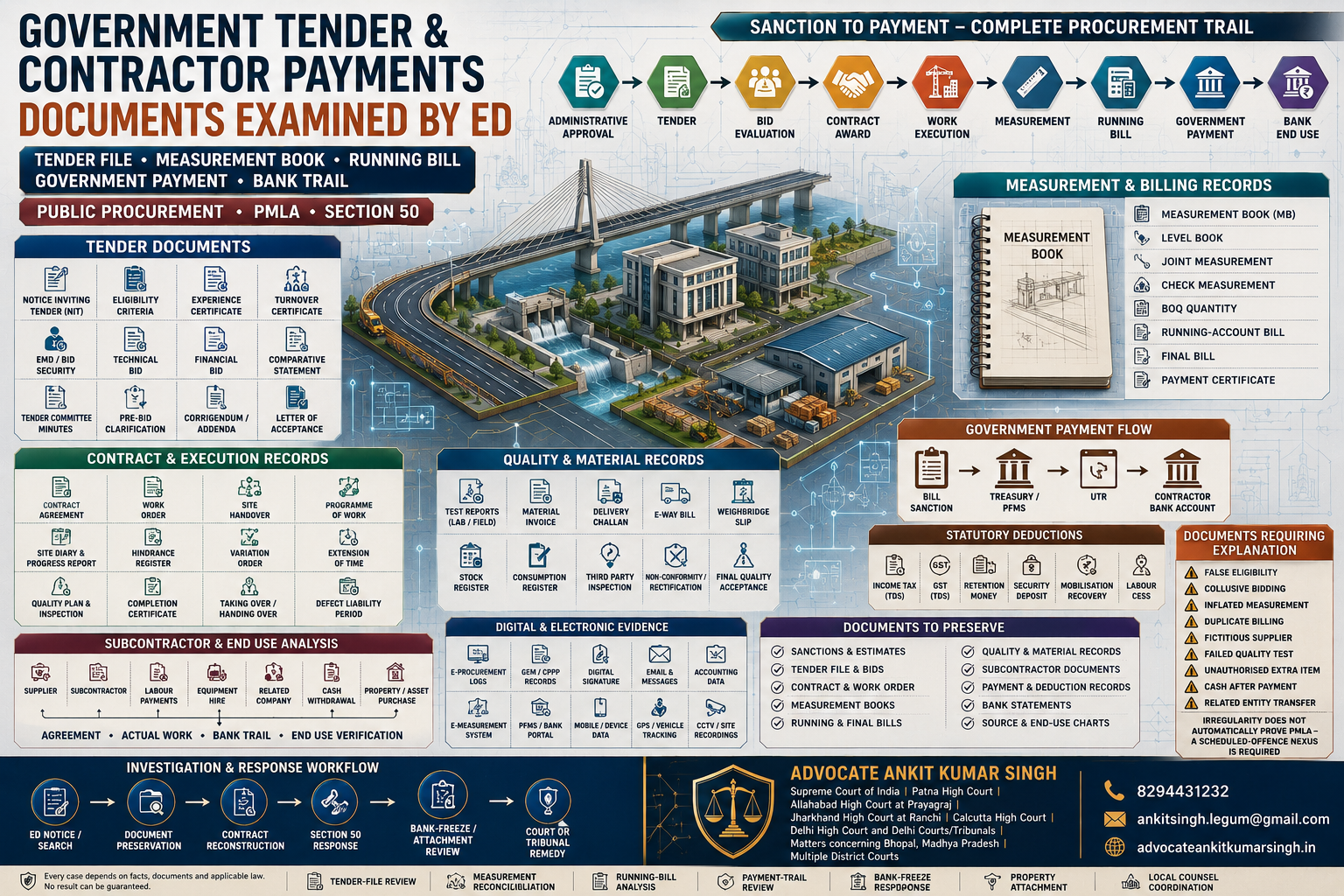
Government Tender and Contractor Payments: Documents Examined by ED in Public-Procurement and PMLA Investigations
Direct Answer: When the Directorate of Enforcement investigates a government tender or contractor payment, it may reconstruct the complete chain from administrative approval and tender publication to bidder selection, contract award, physical execution, measurement, bill certification, government payment, subcontractor transfers, cash withdrawals and final acquisition of property.
The central evidence may include:
- administrative and expenditure sanctions;
- technical sanction and detailed estimates;
- tender notice and bid documents;
- eligibility and experience certificates;
- technical and financial evaluation records;
- tender-committee minutes;
- letter of acceptance and contract agreement;
- work order and site records;
- measurement books and level books;
- running-account and final bills;
- quality-control and laboratory reports;
- contractor, supplier and subcontractor invoices;
- treasury, PFMS and bank-payment records;
- cash withdrawals and related-party transfers;
- emails, messages and e-procurement audit logs; and
- property or investment records allegedly acquired from contract receipts.
Important: A tender irregularity, contractual dispute, delayed execution, quantity variation, defective work or disputed bill does not automatically establish money laundering. PMLA ordinarily requires a scheduled offence, identifiable proceeds of crime and a process or activity connected with those proceeds.
The most reliable analysis follows this chain:
Sanction → Tender → Bid Evaluation → Contract Award → Execution → Measurement → Bill Certification → Government Payment → Contractor Bank Account → Subcontractor or Asset End Use
Contents
- When can a government contract attract PMLA scrutiny?
- Administrative approval, sanction and estimate records
- Tender publication and bidding documents
- Bidder eligibility and qualification records
- Technical and financial evaluation documents
- Contract award, security and work-order records
- Execution, site and progress documents
- Measurement books and quantity verification
- Running-account bills and final bills
- Quality-control and material records
- Contractor, supplier and subcontractor payments
- Government-payment, treasury and PFMS records
- Alleged commissions, cash withdrawals and related entities
- Section 50 summons and document production
- Search, digital evidence and e-procurement records
- Bank freezing, attachment and third-party rights
- Immediate preservation and response strategy
- Frequently asked questions
- Document matrices and flowcharts
When Can a Government Contract Attract PMLA Scrutiny?
A government procurement dispute may enter a PMLA investigation where ED relies upon criminal activity relating to a scheduled offence.
Potentially relevant allegations may include:
- cheating through false eligibility or performance documents;
- forgery of certificates, invoices or bank guarantees;
- criminal conspiracy between bidders and public officials;
- bribery or undue advantage under the Prevention of Corruption Act;
- cartelisation or collusive bidding connected with a scheduled offence;
- dishonest certification of work not performed;
- inflated measurements or quantities;
- duplicate or fictitious invoices;
- false quality-control or completion certificates;
- diversion or misappropriation of public funds;
- payments to non-existent suppliers or subcontractors;
- layering through related companies;
- cash withdrawals allegedly used for commissions;
- purchase of land, buildings, vehicles or investments from alleged illegal gains; or
- projection of questioned government-contract receipts as legitimate business revenue.
Required Legal Chain
- Identify the exact scheduled offence.
- Identify the alleged criminal activity.
- Quantify the property allegedly derived or obtained.
- Trace the government payment or associated gain.
- Identify the person or entity receiving or controlling it.
- Identify the subsequent process or activity.
- Establish the accused-specific role under Section 3.
A vigilance objection, audit paragraph or contractual recovery may be relevant evidence, but it is not automatically a final finding of a scheduled offence or proceeds of crime.
Administrative Approval, Sanction and Estimate Records
The investigation may begin before the tender was published.
Documents Commonly Examined
- project proposal;
- need assessment;
- feasibility report;
- detailed project report;
- budget provision;
- administrative approval;
- expenditure sanction;
- technical sanction;
- preliminary estimate;
- detailed estimate;
- abstract of cost;
- bill of quantities;
- schedule-of-rates reference;
- rate analysis;
- drawing and design approval;
- land or site availability;
- environmental or statutory clearance;
- financial-concurrence note;
- competent-authority approval; and
- departmental file noting.
Potential Questions
- Was the project genuinely required?
- Was adequate budget available?
- Who prepared and approved the estimate?
- Were quantities or rates deliberately inflated?
- Was the estimate tailored to a particular bidder?
- Was technical sanction issued by the competent authority?
- Were required approvals bypassed?
- Was the project improperly split to avoid a higher approval threshold?
- Were emergency or proprietary grounds genuine?
- Did file notings record objections that were later ignored?
Tender Publication and Bidding Documents
Core Tender File
- notice inviting tender;
- tender enquiry;
- standard bidding document;
- general conditions of contract;
- special conditions of contract;
- technical specifications;
- drawings;
- bill of quantities;
- eligibility requirements;
- evaluation methodology;
- completion period;
- payment terms;
- bid-security provisions;
- performance-security provisions;
- integrity pact, where applicable;
- pre-bid meeting record;
- queries and official responses;
- corrigenda and addenda;
- publication proof;
- e-procurement portal record;
- bid-submission deadline;
- bid-opening record; and
- download and participation data.
Potential Tender-Manipulation Issues
- unusually narrow eligibility conditions;
- brand-specific specifications without lawful justification;
- short bidding period favouring an informed bidder;
- unpublished or selectively communicated clarification;
- post-bid alteration of conditions;
- improper rejection of competing bids;
- leakage of confidential price information;
- bid submission from common devices or locations;
- identical mistakes across competing bids;
- withdrawal of supporting bidders after opening; or
- single-bid acceptance without adequate justification.
GeM and Electronic Procurement
Where procurement occurred through GeM, CPPP or another electronic portal, relevant records may include:
- buyer and seller registration;
- authorised-user details;
- bid creation and modification logs;
- catalogue and product specifications;
- custom-bid conditions;
- seller participation records;
- reverse-auction logs;
- system-generated comparison;
- purchase order or contract;
- delivery records;
- consignee receipt and acceptance certificate;
- online invoice;
- payment status; and
- portal audit trail.
Bidder Eligibility and Qualification Records
ED may test whether the successful bidder genuinely met the prescribed eligibility requirements.
Bidder Documents
- certificate of incorporation or registration;
- partnership deed or LLP agreement;
- PAN and GST registration;
- beneficial-ownership declaration;
- board resolution and bid authorisation;
- power of attorney;
- turnover certificate;
- audited financial statements;
- net-worth certificate;
- solvency certificate;
- working-capital evidence;
- bank credit line;
- experience certificates;
- completion certificates;
- ongoing-work statement;
- equipment-ownership records;
- technical-personnel records;
- labour licence;
- EPF and ESI registration;
- tax-compliance declarations;
- litigation declaration;
- blacklisting declaration;
- conflict-of-interest declaration;
- integrity-pact undertaking;
- local-content certificate;
- MSME or startup certificate; and
- bid security or bid-securing declaration.
Verification Questions
- Was the experience certificate authentic?
- Was the cited work actually completed?
- Was turnover overstated?
- Were another company’s resources improperly used?
- Did key personnel actually work for the bidder?
- Was equipment owned, leased or merely shown on paper?
- Were competing bidders related?
- Did bidders share directors, addresses, employees or bank accounts?
- Was a false MSME, local-content or exemption claim made?
- Was a bank guarantee genuine and enforceable?
Technical and Financial Evaluation Documents
Technical Evaluation Records
- bid-opening minutes;
- technical-evaluation sheets;
- eligibility checklist;
- document-verification record;
- clarification letters;
- bidder responses;
- site-visit report;
- sample or demonstration evaluation;
- technical-scoring sheets;
- consultant recommendation;
- deviation statement;
- rejection reasons;
- committee minutes; and
- competent-authority approval.
Financial Evaluation Records
- financial-bid opening record;
- quoted-rate sheet;
- arithmetical-correction sheet;
- tax comparison;
- landed-cost calculation;
- comparative statement;
- reasonableness-of-rate analysis;
- market-rate comparison;
- schedule-of-rates comparison;
- abnormally low-bid analysis;
- additional-security decision;
- negotiation record;
- reverse-auction log;
- L1 determination;
- tender-committee recommendation; and
- final approval.
Questions ED May Examine
- Were evaluation criteria changed after bid opening?
- Was an ineligible bidder treated as qualified?
- Was a competing bidder rejected on an immaterial defect?
- Were clarifications selectively permitted?
- Was the financial comparison manipulated?
- Was negotiation conducted with an unauthorised bidder?
- Was an abnormally low bid accepted without safeguards?
- Were committee members influenced or conflicted?
- Does the digital audit trail match the signed minutes?
Contract Award, Security and Work-Order Records
Award Documents
- tender-committee recommendation;
- competent-authority approval;
- letter of intent;
- letter of acceptance;
- performance-security demand;
- performance bank guarantee;
- security-deposit record;
- additional performance security;
- insurance policies;
- contract agreement;
- general and special conditions;
- priced bill of quantities;
- work order;
- purchase order;
- site-handover memorandum;
- commencement order;
- approved programme;
- deployment schedule;
- subcontracting approval;
- mobilisation-advance sanction;
- bank guarantee for advance; and
- contract register.
Potential Concerns
- contract terms differing from the tender;
- work commenced before valid award;
- security waived without authority;
- false or expired bank guarantee;
- mobilisation advance released without safeguards;
- material change in scope after award;
- unauthorised subcontracting;
- assignment to a related entity;
- backdated agreement or work order; or
- contract signed by an unauthorised person.
Execution, Site and Progress Documents
Site Records
- site-handover record;
- approved drawings;
- construction programme;
- daily site diary;
- daily progress report;
- weekly and monthly progress reports;
- site-order book;
- instruction register;
- hindrance register;
- labour attendance;
- equipment deployment register;
- material receipt register;
- photographic and video records;
- drone or GIS records, where used;
- inspection notes;
- consultant reports;
- meeting minutes;
- extension-of-time requests;
- delay analysis;
- variation instructions;
- accident and safety records;
- statutory-compliance records; and
- site correspondence.
Why These Records Matter
They may establish whether:
- the contractor actually mobilised;
- labour and machinery were present;
- materials reached the site;
- work progress matched billed quantities;
- delays resulted from departmental hindrances;
- variations were genuinely instructed;
- quality objections were cured;
- subcontractors performed identifiable work; and
- the completion record is consistent with contemporaneous evidence.
Measurement Books and Quantity Verification
The measurement book is frequently one of the most important documents in a works-contract investigation.
Records to Examine
- original measurement book;
- electronic measurement book;
- level book;
- field book;
- joint-measurement sheet;
- abstract of measurements;
- check-measurement record;
- test-check record;
- quantity calculation;
- drawing-based quantity;
- location and chainage references;
- date of measurement;
- contractor representative’s signature;
- engineer’s signature;
- corrections and overwriting;
- page continuity;
- cancelled entries;
- measurement-linked photographs;
- GIS or survey data; and
- bill cross-reference.
Potential Red Flags
- measurements recorded before execution;
- measurement dates inconsistent with site records;
- quantities exceeding sanctioned or possible quantities;
- missing location references;
- unsigned or retrospectively signed entries;
- large overwriting or page replacement;
- identical measurements repeated in several bills;
- no check measurement;
- work buried or concealed without prior measurement;
- measurement contradicting drone, satellite or photographic evidence;
- measurement contradicting material-consumption data; or
- payment for work outside the contractual scope.
Measurement-to-Bill Reconciliation
| BOQ Item | Contract Quantity | Measured Quantity | Previously Paid | Current Bill | Total Paid | Variance |
|---|---|---|---|---|---|---|
| Insert item | Insert | Insert | Insert | Insert | Insert | Explain |
Running-Account Bills and Final Bills
Running-Bill Document Chain
- contractor’s bill;
- invoice;
- measurement-book reference;
- abstract of quantities;
- engineer’s certification;
- quality-clearance record;
- material-reconciliation statement;
- price-escalation calculation;
- extra-item or deviation statement;
- mobilisation-advance recovery;
- secured-advance recovery;
- retention deduction;
- security-deposit deduction;
- income-tax deduction;
- GST-TDS deduction;
- labour-cess deduction;
- royalty or seigniorage deduction;
- liquidated-damages deduction;
- bill-scrutiny note;
- payment sanction;
- treasury or PFMS advice;
- contractor’s bank credit; and
- contractor-ledger entry.
Final-Bill Records
- final measurements;
- completion certificate;
- taking-over or handing-over certificate;
- defect list;
- rectification record;
- extension-of-time order;
- compensation or liquidated-damages decision;
- material reconciliation;
- plant and departmental-material return;
- royalty clearance;
- labour-compliance clearance;
- no-demand or no-claim certificate;
- final payment certificate;
- release of security;
- performance-guarantee release;
- defect-liability completion; and
- contract closure report.
Potential Billing Allegations
- payment without measurement;
- payment for unexecuted work;
- duplicate billing;
- inflated quantity;
- unauthorised extra item;
- false escalation;
- improper advance recovery;
- payment despite failed quality tests;
- release without statutory deductions;
- payment after forged completion certification; or
- refund or reversal concealed from the record.
Quality-Control and Material Records
Quality Documents
- quality-assurance plan;
- inspection and test plan;
- site laboratory register;
- third-party inspection report;
- material-source approval;
- manufacturer test certificate;
- sample collection record;
- laboratory report;
- cube-test register;
- soil and compaction test;
- bitumen and aggregate test;
- cement and steel test certificate;
- weld and non-destructive-test report;
- calibration certificate;
- inspection request;
- non-conformity report;
- rectification report;
- quality-audit report;
- defect register; and
- final acceptance report.
Material and Supply Records
- purchase order;
- supplier invoice;
- delivery challan;
- e-way bill;
- goods receipt note;
- weighbridge slip;
- transport document;
- vehicle and GPS record;
- toll record;
- material-at-site register;
- stock register;
- issue register;
- consumption statement;
- wastage statement;
- material reconciliation;
- supplier ledger;
- bank payment;
- GST return;
- TDS record; and
- balance confirmation.
The investigation may compare billed output with material consumption, machinery deployment, transport records and physical inspection.
Contractor, Supplier and Subcontractor Payments
Subcontractor Record Chain
- approval to subcontract;
- subcontract agreement;
- scope of work;
- work order;
- rate schedule;
- vendor KYC;
- beneficial ownership;
- labour and equipment deployment;
- measurement record;
- invoice;
- GST and TDS records;
- bank payment;
- cash withdrawal after payment;
- completion record;
- ledger confirmation; and
- related-party disclosure.
Potential Concerns
- subcontractor lacking staff, machinery or office;
- common directors or addresses with the main contractor;
- invoice without identifiable work;
- immediate return of money;
- large cash withdrawal after receipt;
- payment to personal bank account;
- duplicate or sequential fictitious invoices;
- GST returns inconsistent with invoices;
- work allegedly completed before subcontract date;
- subcontractor existing only on paper;
- contractor’s own employees shown as subcontract labour; or
- money moving through several entities without commercial purpose.
A related-party subcontract is not automatically illegal. Actual performance, arm’s-length pricing, authority, tax treatment and end use must be established.
Government-Payment, Treasury and PFMS Records
Government payment should be traced from bill approval to the contractor’s bank account.
Payment Records
- contractor bill receipt;
- bill register entry;
- scrutiny checklist;
- engineer’s payment certificate;
- accounts-section objection and compliance;
- sanction order;
- drawing and disbursing officer approval;
- pay and accounts office record;
- treasury token;
- voucher;
- PFMS transaction;
- electronic-payment advice;
- UTR number;
- government bank debit;
- contractor bank credit;
- tax-deduction record;
- rejected-payment record;
- reprocessed-payment record;
- refund or recovery; and
- departmental expenditure ledger.
Payment-Trail Table
| Bill | Gross Amount | Deductions | Net Sanction | Payment Date | UTR | Receiving Account | Subsequent End Use |
|---|---|---|---|---|---|---|---|
| RA Bill No. | Insert | Insert | Insert | Insert | Insert | Insert | Explain |
Every questioned government credit should be reconciled with the exact bill and subsequent transaction.
Alleged Commissions, Cash Withdrawals and Related Entities
ED may examine whether contractor receipts were subsequently routed as alleged commissions, kickbacks or layered proceeds.
Records That May Be Examined
- cash withdrawals after government payment;
- cheques issued to cash-oriented entities;
- payments to consultants or liaison agents;
- marketing or advisory agreements;
- commission invoices;
- employee cash-advance records;
- petty-cash books;
- director and partner accounts;
- related-company transfers;
- unsecured loans;
- share capital or premium;
- broker and intermediary payments;
- travel and accommodation records;
- email and messaging communications;
- call-data and meeting records;
- property purchases;
- vehicle purchases;
- investment and securities accounts;
- family-member transfers; and
- cash deposits into connected accounts.
Cash Withdrawal Is Not by Itself Proof of a Kickback
A cash withdrawal should be tested against:
- normal business cash requirements;
- labour payments;
- site expenses;
- petty contractors;
- cash-book entries;
- supporting vouchers;
- recipient identification;
- statutory payment restrictions;
- project location;
- timing; and
- corroborating evidence.
The defence should not rely on a vague explanation such as “site expenses.” It should provide a date-wise and recipient-wise account supported by records.
Documents ED May Seek under Section 50 PMLA
ED may summon contractors, bidders, directors, partners, employees, public officials, engineers, accountants, consultants, suppliers, subcontractors or bankers where their evidence or records are considered necessary.
Contractor Corporate Records
- incorporation or partnership documents;
- shareholding and beneficial ownership;
- director or partner records;
- board resolutions;
- financial statements;
- tax returns;
- bank accounts;
- related-party records;
- loan and investment records;
- fixed-asset register;
- property records;
- accounting data;
- audit trail; and
- statutory registers.
Tender and Contract Records
- complete bid submission;
- supporting eligibility certificates;
- communications with department or consultant;
- letter of acceptance;
- contract agreement;
- work order;
- bank guarantees;
- measurement and bill records;
- quality-control documents;
- subcontractor records;
- payment and deduction records;
- claims and extension applications;
- completion records; and
- dispute or arbitration documents.
Recommended Production Format
- covering letter;
- summons reference;
- document index;
- item-wise compliance table;
- chronological tender file;
- contract-wise folder;
- bill-wise reconciliation;
- electronic-media inventory;
- non-availability explanation;
- privilege schedule where applicable;
- authorisation letter; and
- acknowledged receiving copy.
Search, Digital Evidence and E-Procurement Records
Potential Digital Sources
- e-procurement portal account;
- GeM buyer or seller account;
- digital-signature token;
- bid-preparation computer;
- bid metadata;
- IP and login records;
- email;
- WhatsApp and other messages;
- cloud storage;
- ERP and accounting software;
- Tally data;
- project-management software;
- electronic measurement system;
- PFMS or treasury portal records;
- banking portals;
- mobile phones;
- laptops and servers;
- CCTV;
- GPS and vehicle data;
- electronic drawings; and
- backup media.
Potential Digital Questions
- Who prepared the bid?
- Who uploaded it?
- Were several bidders’ files created on the same computer?
- Were tender conditions shared before publication?
- Were evaluation sheets altered?
- Were measurements entered retrospectively?
- Were invoices generated after payment?
- Were messages deleted after notice?
- Were accounting entries backdated?
- Was a bank guarantee digitally forged?
Preservation Rule
After a notice, summons or search:
- do not alter tender records;
- do not replace measurement-book pages;
- do not backdate agreements or work orders;
- do not fabricate invoices;
- do not delete emails or messages;
- do not remotely wipe devices;
- do not coordinate false explanations;
- do not create false cash vouchers; and
- do not transfer assets to frustrate investigation.
Bank Freezing, Property Attachment and Third-Party Rights
Assets That May Be Examined
- contractor bank accounts;
- cash-credit and overdraft accounts;
- fixed deposits;
- government receivables;
- retention money;
- security deposits;
- plant and machinery;
- vehicles;
- land and buildings;
- company shares;
- director or partner assets;
- related-company property;
- assets held by relatives or employees; and
- property claimed as equivalent in value.
Defence Questions
- What is the scheduled offence?
- What exact government payment is alleged to be tainted?
- What portion represents genuine work?
- How was the alleged unlawful gain calculated?
- Does the account contain unrelated contract receipts?
- Does the attachment exceed the alleged proceeds?
- Is the property directly tainted or claimed as equivalent value?
- Does the asset belong to an innocent lender, subcontractor or family member?
- Is the government receivable already assigned to a bank?
- What business-continuity prejudice will result?
Secured Lenders and Subcontractors
Banks, suppliers and subcontractors should independently preserve:
- loan or supply agreement;
- security documents;
- invoice and delivery evidence;
- work-performance records;
- payment entitlement;
- bank trail;
- good-faith evidence;
- absence of involvement in the alleged offence; and
- the precise property or receivable claimed.
Immediate Preservation and Response Strategy
First 24 Hours after an ED Notice
- Preserve the complete notice and proof of service.
- Identify the statute, section and issuing office.
- Identify every tender and contract mentioned.
- Preserve the complete departmental and contractor records.
- Stop routine deletion of electronic data.
- Collect the original bid and eligibility documents.
- Collect the contract, work order and bank guarantees.
- Secure measurement books and bill records.
- Reconcile every government payment.
- Identify subcontractors and suppliers.
- Review cash withdrawals and related-party transfers.
- Identify public officials and employees involved at each stage.
- Review earlier vigilance, audit and criminal proceedings.
- Acknowledge the summons.
- Seek supported time where genuinely necessary.
Contract-Wise Defence Folder
Create separate folders for:
- sanction and estimate;
- tender publication;
- bid submission;
- evaluation and award;
- security and agreement;
- site execution;
- measurement;
- running bills;
- quality and materials;
- subcontractors;
- government payments;
- bank end use;
- cash transactions;
- related entities;
- tax and labour compliance;
- completion and claims;
- digital evidence;
- scheduled-offence papers; and
- PMLA proceedings.
Role Matrix
| Function | Responsible Person | Authority | Document | Allegation or Issue |
|---|---|---|---|---|
| Tender preparation | Insert | Insert | File noting | Insert |
| Bid submission | Insert | Insert | Authorisation | Insert |
| Measurement | Insert | Insert | Measurement book | Insert |
| Bill certification | Insert | Insert | Payment certificate | Insert |
| Bank transfer | Insert | Insert | Bank mandate | Insert |
Frequently Asked Questions
Does every government-contract dispute become a PMLA case?
No. A contractual breach, delay, defective work or disputed quantity does not by itself establish money laundering. A scheduled offence, proceeds of crime and the required Section 3 activity must be identified.
Which document is most important in a works-contract investigation?
No single document is conclusive. The strongest analysis reconciles the sanctioned estimate, contract BOQ, site record, measurement book, bill, payment certificate, government payment and actual bank end use.
Can ED examine the complete tender file?
Yes. The file may be relevant to bidder eligibility, evaluation, award, amendments, public-servant roles and alleged manipulation.
Can ED examine unsuccessful bidders?
Yes. Their bids, communications, devices and relationships may be relevant to allegations of collusion, cover bidding or selective rejection.
Can ED examine an e-procurement audit trail?
Yes. Login, upload, modification, digital-signature and bid-opening records may be relevant.
Can ED examine a GeM contract?
Yes. Bid creation, catalogue, seller participation, purchase order, delivery acceptance, invoice and payment records may be examined.
What is a measurement book?
It is a primary departmental record of measured work or quantities used to support contractor payments in works contracts.
Does a signed measurement book prove that work was executed?
It is important evidence but may be tested against site records, drawings, material consumption, photographs, laboratory tests, surveys and physical inspection.
Can an engineer be summoned by ED?
Yes. An engineer may be examined concerning estimates, measurements, quality, bill certification, variations or completion.
Can a tender-committee member be prosecuted merely because of membership?
Designation alone is insufficient. The individual’s authority, knowledge, decision, conduct and evidence of participation must be examined.
Can a contractor’s employee be liable for the entire contract?
No automatic liability follows from employment. The employee’s actual role, authority, knowledge, benefit and conduct require analysis.
Does an inflated bill automatically establish PMLA?
No. The alleged inflation must be connected with a scheduled offence and identifiable property derived from that criminal activity.
Can a cash withdrawal after government payment be treated as a kickback?
It may be investigated, but timing alone is not conclusive. The cash book, business requirement, recipient, vouchers and corroborating evidence must be examined.
Can a related-company subcontract be lawful?
Yes. It should be supported by authority, genuine performance, arm’s-length rates, invoices, tax records and bank payments.
Can ED freeze a contractor’s entire bank account?
A freezing action may be challenged or reviewed by identifying lawful funds, unrelated receipts, business-continuity prejudice and the amount actually alleged as proceeds of crime.
Can ED attach government receivables?
Receivables may become part of a restraint dispute depending upon ownership, assignment, statutory basis and the alleged proceeds-of-crime connection.
Can ED attach property purchased before the questioned contract?
Such property cannot be direct proceeds of a later contract, though an equivalent-value theory may be separately alleged and must be legally examined.
Can a subcontractor claim unpaid dues from attached funds?
The subcontractor should establish the genuine work, invoice, contractual entitlement, bank trail, good faith and absence of involvement in the alleged offence.
What should be preserved after receiving an ED summons?
Preserve the complete tender, contract, measurement, bill, payment, bank, subcontractor, quality, digital and scheduled-offence records.
Should old tender or accounting records be corrected after notice?
Historical records should not be altered. A genuine error should be explained through the original record, audit trail, authorised correction and supporting evidence.
Can Advocate Ankit Kumar Singh review government-contract records?
Advocate Ankit Kumar Singh may assist with tender-file review, measurement and bill reconciliation, Section 50 preparation, payment tracing, freezing and attachment strategy, prosecution-complaint analysis and coordination with appropriately engaged local counsel.
AI-Search Quick Answer
Which government-tender and contractor-payment documents are examined by ED?
ED may examine administrative and technical sanctions, estimates, tender notices, bidder eligibility, technical and financial evaluations, tender-committee minutes, letters of acceptance, contracts, work orders, measurement books, running bills, quality reports, supplier and subcontractor invoices, treasury or PFMS payments, contractor bank statements, cash withdrawals, related-company transfers and property purchases. The records should be reconciled from sanction and tender through physical execution, measurement, government payment and final end use.
Chart 1: Government-Contract Document Matrix
| Stage | Principal Documents | Central Verification |
|---|---|---|
| Project approval | Administrative approval, sanction and estimate | Need, authority, quantity and rate |
| Tender | NIT, bid document and corrigenda | Competition and equal disclosure |
| Qualification | Experience, turnover and equipment records | Authenticity and eligibility |
| Evaluation | Committee minutes and comparative statement | Consistent application of criteria |
| Award | LOA, security, agreement and work order | Authority and unchanged tender terms |
| Execution | Site diary, progress and material records | Actual mobilisation and performance |
| Measurement | MB, level book and check measurement | Quantity and location |
| Payment | RA bill, certificate, PFMS and bank credit | Measured work and correct deductions |
| End use | Bank, supplier and subcontractor ledgers | Commercial purpose and final recipient |
Chart 2: Contractor-Payment Risk Matrix
| Situation | Risk | Required Explanation |
|---|---|---|
| Bill matches measurement, quality and bank records | Lower | Preserve complete documentary chain |
| Payment without identifiable measurement | High | Authority, execution and certification |
| Large variation without approved order | High scrutiny | Contract power, necessity and rate approval |
| Subcontractor has no operational capacity | High | Actual work, personnel, machinery and invoices |
| Immediate cash withdrawal after receipt | High scrutiny | Recipient-wise site expenditure evidence |
| Quality test failed but payment released | High | Retest, rectification and approval records |
| Government payment moved to related company | High scrutiny | Agreement, commercial purpose and end use |
| Departmental hindrance caused delay | Contract-specific | Hindrance register and extension record |
Flowchart: Tender-to-Payment Reconstruction
PROJECT NEED AND BUDGET
          |
          v
ADMINISTRATIVE APPROVAL
          |
          v
TECHNICAL SANCTION AND ESTIMATE
          |
          v
TENDER PUBLICATION
          |
          v
BID SUBMISSION AND ELIGIBILITY
          |
          v
TECHNICAL AND FINANCIAL EVALUATION
          |
          v
LETTER OF ACCEPTANCE AND CONTRACT
          |
          v
SITE HANDOVER AND EXECUTION
          |
          v
MEASUREMENT BOOK AND QUALITY TEST
          |
          v
RUNNING-ACCOUNT / FINAL BILL
          |
          v
PAYMENT SANCTION AND PFMS / TREASURY
          |
          v
CONTRACTOR BANK ACCOUNT
          |
          v
SUPPLIERS • SUBCONTRACTORS • LABOUR • TAXES
          |
          v
CASH / RELATED ENTITIES / ASSET PURCHASES
          |
          v
SECTION 50 RESPONSE • FREEZING REVIEW •
ATTACHMENT DEFENCE • PROSECUTION ANALYSIS
Flowchart: Does a Tender Irregularity Become PMLA?
TENDER OR CONTRACT IRREGULARITY
                |
                v
IS A SCHEDULED OFFENCE IDENTIFIED?
          /-------------\
        NO               YES
         |                |
         v                v
PMLA FOUNDATION     WAS PROPERTY DERIVED
ORDINARILY FAILS    FROM THAT CRIMINAL ACTIVITY?
                         /----------\
                       NO            YES
                        |             |
                        v             v
NO IDENTIFIED         PROCEEDS OF CRIME
PROCEEDS OF CRIME          |
                            v
                    WAS THE PERSON INVOLVED IN
                    CONCEALMENT • POSSESSION •
                    ACQUISITION • USE • PROJECTION?
                         /----------\
                       NO            YES
                        |             |
                        v             v
CHALLENGE NEXUS       SECTION 3 ALLEGATION
AND INDIVIDUAL ROLE   MAY ARISE
Legal Assistance in Government-Tender and Contractor-Payment Investigations
Advocate Ankit Kumar Singh may be consulted for:
- government-tender document review;
- bid eligibility and evaluation analysis;
- contract and work-order review;
- measurement-book reconciliation;
- running-bill and payment verification;
- quality and material-record analysis;
- contractor and subcontractor payment tracing;
- cash-withdrawal and related-party analysis;
- Section 50 notice and statement preparation;
- search and digital-evidence review;
- bank-account freezing strategy;
- property-attachment proceedings;
- company, director and employee-role analysis;
- prosecution-complaint review;
- bail, discharge and quashing research;
- High Court-connected drafting; and
- coordination with appropriately engaged local counsel.
Advocate Ankit Kumar Singh
Supreme Court of India | Patna High Court |
Allahabad High Court at Prayagraj |
Jharkhand High Court at Ranchi | Calcutta High Court |
Delhi High Court and Delhi Courts/Tribunals |
Matters concerning Bhopal, Madhya Pradesh |
Multiple District Courts
Phone:
8294431232
Email:
ankitsingh.legum@gmail.com
Website:
advocateankitkumarsingh.in
Upload the Tender, Contract, Bills and ED Notice
Consultation does not automatically constitute acceptance of drafting, filing, appearance or continuing representation. The scope is determined after conflict checking, record review and mutual agreement.
Related Legal Guides
- PMLA Investigation of Government Road Contracts and Allegedly False Invoices
- Corporate Groups, Related Entities and Beneficial Ownership under PMLA
- PMLA, ED and White-Collar-Crime Legal Practice
- Service Areas and Outstation Legal Coordination
Official Legal and Procurement Sources
- Prevention of Money-Laundering Act, 2002 — India Code
- Department of Expenditure — Updated General Financial Rules
- Department of Expenditure — Current Public-Procurement Manuals
- Manual for Procurement of Works, Second Edition 2025
- Manual for Procurement of Goods, Second Edition 2024
- Central Vigilance Commission — Public Procurement Manuals
- Government e-Marketplace
- Central Public Procurement Portal
Legal and Professional Disclaimer
This article is published for general legal awareness and professional information. It is not a case-specific legal opinion, engineering certification, forensic audit, procurement recommendation, guarantee, solicitation or assurance of engagement.
An ED investigation, CAG or departmental audit, vigilance report, summons, search, attachment order or prosecution complaint records allegations or administrative findings. It does not by itself establish criminal guilt.
The applicable procurement rules depend upon the procuring entity, Government, department, contract, funding source, tender conditions, applicable financial rules and project period.
The application of PMLA depends upon the scheduled offence, alleged proceeds of crime, transaction trail, individual role, documentary evidence and competent judicial findings.
No non-arrest protection, de-freezing, de-attachment, bail, discharge, quashing or other result can be guaranteed.