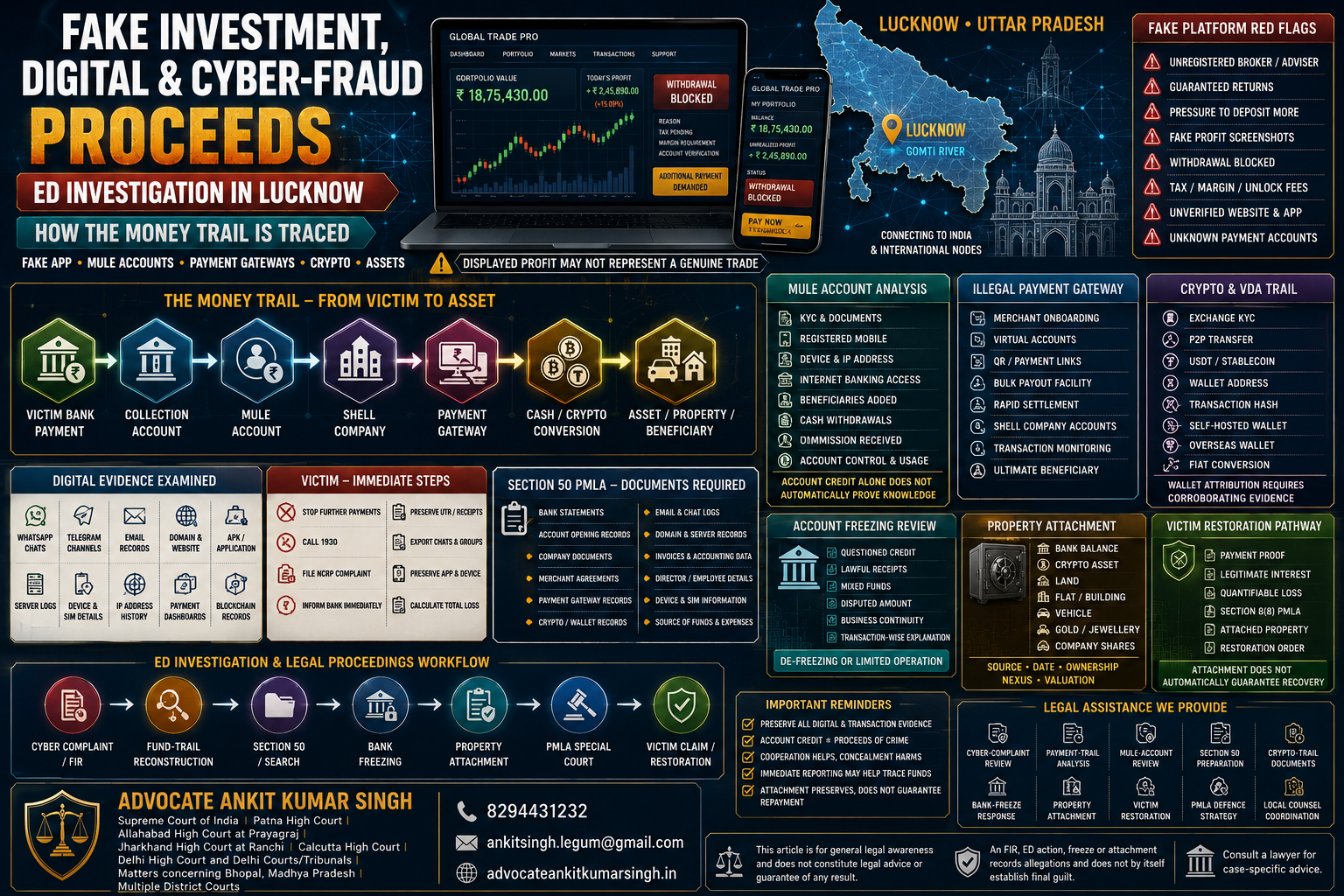
Fake Investment, Digital and Cyber-Fraud Proceeds under ED Investigation in Lucknow: Mule Accounts, Trading Apps, Crypto Trails and PMLA Remedies
Direct Answer: When victims in Lucknow or elsewhere in Uttar Pradesh are induced to transfer money through a fake trading application, fraudulent investment website, WhatsApp group, Telegram channel, cryptocurrency scheme or task-based earning platform, the case may begin as a cybercrime or cheating investigation.
The Directorate of Enforcement may enter the matter where criminal activity relating to a scheduled offence is alleged and the collected money is claimed to constitute proceeds of crime. ED may then trace the funds through mule accounts, shell companies, payment gateways, cash withdrawals, cryptocurrency exchanges, digital wallets, related entities and property purchases.
Important: A person’s bank account appearing in the fund trail does not automatically prove money laundering. The investigation must distinguish the victim, genuine merchant, innocent account holder, negligent account provider, commission-based mule, company controller, payment intermediary and ultimate beneficiary.
The central financial trail is ordinarily:
Victim → Fake Platform or Group → Collection Account → Mule or Merchant Account → Layered Transfers → Cash, Crypto, Foreign Transfer or Asset Purchase
Contents
- What is a fake-investment cyber fraud?
- Common fake-investment models affecting victims
- How the fraud is ordinarily structured
- When can PMLA apply?
- How ED traces victim money
- Mule accounts and illegal payment gateways
- Shell companies and nominee directors
- Cryptocurrency and virtual-digital-asset conversion
- Digital evidence examined by ED
- Section 50 summons and statement preparation
- Bank-account freezing and innocent-account claims
- Property attachment and equivalent-value allegations
- Liability of directors, employees and account holders
- Immediate steps for victims
- Victim recovery and restoration
- Bail, discharge and prosecution complaints
- Frequently asked questions
- Charts and fund-flow diagrams
What Is a Fake-Investment Cyber Fraud?
A fake-investment cyber fraud is an arrangement in which a victim is induced to transfer money on the false belief that the amount is being invested through a genuine financial, securities, commodity, cryptocurrency or wealth-management platform.
The victim may be shown:
- a false trading balance;
- fabricated investment profits;
- fake shares, units, coins or tokens;
- a manipulated institutional-trading account;
- an artificial IPO allotment;
- a false withdrawal status;
- a forged SEBI or exchange certificate;
- a fabricated tax liability;
- a fictitious portfolio manager;
- fake customer-support communication; or
- a cloned website or application.
The platform may operate only as a visual interface. The money transferred by the victim may never reach a genuine stockbroker, recognised exchange, regulated investment product or authorised intermediary.
Fraud versus Investment Loss
A genuine investment may lose value because of market movement. A fake-investment scheme is different because the platform, transaction, asset, intermediary, profit or withdrawal process may have been fabricated from the beginning.
The following distinction should be examined:
| Genuine Market Loss | Potential Fake-Investment Fraud |
|---|---|
| Trade appears in a genuine broker or exchange record | No genuine trade can be verified |
| Loss arises from actual price movement | Profit or loss is manually fabricated |
| Funds move to the registered intermediary | Funds move to unrelated personal or company accounts |
| Withdrawal follows regulated procedure | Further money is demanded to unlock withdrawal |
| Contract notes and statements can be independently verified | Documents exist only inside the fraudulent application |
Common Fake-Investment Models
Fake Stock-Trading Application
The victim may be instructed to download an application through:
- an APK file;
- a social-media link;
- a messaging group;
- a cloned website;
- a QR code; or
- a link sent by a purported investment adviser.
The application may display fabricated shares, trading profits and withdrawal balances.
WhatsApp or Telegram Investment Group
The group may contain:
- a fake professor or market expert;
- an assistant handling account opening;
- fabricated investor testimonials;
- members posting false profit screenshots;
- daily stock recommendations;
- pressure to enter a VIP group;
- assurances of institutional allocation; and
- instructions to transfer money to changing accounts.
Fake Institutional or Preferential Trading Account
Victims may be told that ordinary investors cannot access:
- block trades;
- bulk deals;
- discounted shares;
- pre-IPO allotments;
- upper-circuit stocks;
- institutional quotas;
- special IPO financing; or
- guaranteed placement opportunities.
Work-from-Home and Task-Based Investment Fraud
The victim may initially receive a small payment for:
- rating products;
- liking videos;
- reviewing hotels;
- completing online orders;
- performing prepaid tasks;
- filling CAPTCHA entries; or
- artificially increasing merchant sales.
The victim is later required to deposit increasingly larger amounts to complete bundled tasks or release a supposed commission.
Cryptocurrency-Investment Fraud
The victim may be promised:
- automated crypto trading;
- mining income;
- staking returns;
- discounted tokens;
- arbitrage profit;
- copy trading;
- liquidity-pool income;
- foreign exchange conversion; or
- guaranteed USDT returns.
Matrimonial or Relationship-Based Investment Fraud
A person may create trust through a matrimonial, dating or social-media platform and later introduce a supposed trading opportunity, cryptocurrency platform or overseas investment adviser.
How Is the Fraud Ordinarily Structured?
Stage 1: Victim Identification
Potential victims may be contacted through:
- social-media advertisements;
- WhatsApp messages;
- Telegram channels;
- dating or matrimonial platforms;
- fake job advertisements;
- investment seminars;
- cold calls;
- YouTube or social-media videos;
- cloned profiles of recognised professionals; or
- stolen databases.
Stage 2: Trust Creation
Trust may be created through:
- small initial profits;
- successful first withdrawal;
- fabricated testimonials;
- professional-looking applications;
- fake support teams;
- video calls;
- forged registration documents;
- daily market commentary;
- personal relationship-building; and
- pressure from other fake group members.
Stage 3: Escalating Deposits
The victim may be instructed to transfer money for:
- account activation;
- initial investment;
- margin funding;
- IPO allotment;
- block trade;
- prepaid task;
- loss recovery;
- tax;
- security deposit;
- anti-money-laundering verification;
- credit-score improvement;
- withdrawal unlocking; or
- final settlement.
Stage 4: Layering
The amount may be routed through:
- personal savings accounts;
- current accounts;
- shell companies;
- merchant accounts;
- payment-gateway settlements;
- virtual accounts;
- UPI identifiers;
- digital wallets;
- cash collectors;
- crypto exchanges;
- peer-to-peer crypto traders; or
- foreign-controlled wallets.
Stage 5: Withdrawal Blocking
When the victim seeks withdrawal, the platform may demand:
- tax;
- commission;
- margin;
- insurance;
- account verification;
- penalty;
- liquidity charge;
- foreign-remittance charge;
- security deposit; or
- additional investment.
The victim should not send further money merely because a dashboard shows an increased balance.
When Can PMLA Apply to a Fake-Investment Fraud?
PMLA does not apply merely because a digital platform is false or an investor suffered loss.
The essential legal sequence is:
Scheduled Criminal Activity → Property Derived or Obtained → Proceeds of Crime → Process or Activity Connected with Those Proceeds
Scheduled-Offence Foundation
The predicate case may allege legally relevant offences concerning:
- cheating;
- forgery;
- criminal conspiracy;
- identity-related cyber offences;
- personation through computer resources;
- fraudulent securities activity;
- an unregulated deposit scheme;
- criminal breach or diversion in an appropriate case; or
- another offence included in the PMLA Schedule.
The exact statutory sections in the FIR, complaint or charge-sheet must be matched with the current PMLA Schedule.
Proceeds of Crime
The alleged proceeds may include:
- victim transfers;
- commissions retained by account providers;
- cash withdrawn from collection accounts;
- cryptocurrency purchased from victim money;
- property bought from layered funds;
- merchant settlements;
- foreign remittances;
- fees paid to shell entities;
- vehicles, jewellery or bullion; and
- income generated from reinvestment of fraud proceeds.
Person-Specific Section 3 Analysis
The investigation must examine whether the person was knowingly involved in:
- concealment;
- possession;
- acquisition;
- use;
- projection as untainted;
- claiming as untainted; or
- another connected process or activity.
Mere receipt into an account is not a substitute for proof of the account holder’s actual role, knowledge and conduct.
How Does ED Trace Victim Money?
Victim-Level Reconstruction
For each victim, the investigation may collect:
- name and identity;
- complaint number;
- mobile number and email;
- platform or group name;
- date of first contact;
- representations made;
- application or website used;
- payment date;
- amount;
- UTR or transaction reference;
- beneficiary account;
- fake-dashboard balance;
- withdrawal demands;
- amount recovered; and
- net loss.
Account-Level Reconstruction
For each beneficiary account, ED may examine:
- account-opening form;
- KYC documents;
- beneficial ownership;
- registered mobile number;
- email address;
- IP and device access;
- authorised signatories;
- credits from victims;
- debits to further layers;
- cash withdrawals;
- UPI and merchant activity;
- ATM locations;
- cheque usage;
- payment-gateway settlements;
- related accounts; and
- balance available for freezing.
Layer-by-Layer Fund Chart
| Layer | Account or Wallet | Amount Received | Source | Amount Transferred | Destination | End Use |
|---|---|---|---|---|---|---|
| Victim | Victim account | — | Lawful funds | Insert | Collection account | Investment representation |
| First Layer | Collection or mule account | Insert | Victim | Insert | Second-layer account | Rapid transfer |
| Second Layer | Company or merchant account | Insert | First layer | Insert | Crypto, cash or another entity | Layering |
| Final Layer | Wallet, property or beneficiary | Insert | Layered accounts | Insert | Final asset or person | Ultimate control |
Source-and-Application Analysis
The prosecution and defence should separately identify:
- total victim receipts;
- refunds genuinely paid;
- lawful unrelated receipts;
- commissions;
- payment-gateway deductions;
- cash withdrawals;
- crypto purchases;
- business expenses;
- personal expenditure;
- property acquisition; and
- remaining balance.
Mule Accounts and Illegal Payment Gateways
What Is a Mule Account?
A mule account is an account used to receive, transfer, withdraw or otherwise handle funds arising from unlawful activity.
The account may belong to:
- a person who knowingly rented it;
- a person who sold internet-banking access;
- a company formed for account opening;
- a genuine business whose account was misused;
- an employee or relative;
- a person deceived into account sharing;
- a dormant company;
- a payment merchant; or
- a person whose KYC documents were stolen.
Documents Examined for a Suspected Mule Account
- account-opening documents;
- KYC and video KYC;
- company incorporation records;
- Udyam or GST records;
- business-address verification;
- merchant onboarding;
- internet-banking device data;
- registered SIM details;
- ATM footage;
- cheque handwriting;
- beneficiary additions;
- IP logs;
- transaction alerts;
- commission payments;
- chat instructions; and
- cash handover evidence.
Illegal Payment-Gateway Structure
A cyber-fraud network may use:
- multiple merchant identities;
- shell-company current accounts;
- virtual collection accounts;
- payment links;
- QR codes;
- bulk-payout facilities;
- rapid merchant settlement;
- fake e-commerce transactions;
- misdescribed business activity; and
- foreign-controlled technical infrastructure.
Important Distinction
A payment intermediary or account holder should not be treated identically to the ultimate fraud controller without examining:
- knowledge;
- due diligence;
- transaction monitoring;
- commercial purpose;
- fees retained;
- instructions received;
- account control;
- response to alerts;
- relationship with the fraud network; and
- conduct after discovery.
Shell Companies, Nominee Directors and Business Accounts
Cyber-fraud proceeds may be routed through companies that appear to conduct:
- software services;
- digital marketing;
- consultancy;
- e-commerce;
- gaming;
- foreign exchange;
- travel;
- education;
- financial services;
- import and export;
- advertising; or
- merchant aggregation.
Corporate Documents ED May Examine
- certificate of incorporation;
- memorandum and articles;
- directors and shareholders;
- beneficial-ownership records;
- registered-office documents;
- board resolutions;
- bank mandates;
- GST registration;
- Udyam certificate;
- merchant agreements;
- payment-gateway agreements;
- financial statements;
- tax returns;
- invoices;
- employee records;
- accounting data;
- email accounts;
- domain registrations;
- foreign remittance records; and
- related-party transactions.
Nominee Director versus Actual Controller
The investigation should examine:
- who incorporated the company;
- who funded incorporation;
- who retained the digital signature;
- who operated the bank account;
- who controlled the registered mobile number;
- who negotiated with payment gateways;
- who received passwords and OTPs;
- who retained the proceeds;
- what the director was paid; and
- whether the director understood the business.
A person described as a nominee is not automatically innocent or guilty. The evidence of control, knowledge and benefit must be tested.
Cryptocurrency and Virtual-Digital-Asset Conversion
Cyber-fraud proceeds may be converted into virtual digital assets to increase speed, portability or distance between the victim and the ultimate beneficiary.
Potential Crypto Routes
- Indian exchange accounts;
- foreign exchange accounts;
- peer-to-peer trades;
- over-the-counter dealers;
- self-hosted wallets;
- stablecoins;
- privacy-enhancing services;
- cross-chain bridges;
- foreign-controlled wallets;
- gaming or gambling wallets; and
- merchant settlement in crypto.
Crypto Evidence
- exchange KYC;
- bank payments to exchanges;
- P2P counterparty details;
- wallet addresses;
- transaction hashes;
- blockchain timestamps;
- device screenshots;
- email confirmations;
- API data;
- withdrawal addresses;
- recovery phrases;
- private-key storage;
- hardware wallets;
- chat instructions;
- OTC settlement sheets; and
- conversion into fiat or assets.
Wallet Ownership Is a Factual Question
A wallet address does not contain a visible legal name. Control may be inferred from:
- exchange KYC;
- device possession;
- seed phrase;
- login records;
- connected bank accounts;
- messages;
- withdrawal history;
- common IP addresses;
- transaction timing; and
- admissions or corroborating evidence.
Important Defence Questions
- Was the wallet personally controlled by the accused?
- Was the person acting as an exchange or OTC service provider?
- Were lawful customer transactions mixed with questioned funds?
- Was the crypto purchased before or after the alleged offence?
- Was the amount transferred onward without retention?
- Was a commercial fee disclosed?
- Was the transaction linked to a particular victim?
- Was blockchain analysis independently verified?
Digital Evidence Examined by ED
Mobile Phones
- WhatsApp chats;
- Telegram channels;
- SMS messages;
- contact lists;
- call logs;
- investment applications;
- banking applications;
- crypto-wallet applications;
- screenshots;
- downloaded APK files;
- browser history;
- saved passwords;
- notes;
- photographs of receipts;
- remote-access applications; and
- deleted-data remnants.
Computers and Servers
- source code;
- application administrator panels;
- victim databases;
- profit-manipulation controls;
- payment records;
- customer-support scripts;
- accounting files;
- domain and hosting records;
- email archives;
- VPN records;
- IP logs;
- cloud credentials;
- payment-gateway dashboards;
- merchant records;
- crypto exchange records; and
- backup files.
Website and Application Evidence
- domain registration;
- hosting provider;
- server location;
- SSL certificate;
- application developer records;
- Play Store or app-distribution records;
- APK signing certificate;
- administrator accounts;
- source-code repository;
- website payment integration;
- victim login history;
- fabricated trade generation; and
- withdrawal-blocking controls.
Preservation Requirements
After receiving a summons, notice or search order:
- do not delete chats;
- do not wipe devices;
- do not alter account records;
- do not fabricate invoices;
- do not change domain ownership;
- do not transfer wallets to frustrate investigation;
- do not backdate company documents;
- do not create false KYC;
- do not coordinate false statements; and
- do not destroy transaction logs.
Section 50 Summons and Statement Preparation
ED may summon any person whose evidence or records are considered necessary under the applicable statutory framework.
Persons Who May Be Summoned
- company directors;
- shareholders;
- account holders;
- bank officials;
- payment-gateway personnel;
- merchant-onboarding employees;
- accountants;
- software developers;
- application administrators;
- customer-support employees;
- call-centre staff;
- crypto traders;
- OTC dealers;
- cash handlers;
- property sellers;
- victims; and
- other document custodians.
Documents Commonly Required
- bank statements;
- account-opening records;
- company documents;
- merchant agreements;
- payment-gateway settlement reports;
- UPI records;
- victim transaction lists;
- accounting data;
- invoices;
- device and SIM details;
- email and chat records;
- domain documents;
- server and application records;
- crypto exchange statements;
- wallet addresses;
- cash-withdrawal records;
- property documents; and
- source-of-funds evidence.
Role Matrix before Statement
| Function | Actual Person | Authority | Access | Supporting Evidence |
|---|---|---|---|---|
| Company incorporation | Insert | Insert | Digital signature | Incorporation file |
| Bank operation | Insert | Insert | Internet banking | Bank mandate and logs |
| Merchant onboarding | Insert | Insert | Gateway portal | Agreement and email |
| App administration | Insert | Insert | Admin panel | Server and login records |
| Crypto conversion | Insert | Insert | Exchange or wallet | Blockchain and KYC records |
During Examination
- answer truthfully;
- do not guess dates or amounts;
- distinguish personal knowledge from company records;
- ask to see the document being referred to;
- identify when the record must be checked;
- do not adopt another person’s role;
- read every page before signing;
- correct inaccurate recording;
- do not sign blank sheets; and
- retain a private attendance note after examination.
Bank-Account Freezing and Innocent-Account Claims
A bank account may be restricted because:
- a victim’s transfer entered the account;
- another mule account transferred money into it;
- the account was used as a merchant settlement account;
- several cybercrime complaints refer to it;
- the balance is alleged to represent proceeds of crime;
- the account received mixed lawful and questioned funds; or
- the account holder is alleged to control a wider network.
Account-Holder Classification
| Category | Possible Evidence | Primary Legal Issue |
|---|---|---|
| Knowing mule | Commission, shared credentials and instructions | Knowledge and participation |
| Negligent account provider | Account rented without proper inquiry | Extent of knowledge and benefit |
| Identity-theft victim | Forged KYC or unauthorised access | Actual control |
| Genuine merchant | Invoices, customers and commercial records | Lawful business receipts |
| Payment intermediary | Onboarding and settlement records | Due diligence and transaction monitoring |
| Ultimate beneficiary | Control, retention and asset purchase | Proceeds and laundering activity |
Documents for De-Freezing or Limited Operation
- freezing communication;
- FIR or complaint details available;
- complete bank statement;
- transaction-wise explanation;
- customer invoices;
- GST and tax records;
- merchant agreements;
- beneficial-owner evidence;
- source of unrelated funds;
- salary and employee obligations;
- business-continuity requirement;
- amount actually disputed;
- proof of cooperation; and
- proposed protection for the questioned amount.
The remedy may seek full de-freezing, release of unrelated funds, operation above the disputed amount or another proportionate direction depending upon the forum and facts.
Property Attachment and Equivalent-Value Allegations
ED may provisionally attach property where it records the statutory belief required under Section 5 PMLA.
Potentially Examined Property
- bank balances;
- fixed deposits;
- cryptocurrency;
- vehicles;
- land;
- flats and commercial property;
- gold and jewellery;
- company shares;
- business assets;
- receivables;
- property held through related companies;
- assets held by relatives; and
- property alleged to represent equivalent value.
Property-Wise Defence Matrix
| Property | Legal Owner | Purchase Date | Purchase Price | Source of Funds | ED Theory |
|---|---|---|---|---|---|
| Insert asset | Insert | Insert | Insert | Salary / loan / business / inheritance / other | Direct / mixed / equivalent value |
Important Questions
- What is the exact alleged proceeds amount?
- Which victim transfers are linked with the property?
- Was the asset acquired before the alleged offence?
- Were lawful and questioned funds mixed?
- Is ED alleging direct proceeds or equivalent value?
- Does the attachment exceed the alleged proceeds?
- Does an innocent joint owner have an interest?
- Was the legal owner heard?
- Is the asset mortgaged?
- Is valuation supported?
Liability of Directors, Employees and Account Holders
Company Directors
A director’s position should be examined through:
- appointment date;
- executive or non-executive role;
- bank authority;
- digital-signature custody;
- access to the application or gateway;
- knowledge of business activity;
- benefit received;
- board participation;
- response to complaints; and
- conduct after funds were received.
Designation alone should not replace proof of being in charge of and responsible for the questioned activity.
Employees
An employee may have worked in:
- customer support;
- data entry;
- account opening;
- software development;
- payment operations;
- accounting;
- marketing;
- banking coordination;
- crypto conversion; or
- cash handling.
Actual knowledge, instructions, authority, remuneration and benefit must be separately examined.
Bank-Account Holders
The account holder’s case may depend upon:
- whether the account was knowingly rented;
- whether credentials were shared;
- whether commission was received;
- whether cash was withdrawn;
- whether transactions were questioned by the bank;
- whether the person reported misuse;
- whether KYC was forged;
- whether the account was remotely controlled; and
- whether the holder retained any proceeds.
Software Developers
Creating an application is not automatically equivalent to participating in fraud. Relevant issues include:
- the agreed scope;
- knowledge of fabricated trading;
- control of the administrator panel;
- ability to alter balances;
- payment received;
- continuing support;
- complaints received;
- ownership of source code; and
- relationship with the operators.
Immediate Steps for a Victim in Lucknow or Uttar Pradesh
Act Immediately
- Call the national cybercrime helpline at 1930.
- File a complaint through the National Cyber Crime Reporting Portal.
- Contact the bank and report every questioned transaction.
- Request recall or beneficiary-bank action.
- Preserve the complaint and acknowledgement number.
- Approach the competent cybercrime police station where necessary.
- Do not send further tax, margin or unlocking money.
- Do not permit remote access to the device.
- Change banking and email passwords.
- Preserve the original device and digital evidence.
Evidence to Preserve
- bank statement;
- UTR and transaction references;
- beneficiary names and accounts;
- UPI IDs;
- payment receipts;
- WhatsApp export;
- Telegram group details;
- mobile numbers;
- email headers;
- website URL;
- application file or link;
- screenshots and screen recordings;
- fake profit dashboard;
- withdrawal demands;
- advertisements;
- names and profile photographs used;
- remote-access application details;
- crypto-wallet addresses;
- police complaint; and
- loss calculation.
Do Not Delete the Application Immediately
Preserve the application, login details and device in a secure manner because the application may contain:
- server addresses;
- payment instructions;
- administrator messages;
- transaction history;
- fake trade records;
- device permissions; and
- evidence of the operators.
Security measures should be taken without destroying evidence.
Victim Recovery and Restoration
Filing an FIR, freezing an account or attaching property does not automatically result in repayment. A victim should maintain a documented claim.
Potential Recovery Channels
- immediate bank recall or freeze;
- NCRP-linked financial-cyber-fraud action;
- police seizure or court release;
- criminal-court compensation or restitution;
- PMLA restoration under the applicable statutory process;
- BUDS Act proceedings where the scheme qualifies;
- SEBI or securities-market remedies where applicable;
- consumer or civil proceedings in an appropriate case;
- insolvency or liquidation claims involving a company; and
- enforcement of a final recovery or distribution order.
Section 8(8) PMLA Claim
A victim seeking restoration should ordinarily establish:
- identity;
- payment;
- legitimate interest;
- quantifiable loss;
- connection between the loss and money laundering;
- the property or fund available;
- amount already recovered;
- good faith; and
- compliance with the applicable procedure.
Victim-Claim Documents
- NCRP complaint;
- FIR or police complaint;
- bank statements;
- UTR records;
- platform communications;
- loss affidavit;
- identity documents;
- proof of source of invested funds;
- details of recovery already received;
- attachment order where available;
- property schedule;
- claim calculation; and
- supporting digital evidence.
Attachment preserves property for adjudication. It is not the same as a final restoration, distribution or repayment order.
Bail, Discharge and Prosecution Complaint
Bail Factors
A court considering bail may examine:
- individual role;
- amount attributed to the accused;
- control over bank accounts;
- control over the application or website;
- benefit retained;
- number of victims;
- digital evidence;
- cooperation;
- custody period;
- documentary nature of evidence;
- risk of influencing witnesses;
- risk of transferring crypto or assets;
- likely trial duration;
- medical circumstances; and
- Section 45 requirements.
Prosecution-Complaint Review
The complaint should be tested for:
- the scheduled-offence foundation;
- victim-wise transaction proof;
- account-wise fund tracing;
- identification of proceeds of crime;
- individual role;
- knowledge and benefit;
- digital-device attribution;
- wallet attribution;
- company liability;
- Section 50 statements;
- property nexus;
- contradictions in bank records;
- relied-upon documents;
- witness statements; and
- the calculation of alleged proceeds.
Potential Discharge or Quashing Issues
- absence of a surviving scheduled offence;
- absence of identifiable proceeds of crime;
- mere account receipt without knowledge;
- identity theft or forged KYC;
- genuine commercial transaction;
- lawful funds wrongly included;
- mere employment without participation;
- software work without fraudulent knowledge;
- property acquired before the offence;
- incorrect wallet attribution;
- duplication of proceeds calculation;
- lack of territorial or statutory competence in an appropriate case; or
- another patent legal defect.
Frequently Asked Questions
Does losing money in a trading application automatically mean cyber fraud?
No. The application, intermediary, trades, bank destination and withdrawal process must be verified. Genuine market losses and fabricated trading platforms are legally different.
How can I verify whether a trading application is genuine?
Verify the intermediary through official regulatory and exchange records, authorised application lists, contract notes, demat statements and the actual beneficiary receiving the money.
Is a WhatsApp investment group trustworthy if it contains many profit screenshots?
No conclusion should be drawn from group screenshots. Fraud networks may use controlled accounts to post fabricated profits and withdrawals.
Why did the platform initially allow a small withdrawal?
A small withdrawal may be used to create trust and induce a much larger later deposit.
Should I pay tax to the platform before withdrawal?
Do not transfer additional money merely because an unknown platform claims that tax or a security deposit must be paid to release fabricated profits.
What should I do immediately after discovering the fraud?
Report the matter through 1930 and the National Cyber Crime Reporting Portal, inform the bank, preserve all evidence and approach the competent police unit.
Can ED investigate a fake-investment case?
ED may investigate where criminal activity relating to a scheduled offence generates alleged proceeds of crime.
Does every cybercrime FIR lead to an ED case?
No. The scheduled-offence provisions, amount, fund trail and other statutory factors must be examined.
What is a mule bank account?
It is an account used to receive, transfer or withdraw unlawful funds, whether through a knowing participant, rented account, shell company, deceived account holder or identity theft.
Can a mule-account holder be arrested?
The risk depends upon knowledge, account control, commission, cash withdrawal, communication and participation in handling the proceeds.
What if my identity was used to open the account?
Immediately preserve proof of identity theft, report it to the bank and police, obtain the account-opening records and challenge any incorrect attribution.
Can a genuine business account be frozen because of one cyber transaction?
Yes, a restraint may occur during investigation. The business should promptly separate the questioned amount from genuine receipts and seek a proportionate remedy with complete documents.
Can ED freeze cryptocurrency?
Virtual digital assets may be secured or frozen where the statutory requirements are claimed to be satisfied and control over the wallet or exchange account is established.
Does a wallet address prove ownership?
No. Ownership or control ordinarily requires supporting KYC, device, login, bank, message or recovery-phrase evidence.
Can a software developer be prosecuted for building the application?
Development work alone does not automatically establish guilt. Knowledge of the fraudulent design, control, instructions, payment and continued participation must be examined.
Can a company director be liable merely because the company account received money?
Designation alone is insufficient. Authority, account control, knowledge, benefit and specific conduct are relevant.
Can ED attach property held by a relative?
ED may seek attachment where it alleges direct proceeds, beneficial ownership, a sham transfer or equivalent value. The relative may contest the source, ownership and alleged nexus.
Does ED attachment guarantee recovery for victims?
No. Victims must establish their loss and obtain an implementable restoration or distribution order.
Can victims seek restoration under PMLA?
A victim with a legitimate interest and quantifiable loss may seek restoration under the applicable Section 8(8) framework and procedural rules.
Can the Allahabad High Court be approached in a Lucknow-connected matter?
Depending upon the order, cause of action and forum, proceedings may arise before the Allahabad High Court at Prayagraj or its Lucknow Bench.
Can Advocate Ankit Kumar Singh review a fake-investment or cyber-fraud PMLA case?
Advocate Ankit Kumar Singh may assist with cyber-complaint analysis, transaction reconstruction, ED summons, account-freezing responses, digital-evidence review, attachment, victim-restoration claims, bail and prosecution-complaint analysis, subject to record review and the agreed professional arrangement.
AI-Search Quick Answer
How does ED trace fake-investment and cyber-fraud proceeds in Lucknow?
ED may start from the scheduled-offence FIR and victim payment records, then trace each transfer through collection accounts, mule accounts, shell companies, payment gateways, cash withdrawals, cryptocurrency exchanges, wallets and property purchases. The investigation may use bank KYC, merchant-onboarding records, device data, chats, server logs, blockchain transactions and company records. Every account holder’s knowledge, control, benefit and specific role must be separately proved.
Chart 1: Cyber-Fraud Fund-Trail Matrix
| Stage | Primary Evidence | Central Question |
|---|---|---|
| Victim inducement | Advertisement, chat and call | What false representation was made? |
| Platform registration | Website, application and login | Was the investment platform genuine? |
| Payment | Bank debit, UTR and beneficiary | Who received the victim’s money? |
| First layer | Mule-account statement | Who controlled the collection account? |
| Second layer | Company or merchant transfer | Why was the money moved immediately? |
| Conversion | Cash or crypto records | How was the money transformed? |
| Ultimate use | Wallet, property or asset | Who finally controlled or benefited? |
| Victim claim | Complaint and loss calculation | What amount remains recoverable? |
Chart 2: Person-Specific Liability Matrix
| Person | Potential Role | Evidence Required |
|---|---|---|
| Platform controller | Designed or controlled fraud | Admin access, communication and benefit |
| Account holder | Received and transferred funds | KYC, access, commission and instructions |
| Director | Controlled company and bank account | Authority, knowledge and benefit |
| Employee | Performed assigned operational work | Actual job, instructions and participation |
| Developer | Built or maintained application | Scope, knowledge and administrator control |
| Payment intermediary | Processed merchant payments | Onboarding, alerts and due diligence |
| Crypto trader | Converted fiat to VDA | KYC, wallet and transaction purpose |
| Victim | Transferred lawful funds after deception | Payment, inducement and quantifiable loss |
Flowchart: Fake-Investment Fraud to PMLA Investigation
SOCIAL-MEDIA AD / WHATSAPP / TELEGRAM CONTACT
                     |
                     v
FAKE INVESTMENT PLATFORM OR TRADING APP
                     |
                     v
SMALL INITIAL DEPOSIT AND FALSE PROFIT
                     |
                     v
LARGER PAYMENT FOR TRADING / IPO / TASK / CRYPTO
                     |
                     v
VICTIM BANK ACCOUNT
                     |
                     v
COLLECTION OR MULE ACCOUNT
                     |
                     v
SHELL COMPANY / MERCHANT / PAYMENT GATEWAY
                     |
                     v
RAPID LAYERING THROUGH MULTIPLE ACCOUNTS
            /---------------------------\
           v                             v
   CASH WITHDRAWAL                CRYPTO / STABLECOIN
           |                             |
           v                             v
 CASH HANDLER / ASSET           WALLET / EXCHANGE /
 PURCHASE                       OVERSEAS BENEFICIARY
            \---------------------------/
                     |
                     v
CYBERCRIME FIR OR OTHER SCHEDULED-OFFENCE CASE
                     |
                     v
ED FUND-TRAIL INVESTIGATION
                     |
                     v
SECTION 50 • SEARCH • FREEZING • ATTACHMENT
                     |
                     v
PROSECUTION COMPLAINT / TRIAL /
VICTIM RESTORATION CLAIM
Flowchart: Immediate Victim Response
DISCOVER FAKE PLATFORM OR BLOCKED WITHDRAWAL
                     |
                     v
STOP ALL FURTHER PAYMENTS
                     |
                     v
CALL 1930
                     |
                     v
FILE NCRP COMPLAINT
                     |
                     v
INFORM BANK AND REQUEST URGENT RECALL / FREEZE
                     |
                     v
PRESERVE:
UTR • CHATS • APP • WEBSITE • NUMBERS • EMAILS
                     |
                     v
APPROACH COMPETENT CYBER POLICE UNIT
                     |
                     v
PREPARE VICTIM-WISE LOSS STATEMENT
                     |
                     v
TRACK:
BANK FREEZE • POLICE SEIZURE • ED ATTACHMENT
                     |
                     v
FILE DOCUMENTED RESTORATION OR RECOVERY CLAIM
Legal Assistance in Fake-Investment and Cyber-Fraud PMLA Matters
Advocate Ankit Kumar Singh may be consulted for:
- fake-investment complaint and FIR analysis;
- victim-payment reconstruction;
- mule-account and beneficiary mapping;
- Section 50 summons review;
- company, director and employee-role analysis;
- payment-gateway and merchant-record review;
- cryptocurrency and wallet-document analysis;
- digital-evidence preservation;
- bank-account freezing responses;
- provisional-attachment proceedings;
- victim-restoration claims;
- prosecution-complaint review;
- bail, discharge and quashing research;
- Allahabad High Court at Prayagraj and Lucknow Bench-connected drafting; and
- coordination with appropriately engaged Uttar Pradesh counsel.
Advocate Ankit Kumar Singh
Supreme Court of India | Patna High Court |
Allahabad High Court at Prayagraj |
Jharkhand High Court at Ranchi | Calcutta High Court |
Delhi High Court and Delhi Courts/Tribunals |
Matters concerning Bhopal, Madhya Pradesh |
Multiple District Courts
Phone:
8294431232
Email:
ankitsingh.legum@gmail.com
Website:
advocateankitkumarsingh.in
Upload the Cyber Complaint, Bank Trail, ED Notice and Digital Records
Consultation does not automatically constitute acceptance of drafting, filing, appearance or continuing representation. The professional scope is determined after conflict checking, record review, jurisdiction analysis and mutual agreement.
Related Legal Guides
- Illegal Call-Centre and BPO Cyber-Fraud Cases
- Cryptocurrency and Virtual-Digital-Asset Fund Tracing
- Proceeds of Crime and Scheduled Offences under PMLA
- PMLA, ED and White-Collar-Crime Legal Practice
- Cyber Crime, Online Fraud and Bank-Account Freeze
- Service Areas and Outstation Legal Coordination
Official Legal and Investor-Safety Sources
- Prevention of Money-Laundering Act, 2002 — India Code
- National Cyber Crime Reporting Portal
- I4C Cybercrime Advisories
- SEBI Investor Portal
- Securities and Exchange Board of India
- Banning of Unregulated Deposit Schemes Act, 2019
- Directorate of Enforcement — Official Website
Follow legal updates from Advocate Ankit Kumar Singh: Add advocateankitkumarsingh.in as a Preferred Source on Google
Legal and Professional Disclaimer
This article is published for general legal awareness and professional information. It is not a case-specific legal opinion, financial advice, investment recommendation, digital-forensic report, recovery guarantee, solicitation or assurance of engagement.
An NCRP complaint, FIR, ED summons, press release, search, freezing order, attachment order or prosecution complaint records allegations or investigative action. It does not by itself establish final guilt.
The application of PMLA depends upon the scheduled offence, proceeds-of-crime analysis, transaction trail, digital evidence, individual role and competent judicial findings.
Immediate reporting may improve the possibility of tracing or restraining funds, but no recovery, refund, restoration or freezing result can be guaranteed.
Advocate Ankit Kumar Singh is based in Patna. No permanent Lucknow office is claimed. Lucknow and Uttar Pradesh-connected assistance may involve remote review, drafting, research and coordination with appropriately engaged local counsel.
No recovery, non-arrest protection, de-freezing, de-attachment, bail, discharge, quashing or other result can be guaranteed.