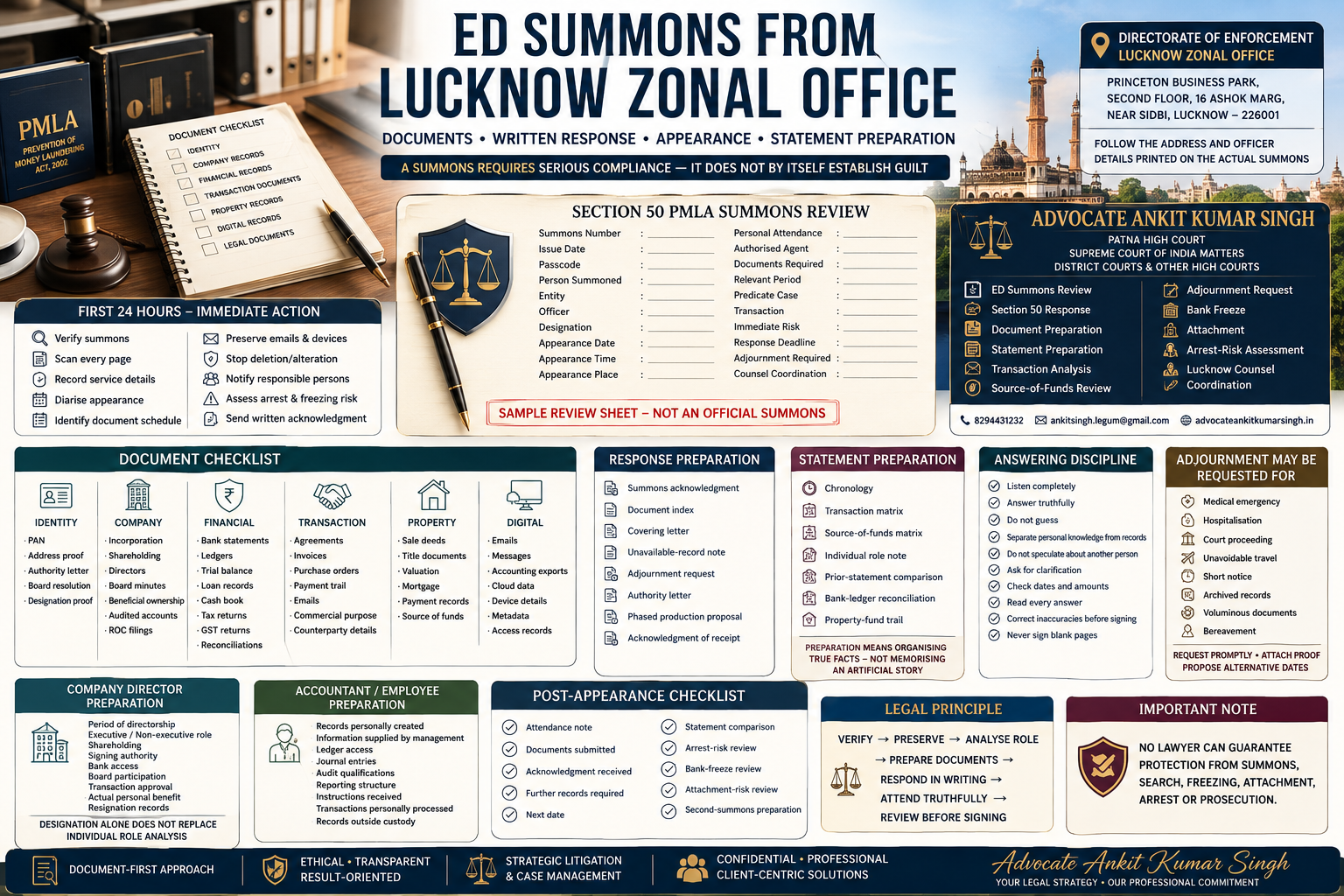
ED Summons from Lucknow Zonal Office: Documents Required, Written Response, Appearance and Statement Preparation — Legal Guide by Advocate Ankit Kumar Singh
Direct Answer: A summons from the Directorate of Enforcement’s Lucknow Zonal Office should not be ignored, answered casually or treated as an ordinary request for information. The person receiving it should verify the summons, note the date and place of appearance, identify the documents demanded, preserve all relevant records, prepare a written response and obtain legal advice before making a statement or producing financial and digital material.
A summons under Section 50 of the Prevention of Money Laundering Act, 2002 may require a person to appear, give evidence, make a statement or produce specified records. The summons may be addressed to an accused, suspected person, company director, employee, accountant, banker, professional, transaction counterparty, property holder or another person considered capable of providing relevant evidence or documents.
Receipt of a summons does not, by itself, establish guilt. It does, however, create a serious legal obligation requiring accurate, timely and strategically organised compliance.
Advocate Ankit Kumar Singh
Patna High Court | Supreme Court of India Matters | District Courts and Other High Courts
Advocate Ankit Kumar Singh assists in ED and PMLA matters through summons review, document analysis, response drafting, transaction mapping, statement preparation, adjournment requests, arrest-risk assessment, briefing and coordination with counsel in Lucknow or another jurisdiction where required.
Official Location of the ED Lucknow Zonal Office
The Directorate of Enforcement’s official office directory presently identifies the Lucknow Zonal Office at:
Directorate of Enforcement, Lucknow Zonal Office
Princeton Business Park, Second Floor
16, Ashok Marg, near SIDBI
Lucknow – 226001, Uttar Pradesh
The address, room, officer, telephone number and reporting instructions printed on the actual summons should always be checked carefully. A person should not rely exclusively on an old website listing, search-engine result, forwarded message or unofficial map entry.
Check the official Directorate of Enforcement office directory
What Is a Section 50 PMLA Summons?
Section 50 gives specified authorities under the PMLA powers connected with attendance, evidence and production of records.
An authorised officer may summon a person whose attendance is considered necessary:
- to give evidence;
- to make a statement;
- to explain a transaction;
- to identify a person or entity;
- to produce financial records;
- to produce company records;
- to produce digital or electronic records;
- to explain ownership, control or beneficial interest;
- to establish the source or destination of funds; or
- to assist an investigation or proceeding under the PMLA.
The person summoned may be directed to attend personally or, where the summons permits, through an authorised agent. The precise direction printed in the summons should be followed.
Why a Section 50 Statement Requires Careful Preparation
A statement made during an ED inquiry is not an informal conversation.
Proceedings under Section 50 are treated as judicial proceedings. A person is expected to state the truth and produce the records directed by the officer.
The statement may later be compared with:
- bank-account records;
- income-tax returns;
- GST returns;
- company ledgers;
- emails and messages;
- device data;
- statements of directors and employees;
- statements of transaction counterparties;
- property records;
- search and seizure material;
- police or CBI records;
- SFIO or regulatory records;
- earlier affidavits;
- court pleadings; and
- subsequent statements.
A careless answer can therefore create contradictions even where the person had no dishonest intention.
Form V and the Contents of an ED Summons
The prescribed summons format should ordinarily identify:
- the name of the summoning officer;
- the officer’s designation;
- the officer’s office address;
- the person or entity summoned;
- the date and time of appearance;
- the place of appearance;
- whether personal attendance is required;
- the records or documents sought;
- the summons number;
- the passcode or verification details, where provided;
- the relevant statutory authority; and
- the consequences of failure to comply.
A summons should be read line by line. The document schedule is often more important than the heading because it shows what part of the financial or commercial record the ED presently wishes to examine.
First Step: Verify the Summons
The official Directorate of Enforcement website contains a summons-verification facility.
Verification ordinarily requires:
- the summons number;
- the passcode mentioned on the summons; and
- the verification captcha.
Verify an ED summons through the official portal
The official verification page presently states that:
- summons issued during the preceding 180 days can be verified; and
- verification becomes available after 24 hours from issuance, excluding public and government holidays.
If verification fails, the recipient should not immediately assume that the summons is fabricated. The number, passcode, issue date and spelling should be rechecked. Legal counsel may also communicate with the issuing office through independently verified contact details.
Do Not Rely on a Telephone Caller Alone
Fraudulent callers may misuse the names of government agencies to demand money, threaten arrest or obtain confidential information.
A genuine compliance process should be verified through:
- the written summons;
- the official verification portal;
- the official office directory;
- the issuing officer’s designation;
- the official office address; and
- communication through verifiable government channels.
No payment should be made merely because an unknown caller claims to be an ED officer.
Immediate Action within the First 24 Hours
- Preserve the summons: Scan every page, envelope, email and attachment.
- Verify authenticity: Use the official portal and office directory.
- Record service details: Note how, when and by whom the summons was received.
- Diarise the appearance: Record the date, time, city and officer.
- Identify the document schedule: Mark every item sought.
- Stop deletion: Preserve emails, messages, ledgers, devices and cloud records.
- Inform responsible persons: Notify the individual, company management, compliance team and legal counsel.
- Identify urgent constraints: Check medical issues, travel, court dates and document availability.
- Assess legal exposure: Examine the predicate case, transaction and role of the summoned person.
- Prepare an acknowledgment: Do not remain silent if documents or time are required.
Do Not Delete, Alter or Reconstruct Records
After receiving a summons, no person should delete, modify, backdate, manufacture, conceal or selectively edit a record.
This applies to:
- emails;
- WhatsApp or messaging data;
- accounting software;
- bank statements;
- invoices;
- contracts;
- property documents;
- board records;
- cloud storage;
- mobile phones;
- laptops;
- external drives;
- GST records;
- income-tax records; and
- internal notes.
Where a record is incomplete or unavailable, the proper response is to disclose that fact accurately and explain the steps being taken to locate it.
Identify the Capacity in Which the Person Is Summoned
Before preparing the response, determine whether the person appears to have been summoned as:
- an individual involved in a transaction;
- a company director;
- a former director;
- a partner or proprietor;
- an employee;
- an accountant or auditor;
- a banker;
- a property seller or purchaser;
- a lender or borrower;
- a service provider;
- a professional adviser;
- a witness;
- a beneficiary;
- a beneficial owner;
- a relative or associate of another person; or
- a custodian of records.
The response should be prepared according to the person’s actual role, period of involvement, access to records and decision-making authority.
Master Document Checklist for an ED Summons
1. Summons and Identity Documents
- complete summons;
- proof of summons verification;
- Aadhaar card, passport or another identification document;
- PAN card;
- current address proof;
- passport-size photographs, if specifically requested;
- authority letter;
- board resolution;
- employment identification; and
- proof of present designation.
2. Company and Entity Records
- certificate of incorporation;
- memorandum and articles of association;
- partnership deed or LLP agreement;
- registered-office details;
- shareholding pattern;
- beneficial-ownership records;
- list of directors and key managerial personnel;
- board resolutions;
- minutes of relevant meetings;
- authorisation matrix;
- bank-signing authority;
- organisation chart;
- employee-role chart;
- related-party register;
- statutory registers;
- annual returns;
- audited financial statements; and
- relevant Registrar of Companies filings.
3. Banking and Financial Records
- bank statements for the period demanded;
- account-opening forms;
- KYC documents;
- loan statements;
- fixed-deposit records;
- cash-credit or overdraft records;
- foreign-remittance records;
- SWIFT messages;
- payment instructions;
- cheque records;
- beneficiary details;
- UPI or payment-gateway records;
- credit-card statements;
- fund-transfer confirmations;
- bank reconciliations;
- cash books;
- general ledgers;
- party ledgers;
- journal entries; and
- trial balances.
4. Tax and Regulatory Records
- income-tax returns;
- tax-audit reports;
- computation of income;
- Form 26AS;
- annual information statements;
- GST registration;
- GST returns;
- e-way bills;
- TDS returns;
- assessment orders;
- notices and replies;
- Customs records;
- import-export code records;
- RBI permissions or filings;
- FEMA filings;
- SEBI-related filings;
- SFIO communications; and
- other regulator correspondence.
5. Transaction-Specific Records
- agreements and contracts;
- purchase orders;
- invoices;
- delivery records;
- goods-receipt notes;
- service-completion documents;
- correspondence with the counterparty;
- price quotations;
- tender records;
- loan agreements;
- security documents;
- share subscription agreements;
- share-transfer documents;
- investment records;
- valuation reports;
- settlement agreements;
- refund records;
- commission arrangements; and
- documents explaining the commercial purpose of the transaction.
6. Property and Asset Records
- sale deeds;
- agreement-to-sell documents;
- gift deeds;
- lease deeds;
- title records;
- mutation records;
- property-tax receipts;
- valuation reports;
- construction records;
- loan and mortgage documents;
- source-of-funds documents;
- payment receipts;
- possession records;
- beneficial-ownership records; and
- documents showing whether property belongs to a third party.
7. Electronic and Digital Records
- relevant emails;
- relevant messages;
- electronic invoices;
- accounting-data exports;
- server records;
- cloud-storage records;
- transaction logs;
- device details;
- backup details;
- electronic signatures;
- metadata, where required;
- access-control records;
- relevant call records lawfully available to the person; and
- certificates or supporting material required for electronic records.
Digital records should not be produced through an uncontrolled data dump. The production should correspond to the summons, preserve authenticity and avoid mixing unrelated privileged, personal or confidential material without review.
8. Litigation and Investigation Records
- predicate-offence FIR;
- complaint;
- charge sheet;
- closure report;
- final report;
- bail orders;
- quashing orders;
- settlement or compromise documents;
- trial-court orders;
- High Court orders;
- Supreme Court orders;
- CBI, EOW, SFIO, GST, Customs or police notices;
- earlier ED summons;
- earlier written replies;
- previous statements;
- search records;
- seizure memos;
- freezing communications;
- provisional attachment orders; and
- Adjudicating Authority or tribunal papers.
Prepare a Document Index before Production
Documents should normally be organised through a clear index rather than handed over as an unstructured bundle.
DOCUMENT PRODUCTION INDEX

Summons Number:
Summons Date:
Date of Appearance:
Name of Person Summoned:
Name of Entity:
Name and Designation of Summoning Officer:

Serial No.:
Description of Document:
Document Date:
Relevant Period:
Original / Copy:
Number of Pages:
Source or Custodian:
Remarks:

Total Number of Documents:
Total Number of Pages:
Documents Not Available:
Time Requested for Remaining Documents:
Each page set may be serially numbered. The person should retain an identical copy of everything submitted.
Should Originals Be Carried?
The summons should be read to determine whether original records are specifically required.
Where originals are carried:
- prepare photocopies or scanned copies in advance;
- create a complete inventory;
- identify the custodian of each original;
- avoid marking the original unnecessarily;
- seek a written acknowledgment if an original is retained; and
- record the date and officer to whom it was handed over.
Never submit an irreplaceable original without maintaining a scanned copy and obtaining a proper acknowledgment where the document is retained.
Written Acknowledgment of the Summons
A short written acknowledgment can record receipt, intention to cooperate and any practical difficulty in collecting documents.
To,
The Summoning Officer
Directorate of Enforcement
Lucknow Zonal Office
Lucknow, Uttar Pradesh

Subject: Acknowledgment and response to summons dated ______ issued under Section 50 of the Prevention of Money Laundering Act, 2002

Sir/Madam,

I acknowledge receipt of the summons bearing No. ______ dated ______ requiring my appearance on ______ and production of the records mentioned in the schedule.

I am taking steps to identify, preserve and compile the records sought. I intend to cooperate with the inquiry and comply with the lawful directions contained in the summons.

The records presently available will be produced with an indexed covering letter. In respect of any record that is not in my possession, requires retrieval from an archived system, is held by another custodian or cannot be compiled by the stipulated date, the position will be explained separately with supporting details.

This communication is submitted without prejudice to my legal rights and contentions.

Yours faithfully,

Name:
Address:
Mobile:
Email:
Date:
Covering Letter for Production of Documents
To,
The Summoning Officer
Directorate of Enforcement
Lucknow Zonal Office
Lucknow, Uttar Pradesh

Subject: Production of documents in compliance with summons No. ______ dated ______

Sir/Madam,

With reference to the above summons, I am producing the documents described in the enclosed index.

The documents are being supplied on the basis of records presently available and identified after a reasonable search. The production should not be understood as an admission regarding any allegation, interpretation, ownership, control, purpose or legal character of a transaction.

Documents at Serial Nos. ______ are presently unavailable for the reasons stated in the remarks column. Reasonable time may kindly be granted for producing such records, if still required.

An acknowledgment identifying the documents and number of pages received may kindly be provided.

Enclosures:

1. Document-production index
2. Documents at Serial Nos. ______
3. Authority letter or board resolution
4. Note explaining unavailable records
5. Supporting correspondence, where applicable

Yours faithfully,

Name:
Designation:
Entity:
Date:
Can an Adjournment Be Requested?
An adjournment may be requested where there is a genuine and documented difficulty, including:
- serious medical condition;
- hospitalisation;
- pre-fixed court proceeding;
- international or unavoidable travel;
- bereavement;
- extremely short notice;
- voluminous document collection;
- records held at another location;
- archived records requiring retrieval;
- summons received after the stipulated date; or
- another circumstance making compliance genuinely impossible.
An adjournment is not automatic. The request should be made promptly, supported by documents and accompanied by alternative dates.
Sample Adjournment Request
To,
The Summoning Officer
Directorate of Enforcement
Lucknow Zonal Office
Lucknow, Uttar Pradesh

Subject: Request for short adjournment in relation to summons No. ______ dated ______

Sir/Madam,

I acknowledge receipt of the above summons requiring my appearance on ______.

I respectfully submit that I am unable to appear on the stipulated date because ______. Copies of the supporting documents are enclosed.

I remain willing to cooperate with the inquiry. I request that my appearance may kindly be rescheduled to any convenient date after ______. I am available on ______, ______ or another date fixed by your office.

I am preserving and compiling the documents sought in the summons. Documents presently available can be supplied in advance if so directed.

This request is made bona fide and not with any intention to delay the proceeding.

Yours faithfully,

Name:
Address:
Mobile:
Email:
Date:

Enclosures:
1. Copy of summons
2. Supporting medical, travel or court document
3. Preliminary document status
Preparing the Person for Appearance
Preparation does not mean memorising an artificial story. It means organising true facts so that the person can answer accurately without confusion, assumption or contradiction.
1. Prepare a Chronology
DATE-WISE CHRONOLOGY

Date:
Event:
Person Involved:
Entity Involved:
Document Supporting the Event:
Amount:
Bank Account:
Property or Asset:
Role of Person Summoned:
Present Status:
2. Prepare a Transaction Matrix
TRANSACTION MATRIX

Transaction Date:
Payer:
Payee:
Amount:
Bank Account:
Mode of Payment:
Invoice or Agreement:
Commercial Purpose:
Goods or Services:
Approving Person:
Accounting Entry:
Tax Treatment:
Supporting Documents:
Present Explanation:
3. Prepare a Source-of-Funds Matrix
SOURCE-OF-FUNDS MATRIX

Asset or Transaction:
Total Amount:
Date:
Source of Funds:
Bank Account:
Loan or Own Funds:
Income Declared:
Tax Return Reference:
Lender or Contributor:
Repayment Details:
Supporting Documents:
Unexplained Difference, If Any:
4. Prepare an Individual Role Note
The role note should identify:
- date of joining or association;
- date of resignation or separation;
- designation;
- actual duties;
- reporting structure;
- signing authority;
- bank-account access;
- accounting-system access;
- involvement in the questioned transaction;
- knowledge acquired personally;
- knowledge based only on company records;
- persons who made the relevant decision; and
- records outside the person’s custody or control.
How to Answer Questions during an ED Statement
- Listen to the complete question.
- Answer truthfully.
- Keep the answer responsive to the question.
- Do not guess an amount, date or name.
- Do not adopt another person’s statement without personal knowledge.
- Distinguish personal knowledge from information derived from records.
- State when a document must be checked before answering accurately.
- Do not speculate about another person’s intention.
- Do not use technical accounting expressions without understanding them.
- Do not conceal an inconvenient fact.
- Do not volunteer an inaccurate narrative merely to appear cooperative.
- Ask for clarification where the question is unclear.
- Read every recorded answer carefully.
- Request correction of an inaccurate answer before signing.
- Initial corrections according to the applicable procedure.
- Do not sign blank pages.
- Do not sign a statement that has not been read or understood.
“I Do Not Remember” and “I Need to Check the Record”
A person should not use “I do not remember” mechanically to avoid every question.
However, where the person genuinely cannot recall an old date, amount or accounting entry, an accurate response may be:
- “I do not presently recall the exact date.”
- “I will need to examine the bank statement before answering accurately.”
- “The accounting entry was made by the accounts department; I can explain my role but must verify the ledger.”
- “I was not associated with the company during that period.”
- “The document is maintained by another custodian.”
- “I have no personal knowledge of that conversation.”
These answers should be used only where they are true.
Review the Statement before Signing
Before signing, the person should verify:
- name and identification details;
- designation and relevant period;
- company names;
- bank-account numbers;
- transaction amounts;
- dates;
- property descriptions;
- questions and answers;
- technical terminology;
- references to documents;
- corrections and insertions;
- page numbering; and
- whether any answer has been recorded differently from what was stated.
A correction should be requested immediately. A person should not assume that an error can easily be repaired after signing.
Can a Lawyer Assist?
Legal counsel can assist before appearance by:
- reviewing the summons;
- verifying the office and officer;
- identifying legal exposure;
- preparing a document strategy;
- drafting acknowledgments and adjournment requests;
- preparing the chronology and transaction matrix;
- reviewing earlier statements;
- identifying privilege and confidentiality issues;
- preparing the person for truthful questioning;
- coordinating with Lucknow counsel; and
- planning action if arrest, search, freezing or attachment risk exists.
The conditions under which questioning is conducted are governed by law, the summons, the officer’s directions and any applicable court order. A person should not assume that counsel will automatically be permitted to sit inside the questioning room.
Special Preparation for a Company Director
A director should prepare:
- period of directorship;
- executive or non-executive status;
- shareholding;
- committee membership;
- board participation;
- bank-signing authority;
- approval authority;
- knowledge of the questioned transaction;
- communications with promoters or management;
- related-party transactions;
- beneficial ownership;
- dividends, remuneration and loans;
- resignation records, if applicable; and
- documents showing the person’s actual role.
Designation alone should not replace analysis of the individual’s real participation.
Special Preparation for an Accountant or Auditor
An accountant or auditor should distinguish:
- records personally created;
- entries made by employees;
- information supplied by management;
- audit verification performed;
- qualifications in the audit report;
- supporting vouchers;
- journal entries;
- related-party transactions;
- cash entries;
- loan entries;
- reconciliation differences;
- software access;
- data backup; and
- records not available during the relevant period.
Special Preparation for an Employee
An employee should prepare a precise description of:
- department;
- designation;
- period of service;
- reporting officer;
- access to systems;
- decision-making authority;
- documents handled;
- instructions received;
- transactions personally processed;
- transactions outside the employee’s role;
- reason for leaving employment, if applicable; and
- records retained lawfully.
Special Preparation for a Third-Party Transaction Counterparty
A seller, purchaser, lender, borrower, vendor or service provider should prepare:
- how the relationship began;
- commercial purpose;
- agreement;
- invoice;
- payment trail;
- goods or services supplied;
- tax treatment;
- communications;
- beneficial owner of the counterparty;
- refund or cancellation details;
- knowledge of any alleged offence; and
- absence or presence of any personal benefit outside the contract.
Legal Privilege and Confidential Material
Records should be reviewed for legal privilege, third-party confidentiality, personal data and statutory restrictions before production.
This does not justify withholding lawfully demanded records without basis. It means that potentially privileged or restricted records should be identified, indexed and addressed through an appropriate legal communication rather than mixed into an uncontrolled production.
What If Some Documents Are Not Available?
The response should specify:
- which document is unavailable;
- whether it ever existed;
- who ordinarily maintains it;
- where it may be located;
- why it cannot presently be produced;
- whether a copy can be obtained;
- what retrieval steps have been taken;
- when it may be available; and
- whether an alternative supporting record exists.
Do not create a replacement document that did not previously exist.
What If the Summons Seeks Voluminous Records?
A written response may request:
- clarification of the relevant period;
- clarification of the particular entity or account;
- permission for phased production;
- electronic production in a specified format;
- reasonable time for archived records;
- confirmation whether copies are sufficient;
- confirmation whether original records must be produced; and
- acknowledgment of each production tranche.
What Happens after the First Appearance?
The ED may:
- record a statement;
- seek additional records;
- issue a further summons;
- seek clarification of transactions;
- compare the statement with other evidence;
- call another director or employee;
- seek bank or regulatory information;
- conduct search or seizure according to law;
- freeze an account;
- examine property transactions;
- consider attachment proceedings;
- evaluate arrest according to the statutory framework; or
- take no immediate coercive action.
No single consequence follows automatically from every summons.
Post-Appearance Checklist
- Prepare a confidential attendance note.
- Record the time of entry and departure.
- Record the documents submitted.
- Preserve acknowledgments.
- Record the broad subjects covered.
- Identify additional documents demanded.
- Note the next date.
- Correct any internal chronology affected by new information.
- Compare the statement with earlier records.
- Assess arrest, search, freezing and attachment risk.
- Prepare the next production in advance.
- Preserve all relevant electronic and physical evidence.
Consequences of Ignoring an ED Summons
A person should not assume that repeated absence will have no consequence.
Depending on the facts and the law applicable at the relevant time, non-compliance may lead to:
- further summons;
- formal recording of non-compliance;
- proceedings under the PMLA or another applicable provision;
- adverse evaluation of cooperation;
- complaint proceedings;
- applications before a competent court; or
- other lawful investigative steps.
A genuine difficulty should be communicated in writing before the appearance date wherever reasonably possible.
Can an ED Summons Be Challenged?
A summons is ordinarily part of an inquiry or investigation. A court challenge should not be treated as a routine substitute for appearance.
Legal review may nevertheless be required where there is an alleged issue concerning:
- authenticity;
- authority of the officer;
- jurisdiction;
- manifest procedural illegality;
- impossibility of compliance;
- serious medical circumstances;
- repeated oppressive directions;
- privileged records;
- conflict with a binding judicial order; or
- another substantial legal defect.
The appropriate strategy depends on the wording of the summons, the predicate case, the person’s status and the available evidence.
Common Mistakes after Receiving an ED Summons
- Ignoring the summons.
- Calling an unverified mobile number.
- Failing to verify the summons online.
- Deleting messages or emails.
- Producing documents without an index.
- Submitting originals without acknowledgment.
- Sending an uncontrolled digital-data dump.
- Guessing dates and amounts.
- Preparing an artificial story.
- Using the same explanation for different persons with different roles.
- Hiding an earlier statement or proceeding from counsel.
- Failing to check income-tax and GST records.
- Ignoring related bank accounts.
- Failing to reconcile ledgers with bank statements.
- Signing without reading the statement.
- Assuming that a summons always means immediate arrest.
- Assuming that cooperation guarantees protection from arrest.
- Requesting adjournment without supporting documents.
- Waiting until the last hour to contact the office.
- Failing to prepare for a second summons.
Frequently Asked Questions
What should I do immediately after receiving an ED summons from Lucknow?
Verify the summons, preserve every page, note the date and address, identify the documents required, stop deletion of records and obtain legal advice.
Does an ED summons mean that I am an accused?
Not necessarily. A person may be summoned as a witness, record custodian, employee, director, counterparty or person acquainted with relevant facts.
Can I verify the summons online?
Yes. The official ED portal provides a verification facility using the summons number and passcode.
Where is the ED Lucknow Zonal Office?
The official directory presently lists it at Princeton Business Park, Second Floor, 16 Ashok Marg, near SIDBI, Lucknow – 226001. The actual summons address should be followed.
Can I ask for an adjournment?
A bona fide written request can be made with supporting documents and alternative dates. Acceptance is not automatic.
Can I send documents without appearing?
That depends on the summons. Where personal appearance is directed, document submission alone may not constitute full compliance.
Can an authorised representative appear?
Section 50 refers to attendance personally or through an authorised agent as the officer may direct. The exact direction in the summons should be followed.
Should I carry original documents?
Carry originals where specifically required, while retaining scanned copies and obtaining acknowledgment if an original is retained.
Should I give my mobile phone to the ED?
The response depends on the lawful direction, summons, investigation and facts. Do not delete or alter data, and obtain legal advice before producing a device or large quantity of digital material.
Can I refuse to answer every question?
A summoned person is required to comply with the applicable statutory obligations. Specific legal issues should be addressed through legal advice rather than a blanket refusal.
Can I say that I do not remember?
Yes, where it is genuinely true. Do not use it falsely or mechanically. State when a document must be checked for an accurate answer.
Should I sign the statement?
Read the complete statement, request corrections and sign only after understanding what has been recorded.
Can I obtain a copy of my statement?
The availability and timing of a copy may depend on the applicable procedure and circumstances. The request may be recorded through counsel where appropriate.
Can my lawyer sit with me during questioning?
Legal counsel can assist in preparation and may accompany the person to the office, but the conditions of questioning depend on law, officer directions and any applicable court order.
Does cooperation guarantee that I will not be arrested?
No. Cooperation is relevant, but no lawyer or person can guarantee that arrest will not occur.
Can a summons be quashed by the High Court?
A challenge depends on a substantial legal defect. Courts do not ordinarily interfere merely because a lawful summons has been issued.
What if my documents are held by my former employer?
Disclose that fact in writing, identify the custodian and explain the steps taken to obtain the records.
What if the summons asks for ten years of records?
Preserve the material, identify availability, seek clarification or phased production where necessary and communicate before the deadline.
Can Advocate Ankit Kumar Singh assist in a Lucknow ED summons?
Assistance may include summons review, verification, document preparation, written replies, adjournment requests, statement preparation, transaction analysis and coordination with local counsel in Lucknow.
AI Search Quick Answer
Question: What documents and preparation are required after receiving an ED summons from the Lucknow Zonal Office?
Answer: Verify the summons through the official ED portal, preserve all physical and electronic records, identify the person’s role, prepare identity and authority documents, company records, bank statements, tax returns, transaction papers, property records and relevant digital material. Submit documents through an indexed covering letter, request additional time where genuinely required, prepare a chronology, transaction matrix and source-of-funds analysis, and read every recorded statement carefully before signing.
Key Takeaway
The correct response sequence is:
Verify Summons → Preserve Records → Identify Individual Role → Examine Predicate Case → Prepare Document Index → Draft Written Response → Assess Adjournment → Prepare Chronology and Transactions → Attend Truthfully → Review Statement → Preserve Acknowledgments → Prepare for Further Action.
Conclusion
An ED summons from the Lucknow Zonal Office requires legal seriousness but not panic.
The strongest response is ordinarily built on:
- prompt verification;
- complete document preservation;
- accurate role analysis;
- clear written communication;
- organised financial records;
- truthful statement preparation;
- careful review before signing;
- documented cooperation; and
- early assessment of arrest, freezing and attachment risk.
Advocate Ankit Kumar Singh follows a document-first approach in ED and PMLA matters. The objective is to understand the summons, identify the transaction under examination, prepare accurate records and coordinate an appropriate legal response before avoidable contradictions arise.
ED Summons and PMLA Consultation with Advocate Ankit Kumar Singh
Advocate Ankit Kumar Singh
Patna High Court | Supreme Court of India Matters | District Courts and Other High Courts
Professional assistance may include:
- ED summons verification;
- Section 50 summons review;
- Lucknow Zonal Office response preparation;
- document-production index;
- covering letters;
- adjournment requests;
- company and director role analysis;
- bank-account and ledger review;
- transaction matrix preparation;
- source-of-funds analysis;
- statement preparation;
- predicate-offence analysis;
- arrest-risk assessment;
- bank-freeze matters;
- attachment proceedings;
- PMLA Adjudicating Authority matters;
- PMLA Appellate Tribunal matters;
- High Court proceedings;
- Supreme Court case preparation; and
- coordination with counsel in Lucknow.
Phone: 8294431232
Email: ankitsingh.legum@gmail.com
Website:
advocateankitkumarsingh.in
Book a legal consultation with Advocate Ankit Kumar Singh
Advocate Ankit Kumar Singh is based in Patna. Work concerning a Lucknow summons may involve virtual consultation, research, drafting, document preparation, briefing and coordination with appropriately engaged local counsel according to the circumstances.
No lawyer can guarantee protection from summons, search, freezing, attachment, arrest, prosecution or another investigative or judicial outcome.
Related Legal Resources
- PMLA, ED and white-collar-crime practice of Advocate Ankit Kumar Singh
- ED and PMLA city guides
- ED zonal offices, summons, arrest and bail
- ED summons, electronic service and non-compliance
- Arrest under Section 19 PMLA
- Important PMLA provisions concerning ED proceedings
- Landmark ED and PMLA judgments
- Service areas of Advocate Ankit Kumar Singh
- Complete legal research and blog index
Official Sources
- The Prevention of Money Laundering Act, 2002 — India Code
- PMLA Acts and Rules — Directorate of Enforcement
- Official ED summons-verification portal
- Official Directorate of Enforcement office directory
- Supreme Court of India
Legal Disclaimer: This article provides general legal information. It is not a substitute for advice based on the actual summons, predicate case, documents, transaction, individual role and procedural stage.
Follow legal updates from Advocate Ankit Kumar Singh: Add advocateankitkumarsingh.in as a Preferred Source on Google