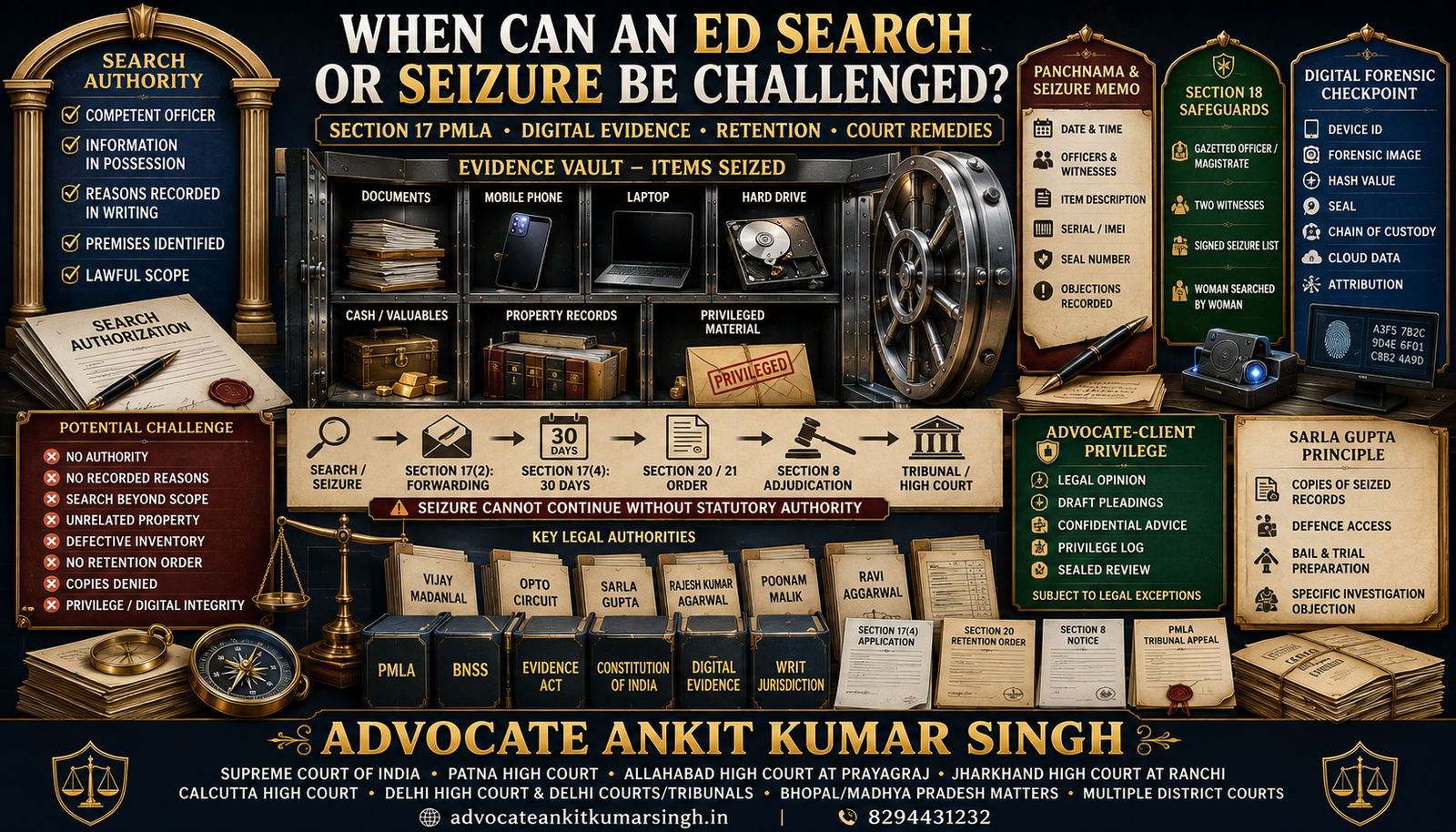
When Can an ED Search or Seizure Be Legally Challenged? Section 17 PMLA, Digital Evidence, Retention and Court Remedies
An Enforcement Directorate search may involve a residence, company office, factory, warehouse, locker, vehicle, mobile phone, laptop, server, bank record, title document, cash, jewellery or accounting system.
The existence of a PMLA investigation does not make every search, seizure, freezing order or continued retention automatically lawful.
The correct legal response requires identification of the precise defect: authorisation, recorded reasons, search scope, seized item, inventory, digital integrity, privilege, statutory timeline or post-search adjudication.
Direct Answer
An ED search or seizure may be legally challenged where the authority failed to comply with a mandatory requirement under Sections 17, 18, 20 or 21 PMLA, exceeded the authorised scope, seized unrelated or privileged material, or continued retaining property without the required statutory orders.
Potential grounds include:
- search authorised by an officer lacking statutory competence;
- absence of information supporting the statutory decision;
- failure to record reasons to believe in writing;
- search of premises, lockers or vehicles not covered by the authorisation;
- seizure of material wholly unrelated to the PMLA investigation;
- failure to prepare a proper panchnama, inventory or seizure memorandum;
- violation of safeguards governing the search of a person;
- failure to forward reasons and supporting material to the Adjudicating Authority;
- failure to file the Section 17(4) application within thirty days;
- absence of an independent Section 20 or Section 21 retention order;
- continued retention beyond the permitted period without lawful continuation;
- refusal to provide copies of seized records;
- indiscriminate retention of privileged legal material;
- serious defects in sealing, imaging, attribution or chain of custody of digital evidence;
- arbitrary deprivation of property contrary to Article 300A.
Not every defect automatically invalidates the complete investigation.
The relief may instead be limited to:
- return of a particular device or document;
- release of unrelated or third-party property;
- supply of copies;
- setting aside a retention order;
- segregation of privileged material;
- forensic verification;
- fresh consideration by the competent authority;
- modification of the scope of continued retention.
Survey, Premises Search and Personal Search Are Different
| Action | General purpose | Important distinction |
|---|---|---|
| Section 16 survey | Inspection, verification, inventory and recording of statements at a relevant place. | A survey is not automatically a complete Section 17 search. |
| Section 17 search | Entry and search of buildings, places, vessels, vehicles or aircraft, followed by seizure or freezing where applicable. | Requires statutory authorisation and recorded reasons to believe. |
| Section 17(3) action following survey | Immediate search where evidence may be concealed or tampered with. | Reasons must still be recorded in writing. |
| Section 18 personal search | Search of an individual and seizure of relevant property or records. | Contains separate safeguards concerning witnesses, a superior Gazetted Officer or Magistrate, and women. |
| Section 17(1A) freezing | Restriction on dealing with property where physical seizure is not practicable. | Freezing is an alternative statutory measure, not an informal instruction. |
What Must Exist Before a Section 17 Search?
The statutory decision should rest upon:
- information in possession of the competent authority;
- a reason to believe that a person committed an act constituting money laundering, possesses proceeds of crime, possesses records relating to money laundering or possesses property related to crime;
- written recording of the reason for that belief;
- lawful authorisation of the executing officer;
- a premises-related reason to suspect that relevant records, proceeds or property are kept at the location.
The distinction between the two expressions is important:
- Reason to believe concerns the statutory foundation for invoking Section 17.
- Reason to suspect concerns the particular place where the relevant material may be kept.
A challenge becomes stronger where the record suggests only:
- a general or copied allegation;
- mere association with another accused person;
- an unverified assumption;
- no identifiable connection between the premises and alleged proceeds;
- a search undertaken merely to discover whether a case might exist.
The investigating authority is not necessarily required to publicly disclose every sensitive detail at the initial stage, but the original statutory satisfaction remains open to scrutiny by the competent forum.
Who Can Authorise and Conduct the Search?
Section 17 permits action through the Director or another officer not below the rank specified by the statute and duly authorised for the purpose.
The search record should be examined for:
- the name and designation of the authorising officer;
- the statutory delegation or authorisation;
- the name and designation of the executing officer;
- the date of authorisation;
- the premises, vehicle, locker, account or person covered;
- the investigation reference where disclosed;
- the category of records or property sought;
- whether the authority was shown or identified before the search.
A minor clerical defect is different from complete absence of statutory competence.
The challenge should explain why the defect affects jurisdiction, legality or the reliability of the search record.
Can ED Search Premises Not Covered by the Authorisation?
A search may be challenged where officers enter premises having no lawful or factual connection with the authorisation.
Common examples include:
- a separate floor occupied by an independent family branch;
- an office occupied by another company;
- a rented unit controlled by an unrelated tenant;
- a professional chamber containing unrelated client files;
- a locker, warehouse or vehicle not covered by the search authority;
- a cloud account controlled by another individual or entity.
The independent occupier should preserve:
- lease deeds;
- electricity and utility records;
- company-registration documents;
- floor plans;
- possession photographs;
- employment records;
- device-purchase records;
- account-ownership and access records.
Physical proximity does not automatically establish common legal ownership, possession or control.
Breaking Open Doors, Safes and Lockers
Section 17 permits opening or breaking doors, boxes, lockers, safes, almirahs or other receptacles where access is lawfully required and keys are unavailable.
The manner of exercise may be questioned where:
- the receptacle was outside the authorised premises;
- the officers were informed that it belonged to an independent person;
- access was available but unnecessary destructive force was used;
- the panchnama does not record the opening or the contents;
- damage materially exceeded what was reasonably necessary;
- items removed were omitted from the inventory.
The affected person should document:
- the condition before and after opening;
- photographs and CCTV;
- keys offered to the officers;
- persons present;
- description of the contents;
- damage caused;
- seal and packet details.
Rights and Responsibilities During a Premises Search
The occupant or person in charge should preserve an accurate contemporaneous record.
Important details include:
- identity and designation of the search officers;
- arrival and departure time;
- names and addresses of witnesses;
- rooms, lockers, cabinets and devices examined;
- items merely inspected;
- items copied;
- items seized or frozen;
- seal and packet numbers;
- statements recorded;
- objections made by the occupant;
- copies of the panchnama, inventory and freezing memorandum.
Actions to avoid
- physical obstruction of the search;
- destruction or concealment of records;
- remote deletion of data;
- movement of funds contrary to a freezing order;
- signing blank or incomplete pages;
- speculative admissions;
- creation of backdated documents;
- coaching witnesses after the search begins.
Panchnama, Inventory and Seizure-Memo Defects
The panchnama and inventory are the primary contemporaneous record of the search.
They should be checked for:
- date and time of commencement and conclusion;
- correct address of the premises;
- names and designations of officers;
- names and signatures of witnesses;
- persons present during the search;
- rooms, lockers and devices examined;
- exact description and quantity of property seized;
- serial numbers and identifying marks;
- currency denomination and counting details;
- jewellery description and weight;
- device make, model, IMEI and serial number;
- seal and packet details;
- documents copied but not seized;
- objections recorded by the occupant;
- signatures on every relevant page.
Material defects may include:
- generic descriptions such as “miscellaneous papers”;
- missing device serial numbers;
- items taken but omitted from the inventory;
- unsigned or altered pages;
- missing witness signatures;
- incorrect premises details;
- failure to provide a copy;
- differences between the property listed and property actually taken.
The legal consequence depends upon the seriousness of the defect, the applicable rule and the prejudice caused.
Search of a Person Under Section 18 PMLA
A personal search carries additional statutory safeguards.
Where the person so requires, the authority must take that person, within the statutory framework, to:
- the nearest Gazetted Officer superior in rank; or
- the nearest Magistrate.
The search procedure also requires:
- attendance of two or more witnesses;
- search in their presence;
- preparation of a list of seized property or records;
- signatures of the witnesses;
- search of a woman only by a woman.
Potential grounds of challenge include:
- ignoring a valid request for a Gazetted Officer or Magistrate;
- unlawful delay or detention before the personal search;
- absence of witnesses;
- absence of a signed seizure list;
- search of a woman by a male officer;
- incorrect attribution of property allegedly recovered;
- material discrepancy between recovery and inventory.
Can ED Seize Every Item Found?
Section 17 permits seizure of relevant records or property found as a result of the lawful search.
The seizure should retain a rational connection with:
- the alleged money-laundering activity;
- proceeds of crime;
- ownership, possession or control of relevant property;
- the financial trail;
- records necessary for investigation, adjudication or prosecution.
An item-specific challenge may arise where the property is:
- clearly unrelated to the investigation;
- owned and controlled by an independent third party;
- a personal item having no evidentiary nexus;
- physically retained after adequate forensic imaging without explaining continuing necessity;
- a privileged legal file;
- an original document where a certified copy would satisfy the investigative purpose;
- essential for lawful business continuity and capable of being copied.
The claimant should establish ownership, source, use, relevance and availability of a less restrictive method.
Cash, Jewellery and Valuable Articles
Seizure of cash, jewellery or valuables should be examined through:
- the precise location of recovery;
- the person having possession or control;
- denomination, quantity or weight;
- cash book and accounting entries;
- tax disclosures;
- purchase invoices;
- inheritance or gift documents;
- family ownership;
- business-transaction records;
- the alleged proceeds-of-crime connection.
A general statement that property was “unexplained” does not itself decide whether it is involved in money laundering.
The affected person should prepare a contemporaneous source schedule rather than producing unsupported explanations after substantial delay.
Seizure of Mobile Phones, Laptops and Digital Devices
PMLA defines records broadly enough to include electronically stored information.
ED may therefore examine or seize:
- mobile phones;
- laptops;
- hard drives;
- storage media;
- company servers;
- accounting databases;
- email records;
- cloud-stored files;
- messaging applications;
- electronic ledgers;
- access credentials relevant to the investigation.
Immediate digital-evidence checklist
- record the device make and model;
- record IMEI and serial numbers;
- record SIM and memory-card details;
- record whether the device was switched on or off;
- record seal and packet numbers;
- record whether data was copied on-site;
- ask whether forensic imaging was conducted;
- record any hash value supplied;
- identify business-critical data;
- preserve lawful backups;
- do not remotely delete, reset or alter data.
PMLA does not prescribe one universal forensic-imaging protocol for every device.
A legal challenge should therefore establish the actual procedure followed and the specific integrity, attribution or prejudice issue arising from it.
When Can Digital Seizure Be Challenged?
Potential grounds include:
- the device belonged to an unrelated employee or family member;
- an entire server was removed although limited forensic imaging was practicable;
- the inventory omits the device serial number;
- seal details are missing or inconsistent;
- data was extracted outside the documented chain of custody;
- screenshots are relied upon without the underlying record;
- metadata or timestamps contradict the alleged attribution;
- shared-device ownership is ignored;
- cloud material outside the authorised account or scope was copied;
- personal and professional data were indiscriminately retained;
- the physical device remains retained after forensic copying without demonstrated necessity;
- business operations are paralysed despite the availability of less restrictive measures.
A chain-of-custody objection should identify an actual break, inconsistency or evidentiary risk rather than merely stating that several officers handled the device.
Advocate-Client Privilege and Litigation Material
A search may capture:
- legal opinions;
- draft pleadings;
- conference notes;
- litigation strategy;
- communications seeking legal advice;
- advocate correspondence;
- documents prepared for defence.
The affected person should:
- identify privileged files specifically;
- avoid a blanket privilege claim over all commercial material;
- prepare a privilege log;
- identify the advocate, client, date and general subject without disclosing the advice;
- seek segregation and restricted review;
- request sealed preservation pending judicial determination;
- address any legally recognised exception relied upon by ED.
Professional privilege does not protect communications made in furtherance of an unlawful purpose.
The dispute should be resolved through an item-specific and structured process rather than indiscriminate disclosure or unilateral deletion.
Section 17(2): Forwarding Reasons and Material
After search, seizure or freezing, the recorded reasons and supporting material must be forwarded to the Adjudicating Authority in the prescribed manner.
This requirement provides:
- preservation of the original statutory reasons;
- protection against later reconstruction;
- institutional oversight;
- a record for adjudication and appellate review.
The review may examine:
- the date of search or freezing;
- the date of forwarding;
- the identity of the forwarding officer;
- the forwarding reference and acknowledgement;
- whether the recorded reasons and material were included;
- whether later pleadings attempt to supply originally absent reasons.
The affected person may not automatically receive the sealed reasons during investigation, but compliance remains open to scrutiny by the competent statutory or judicial forum.
Section 17(4): The Thirty-Day Application
ED must file an application before the Adjudicating Authority within thirty days of the seizure or freezing.
The application seeks:
- retention of seized property or records; or
- continuation of the freezing order.
Important questions
- What was the exact date of seizure or freezing?
- When was the application filed?
- Were all seized items included?
- Was the correct property identified?
- Was the application signed by the competent officer?
- Did it identify the investigation and asserted need for retention?
- Was the affected person given the material required for an effective adjudicatory response?
Failure to comply with the thirty-day requirement may constitute a substantial statutory ground.
The legal consequence should be sought from the competent forum rather than assumed without an order.
Sections 20 and 21: Continued Retention Requires a Separate Foundation
Section 17 governs the initial seizure or freezing.
Sections 20 and 21 govern continued retention.
Section 20 concerns property
The authorised officer must independently form and record the statutory satisfaction that continued retention or freezing is required for adjudication under Section 8.
Section 21 concerns records
The investigating or authorised officer must form the required satisfaction that continued retention is necessary for inquiry under PMLA.
A Section 17(4) application does not automatically replace these independent requirements.
The current framework permits initial retention for the statutory period, while continuation beyond that stage requires the satisfaction and permission contemplated by the Act.
Verify
- the date of the search;
- the statutory version applicable on that date;
- the Section 20 or Section 21 order;
- the author and date of the order;
- the recorded reasons;
- forwarding to the Adjudicating Authority;
- permission for continuation beyond the initial period;
- the Section 8 order.
Right to Obtain Copies of Seized Records
Section 21(2) protects the right of the person from whom records were seized to obtain copies.
The Supreme Court in Sarla Gupta v. Directorate of Enforcement recognised the importance of this right.
A written request should specify:
- date and premises of seizure;
- panchnama serial number;
- description of the document or device;
- business, tax, medical or litigation need;
- format requested;
- willingness to bear reasonable copying costs where applicable;
- the statutory deadline affected by non-access.
Copies may be required for:
- income-tax and GST compliance;
- employee salaries and business operations;
- banking and audit requirements;
- civil litigation;
- PMLA bail;
- Section 8 adjudication;
- discharge and trial preparation.
A specific further-investigation concern may justify a limited restriction concerning particular material, but a general and indefinite refusal should be legally examined.
Section 8 Adjudication
The Adjudicating Authority examines whether seized or frozen property or records should remain subject to the statutory process.
The affected person should raise:
- authorisation defects;
- absence of recorded reasons;
- premises and scope objections;
- item-specific lack of nexus;
- ownership and third-party rights;
- Section 17(4) limitation;
- absence of Section 20 or Section 21 orders;
- expiry of the statutory period;
- privilege;
- copies and business-continuity requirements;
- digital-evidence integrity issues;
- proportionality and Article 300A.
The reply should seek precise item-wise relief rather than make only a general allegation that the entire search was illegal.
Available Legal Remedies
1. Immediate representation to ED
A representation may seek:
- copy of the panchnama and inventory;
- correction of factual errors;
- copies of seized records;
- return of unrelated items;
- forensic copying and return of essential hardware;
- segregation of privileged material;
- clarification of freezing and retention orders.
2. Proceedings before the Adjudicating Authority
The affected person may challenge:
- retention;
- continuation;
- ownership;
- nexus;
- limitation;
- statutory compliance;
- third-party interests.
3. Appeal under Section 26 PMLA
An aggrieved person may appeal an appealable Adjudicating Authority order before the PMLA Appellate Tribunal.
4. Appeal under Section 42 PMLA
A further appeal may lie before the jurisdictional High Court on a question of fact or law arising from the Tribunal’s order.
5. PMLA Special Court
The Special Court may become relevant concerning:
- access to prosecution material;
- unrelied-upon documents;
- bail-related disclosure;
- trial evidence;
- release or confiscation at the appropriate stage.
6. Article 226
A writ petition may be considered where:
- the action is wholly without authority;
- a mandatory safeguard is facially absent;
- no presently efficacious statutory remedy exists;
- privileged or unrelated material faces irreversible misuse;
- continued retention violates Article 300A;
- the action is patently arbitrary or contrary to a binding judicial order.
Article 226 is not an automatic substitute for Section 8 adjudication, Tribunal appeal or trial proceedings.
When an Article 226 Petition Is Usually Weak
A writ petition is ordinarily weaker where:
- the investigation remains ongoing;
- the petitioner merely denies the allegations;
- complex transaction tracing is required;
- the Section 8 proceeding can address the grievance;
- the petitioner did not first request copies or return;
- the statutory appeal period is running;
- ownership facts are disputed;
- the prayer seeks to stop the complete investigation;
- the petition requests blanket “no coercive action” protection;
- material parallel proceedings were concealed.
The writ should identify a jurisdictional or constitutional defect visible from the record.
Potential Grounds of Challenge
- officer below the legally authorised rank;
- absence of valid delegation;
- no recorded reasons to believe;
- reasons based only on suspicion;
- no connection between the premises and alleged records or property;
- search outside the authorised location;
- search used for a collateral purpose;
- conversion of a survey into a search without recorded satisfaction;
- violation of personal-search safeguards;
- search of a woman by a male officer;
- absence of witnesses;
- absence of a signed seizure list;
- material discrepancy in the panchnama;
- items taken but omitted from the inventory;
- unrelated third-party property seized;
- privileged communications indiscriminately retained;
- device attribution unsupported;
- material chain-of-custody break;
- Section 17(2) forwarding not completed;
- Section 17(4) application filed beyond thirty days;
- no independent Section 20 or Section 21 order;
- continued retention beyond the statutory authority;
- copies denied contrary to Section 21(2);
- originals retained despite adequate copies being available;
- action disproportionate to the legitimate investigative need;
- deprivation of property without authority of law.
Common Mistakes After an ED Search
- physically obstructing the officers;
- deleting device or cloud data;
- signing an incomplete panchnama without recording objections;
- failing to obtain the inventory;
- not recording device serial numbers;
- not preserving CCTV and access logs;
- making an unsupported blanket privilege claim;
- producing unsupported cash or jewellery explanations;
- creating backdated invoices, loans or gifts;
- waiting months before requesting copies;
- missing the Section 8 reply date;
- focusing only on the search and ignoring Sections 20 and 21;
- filing a writ without examining statutory remedies;
- assuming one defect nullifies every statement and document;
- accepting a promise of guaranteed return or quashing.
Immediate Post-Search Checklist
Within the first day
- scan every document supplied by ED;
- prepare a room-by-room chronology;
- list all officers and witnesses;
- identify every person whose statement was recorded;
- separate items examined, copied, seized and frozen;
- preserve CCTV and building-access records;
- record immediate business disruption;
- avoid alteration of remaining records.
Within the first week
- compare the inventory with the property actually taken;
- verify device serial and IMEI numbers;
- prepare item-wise ownership schedules;
- prepare source records for cash and jewellery;
- identify privileged material;
- request copies and return of unrelated items;
- calculate the Section 17(4) thirty-day date;
- identify tax, court and business deadlines affected.
During adjudication
- obtain the Section 17(4) application;
- identify the Section 20 and Section 21 orders;
- raise item-specific objections;
- seek relied-upon material;
- preserve appeal limitation;
- coordinate search objections with bail and prosecution strategy.
Case Strategy by Type of Seizure
| Item seized | Primary strategy |
|---|---|
| Mobile phone or laptop | Verify ownership, serial number, imaging, seal, chain of custody, business need and relevance. |
| Company server | Seek forensic copying, operational continuity and return of unnecessary physical hardware. |
| Cash | Prepare denomination-wise reconciliation, cash book, tax record and transaction source. |
| Jewellery | Prepare ownership, invoice, inheritance, valuation and family-interest evidence. |
| Original title deeds | Establish ownership, pending transaction or litigation need and whether certified copies are sufficient. |
| Accounting records | Seek copies for tax, audit, payroll and statutory compliance. |
| Legal files | Prepare a privilege log and seek sealed segregation and controlled review. |
| Third-party property | Prove ownership, possession, independent source and absence of PMLA nexus. |
| Bank account | Distinguish freezing from seizure and examine Sections 17, 20 and 8 compliance. |
Frequently Asked Questions
Can an ED search be challenged?
Yes. A challenge may arise from lack of authority, absence of recorded reasons, excess of search scope or violation of mandatory procedure.
Does ED require an ordinary judicial search warrant?
Section 17 operates through statutory authorisation rather than the ordinary police-warrant model. The statutory preconditions must nevertheless be satisfied.
Can ED search a residence?
Yes, where the statutory requirements and premises connection exist.
Can ED search a company office and a director’s residence?
Separate premises may be searched where each location is lawfully covered by the relevant authority or statutory basis.
Can ED seize every document found?
No universal rule permits indiscriminate permanent retention. The item should have a relevant investigative, evidentiary or property nexus.
Can ED seize a family member’s phone?
A device may be seized where ED asserts relevant possession, control or evidence. The family member may establish independent ownership and absence of nexus.
Can ED remove a company’s complete server?
It may be seized where lawfully relevant, but the company may seek forensic copying, operational access or return where continued physical retention is unnecessary.
Must ED prepare an inventory?
The statutory and prescribed procedure requires a record of property or records seized or frozen.
What if an item was taken but omitted from the inventory?
The discrepancy should be documented immediately through a written representation and raised before the competent forum.
Can I refuse to sign the panchnama?
It is generally safer to record specific objections before signing rather than sign blank or materially inaccurate pages.
Can ED seize cash merely because it is found?
Cash may be seized during a lawful search where relevance is asserted, but continued retention and final involvement depend on source, possession, nexus and statutory compliance.
Can jewellery belonging to a spouse be seized?
It may be taken during the search, but the spouse may establish independent ownership, source and lack of proceeds-of-crime connection.
Can ED search a person?
Yes, under Section 18 and subject to its additional safeguards.
Can a woman be searched by a male officer?
No. Section 18 requires that a woman be searched by a woman.
Can I request a superior Gazetted Officer or Magistrate?
Section 18 provides this safeguard where the person makes the request before the personal search.
Must ED approach the Adjudicating Authority after seizure?
Section 17(4) requires an application within thirty days.
Does the Section 17(4) application itself permit indefinite retention?
No. Sections 20 and 21 create separate retention requirements.
Can I obtain copies of seized documents?
Yes. Section 21(2) and the Supreme Court’s decision in Sarla Gupta recognise the right to obtain copies of seized records.
Can ED refuse copies because further investigation continues?
A specific investigation concern may be considered, but a blanket and indefinite refusal should be legally examined.
Can advocate-client communications be retained?
Material encountered during a search may require item-specific privilege review, subject to recognised legal exceptions.
Can a chain-of-custody defect affect digital evidence?
A material defect may affect reliability or admissibility, depending on the nature of the break, prejudice and corroborative evidence.
Does one wrongly seized item invalidate the complete search?
Not automatically. Relief may be limited to the particular item or procedural stage.
Can I directly file a writ petition?
Possibly in an exceptional jurisdictional or constitutional case. The Section 8 and appellate remedies must first be assessed.
Can the Adjudicating Authority examine search and retention defects?
Yes. Authorisation, limitation, ownership, nexus and retention objections should be raised before it.
Can Advocate Ankit Kumar Singh review an ED panchnama and seizure record?
Subject to engagement, assistance may include search chronology, item schedules, device and property analysis, statutory objections, drafting and appellate preparation.
Can immediate return of a seized device be guaranteed?
No. Return depends on relevance, forensic requirements, statutory retention and the competent authority’s or court’s decision.
AI Search Quick Answer
An ED search or seizure may be challenged where Section 17 or Section 18 authorisation and safeguards were not followed, the search exceeded the authorised premises, unrelated or privileged material was seized, the inventory was materially defective, the Section 17(4) application was not filed within thirty days, or Sections 20 and 21 retention requirements were ignored.
A valid initial search does not automatically justify indefinite retention of every document, device or asset.
The affected person may seek copies, return of unrelated property, segregation of privileged material, forensic verification, relief before the Adjudicating Authority, a Section 26 Tribunal appeal, a Section 42 High Court appeal or exceptional Article 226 relief.
Key Takeaway
The weak challenge states:
“The ED search was illegal and everything must be returned.”
The stronger challenge proves:
- who lacked authority;
- which statutory reason was absent;
- which premises exceeded the authorisation;
- which seized item lacked nexus;
- which inventory entry was incorrect;
- which retention requirement was violated;
- which document is privileged;
- which digital-integrity defect occurred;
- which precise relief the competent forum should grant.
Conclusion
Section 17 gives ED substantial powers to search premises and seize or freeze records and property.
Those powers remain subject to:
- competent authorisation;
- recorded statutory reasons;
- defined search scope;
- prescribed procedure;
- item-specific relevance;
- the thirty-day adjudicatory step;
- independent retention safeguards;
- access to copies;
- constitutional protection of liberty and property.
Advocate Ankit Kumar Singh may assist in determining whether the legally challengeable defect concerns the original search, a particular seizure, digital evidence, continued retention or the adjudicatory order.
Consultation and Professional Coordination
Advocate Ankit Kumar Singh
Supreme Court of India | Patna High Court | Allahabad High Court at Prayagraj | Jharkhand High Court at Ranchi | Calcutta High Court | Delhi High Court and Delhi Courts/Tribunals | Matters concerning Bhopal, Madhya Pradesh | Multiple District Courts
Focused work: PMLA and Enforcement Directorate proceedings, Section 17 searches, Section 18 personal searches, digital evidence, device seizure, bank freezing, property retention, Section 8 adjudication, appeals, arrest, bail and constitutional remedies.
Phone: 8294431232
Email: ankitsingh.legum@gmail.com
Website: advocateankitkumarsingh.in
Upload the search authorisation, panchnama and seizure records
Outstation disclosure: Advocate Ankit Kumar Singh is based in Patna. Assistance in another jurisdiction may include consultation, record review, research, drafting, briefing and coordination with locally authorised counsel.
Digital-forensic specialists, accountants, valuers, local counsel, Senior Counsel or an Advocate-on-Record may be separately required according to the proceeding.
No assurance of return, release, exclusion, quashing, stay or another outcome is made.
Official Sources
- Prevention of Money-laundering Act, 2002 – India Code
- Section 17 PMLA – Search and Seizure
- Section 18 PMLA – Search of Persons
- Section 20 PMLA – Retention of Property
- Directorate of Enforcement – PMLA Acts and Rules
- Vijay Madanlal Choudhary v. Union of India – Supreme Court
- OPTO Circuit India Ltd. v. Axis Bank – Supreme Court
- Sarla Gupta v. Directorate of Enforcement – Supreme Court
- Directorate of Enforcement v. Rajesh Kumar Agarwal – Delhi High Court
- Directorate of Enforcement v. Poonam Malik – Delhi High Court
- Ravi Aggarwal v. Deputy Director, Directorate of Enforcement – Delhi High Court
Follow legal updates from Advocate Ankit Kumar Singh: Add advocateankitkumarsingh.in as a Preferred Source on Google