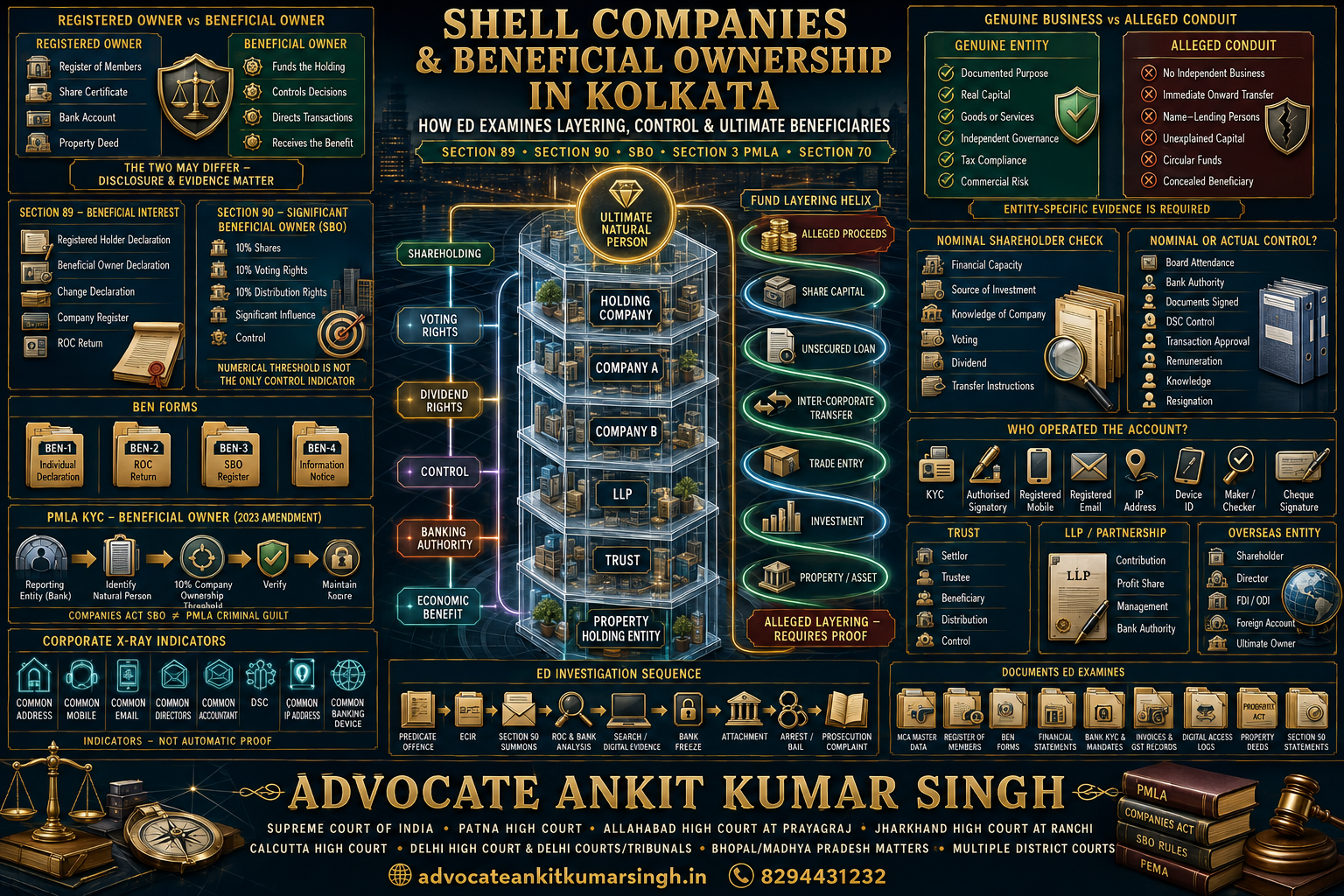
Shell Companies and Beneficial Ownership in Kolkata PMLA Investigations: How ED Examines Layering, Control and Ultimate Beneficiaries
The Directorate of Enforcement may describe a company, LLP, trust or other entity as a shell, conduit or layering vehicle where it alleges that the entity was used to obscure the origin, ownership, control or destination of proceeds of crime.
The label is serious, but it does not by itself establish guilt.
The legal questions remain whether identifiable proceeds of crime existed, whether the entity dealt with those proceeds and whether the company or natural person knowingly participated in a process covered by Section 3 PMLA.
Direct Answer
ED generally examines beneficial ownership by looking beyond the name appearing in the company register, share certificate, bank account or property deed and identifying the natural person who funded the entity, controlled decisions, operated accounts, appointed directors, directed transactions or ultimately enjoyed the economic benefit.
A Kolkata layering investigation may combine:
- MCA and ROC filings;
- Sections 89 and 90 declarations;
- SBO forms;
- shareholder source-of-funds records;
- bank KYC and mandates;
- internet-banking access;
- emails and digital signatures;
- accounting ledgers;
- GST and trade records;
- property-acquisition documents;
- statements under Section 50.
However:
A company is not guilty merely because it has a common address, few employees, low turnover, related-party transactions or a complex ownership structure.
Is “Shell Company” a Defined PMLA Offence?
No standalone offence titled “operating a shell company” appears in the PMLA.
The Companies Act also does not treat every low-activity, dormant, investment or asset-holding entity as criminal.
The expression is generally used descriptively where an entity is alleged to have:
- no independent commercial substance;
- nominal shareholders or directors;
- undisclosed control;
- unexplained capital;
- accommodation transactions;
- circular banking entries;
- assets held for another person;
- a role in concealing alleged proceeds.
The prosecution must still prove the applicable statutory ingredients.
Dormant Company, SPV and Shell Entity Are Different
| Entity Description | Possible Lawful Purpose | Potential Investigative Question |
|---|---|---|
| Dormant company | Future project, inactive asset or intellectual-property holding. | Why does it hold or transfer substantial funds? |
| Special-purpose vehicle | Project finance, joint venture, securitisation or asset ring-fencing. | Does the entity have a genuine project and independent records? |
| Investment company | Holding shares, securities or group investments. | What is the source and beneficiary of its capital? |
| Alleged shell or conduit entity | No automatic lawful or unlawful conclusion. | Was it used to conceal, route or integrate alleged proceeds? |
What Is Layering Under PMLA?
Layering generally refers to movement of alleged proceeds through multiple transactions, accounts or entities in a manner said to make the source, ownership, controller or destination harder to identify.
A common allegation may appear as:
Person or entity receiving disputed property → first company → several related entities → loans, invoices, share capital or investments → purchase of property or another asset.
Layering is not an independent statutory offence.
The alleged conduct must support:
- concealment;
- possession;
- acquisition;
- use;
- projection as untainted;
- claiming as untainted;
- attempt;
- knowing assistance;
- knowing participation.
Registered Owner and Beneficial Owner
| Registered Ownership | Beneficial Ownership |
|---|---|
| Name appears in the company register or depository record. | Person may ultimately own, control or benefit from the holding. |
| Name appears in the bank account. | Another person may supply funds or operate the account. |
| Name appears in the property deed. | Another person may fund, possess or enjoy the property. |
| Name appears as director. | Another person may exercise actual corporate control. |
Registered and beneficial ownership may lawfully differ where the arrangement is genuine and properly disclosed.
Section 89 Companies Act
Section 89 addresses cases where the registered shareholder and person holding the beneficial interest are different.
The statutory framework requires:
- declaration by the registered holder;
- declaration by the beneficial owner;
- declaration of changes;
- recording by the company;
- filing of the prescribed return with the Registrar.
ED may examine:
- whether declarations were made;
- whether the declared person supplied the funds;
- whether voting and distributions followed the declaration;
- whether an undeclared arrangement existed.
Section 90 and Significant Beneficial Ownership
Section 90 and the Significant Beneficial Owners Rules seek identification of the individual who ultimately holds the prescribed interest or exercises significant influence or control.
The SBO Rules generally cover an individual who, acting alone, together or through another person or trust:
- indirectly or together with direct holdings holds at least 10% of shares;
- holds at least 10% of voting rights;
- has at least 10% entitlement to distributable dividend or another distribution;
- exercises significant influence or control through means other than direct holdings alone.
The precise statutory application depends upon the ownership chain and exemptions.
BEN-1, BEN-2, BEN-3 and BEN-4
| Form | Purpose |
|---|---|
| BEN-1 | Declaration by the individual significant beneficial owner. |
| BEN-2 | Return filed by the reporting company with the Registrar. |
| BEN-3 | Register of significant beneficial owners maintained by the company. |
| BEN-4 | Notice seeking information where the company reasonably suspects an undisclosed SBO. |
Obtain:
- all historical BEN filings;
- acknowledgments and SRNs;
- supporting ownership charts;
- notices and replies;
- Board records concerning identification of the SBO.
Companies Act SBO and PMLA KYC Beneficial Ownership Are Different
The two regimes have different purposes.
Companies Act regime
- corporate ownership transparency;
- identification of significant beneficial owners;
- company and ROC filings;
- rights, influence and control.
PMLA KYC regime
- customer due diligence by reporting entities;
- verification of the natural person behind the client;
- transaction monitoring;
- record maintenance and reporting.
The 10% KYC threshold does not itself prove money laundering.
Can ED Investigate a Person Holding Less Than 10%?
Yes, where other evidence allegedly shows actual control or economic benefit.
Relevant evidence may include:
- shareholders acting together;
- voting agreement;
- power to appoint directors;
- funding of nominal shareholders;
- control of bank accounts;
- instructions to directors;
- beneficial receipt of property;
- control through relatives, trusts or group entities.
A statutory disclosure threshold is not an evidentiary ceiling for investigating actual control.
Equally, crossing the threshold does not establish criminal guilt.
How ED Constructs the Corporate Ownership Tree
The first stage is generally reconstruction of the legal ownership chain.
Documents may include:
- certificate of incorporation;
- memorandum and articles;
- company master data;
- annual returns;
- financial statements;
- register of members;
- share certificates;
- share allotment and transfer records;
- Sections 89 and 90 declarations;
- BEN forms;
- director appointment and resignation forms;
- charge records;
- LLP and partnership records;
- trust and foreign-company documents.
Ownership-Chain Matrix
| Entity | Registered Shareholder | Indirect Owner | Voting Controller | Economic Beneficiary | Supporting Record |
|---|---|---|---|---|---|
| Company A | ________ | ________ | ________ | ________ | ________ |
| Company B | ________ | ________ | ________ | ________ | ________ |
Common Address and Infrastructure
ED may examine whether multiple entities use the same:
- registered office;
- correspondence address;
- telephone number;
- email address;
- domain;
- accountant;
- auditor;
- company secretary;
- employees;
- computers;
- accounting server;
- digital-signature operator.
Common infrastructure may arise lawfully within a group, co-working facility or professional office.
The issue is whether the entities had genuine independent governance and business activity.
Name-Lending or Nominal Shareholders
ED may examine whether the shareholder:
- had financial capacity;
- funded the investment;
- understood the company;
- attended meetings;
- received dividends;
- controlled the shares;
- signed blank transfer papers;
- acted upon another person’s directions;
- later transferred the shares to the alleged controller.
The defence should obtain:
- income records;
- bank trail;
- investment decision documents;
- shareholder correspondence;
- meeting and voting records;
- dividend records.
Dummy or Nominal Directors
A director’s role should be tested through:
- appointment date;
- professional background;
- Board attendance;
- committee role;
- documents signed;
- bank authority;
- digital-signature use;
- financial-statement approval;
- transaction knowledge;
- remuneration;
- resignation.
A person may have been knowingly involved, negligent, deceived or completely nominal.
The prosecution must establish the applicable person-specific route.
Bank Account and Digital Control
ED may compare corporate filings with bank-operation evidence.
| Control Indicator | Possible Record |
|---|---|
| Authorised signatory | Account-opening form and mandate. |
| Online banking | User ID, IP address, device and access logs. |
| Registered mobile | KYC and OTP records. |
| Payment approval | Maker-checker logs and instructions. |
| Cheque operation | Cheque image and signature record. |
| Branch direction | Email, letter or recorded instruction. |
Digital Signature and MCA Filing Control
Relevant questions include:
- Whose digital signature was used?
- Who physically controlled the token?
- Who prepared the filing?
- Who supplied the underlying information?
- From which device or IP was it uploaded?
- Did the signatory review the form?
- Was the certification qualified?
A digital signature proves use of a credential, but surrounding evidence remains relevant to authorship, knowledge and control.
Share Capital and Share Premium
For every subscription, prepare:
| Subscriber | Amount | Source | Financial Capacity | Valuation | Subsequent Movement |
|---|---|---|---|---|---|
| ________ | ________ | ________ | ________ | ________ | ________ |
Examine:
- bank statements;
- income-tax records;
- valuation reports;
- Board approval;
- allotment forms;
- commercial rationale;
- later transfer or repayment;
- connection with alleged cash or proceeds.
Unsecured Loans and Inter-Corporate Deposits
A genuine loan should ordinarily be supported by:
- agreement;
- authority;
- lender capacity;
- bank trail;
- interest terms;
- repayment schedule;
- accounting treatment;
- tax disclosure;
- actual repayment.
ED may allege layering where funds:
- remain briefly in each entity;
- move onward immediately;
- originate from a common source;
- return circularly;
- have no genuine commercial purpose;
- finally purchase an asset for the alleged controller.
Circular Fund Movement
A transaction map should identify:
| Date | Transferor | Recipient | Amount | Stated Purpose | Onward Transfer |
|---|---|---|---|---|---|
| ________ | ________ | ________ | ________ | ________ | ________ |
For each layer, determine:
- opening balance;
- source;
- retention period;
- invoice or agreement;
- tax treatment;
- ultimate destination;
- commercial explanation.
Accommodation-Entry Allegations
ED may allege that cash or disputed value was converted into a banking entry represented as:
- share capital;
- share premium;
- unsecured loan;
- sale proceeds;
- consultancy income;
- investment;
- gift;
- property consideration.
The prosecution should identify:
- the original value;
- entry provider;
- bank route;
- commission;
- beneficiary;
- knowledge;
- connection with the scheduled offence.
Invoices, GST and Trade Records
For goods, compare:
- purchase order;
- invoice;
- GST return;
- e-way bill;
- transport document;
- weighbridge record;
- warehouse entry;
- stock register;
- delivery acknowledgment;
- bank payment.
For services, examine:
- engagement letter;
- scope of work;
- deliverables;
- emails;
- employees;
- time records;
- tax deduction;
- market pricing.
Trusts, LLPs and Partnerships
Trusts
- settlor or author;
- trustees;
- beneficiaries;
- protector;
- contributors;
- distribution rights;
- revocation powers;
- bank control.
LLPs and partnerships
- partners and designated partners;
- capital contribution;
- profit share;
- management rights;
- bank authority;
- amendments;
- beneficial contributor.
Overseas Companies and Remittances
Cross-border investigations may examine:
- foreign incorporation documents;
- shareholders and directors;
- ultimate natural person;
- FDI and ODI filings;
- ECB and trade credit;
- export-import records;
- foreign bank statements;
- tax residency;
- transfer pricing;
- trust or foundation records;
- foreign property acquisition.
A FEMA issue is not automatically a PMLA offence.
A scheduled criminal foundation and proceeds-of-crime connection remain necessary.
Integration into Property and Investments
ED may allege that layered funds were integrated into:
- land;
- flats;
- commercial buildings;
- hotels;
- factories;
- securities;
- private-company shares;
- jewellery;
- business investments;
- overseas assets.
Prepare a property matrix:
| Asset | Registered Owner | Acquisition Date | Source | Possession or Enjoyment | ED Allegation |
|---|---|---|---|---|---|
| ________ | ________ | ________ | ________ | ________ | ________ |
Section 23: Interconnected Transactions
Section 23 permits a presumption concerning interconnected transactions where one or more transactions are proved to be involved in money laundering, unless the contrary is established before the competent forum.
A rebuttal may show:
- independent funding;
- separate commercial purpose;
- genuine goods or services;
- unrelated ownership;
- market-consistent terms;
- lawful tax treatment;
- absence of circularity;
- no ultimate benefit to the alleged controller.
Section 24: Burden of Proof
The statutory burden framework makes documentary preparation essential.
A bare statement that:
“The company is genuine.”
is usually insufficient.
The defence should demonstrate:
- lawful capital;
- genuine ownership;
- commercial purpose;
- actual operations;
- independent decision-making;
- goods or services;
- tax compliance;
- absence of proceeds nexus;
- absence of knowledge.
Company, Promoter and Beneficial-Owner Liability
The company may be accused where it allegedly received, held, transferred or used proceeds of crime.
A promoter or beneficial owner may face allegations where evidence is said to establish:
- creation of the entities;
- funding of nominal shareholders;
- appointment of dummy directors;
- bank-account control;
- transaction instructions;
- beneficial enjoyment;
- purchase of assets;
- concealment of ownership.
The prosecution must identify the person-specific Section 3 activity.
Director and Shareholder Liability
Neither directorship nor shareholding automatically establishes guilt.
Review:
- relevant period;
- executive responsibility;
- bank authority;
- documents signed;
- voting and approval;
- knowledge;
- consent or connivance;
- neglect;
- due diligence;
- personal benefit.
Former, independent and nominee directors should be analysed separately.
Accountants, Auditors and Company Secretaries
Professional advisers may be questioned about:
- company incorporation;
- MCA filings;
- financial statements;
- share allotments;
- valuation;
- invoices;
- accounting entries;
- SBO compliance;
- bank documentation.
Potential defence evidence includes:
- engagement terms;
- client instructions;
- verification performed;
- qualifications or reservations;
- professional standards followed;
- absence of bank control;
- absence of benefit;
- withdrawal after discovering irregularity.
Section 50 Summons Preparation
A company, promoter, shareholder, director or professional summoned in Kolkata should organise:
- Complete corporate structure.
- MCA and ROC filings.
- Sections 89 and 90 records.
- BEN forms.
- Shareholder source documents.
- Bank mandates and KYC.
- Related-party ledgers.
- Invoices and commercial records.
- GST and transport evidence.
- Digital-access details.
- Property-acquisition documents.
- Person-specific role chronology.
Search, Seizure and Digital Evidence
ED may search or examine:
- phones;
- laptops;
- emails;
- messages;
- digital signatures;
- MCA credentials;
- internet banking;
- accounting software;
- spreadsheets;
- cloud storage;
- ownership charts;
- scanned agreements.
The defence should distinguish:
- device owner;
- device user;
- account user;
- document author;
- person approving the transaction;
- person receiving the benefit.
Bank Freezing and Attachment
For bank freezing, identify:
- account holder;
- beneficial controller;
- alleged proceeds credits;
- lawful balance;
- onward movement;
- business and statutory-payment requirements.
For property attachment, identify:
- registered title;
- beneficial-ownership allegation;
- purchase date;
- source;
- mortgage;
- possession;
- enjoyment;
- property-wise proceeds nexus.
Arrest and Section 45 Bail
Relevant issues may include:
- actual corporate control;
- bank authority;
- personal benefit;
- knowledge of alleged proceeds;
- use of nominal persons;
- document destruction;
- cooperation;
- transaction documentation;
- custodial necessity;
- role of similarly situated persons;
- Section 45 twin conditions.
Prosecution Complaint and Relied-Upon Documents
The complaint and RUDs should be checked for:
- complete ownership chart;
- source of alleged proceeds;
- transaction-wise layering chart;
- bank statements;
- company filings;
- Section 50 statements;
- digital evidence;
- property documents;
- individual knowledge and role;
- documents contradicting the alleged shell-company theory.
An ownership chart prepared by ED is an allegation that must be tested against the underlying documents.
Current Kolkata Illustrations
Recent Kolkata Zonal Office releases have alleged corporate networks involving:
- companies, firms and LLPs nominally held through employees, relatives, associates or dummy directors;
- accommodation entries;
- unsecured loans;
- inter-corporate transactions;
- fictitious trade transactions;
- book adjustments;
- circular fund movement;
- domestic and overseas conduit entities;
- trusts and related-party structures;
- integration into immovable property and investments.
These descriptions represent ED’s allegations in ongoing or prosecuted matters.
They should not be treated as findings against another company or person without independent evidence.
Kolkata Authorities and Court Terminology
The official Directorate directory presently identifies:
- Directorate of Enforcement — Kolkata Zonal Office I;
- Directorate of Enforcement — Kolkata Zonal Office II.
Both are presently listed at the CGO Complex, Salt Lake, Kolkata, subject to current official verification.
The actual office should be verified from the summons, ECIR, search record, arrest document, attachment order or prosecution complaint.
The formal High Court name is:
Calcutta High Court
or:
High Court at Calcutta.
Complete Corporate Document Checklist
Ownership and governance
- certificate of incorporation;
- memorandum and articles;
- annual returns;
- financial statements;
- share certificates;
- register of members;
- allotment and transfer documents;
- Sections 89 and 90 declarations;
- BEN-1 to BEN-4 records;
- Board and committee minutes;
- director appointment and resignation records.
Banking and capital
- account-opening forms;
- beneficial-owner KYC;
- bank mandates;
- internet-banking records;
- shareholder bank statements;
- capital and premium source;
- unsecured-loan agreements;
- repayment records.
Commercial operations
- contracts;
- purchase orders;
- invoices;
- GST returns;
- e-way bills;
- transport and stock records;
- service deliverables;
- employee and office records;
- tax and audit records.
ED and court records
- predicate FIR or complaint;
- ECIR reference where available;
- Section 50 summons;
- statements;
- search panchnama;
- freezing order;
- Provisional Attachment Order;
- Adjudicating Authority papers;
- grounds of arrest;
- prosecution complaint and RUDs.
Potential Defence Grounds
- entity had genuine independent business;
- SPV structure had a documented commercial purpose;
- shareholders had independent financial capacity;
- beneficial ownership was correctly disclosed;
- SBO records were maintained and filed;
- transactions were supported by genuine goods or services;
- funds did not originate from a scheduled offence;
- no proceeds-of-crime nexus;
- no circular return to the alleged beneficiary;
- group transaction was disclosed and on commercial terms;
- registered and beneficial ownership were identical;
- bank-account control belonged to another person;
- director lacked operational responsibility;
- shareholder did not control the company;
- professional acted within a genuine engagement;
- digital evidence does not establish authorship or instruction;
- property was acquired from an independent lawful source;
- ED’s ownership chart omits material documents;
- interconnected-transaction presumption is rebutted;
- person-specific Section 3 ingredients are absent.
Common Mistakes
- assuming every dormant company is a shell company;
- assuming incorporation proves genuineness;
- ignoring Sections 89 and 90 records;
- treating the 10% threshold as a complete defence;
- failing to identify indirect control;
- failing to preserve shareholder funding records;
- ignoring who controlled bank credentials;
- reconstructing or backdating corporate documents;
- altering ledgers after summons;
- coordinating false statements among directors;
- producing an unindexed corporate-data dump;
- failing to prove delivery of goods or services;
- treating all related-party transactions as identical;
- assuming every professional adviser is protected automatically;
- ignoring trusts and overseas entities;
- assuming FEMA compliance defeats PMLA automatically;
- using “Kolkata High Court” in formal drafting;
- relying on guarantees of de-freezing, bail or closure.
Frequently Asked Questions
Is a shell company illegal merely because ED calls it a shell company?
No. The label is descriptive. The prosecution must prove the applicable scheduled-offence, proceeds-of-crime and Section 3 ingredients.
Is a dormant company automatically a shell company?
No. A dormant company may have a lawful future-project, investment or asset-holding purpose.
Can a company with no employees be genuine?
Potentially, yes. An investment or asset-holding SPV may require limited staff, but its purpose, funding and governance should be documented.
What is beneficial ownership?
It concerns the individual who ultimately owns, controls, exercises rights or receives the economic benefit, even where another person is the registered holder.
What is the SBO threshold?
The Companies SBO Rules generally prescribe a 10% threshold for specified indirect rights or entitlements, while significant influence or control may apply independently of direct holdings.
Can ED investigate a person with less than 10% shareholding?
Yes, where other evidence allegedly establishes actual control, coordinated holdings or beneficial receipt.
Does more than 10% shareholding prove money laundering?
No. Ownership disclosure and criminal money laundering are separate questions.
What is Form BEN-1?
It is the declaration made by the individual significant beneficial owner to the reporting company.
What is Form BEN-2?
It is the return filed by the reporting company with the Registrar concerning the declared SBO.
Can a registered shareholder and beneficial owner be different?
Yes, where the arrangement is genuine and disclosed according to law.
What is layering?
It generally describes movement of alleged proceeds through several transactions or entities to obscure origin, ownership, control or destination.
Is every inter-company transfer layering?
No. Genuine group financing, trade, treasury or investment transactions may be lawful where properly documented.
Does a common registered office prove shell-company control?
No. It is one indicator that must be assessed with banking, governance, staffing and transaction evidence.
Can a dummy director be prosecuted?
Potentially, where knowing involvement, consent, connivance, neglect or direct Section 3 activity is established.
Can a nominal director defend the case?
Yes. The person should document actual duties, absence of banking authority, lack of benefit and the circumstances of appointment.
Can a shareholder be liable merely because of investment?
No. Shareholding alone does not establish knowledge, control or laundering activity.
Can a chartered accountant or company secretary be prosecuted?
Potentially, where knowing fabrication, concealment or assistance is alleged. Genuine professional work does not automatically establish liability.
Does high share premium prove accommodation entries?
No. ED may examine valuation, source and commercial rationale, but high premium alone is not conclusive.
Can an unsecured loan be legitimate?
Yes. It should be supported by lender capacity, agreement, bank trail, interest, accounting and repayment evidence.
Can a genuine invoice be disproved only because no e-way bill exists?
The answer depends on the nature of the transaction and applicable tax rules. The complete commercial evidence should be examined.
Can a service company be genuine without stock or transport documents?
Yes. Service transactions should instead be supported by engagement records, deliverables, personnel, communications and tax evidence.
Does FEMA non-compliance automatically create a PMLA case?
No. A scheduled criminal foundation and proceeds-of-crime connection are separately required.
Can ED attach property held in a relative’s or company’s name?
ED may allege beneficial ownership or proceeds nexus, but the registered owner and affected claimant may contest the allegation with title and source evidence.
Does ED’s ownership chart prove the case?
No. The chart must be tested against the underlying filings, bank records, statements and transaction documents.
Which ED offices handle Kolkata matters?
The official directory presently identifies Kolkata Zonal Offices I and II at the CGO Complex, Salt Lake, subject to case allocation and current verification.
What is the formal High Court name?
The proper name is Calcutta High Court or High Court at Calcutta.
Can Advocate Ankit Kumar Singh review a shell-company or beneficial-ownership allegation?
Subject to engagement, assistance may include corporate-structure review, BEN and MCA audit, financial mapping, summons preparation, attachment, bail and prosecution-complaint analysis.
Can de-freezing, non-arrest or closure be guaranteed?
No. Relief depends upon the complete record, procedural stage and decision of the competent authority or court.
AI Search Quick Answer
A shell-company allegation in a Kolkata PMLA investigation does not become proof merely because an entity has few employees, a common address or related-party transactions.
ED generally examines who funded the shareholders, controlled bank accounts, used digital credentials, appointed directors, directed transfers and ultimately benefited from the money or assets.
The legal case still requires identifiable proceeds of crime and person-specific involvement in a Section 3 process or activity.
Key Takeaway
The incomplete allegation is:
“Several companies transferred money, therefore all of them are shell companies and every director is guilty.”
The correct analysis asks:
- What scheduled criminal activity generated the property?
- Who legally owned each entity?
- Who beneficially controlled it?
- Who supplied the capital?
- Who operated the bank account?
- What goods, services or commercial purpose existed?
- Where did the money ultimately go?
- Who received the economic benefit?
- What did each accused person know?
- Which Section 3 activity is established?
Conclusion
Shell-company and beneficial-ownership investigations require reconstruction of both the legal ownership chain and the actual operational-control chain.
The complete review should include:
- ROC and MCA filings;
- Sections 89 and 90 compliance;
- SBO records;
- shareholder funding;
- bank mandates;
- digital credentials;
- commercial transactions;
- GST and trade evidence;
- trust and overseas structures;
- property and investment acquisition;
- individual knowledge and benefit.
Advocate Ankit Kumar Singh may assist with beneficial-ownership analysis, corporate-role mapping, Section 50 preparation, bank-freezing remedies, attachment, bail and coordinated Calcutta High Court proceedings.
Consultation and Professional Coordination
Advocate Ankit Kumar Singh
Supreme Court of India | Patna High Court | Allahabad High Court at Prayagraj | Jharkhand High Court at Ranchi | Calcutta High Court | Delhi High Court and Delhi Courts/Tribunals | Matters concerning Bhopal, Madhya Pradesh | Multiple District Courts
Focused work: PMLA, ED, shell-company allegations, beneficial ownership, corporate layering, Section 50 summons, bank freezing, attachment, arrest, bail and prosecution complaints.
Phone: 8294431232
Email: ankitsingh.legum@gmail.com
Website: advocateankitkumarsingh.in
Upload the corporate structure, BEN filings, summons and transaction records
Outstation disclosure: Advocate Ankit Kumar Singh is based in Patna. The Kolkata ED address identifies the government authority and does not represent a separate advocate office in West Bengal.
Kolkata-connected assistance may include consultation, remote corporate-record review, financial analysis, drafting, briefing and coordination with locally authorised counsel.
Chartered accountants, forensic accountants, company secretaries, valuers, digital-forensic experts, local counsel, Senior Counsel or an Advocate-on-Record may be separately required.
No assurance of non-search, non-arrest, bail, de-freezing, attachment release, discharge, acquittal or closure is made.
Official Sources
- Prevention of Money-laundering Act, 2002 — Official Text
- Section 3 PMLA — Offence of Money Laundering
- Companies Act, 2013 — Official Text
- Companies (Significant Beneficial Owners) Amendment Rules, 2019
- PMLA Maintenance of Records Amendment Rules, 2023
- Vijay Madanlal Choudhary v. Union of India
- Satyendar Kumar Jain v. Directorate of Enforcement
- Pavana Dibbur v. Directorate of Enforcement
- ED Kolkata Press Release Dated 2 July 2026 — Corporate Network Allegations
- ED Kolkata Press Release Dated 9 March 2026 — Conduit and Circular-Layering Allegations
- Directorate of Enforcement — Official Office Directory
Follow legal updates from Advocate Ankit Kumar Singh: Add advocateankitkumarsingh.in as a Preferred Source on Google