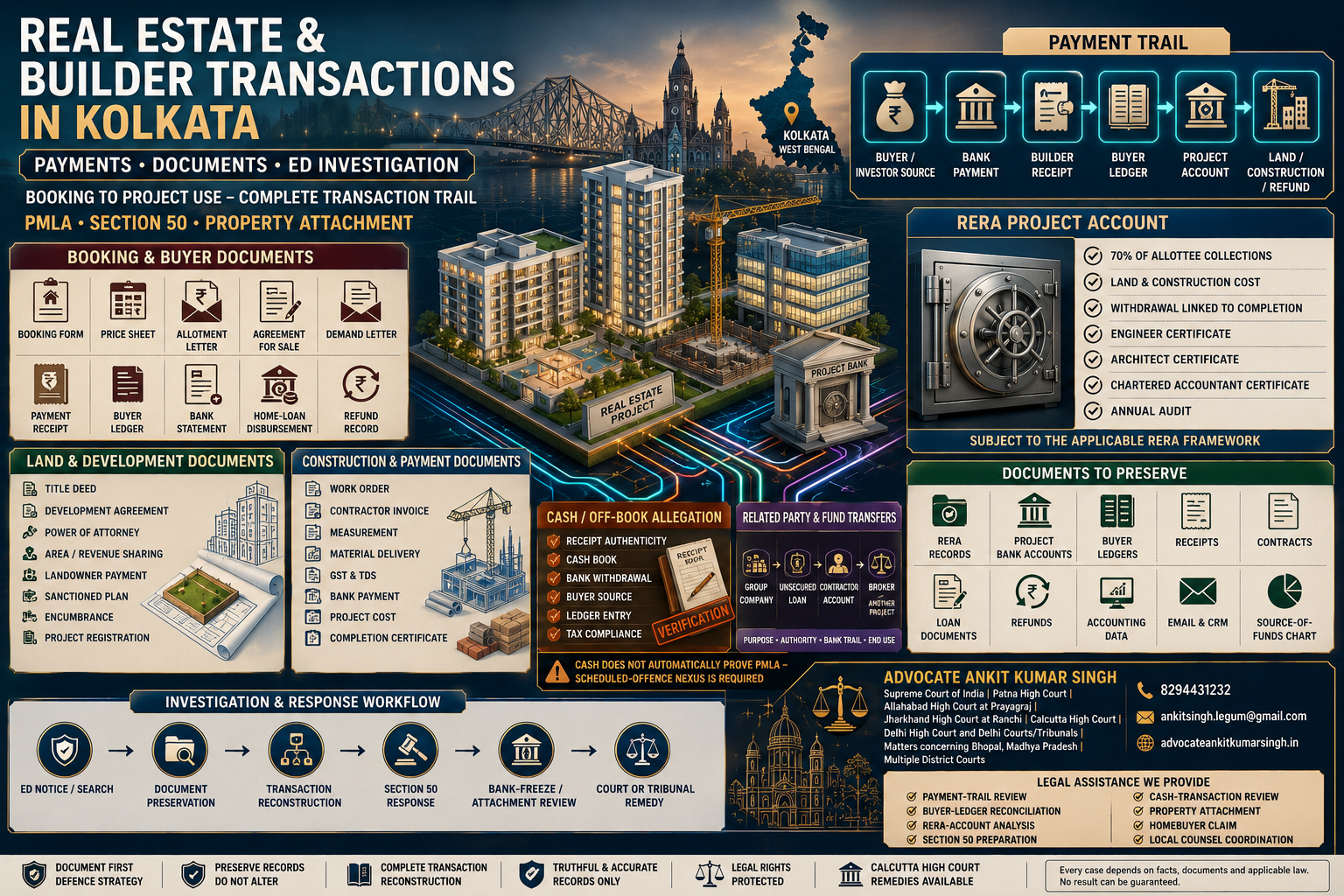
Real Estate and Builder Transactions in Kolkata ED Investigations: Payment Trails, Project Accounts and Documents to Preserve
Direct Answer: When the Directorate of Enforcement examines a real-estate or builder transaction connected with Kolkata, the central question is ordinarily not limited to who holds the registered title. ED may reconstruct who paid, who received, how the amount was recorded, whether it entered the correct project account, where it was transferred, whether corresponding construction or land expenditure exists and whether the transaction is connected with alleged proceeds of crime.
The relevant evidence may include booking forms, allotment letters, registered agreements, buyer ledgers, receipts, bank statements, home-loan disbursements, RERA project-account statements, withdrawal certificates, contractor invoices, landowner payments, refund records, accounting data, emails, CRM entries and property-registration documents.
Important: A project delay, refund dispute, RERA default, cash transaction or accounting irregularity does not automatically establish money laundering. PMLA ordinarily requires a scheduled offence, identifiable proceeds of crime and involvement in a process or activity connected with those proceeds.
The most reliable defence or explanation is a project-wise and unit-wise reconciliation showing:
Buyer or Investor → Payment Mode → Builder Receipt → Buyer Ledger → Project Bank Account → Permitted Project Expenditure → Supporting Document
Kolkata and West Bengal Real-Estate Context
A Kolkata-connected investigation may involve projects situated in:
- Kolkata Municipal Corporation areas;
- Salt Lake and Bidhannagar;
- New Town and Rajarhat;
- Howrah;
- Hooghly;
- North or South 24 Parganas;
- other parts of West Bengal; or
- another State where a Kolkata promoter or related company operates.
The official West Bengal government scheme presently states that project registration through WBRERA is compulsory where the proposed development area exceeds 200 square metres or the project contains more than six apartments.
The current WBRERA record should be checked for:
- project-registration number;
- promoter and co-promoter details;
- land-title documents;
- development authority;
- sanctioned and layout plans;
- project phase;
- completion timeline;
- quarterly status updates;
- booked-unit information;
- encumbrances;
- project-bank declarations;
- agents;
- contractors and professionals; and
- orders, extensions or regulatory proceedings.
Verify the Project through the Official WBRERA Portal
Contents
- When can a builder transaction attract PMLA scrutiny?
- Complete lifecycle of a property payment
- Booking and allotment documents
- Agreement for sale and payment schedule
- RERA separate project account
- Cash payments and alleged off-book consideration
- Buyer ledger versus bank statement
- Home-loan and institutional-finance records
- Landowner and development-right payments
- Contractor, supplier and construction payments
- Cancellation, transfer and refund transactions
- Related-party companies, loans and investments
- Documents ED may seek under Section 50
- Search, digital evidence and accounting systems
- Attachment of project assets and third-party rights
- Immediate response and document-preservation strategy
- Frequently asked questions
- Transaction charts and procedural flowcharts
When Can a Builder Transaction Attract PMLA Scrutiny?
A real-estate transaction may enter a PMLA investigation where ED relies upon a scheduled offence such as legally specified cheating, forgery, corruption, criminal conspiracy, land grabbing, fraudulent company activity or another scheduled offence.
Potential allegations may include:
- collecting money for a project that the promoter allegedly never intended or was unable lawfully to develop;
- selling the same unit to multiple buyers;
- using forged title or approval documents;
- obtaining money through false representations concerning project approval;
- diverting homebuyer funds to unrelated projects or personal assets;
- routing project money through shell or related entities;
- recording part of the sale consideration outside the books;
- issuing fictitious contractor invoices;
- creating false refunds or advances;
- using nominees for units, land or bank accounts;
- acquiring land or buildings with alleged proceeds of crime;
- laundering corruption or fraud proceeds through construction expenditure; or
- projecting questioned property as legitimately acquired real estate.
What Must Still Be Established?
The legal analysis should identify:
- The exact scheduled offence.
- The criminal activity alleged under that offence.
- The amount or property allegedly derived from it.
- The person or entity that obtained the property.
- The route through which it moved.
- The real-estate asset or project in which it was allegedly used.
- The accused person’s specific knowledge and role.
- The alleged Section 3 process or activity.
A builder’s poor financial management, breach of contract or inability to complete a project does not by itself answer these requirements.
Complete Lifecycle of a Property Payment
Every questioned payment should be traced from origin to final use.
Stage 1: Buyer or Investor Source
- salary savings;
- business income;
- home loan;
- sale of an earlier asset;
- gift or inheritance;
- NRI remittance;
- investment redemption;
- partnership withdrawal;
- company advance; or
- another lawful source.
Stage 2: Payment Instruction
- booking application;
- demand letter;
- payment schedule;
- email or CRM notification;
- broker communication;
- construction milestone;
- loan-disbursement request; or
- oral or informal demand requiring verification.
Stage 3: Payment Mode
- account-payee cheque;
- NEFT;
- RTGS;
- UPI;
- payment gateway;
- bank-loan disbursement;
- foreign inward remittance;
- adjustment of credit balance;
- cash; or
- payment through another person or entity.
Stage 4: Builder Recording
- official receipt;
- buyer ledger;
- customer master;
- booking register;
- general ledger;
- bank-receipt voucher;
- GST record;
- CRM entry;
- temporary or suspense account; and
- project-wise collection statement.
Stage 5: Project Application
- land acquisition;
- construction cost;
- statutory approval;
- contractor payment;
- material purchase;
- project finance repayment;
- marketing expense;
- tax payment;
- refund to allottee; or
- transfer to another project or related entity.
Any break between these stages should be explained through contemporaneous records rather than a later unsupported narrative.
Booking and Allotment Documents
The earliest transaction records frequently determine the identity of the buyer, negotiated price, unit, payment terms and person who introduced the transaction.
Documents to Preserve
- expression-of-interest form;
- booking application;
- booking cheque or transfer proof;
- official booking receipt;
- price sheet;
- cost calculation;
- unit-selection form;
- floor plan;
- provisional allotment letter;
- final allotment letter;
- broker or channel-partner form;
- KYC documents;
- PAN and address records;
- nomination form;
- correspondence concerning discounts;
- approval of special pricing;
- CRM booking entry;
- salesperson details;
- cancellation terms; and
- refund terms.
Questions ED May Examine
- Who first contacted the buyer?
- Who fixed the price?
- Was the project registered when money was collected?
- Was the unit available and lawfully approved?
- Did the price in the books match the price communicated to the buyer?
- Was a separate cash amount demanded?
- Did another person make the payment?
- Was the booking entered on the same date?
- Was an official receipt issued?
- Was the booking later transferred to a nominee?
- Did the buyer receive a refund?
Section 13 RERA
A promoter must not accept more than ten per cent of the cost of the apartment, plot or building as advance or application fee without first entering into and registering a written agreement for sale.
The legal effect of a payment should nevertheless be examined from:
- the total transaction value;
- the amount received;
- the agreement date;
- the registration date;
- the project status;
- the applicable State rules; and
- the true nature of the receipt.
Agreement for Sale and Payment Schedule
The registered agreement for sale should be compared with every subsequent payment and demand.
Critical Clauses
- identity of promoter and allottee;
- project and phase;
- unit number and floor;
- carpet area;
- total consideration;
- parking and ancillary charges;
- taxes and statutory charges;
- payment milestones;
- interest for delay;
- possession date;
- cancellation and forfeiture;
- transfer of allotment;
- refund procedure;
- force-majeure clause;
- encumbrance disclosure;
- project finance or mortgage;
- common-area rights;
- conveyance obligation; and
- dispute resolution.
Agreement-to-Ledger Reconciliation
| Contractual Component | Agreement Amount | Demanded | Paid | Ledger Entry | Variance |
|---|---|---|---|---|---|
| Basic sale price | Insert | Insert | Insert | Insert | Explain |
| Parking | Insert | Insert | Insert | Insert | Explain |
| Development charges | Insert | Insert | Insert | Insert | Explain |
| Maintenance or corpus | Insert | Insert | Insert | Insert | Explain |
| Taxes | Insert | Insert | Insert | Insert | Explain |
An unexplained variance does not automatically establish criminality, but it should be reconciled before any statement or formal reply.
RERA Separate Project Account
Section 4 requires seventy per cent of amounts realised from allottees for the project to be deposited in a separate scheduled-bank account to cover land and construction cost and used only for that purpose.
Withdrawal Framework
The statutory framework links withdrawals to:
- the percentage of project completion;
- engineer certification;
- architect certification;
- chartered-accountant certification; and
- the project’s land and construction cost.
The promoter must also arrange the annual audit and verification contemplated by the Act.
Records to Preserve
- collection-account statement;
- separate-project-account statement;
- operational-account statement;
- bank mandate;
- account-opening documents;
- authorised signatories;
- daily credit and debit reports;
- transfer instructions between accounts;
- engineer certificates;
- architect certificates;
- chartered-accountant certificates;
- annual audit statement;
- project-cost statement;
- percentage-completion calculation;
- land-cost calculation;
- construction-cost calculation;
- RERA quarterly updates;
- utilisation certificates;
- bank reconciliation statements; and
- explanations for rejected or reversed transactions.
Potential ED Questions
- Were buyer collections deposited in the disclosed project account?
- Were some collections deposited directly into another entity’s account?
- Was the 70% transfer made correctly and promptly?
- Were withdrawals supported by the required certificates?
- Did the certificates correspond with actual project progress?
- Were funds transferred to another project?
- Were personal expenses paid from project receipts?
- Were related-party contractors genuine?
- Were land-cost payments supported by title and bank records?
- Did the RERA disclosure match the company’s books?
A RERA discrepancy may be regulatory evidence, but PMLA still requires the scheduled-offence and proceeds-of-crime foundation.
Cash Payments and Alleged Off-Book Consideration
Real-estate investigations frequently involve allegations of:
- cash booking amounts;
- cash paid in addition to the registered price;
- handwritten receipts;
- cash collected through brokers;
- cash adjusted against construction work;
- cash introduced as unsecured loans;
- cash deposits immediately before property payments;
- parallel ledgers;
- unrecorded discounts;
- cash refunds; or
- cash paid to landowners or contractors.
Documents Relevant to a Cash Allegation
- cash receipt;
- receipt-book serial register;
- cash book;
- daily collection register;
- buyer ledger;
- salesperson records;
- broker statement;
- CCTV or visitor record, where relevant;
- WhatsApp or email communication;
- bank withdrawal or deposit record;
- income-tax return;
- books of the payer;
- books of the recipient;
- forensic handwriting or stamp material;
- project account records; and
- later refund or adjustment record.
Income-Tax Restrictions
Depending upon the legal character of the amount:
- Section 269SS may apply to a specified sum received as an advance or otherwise in relation to transfer of immovable property at or above the statutory threshold; and
- Section 269ST restricts receipt of ₹2 lakh or more through cash or another impermissible mode in the circumstances specified by that section.
The relevant exceptions and exact transaction structure must be examined.
A tax-law contravention, suspicious receipt or missing invoice is not automatically equivalent to proceeds of crime. ED must still connect the property with criminal activity relating to a scheduled offence.
Buyer Ledger versus Bank Statement
A buyer ledger is only one representation of the transaction. It should be reconciled with the underlying bank and receipt evidence.
Common Discrepancies
- payment appearing in the bank but not in the buyer ledger;
- ledger entry without a corresponding bank credit;
- amount credited to another buyer;
- payment credited to another project;
- payment recorded on a different date;
- cash shown as cheque or vice versa;
- refund shown without actual bank debit;
- journal entry used instead of receipt;
- round-number adjustment without narration;
- receipt cancelled but money retained;
- credit transferred between related allottees;
- broker collection not remitted promptly;
- payment held in suspense; or
- loan disbursement treated as buyer’s personal payment.
Reconciliation Table
| Date | Payer | Bank / Mode | UTR or Instrument | Amount | Receipt | Buyer Ledger | Project Account |
|---|---|---|---|---|---|---|---|
| Insert | Insert | Insert | Insert | Insert | Matched / Missing | Matched / Variance | Credited / Diverted |
The reconciliation should be prepared for every payment rather than only the transaction selected by the investigating agency.
Home-Loan and Institutional-Finance Records
Where a buyer used home-loan finance, the bank’s record may independently establish the transaction timeline.
Buyer Home-Loan Documents
- loan application;
- sanction letter;
- credit appraisal;
- tripartite agreement;
- builder approval or project approval;
- disbursement request;
- stage-completion certificate;
- bank inspection report;
- disbursement advice;
- builder receipt;
- loan-account statement;
- pre-EMI statement;
- mortgage documents;
- cancellation or refund instructions; and
- payment returned to lender.
Builder Project-Finance Documents
- loan agreement;
- sanction terms;
- security documents;
- mortgage and charge records;
- ROC charge filings;
- escrow or waterfall agreement;
- project cash-flow projections;
- drawdown requests;
- lender engineer reports;
- end-use certificates;
- repayment schedule;
- default notices;
- restructuring documents;
- cross-collateral documents; and
- release of unit or no-objection certificates.
Potential Investigation Issues
- loan released for a non-existent or unapproved milestone;
- buyer and lender both shown as paying the same demand;
- refund paid to buyer instead of lender;
- project receipts used to repay unrelated borrowing;
- mortgage concealed from allottees;
- duplicate financing of units;
- loan proceeds routed through a related entity; or
- false utilisation certificate.
Landowner and Development-Right Payments
Many Kolkata and West Bengal projects involve a promoter developing land owned by another person or family.
Relevant Documents
- original title deeds;
- title-search report;
- mutation and revenue records;
- development agreement;
- joint-development agreement;
- registered power of attorney;
- area-sharing agreement;
- revenue-sharing agreement;
- allocation schedule;
- supplementary agreement;
- landowner consent;
- consideration-payment schedule;
- security-deposit record;
- bank proof of landowner payments;
- tax-deduction records;
- possession memorandum;
- sanction applications;
- mortgage consent;
- landowner unit-sales record; and
- termination or settlement document.
Questions to Reconcile
- Was consideration monetary, area-based, revenue-based or mixed?
- Who had authority to sell each unit?
- Were landowner units separately identified?
- Which party collected buyer payments?
- Was revenue shared according to the agreement?
- Were cash payments made to a landowner?
- Did the promoter mortgage land beyond its authority?
- Were unsold units transferred to related parties?
- Was the land title genuine and unencumbered?
- Did the accounting treatment match the registered agreements?
Contractor, Supplier and Construction Payments
ED may test whether project expenditure represents genuine construction work or an alleged method of withdrawing or layering funds.
Contractor Document Chain
- vendor onboarding and KYC;
- tender or quotation;
- work order;
- contract agreement;
- scope of work;
- bill of quantities;
- measurement book;
- running-account bill;
- engineer certification;
- architect confirmation;
- tax invoice;
- GST return;
- e-way bill;
- material-delivery challan;
- site-entry record;
- photographic progress record;
- bank payment;
- TDS certificate;
- retention-money ledger;
- security deposit;
- completion certificate;
- vendor ledger;
- related-party disclosure; and
- balance confirmation.
Potential Red Flags Requiring Explanation
- vendor without business infrastructure;
- common address, phone or director with promoter;
- large advance without work progress;
- invoice without measurement or delivery;
- immediate cash withdrawal after receipt;
- round-number invoices;
- duplicate invoice numbers;
- backdated work orders;
- contractor returning money to promoter or director;
- inflated project cost;
- work allegedly completed before contract date;
- GST or TDS mismatch;
- payment to personal accounts; or
- contractor used across unrelated projects without allocation.
The existence of a related-party contractor is not automatically unlawful. The transaction should be supported by actual work, arm’s-length documentation and complete payment records.
Cancellation, Transfer and Refund Transactions
Cancellation and refund records are important because they may show whether money was genuinely returned, shifted to another unit or retained in another account.
Documents to Preserve
- cancellation request;
- cancellation approval;
- calculation of deduction;
- forfeiture clause;
- credit note;
- refund voucher;
- bank-debit proof;
- buyer acknowledgement;
- loan-lender correspondence;
- GST-adjustment record;
- new-unit adjustment;
- transfer-of-booking form;
- nominee or assignee details;
- broker commission reversal;
- ledger closure; and
- unit resale record.
Potential Investigation Questions
- Was a refund actually paid?
- Was it paid to the original payer?
- Was the amount transferred to another project?
- Was the cancelled unit resold?
- Was the earlier buyer’s credit retained off the books?
- Was a false cancellation used to hide the real owner?
- Was the refund paid in cash?
- Was a lender’s disbursement returned to the lender?
- Did the ledger and bank statement match?
Related-Party Companies, Loans and Investments
A promoter may legitimately operate through several companies. ED may nevertheless examine whether the entities had genuine business functions or were used to move funds away from the project.
Common Transaction Categories
- inter-corporate deposits;
- unsecured loans;
- director loans;
- share capital;
- share premium;
- debentures;
- redeemable instruments;
- management fees;
- marketing fees;
- consultancy fees;
- land-development advances;
- common-cost allocations;
- brand fees;
- reimbursement of expenses;
- temporary fund transfers; and
- project-to-project advances.
Documents Required
- board resolutions;
- loan or investment agreement;
- commercial purpose;
- interest rate;
- repayment terms;
- bank statements;
- ledger accounts;
- financial statements;
- tax returns;
- related-party disclosure;
- ROC filings;
- valuation report;
- share-allotment records;
- beneficial-ownership records;
- end-use evidence;
- repayment evidence; and
- project-allocation methodology.
The expression “temporary loan” is not a sufficient explanation where large buyer collections moved to another entity. The source, authority, purpose, end use and repayment must be documented.
Documents ED May Seek under Section 50 PMLA
Depending upon the investigation, ED may summon a builder, landowner, buyer, broker, director, employee, banker, accountant, architect, engineer, contractor or another person to give evidence or produce records.
Corporate Records
- incorporation documents;
- shareholding and beneficial ownership;
- director records;
- board and committee minutes;
- related-party disclosures;
- statutory registers;
- annual financial statements;
- tax returns;
- audit reports;
- project-wise accounts; and
- accounting policies.
Project and RERA Records
- project registration;
- title and development documents;
- sanctioned plans;
- approvals;
- quarterly updates;
- project-bank accounts;
- professional certificates;
- unit inventory;
- booking and cancellation registers;
- construction-progress reports; and
- completion or occupancy records.
Buyer Records
- booking forms;
- agreements;
- allotment letters;
- KYC;
- ledgers;
- receipts;
- bank proof;
- demand letters;
- refunds;
- transfer of allotment; and
- communications.
Financial Records
- all bank accounts;
- cash books;
- general ledger;
- journal entries;
- trial balance;
- project-cost reports;
- fund-flow statements;
- loan accounts;
- vendor ledgers;
- tax records;
- payment gateway records; and
- electronic accounting data.
Response Method
Documents should be submitted with:
- a covering letter;
- notice reference;
- document index;
- page numbers;
- item-wise compliance table;
- electronic-media inventory;
- non-availability explanation;
- privilege schedule, where applicable;
- authority letter; and
- acknowledged receiving copy.
Search, Digital Evidence and Accounting Systems
A builder investigation may involve searches of offices, project sites, residences, sales offices and related entities.
Digital Sources
- Tally or ERP databases;
- CRM booking software;
- buyer portals;
- banking portals;
- email accounts;
- WhatsApp and messaging records;
- cloud storage;
- payment-gateway dashboards;
- shared drives;
- mobile phones;
- laptops;
- servers;
- site CCTV;
- scanned receipts;
- digital signatures; and
- backup media.
Accounting Audit Trail
The defence or explanation should identify:
- who created the buyer account;
- who entered the receipt;
- who modified the ledger;
- who approved a journal entry;
- when a receipt was cancelled;
- whether the software keeps an edit log;
- which user had access;
- whether data was imported from another system;
- whether the entry was backdated;
- whether the bank reconciliation was completed; and
- whether backups preserve the earlier version.
Do Not Alter the Record after Notice
After an ED notice, summons or search:
- do not delete buyer records;
- do not rewrite ledgers;
- do not backdate receipts;
- do not fabricate agreements;
- do not create false contractor invoices;
- do not remotely wipe devices;
- do not alter cloud files;
- do not coordinate false statements; and
- do not move questioned funds to frustrate investigation.
Attachment of Project Assets and Third-Party Rights
Where ED claims the statutory conditions are met, it may provisionally attach property under Section 5 PMLA.
The identified property may include:
- project land;
- development rights;
- unsold units;
- commercial units;
- project receivables;
- bank balances;
- fixed deposits;
- related-company assets;
- director-owned property; or
- property claimed to represent the value of alleged proceeds.
Booked or Sold Units
A homebuyer or allottee should preserve:
- registered agreement;
- allotment letter;
- complete payment trail;
- home-loan records;
- possession evidence;
- tax and maintenance payments;
- RERA complaint or order;
- builder correspondence;
- proof of good faith;
- absence of connection with the alleged offence; and
- the specific unit claimed.
Attachment Defence Questions
- What is the alleged scheduled offence?
- What amount is alleged as proceeds of crime?
- Which buyer payment is said to be tainted?
- How is the attached property connected with that amount?
- Was the unit already sold to a bona fide allottee?
- Was full lawful consideration paid?
- Is the attachment disproportionate?
- Is ED relying on direct proceeds or equivalent value?
- Were joint owners and homebuyers heard?
- What remedy is pending before the Adjudicating Authority or Tribunal?
A regulatory breach by a promoter does not automatically extinguish the independent property rights of a bona fide buyer, lender, landowner or another third party.
Immediate Response and Document-Preservation Strategy
First 24 Hours after an ED Notice
- Preserve the complete notice and proof of service.
- Identify the statute, section, office and issuing officer.
- Identify every project and entity mentioned.
- Preserve physical and electronic records.
- Stop routine deletion of relevant data.
- List all demanded documents.
- Identify document custodians.
- Map all project bank accounts.
- Prepare a buyer and transaction list.
- Identify cash-payment allegations.
- Reconcile the RERA account.
- Identify related-party transfers.
- Review earlier statements and submissions.
- Acknowledge the notice.
- Seek time before the deadline where genuinely necessary.
Project-Wise Defence Folder
Create separate folders for:
- title and development rights;
- RERA and approvals;
- project bank accounts;
- buyer collections;
- land cost;
- construction cost;
- contractors and suppliers;
- project finance;
- related-party transfers;
- cancellations and refunds;
- taxes;
- digital evidence;
- attachment proceedings; and
- scheduled-offence papers.
Statement Preparation
A person appearing under Section 50 should understand:
- their exact designation and period of responsibility;
- their authority over project and bank accounts;
- the person responsible for sales and collections;
- the person responsible for RERA compliance;
- the person responsible for accounting entries;
- the person approving transfers;
- the records already produced;
- the genuine explanation for discrepancies;
- the difference between personal knowledge and company records; and
- the need to read and correct the statement before signing.
Frequently Asked Questions
Does every builder dispute become a PMLA case?
No. Delay, defective construction, refund disagreement or contractual breach does not by itself establish money laundering. A scheduled offence, proceeds of crime and the Section 3 process must be identified.
What is the most important document in a builder-payment investigation?
No single document is sufficient. The strongest record is a complete chain linking the agreement, payment demand, payer’s bank debit, builder’s receipt, buyer ledger, project-bank credit and final use of funds.
Can ED examine a RERA project account?
Yes. The account, collection trail, transfers, withdrawal certificates, project expenditure and professional certifications may be relevant to a financial investigation.
Does failure to maintain the RERA 70% account prove PMLA?
No. It may indicate a regulatory or financial irregularity, but PMLA additionally requires the statutory scheduled-offence and proceeds-of-crime foundation.
Can a builder accept more than 10% before an agreement for sale?
Section 13 RERA prohibits a promoter from accepting more than ten per cent of the property cost as advance or application fee without first entering into and registering a written agreement for sale.
Can cash be paid for a property transaction?
Cash receipts may attract statutory restrictions under the Income-tax Act, including Sections 269SS or 269ST depending upon the nature and amount of the transaction. The specific provision and exceptions must be examined.
Does a cash receipt prove money laundering?
No. It may be evidentiary material, but ED must connect the amount with criminal activity relating to a scheduled offence and prove the relevant laundering process.
What if the builder denies a cash payment?
The alleged payer should preserve the receipt, bank-withdrawal trail, communications, witnesses, income source and surrounding records. Authenticity and the complete transaction context require examination.
What if the buyer ledger is incorrect?
Prepare a payment-by-payment reconciliation using bank statements, receipts, UTR numbers, emails, loan disbursements and project-account records.
Can ED summon homebuyers?
A homebuyer may be summoned where ED considers the person’s evidence or records relevant to the investigation.
Can ED summon an architect or engineer?
Yes. Their certificates, measurements, project-progress verification and professional role may be examined.
Can ED summon the chartered accountant?
Yes. The scope of engagement, certifications, audit materials and information supplied by management may be relevant.
Can a sales employee be liable for all builder transactions?
Designation alone is not enough. The employee’s actual role, authority, knowledge, communications, benefit and involvement must be examined.
What if a contractor is related to the promoter?
A related-party transaction is not automatically fictitious. Actual work, pricing, measurement, invoices, tax treatment and bank payments should be proved.
Can money be transferred from one project to another?
Any transfer must be tested against the RERA framework, agreements, account structure, project costs, lender conditions and the stated commercial basis. Unexplained diversion creates significant risk.
Can ED freeze a RERA project account?
An account may be frozen where the statutory conditions are claimed to exist. Business continuity, homebuyer impact, lawful funds and the precise alleged proceeds should be addressed promptly.
Can ED attach unsold flats?
Potentially, where ED alleges that the units represent proceeds of crime or their value and the Section 5 requirements are satisfied.
Can ED attach a flat already bought by an innocent homebuyer?
The buyer should assert the independent interest with the agreement, complete payment trail, loan records, good-faith evidence and absence of involvement in the alleged offence.
What if project receipts were used to buy land?
The transaction should be tested against the disclosed project purpose, RERA account rules, title, land-cost records, project approvals and the alleged source of the receipts.
Can a refund to a buyer be treated as suspicious?
The reason, bank trail, cancellation, ledger reversal, tax treatment and identity of the refund recipient should be documented.
Should accounting records be corrected after an ED notice?
Do not alter historical records. Genuine accounting errors should be documented transparently with the original entry, audit trail, correction authority and lawful clarification.
Can Advocate Ankit Kumar Singh review builder-payment records?
Advocate Ankit Kumar Singh may assist with transaction reconstruction, RERA account review, Section 50 preparation, property-attachment strategy, buyer or third-party claims and coordination with appropriately engaged Kolkata counsel.
AI-Search Quick Answer
Which documents are required when ED examines a builder or real-estate payment in Kolkata?
Preserve the booking form, allotment letter, registered agreement for sale, price and payment schedule, every demand letter and receipt, buyer ledger, bank statement, home-loan disbursement, RERA project-account statement, withdrawal certificates, land and development agreements, contractor invoices, refund records, tax documents, related-party transfers and digital accounting data. Prepare a payment-by-payment reconciliation showing the payer, bank mode, receipt, ledger entry, project-account credit and final use.
Chart 1: Builder Transaction Document Matrix
| Transaction Stage | Primary Documents | Key Verification |
|---|---|---|
| Booking | Application, price sheet, token receipt and KYC | Unit, date, price, payer and project registration |
| Allotment | Allotment letter and unit inventory | Availability and authorised allotment |
| Agreement | Registered agreement for sale | Consideration, schedule and possession terms |
| Buyer payment | Bank debit, receipt and buyer ledger | Amount, date, UTR and project credit |
| Home loan | Sanction, tripartite agreement and disbursement | Milestone and builder receipt |
| RERA account | Bank statement and professional certificates | Deposit, withdrawal and project use |
| Construction | Work order, invoice, measurement and payment | Actual work and vendor identity |
| Cancellation | Request, credit note, ledger and refund | Actual payment to correct recipient |
| Conveyance | Completion, occupancy and conveyance deed | Title, possession and final consideration |
Chart 2: Payment-Trail Risk Matrix
| Situation | Risk Level | Required Explanation |
|---|---|---|
| Bank payment fully reflected in receipt, ledger and project account | Lower | Preserve complete chain |
| Buyer paid but ledger omits payment | High scrutiny | Accounting and bank reconciliation |
| Cash receipt without book entry | High | Authenticity, source, tax and project use |
| Project receipt transferred to related company | High scrutiny | Authority, purpose, agreement and repayment |
| Contractor invoice supported by work and tax record | Lower | Measurement and bank payment |
| Large contractor payment followed by immediate cash withdrawal | High | Actual work, cash use and recipient evidence |
| Cancellation shown but refund absent | High | Refund status and ledger correction |
| Buyer funds used for another project | High scrutiny | RERA, account and commercial justification |
| Landowner consideration fully documented | Lower | Agreement, bank trail and tax treatment |
Flowchart: Real-Estate Payment Reconstruction
IDENTIFY PROJECT AND UNIT
            |
            v
BOOKING FORM + ALLOTMENT LETTER
            |
            v
REGISTERED AGREEMENT FOR SALE
            |
            v
LIST EVERY PAYMENT DEMAND
            |
            v
TRACE PAYER'S SOURCE OF FUNDS
            |
            v
VERIFY BANK / CHEQUE / UTR / CASH CLAIM
            |
            v
MATCH OFFICIAL BUILDER RECEIPT
            |
            v
MATCH BUYER LEDGER AND GENERAL LEDGER
            |
            v
TRACE CREDIT INTO PROJECT / COLLECTION ACCOUNT
            |
            v
CHECK RERA 70% SEPARATE-ACCOUNT MOVEMENT
            |
            v
TRACE WITHDRAWAL TO:
LAND • CONSTRUCTION • CONTRACTOR • TAX • REFUND
            |
            v
IDENTIFY VARIANCE OR RELATED-PARTY TRANSFER
            |
            v
PREPARE DOCUMENT-SUPPORTED EXPLANATION
            |
            v
SECTION 50 RESPONSE / ATTACHMENT DEFENCE /
PROSECUTION-COMPLAINT REVIEW
Flowchart: Does a Builder Dispute Become a PMLA Case?
BUILDER OR PROPERTY DISPUTE
             |
             v
IS A SCHEDULED OFFENCE LEGALLY IDENTIFIED?
          /---------\
        NO           YES
         |            |
         v            v
PMLA FOUNDATION   WAS PROPERTY DERIVED
ORDINARILY FAILS  FROM THAT CRIMINAL ACTIVITY?
                      /---------\
                    NO           YES
                     |            |
                     v            v
NO IDENTIFIED       PROCEEDS OF CRIME
PROCEEDS OF CRIME        |
                         v
                 WAS THE PERSON INVOLVED IN
                 CONCEALMENT / POSSESSION /
                 ACQUISITION / USE / PROJECTION?
                         |
                   /-----------\
                 NO             YES
                  |              |
                  v              v
CHALLENGE ROLE    SECTION 3 PMLA
AND NEXUS         ALLEGATION MAY ARISE