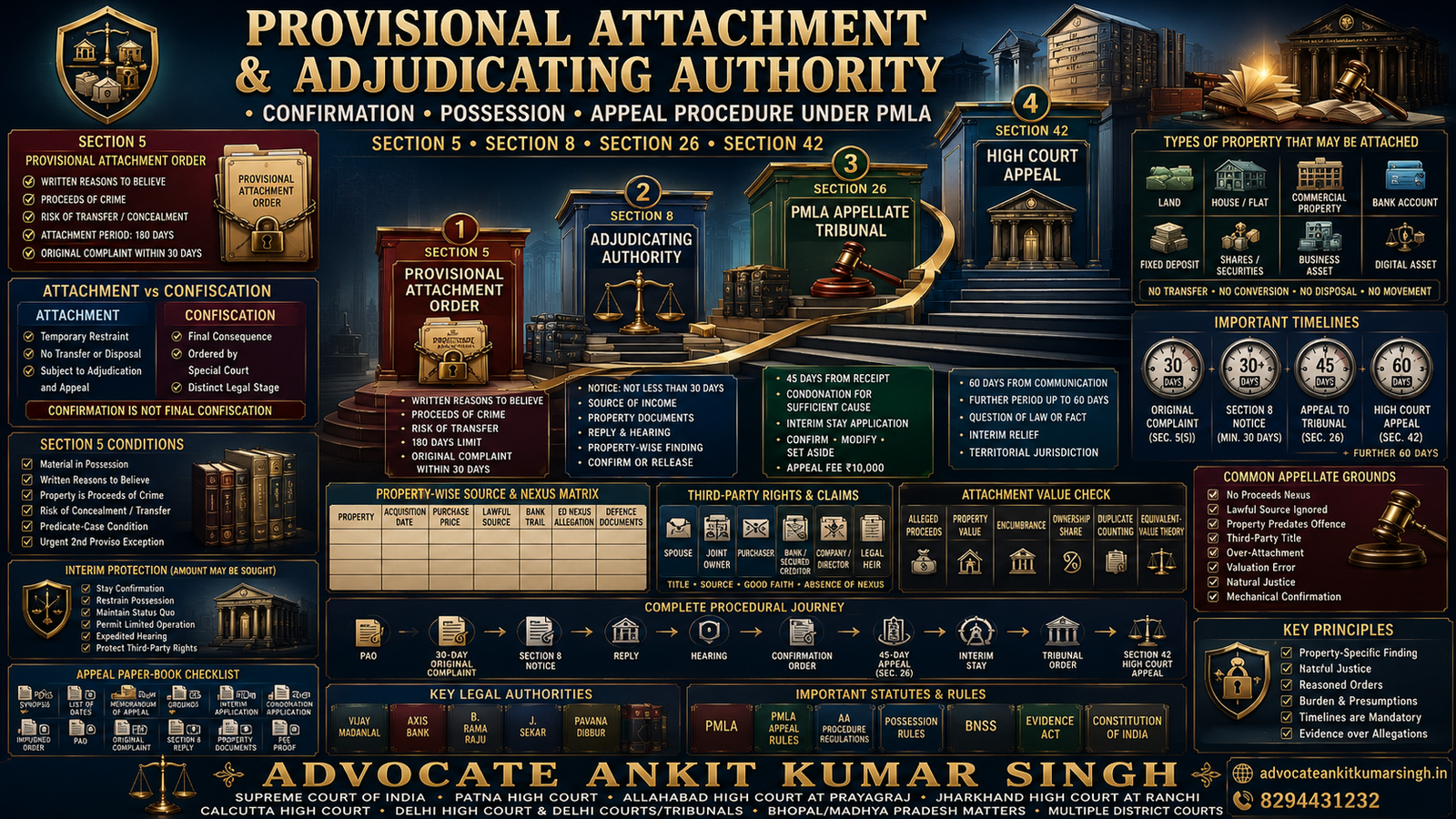
Provisional Attachment, Adjudicating Authority Confirmation and Appeal Procedure Under PMLA: Complete Section 5, Section 8 and Section 26 Guide
A Provisional Attachment Order passed by the Enforcement Directorate can restrict the sale, transfer, conversion, movement or disposal of land, houses, bank balances, fixed deposits, shares, business assets and other property.
The order is serious, but it is not final confiscation and it is not by itself a finding of guilt.
The affected person receives a statutory opportunity before the PMLA Adjudicating Authority and, after confirmation, a right of appeal before the Appellate Tribunal under Section 26.
Direct Answer
After ED passes a Provisional Attachment Order under Section 5 PMLA, it must file a complaint stating the attachment facts before the Adjudicating Authority within 30 days. The Authority may then issue a Section 8 notice of not less than 30 days, consider the reply and documents, hear the affected parties and decide whether all or any property is involved in money laundering.
If the attachment is confirmed under Section 8(3), an aggrieved person may ordinarily appeal under Section 26 within 45 days from receipt of the order.
The appellate strategy should normally include:
- a complete memorandum of appeal;
- a property-wise challenge;
- a separate interim-stay application;
- proof of the date of receipt;
- a delay-condonation application where required;
- the PAO, Original Complaint, notice, reply and confirmation order;
- lawful-source, title, valuation and third-party documents.
Attachment, Seizure, Freezing, Possession and Confiscation Are Different
| Stage | Meaning |
|---|---|
| Attachment | A legal prohibition against transfer, conversion, disposition or movement of property. |
| Seizure | Physical taking of property, records or another item into custody. |
| Freezing | A prohibition against dealing with property where physical seizure is impracticable or another statutory freezing power is used. |
| Possession | Taking control of attached or frozen property after the statutory confirmation stage and in the prescribed manner. |
| Confiscation | Final vesting consequence ordered by the competent Special Court under the applicable provision of Section 8. |
These expressions should not be used interchangeably.
What Is a Provisional Attachment Order?
A Provisional Attachment Order, commonly called a PAO, is a written order passed under Section 5 restricting dealings with property alleged to be involved in money laundering.
The PAO may concern:
- land;
- house or flat;
- commercial premises;
- factory or plant;
- agricultural property;
- bank balance;
- fixed deposit;
- shares or securities;
- business interest;
- vehicle or machinery;
- valuable documents;
- digital assets;
- property of equivalent value, where legally invoked.
Statutory Conditions Under Section 5
The authorised officer must ordinarily possess material and record written reasons to believe that:
- a person is in possession of proceeds of crime; and
- the proceeds are likely to be concealed, transferred or dealt with in a manner capable of frustrating confiscation proceedings.
The defence should identify:
- the property alleged to be proceeds of crime;
- the scheduled criminal activity;
- the alleged derivation or equivalent-value theory;
- the person alleged to possess it;
- the risk of concealment or transfer;
- the material referred to in the PAO;
- whether the statutory conclusions are property-specific.
Ordinary Predicate-Case Requirement
The first proviso to Section 5 ordinarily requires the relevant police report or competent complaint concerning the scheduled offence.
The following should be checked:
- predicate FIR or CBI RC;
- offences invoked;
- charge sheet or police report;
- competent criminal complaint;
- cognizance status;
- connection between the predicate allegation and attached property.
An attachment cannot be sustained merely because ED suspects that some criminal offence may exist.
Urgent Attachment Under the Second Proviso
The second proviso permits attachment without waiting for the ordinary first-proviso stage where ED records reasons to believe that immediate non-attachment is likely to frustrate proceedings under PMLA.
The PAO should be examined for:
- express reliance on the second proviso;
- specific urgency;
- actual risk of disposal;
- recent attempted sale or transfer;
- movement of funds;
- creation of third-party rights;
- whether a generic apprehension replaced property-specific reasoning.
The 180-Day Provisional Period
A Section 5 attachment may operate for a period not exceeding 180 days from the date of the PAO, subject to the statutory method of excluding a High Court stay period.
Prepare a limitation chart:
| Event | Date | Importance |
|---|---|---|
| PAO passed | ________ | Starting date of provisional attachment. |
| PAO served | ________ | Relevant for knowledge and preparation. |
| Original Complaint filed | ________ | Must ordinarily be within 30 days. |
| Section 8 notice | ________ | Starts reply and hearing preparation. |
| Court stay commenced | ________ | May be excluded from calculation. |
| Stay vacated | ________ | Apply statutory calculation. |
| Section 8 order | ________ | Determines confirmation or non-confirmation. |
Can the Owner Continue Using Immovable Property?
Section 5(4) states that provisional attachment does not prevent a person interested from enjoyment of the attached immovable property.
This may protect continued:
- residence;
- occupation;
- ordinary agricultural use;
- ordinary business use;
- receipt or management subject to the order and applicable directions.
However, enjoyment does not mean freedom to:
- sell;
- gift;
- mortgage;
- create a new lease;
- transfer possession to defeat attachment;
- create another prohibited third-party interest.
After confirmation, Section 8(4) and the possession rules may create separate consequences.
Original Complaint Within 30 Days
Section 5(5) requires ED to file a complaint stating the facts of attachment before the Adjudicating Authority within 30 days from attachment.
The complaint is commonly registered as an Original Complaint.
Obtain and examine:
- complete Original Complaint;
- property schedule;
- list of relied-upon documents;
- proceeds calculation;
- money-trail chart;
- bank statements;
- valuation material;
- statements relied upon;
- predicate-case documents;
- corporate or ownership records.
Section 8(1) Show-Cause Notice
The Adjudicating Authority may issue a notice of not less than 30 days requiring the person to indicate:
- sources of income;
- earnings;
- assets;
- source of acquisition;
- evidence relied upon;
- other relevant information;
- why the property should not be declared involved in money laundering.
Record:
- date of notice;
- date and mode of service;
- reply deadline;
- hearing date;
- property described;
- persons served;
- documents supplied;
- documents still required.
Joint Holders and Property Held for Another Person
Where property is jointly held, Section 8 requires notice to all joint holders.
Where the notice alleges that one person holds property for another, a copy should also be served upon the other person.
Relevant claimants may include:
- spouse;
- parent or child;
- co-owner;
- legal heir;
- trust beneficiary;
- company;
- bank or secured creditor;
- purchaser;
- lessor or lessee;
- person who funded acquisition.
Every claimant should file a clear title and source claim rather than rely solely on the main notice recipient.
Inspection and Copies Before Filing the Reply
The Adjudicating Authority Procedure Regulations permit applications for inspection and certified copies.
The affected person should seek, where relevant:
- Original Complaint;
- PAO;
- property schedule;
- relied-upon documents;
- statements relied upon;
- valuation reports;
- bank or company records;
- earlier orders;
- filing and registration details.
Where a relied-upon document is withheld:
- identify it specifically;
- make a written request;
- seek inspection;
- record the prejudice caused;
- request appropriate time after supply.
How to Structure the Section 8 Reply
A complete reply may contain:
- Preliminary jurisdictional objections.
- Chronology.
- Response to the PAO.
- Response to the Original Complaint.
- Scheduled-offence analysis.
- Proceeds-of-crime analysis.
- Property-wise lawful-source analysis.
- Valuation objections.
- Third-party and joint-holder claims.
- Procedural and natural-justice objections.
- Documents and reconciliation charts.
- Specific prayer for non-confirmation and release.
Property-Wise Source Chart
| Property | Acquisition Date | Cost | Source of Funds | ED Allegation | Defence Documents |
|---|---|---|---|---|---|
| ________ | ________ | ________ | Loan / income / sale proceeds / inheritance | ________ | ________ |
Useful source documents include:
- income-tax returns;
- bank statements;
- loan sanction and repayment;
- sale deed;
- inheritance or partition document;
- gift deed and donor source;
- salary and business-income records;
- audited financial statements;
- construction invoices;
- valuation report;
- payment receipts.
Property Acquired Before the Alleged Crime
Where property predates the scheduled criminal activity, direct derivation from the later alleged offence should be questioned.
Prepare:
- title date;
- payment date;
- bank debit;
- loan date;
- possession date;
- construction period;
- income earned before acquisition;
- tax and balance-sheet disclosure.
ED may rely upon an equivalent-value theory in an appropriate case, which must be challenged separately through the statutory definition, facts and valuation.
Third-Party and Bona Fide Claims
A person may claim that property:
- was lawfully acquired for value;
- was acquired before the alleged offence;
- was financed independently;
- is held under a genuine mortgage;
- belongs to a company rather than its director;
- belongs to a spouse with independent income;
- is inherited or ancestral;
- is held in trust;
- contains only a limited share of the notice recipient.
The claimant should prove:
- title;
- consideration;
- date;
- good faith;
- independent source;
- absence of collusion;
- absence of benefit from alleged proceeds;
- reasonable due diligence where relevant.
Bank and Secured-Creditor Claims
Where a bank or financial institution has a mortgage, charge or security interest, preserve:
- sanction letter;
- loan agreement;
- mortgage deed;
- charge registration;
- disbursement records;
- repayment history;
- default date;
- enforcement action;
- valuation;
- borrower disclosures.
The competing statutory rights, timing, good faith and nature of the property interest require case-specific analysis.
Valuation and Over-Attachment
The defence should test whether:
- the same proceeds were counted more than once;
- gross turnover was treated as proceeds;
- lawful and disputed funds were mixed;
- current market value replaced the legally relevant value without explanation;
- the complete property was attached although only a share was alleged;
- mortgage debt was ignored;
- construction and land values were duplicated;
- several equivalent-value properties exceeded the alleged proceeds.
Prepare a valuation comparison:
| Property | ED Value | Acquisition Value | Independent Value | Encumbrance | Net Interest |
|---|---|---|---|---|---|
| ________ | ________ | ________ | ________ | ________ | ________ |
Burden of Proof and Presumptions
Sections 22, 23 and 24 may become relevant to:
- ownership or contents of records;
- interconnected transactions;
- presumption concerning involvement of alleged proceeds.
The reply should therefore contain affirmative evidence rather than a bare denial.
Useful rebuttal material includes:
- independent title;
- lawful bank trail;
- tax disclosure;
- loan documentation;
- unrelated transaction purpose;
- separate ownership;
- chronological inconsistency in ED’s theory;
- property predating the alleged proceeds.
Hearing Before the Adjudicating Authority
The hearing should be organised around:
- jurisdiction;
- scheduled offence;
- proceeds definition;
- property nexus;
- source of funds;
- valuation;
- third-party interest;
- procedure;
- relief.
Carry:
- short synopsis;
- chronology;
- property chart;
- money-trail chart;
- case-law compilation;
- document cross-reference;
- written submissions;
- specific prayer.
What Must the Adjudicating Authority Decide?
After considering the reply, hearing both sides and examining relevant material, the Authority must record a finding concerning whether all or any property is involved in money laundering.
The order should address:
- each material objection;
- each property;
- each affected claimant;
- source documents;
- ED’s proceeds theory;
- valuation;
- scheduled-offence connection;
- third-party rights;
- relief granted or refused.
A mechanical reproduction of the Original Complaint without analysing the defence may become an appellate ground.
Confirmation Under Section 8(3)
Where the Authority finds that property is involved in money laundering, it may confirm:
- the Section 5 attachment;
- retention of seized property;
- continuation of freezing;
- retention of specified records.
The confirmation order may continue during:
- the investigation for the statutory period described in Section 8(3); or
- the pendency of proceedings relating to an offence under PMLA before a court, as applicable.
The precise statutory period and exclusion of court-stay time should be calculated from the current text and case chronology.
Confirmation Is Not Final Confiscation
The following distinction is critical:
| Confirmation | Confiscation |
|---|---|
| Passed by the Adjudicating Authority under Section 8(3). | Ordinarily ordered by the Special Court under the applicable part of Section 8. |
| Continues attachment, retention or freezing. | Creates the final statutory vesting consequence. |
| Based on adjudicatory prima facie findings. | Follows the Special Court’s statutory determination. |
| Appealable under Section 26. | Subject to the remedies applicable to the Special Court order. |
Taking Possession After Confirmation
Section 8(4) provides for taking possession after confirmation in the prescribed manner.
Depending upon the property, ED may initiate steps concerning:
- physical possession;
- symbolic possession;
- service of possession notice;
- affixation;
- intimation to registration or revenue authorities;
- bank or depository instructions;
- management of movable or immovable property.
Immediately after confirmation:
- obtain the order;
- record the date of receipt;
- prepare the Section 26 appeal;
- file an urgent interim application;
- seek restraint against irreversible possession consequences where justified.
Final Confiscation or Release by the Special Court
At the applicable final stage, the Special Court may:
- order confiscation where money laundering is proved;
- order release where no money laundering occurred or the property is not involved;
- determine confiscation or release where trial cannot proceed in circumstances covered by Section 8(7);
- consider restoration claims under the statutory framework.
The Adjudicating Authority’s confirmation does not predetermine the Special Court’s final conclusion.
Who Can Appeal Under Section 26?
The following may potentially qualify as an aggrieved person where their legal rights are affected:
- notice recipient;
- registered owner;
- joint holder;
- spouse or family claimant;
- company or partnership;
- trust or beneficiary;
- purchaser;
- bank or secured creditor;
- person claiming lawful possession;
- legal representative.
The appeal should clearly explain how the impugned order prejudices the appellant.
Forty-Five-Day Limitation
Section 26 requires filing within 45 days from the date on which a copy of the Adjudicating Authority’s order is received.
Preserve proof of receipt through:
- email header;
- portal download record;
- registered-post acknowledgment;
- speed-post envelope;
- delivery tracking;
- certified-copy receipt;
- Registry communication.
Do not calculate only from:
- the date printed on the order;
- the hearing date;
- an oral statement that the order was passed;
- an unofficial copy.
Condonation of Delay
The Appellate Tribunal may entertain a delayed appeal where sufficient cause is established.
The condonation application should include:
- date of order;
- date of receipt;
- last limitation date;
- actual filing date;
- total delay;
- precise reasons;
- supporting documents;
- absence of deliberate inaction;
- prejudice if appeal is rejected;
- strong prima facie grounds where relevant.
Possible supporting records include:
- medical documents;
- service proof;
- portal difficulty record;
- certified-copy application;
- death or family emergency record;
- company-authorisation chronology;
- wrong-forum proceeding documents.
Statutory Form and Appeal Fee
The Prevention of Money-laundering (Appeal) Rules, 2005 require the appeal to contain:
- appellant’s name and address;
- impugned order details;
- brief facts;
- separately stated grounds;
- specific relief sought;
- declaration concerning fee;
- list of documents;
- signature and verification.
The Rules prescribe a ₹10,000 fee for an attachment-confirmation appeal under Section 8(3).
The current payment mechanism and Registry requirements should be checked before filing.
Physical and Electronic Filing Requirements
The 2005 Rules state that the appeal should be filed:
- in the prescribed form;
- in quadruplicate;
- with four copies of the impugned order.
Current Tribunal practice may additionally require:
- electronic filing;
- eReference number;
- searchable PDFs;
- separate appeal and annexure files;
- proof of fee;
- physical sets after scrutiny;
- service upon the respondent;
- compliance with current Registry directions.
Registry requirements can change and should be verified at the time of filing.
Complete Appeal Filing Set
- Index.
- Memo of parties.
- Synopsis.
- List of dates.
- Memorandum of appeal.
- Questions raised.
- Grounds.
- Prayer.
- Interim-relief application.
- Delay-condonation application, where necessary.
- Exemption application, where necessary.
- Affidavit or verification.
- Authorisation or vakalatnama.
- Impugned confirmation order.
- Provisional Attachment Order.
- Original Complaint.
- Section 8 notice.
- Reply and annexures.
- Rejoinder, where filed.
- Written submissions.
- Proof of receipt of the impugned order.
- Prescribed fee proof.
- Proof of service.
- Property and source charts.
- Judgment compilation.
How to Frame the Grounds of Appeal
Grounds should be concise, numbered and directed against specific findings.
Potential grounds may include:
- absence of a valid scheduled-offence foundation;
- no identifiable proceeds of crime;
- no causal nexus with the attached property;
- property predating the alleged offence;
- lawful source ignored;
- loan finance ignored;
- third-party title ignored;
- joint ownership not examined;
- notice not served upon all required persons;
- relied-upon records not supplied;
- reply not considered;
- mechanical confirmation;
- incorrect burden of proof;
- over-attachment;
- duplicate valuation;
- equivalent-value conditions not established;
- reasons to believe unsupported;
- second-proviso urgency not established;
- procedural timelines violated;
- natural justice denied;
- order lacking property-wise findings.
Do Not Merely Repeat the Section 8 Reply
An appeal should identify errors in the confirmation order.
For every ground, state:
- what ED alleged;
- what the appellant proved;
- what the Authority recorded;
- what evidence was ignored or misunderstood;
- why the conclusion is legally or factually unsustainable;
- what appellate relief should follow.
Interim-Stay Application
A separate interim application may request:
- stay of the confirmation order;
- stay of taking physical possession;
- status quo concerning title and possession;
- protection of residence;
- continued business use;
- limited bank operation;
- salary and statutory-payment permission;
- restraint against disposal or irreversible management action;
- expedited hearing.
Interim-relief factors
- strong prima facie case;
- balance of convenience;
- irreparable prejudice;
- lawful source;
- property predating allegations;
- third-party rights;
- undertaking not to alienate;
- security or protective conditions;
- absence of investigation prejudice.
Possible Protective Undertakings
Depending upon the case, an appellant may offer:
- not to sell or transfer;
- not to create a third-party interest;
- to maintain the property;
- to file periodic statements;
- to preserve rent or income accounts;
- to maintain a minimum bank balance;
- to permit inspection;
- to comply with another proportionate safeguard.
An undertaking should not be offered without understanding its long-term legal and commercial consequences.
Powers of the Appellate Tribunal
After giving the parties an opportunity of hearing, the Tribunal may:
- confirm the order;
- modify the order;
- set aside the order;
- grant appropriate consequential relief;
- pass procedural or interim directions within its jurisdiction.
The Tribunal is guided by principles of natural justice and has specified civil-court powers concerning:
- summoning persons;
- production of documents;
- evidence on affidavits;
- public records;
- commissions;
- review;
- setting aside default or ex parte orders.
Additional Documents in Appeal
Where an important document was not filed before the Adjudicating Authority, the appellant should explain:
- why it was unavailable;
- when it was obtained;
- why it is necessary;
- how it affects the property finding;
- why receiving it does not unfairly prejudice the respondent.
Do not silently add a new factual case without an appropriate application and explanation.
Tribunal Hearing Preparation
Prepare a concise hearing bundle containing:
- two-page case summary;
- limitation note;
- property chart;
- source-of-funds chart;
- ED’s proceeds calculation;
- appellant’s corrected calculation;
- key documents;
- five to ten principal grounds;
- interim-relief note;
- authorities arranged proposition-wise.
Appeal to the High Court Under Section 42
A person aggrieved by the Appellate Tribunal’s decision or order may file an appeal to the competent High Court:
- within 60 days from communication of the Tribunal order;
- on a question of law or fact arising from the order.
The High Court may permit filing within a further period not exceeding 60 days where sufficient cause is established.
Prepare:
- questions of law and fact;
- Tribunal order;
- Adjudicating Authority order;
- appeal pleadings;
- material documents;
- limitation calculation;
- interim-relief application;
- certified copies as required by High Court rules.
Which High Court Has Jurisdiction?
Section 42 defines the competent High Court by reference to where the aggrieved party ordinarily:
- resides;
- carries on business;
- personally works for gain.
Where the Central Government is the appellant, the respondent’s corresponding location becomes relevant under the statutory explanation.
Territorial jurisdiction should not be assumed solely from:
- the ED office;
- location of the property;
- place where the ECIR was recorded;
- place where the Tribunal sits.
Writ Petition or Statutory Appeal?
After Section 8 confirmation, the Section 26 appeal is ordinarily the primary remedy.
Exceptional writ grounds may include:
- complete absence of jurisdiction;
- patent violation of a mandatory provision;
- fundamental denial of hearing;
- action against a person or property wholly outside the statutory power;
- remedy rendered ineffective by exceptional urgency;
- clear constitutional violation.
A writ petition should not be used merely to obtain a second factual hearing while bypassing the Tribunal.
Multiple Properties and Multiple Appellants
Where an order affects several persons or properties, determine:
- whether one combined appeal is procedurally suitable;
- whether separate appeals are required;
- whether each appellant is independently aggrieved;
- whether the factual and legal grounds differ;
- whether each property has a separate source;
- whether separate interim relief is necessary.
Do not mix a spouse’s independent property claim with a company’s turnover defence without clearly separating both cases.
Death or Insolvency During Attachment Proceedings
Section 72 permits legal representatives, an official assignee or official receiver, as applicable, to institute or continue appellate proceedings in specified circumstances.
Immediately preserve:
- death certificate;
- legal-heir document;
- probate or succession record;
- company or insolvency order;
- substitution application;
- authority to continue the appeal.
Complete PAO-to-Appeal Chronology
| Stage | Date | Deadline or Action |
|---|---|---|
| Provisional Attachment Order | ________ | Obtain order, property schedule and source records. |
| Original Complaint | ________ | Check filing within 30 days. |
| Section 8 notice | ________ | Calculate reply and hearing preparation. |
| Reply filed | ________ | Ensure service and acknowledgment. |
| Hearing | ________ | File written submissions. |
| Confirmation order | ________ | Obtain complete signed order. |
| Order received | ________ | Start Section 26 limitation. |
| Appeal deadline | ________ | 45 days from receipt. |
| Interim application | ________ | Seek urgent listing before possession action. |
| Tribunal order | ________ | Calculate Section 42 limitation. |
Complete Section 8 Document Checklist
ED and procedural records
- PAO;
- property schedule;
- Original Complaint;
- Section 8 notice;
- relied-upon documents;
- statements;
- valuation material;
- predicate FIR and charge sheet;
- ECIR reference where known;
- earlier attachment or freezing orders.
Title and source records
- sale deed;
- gift deed;
- partition deed;
- inheritance record;
- mutation record;
- loan and mortgage documents;
- bank statements;
- income-tax returns;
- audited accounts;
- construction records;
- valuation reports.
Third-party records
- joint-ownership documents;
- independent-income records;
- secured-creditor documents;
- purchaser due-diligence material;
- trust or company resolutions;
- beneficial-ownership evidence;
- lease or tenancy documents.
Complete Section 26 Appeal Checklist
- appeal form;
- synopsis;
- chronology;
- memo of parties;
- numbered grounds;
- prayer;
- interim application;
- condonation application, where required;
- affidavit or verification;
- vakalatnama or authorisation;
- proof of receipt;
- fee proof;
- impugned order;
- PAO;
- Original Complaint;
- notice;
- reply;
- rejoinder;
- written submissions;
- annexures;
- proof of service;
- e-filing acknowledgment;
- physical sets where directed.
Common Mistakes
- waiting until possession action begins before preparing the appeal;
- calculating limitation only from the date printed on the order;
- failing to preserve proof of receipt;
- assuming filing automatically stays the order;
- filing no separate interim application;
- repeating the Section 8 reply without challenging the confirmation findings;
- mixing several properties without individual source analysis;
- failing to join an affected joint holder;
- ignoring the bank or mortgage interest;
- using one valuation for different interests;
- filing illegible or unpaginated annexures;
- omitting the PAO or Original Complaint;
- failing to explain delay;
- changing the factual case for the first time without explanation;
- assuming confirmation means final confiscation;
- filing a writ without considering the Section 26 remedy;
- relying upon promises of guaranteed release.
Frequently Asked Questions
What is a Provisional Attachment Order?
It is a temporary written restraint under Section 5 prohibiting specified dealings with property alleged to be involved in money laundering.
Does a PAO prove guilt?
No. It is an interim protective measure based on the statutory reasons-to-believe framework.
How long can a Section 5 attachment continue?
The provisional order may operate for up to 180 days, subject to the statutory treatment of a High Court stay and earlier Section 8 confirmation.
Must ED file a complaint after attachment?
Yes. Section 5(5) requires a complaint stating the attachment facts before the Adjudicating Authority within 30 days.
How much time does a Section 8 notice provide?
The statutory notice period must not be less than 30 days.
Must every joint owner receive notice?
Section 8 expressly requires service upon all persons jointly holding the property.
Can a spouse file an independent claim?
Yes. The spouse should establish independent title, income, payment and absence of proceeds nexus.
Can a bank claim mortgage rights?
Yes. The bank should place its sanction, mortgage, disbursement, charge and good-faith documents before the competent forum.
Can ED attach property acquired before the alleged offence?
Direct derivation should be questioned. ED may separately rely upon an equivalent-value theory, which must satisfy the statutory and factual conditions.
Can the owner remain in an attached house?
During provisional attachment, Section 5(4) protects enjoyment of immovable property. Confirmation and possession proceedings require separate analysis.
Can attached property be sold?
Attachment ordinarily prohibits transfer, conversion, disposition or movement contrary to the order.
What happens if the Adjudicating Authority rejects ED’s case?
The attachment is not confirmed, subject to ED’s statutory appellate rights and any lawful withholding or protective provision that applies.
Is confirmation the same as confiscation?
No. Confirmation continues the attachment. Final confiscation ordinarily requires the Special Court’s statutory order.
Can ED take possession immediately after confirmation?
Section 8(4) provides for possession after confirmation in the prescribed manner. An urgent appeal and interim application may therefore be necessary.
How many days are available for a Section 26 appeal?
The appeal should be filed within 45 days from receipt of the Adjudicating Authority’s order.
Can delay in filing be condoned?
Yes. The Tribunal may entertain a delayed appeal where sufficient cause is established.
Is there a fixed outer condonation limit under Section 26?
Section 26 itself does not specify a fixed additional maximum period comparable to the further 60-day ceiling stated in Section 42.
What is the statutory appeal fee?
The 2005 Appeal Rules state ₹10,000 for an appeal against an attachment-confirmation order under Section 8(3).
Is the appeal filed online?
Current Registry and electronic-filing directions should be checked. The statutory Rules also retain physical quadruplicate and order-copy requirements.
Does filing an appeal automatically stay possession?
No automatic stay should be assumed. A separate interim application should be filed where protection is required.
Can the Tribunal modify only part of the order?
Yes. Section 26 permits the Tribunal to confirm, modify or set aside the impugned order.
Can new documents be filed in appeal?
Relevant additional documents may be sought to be placed through an appropriate application explaining why they were not produced earlier and why they are necessary.
What is the limitation for a High Court appeal?
Section 42 provides 60 days from communication of the Tribunal order, with a further extension not exceeding 60 days on sufficient cause.
Can a writ petition be filed directly against a PAO?
Exceptional constitutional grounds may be examined, but the statutory adjudication and appellate remedies are ordinarily the primary route.
Can Advocate Ankit Kumar Singh prepare the Section 8 reply and Section 26 appeal?
Subject to engagement, assistance may include PAO review, source analysis, reply, hearing note, Tribunal appeal, interim application and High Court strategy.
Can release or stay be guaranteed?
No. Every remedy depends upon the complete documents, applicable law and the competent forum’s determination.
AI Search Quick Answer
A Provisional Attachment Order under Section 5 PMLA is an interim restraint, not final confiscation.
ED must file its Original Complaint before the Adjudicating Authority within 30 days. The Authority may issue a notice of at least 30 days, hear affected owners and third parties and decide whether all or any property is involved in money laundering.
After confirmation under Section 8(3), an aggrieved person ordinarily has 45 days from receipt of the order to file a Section 26 appeal and should separately seek interim protection against possession or other irreversible action.
Key Takeaway
The incomplete response is:
“The property is genuine and therefore ED should release it.”
The legally complete response proves:
- who owns each property;
- when it was acquired;
- how it was funded;
- what ED alleges;
- why the proceeds nexus fails;
- which statutory condition was not satisfied;
- what the Adjudicating Authority failed to consider;
- what precise appellate and interim relief is required.
Conclusion
A PMLA attachment case must be handled through strict chronology and property-specific evidence.
The decisive stages are:
- Section 5 reasons and PAO;
- 180-day calculation;
- 30-day Original Complaint;
- Section 8 notice and reply;
- lawful-source and nexus evidence;
- confirmation findings;
- possession consequences;
- 45-day Tribunal appeal;
- interim protection;
- Section 42 High Court appeal.
Advocate Ankit Kumar Singh may assist with PAO analysis, Adjudicating Authority replies, property and money-trail charts, Tribunal appeals, interim applications and coordinated High Court proceedings.
Consultation and Professional Coordination
Advocate Ankit Kumar Singh
Supreme Court of India | Patna High Court | Allahabad High Court at Prayagraj | Jharkhand High Court at Ranchi | Calcutta High Court | Delhi High Court and Delhi Courts/Tribunals | Matters concerning Bhopal, Madhya Pradesh | Multiple District Courts
Focused work: PMLA and Enforcement Directorate proceedings, Provisional Attachment Orders, Section 8 replies, property-source analysis, bank and third-party claims, PMLA Appellate Tribunal appeals, interim stays and High Court remedies.
Phone: 8294431232
Email: ankitsingh.legum@gmail.com
Website: advocateankitkumarsingh.in
Upload the PAO, Original Complaint, Section 8 notice and property documents
Outstation disclosure: Advocate Ankit Kumar Singh is based in Patna. Outstation attachment and appellate assistance may include consultation, remote record review, drafting, paper-book preparation, briefing and coordination with locally authorised counsel.
Chartered accountants, valuers, forensic accountants, local counsel, Senior Counsel or an Advocate-on-Record may be separately required.
No assurance of non-confirmation, stay, release, de-freezing, restoration or success in appeal is made.
Official Sources
- Prevention of Money-laundering Act, 2002 – Official India Code Text
- Section 5 PMLA – Attachment of Property Involved in Money Laundering
- Section 8 PMLA – Adjudication, Confirmation, Possession, Confiscation and Release
- Section 26 PMLA – Appeal to the Appellate Tribunal
- Section 42 PMLA – Appeal to the High Court
- Prevention of Money-laundering (Appeal) Rules, 2005
- Adjudicating Authority (Procedure) Regulations, 2013
- Directorate of Enforcement – PMLA Acts, Rules and Regulations
- Vijay Madanlal Choudhary v. Union of India
- Appellate Tribunal Order Explaining Section 5, Section 8 and Section 26 Hierarchy
Follow legal updates from Advocate Ankit Kumar Singh: Add advocateankitkumarsingh.in as a Preferred Source on Google