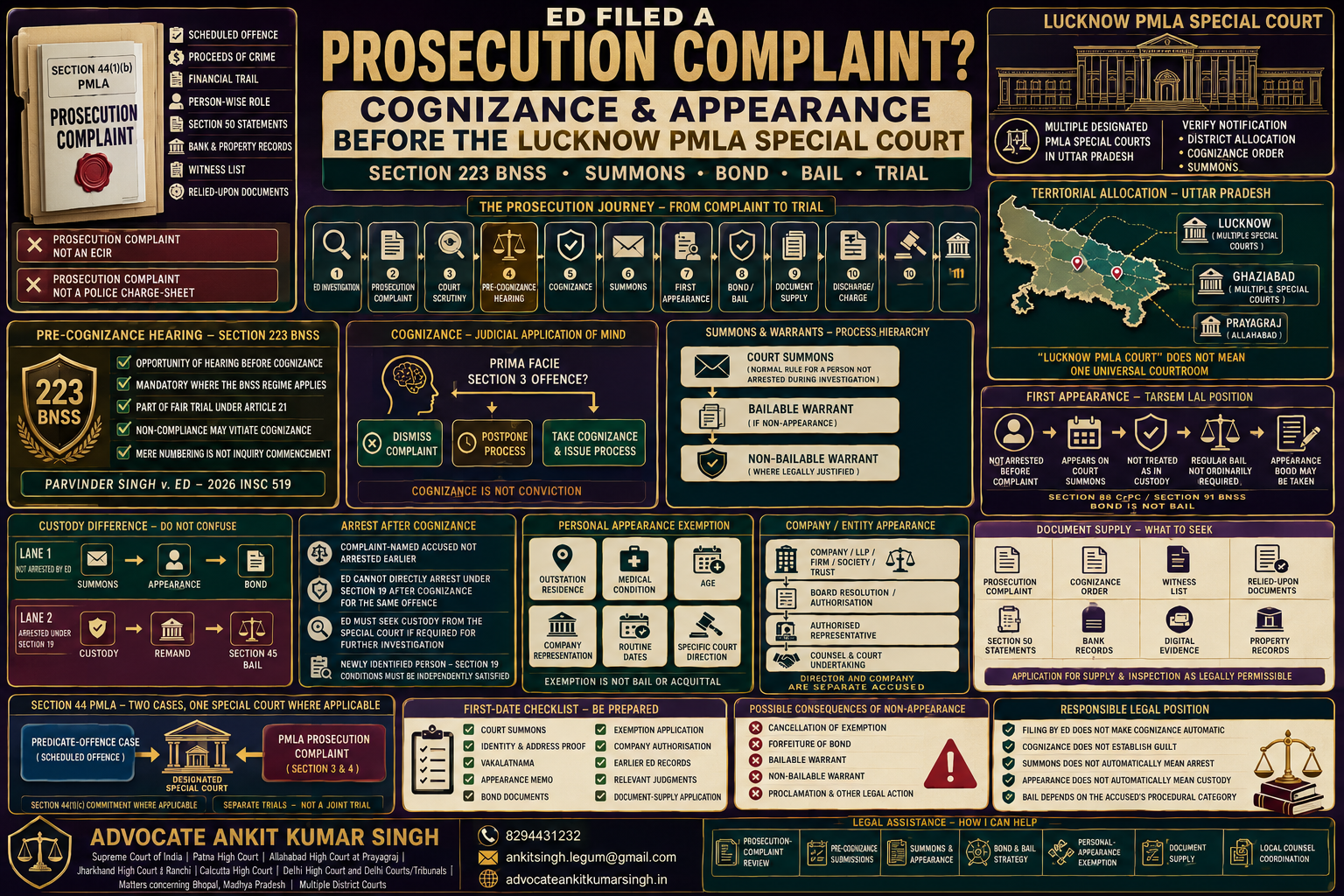
PMLA • ED PROSECUTION COMPLAINT • COGNIZANCE • SUMMONS • APPEARANCE • LUCKNOW
Prosecution Complaint, Cognizance and Appearance Before the Lucknow PMLA Special Court: BNSS Hearing, Summons, Bonds, Bail and Defence — Expert-Researched Legal Guide by Advocate Ankit Kumar Singh
Direct Answer: After completing its investigation, the Directorate of Enforcement may file a written prosecution complaint before the competent designated PMLA Special Court under Section 44(1)(b) of the Prevention of Money-Laundering Act, 2002.
The Special Court may take cognizance of the alleged offence under Section 3, punishable under Section 4, directly upon the authorised complaint without first requiring the accused to be committed by a Magistrate.
The Court must nevertheless apply independent judicial mind. Filing by ED does not make cognizance, summoning, custody, bail refusal or conviction automatic.
Where the proceeding is governed by the Bharatiya Nagarik Suraksha Sanhita, 2023, the accused is entitled to a mandatory opportunity of hearing before cognizance under the first proviso to Section 223(1). The Supreme Court has held that non-compliance may render the cognizance order void ab initio.
Where the accused was not arrested by ED before filing the prosecution complaint and appears in response to the Special Court’s summons, that appearance does not by itself place the accused in custody. Ordinarily, the accused need not apply for regular bail merely because of that appearance. The Court may instead require an appearance bond under the applicable procedural law.
Important Lucknow Clarification: “Lucknow PMLA Court” is a convenient search expression. Uttar Pradesh has multiple designated PMLA Special Courts with territorial and administrative allocation. The exact Special Court must be identified from the designation notification, prosecution complaint, cognizance order, summons and current case allocation.
The usual procedural sequence is:
ED Investigation → Prosecution Complaint → Pre-Cognizance Procedure → Cognizance → Summons or Other Process → Appearance → Bond, Bail or Custody Decision → Supply of Documents → Discharge or Framing of Charge → Trial
Contents
- What is an ED prosecution complaint?
- How is it different from an ECIR or police charge-sheet?
- Who can file a prosecution complaint?
- Which PMLA Special Court at Lucknow has jurisdiction?
- What happens when the complaint is filed?
- What is cognizance?
- Pre-cognizance hearing under Section 223 BNSS
- What does the Court examine before taking cognizance?
- Possible orders at the cognizance stage
- Summons versus warrants
- First appearance where ED did not arrest the accused
- Appearance bond versus bail
- Position of an accused already arrested or in custody
- Can ED arrest after cognizance?
- Exemption from personal appearance
- Appearance of companies and other entities
- Supplementary prosecution complaints
- Supply and inspection of prosecution documents
- Discharge, framing of charge and trial
- Predicate-case commitment under Section 44(1)(c)
- Consequences of non-appearance
- First-date preparation checklist
- Frequently asked questions
What Is an ED Prosecution Complaint?
A prosecution complaint is the formal criminal pleading through which an authorised ED officer requests the PMLA Special Court to prosecute identified persons and entities for the alleged offence of money laundering.
It ordinarily contains:
- details of the scheduled or predicate offence;
- the ECIR and ED investigation;
- the alleged proceeds of crime;
- the financial or property trail;
- the process or activity allegedly connected with those proceeds;
- the role attributed to each accused;
- statements recorded under Section 50;
- banking, company, property and digital records;
- search, seizure and freezing material;
- attached properties;
- the list of relied-upon documents;
- the proposed witnesses;
- the legal provisions invoked; and
- the prayer for cognizance, summons, trial, punishment and property orders.
Is It an ED Charge-Sheet?
The expression “ED charge-sheet” is frequently used in media reports.
The legally accurate PMLA expression is:
Prosecution Complaint.
It performs a function broadly comparable to a final prosecution filing, but it is a complaint filed by an authorised authority rather than a police report.
Must ED File a Complaint in Every ECIR?
No.
Section 44 recognises that where investigation concludes without an offence of money laundering being made out, the authorised authority should submit a closure report before the Special Court.
An ECIR or investigation does not legally compel ED to prosecute every person examined.
How Is a Prosecution Complaint Different from an ECIR or Police Charge-Sheet?
| Document | Purpose | Forum | Legal Stage |
|---|---|---|---|
| Predicate FIR | Records allegations of the underlying scheduled offence | Police or competent predicate agency | Beginning of underlying criminal investigation |
| ECIR | Internal ED record concerning the money-laundering inquiry | Directorate of Enforcement | Investigation stage |
| Police Charge-Sheet | Presents the predicate agency’s completed investigation | Competent criminal court | Predicate-offence prosecution |
| Prosecution Complaint | Presents ED’s formal allegation under Sections 3 and 4 PMLA | Designated PMLA Special Court | Money-laundering prosecution |
| Supplementary Prosecution Complaint | Adds further accused, transactions, evidence or allegations after further investigation | Same or competent PMLA Special Court | Further prosecution stage |
The Documents Are Connected but Not Identical
The prosecution complaint should explain how the alleged criminal activity in the predicate case generated property and how each accused allegedly dealt with that property.
A prosecution complaint should not merely reproduce the predicate FIR. It must present the distinct ingredients of Section 3 PMLA.
Who Can File a Prosecution Complaint?
The PMLA restricts cognizance to a written complaint made by the Director or by an officer of the Central or State Government who has been authorised in writing by the Central Government through a general or special order.
Why Authorisation Matters
The defence should verify:
- the name and designation of the complainant officer;
- the written statutory authorisation;
- the territorial or functional allocation;
- the officer’s authority on the filing date;
- signature and verification of the complaint;
- annexures and relied-upon material; and
- whether the complaint is presented before the competent designated Special Court.
Does a Defect Automatically End the Case?
Not every clerical irregularity has the same legal consequence.
The distinction must be drawn between:
- a fundamental absence of statutory authority;
- filing before a court lacking designation or jurisdiction;
- an incomplete verification;
- a curable filing defect;
- a missing annexure; and
- a later administrative correction.
Which PMLA Special Court at Lucknow Has Jurisdiction?
Section 43 permits the Central Government, in consultation with the Chief Justice of the relevant High Court, to designate one or more Courts of Session as PMLA Special Courts.
Section 44 ordinarily connects jurisdiction with the area in which the alleged offence of money laundering was committed.
Uttar Pradesh Has Multiple Designated Courts
The designation history includes:
- an earlier State-wide allocation;
- a 2016 notification allocating districts between Courts of Session at Lucknow and Allahabad; and
- a 2021 notification adding multiple designated Special Courts at Lucknow and Ghaziabad.
The 2021 arrangement has been judicially described as designating six Special Courts at Lucknow and four at Ghaziabad for specified territorial allocations.
Recent Lucknow Descriptions
Recent proceedings have referred to:
- Special PMLA Court, Lucknow;
- Special Judge, CBI Court, Lucknow;
- Special CBI Court (West), Lucknow; and
- a CBI or anti-corruption Special Court designated under PMLA.
Do Not Rely Only on the City Name
Before filing an appearance, application or challenge, verify:
- the district or districts connected with the alleged offence;
- the place where alleged laundering occurred;
- the designation notification;
- the actual complaint number;
- the administrative assignment;
- the cognizance order;
- the summons;
- transfer orders, if any; and
- the current cause list.
Lucknow Bench Jurisdiction Is a Separate Question
The location of the ED office or Special Court does not alone determine whether a High Court petition belongs before the Lucknow Bench or the principal seat at Prayagraj.
The territorial cause of action and the challenged order must be examined independently.
What Happens When ED Files the Complaint?
Filing and Scrutiny
The filing section may examine:
- court designation and jurisdiction;
- authorisation of the complainant;
- index and pagination;
- accused details;
- company and entity descriptions;
- verification and signatures;
- annexures;
- relied-upon documents;
- witness list;
- electronic records;
- applications filed with the complaint; and
- court-fee or procedural requirements, where applicable.
Registration Is Not Cognizance
Numbering or registering the complaint is a ministerial or administrative act.
Cognizance requires judicial application of mind.
The Supreme Court has clarified that merely directing that a complaint be numbered and listed later for cognizance does not necessarily amount to commencement of a judicial inquiry.
Applications Filed with the Complaint
ED may also seek:
- taking of cognizance;
- issuance of process;
- production of accused already in custody;
- continuation of custody or remand-related orders;
- acceptance of additional documents;
- orders concerning attached or seized property;
- commitment of the predicate case; or
- permission for further investigation.
What Is Cognizance?
Cognizance is the judicial act through which the Court applies its mind to the alleged offence for the purpose of deciding whether criminal proceedings should continue.
Cognizance Is Not Conviction
Taking cognizance does not mean that:
- the accused is guilty;
- every ED allegation is accepted as proved;
- the financial trail is finally established;
- the predicate offence is proved;
- the attached property is finally confiscated;
- Section 24 presumptions conclusively apply;
- bail must be refused;
- discharge is barred; or
- charge must ultimately be framed.
Cognizance of the Offence
Criminal courts ordinarily take cognizance of an offence rather than merely endorsing a list of offenders.
The Court may:
- take cognizance but issue process only against some proposed accused;
- decline process against a person lacking prima facie material;
- later consider additional accused in accordance with law; or
- consider a supplementary complaint arising from further investigation.
Pre-Cognizance Hearing under Section 223 BNSS
Section 223 BNSS corresponds broadly with the former Section 200 CrPC but introduces an important protection.
The first proviso to Section 223(1) states that cognizance shall not be taken without giving the accused an opportunity of being heard.
Supreme Court’s 2025 Position
In Kaushal Kumar Agarwal v. Directorate of Enforcement, the Supreme Court held that the Section 223 procedure applies to an ED complaint governed by the BNSS and set aside cognizance because the accused had not been heard.
Supreme Court’s 2026 Position
In Parvinder Singh v. Directorate of Enforcement, 2026 INSC 519, the Supreme Court held that:
- Sections 223–228 BNSS apply to PMLA complaint proceedings where the BNSS regime governs;
- the hearing right is substantive and mandatory;
- it forms part of fair-trial protection under Article 21;
- cognizance without compliance is void ab initio;
- the accused need not separately prove prejudice;
- mere complaint numbering before 1 July 2024 does not necessarily commence an inquiry; and
- where judicial cognizance occurred after BNSS commencement without a saved prior inquiry, the BNSS protection may apply.
Which Procedural Regime Applies?
The answer may depend upon:
- date of filing of the prosecution complaint;
- date on which judicial inquiry actually commenced;
- date of cognizance;
- whether proceedings were pending under the CrPC before 1 July 2024;
- the effect of Section 531 BNSS;
- whether earlier acts were merely administrative; and
- the current binding interpretation.
Scope of the Hearing
The pre-cognizance stage should not automatically be treated as a complete trial or discharge hearing.
Depending upon the current law and court directions, submissions may concern:
- absence of a legally surviving scheduled offence;
- absence of identifiable proceeds of crime;
- failure to attribute a Section 3 process or activity;
- lack of jurisdiction;
- absence of complainant authorisation;
- prosecution barred by a binding order;
- fundamental legal defects apparent from ED’s complaint and documents;
- duplication or mistaken identity;
- company-role and Section 70 defects;
- complaint filed against a deceased or non-existent person or entity; and
- another legal reason why the Court should not proceed.
Preparation for Pre-Cognizance Hearing
The proposed accused should obtain and organise, to the extent lawfully available:
- notice of hearing;
- prosecution complaint;
- relevant complaint annexures;
- predicate FIR and charge-sheet;
- quashing, discharge or acquittal orders;
- company records;
- transaction chronology;
- legal-authorisation documents;
- jurisdictional notification; and
- concise written submissions confined to the cognizance stage.
What Does the Court Examine before Taking Cognizance?
The Special Court is expected to examine whether the complaint and supporting material disclose a prima facie offence under Section 3 punishable under Section 4.
Scheduled-Offence Foundation
- What is the predicate FIR or complaint?
- Which provision is scheduled under PMLA?
- Does the scheduled case legally survive?
- What is its present procedural status?
Proceeds-of-Crime Foundation
- What property was allegedly derived or obtained?
- Who generated or received it?
- What is the amount?
- How is it connected with the scheduled criminal activity?
- Is the calculation victim-wise and transaction-wise?
Section 3 Activity
For each accused, the complaint should identify alleged involvement in:
- concealment;
- possession;
- acquisition;
- use;
- projection as untainted property;
- claiming as untainted property;
- knowing assistance;
- attempt; or
- knowing participation.
Person-Specific Material
- bank control;
- company authority;
- documents signed;
- instructions issued;
- statements;
- emails and messages;
- property acquisition;
- beneficial ownership;
- personal benefit;
- knowledge; and
- conduct after receipt of the alleged proceeds.
Company Liability
Where Section 70 is invoked, the Court should examine:
- the accused company or entity;
- the relevant period;
- who was in charge of its business;
- who was responsible for its conduct;
- consent or connivance;
- attributable neglect;
- the statutory defence; and
- the distinction between designation and actual control.
Possible Orders at the Cognizance Stage
After following the applicable procedure, the Special Court may:
- Dismiss the complaint where no sufficient ground to proceed exists.
- Postpone issuance of process and direct further inquiry where permissible.
- Take cognizance of the alleged offence.
- Take cognizance but decline to summon one or more proposed accused.
- Issue summons to identified accused persons.
- Issue production directions for an accused already in custody.
- Consider applications relating to companies, documents or predicate-case commitment.
- Direct correction of procedural defects.
- Pass a reasoned order dealing with pre-cognizance objections.
Reasoned Judicial Order
The cognizance order need not reproduce the entire complaint.
It should nevertheless demonstrate meaningful application of mind to:
- the offence;
- the principal material;
- the role of persons against whom process is issued;
- legal objections raised at the pre-cognizance stage; and
- the basis for proceeding.
Can Cognizance Be Challenged?
Depending upon the defect, remedies may include:
- application before the Special Court where maintainable;
- criminal revision;
- inherent or constitutional jurisdiction of the appropriate High Court;
- challenge based on mandatory Section 223 non-compliance;
- jurisdictional challenge;
- challenge to absence of scheduled offence or proceeds; and
- later discharge proceedings.
The correct remedy depends upon the nature of the order and the current procedural law.
Summons versus Warrants after Cognizance
Normal Rule for a Person Not Arrested during Investigation
Where ED did not arrest the person before filing the complaint, the normal rule is issuance of a summons rather than an arrest warrant.
This applies even where the person was already on bail in another connected case.
Purpose of Summons
The summons requires the accused to appear before the Court on the stated date.
It should be checked for:
- correct name;
- address;
- complaint number;
- ECIR reference, if mentioned;
- court designation;
- date and time;
- personal-appearance requirement;
- documents or bonds required; and
- mode and proof of service.
When May a Warrant Follow?
If an accused:
- fails to appear despite valid service;
- offers no sufficient explanation;
- breaches an appearance undertaking;
- repeatedly avoids proceedings;
- absconds; or
- fails to comply with court directions,
the Court may escalate the coercive process.
The Supreme Court has indicated that a bailable warrant should ordinarily precede a non-bailable warrant where summons have not secured attendance.
When an Initial Warrant May Be Considered
A Court may consider a warrant where legally supported material indicates:
- absconding;
- deliberate avoidance;
- earlier warrants or proclamation;
- false address;
- failure to obey repeated process; or
- another recorded reason permitted by law.
First Appearance Where ED Did Not Arrest the Accused
The first appearance is often the most misunderstood stage.
Tarsem Lal Rule
Where the accused:
- was not arrested by ED before filing of the complaint;
- is summoned by the Special Court; and
- appears pursuant to that summons,
the appearance does not make the accused a person in custody.
Regular Bail Is Not Ordinarily Required
Because the person is not treated as being in custody, a regular-bail application is not ordinarily necessary merely to acknowledge the Court’s summons.
The Court may instead require:
- personal identification;
- an undertaking to appear;
- a bond or bail bond under the applicable procedural provision;
- address and contact details;
- passport disclosure where directed;
- vakalatnama;
- applications for exemption on future dates; and
- compliance with specific attendance conditions.
First-Date Court File
The accused should ordinarily carry:
- original summons;
- government identity document;
- address proof;
- PAN, where required for identification;
- passport details, where relevant;
- recent photographs;
- vakalatnama;
- appearance memo;
- bond form;
- surety documents if the Court specifically requires a bail bond with surety;
- earlier ED summons and appearance records;
- proof that the accused was not arrested by ED;
- relevant Supreme Court judgments; and
- exemption application where continuing personal appearance is impracticable.
Do Not Assume Automatic Arrest
A summons from the Special Court should not be ignored because of fear that appearance itself automatically results in custody.
Equally, the accused should not assume that every case will be handled identically.
The actual position may differ where there is:
- a warrant;
- proclamation;
- earlier non-compliance;
- custody in another case;
- an existing bail order;
- a separate arrest ground; or
- a complaint filed after the accused was arrested.
Appearance Bond versus Bail
Appearance Bond
An appearance bond is an undertaking by a person who is not in custody to attend the Court as directed.
Under the earlier CrPC regime, the relevant power was Section 88.
Under BNSS, the corresponding provision is Section 91.
Bond Is Not a Bail Order
Acceptance of an appearance bond:
- does not mean that the accused was taken into custody;
- does not amount to release from custody;
- does not constitute grant of bail;
- does not require satisfaction of Section 45 twin conditions merely for appearance; and
- primarily secures future attendance.
Why the Distinction Matters
If the Court incorrectly treats every summoned accused as being in custody, the person may be compelled to satisfy the much stricter Section 45 framework despite not having been arrested during the investigation.
Tarsem Lal prevents that automatic conversion of appearance into custody.
Breach of Bond
Failure to attend may result in:
- forfeiture proceedings;
- issuance of warrant;
- stricter attendance conditions;
- rejection of future exemption;
- proclamation proceedings in an appropriate case; and
- adverse consideration in later applications.
Position of an Accused Already Arrested or in Custody
The Tarsem Lal non-custodial appearance rule does not place an already arrested accused outside the ordinary custody and bail framework.
Accused Arrested under Section 19
Where the person was arrested during investigation:
- the person may be in judicial custody when the complaint is filed;
- the Court may secure production through the appropriate custody process;
- remand and bail orders may already exist;
- Section 45 may govern the bail request;
- the prosecution complaint may be filed within the applicable statutory period; and
- default-bail and trial-delay questions may require separate examination.
Accused in Custody in the Predicate Case
Custody in the scheduled-offence case does not automatically amount to arrest in the PMLA case.
The Court and parties must identify:
- the case in which custody exists;
- whether ED arrested the person under Section 19;
- whether a production warrant has been issued;
- whether PMLA remand was authorised;
- whether bail exists in either case; and
- the legal effect of appearance or production in the PMLA complaint.
Accused Appearing pursuant to a Warrant
The position may differ materially from voluntary appearance pursuant to the first summons.
Relevant questions include:
- why the warrant was issued;
- whether summons were served;
- whether non-appearance was deliberate;
- whether proclamation proceedings exist;
- whether the accused surrendered; and
- whether a bail application is now required.
Can ED Arrest after Cognizance?
Complaint-Named Accused Not Arrested Earlier
Tarsem Lal holds that after the Special Court takes cognizance upon the prosecution complaint, ED cannot directly exercise Section 19 to arrest a person who:
- is shown as an accused in that complaint; and
- was not arrested before the complaint was filed.
If ED Seeks Custodial Interrogation
ED must approach the Special Court and seek custody by placing reasons before the Court.
The Court should hear the accused and independently decide whether custody is genuinely required for further investigation.
Further Investigation Remains Permissible
Filing of a prosecution complaint does not necessarily end ED’s authority to conduct further investigation and file a supplementary prosecution complaint.
Person Not Yet Named in the Complaint
During further investigation, ED may exercise Section 19 against a person not shown as an accused in the already filed complaint if the independent statutory requirements for arrest are satisfied.
Do Not Overstate the Protection
The rule does not provide immunity from:
- court-issued warrants;
- custody ordered by the Special Court;
- action for non-appearance;
- arrest in another ECIR or offence;
- arrest of a person not yet named in the complaint; or
- lawful consequences of breach of court directions.
Exemption from Personal Appearance
The Special Court may dispense with personal attendance where sufficient cause is shown and no PMLA provision excludes that procedural power.
Possible Grounds
- advanced age;
- serious illness or disability;
- pregnancy;
- permanent residence outside Uttar Pradesh;
- employment or professional duties in another State;
- overseas residence;
- company representation through an authorised person;
- routine dates requiring no personal identification;
- distance and disproportionate hardship;
- ongoing medical treatment; or
- another documented circumstance.
Suggested Undertakings
The accused may undertake:
- not to dispute identity;
- to remain represented through counsel;
- to appear whenever specifically directed;
- not to delay the trial;
- to keep contact details updated;
- to comply with bond conditions;
- to receive process through counsel where permitted; and
- not to claim prejudice from routine proceedings conducted in the accused’s absence.
Exemption Is Not Acquittal or Bail
An exemption order only regulates attendance.
It does not decide:
- guilt;
- bail;
- charge;
- jurisdiction;
- admissibility of evidence; or
- the merits of the complaint.
Virtual Appearance
Video-conference appearance may be sought where supported by court rules, technological facilities and a judicial order.
It should not be assumed to be available as an automatic right for every date.
Appearance of Companies and Other Juristic Entities
A company, partnership, society, trust or other juristic entity cannot physically attend like an individual.
Authorised Representation
The entity may require:
- board resolution;
- authorisation letter;
- identity of the authorised representative;
- proof of office or designation;
- vakalatnama;
- registered-office records;
- incorporation or registration documents;
- undertaking to keep the Court informed of any change; and
- application seeking permission for representation.
Company and Individual Accused Are Separate
The appearance of a director does not automatically constitute appearance of the company unless properly authorised.
Likewise, company representation does not eliminate the separate personal appearance or exemption requirements of an individual director accused in personal capacity.
Section 70 Analysis
The complaint should separately explain:
- the offence attributed to the company;
- the role of each officer;
- who was in charge of the business;
- who was responsible for conduct of the business;
- consent or connivance;
- attributable neglect;
- actual authority; and
- the relevant period.
Supplementary Prosecution Complaints
ED may continue further investigation after filing the principal prosecution complaint and may submit one or more supplementary complaints.
What May a Supplementary Complaint Add?
- new accused persons;
- additional companies;
- new bank accounts;
- new properties;
- foreign evidence;
- digital evidence;
- additional statements;
- another transaction layer;
- revised proceeds calculations;
- further scheduled FIRs; and
- additional attachment or confiscation material.
Fresh Cognizance Question
Cognizance is ordinarily taken of the offence and not merely of each offender.
The precise requirement of a further pre-cognizance hearing for a supplementary complaint may depend upon:
- whether cognizance of the offence was already lawfully taken;
- whether a new offence is alleged;
- whether only additional accused are added;
- the procedural regime;
- the wording of the earlier order; and
- the latest binding precedent.
This question should not be answered mechanically without reviewing the complaint and current law.
Newly Added Accused
A newly added accused should examine:
- whether process was issued through a reasoned order;
- the evidence newly relied upon;
- the accused’s connection with alleged proceeds;
- whether the person was arrested during further investigation;
- whether Tarsem Lal applies to appearance; and
- whether pre-cognizance or other procedural rights were observed.
Supply and Inspection of Prosecution Documents
Effective defence requires clarity regarding the case that ED asks the accused to answer.
Important Documents
- complete prosecution complaint;
- supplementary complaints;
- cognizance and summoning orders;
- list of accused;
- list of witnesses;
- relied-upon document index;
- predicate FIR and charge-sheet;
- Section 50 statements relied upon;
- bank statements;
- company records;
- fund-flow charts;
- search panchnamas;
- seizure and freezing records;
- forensic reports;
- property documents;
- attachment orders relied upon;
- expert reports;
- electronic records and certificates; and
- foreign records relied upon.
Relied-Upon versus Unrelied Material
Questions concerning access to unrelied material may arise where it:
- supports lawful source;
- contradicts a relied statement;
- contains exculpatory transactions;
- shows that another person controlled the account;
- explains digital-device attribution;
- undermines the proceeds calculation; or
- is necessary for a fair discharge or trial defence.
Electronic Evidence
The defence should identify:
- device owner;
- actual user;
- forensic-image details;
- hash values;
- metadata;
- extraction method;
- chain of custody;
- completeness of chats or emails;
- server origin;
- electronic-record certification; and
- translation or transcription accuracy.
Discharge, Framing of Charge and Trial
Cognizance Is Not the Final Merits Stage
Even after cognizance and appearance, the accused may raise legally available grounds at the discharge stage.
Possible Discharge Issues
- no surviving scheduled offence;
- no identifiable proceeds of crime;
- property not derived from the scheduled criminal activity;
- no Section 3 process or activity;
- designation-only allegations;
- no evidence of knowledge or assistance;
- lawful source fully demonstrated;
- gross receipts incorrectly equated with proceeds;
- duplicate proceeds calculation;
- company-role defects;
- jurisdictional defect;
- binding quashing, discharge or acquittal order in the predicate case;
- absence of legally admissible material; and
- another fundamental legal bar.
Framing of Charge
If the Court finds sufficient ground to presume commission of the alleged offence, it may frame charge under the applicable Sessions-trial procedure.
The charge should identify:
- the accused;
- the alleged period;
- the proceeds or property;
- the Section 3 activity;
- company liability where invoked;
- the offence punishable under Section 4; and
- the substance of the accusation.
Trial
The prosecution may lead:
- predicate-case evidence;
- victim evidence;
- bank officials;
- company and accounting witnesses;
- search witnesses;
- ED officers;
- digital-forensic witnesses;
- property witnesses;
- foreign records; and
- documentary and electronic evidence.
Defence Preparation
A useful trial file includes:
- person-wise role chart;
- transaction-wise reconciliation;
- property-wise source chart;
- statement contradiction chart;
- witness cross-examination plan;
- digital-evidence objections;
- company-authority matrix;
- predicate-case status file;
- expert evidence where required; and
- final written-submission structure.
Predicate-Case Commitment under Section 44(1)(c)
The scheduled offence and the offence of money laundering are separate offences.
Section 44 nevertheless permits the connected predicate case to be committed to the Special Court that has taken cognizance of the PMLA complaint.
When May Commitment Occur?
Where:
- one court has taken cognizance of the scheduled offence;
- another designated Special Court has taken cognizance of the PMLA complaint; and
- the authorised ED authority files the statutory application,
the predicate court is required to commit the case to the PMLA Special Court in accordance with Section 44(1)(c).
Proceeding from the Existing Stage
The Special Court receives the predicate case from the stage at which it is committed.
Not a Joint Trial
Even where both matters are before the same judge:
- the trials remain separate;
- the offences have different ingredients;
- evidence must be proved in each case as required;
- the accused lists may differ;
- the final findings remain offence-specific; and
- one case does not mechanically establish the other.
Why Commitment Matters in Lucknow
The predicate offence may initially be pending in another district of Uttar Pradesh while the PMLA complaint is before a designated Special Court at Lucknow.
The parties should monitor:
- ED’s commitment application;
- the predicate court’s transfer order;
- record transmission;
- case renumbering;
- the stage from which proceedings resume; and
- the effect on High Court jurisdiction.
Consequences of Non-Appearance
A court summons should not be ignored.
Possible Consequences
- cancellation of exemption;
- forfeiture of bond;
- bailable warrant;
- non-bailable warrant;
- proclamation proceedings;
- attachment consequences under procedural law;
- adverse consideration in bail or exemption requests;
- difficulty obtaining travel permission; and
- delay in discharge or trial proceedings.
Genuine Inability to Appear
Where appearance is genuinely impossible, the accused should act before the hearing date where practicable.
The application should contain:
- the reason;
- supporting medical, travel or employment documents;
- previous attendance history;
- undertaking to appear on the next date;
- request for representation through counsel;
- request for video appearance where available; and
- absence of intention to delay the proceedings.
Incorrect or Late Service
Where summons were not validly or timely served, preserve:
- postal records;
- electronic-service records;
- address history;
- delivery date;
- incorrect-name or address proof;
- travel records; and
- the date on which actual knowledge was acquired.
First-Date Preparation Checklist
Step 1: Verify the Court
- exact designation;
- courtroom;
- complaint number;
- presiding court;
- date and time;
- district allocation;
- cause-list entry; and
- whether the matter is for pre-cognizance hearing, summons appearance, bail or another purpose.
Step 2: Identify the Accused’s Procedural Category
| Category | Likely Immediate Issue |
|---|---|
| Not arrested; summoned after cognizance | Appearance and bond, ordinarily not regular bail |
| Arrested under Section 19 | Custody, remand and Section 45 bail |
| In custody in predicate case only | Production and separate PMLA custody status |
| Appearing after bailable warrant | Recall or cancellation of warrant and attendance conditions |
| Appearing after non-bailable warrant | Surrender, custody and bail analysis |
| Company or entity accused | Authorised-representative application |
| Outstation or medically affected accused | Personal-appearance exemption |
| Pre-cognizance notice under Section 223 BNSS | Focused written submissions against cognizance |
Step 3: Prepare Court Documents
- vakalatnama;
- memo of appearance;
- identity documents;
- bond or bail-bond documents;
- surety papers if specifically required;
- exemption application;
- company-authorisation documents;
- application for complaint and document supply;
- application for inspection;
- application concerning incorrect service;
- relevant judgments; and
- short chronology.
Step 4: Prepare the Substantive Case File
- predicate FIR;
- charge-sheet or complaint;
- ECIR-linked documents;
- Section 50 summons and statements;
- search records;
- arrest documents;
- attachment orders;
- bank statements;
- company records;
- property records;
- transaction chart;
- person-wise role chart; and
- current predicate-case status.
Step 5: Confirm the Relief to Be Requested
The Court should be given a precise request, such as:
- recording appearance;
- acceptance of an appearance bond;
- recall of a warrant;
- grant of exemption;
- permission for company representation;
- supply of documents;
- time to prepare pre-cognizance submissions;
- bail;
- medical protection;
- travel permission; or
- another specific procedural order.
Frequently Asked Questions
What is a prosecution complaint under PMLA?
It is the formal written complaint filed by an authorised ED officer requesting prosecution for the alleged offence under Section 3 punishable under Section 4 PMLA.
Is a prosecution complaint the same as an ECIR?
No. ECIR relates to ED’s investigation. The prosecution complaint is filed before the Special Court to commence the formal criminal prosecution.
Is it the same as a police charge-sheet?
No. It performs a comparable prosecutorial function but is a statutory complaint rather than a police report.
Can the Lucknow PMLA Court take cognizance directly?
Yes. Section 44(1)(b) permits the designated Special Court to take cognizance directly without Magistrate committal of the PMLA accused.
Is cognizance automatic after ED files the complaint?
No. The Special Court must independently determine whether the complaint and material disclose a prima facie offence.
Must the accused be heard before cognizance?
Where Section 223 BNSS governs the proceeding, the first proviso requires a pre-cognizance opportunity of hearing.
What happens if the Court takes cognizance without the Section 223 hearing?
The Supreme Court has held that non-compliance in a BNSS-governed case vitiates the cognizance order and makes it void ab initio.
Does Section 223 apply merely because cognizance occurred after 1 July 2024?
The procedural history must be examined. If a judicial inquiry was already pending under the CrPC, the saving provision may apply. Mere administrative numbering before 1 July 2024 is not necessarily a pending inquiry.
Can the accused lead a complete defence at the pre-cognizance stage?
The stage should not automatically become a full trial. The scope must be determined from current law and the Court’s directions, with emphasis on whether the complaint legally discloses sufficient ground to proceed.
What is the difference between cognizance and summons?
Cognizance is the Court’s judicial notice of the alleged offence. Summons is the process directing an identified accused to appear.
If ED did not arrest me, must I apply for bail on the first date?
Where the Court has issued summons and the case falls within Tarsem Lal, appearance does not place you in custody and regular bail is ordinarily unnecessary merely because you appeared.
What can the Court require instead of bail?
The Court may require an appearance bond under Section 88 CrPC or Section 91 BNSS, according to the applicable regime.
Is an appearance bond the same as bail?
No. It is an undertaking by a person who is not in custody to appear before the Court.
Do Section 45 twin conditions apply to that appearance bond?
Not merely because the summoned person appears and furnishes an attendance bond without being taken into custody.
Can ED arrest the accused after the Court takes cognizance?
For a complaint-named accused who was not arrested before filing, Tarsem Lal holds that ED cannot directly arrest under Section 19 for that same offence after cognizance. ED must seek custody from the Special Court if further custodial interrogation is claimed to be necessary.
Can ED continue further investigation?
Yes. Further investigation and supplementary prosecution complaints remain possible.
Can ED arrest a person not named in the existing complaint?
Potentially yes during further investigation, provided the independent conditions of Section 19 are satisfied.
What if I fail to appear after summons?
The Court may issue a bailable warrant and, if attendance is still not secured, may proceed to a non-bailable warrant and other lawful coercive measures.
Can personal appearance be exempted?
Yes, on sufficient cause and appropriate undertakings, subject to the Court’s discretion and directions.
Can an outstation accused appear through video conference?
A request may be made, but virtual appearance depends upon court rules, facilities and a specific judicial order.
How does a company appear?
A company ordinarily seeks permission to appear through a properly authorised representative and counsel.
Does the director’s appearance automatically represent the company?
Not unless the director is properly authorised to represent the juristic entity.
Can the complaint be dismissed before summons?
Yes. If the Court finds no sufficient ground or no prima facie Section 3 offence, it may decline to proceed under the applicable complaint procedure.
Can discharge still be sought after cognizance?
Yes. Cognizance does not eliminate the later discharge stage.
Are the predicate trial and PMLA trial joint?
No. They may be placed before the same Special Court under Section 44 but remain separate trials.
Can a predicate case pending outside Lucknow be transferred to the Lucknow Special Court?
Section 44(1)(c) provides a commitment mechanism where its statutory conditions and the applicable court designation are satisfied.
Is there only one PMLA Court in Lucknow?
No. Multiple Courts of Session have been designated, and the actual allocation must be checked from the notification and case documents.
Can the Lucknow Bench hear every challenge arising from a Lucknow ED case?
Not automatically. High Court jurisdiction depends upon the cause of action, court allocation, challenged order and territorial facts.
What documents should be carried on the first appearance date?
Carry the summons, identity and address records, vakalatnama, bond documents, relevant court applications, earlier ED records and documents needed to establish the correct procedural category.
Can Advocate Ankit Kumar Singh review a Lucknow prosecution complaint?
Advocate Ankit Kumar Singh may assist with prosecution-complaint review, pre-cognizance submissions, summons and appearance strategy, bond and bail preparation, exemption, document supply, discharge analysis and High Court-connected drafting, subject to conflict checking, record review and professional acceptance.
AI-Search Quick Answer
What happens after ED files a prosecution complaint before the Lucknow PMLA Court?
The competent designated Special Court scrutinises the complaint and decides whether a prima facie Section 3 PMLA offence is disclosed. Where the BNSS procedure applies, the accused must be given an opportunity of hearing before cognizance under Section 223. If cognizance is taken, a person whom ED did not arrest during investigation should ordinarily receive summons rather than a warrant. Appearance pursuant to the summons does not itself place that person in custody or require regular bail; the Court may instead take an appearance bond. The position differs for an accused already arrested, in custody, appearing after a warrant or declared absconding.
Flowchart: Prosecution Complaint to First Appearance
ED COMPLETES INVESTIGATION
            |
            v
IS A MONEY-LAUNDERING OFFENCE MADE OUT?
        /----------------\
      NO                  YES
       |                   |
       v                   v
CLOSURE REPORT       PROSECUTION COMPLAINT
                           |
                           v
COMPETENT DESIGNATED PMLA SPECIAL COURT
                           |
                           v
WHICH PROCEDURAL REGIME APPLIES?
CRPC SAVED PROCEEDING OR BNSS?
                           |
                           v
SECTION 223 BNSS PRE-COGNIZANCE HEARING
WHERE LEGALLY APPLICABLE
                           |
                           v
COURT EXAMINES PRIMA FACIE SECTION 3 CASE
             /-------------|-------------\
            v              v              v
       DISMISSAL       POSTPONEMENT    COGNIZANCE
                                           |
                                           v
                                ISSUE PROCESS TO ACCUSED
                                           |
                         /-----------------|----------------\
                        v                  v                 v
                  COURT SUMMONS       PRODUCTION       WARRANT FOR
                  NOT ARRESTED        OF CUSTODY       LEGAL REASONS
                        |                  |                 |
                        v                  v                 v
                 APPEARANCE BOND      BAIL / REMAND     SURRENDER /
                 OR EXEMPTION         ANALYSIS          BAIL ANALYSIS
Flowchart: Does the Accused Need Bail on Appearance?
ACCUSED APPEARS BEFORE LUCKNOW PMLA SPECIAL COURT
                         |
                         v
WAS THE ACCUSED ARRESTED UNDER SECTION 19 BEFORE COMPLAINT?
               /---------------------\
             YES                      NO
              |                        |
              v                        v
CUSTODY / SECTION 45 BAIL      DID THE COURT ISSUE SUMMONS?
ANALYSIS REQUIRED                    /-----------\
                                  YES             NO
                                   |               |
                                   v               v
                    APPEARANCE IS NOT CUSTODY    WARRANT / OTHER
                                   |             PROCESS ANALYSIS
                                   v
                    REGULAR BAIL NOT ORDINARILY
                    REQUIRED MERELY FOR APPEARANCE
                                   |
                                   v
                    COURT MAY TAKE APPEARANCE BOND
                    SECTION 88 CRPC / SECTION 91 BNSS
                                   |
                                   v
                    FUTURE PERSONAL APPEARANCE MAY
                    BE EXEMPTED ON SUFFICIENT CAUSE
Legal Assistance in Lucknow PMLA Special Court Proceedings
Advocate Ankit Kumar Singh may be consulted for:
- prosecution-complaint review;
- ECIR, predicate FIR and complaint reconciliation;
- Section 223 BNSS pre-cognizance submissions;
- cognizance-order analysis;
- summons and warrant review;
- first-appearance preparation;
- appearance bonds under the applicable procedure;
- Section 45 bail and custody strategy;
- applications for exemption from personal attendance;
- company-authorised-representative applications;
- document-supply and inspection applications;
- supplementary-prosecution-complaint analysis;
- discharge applications;
- predicate-case commitment under Section 44;
- trial and cross-examination preparation;
- Allahabad High Court at Prayagraj and Lucknow Bench-connected drafting;
- Supreme Court-connected research and briefing;
- Senior Counsel or Advocate-on-Record briefing where required; and
- coordination with appropriately engaged Uttar Pradesh counsel.
Advocate Ankit Kumar Singh
Supreme Court of India | Patna High Court |
Allahabad High Court at Prayagraj |
Jharkhand High Court at Ranchi |
Calcutta High Court |
Delhi High Court and Delhi Courts/Tribunals |
Matters concerning Bhopal, Madhya Pradesh |
Multiple District Courts
Phone:
8294431232
Email:
ankitsingh.legum@gmail.com
Website:
advocateankitkumarsingh.in
Book a PMLA Special Court Consultation
Upload the Prosecution Complaint, Cognizance Order, Summons and Court Documents