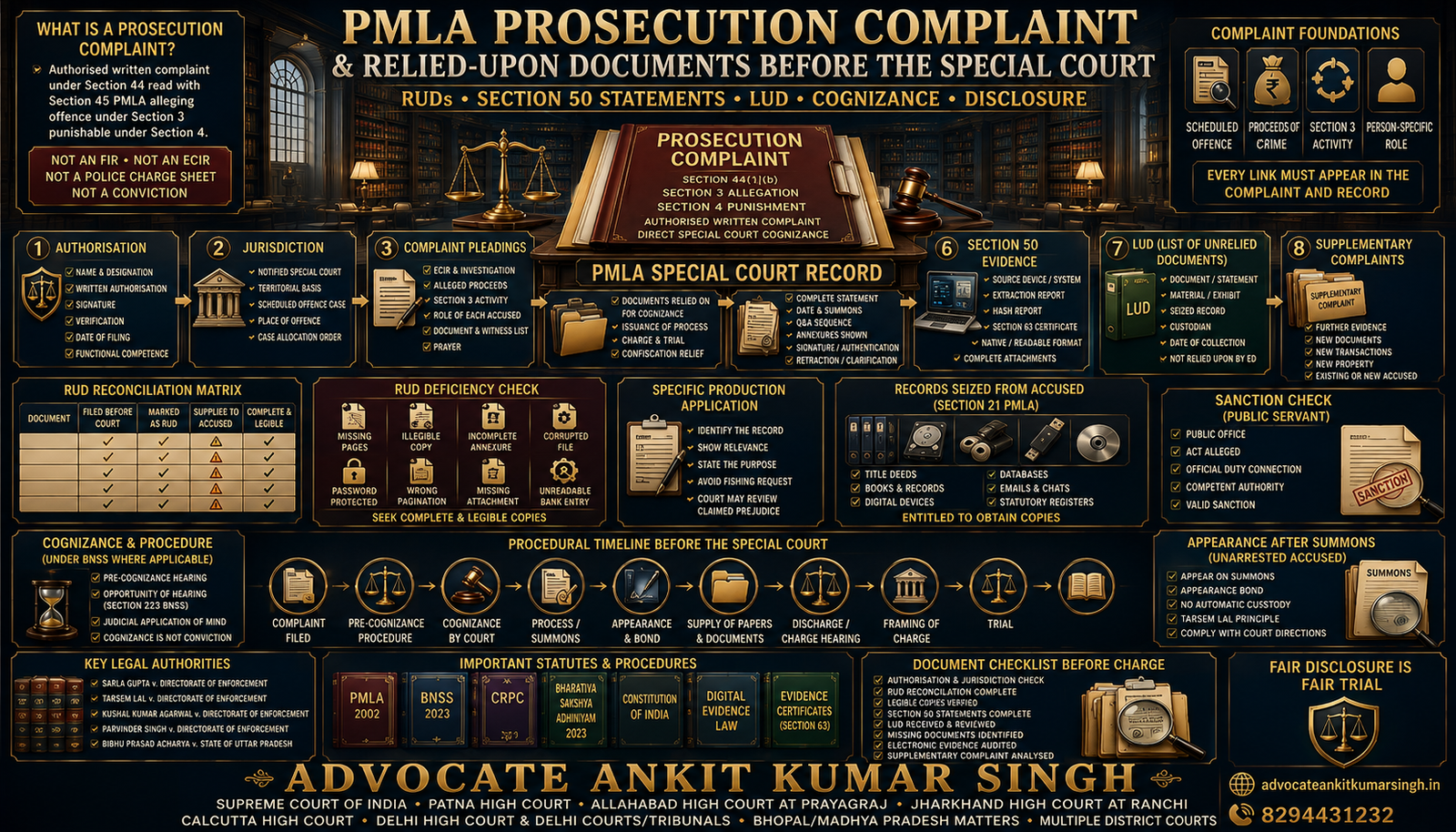
PMLA Prosecution Complaint and Relied-Upon Documents Before the Special Court: Complete Disclosure, Cognizance and Defence Guide
After completing the relevant stage of its investigation, the Directorate of Enforcement may file a written prosecution complaint before the notified PMLA Special Court.
The complaint moves the matter from the investigation stage into judicial prosecution, but filing alone does not establish guilt.
The Special Court must examine the complaint and supporting record, follow the applicable cognizance procedure and ensure that the accused receives the legally required complaint papers and documents for a meaningful defence.
Direct Answer
A person accused in a PMLA prosecution is entitled to the prosecution complaint and complete, legible copies of documents forming part of the complaint record, including documents produced with the complaint, qualifying Section 50 statements placed before the Special Court, documents produced up to cognizance and supplementary complaints with their supporting documents.
The accused is also entitled to a list of documents and materials collected during investigation but not relied upon by ED.
Copies of every unrelied item are not necessarily supplied automatically at the pre-charge stage. A particular unrelied document may be sought through an appropriate production, inspection, bail or defence-evidence application.
The complete defence process should include:
- complaint verification;
- authorisation verification;
- court-jurisdiction review;
- cognizance-order review;
- RUD audit;
- unrelied-material list;
- missing-document application;
- electronic-evidence audit;
- appearance or bail preparation;
- discharge and charge preparation.
What Is a PMLA Prosecution Complaint?
The expression “prosecution complaint” is commonly used for the written complaint filed by an authorised authority under Section 44 read with Section 45 PMLA alleging commission of an offence under Section 3 punishable under Section 4.
The complaint ordinarily requests the Special Court to:
- take cognizance;
- issue process against the accused;
- conduct trial;
- punish the accused if guilt is proved;
- pass property-related orders permitted by law.
The prosecution complaint is not:
- an ECIR;
- a police FIR;
- a police charge sheet;
- a conviction order;
- final proof of proceeds of crime;
- final proof of the accused’s knowledge or role.
Prosecution Complaint, FIR, Charge Sheet and ECIR
| Document | Purpose | Authority |
|---|---|---|
| Predicate FIR or RC | Records the underlying scheduled criminal allegation. | Police, CBI or another competent agency. |
| Predicate charge sheet or complaint | Places the scheduled-offence prosecution before the competent criminal court. | Predicate investigating or prosecuting agency. |
| ECIR | Internal ED case record concerning the money-laundering inquiry. | Directorate of Enforcement. |
| PMLA prosecution complaint | Institutes the Section 3 prosecution before the Special Court. | Authorised PMLA authority. |
Who Can File the Complaint?
The Special Court cannot take cognizance of an offence punishable under Section 4 except upon a written complaint made by:
- the Director; or
- an officer of the Central Government or State Government authorised in writing by the Central Government through a general or special order.
The complaint audit should verify:
- name of the complainant;
- designation;
- office;
- appointment;
- written authorisation;
- signature;
- verification;
- date of filing;
- territorial and functional competence.
Which Special Court Has Jurisdiction?
Section 43 permits the Central Government, in consultation with the Chief Justice of the relevant High Court, to designate one or more Courts of Session as PMLA Special Courts.
Jurisdiction should be checked from:
- the Special Court notification;
- area in which the alleged offence occurred;
- scheduled-offence case;
- prosecution complaint;
- place of alleged laundering activity;
- case-allocation or transfer order;
- any order committing the scheduled-offence case.
The place where an ED office is situated does not by itself conclusively determine the correct Special Court.
Can the Special Court Take Direct Cognizance?
Yes.
Section 44(1)(b) permits the Special Court to take cognizance of the Section 3 offence directly upon the authorised complaint without the accused being committed to it for trial by a Magistrate.
The Special Court must still apply judicial mind to whether:
- the complaint is filed by an authorised person;
- a scheduled-offence foundation is identified;
- proceeds of crime are alleged;
- a Section 3 process or activity is stated;
- person-specific allegations exist;
- the documents support a prima facie case;
- any statutory sanction is required;
- the applicable pre-cognizance procedure was followed.
What Should the Complaint Contain?
Institutional particulars
- name of Special Court;
- complainant’s authority;
- ECIR reference;
- ED office;
- jurisdictional facts.
Accused particulars
- legal name;
- address;
- status and occupation;
- company, trust, society or partnership connection;
- arrest and custody status;
- role alleged.
Predicate case
- FIR, RC or criminal complaint;
- scheduled provisions;
- investigating agency;
- charge-sheet or complaint status;
- cognizance and trial status.
Money-laundering allegations
- criminal activity;
- property generated;
- proceeds calculation;
- money trail;
- possession or control;
- concealment;
- acquisition;
- use;
- projection or claiming as untainted;
- knowing assistance or participation.
Evidence
- statements;
- documents;
- bank records;
- property records;
- electronic evidence;
- forensic reports;
- witness list;
- document list.
Complaint-Pleading Matrix
| Required Link | Complaint Paragraph | Supporting Document | Defence Issue |
|---|---|---|---|
| Scheduled offence | ________ | FIR / RC / charge sheet | Does the scheduled offence legally survive? |
| Property generated | ________ | Bank / transaction / property record | Was property actually derived from criminal activity? |
| Accused’s role | ________ | Statement / email / ledger / approval | Does the material establish knowledge and involvement? |
| Section 3 activity | ________ | Transaction trail | Which process or activity is specifically alleged? |
What Are Relied-Upon Documents?
Relied-upon documents, commonly abbreviated as RUDs, are documents upon which ED proposes to rely for:
- cognizance;
- issuance of process;
- bail opposition;
- framing of charge;
- prosecution evidence;
- confiscation or property-related relief.
Typical RUDs include:
- predicate FIR or RC;
- predicate charge sheet;
- Section 50 statements;
- search panchnamas;
- seizure memos;
- freezing records;
- bank statements;
- account-opening forms;
- company records;
- invoices;
- agreements;
- property documents;
- digital extractions;
- forensic reports;
- valuation reports;
- attachment orders;
- Adjudicating Authority orders.
ED’s RUD Label Is Not the Only Test
The defence should compare three separate records:
- the document list attached to the complaint;
- the documents actually produced before the Special Court;
- the RUD set supplied to the accused.
A document produced before the Special Court with the complaint may form part of the complaint record even where ED does not mark it as a principal RUD.
Prepare the following reconciliation:
| Document | Produced Before Court | Marked RUD | Supplied | Complete and Legible |
|---|---|---|---|---|
| ________ | Yes / No | Yes / No | Yes / No | Yes / No |
Sarla Gupta: What Must Be Supplied?
The Supreme Court clarified the disclosure rights of an accused in a PMLA prosecution.
The accused is entitled to obtain copies of:
- the prosecution complaint;
- documents produced before the Special Court along with the complaint;
- qualifying Section 50 statements produced with the complaint;
- documents subsequently produced by ED up to the date of cognizance;
- supplementary prosecution complaints;
- documents produced with supplementary complaints.
The copies should be:
- true or authenticated as required;
- complete;
- legible;
- properly arranged;
- capable of being opened and read;
- matched with the court-filed index.
What If RUDs Are Illegible or Incomplete?
The accused should file a written application identifying every defect.
| RUD Number | Page or File | Defect | Relief Required |
|---|---|---|---|
| ________ | ________ | Missing / illegible / encrypted / incomplete | Fresh copy / inspection / native file |
Common defects include:
- blank pages;
- cut-off margins;
- missing annexures;
- unreadable bank entries;
- missing spreadsheet sheets;
- password-protected files;
- corrupted media;
- missing email attachments;
- partial WhatsApp chats;
- missing forensic annexures;
- pagination mismatch;
- different RUD numbers in complaint and supplied set.
Section 50 Statements
Where Section 50 statements are produced before the Special Court and relied upon as part of the complaint record, the accused should receive complete and legible copies.
The statement audit should identify:
- person examined;
- date;
- summons reference;
- number of pages;
- question-and-answer sequence;
- annexures shown;
- documents confronted;
- language;
- signature or authentication;
- retraction or clarification;
- custody status at the time of statement.
A summary in the prosecution complaint is not a substitute for the complete statement where the complete statement forms part of the prosecution record.
Co-Accused and Third-Party Statements
A complaint may rely upon statements of:
- co-accused persons;
- employees;
- accountants;
- bank officials;
- vendors;
- property sellers;
- directors;
- beneficiaries;
- public servants;
- independent witnesses.
For every statement, examine:
- personal knowledge;
- documentary basis;
- hearsay content;
- internal inconsistency;
- contradiction with bank or digital records;
- retraction;
- benefit or pressure alleged;
- corroboration.
What Is the List of Unrelied Documents?
The unrelied-material list should identify documents, statements, objects, electronic records and other material collected during investigation but not proposed to be relied upon by ED.
The list may reveal:
- lawful-source records;
- statements inconsistent with the complaint;
- records identifying another account operator;
- complete chats from which selected extracts were taken;
- alternate valuation reports;
- documents showing that a transaction was reversed;
- documents showing that goods or services were delivered;
- records concerning a different entity;
- exculpatory digital metadata.
Is the Accused Automatically Entitled to Copies of Every Unrelied Document?
The right to receive a list of unrelied materials should be distinguished from an automatic right to immediate copies of every unrelied item.
A particular document may be sought by demonstrating:
- identification from the unrelied-material list;
- relevance;
- necessity;
- connection with bail, charge, cross-examination or defence;
- absence of a fishing inquiry;
- why inspection alone is insufficient.
Where further investigation is continuing, ED may contend that disclosure would prejudice the investigation.
The Court should examine the document and the claimed prejudice rather than accept a generic objection.
Application for Specific Unrelied Material
A specific application should state:
- document or material sought;
- reference in the LUD or seizure memo;
- custodian;
- relevance;
- stage of proceeding;
- purpose for which it is required;
- why it supports a fair defence;
- protective conditions acceptable to the applicant.
Possible statutory routes may include:
- Section 91 CrPC;
- the corresponding BNSS production provision;
- a bail-related production request;
- inspection;
- defence evidence under Section 233(3) CrPC;
- Section 256(3) BNSS;
- the Court’s procedural powers under the PMLA framework.
Records Seized or Frozen from the Accused
Section 21 PMLA separately recognises the right of the person from whom records were seized or frozen to obtain copies.
The copy request should identify:
- search date;
- panchnama;
- record description;
- device or storage source;
- page range;
- folder or database;
- business or legal requirement;
- preferred format;
- reasonable copying arrangement.
Examples include:
- title deeds;
- company books;
- accounting databases;
- tax files;
- contracts;
- emails;
- mobile-phone data;
- server backups;
- statutory registers.
Electronic RUDs
Electronic evidence may be supplied through:
- searchable PDF;
- spreadsheet;
- native email file;
- chat export;
- forensic extraction;
- database backup;
- hard-drive image;
- cloud export;
- audio or video file.
The defence should request:
- file name;
- source device;
- extraction report;
- hash report;
- metadata;
- software required to open it;
- Section 63 certificate where applicable;
- complete attachments;
- read-only or working copy;
- index linking each file to the complaint paragraph.
Digital-Evidence RUD Matrix
| Electronic Record | Source | Format Supplied | Certificate | Integrity Record | Defence Issue |
|---|---|---|---|---|---|
| WhatsApp chat | Phone / extraction | PDF / database | ________ | Hash / report | Completeness and attribution |
| Mailbox / server | PDF / native | ________ | Headers | Account control and sender | |
| Accounting ledger | ERP / Tally-type system | PDF / backup | ________ | Audit trail | User and transaction corroboration |
Privileged and Confidential Material
The seized or court-filed record may contain:
- legal opinions;
- communications seeking legal advice;
- draft pleadings;
- bail strategy;
- conference notes;
- internal litigation analysis;
- sensitive personal data;
- commercially confidential records.
Potentially privileged material should be:
- identified specifically;
- listed in a privilege schedule;
- preserved without alteration;
- segregated;
- placed before the Court for controlled or sealed determination where appropriate.
Ordinary business communication does not become privileged merely because an advocate was copied.
Communications in furtherance of an unlawful purpose are not protected merely because legal terminology appears in them.
Supplementary Prosecution Complaint
The explanation to Section 44 treats the complaint as including a subsequent complaint filed after further investigation to bring further oral or documentary evidence.
A supplementary complaint may:
- add evidence against an existing accused;
- add a person not named in the original complaint;
- add transactions;
- add properties;
- add witnesses;
- add RUDs;
- revise the alleged proceeds calculation.
The defence should compare:
| Issue | Original Complaint | Supplementary Complaint |
|---|---|---|
| Accused | ________ | ________ |
| Alleged proceeds | ________ | ________ |
| Transactions | ________ | ________ |
| RUDs | ________ | ________ |
| Witnesses | ________ | ________ |
Does the First Complaint End Further Investigation?
No.
Section 44 expressly recognises further investigation and subsequent complaints.
However, continuing investigation should not become a justification for:
- indefinite non-supply of the complaint record;
- withholding documents already produced before the Court;
- keeping an accused uninformed about the allegations already prosecuted;
- repeatedly changing the proceeds calculation without explanation;
- denying specific exculpatory material without judicial review.
Pre-Cognizance Hearing Under Section 223 BNSS
Under the current Supreme Court position, where cognizance is taken in the BNSS regime, the accused must receive an opportunity of hearing before cognizance under the first proviso to Section 223(1).
The accused should seek access to:
- prosecution complaint;
- complaint index;
- documents produced with the complaint;
- notice of hearing;
- time to file objections.
Pre-cognizance submissions may address:
- lack of authorisation;
- lack of jurisdiction;
- absence of a scheduled offence;
- absence of proceeds of crime;
- absence of person-specific Section 3 allegations;
- sanction requirement;
- legal impossibility;
- documents contradicting the complaint;
- procedural defects apparent from the complaint record.
The pre-cognizance hearing is not ordinarily a full trial.
Complaint Filed Before BNSS but Cognizance Taken Later
The current Supreme Court position requires careful attention to the date on which cognizance was taken.
Where:
- the complaint was filed before 1 July 2024; but
- cognizance was taken on or after commencement of the BNSS,
the applicability of Section 223 BNSS and the requirement of a pre-cognizance hearing must be examined in light of the latest Supreme Court law.
What Should the Cognizance Order Show?
The order should demonstrate judicial consideration of:
- the complaint;
- authorisation;
- scheduled-offence foundation;
- alleged proceeds of crime;
- Section 3 activity;
- role of each person summoned;
- documents placed before the Court;
- pre-cognizance submissions where applicable;
- sanction where required;
- reason for issuance of process.
A cognizance order need not reproduce every page of the complaint, but it should not be a mechanical endorsement.
Cognizance, Process, Appearance and Charge Are Different
| Stage | Legal Function |
|---|---|
| Cognizance | Judicial recognition that the complaint discloses a prima facie offence for proceeding. |
| Issue of process | Direction requiring the accused to appear. |
| Appearance | Submission to the Court’s jurisdiction and compliance with bond or bail directions. |
| Discharge hearing | Examination of whether sufficient ground exists to proceed to charge. |
| Framing of charge | Formal statement of the accusation to be tried. |
| Trial | Recording and testing prosecution and defence evidence. |
Person Not Arrested During Investigation
Where ED did not arrest an accused during investigation and the Special Court later issues summons, appearance does not automatically require the person to be taken into custody or to seek regular bail merely because the complaint has been filed.
The person should:
- appear on the date fixed;
- carry identification;
- file an appearance bond under the applicable provision;
- provide address and contact information;
- seek passport or travel directions where required;
- seek exemption from future personal appearance where justified;
- comply with court directions.
Can ED Arrest After Cognizance?
After the Special Court has taken cognizance against a person named as an accused, ED cannot mechanically arrest that person under Section 19 as though the judicial proceeding had not commenced.
If ED seeks custodial interrogation after cognizance, it must approach the Special Court and establish:
- why custody is necessary;
- what further investigation remains;
- why questioning without custody is insufficient;
- why the request is not punitive;
- what material justifies custodial interrogation.
Public-Servant Sanction
Where the prosecution complaint concerns a public servant and acts allegedly connected with official duty, the requirement of prosecution sanction should be examined.
Review:
- office held;
- dates;
- nature of alleged official act;
- connection between official duty and allegation;
- competent sanctioning authority;
- sanction order;
- material placed before that authority;
- applicable CrPC or BNSS provision.
Sanction is not automatically required merely because the accused once held public office.
Company, Trust, Society and Partnership Accused
Where an entity and its officers are prosecuted, prepare a role chart.
| Accused | Designation | Actual Function | Transaction Authority | Alleged Knowledge | Personal Benefit |
|---|---|---|---|---|---|
| ________ | ________ | ________ | ________ | ________ | ________ |
The complaint should distinguish:
- the entity’s alleged conduct;
- day-to-day control;
- specific approval;
- knowledge;
- consent;
- connivance;
- neglect;
- individual benefit.
Complete Prosecution-Complaint Audit
Volume A — Complaint pleadings
- complaint;
- memo of parties;
- verification;
- authorisation;
- prayer;
- property schedule.
Volume B — Predicate case
- FIR or RC;
- charge sheet;
- supplementary reports;
- cognizance order;
- charge order;
- quashing, closure, discharge or acquittal orders.
Volume C — ED investigation
- Section 50 summons;
- statements;
- search and seizure records;
- freezing records;
- retention orders;
- attachment records.
Volume D — Financial and property evidence
- bank statements;
- ledgers;
- contracts;
- invoices;
- property documents;
- valuation reports;
- money-trail charts.
Volume E — Digital evidence
- device inventory;
- forensic extraction;
- hash report;
- emails;
- chats;
- accounting data;
- electronic-evidence certificates.
RUD Deficiency Application Checklist
- case number;
- complaint date;
- cognizance date;
- date of supply;
- RUD number;
- page or file reference;
- precise defect;
- earlier written request;
- prejudice caused;
- specific relief;
- request for time after compliance;
- supporting affidavit where required.
Unrelied-Material Application Checklist
- request for complete LUD;
- document number;
- seizure or collection source;
- date;
- custodian;
- relevance;
- purpose;
- stage of proceeding;
- specific statutory route;
- protective conditions;
- request for Court inspection where ED alleges prejudice.
Preparation Before Discharge or Charge
Before the charge hearing, prepare:
- complaint synopsis;
- paragraph-wise role chart;
- scheduled-offence status;
- proceeds calculation;
- transaction chronology;
- RUD reconciliation;
- missing-document chart;
- unrelied-material list;
- electronic-evidence defects;
- lawful-source documents;
- legal propositions;
- person-specific defence.
The central questions are:
- Does the complaint allege every necessary ingredient?
- Do the supplied documents support those allegations?
- Is there a property generated from scheduled criminal activity?
- Is the accused connected with that property?
- Which Section 3 activity is specifically alleged?
- Is the allegation based only on designation or relationship?
Defence Documents at the Charge Stage
The general criminal-law rule restricts the scope of defence material that may be relied upon at the ordinary charge stage.
The defence should therefore distinguish:
- prosecution documents contradicting the complaint;
- documents forming part of the court record;
- judicially admitted or unimpeachable records;
- material relevant only for bail;
- material requiring proof at trial;
- material to be summoned at the defence stage.
A discharge application should not assume that every private defence document will automatically be considered without proof.
Use of Unrelied Documents at Bail Stage
Where an unrelied document is material to Section 45 bail, the accused may seek its production through an appropriate application.
Examples include:
- complete bank statement showing lawful source;
- full chat contradicting a selected extract;
- statement identifying another operator;
- valuation reducing the alleged proceeds;
- document showing transaction reversal;
- record showing that property predates the offence;
- company-authority records showing lack of control.
The application should explain why the material is necessary to assess the prima facie bail conditions.
Use of Unrelied Documents at Trial
At the appropriate defence stage, the accused may seek:
- production of documents in ED custody;
- summoning of a third-party custodian;
- production of bank or server records;
- examination of a forensic expert;
- production of complete digital data;
- production of an alternate statement or report.
The right to summon defence evidence should be interpreted consistently with the accused’s ability to rebut statutory presumptions and receive a fair trial.
Potential Grounds of Challenge
- complaint filed by an unauthorised person;
- wrong Special Court;
- absence of a scheduled-offence foundation;
- no identifiable proceeds of crime;
- no person-specific Section 3 allegation;
- designation treated as automatic liability;
- required sanction absent;
- pre-cognizance hearing not provided where applicable;
- mechanical cognizance order;
- documents referred to but not filed;
- court-filed documents not supplied;
- Section 50 statements supplied incompletely;
- illegible or corrupted RUDs;
- LUD not supplied;
- specific exculpatory material withheld without judicial review;
- electronic evidence lacking source or certification;
- supplementary complaint contradicting the original complaint;
- alleged proceeds repeatedly recalculated without explanation;
- privileged material used without lawful segregation;
- custody sought without demonstrated necessity.
Common Mistakes
- treating the complaint as final proof of guilt;
- failing to compare court-filed papers with the RUD set;
- accepting illegible documents;
- failing to request the LUD;
- seeking every unrelied document through a vague application;
- not identifying a specific missing annexure;
- ignoring supplementary complaints;
- ignoring changes in the proceeds calculation;
- filing charge submissions before completing the document audit;
- assuming every private defence document can be relied upon at charge;
- failing to preserve proof of document supply;
- ignoring electronic-file passwords and software requirements;
- failing to seek full Section 50 statements;
- treating contact names or ledger narrations as conclusive;
- missing the pre-cognizance-hearing issue;
- filing an unnecessary regular-bail application where Tarsem Lal applies;
- ignoring privilege;
- promising automatic discharge.
Frequently Asked Questions
What is a prosecution complaint under PMLA?
It is the authorised written complaint through which ED institutes prosecution for an alleged Section 3 offence before the PMLA Special Court.
Is a prosecution complaint the same as an FIR?
No. The FIR concerns the underlying criminal allegation. The prosecution complaint concerns the alleged offence of money laundering.
Is it the same as a police charge sheet?
No. It is a complaint filed by an authorised PMLA authority, although it performs a comparable prosecutorial function.
Can the Special Court take cognizance directly?
Yes. Section 44 permits direct cognizance without committal by a Magistrate.
Who can file the complaint?
The Director or another Central or State Government officer authorised in writing by the Central Government.
What are RUDs?
They are documents upon which ED proposes to rely in support of cognizance, charge, trial or related relief.
Must the complaint be supplied to the accused?
Yes. The accused should receive the prosecution complaint and the legally required supporting record.
Must documents filed with the complaint be supplied?
The Supreme Court has clarified that documents produced before the Special Court with the complaint form part of the disclosure obligation.
Must Section 50 statements be supplied?
Qualifying Section 50 statements produced as part of the complaint record should be supplied completely and legibly.
What if only a summary of the statement appears in the complaint?
The complete statement should be sought where it has been produced or relied upon as part of the court record.
What if an RUD is unreadable?
File a specific application identifying the RUD, page or file, defect and replacement required.
What is an LUD?
It is the list of documents and materials collected during investigation but not relied upon by ED.
Is every unrelied document supplied automatically?
Not necessarily. The accused is entitled to the list and may seek a specific item through an appropriate production application.
Can ED oppose production because further investigation is pending?
ED may raise a specific prejudice objection. The Court should examine the claim judicially.
Can the accused obtain copies of records seized from them?
Section 21 PMLA separately recognises entitlement to obtain copies of seized or frozen records.
Can electronic RUDs be supplied through a hard drive?
Yes, provided the files are complete, accessible, indexed and usable and the required source and certification records are available.
Can ED file a supplementary prosecution complaint?
Yes. Further investigation and subsequent complaints are expressly recognised under Section 44.
Can a new accused be added through a supplementary complaint?
Yes, where further investigation allegedly produces evidence against a person not named in the original complaint.
Does the accused receive documents filed with the supplementary complaint?
Copies of the supplementary complaint and accompanying court-filed documents should be supplied according to law.
Is the accused entitled to a hearing before cognizance?
Under the current BNSS-based Supreme Court position, a pre-cognizance hearing is required where cognizance is taken under the applicable Section 223 regime.
What if the complaint was filed before July 2024 but cognizance was later?
The date of cognizance and current Supreme Court law should be examined carefully.
Does cognizance mean guilt is proved?
No. It is a prima facie procedural determination allowing the prosecution to proceed.
Does summons mean the accused must be arrested?
No. A person not arrested during investigation who appears on summons ordinarily follows the appearance-bond procedure recognised in Tarsem Lal.
Can ED arrest an accused after cognizance?
ED cannot mechanically exercise Section 19 against a person already before the Court as an accused. A custody request must be placed before and justified to the Special Court.
Can prosecution sanction be relevant?
Yes, particularly for qualifying public servants and acts connected with official duty.
Can company directors be prosecuted merely because of designation?
The complaint should establish the relevant statutory and person-specific role rather than rely only on designation.
Can privileged lawyer-client communications be used?
Potentially privileged material should be identified and judicially segregated, subject to recognised legal exceptions.
Should all document issues be resolved before the charge hearing?
Material disclosure deficiencies should be raised before a meaningful charge or discharge hearing.
Can Advocate Ankit Kumar Singh review the complaint and RUDs?
Subject to engagement, assistance may include complaint analysis, RUD audit, missing-document applications, unrelied-material requests, appearance, bail, discharge and trial preparation.
Can dismissal or discharge be guaranteed?
No. Relief depends upon the complaint, documents, procedural history and judicial determination.
AI Search Quick Answer
A PMLA prosecution complaint is the authorised written pleading through which ED asks the Special Court to take cognizance of alleged money laundering.
The accused should receive the complaint and complete, legible copies of documents produced with it, qualifying Section 50 statements placed before the Court, documents produced up to cognizance and supplementary complaints with their accompanying record.
The accused is also entitled to a list of unrelied materials and may seek specific unrelied documents through an appropriate production application.
Key Takeaway
The incomplete approach is:
“ED supplied a folder called RUDs, so document disclosure is complete.”
The correct audit asks:
- What was actually filed before the Special Court?
- What did the Court consider before cognizance?
- What did ED mark as relied upon?
- What was supplied to the accused?
- Is every document complete and legible?
- Were Section 50 statements supplied fully?
- Was the list of unrelied material supplied?
- Which specific unrelied documents are required?
- Are digital files accessible and authenticated?
- Do the documents support the complaint’s legal ingredients?
Conclusion
A prosecution complaint should be analysed as both a legal pleading and an evidence-indexed case.
The defence should separately examine:
- authorisation;
- jurisdiction;
- scheduled offence;
- proceeds of crime;
- person-specific Section 3 role;
- pre-cognizance procedure;
- RUDs;
- unrelied-material list;
- electronic evidence;
- supplementary complaints;
- appearance, bail, discharge and trial strategy.
Advocate Ankit Kumar Singh may assist with prosecution-complaint review, document reconciliation, disclosure applications, pre-cognizance submissions, appearance, bail, discharge, charge and coordinated Special Court proceedings.
Consultation and Professional Coordination
Advocate Ankit Kumar Singh
Supreme Court of India | Patna High Court | Allahabad High Court at Prayagraj | Jharkhand High Court at Ranchi | Calcutta High Court | Delhi High Court and Delhi Courts/Tribunals | Matters concerning Bhopal, Madhya Pradesh | Multiple District Courts
Focused work: PMLA prosecution complaints, Special Court proceedings, RUD and LUD audits, Section 50 statements, electronic evidence, appearance, bail, discharge, charge and trial preparation.
Phone: 8294431232
Email: ankitsingh.legum@gmail.com
Website: advocateankitkumarsingh.in
Upload the prosecution complaint, RUDs and Special Court orders
Outstation disclosure: Advocate Ankit Kumar Singh is based in Patna. Outstation Special Court assistance may involve consultation, remote document review, drafting, briefing and coordination with locally authorised counsel.
Independent forensic experts, accountants, local trial counsel, Senior Counsel or an Advocate-on-Record may be separately required.
No assurance of dismissal, non-cognizance, non-custody, bail, discharge, acquittal or property release is made.
Official Sources
- Prevention of Money-laundering Act, 2002 – Official Text
- Section 44 PMLA – Offences Triable by Special Courts
- Section 45 PMLA – Cognizance and Bail
- Bharatiya Nagarik Suraksha Sanhita, 2023 – Official Text
- Section 223 BNSS – Examination of Complainant and Pre-Cognizance Hearing
- Section 231 BNSS – Documents in Sessions-Triable Complaint Cases
- Sarla Gupta v. Directorate of Enforcement – Complaint Records and Unrelied Material
- Kushal Kumar Agarwal v. Directorate of Enforcement – Section 223 BNSS
- Parvinder Singh v. Directorate of Enforcement – Pre-Cognizance Hearing
- Directorate of Enforcement v. Bibhu Prasad Acharya – Prosecution Sanction
Follow legal updates from Advocate Ankit Kumar Singh: Add advocateankitkumarsingh.in as a Preferred Source on Google