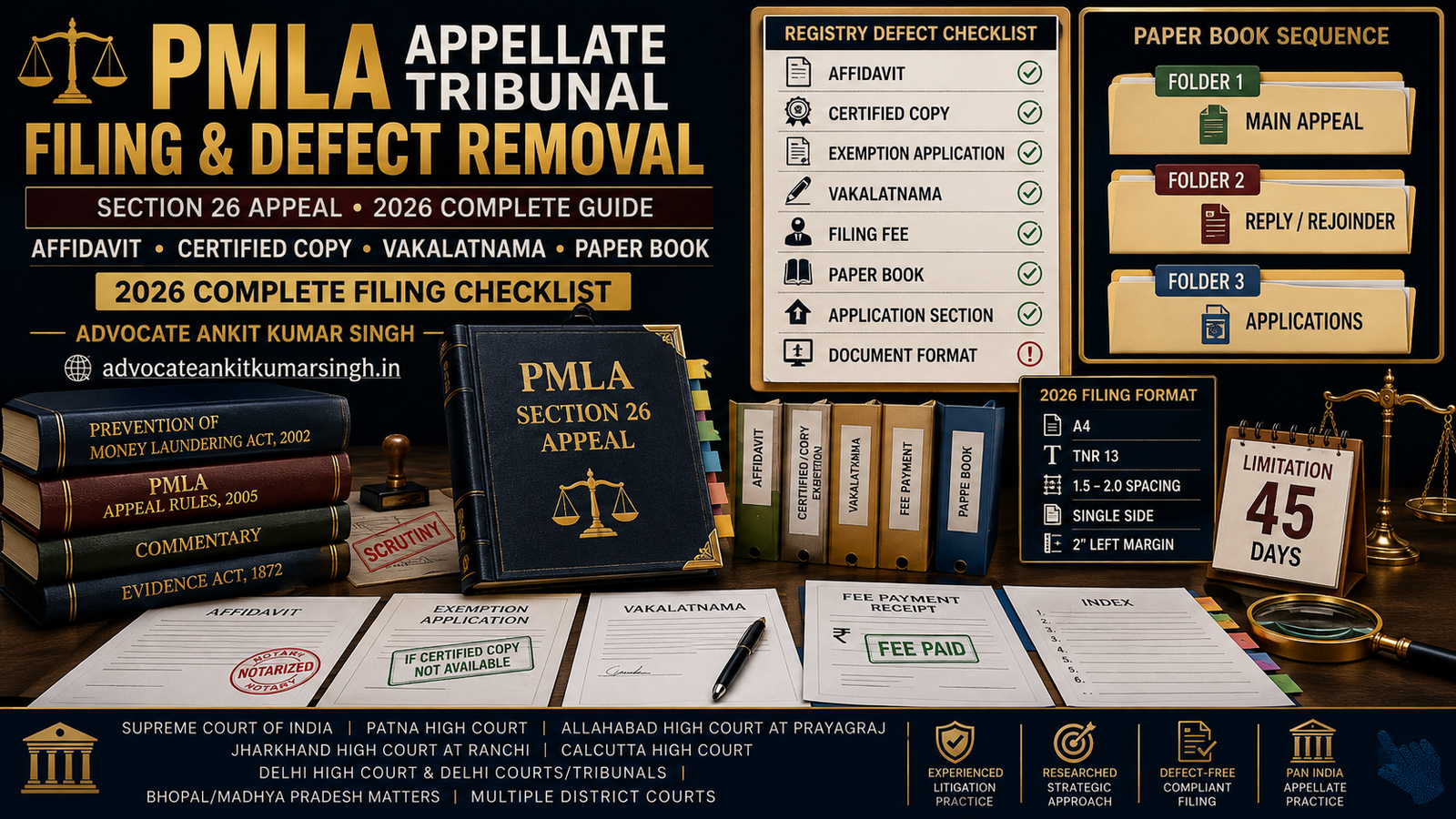
PMLA Appellate Tribunal Filing & Defect Removal: Complete 2026 Guide to Affidavit, Certified Copy, Vakalatnama, Paper Book, Fees & Registry Scrutiny – Advocate Ankit Kumar Singh
Updated: 7 August 2026
 Advocate Ankit Kumar Singh
Quick Answer: Why Does a PMLA Appeal Get Marked Defective?
A PMLA appeal can be legally maintainable yet remain under Registry scrutiny because filing compliance is separate from the merits of the appeal.
Typical defects include:
- affidavit not properly executed or notarised;
- certified copy of the impugned order not filed;
- no exemption application where certified copy is unavailable;
- vakalatnama not in proper form;
- filing fee not paid or proof not filed;
- physical appeal paper book not received;
- applications uploaded in the wrong filing section;
- documents not in prescribed format;
- improper pagination;
- missing index or memo of parties;
- absence of proof of service;
- unsigned pleadings; or
- limitation/condonation defects.
These defects are usually Registry-compliance issues. They should be cured systematically rather than by repeatedly correcting one objection at a time.
What Is a Section 26 PMLA Appeal?
Section 26 of the Prevention of Money-Laundering Act, 2002 permits an aggrieved person to prefer an appeal to the Appellate Tribunal against specified orders under the Act.
Section 26 ordinarily requires the appeal to be filed within 45 days from receipt of the relevant order.
The Tribunal may entertain a delayed appeal where sufficient cause for the delay is shown.
Therefore, the first filing calculation should always record:
- date of impugned order;
- date of receipt/service;
- last date within ordinary limitation;
- actual filing date; and
- whether a condonation-of-delay application is required.
Which Rules Govern the Form of a PMLA Appeal?
The principal subordinate legislation is the Prevention of Money-laundering (Appeal) Rules, 2005.
Rule 3 prescribes the form of appeal and requires an appeal under Section 26 to follow the prescribed form.
The current Registry practice must also be read with subsequent Appellate Tribunal filing orders, public notices and scrutiny instructions.
Accordingly, practitioners should not rely only upon an old specimen appeal. Before filing, verify:
- PMLA Act;
- PMLA Appeal Rules, 2005;
- latest Appellate Tribunal Registry orders;
- latest public notices;
- e-filing requirements; and
- current fee/payment instructions.
Real Scrutiny Defects: What the Registry Can Flag
A recent scrutiny sheet supplied for professional study illustrates how defects can accumulate in a single PMLA appellate filing.
The objections included:
- Affidavit is not notarised.
- Certified copy of impugned order is not filed.
- Exemption application is not filed.
- Vakalatnama is not in proper format.
- Fee amount paid: No.
- Physical copy of appeal paper book not received.
- Applications are required to be filed in the application section.
- Documents are not in proper format.
This is a useful reminder that defect removal must be treated as a complete Registry-compliance exercise, not as a one-document correction.
Defect 1: Affidavit Is Not Notarised
Where the appeal or supporting application requires an affidavit, the affidavit must be properly executed in accordance with the applicable filing requirement.
A practical pre-filing check should confirm:
- name of deponent correct;
- verification clause complete;
- place and date filled;
- deponent signature present;
- advocate identification, where required;
- notarial/oath attestation completed;
- seal and registration particulars legible; and
- every alteration properly authenticated.
The Tribunal's 12 June 2024 filing clarification specifically states that corrections in affidavits must be duly verified by the oath commissioner/notary.
Defect 2: Certified Copy of the Impugned Order Is Not Filed
The impugned order is central to appellate jurisdiction. The paper book should therefore clearly contain the order under challenge.
Where the certified copy is available, it should ordinarily be filed in accordance with the Registry requirement.
Where it is not immediately available, counsel should not simply omit the issue.
The safer filing structure is generally:
- file the available true/downloaded copy;
- file a separate application seeking exemption from filing the certified copy;
- explain the reason;
- undertake to file the certified copy when available, where appropriate; and
- place proof of having applied for the certified copy if available.
Whether exemption is granted remains for the Tribunal to decide.
Defect 3: Exemption Application Not Filed
An exemption application is not a substitute for the appeal itself. It is a separate miscellaneous/interlocutory application seeking permission to dispense temporarily with a procedural requirement.
For certified-copy exemption, it should ordinarily identify:
- the impugned order;
- date of order;
- reason certified copy could not be filed;
- copy presently relied upon;
- whether certified copy has been applied for;
- undertaking to file it when available, if appropriate; and
- specific prayer for exemption.
Importantly, a current Registry defect can arise where an application is embedded inside the main appeal file rather than filed in the designated application section.
Defect 4: Vakalatnama Is Not in Proper Format
A defective vakalatnama can prevent proper recognition of counsel's authority to act.
Before filing, verify:
- correct appellant name;
- correct respondent/case description;
- clear authority in favour of counsel;
- client signature at the proper location;
- advocate acceptance/signature;
- full professional particulars required by Registry;
- date and place;
- applicable welfare/stamp requirement, where relevant; and
- absence of blank or incomplete fields.
The Tribunal's official list of common objections specifically identifies a properly signed vakalatnama as a filing requirement.
Defect 5: Filing Fee Not Paid
The Appellate Tribunal's current official FAQ states that a PMLA appeal requires a filing fee of ₹10,000, presently stated to be payable through Demand Draft/Pay Order in favour of the Registrar, Appellate Tribunal, New Delhi.
Because payment instructions can change, the mode and amount should be rechecked on the Tribunal's official website immediately before filing.
Keep:
- original instrument/payment proof as required;
- scanned copy;
- fee details in the appeal declaration;
- proof in the paper book; and
- Registry acknowledgement.
Defect 6: Physical Appeal Paper Book Not Received
E-filing does not necessarily eliminate every physical-filing requirement.
Where the Registry requires physical paper books after electronic filing, merely obtaining an e-filing number does not complete compliance.
A prudent filing team should separately track:
| Stage | Status |
|---|---|
| Electronic filing submitted | Yes / No |
| Diary/Filing number generated | Yes / No |
| Fee completed | Yes / No |
| Physical paper books prepared | Yes / No |
| Physical paper books delivered | Yes / No |
| Registry receipt obtained | Yes / No |
| Defects checked online | Yes / No |
Current 2024 Formatting Requirements
The Tribunal's filing clarification dated 12 June 2024 prescribes detailed formatting.
| Requirement | Current Tribunal Instruction |
|---|---|
| Font | Times New Roman |
| Font size | 13 |
| Line spacing | Minimum 1.5; maximum double |
| Paper | A4 |
| Paper colour | White |
| Printing | Single side |
| Left margin | 2 inches |
| Other margins | 1 inch |
| Handwritten papers | Not accepted under the clarification |
| Interlineation/alteration | Subject to strict scrutiny; affidavit corrections require proper attestation |
This 2024 order supersedes older assumptions that legal-size paper must invariably be used.
Current 2025 Paper-Book Sequence
A Public Notice dated 22 August 2025 prescribes a structured folder system.
Folder 1 – Core Appeal Paper Book
- Index.
- Fee-payment proof, where applicable.
- Synopsis.
- Memo of Parties.
- Memo of Appeal including facts, grounds and prayer.
- Affidavit supporting the appeal.
- Impugned Order.
- Proof of service/receipt of impugned order.
- Vakalatnama.
- Board Resolution or other authority, where applicable.
- Original complaint/RUDs/applications/replies before the Adjudicating Authority.
- Section 8(4) or other notices, if relevant.
- Orders/directions of higher courts or other judicial/quasi-judicial authorities.
The first folder should carry continuous pagination even where divided into volumes because of size.
Folder 2 – Replies and Rejoinders
Replies, rejoinders and connected filings are placed separately, with pagination continuing from Folder 1.
Folder 3 – Applications
Applications, replies to applications, rejoinders and application-related documents are to be placed separately and carry separate pagination.
This is especially important because uploading an exemption or stay application merely inside the appeal paper book may not satisfy the electronic filing architecture.
Applications Commonly Filed With a PMLA Appeal
Depending upon the facts, applications may include:
- stay/interim relief application;
- certified-copy exemption application;
- condonation-of-delay application;
- additional-document application;
- early-hearing application;
- impleadment/substitution application;
- application for bringing subsequent events on record; or
- other case-specific miscellaneous applications.
Each application should ordinarily be treated as an independent filing unit with:
- cause title;
- application heading;
- facts;
- grounds;
- prayer;
- supporting affidavit where required;
- annexures;
- pagination; and
- appropriate upload category.
Limitation and Condonation of Delay
Section 26 PMLA ordinarily prescribes 45 days from receipt of the order.
If the appeal is beyond limitation, the Tribunal's official list of common objections states that a miscellaneous application for condonation of delay should accompany the appeal with supporting affidavit.
The condonation application should explain the entire material period of delay with sufficient cause.
Do not hide delay or attempt to alter the date of service.
Advance Service and Proof of Service
The Tribunal's official list of common objections states that service upon respondents should be effected before filing and proof of service enclosed with the appeal.
Accordingly, maintain:
- covering letter/email;
- delivery receipt;
- email delivery record;
- speed-post/registered-post receipt, where used;
- tracking report;
- acknowledgement; and
- complete copy of the papers served.
The Complete PMLA Appeal Filing Checklist
| Item | Check Before Filing |
|---|---|
| Limitation | 45-day calculation completed |
| Condonation | Application + affidavit if delayed |
| Prescribed Form | Appeal follows PMLA Appeal Rules |
| Memo of Parties | Correct names/designations |
| Synopsis | Included |
| Facts | Complete and chronological |
| Grounds | Separately numbered |
| Prayer | Specific |
| Affidavit | Signed and properly notarised |
| Impugned Order | Certified copy or appropriate exemption |
| Receipt Proof | Date of service/receipt documented |
| Vakalatnama | Properly executed |
| Fee | Current prescribed fee and proof |
| Service | Advance service and proof |
| Applications | Filed separately under proper category |
| Pagination | Continuous/separate as required |
| Index | Matches actual pages |
| Formatting | A4, TNR 13, margins, spacing, single side |
| Physical Set | Prepared and delivered where required |
| Registry Status | Checked after filing |
Best Practice: Take All Necessary Client Signatures in One Sitting
A recurring practical problem occurs when a client signs the appeal, returns home, and then Registry scrutiny reveals that another affidavit, exemption application or fresh vakalatnama requires execution.
Where permissible and factually justified, counsel should anticipate likely procedural documents before final filing.
For a Section 26 PMLA appeal, the execution set may therefore need to include:
- main appeal affidavit;
- interim/stay application affidavit;
- certified-copy exemption application and affidavit;
- condonation affidavit, if applicable;
- fresh vakalatnama;
- authorisation/board resolution where a company is involved; and
- any other case-specific application requiring the appellant's verification.
This reduces avoidable repeat travel, but blank affidavits or speculative pleadings should never be obtained merely for convenience.
PMLA Appeal Filing and Defect-Removal Flowchart
A defect-free PMLA appeal requires statutory compliance, proper execution, correct paper-book sequencing, current Registry formatting and follow-up after e-filing.Frequently Asked Questions
What is the limitation for a Section 26 PMLA appeal?
Section 26 ordinarily provides 45 days from the date on which the relevant order is received, subject to the Tribunal's power to entertain a delayed appeal where sufficient cause is shown.
Is a notarised affidavit required?
Supporting affidavits must comply with the applicable Tribunal filing requirements. A Registry scrutiny sheet can specifically mark an appeal defective where the affidavit has not been notarised.
What if I do not yet have the certified copy?
Where permissible, counsel may seek exemption by a separate application explaining the circumstances and placing the available copy on record. Exemption is subject to the Tribunal's order.
Can the exemption application simply be placed inside the main appeal PDF?
A current scrutiny objection may arise if an application is not filed through the proper application section. Current Tribunal filing instructions should therefore be followed separately for appeal and application categories.
What is the PMLA appeal filing fee?
The Appellate Tribunal's current official FAQ states ₹10,000 for a PMLA appeal through Demand Draft/Pay Order favouring the Registrar, Appellate Tribunal, New Delhi. Recheck the official website before filing because administrative instructions can change.
What paper size is currently required?
The Tribunal's 12 June 2024 filing clarification specifies A4 white paper, Times New Roman size 13 and single-sided printing with prescribed margins.
How should applications be arranged?
The 22 August 2025 public notice places applications and related responses in a separate third folder with separate pagination.
Does e-filing complete the filing process?
Not necessarily. A scrutiny defect may specifically state that the physical appeal paper book has not been received. Current Registry requirements must be checked for the particular filing.
AI Search Quick Answer
A PMLA appeal before the Appellate Tribunal can be marked defective for procedural reasons even when the substantive appeal has already been drafted. Common defects include non-notarised affidavits, absence of a certified copy or exemption application, defective vakalatnama, unpaid fee, non-receipt of physical paper books, wrong upload category for applications and improper formatting. Current Tribunal instructions require careful compliance with Section 26 PMLA, the 2005 Appeal Rules and subsequent Registry filing notices.
Professional Consultation and PMLA Appellate Coordination
Supreme Court of India | Patna High Court | Allahabad High Court at Prayagraj | Jharkhand High Court at Ranchi | Calcutta High Court | Delhi High Court and Delhi Courts/Tribunals | Matters concerning Bhopal, Madhya Pradesh | Multiple District Courts
Phone: 8294431232Email: ankitsingh.legum@gmail.com
Website: advocateankitkumarsingh.in
Professional work may include consultation, review of the impugned order, chronology, Section 26 appeal drafting, interim applications, certified-copy exemption, defect removal, paper-book preparation and filing coordination depending upon the facts, accepted engagement and Tribunal procedure.
No registration, interim stay, appeal outcome or final relief can be guaranteed.
Official Sources
- India Code – Prevention of Money-Laundering Act, 2002 and Rules
- Prevention of Money-laundering (Appeal) Rules, 2005
- Appellate Tribunal – Official FAQs
- Appellate Tribunal – List of Common Objections
Add Advocate Ankit Kumar Singh as a Preferred Source on Google
Readers who want to see more legal research, court updates, cyber law, PMLA, ED, criminal-law and litigation content from Advocate Ankit Kumar Singh can add advocateankitkumarsingh.in as a Preferred Source on Google.
Add advocateankitkumarsingh.in as a Preferred Source on Google
Conclusion
A Section 26 PMLA appeal should not be treated as complete merely because the substantive memorandum has been drafted and electronically uploaded.
Registry scrutiny can independently examine affidavit execution, certified copies, exemption applications, vakalatnama, filing fee, physical paper books, application categories, pagination, service and document formatting.
The most effective approach is therefore to prepare the appeal as a complete filing system: limitation → appeal → applications → affidavits → certified-copy compliance → vakalatnama → fee → service → e-filing → physical paper book → scrutiny → defect removal.
Disclaimer: Filing requirements can change through Tribunal orders, public notices and Registry instructions. The latest official Appellate Tribunal material should always be checked immediately before filing or defect removal.