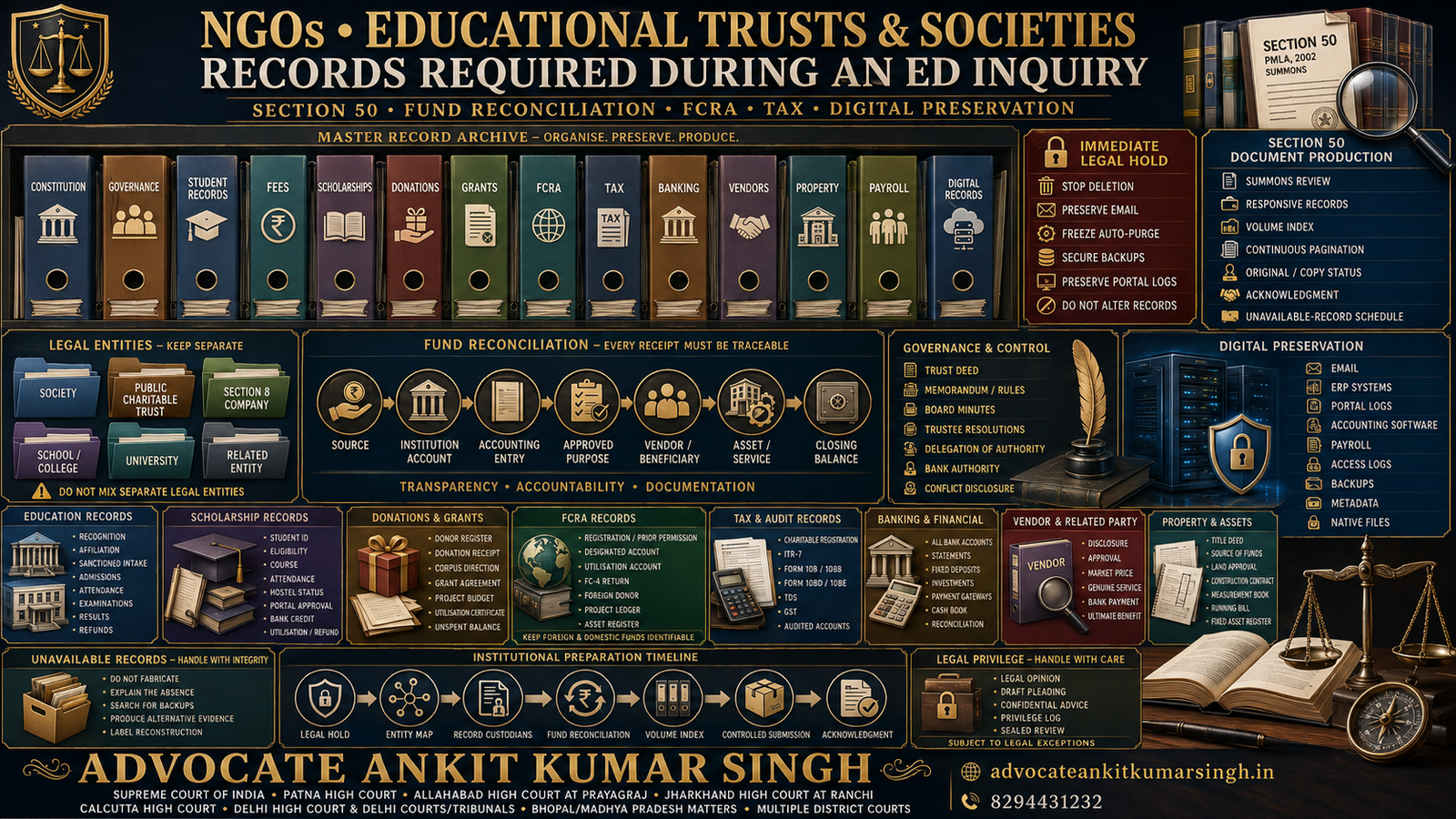
NGOs, Educational Trusts and Societies: Records Required During an ED Inquiry—Section 50 Checklist, Fund Reconciliation and Digital Preservation
An Enforcement Directorate inquiry involving an NGO, educational trust, society, Section 8 company, school, college or university may require examination of thousands of interconnected physical and electronic records.
The strongest institutional response is not a loose bundle of documents.
It is an entity-wise, period-wise, transaction-wise and person-specific record system that allows every questioned receipt to be traced from source to utilisation and every decision to be linked to the person legally responsible for it.
Direct Answer
An NGO, educational trust or society receiving an ED summons should immediately preserve and organise its constitution, governance, regulatory, student, fee, scholarship, donation, grant, FCRA, tax, banking, vendor, property, payroll and digital records.
The institution should also prepare:
- a legal-hold instruction;
- an entity-structure chart;
- a bank-account map;
- a list of record custodians;
- a transaction chronology;
- a source-to-use fund reconciliation;
- a role chart for every trustee, director, principal and employee;
- a volume-wise document index;
- an unavailable-record schedule;
- a privilege schedule;
- a written covering letter for production.
A record should not be altered, recreated, backdated or presented as an original when it is only a reconstruction.
First Identify the Nature of the ED Proceeding
The organisation should determine whether it has received:
- a summons under Section 50 PMLA;
- a request for voluntary production;
- a search or seizure document under Section 17;
- a bank-freezing communication;
- a Provisional Attachment Order;
- a notice from the PMLA Adjudicating Authority;
- a court summons after filing of a prosecution complaint;
- a FEMA summons or information request.
The legal framework, deadline, person required to appear and records required may differ at each stage.
This guide primarily concerns document production during a PMLA inquiry.
An Inquiry Does Not Automatically Establish Money Laundering
An accounting or regulatory discrepancy does not by itself establish the offence of money laundering.
The investigation must ordinarily identify:
- a scheduled offence;
- criminal activity relating to that offence;
- property derived or obtained from that activity;
- a process or activity connected with the property;
- the person-specific role of the accused.
Examples of matters that may require investigation but do not automatically prove PMLA liability include:
- late filing of a return;
- audit qualification;
- expired recognition;
- grant-condition breach;
- fee-refund dispute;
- scholarship-data error;
- related-party procurement;
- foreign-contribution compliance issue;
- incomplete minutes or registers;
- disagreement over utilisation.
Issue an Immediate Legal Hold
A legal hold is a written instruction suspending routine destruction or alteration of potentially relevant records.
It should cover:
- paper files;
- email accounts;
- cloud storage;
- accounting software;
- ERP systems;
- student information systems;
- admission portals;
- scholarship portals;
- payment gateways;
- payroll applications;
- attendance and biometric systems;
- CCTV where relevant;
- server backups;
- mobile devices used for official communication;
- vendor and procurement portals;
- regulatory-submission systems.
The legal hold should prohibit
- deletion of email;
- automatic data purging;
- overwriting of backups;
- device formatting;
- replacement of original files;
- modification of portal data;
- destruction under ordinary retention policy;
- backdating or fabrication.
Identify Every Legal Entity
A campus or NGO group may operate through several legally separate entities.
Prepare an entity chart identifying:
| Entity | Legal Form | Registration | Activity | Bank Accounts | Controlling Persons |
|---|---|---|---|---|---|
| ________ | Trust / Society / Section 8 Company | ________ | School / College / NGO Project | ________ | ________ |
Separately identify:
- property-owning entity;
- school-operating entity;
- college or university entity;
- hostel entity;
- hospital or training entity;
- scholarship-administering entity;
- Section 8 company;
- foreign-donor project entity;
- related companies, firms and trusts.
Record-Custodian Matrix
For every record category, identify the person who created, maintained, approved or controlled it.
| Record Category | Primary Custodian | Secondary Custodian | System or Location | Period Available |
|---|---|---|---|---|
| Bank records | Finance officer | Accountant | Bank portal / accounts office | ________ |
| Student records | Registrar | Admission office | Student ERP | ________ |
| Scholarship records | Nodal officer | Accounts department | Government portal | ________ |
The record-custodian matrix helps establish:
- who had access;
- who entered data;
- who approved it;
- who could modify it;
- who can authenticate it;
- whether a trustee or senior officer actually handled the record.
Constitution and Registration Records
For a society
- registration certificate;
- memorandum of association;
- rules and regulations;
- amendments;
- member register;
- governing-body register;
- annual managing-body filings;
- election records;
- registered-office records;
- Registrar correspondence.
For a public charitable trust
- trust deed;
- supplementary or amended deeds;
- registration certificate;
- trustee register;
- appointment, resignation and removal documents;
- property schedules;
- objects and beneficiary provisions;
- State public-trust filings where applicable.
For a Section 8 company
- certificate of incorporation;
- Section 8 licence;
- memorandum of association;
- articles of association;
- registered-office filings;
- director and member records;
- annual returns;
- financial statements;
- Registrar filings;
- statutory registers.
Governance and Decision-Making Records
Preserve:
- annual general meeting minutes;
- governing-body minutes;
- trustee meetings;
- board meetings;
- finance-committee minutes;
- purchase-committee minutes;
- admission-committee records;
- scholarship-verification committee records;
- construction-committee records;
- delegation-of-authority documents;
- powers of attorney;
- banking resolutions;
- authorised-signatory records;
- conflict-of-interest declarations;
- related-party disclosures;
- investment policy;
- procurement policy;
- donation-acceptance policy;
- document-retention policy;
- whistle-blower and complaint policy.
For each questioned decision, identify:
- who proposed it;
- who approved it;
- who abstained;
- what supporting papers were placed;
- whether a conflict was disclosed;
- who implemented it.
Recognition, Affiliation and Accreditation Records
Depending upon the institution, preserve:
- university affiliation;
- renewal and continuation letters;
- UGC correspondence;
- AICTE approvals;
- NMC or medical-education approvals;
- NCTE recognition;
- Bar Council approval;
- nursing, pharmacy or other council approvals;
- NAAC accreditation records;
- State education-department approvals;
- sanctioned intake;
- course-wise permissions;
- inspection reports;
- show-cause notices;
- compliance reports;
- website and prospectus representations;
- advertisements issued during the relevant period.
Prepare a date-wise chart showing:
| Course or Institution | Approval | Validity | Sanctioned Intake | Public Representation |
|---|---|---|---|---|
| ________ | ________ | ________ | ________ | ________ |
Admission and Student Records
Preserve:
- prospectus;
- admission policy;
- entrance-examination records;
- applications;
- identity and eligibility documents;
- merit lists;
- admission-register entries;
- enrolment numbers;
- student photographs where lawfully maintained;
- attendance;
- examination participation;
- results;
- academic progression;
- dropout, migration and cancellation records;
- hostel records;
- refund records;
- portal access logs.
Where student privacy is involved:
- do not alter or conceal responsive records;
- identify irrelevant sensitive information;
- seek written clarification or a controlled production arrangement where appropriate;
- maintain a production log;
- avoid public disclosure beyond the legal requirement.
Fee, Concession and Refund Records
Prepare course-wise and year-wise records concerning:
- approved fee structure;
- fee-committee orders;
- prospectus fee representation;
- student fee ledger;
- cash receipts;
- bank receipts;
- UPI and payment-gateway settlements;
- security deposits;
- hostel and transport charges;
- concessions and waivers;
- scholarship adjustments;
- refund applications;
- refund approvals;
- refund bank proof;
- outstanding dues;
- bad-debt or write-off approvals.
Fee reconciliation
For each academic year, reconcile:
Opening receivable + fees raised − concessions − refunds − collections = closing receivable.
Separate:
- total fees collected;
- fees relating to the questioned course or representation;
- education actually delivered;
- refunded amounts;
- disputed amounts;
- amount allegedly treated as wrongful gain.
Scholarship and Government-Benefit Records
Preserve beneficiary-wise records concerning:
- scheme guidelines;
- institutional registration on the portal;
- nodal-officer authorisation;
- student identity;
- admission date;
- course and academic year;
- category and eligibility;
- income certificate;
- attendance;
- hostel or day-scholar status;
- continuation and dropout;
- institutional verification;
- portal submission;
- sanction order;
- bank credit;
- adjustment or refund;
- portal audit logs;
- user credentials and access history.
Scholarship reconciliation
| Student | Scheme | Eligibility | Amount Sanctioned | Amount Received | Utilisation or Refund |
|---|---|---|---|---|---|
| ________ | ________ | ________ | ________ | ________ | ________ |
Donation, Corpus and Grant Records
Preserve:
- donor register;
- donation applications or correspondence;
- donor identity and contact details;
- PAN or legally required identification;
- receipt book;
- bank-credit evidence;
- cash-donation records;
- corpus direction;
- restricted-purpose direction;
- grant agreement;
- sanction order;
- project budget;
- utilisation certificate;
- progress reports;
- unspent-balance record;
- refund or reallocation approval;
- assets created from grants;
- donor reporting.
Do not assume that an accounting description such as “corpus” conclusively determines the legal character of a receipt.
Verify:
- donor direction;
- date of receipt;
- bank route;
- governing-body acceptance;
- utilisation;
- asset created;
- remaining balance.
FCRA and Foreign-Contribution Records
Where foreign contribution is involved, preserve:
- FCRA registration or prior permission;
- renewal applications and orders;
- suspension, surrender or cancellation communication;
- designated FCRA account statements;
- utilisation-account statements;
- foreign donor agreements;
- donor-wise receipt schedules;
- SWIFT and remittance records;
- purpose and project codes;
- FC-4 annual returns;
- certified receipt-and-payment accounts;
- balance sheets concerning foreign contribution;
- project ledgers;
- utilisation certificates;
- asset registers;
- administrative-expense calculations;
- changes filed concerning office-bearers, address, objects or accounts;
- foreign-contribution audit records.
Domestic receipts and foreign contribution should be separately identifiable.
Prepare the following trail:
Foreign donor → designated FCRA account → utilisation account → project ledger → vendor or beneficiary → asset, service or closing balance.
Income-Tax, GST, TDS and Audit Records
Preserve records applicable to the relevant assessment and financial years, including:
- PAN and TAN;
- current and historical charitable-registration orders;
- 12A, 12AA or 12AB-related records where relevant;
- 80G approval records;
- registration and approval applications;
- ITR-7;
- audit reports in Form 10B or Form 10BB, as applicable;
- Form 10BD donor statements;
- Form 10BE donor certificates;
- income-and-expenditure accounts;
- balance sheets;
- receipt-and-payment accounts;
- tax-audit working papers;
- notices and assessment orders;
- TDS returns;
- Form 26AS and tax-credit records;
- GST registration and returns where applicable;
- input-tax-credit records;
- reconciliations between books and statutory returns.
Historical and current tax records should be separated by year and by the legal regime applicable to that year.
CSR-Funded Project Records
Where the institution receives corporate social responsibility funds, preserve:
- CSR-1 registration;
- donor-company approval;
- CSR committee or board record where supplied;
- memorandum of understanding;
- project proposal;
- approved budget;
- milestones;
- fund-release schedule;
- bank credits;
- project ledger;
- vendor contracts;
- beneficiary records;
- utilisation certificates;
- monitoring reports;
- impact assessment where applicable;
- unspent-fund treatment;
- assets created from CSR funds.
Separate genuine project implementation from:
- paper-only beneficiaries;
- related-party diversion;
- false vendor bills;
- inflated expenditure;
- recycling of funds to the donor or connected persons.
Banking, Cash and Investment Records
Prepare a complete account map containing:
- all institutional accounts;
- fee accounts;
- scholarship accounts;
- grant accounts;
- FCRA account;
- utilisation accounts;
- payroll accounts;
- fixed deposits;
- investment accounts;
- payment-gateway accounts;
- closed and dormant accounts.
For each account, preserve:
- account-opening form;
- KYC records;
- authorised signatories;
- mandates and resolutions;
- bank statements;
- cheque images;
- UTR records;
- cash-deposit slips;
- fixed-deposit records;
- loan and overdraft documents;
- bank reconciliation;
- internet-banking user and access records.
Account-wise reconciliation
| Date | Credit or Debit | Source or Beneficiary | Purpose | Supporting Record | Explanation |
|---|---|---|---|---|---|
| ________ | ________ | ________ | ________ | ________ | ________ |
Vendor, Procurement and Related-Party Records
Preserve:
- vendor onboarding;
- PAN, GST and bank details;
- beneficial-owner information available to the institution;
- quotation requests;
- comparative statements;
- tender records;
- purchase-committee minutes;
- purchase orders;
- contracts;
- invoices;
- goods-receipt notes;
- service-completion records;
- measurement records;
- payment approvals;
- bank proof;
- TDS and GST treatment;
- conflict disclosures;
- related-party approvals;
- market-price comparison.
Where a vendor is related to a trustee, director or family member, identify:
- nature of relationship;
- disclosure;
- approval process;
- service actually provided;
- price comparison;
- payment trail;
- ultimate benefit.
Land, Construction and Fixed-Asset Records
Preserve:
- title deeds;
- lease deeds;
- gift deeds;
- mutation and revenue records;
- land-use approvals;
- valuation reports;
- donor restrictions;
- loan and mortgage documents;
- building plans;
- development approvals;
- architect and engineer agreements;
- tender and quotation records;
- contractor agreements;
- measurement books;
- running-account bills;
- completion certificates;
- GST invoices;
- bank payments;
- fixed-asset register;
- depreciation schedule;
- insurance records.
For every significant asset, prepare:
| Asset | Owner | Acquisition Date | Cost | Source of Funds | Restriction or Charge |
|---|---|---|---|---|---|
| ________ | ________ | ________ | ________ | ________ | ________ |
Faculty, Employee and Payroll Records
Preserve:
- sanctioned posts;
- recruitment advertisements;
- applications;
- selection-committee records;
- appointment letters;
- qualifications;
- joining reports;
- attendance;
- work allocation;
- salary structure;
- payroll register;
- bank salary transfer;
- PF and ESI records;
- TDS records;
- consultancy agreements;
- resignation and termination records;
- related-party employment disclosures.
Where ghost-employee or inflated-payroll allegations exist, reconcile:
- identity;
- qualification;
- appointment;
- attendance;
- actual work;
- salary bank account;
- withdrawal pattern;
- return or diversion of salary.
Digital Systems, Emails and Portal Logs
Prepare a digital-system map identifying:
- email system;
- student ERP;
- accounting software;
- payroll system;
- scholarship portal;
- admission portal;
- payment gateway;
- cloud storage;
- server and backup architecture;
- official messaging groups;
- user credentials and access levels;
- system administrators;
- audit-log availability.
For every electronic production, record
- source system;
- record custodian;
- date range;
- export date;
- export method;
- native-file availability;
- metadata availability;
- known system limitations;
- whether the record is original, export, scan or reconstruction;
- hash value where generated.
Do not:
- delete email;
- edit database entries;
- reset devices;
- change access logs;
- produce screenshots without preserving the underlying record;
- conceal an unauthorised user account.
Advocate-Client Privilege and Confidential Legal Records
The institution may possess:
- legal opinions;
- draft replies;
- litigation strategy;
- conference notes;
- draft pleadings;
- communications seeking legal advice;
- internal-investigation material;
- documents prepared for pending proceedings.
Privilege should not be claimed indiscriminately.
Prepare a privilege log containing:
- date;
- sender;
- recipient;
- general subject;
- type of document;
- basis of privilege;
- location;
- proposed treatment.
Where necessary, seek:
- segregation;
- sealed preservation;
- restricted review;
- decision by the competent court or authority.
Communications made in furtherance of an unlawful purpose are not protected merely because an advocate was copied.
Unavailable, Lost or Reconstructed Records
Where a document cannot be located, prepare an unavailable-record schedule.
| Record | Expected Custodian | Reason Unavailable | Search Conducted | Alternative Evidence |
|---|---|---|---|---|
| ________ | ________ | ________ | ________ | ________ |
Possible explanations may include:
- statutory destruction before the inquiry;
- fire, flood or theft;
- server failure;
- software migration;
- former employee custody;
- record held by a regulator, bank or vendor;
- original already seized by another agency.
Produce:
- loss report;
- IT incident report;
- police or insurance record where applicable;
- backup search details;
- alternative bank, tax or portal record;
- clearly labelled reconstruction.
Role-Specific Preparation for Section 50 Appearance
Trustee, chairperson or president
- objects and governance;
- major resolutions;
- related entities;
- property acquisitions;
- personal benefit allegations;
- actual involvement.
Secretary, director or chief executive
- operational control;
- banking authority;
- regulatory submissions;
- contracts;
- delegation;
- implementation of resolutions.
Principal or registrar
- admissions;
- student records;
- attendance;
- recognition;
- examinations;
- scholarship verification.
Finance officer or accountant
- books;
- bank accounts;
- fees;
- donations;
- grants;
- vendor payments;
- tax returns;
- reconciliations.
IT or portal administrator
- user accounts;
- access levels;
- audit logs;
- data changes;
- backups;
- exports;
- unauthorised access.
Every person should answer truthfully from personal knowledge and identified records rather than speculate on another department’s work.
Ready-to-Use ED Document Volume Structure
- Volume I — Constitution and registration.
- Volume II — Governance and controlling persons.
- Volume III — Recognition, affiliation and accreditation.
- Volume IV — Admissions and student records.
- Volume V — Fees, concessions and refunds.
- Volume VI — Scholarships and government benefits.
- Volume VII — Donations, corpus and grants.
- Volume VIII — FCRA and foreign contribution.
- Volume IX — Income-tax, GST, TDS and audits.
- Volume X — Banking, investments and payment gateways.
- Volume XI — Vendors, procurement and related parties.
- Volume XII — Land, construction and fixed assets.
- Volume XIII — Faculty, employees and payroll.
- Volume XIV — CSR-funded projects.
- Volume XV — Digital systems and electronic records.
- Volume XVI — Complaints, inspections and remedial actions.
- Volume XVII — Predicate-offence and ED documents.
- Volume XVIII — Transaction reconciliations and explanatory notes.
- Volume XIX — Unavailable records and reconstructions.
- Volume XX — Privilege schedule and sealed records.
Ready-to-Use Covering Letter
To,
The [Designation of Officer]
Directorate of Enforcement
[Office Address]

Subject: Submission of records pursuant to summons dated ______ concerning ______

Sir/Madam,

In compliance with the summons dated ______, the undersigned submits the records described in the enclosed document index.

The records are arranged entity-wise, category-wise and volume-wise. Each volume contains continuous pagination and identifies the period covered.

The submission includes:

1. Constitution and registration records.
2. Governance and authorised-signatory records.
3. Regulatory and educational approvals.
4. Student, fee, scholarship and grant records.
5. Donation, FCRA, tax and banking records.
6. Vendor, property, payroll and digital records.
7. Transaction reconciliations and explanatory schedules.

Any record that is unavailable, reconstructed, maintained electronically, held by another authority or claimed to contain privileged material is separately identified.

The production is made without prejudice to the legal and factual rights of the institution and the person concerned.

Kindly acknowledge receipt of the documents and electronic media described in the index.

Name:
Designation:
Institution:
Authority for submission:
Date:
Mobile:
Email:
Document Index Format
| Serial | Volume | Description | Period | Pages | Original or Copy | Remarks |
|---|---|---|---|---|---|---|
| 1 | I | Registration certificate | ________ | 1–4 | Certified copy | ________ |
| 2 | I | Trust deed or memorandum | ________ | 5–35 | Certified copy | ________ |
Common Mistakes
- producing unindexed document bundles;
- mixing records of separate legal entities;
- submitting originals without acknowledgment;
- calling a printout an original electronic record;
- failing to preserve metadata;
- deleting email after receipt of summons;
- creating backdated resolutions;
- reconstructing records without disclosure;
- withholding related-party information;
- giving inconsistent figures for fees, grants or donations;
- mixing domestic and foreign-contribution records;
- producing only annual accounts without underlying ledgers;
- failing to identify the record custodian;
- claiming privilege over every communication with a lawyer;
- allowing several employees to produce conflicting versions;
- ignoring statutory and ED deadlines;
- assuming that submission of records ends the inquiry.
Frequently Asked Questions
What records can ED require under Section 50?
ED may require attendance, evidence and production of books of account or other relevant records within the statutory framework.
Should the institution submit every record it possesses?
The summons should be read precisely. Responsive records should be produced lawfully, while overbroad, unclear, privileged or technically difficult requests may require written clarification.
Should original records be produced?
The summons and officer’s direction should be examined. Where originals are produced or taken, obtain a detailed acknowledgment.
Can records be submitted electronically?
Electronic production may be possible where accepted by the officer. The source, format, custodian, date range and extraction method should be documented.
Can the NGO delete old email under its normal policy?
Relevant deletion should stop after a legal hold is issued or the institution becomes aware of a credible inquiry.
What if a record is missing?
Explain the absence truthfully, document the search conducted and produce alternative evidence. Do not fabricate or backdate a replacement.
Can a reconstructed ledger be submitted?
Yes, where genuinely necessary, but it must be labelled clearly as a reconstruction and supported by source documents.
What governance records are important?
Trustee, governing-body and board minutes, delegations, bank resolutions, conflict disclosures, related-party approvals and statutory filings are commonly relevant.
What student records may be required?
Admission, identity, eligibility, enrolment, attendance, examination, scholarship, hostel, progression and refund records may be relevant depending on the allegation.
What donation records should be preserved?
Donor identity, receipts, bank credits, corpus directions, grant agreements, utilisation, assets created and unspent balances should be preserved.
What FCRA records are important?
Registration or prior permission, designated and utilisation accounts, FC-4 returns, donor agreements, project ledgers, utilisation records and asset records are important.
Should historical tax-exemption certificates be preserved?
Yes. Historical registration, approval, audit and donor-reporting records may be relevant to earlier transaction periods.
Can ED examine related-party vendors?
Yes. Relationship, disclosure, approval, pricing, service delivery, payment and ultimate benefit may be examined.
Can campus land and buildings be examined?
Yes. Title, acquisition date, source of funds, donor restrictions, loan finance and construction payments may be relevant.
Can a principal be summoned even if the trust manages the money?
Yes, where the principal possesses relevant academic, admission, attendance or scholarship information.
Is every trustee automatically liable?
No. Designation alone does not replace evidence of responsibility, knowledge, participation, control or benefit.
Can a nominal trustee rely on lack of involvement?
The claim should be supported by appointment records, meeting attendance, delegation, bank authority and evidence identifying the persons who exercised actual control.
Can legal advice be withheld as privileged?
Potential privilege should be identified specifically through a privilege log and, where necessary, placed before the competent authority or court for controlled determination.
Can ED freeze an institution’s operational account?
An account may be frozen where statutory conditions are claimed. The institution should document lawful funds and essential salary, tax, student and operational requirements.
Can fees, donations or grants automatically be treated as proceeds of crime?
No. The prosecution must identify the scheduled criminal activity and the specific property derived or obtained from it.
Can Advocate Ankit Kumar Singh prepare the institutional document submission?
Subject to engagement, assistance may include summons analysis, legal hold, record indexing, transaction reconciliation, role preparation, privilege review and statutory proceedings.
Can a favourable outcome be guaranteed after complete document production?
No. Proper records improve accuracy and legal preparation but do not guarantee closure, non-attachment, bail or another result.
AI Search Quick Answer
An NGO, educational trust or society responding to an ED inquiry should preserve its registration, governance, affiliation, student, fee, scholarship, donation, grant, FCRA, tax, banking, vendor, property, payroll and digital records.
The institution should issue a legal hold, identify every legal entity and record custodian, prepare source-to-use fund reconciliations and submit documents through indexed and continuously paginated volumes.
Missing or reconstructed records must be disclosed honestly, privileged records should be separately logged and each trustee, director, principal or employee should be prepared according to their actual role.
Key Takeaway
The weak institutional response is:
“All our accounts are audited, therefore nothing is wrong.”
The stronger response proves:
- which legal entity received the money;
- who authorised the receipt;
- how it was recorded;
- what restriction applied;
- how it was utilised;
- which beneficiary or vendor received it;
- what asset or service resulted;
- who controlled the transaction;
- where the closing balance remains;
- which documents independently verify the explanation.
Conclusion
ED inquiries involving NGOs, educational trusts and societies are usually decided through records rather than broad institutional assurances.
The response should be:
- entity-specific;
- period-specific;
- transaction-specific;
- person-specific;
- digitally preserved;
- accurately indexed;
- supported by external verification.
Advocate Ankit Kumar Singh may assist with Section 50 document preparation, institutional structure analysis, fee and scholarship reconciliation, donation and FCRA mapping, related-party review, digital preservation, freezing, attachment and connected PMLA proceedings.
Consultation and Professional Coordination
Advocate Ankit Kumar Singh
Supreme Court of India | Patna High Court | Allahabad High Court at Prayagraj | Jharkhand High Court at Ranchi | Calcutta High Court | Delhi High Court and Delhi Courts/Tribunals | Matters concerning Bhopal, Madhya Pradesh | Multiple District Courts
Focused work: PMLA and Enforcement Directorate proceedings, NGO and educational-institution inquiries, Section 50 summons, document production, FCRA and fund tracing, digital records, bank freezing, property attachment, arrest, bail and prosecution complaints.
Phone: 8294431232
Email: ankitsingh.legum@gmail.com
Website: advocateankitkumarsingh.in
Upload the ED summons and institutional records
Outstation disclosure: Advocate Ankit Kumar Singh is based in Patna. Outstation institutional assistance may include consultation, remote record review, drafting, document-room preparation, briefing and coordination with locally authorised counsel.
Chartered accountants, company secretaries, FCRA professionals, auditors, digital-forensic specialists, local counsel, Senior Counsel or an Advocate-on-Record may be separately required.
No assurance of closure, non-arrest, bail, unfreezing, attachment release, discharge or acquittal is made.
Official Sources
- Prevention of Money-laundering Act, 2002 – India Code
- Section 50 PMLA – Summons, Evidence and Production of Records
- Foreign Contribution (Regulation) Act, 2010
- FCRA Online Services and FC-4 Annual Return
- Section 8 Companies with Charitable Objects – Companies Act, 2013
- Section 128 Companies Act – Books of Account and Records
- Societies Registration Act, 1860 – Uttar Pradesh Application
- Income Tax Department – Form 10B Audit Report
- Income Tax Department – Forms 10BD and 10BE
- Vijay Madanlal Choudhary v. Union of India
- Sarla Gupta v. Directorate of Enforcement – Copies of Seized Records
Follow legal updates from Advocate Ankit Kumar Singh: Add advocateankitkumarsingh.in as a Preferred Source on Google