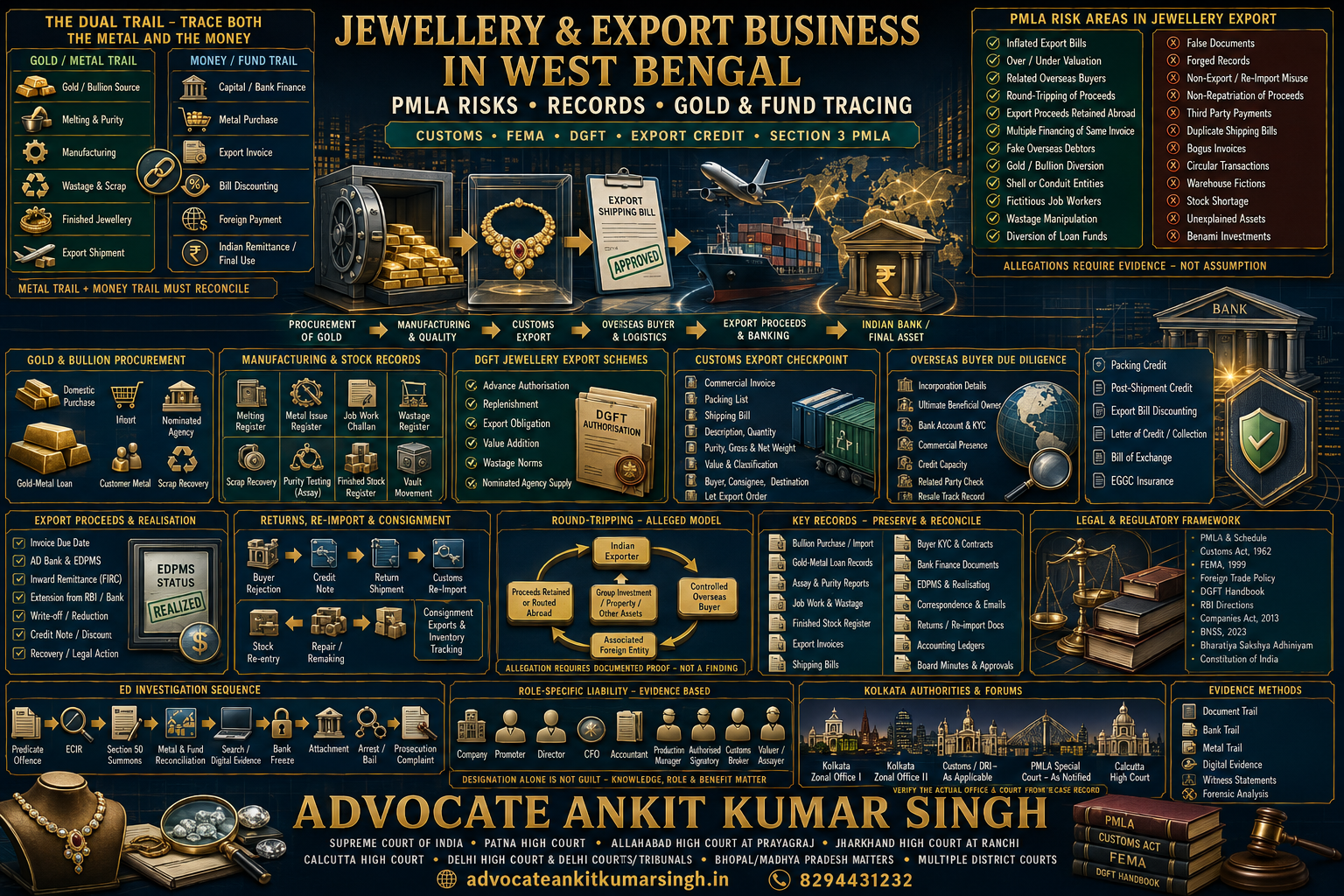
Jewellery and Export Business in West Bengal: PMLA Risks, Records and Fund Tracing in Kolkata Investigations
Jewellery manufacturing and export involve a specialised trail of precious metal, stones, manufacturing records, customs declarations, overseas receivables, banking facilities and foreign-exchange realisation.
When those records do not reconcile, the matter may begin as a Customs, FEMA, DGFT, banking or commercial dispute.
It becomes a PMLA proceeding only where ED alleges an underlying scheduled offence, identifiable proceeds of crime and a person or entity involved in a process connected with those proceeds.
Direct Answer
In a Kolkata jewellery-export investigation, ED may trace both the physical metal and the money: where the gold or bullion came from, how much was issued for manufacturing, what jewellery was produced, what was exported, who the overseas buyer was, whether the declared value was genuine, whether bank finance was obtained against the export and where the foreign sale proceeds ultimately went.
The complete trail is:
Gold or bullion procurement → manufacturing and wastage → finished jewellery → export declaration → overseas buyer → export receivable → bank finance or collection → foreign proceeds → Indian account, related entity or final asset.
An inconsistency may justify investigation.
It does not by itself prove fraud or money laundering.
When Can a Jewellery-Export Case Become a PMLA Matter?
A PMLA proceeding requires:
- a registered or legally instituted scheduled-offence foundation;
- property derived or obtained from the alleged criminal activity;
- identifiable proceeds of crime;
- a Section 3 process or activity;
- person-specific knowledge, assistance, participation or involvement.
Depending upon the facts and applicable law, the predicate proceeding may allege:
- Customs Act Section 135;
- cheating;
- forgery or use of forged records;
- criminal conspiracy directed towards a scheduled offence;
- corruption;
- Companies Act fraud;
- another scheduled offence.
FEMA Contravention Is Not Automatically Money Laundering
FEMA requires exporters to make true and correct export declarations and take reasonable steps to realise and repatriate foreign exchange according to the applicable RBI framework.
A delayed or unrealised export bill may lead to:
- AD bank follow-up;
- ED action under FEMA;
- adjudication;
- penalty;
- compounding where legally available;
- regulatory restrictions.
Those consequences do not automatically establish proceeds of crime under PMLA.
A separate scheduled offence and criminally derived property remain necessary.
Customs Act Section 135 and the PMLA Schedule
Section 135 Customs Act appears in the PMLA Schedule.
Where a competent Customs or DRI proceeding alleges conduct satisfying Section 135, ED may examine whether property was derived from that scheduled criminal activity.
The defence should still examine:
- the precise Customs allegation;
- goods involved;
- valuation;
- prohibition or duty condition;
- knowledge;
- complaint status;
- proceeds allegedly generated;
- individual role.
Every Customs demand, confiscation or penalty does not automatically establish a Section 135 offence.
Regulatory Default, Fraud and PMLA Are Different
| Issue | Principal Question |
|---|---|
| DGFT default | Were export-obligation, value-addition or authorisation conditions fulfilled? |
| Customs dispute | Were description, value, quantity, purity and exemption conditions correct? |
| FEMA default | Were foreign exchange and export proceeds realised and repatriated lawfully? |
| Bank default | Were export-credit facilities repaid? |
| Predicate criminal case | Was cheating, forgery, Customs evasion or another scheduled offence committed? |
| PMLA proceeding | Were criminally derived proceeds handled through a Section 3 process? |
The Two Trails ED May Reconstruct
Physical metal trail
Opening stock + purchases or imports + metal received + scrap recovered − manufacture − wastage − sales − exports = closing stock.
Financial trail
Capital or bank finance → metal purchase → manufacture → export invoice → overseas receivable → bill discounting or collection → foreign payment → repayment, business use, transfer or asset acquisition.
The two trails should reconcile batch by batch and period by period.
Gross Weight, Net Metal and Fine-Gold Equivalent
Jewellery value cannot be tested only through gross weight.
For every line item, identify:
- gross weight;
- stone weight;
- net precious-metal weight;
- purity or carat;
- fine-gold equivalent;
- findings and mountings;
- making charges;
- stone value;
- declared export value.
| Item | Gross Weight | Stone Weight | Net Metal | Purity | Fine-Metal Equivalent |
|---|---|---|---|---|---|
| ________ | ________ | ________ | ________ | ________ | ________ |
Manufacturing and Job-Work Records
Preserve:
- bullion receipt register;
- melting register;
- metal issue register;
- batch or lot number;
- job-work challan;
- artisan or karigar KYC;
- stone issue and return;
- purity testing;
- wastage record;
- scrap recovery;
- finished-goods register;
- vault movement;
- labour payment.
A genuine job worker should be capable of confirming:
- metal received;
- work performed;
- goods returned;
- wastage;
- payment;
- relevant dates.
Wastage, Scrap and Recovery
Wastage should be reconciled with:
- applicable DGFT or authorisation norms;
- product and manufacturing method;
- historic production yield;
- scrap recovered;
- refiner records;
- job-worker confirmation;
- stock ledger;
- accounts.
Unexplained excess wastage may be alleged as diversion of precious metal.
A commercially impossible near-zero wastage figure may also attract scrutiny.
Gold from Nominated Agencies or Gold-Metal Loans
Review:
- supplier or nominated agency;
- gold-loan agreement;
- quantity;
- purity;
- delivery;
- price fixing;
- interest or premium;
- hedging;
- export obligation;
- repayment;
- stock utilisation.
Prepare a gram-wise chart showing where every quantity supplied was used.
Advance Authorisation and Replenishment
For every authorisation, record:
| Authorisation | Input | Quantity | Export Product | Obligation | Actual Export | Status |
|---|---|---|---|---|---|---|
| ________ | ________ | ________ | ________ | ________ | ________ | ________ |
Preserve:
- authorisation and amendments;
- shipping-bill endorsements;
- consumption records;
- value-addition calculation;
- export-obligation discharge;
- bond or bank guarantee;
- redemption or closure certificate;
- replenishment application.
Complete Export Document Set
- purchase order;
- sales contract;
- commercial invoice;
- packing list;
- shipping bill;
- export declaration;
- product and purity description;
- gross and net weight;
- stone details;
- buyer and consignee;
- destination;
- airway bill or transport document;
- Customs examination record;
- Let Export Order;
- insurance;
- certificate of origin where applicable;
- bank submission;
- realisation record.
Customs Valuation and Purity Review
Customs or ED may compare:
- declared transaction value;
- metal-market value;
- purity;
- stone valuation;
- making charges;
- comparable sales;
- relationship between buyer and exporter;
- foreign resale value;
- subsequent credit note;
- actual payment.
A valuation difference should not automatically be described as fraud without examining the method and commercial context.
Inflated Export Bills
An inflated-export allegation may concern:
- overstated quantity;
- overstated purity;
- overvalued stones;
- artificial making charges;
- related buyer;
- fictitious receivable;
- export finance obtained against an inflated bill;
- no genuine expectation of payment.
The defence should obtain:
- independent valuation;
- assay reports;
- buyer negotiations;
- price lists;
- comparable exports;
- foreign resale evidence;
- actual remittance;
- insurance valuation.
Undervaluation and Overseas Retention
An undervaluation theory may allege that part of the genuine consideration was retained abroad.
Review:
- related-party pricing;
- foreign buyer resale;
- commission;
- foreign taxes;
- warehouse costs;
- insurance;
- credit risk;
- quality discounts;
- offshore accounts;
- ultimate beneficiary.
Overseas Buyer and Beneficial-Owner Audit
| Buyer | Country | Registered Owner | Ultimate Owner | Related Party | Payment Capacity |
|---|---|---|---|---|---|
| ________ | ________ | ________ | ________ | Yes / No | ________ |
Preserve:
- foreign incorporation documents;
- directors and shareholders;
- bank account;
- office and employees;
- buyer credit report;
- transaction history;
- related-party disclosure;
- ultimate resale records.
Export Bill Discounting
Export bill discounting allows the exporter to obtain bank finance before the overseas buyer pays.
Preserve:
- discounting application;
- export bill;
- shipping documents;
- bill of exchange;
- letter of credit or collection terms;
- buyer acceptance;
- discounted amount;
- due date;
- interest;
- overdue and crystallisation status;
- actual recovery.
Bank funds received by discounting are not the same as realised foreign export proceeds.
Multiple Financing of One Export
Prepare an invoice-wise lender matrix:
| Invoice | Shipping Bill | Buyer | Bank | Finance Amount | Realisation |
|---|---|---|---|---|---|
| ________ | ________ | ________ | ________ | ________ | ________ |
Check whether the same:
- invoice;
- shipping bill;
- receivable;
- stock;
- purchase order;
- insurance cover
was represented to more than one lender.
Unrealised or Delayed Export Proceeds
For every outstanding invoice, record:
- shipment date;
- contractual due date;
- prescribed regulatory date;
- buyer correspondence;
- AD bank follow-up;
- EDPMS status;
- extension;
- insurance claim;
- legal recovery;
- write-off;
- credit note;
- re-import;
- final disposal.
The applicable RBI period should be verified for the transaction date and exporter category.
Extensions, Write-Offs and Credit Notes
A lawful adjustment should be supported by:
- application to the AD bank;
- bank decision;
- buyer-default evidence;
- Board approval;
- insurance position;
- recovery action;
- tax treatment;
- accounting entry;
- EDPMS update;
- regulatory permission where required.
Do not create retrospective extension or buyer-dispute records after an investigation begins.
Third-Party Payments and Change of Buyer
Where payment comes from a person other than the named buyer, identify:
- payer;
- relationship with buyer;
- contractual authority;
- AD bank treatment;
- invoice reference;
- country;
- purpose;
- complete bank trail.
Where the buyer changes after shipment, preserve the original default, revised sale, price and bank communication.
Consignment Exports and Overseas Warehouses
Preserve:
- consignee agreement;
- foreign warehouse details;
- item-wise inventory;
- sale statements;
- commission;
- expenses;
- unsold stock;
- returns and re-imports;
- foreign receipts;
- repatriation.
Consignment stock should not disappear from both Indian and foreign records.
Foreign Exhibitions and Display Sales
The file should include:
- applicable approval;
- temporary export documents;
- item inventory;
- insurance;
- foreign exhibition sales;
- unsold return;
- foreign-account statement where used;
- repatriation record;
- AD bank reporting;
- Customs re-import.
Returned or Re-Imported Jewellery
A genuine return should show:
- buyer complaint;
- quality report;
- credit note;
- return transport document;
- Customs re-import record;
- matching item or serial information;
- stock re-entry;
- repair or remaking;
- replacement export;
- bank adjustment.
Round-Tripping of Gold, Bullion and Jewellery
An alleged route may be:
Indian exporter → controlled overseas buyer → associated foreign entity → third-market sale → proceeds retained or moved abroad → Indian export bill discounted by a bank → funds transferred through group entities → investment or property.
For every step, demand:
- bank record;
- invoice;
- shipping record;
- foreign-company record;
- resale record;
- beneficial-owner evidence;
- final asset link.
Export Proceeds Retained Abroad
ED may examine whether the overseas entity:
- received the customer payment;
- failed to remit it to India;
- purchased foreign property;
- paid another group company;
- funded a promoter or trust;
- invested in securities;
- concealed the receipt from the AD bank.
The analysis should distinguish:
- FEMA default;
- lawful foreign retention;
- approved set-off;
- genuine buyer dispute;
- criminally derived and concealed proceeds.
Diversion of Jewellery-Business Finance
Bank finance sanctioned for:
- bullion procurement;
- working capital;
- manufacturing;
- export packing credit;
- post-shipment credit
may be alleged to have been diverted into:
- related companies;
- real estate;
- another industry;
- overseas assets;
- personal property;
- circular transactions.
Separate genuine business use from the amount specifically alleged to be diverted.
Export and Fund-Tracing Matrix
| Batch | Metal Source | Export Invoice | Buyer | Bank Finance | Foreign Receipt | Final Use |
|---|---|---|---|---|---|---|
| ________ | ________ | ________ | ________ | ________ | ________ | ________ |
Promoter and Director Liability
Review:
- relevant period;
- bullion procurement authority;
- export pricing;
- buyer selection;
- overseas-company control;
- bank-finance applications;
- shipping declarations;
- digital banking;
- fund transfers;
- personal benefit;
- knowledge;
- due diligence.
Designation alone does not establish guilt.
CFO, Accountant and Finance-Team Liability
Relevant records may include:
- export-receivable ledger;
- EDPMS reconciliation;
- bank submissions;
- bill discounting;
- credit notes;
- write-offs;
- related-party ledger;
- foreign-currency accounting;
- audit responses;
- payment approvals.
The prosecution must distinguish ordinary accounting work from knowing falsification or concealment.
Production Manager and Inventory Personnel
Relevant questions include:
- Who controlled the vault?
- Who issued precious metal?
- Who approved wastage?
- Who certified finished quantity?
- Who prepared packing details?
- Who reconciled job work?
- Who reported stock shortages?
Customs Brokers, Freight Agents and Professionals
Liability should be role-specific.
Review whether the person:
- merely filed documents supplied by the exporter;
- knew the declarations were false;
- created or altered supporting records;
- participated in substitution;
- received an unusual benefit;
- ignored clear warning signs;
- exercised due diligence.
Section 50 Summons Preparation
Prepare:
- Complete entity structure.
- Metal-procurement chart.
- Stock and production reconciliation.
- Job-work records.
- Authorisation and DGFT records.
- Export batch files.
- Buyer and beneficial-owner records.
- Bank-finance and realisation chart.
- Overdue-invoice explanation.
- Overseas-company records.
- Property and investment trail.
- Person-specific role chronology.
Search, Seizure and Digital Evidence
ED may examine:
- ERP and accounting software;
- inventory databases;
- emails;
- messaging applications;
- bank credentials;
- Customs and DGFT accounts;
- digital signatures;
- buyer databases;
- foreign-company files;
- CCTV and vault-access logs;
- spreadsheets;
- cloud data.
Preserve data and do not reset devices, alter ledgers or create retrospective documents.
Bank Freezing and Provisional Attachment
For bank accounts, identify:
- export receipts;
- bill-discounting credits;
- lawful domestic receipts;
- alleged proceeds credits;
- onward transfers;
- business and statutory-payment requirements.
For property, identify:
- registered owner;
- purchase date;
- consideration;
- source;
- mortgage;
- possession;
- alleged proceeds nexus;
- third-party rights.
Arrest and Section 45 Bail
The defence should examine:
- actual role;
- control of overseas buyers;
- metal and fund trail;
- alleged falsification;
- personal benefit;
- cooperation;
- document preservation;
- custodial necessity;
- prosecution-complaint status;
- parity;
- Section 45 twin conditions.
Prosecution Complaint and Relied-Upon Documents
The complaint and RUD set should contain or identify:
- predicate FIR or complaint;
- Customs or CBI records;
- metal and production trail;
- export invoices;
- shipping bills;
- overseas buyers;
- bank-finance documents;
- foreign remittances;
- related entities;
- property purchases;
- person-specific statements and digital evidence.
ED’s fund-flow or round-tripping chart should be tested against the underlying documents.
Current Kolkata Illustration
ED releases concerning Shree Ganesh Jewellery House allege that:
- the predicate matter arose from a CBI BS&FC Kolkata bank-fraud case;
- credit facilities were obtained or enhanced through false financial statements and inflated export bills;
- gold, bullion and jewellery were routed through domestic and overseas entities;
- jewellery manufactured in Kolkata was shown as exported to controlled overseas companies;
- corresponding sale proceeds were not brought back to repay consortium banks;
- export-bill discounting facilities were used;
- part of the jewellery-business finance was diverted into another project;
- supplementary prosecution and attachment followed.
These are allegations made by the investigating agency and not final findings of guilt.
Kolkata Authorities and Formal Court Name
The official ED directory presently identifies:
- Directorate of Enforcement — Kolkata Zonal Office I;
- Directorate of Enforcement — Kolkata Zonal Office II.
The actual office should be verified from the summons, ECIR, search record, freezing communication, attachment order or prosecution complaint.
The formal High Court name is:
Calcutta High Court
or:
High Court at Calcutta.
Complete Record Checklist
Corporate and business records
- incorporation and ownership documents;
- director and promoter records;
- Board and committee minutes;
- related-party register;
- overseas-company records.
Metal and production records
- bullion purchases and imports;
- gold-metal loan records;
- melting and production registers;
- job-work records;
- wastage and scrap;
- finished stock;
- assay and purity reports.
Export records
- purchase orders;
- invoices;
- packing lists;
- shipping bills;
- Customs examination;
- transport and insurance;
- buyer and consignee records;
- return and re-import records.
Banking and FEMA records
- packing and post-shipment credit;
- bill discounting;
- letters of credit;
- bank submissions;
- EDPMS status;
- inward remittances;
- extensions;
- write-offs;
- credit notes;
- foreign-account records.
ED and court records
- predicate FIR or complaint;
- ECIR reference where available;
- Section 50 summons;
- statements;
- search panchnama;
- freezing documents;
- attachment order;
- grounds of arrest;
- prosecution complaint and RUDs.
Potential Defence Grounds
- only regulatory delay or commercial default existed;
- no scheduled offence survives;
- no property was derived from criminal activity;
- export was genuine and physically completed;
- quantity and purity were independently supported;
- valuation was commercially justified;
- buyer was genuine and independent;
- non-realisation resulted from documented buyer default;
- extension, write-off or re-import was lawfully processed;
- bank-finance amount wrongly treated as export proceeds;
- entire loan wrongly treated as proceeds of crime;
- metal trail reconciles;
- wastage and scrap are supported;
- related overseas transaction was disclosed and genuine;
- no round-trip returned value to the alleged beneficiary;
- person lacked control or knowledge;
- digital evidence does not establish authorship;
- property came from an independent lawful source;
- ED’s fund-flow chart contains duplication or gaps.
Common Mistakes
- treating every FEMA default as PMLA;
- assuming every Customs penalty is a scheduled offence;
- failing to reconcile grams and rupees together;
- mixing gross weight with net precious-metal weight;
- ignoring stone value and purity;
- failing to document wastage and scrap;
- using unverified job workers;
- failing to disclose related overseas buyers;
- treating bank discounting as export realisation;
- financing the same invoice more than once;
- creating retrospective buyer correspondence;
- altering stock or EDPMS reconciliations after summons;
- ignoring re-import and returned-goods records;
- failing to map foreign resale and final proceeds;
- treating every director as automatically responsible;
- using “Kolkata High Court” in formal drafting;
- relying on guarantees of non-arrest, bail or closure.
Frequently Asked Questions
Does delayed jewellery-export payment automatically create PMLA liability?
No. Delayed realisation may involve FEMA or banking compliance, but PMLA additionally requires a scheduled offence and proceeds of crime.
Is Customs Act Section 135 a scheduled offence?
Yes, Section 135 appears in the PMLA Schedule. The specific ingredients and prosecution record must still be established.
Does every Customs valuation dispute become Section 135?
No. A valuation disagreement, civil demand or penalty should not automatically be equated with a criminal Section 135 offence.
Is the complete export invoice value proceeds of crime?
Not automatically. ED must identify the property actually derived from the alleged scheduled criminal activity.
Is the complete bank-finance amount proceeds of crime?
No universal answer applies. Sanction, disbursement, genuine use, alleged diversion, recovery and proceeds must be separately calculated.
What is the most important jewellery record?
No single record is sufficient. The metal trail, production records, export documents, buyer trail and banking realisation must reconcile.
Why is fine-gold equivalent important?
It allows different purities and jewellery forms to be compared on a consistent precious-metal basis.
Can manufacturing wastage be treated as diversion?
Unexplained or excessive wastage may be questioned, but genuine process loss and recovered scrap must be considered.
Can jewellery be manufactured through job workers?
Yes. The exporter should preserve metal issue, return, wastage, labour-payment and job-worker identity records.
Can ED investigate an overseas buyer owned by the promoter?
Yes. Related ownership, payment capacity, resale, fund retention and ultimate benefit may be examined.
Is a related overseas buyer illegal?
No. The relationship should be disclosed and the transaction should have genuine commercial substance and support.
What is export bill discounting?
It is bank finance given against an export bill before the overseas buyer makes payment.
Does bill discounting mean the export proceeds were realised?
No. The bank advance and the foreign buyer’s eventual payment are separate events.
Can the same invoice be financed by two banks?
Unauthorised duplicate financing may create serious banking and criminal issues. Every invoice should be reconciled lender-wise.
What if the overseas buyer becomes insolvent?
Preserve insolvency records, correspondence, insurance, recovery action, extension and write-off documentation.
What if the jewellery is returned?
Preserve the quality complaint, credit note, return transport, Customs re-import and stock re-entry.
Can export proceeds be received from a third party?
The transaction requires proper contractual, KYC and AD bank documentation under the applicable framework.
Does a FEMA contravention automatically create proceeds of crime?
No. FEMA contravention alone is not a substitute for a scheduled criminal offence.
Can ED freeze the exporter’s operating accounts?
ED may invoke its statutory powers where the conditions are alleged, but the account holder may challenge nexus, amount, procedure and continued necessity.
Can property purchased before the disputed exports be attached?
The source, acquisition date, title and equivalent-value theory should be examined carefully.
Is every director liable for export declarations?
No. Actual responsibility, authority, knowledge, consent, connivance, neglect and due diligence must be examined individually.
Can an accountant be prosecuted?
Potentially, where knowing falsification, concealment or assistance is established. Ordinary accounting work does not automatically create liability.
Can a customs broker be prosecuted for filing documents?
Liability requires a role-specific analysis of knowledge, instructions, participation and due diligence.
Which ED offices handle Kolkata matters?
The official directory presently identifies Kolkata Zonal Offices I and II, subject to actual case allocation and current verification.
What is the formal High Court name?
The correct institutional name is Calcutta High Court or High Court at Calcutta.
Can Advocate Ankit Kumar Singh review a jewellery-export PMLA case?
Subject to engagement, assistance may include metal reconciliation, export-document review, fund tracing, summons preparation, freezing, attachment, bail and prosecution-complaint analysis.
Can non-arrest, de-freezing or closure be guaranteed?
No. Relief depends upon the complete record, applicable law and decision of the competent authority or court.
AI Search Quick Answer
A jewellery-export discrepancy in West Bengal does not automatically become a PMLA offence.
ED must identify an underlying scheduled offence and trace property generated through it.
The investigation may compare gold and bullion procurement, purity, manufacturing, wastage, shipping bills, overseas buyers, export-credit finance, foreign-currency receipts and the final use of funds.
Key Takeaway
The incomplete allegation is:
“Export proceeds were delayed, therefore the entire jewellery business and every director committed money laundering.”
The correct analysis asks:
- What scheduled offence is alleged?
- What metal was procured?
- What jewellery was manufactured?
- Was the export physically genuine?
- Was the value commercially supported?
- Who controlled the overseas buyer?
- Was bank finance obtained?
- Were foreign proceeds realised?
- Where did the money ultimately go?
- What did each person know and do?
Conclusion
Jewellery-export PMLA cases require an integrated review of precious-metal inventory, manufacturing, Customs, DGFT, FEMA, banking and corporate records.
The review should separately establish:
- the scheduled-offence foundation;
- the metal trail;
- the export trail;
- the overseas buyer;
- the bank-finance trail;
- the foreign-receipt trail;
- the alleged proceeds;
- the person-specific role.
Advocate Ankit Kumar Singh may assist with jewellery-export record review, metal and fund reconciliation, Section 50 preparation, freezing, attachment, bail and coordinated Calcutta High Court proceedings.
Consultation and Professional Coordination
Advocate Ankit Kumar Singh
Supreme Court of India | Patna High Court | Allahabad High Court at Prayagraj | Jharkhand High Court at Ranchi | Calcutta High Court | Delhi High Court and Delhi Courts/Tribunals | Matters concerning Bhopal, Madhya Pradesh | Multiple District Courts
Focused work: PMLA, ED, jewellery and bullion fund tracing, Customs and DRI proceedings, FEMA export issues, bank freezing, attachment, arrest, bail and prosecution complaints.
Phone: 8294431232
Email: ankitsingh.legum@gmail.com
Website: advocateankitkumarsingh.in
Upload the jewellery stock, export, banking and ED records
Outstation disclosure: Advocate Ankit Kumar Singh is based in Patna. The Kolkata ED address identifies the government authority and does not represent a separate advocate office in West Bengal.
West Bengal-connected assistance may involve remote record review, legal research, metal and fund-tracing analysis, drafting, briefing and coordination with locally authorised counsel.
Chartered accountants, forensic accountants, Customs consultants, company secretaries, valuers, gemologists, assayers, digital-forensic experts, local counsel, Senior Counsel or an Advocate-on-Record may be separately required.
No assurance of non-search, non-arrest, bail, de-freezing, attachment release, discharge, acquittal or closure is made.
Official Sources
- Prevention of Money-laundering Act, 2002 — Official Text
- Schedule to the PMLA — Customs Act Section 135
- Customs Act, 1962 — Official Text
- Foreign Exchange Management Act, 1999 — Official Text
- RBI Master Direction — Export of Goods and Services
- Foreign Trade Policy 2023
- DGFT Handbook of Procedures — Chapter 4
- CBIC Procedure for E-Commerce Export of Jewellery
- Vijay Madanlal Choudhary v. Union of India
- Pavana Dibbur v. Directorate of Enforcement
- Yash Tuteja v. Union of India
- ED Kolkata — Jewellery Export and Restitution Press Release, 16 December 2025
- ED Kolkata — Supplementary Prosecution Complaint Press Release, 9 March 2026
- Directorate of Enforcement — Official Office Directory
Follow legal updates from Advocate Ankit Kumar Singh: Add advocateankitkumarsingh.in as a Preferred Source on Google