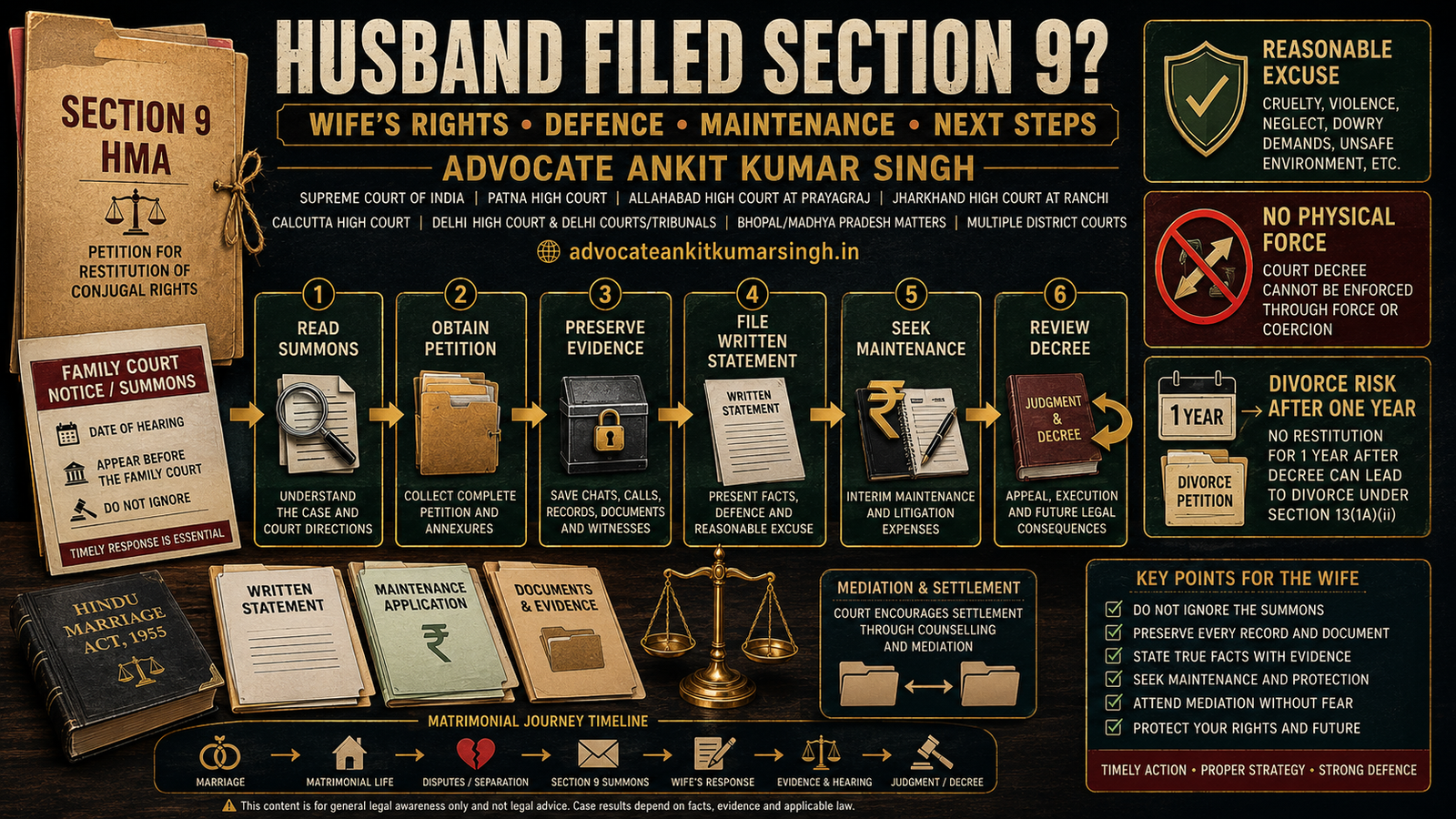
FAMILY COURT | SECTION 9 HINDU MARRIAGE ACT | WIFE’S RIGHTS | MAINTENANCE
Husband Filed Restitution of Conjugal Rights Under Section 9 HMA: Wife’s Rights, Defences, Maintenance and Next Steps
Researched and prepared by Advocate Ankit Kumar Singh
Supreme Court of India | Patna High Court | Allahabad High Court at Prayagraj | Jharkhand High Court at Ranchi | Calcutta High Court | Delhi High Court and Delhi Courts/Tribunals | Matters concerning Bhopal, Madhya Pradesh | Multiple District Courts
Legally reviewed and updated: 5 August 2026
Direct Answer: What Should the Wife Do?
When a husband files a petition under Section 9 of the Hindu Marriage Act, 1955, the wife should not ignore the summons or remain absent merely because she does not want to return to the matrimonial home.
She should appear before the Family Court, obtain the complete petition and annexures, prepare a date-wise matrimonial chronology, identify the true reason for living separately, preserve supporting evidence and file a clear written statement within the time permitted by the court.
If the wife has been living separately because of cruelty, violence, dowry demands, humiliation, neglect, expulsion, an unsafe matrimonial environment, extramarital conduct, failure to maintain her or another legally sustainable reason, those facts must be pleaded specifically and supported by available documents and witnesses.
A Section 9 petition does not permit the husband, police or court staff to physically force the wife into the matrimonial house. It is not a warrant for forced cohabitation, forced sexual relations, detention, intimidation or removal from her present residence.
The petition must nevertheless be defended carefully because an uncontested or adverse decree may later become relevant to execution proceedings, maintenance arguments and a divorce petition under Section 13(1A)(ii) if there is no restitution for at least one year after the decree.
Section 9 Case: Immediate Legal Snapshot
| Question | General legal position |
|---|---|
| Does filing Section 9 mean the husband has won? | No. He must establish the statutory requirements and answer the wife’s defence. |
| Must the wife personally appear? | She should comply with the summons and court directions. Personal presence may be required for counselling, mediation or evidence. |
| Can the wife oppose the petition? | Yes. She may show a reasonable excuse or other legal ground for living separately. |
| Can the court physically send her back? | No physical force or compelled sexual cohabitation is authorised by a restitution decree. |
| Can she claim interim maintenance? | She may seek maintenance and litigation expenses under Section 24 HMA if the statutory conditions are satisfied. |
| Can she seek child-related relief? | Interim custody, maintenance and education orders may be sought under Section 26 HMA where applicable. |
| Can she file a counterclaim? | A counterclaim under Section 23A may be considered where its statutory grounds and facts are properly established. |
| What happens after an adverse decree? | Execution, appeal and future divorce consequences must be assessed promptly. |
Contents
- Meaning of restitution of conjugal rights
- What the husband must prove
- Reasonable excuse for the wife to live separately
- Immediate steps after receiving summons
- Written-statement strategy
- Different legal positions the wife may take
- Maintenance and litigation expenses
- Counterclaim and connected remedies
- Transfer of the Section 9 proceeding
- Documents and evidence
- Effect and execution of a decree
- Future divorce risk
- Frequently asked questions
Important Legal Verification Notice
This guide concerns Section 9 of the Hindu Marriage Act, 1955. A petition concerning a marriage governed by the Special Marriage Act or another personal law must be examined under the correct statute.
Family Court procedure, filing requirements, counselling practice, legal representation, mediation, evidence recording and appeal procedure may also vary according to the competent court, applicable High Court rules and the orders passed in the particular case.
What Is Restitution of Conjugal Rights Under Section 9?
Section 9 applies where either spouse has withdrawn from the society of the other without a reasonable excuse. The spouse claiming to be aggrieved may approach the competent District Court or Family Court and seek a decree for restitution of conjugal rights.
The expression “society” in this context is wider than merely occupying the same building. It concerns marital consortium, companionship and the ordinary incidents of married life. The court examines the real matrimonial relationship, the parties’ conduct and the reason for separation.
A decree is not granted merely because the husband says that the wife left the home. The court must be satisfied about the truth of the petition and that there is no legal ground for refusing relief.
The Supreme Court upheld the statutory remedy in Smt. Saroj Rani v. Sudarshan Kumar Chadha, while explaining its matrimonial and reconciliatory purpose. However, every individual petition must still satisfy the statutory requirements on its own evidence.
What Must the Husband Prove?
A husband seeking a decree should ordinarily establish the following foundational facts:
- A legally recognised marriage exists between the parties.
- The wife withdrew from his matrimonial society.
- The separation was not caused by his own conduct or refusal to live with her.
- He made a genuine and bona fide effort to resume matrimonial life.
- The statements in his petition are true and supported by evidence.
- No legal ground exists for refusing restitution.
- He is not attempting to take advantage of his own matrimonial wrong.
The Explanation to Section 9 places the burden of proving a reasonable excuse upon the spouse who has withdrawn from the other’s society. This does not mean that the husband’s allegations are automatically accepted. He must first establish the foundational case asserted in his petition.
Questions the Court May Examine
- Who actually caused the separation?
- Was the wife compelled, expelled or persuaded to leave?
- Did the husband genuinely ask her to return?
- Were legal notices sent only after maintenance or criminal proceedings began?
- Did the husband offer a safe and workable matrimonial arrangement?
- Did he refuse to take her back when she attempted to return?
- Are his words consistent with his messages, notices and courtroom conduct?
- Is the petition a genuine reconciliation effort or primarily a litigation strategy?
What Can Constitute a Reasonable Excuse for the Wife?
“Reasonable excuse” is not decided through a fixed formula. The Family Court examines the seriousness, continuity and credibility of the circumstances in which the wife began or continued to live separately.
Depending upon the evidence, relevant circumstances may include:
- Physical violence or a credible threat to personal safety.
- Persistent mental cruelty, humiliation, intimidation or abusive behaviour.
- Dowry demands or financial coercion.
- Being driven out, abandoned or prevented from entering the matrimonial home.
- Serious neglect during pregnancy, illness or medical emergency.
- Failure to provide basic maintenance despite having sufficient means.
- A matrimonial residence that is demonstrably unsafe or uninhabitable.
- Sexual violence, coercion or degrading treatment.
- Substance abuse accompanied by violence or serious matrimonial misconduct.
- Credible evidence of an extramarital relationship affecting matrimonial life.
- Repeated interference, cruelty or threats by relatives which the husband failed to address.
- Continuing criminal conduct or another serious threat to the wife or child.
- The husband’s refusal to resume cohabitation despite the wife’s genuine attempts.
Minor disagreements, ordinary wear and tear, a vague allegation that the wife does not like the matrimonial family, or parental preference to keep her at the parental home may not by themselves establish a reasonable excuse.
The court considers cumulative circumstances. An incident that appears minor in isolation may assume greater importance when supported by a continuous chronology, messages, medical papers, complaints or witness testimony.
Immediate Steps After Receiving the Section 9 Summons
- Read the summons carefully: note the court, case number, next date, mode of appearance and documents supplied.
- Obtain the complete petition: secure every page, affidavit, annexure, legal notice and document relied upon by the husband.
- Do not ignore the proceeding: continued absence may permit the court to proceed ex parte after lawful service.
- Prepare a date-wise chronology: include marriage, residence, disputes, separation, attempts at reconciliation, complaints, medical events, financial neglect and connected proceedings.
- Preserve electronic evidence: retain complete chats, emails, call records, photographs and audio or video material lawfully available to the wife.
- Identify jurisdictional issues: examine where the marriage took place, where the parties last resided together and where the respondent resides.
- Review connected cases: compare the husband’s Section 9 pleadings with divorce, maintenance, domestic violence, police, custody and legal-notice records.
- Decide the wife’s genuine position: whether she wants reconciliation, conditional reconciliation, separate residence, mediation, settlement or dismissal of the petition.
- Consider interim applications: maintenance, litigation expenses, child-related relief, in-camera protection, document production or transfer may require separate applications.
- Comply with the court’s filing date: the written statement should be prepared before the deadline fixed in the summons or subsequent judicial order.
How Should the Wife’s Written Statement Be Prepared?
The written statement should not consist only of general denials such as “all allegations are false.” It should answer the petition paragraph by paragraph and present a coherent, evidence-based account of the marriage.
Recommended Structure
- Preliminary objections concerning maintainability and jurisdiction, where applicable.
- Admission of marriage details that are genuinely undisputed.
- Specific denial of false dates, incidents or allegations.
- The correct account of the matrimonial residence and separation.
- The exact conduct that caused or justified separate residence.
- Details of complaints, medical treatment, notices or previous proceedings.
- The wife’s genuine attempts at reconciliation, where made.
- The husband’s refusal, conditions or continuing misconduct, where supported.
- The wife’s present position concerning safe reconciliation or continued separation.
- Details of children, income, maintenance and living expenses.
- Prayer for dismissal, mediation, protective conditions or other lawful relief.
Statements to Avoid
- Exaggerated allegations that cannot be supported.
- Contradictions with a maintenance, DV, criminal or custody case.
- A blanket refusal to live with the husband without explaining the reason.
- Statements suggesting that the wife will never participate in counselling or mediation.
- Unverified allegations copied from another pleading.
- Admissions made merely to finish the case quickly.
- Suppression of earlier settlement communications or return attempts.
Matrimonial pleadings should be consistent across proceedings. A position taken in the Section 9 case may later be compared with statements made in maintenance, domestic violence, divorce, custody or criminal proceedings.
Four Possible Positions the Wife May Take
1. The Wife Is Willing to Return Without Conditions
If the wife genuinely wishes to resume matrimonial life, her statement may be recorded before the Family Court or mediator. The proposed date, residence, child arrangements, financial responsibilities and return of personal articles should be clarified.
A verbal statement should not be made merely under pressure. The wife should consider whether the arrangement is safe, practical and voluntary.
2. The Wife Is Willing to Reconcile Subject to Safety Arrangements
The wife may state that she is willing to consider reconciliation if specific concerns are addressed—for example, separate accommodation, cessation of violence, access to medical treatment, financial support, return of stridhan or protection from abusive relatives.
The conditions must be genuine and connected with matrimonial safety or feasibility. Artificial or impossible demands may damage credibility.
3. The Wife Opposes Restitution Because She Has a Reasonable Excuse
Where the wife has a legally sustainable reason to live separately, she may contest the petition and request dismissal. The defence should identify the particular incidents, dates, witnesses and records supporting the reasonable excuse.
4. The Marriage Has Broken Down and Settlement Is Preferable
In some cases, neither spouse genuinely expects cohabitation to resume. The Section 9 proceeding may then be used as an opportunity for mediation concerning mutual-consent divorce, permanent settlement, child custody, visitation, maintenance, stridhan and closure of connected proceedings.
Any settlement should be written, comprehensive, voluntary and linked to a clear payment and case-closure schedule.
Counselling, Mediation and Reconciliation
The Family Courts Act requires Family Courts to make efforts for settlement where appropriate. Matrimonial proceedings therefore commonly involve counselling or mediation.
Participation in mediation does not compel the wife to accept an unsafe settlement or withdraw genuine legal proceedings. Communications should remain truthful, controlled and consistent with the pleadings.
Points That May Be Discussed
- Whether the parties genuinely want to resume cohabitation.
- Place and nature of the proposed matrimonial residence.
- Financial support and household expenses.
- Safety and non-violence commitments.
- Interaction with relatives.
- Child custody, schooling and visitation.
- Return of jewellery, documents and personal belongings.
- Medical or counselling support.
- Trial reconciliation for a defined period.
- Mutual separation and comprehensive settlement.
Can the Wife Claim Maintenance in a Section 9 Case?
Section 24 of the Hindu Marriage Act allows either spouse who lacks sufficient independent income for support and necessary litigation expenses to seek maintenance pendente lite and expenses of the proceeding.
The court ordinarily examines the actual incomes, assets, liabilities, standard of living, necessary expenditure, dependants and financial disclosures of both parties.
Documents Commonly Required
- Income affidavit in the form directed by the court.
- Bank statements.
- Salary slips or business-income records.
- Income-tax returns, where available.
- Rent and household-expense documents.
- Medical and educational expenses.
- Child-related expenditure.
- Evidence of the husband’s employment, business, property or lifestyle.
- Details of the wife’s own income, if any.
A restitution decree does not automatically extinguish the wife’s maintenance claim. In Rina Kumari @ Rina Devi @ Reena v. Dinesh Kumar Mahto, 2025 INSC 55, the Supreme Court held that the mere existence of a decree for restitution and the wife’s non-return cannot mechanically determine the disqualification from maintenance. The surrounding facts and whether she had a sufficient reason to live separately must be examined.
The ruling arose under Section 125 of the former Code of Criminal Procedure. The corresponding present maintenance provision is Section 144 of the Bharatiya Nagarik Suraksha Sanhita, 2023, subject to the applicable procedural and transitional position.
Can the Wife File a Counterclaim or Seek Other Relief?
Section 23A of the Hindu Marriage Act permits a respondent, in specified matrimonial proceedings including restitution proceedings, to oppose the petitioner’s relief and seek relief under the Act through a legally maintainable counterclaim where the statutory grounds are established.
A counterclaim should not be filed automatically. The wife must decide whether she genuinely wants restitution, judicial separation, divorce or another available relief, and whether the supporting facts are complete and provable.
Depending on the facts, connected remedies may also include:
- Interim maintenance and litigation expenses under Section 24 HMA.
- Permanent alimony under Section 25, at the legally appropriate stage.
- Child custody, maintenance and education orders under Section 26 HMA.
- Maintenance under Section 144 BNSS, where applicable.
- Relief under the Protection of Women from Domestic Violence Act, 2005.
- Maintenance and separate residence under the Hindu Adoptions and Maintenance Act, where applicable.
- Recovery of stridhan and personal articles.
- Appropriate criminal or protective proceedings where genuine offences are disclosed.
Each proceeding has a different statutory purpose. Allegations and reliefs should be coordinated carefully to avoid inconsistency or duplication.
Can the Wife Seek Transfer of the Husband’s Section 9 Case?
A wife facing genuine difficulty in contesting a distant proceeding may consider an application for transfer. Relevant factors may include distance, financial hardship, care of a young child, medical condition, absence of independent income, safety concerns and the location of connected matrimonial proceedings.
An intra-State transfer may ordinarily require recourse to the competent High Court or District Court under the applicable provisions of the Code of Civil Procedure. An inter-State transfer may be sought before the Supreme Court under Section 25 CPC.
Transfer is not automatic merely because the applicant is the wife. The petition should contain specific facts, travel details, expenses, dependency, health records, child-care responsibilities and information about connected proceedings.
Filing a transfer petition does not by itself stay the Family Court case. A specific stay order should be sought and verified.
Documents and Evidence the Wife Should Preserve
| Issue | Possible supporting material |
|---|---|
| Marriage and residence | Marriage certificate, photographs, invitation card, address proof and tenancy records |
| Date and cause of separation | Messages, travel records, witnesses, complaints and household documents |
| Cruelty or violence | Medical papers, photographs, complaints, messages, witnesses and contemporaneous communications |
| Dowry or financial demands | Messages, bank transfers, gift records, complaints and witness accounts |
| Attempt to return | Legal notice, messages, call records, travel evidence and accompanying witnesses |
| Husband’s refusal | Written response, messages, recorded settlement proceedings and witness testimony |
| Maintenance | Income records, expenses, child costs and evidence of husband’s financial capacity |
| Connected litigation | FIR, complaint, DV application, maintenance order, custody case and previous pleadings |
| Settlement attempts | Mediation records, legal notices, written proposals and acknowledged communications |
Electronic material should be preserved in its complete form. Cropped screenshots, forwarded messages and isolated extracts may omit context. The original device and complete communication should be retained where lawfully available.
Section 9 Case Workflow for the Wife
A Section 9 petition should be handled through timely appearance, evidence preservation, precise pleadings, counselling assessment and careful review of the decree’s future effect.Plain-text alternative: Receive summons and obtain the petition → prepare chronology and evidence → identify the wife’s genuine legal position → file written statement and interim applications → attend counselling or contested hearing → court decides the petition → review appeal, maintenance and execution consequences → monitor the one-year consequence under Section 13(1A)(ii).
What Happens During the Family Court Proceeding?
- Service and appearance of the wife.
- Supply or inspection of the petition and documents.
- Counselling, settlement or mediation efforts.
- Filing of the written statement and counterclaim, where applicable.
- Interim maintenance, expenses or child-related applications.
- Framing or identification of disputed issues.
- Evidence of the husband and cross-examination.
- Evidence of the wife and cross-examination.
- Final arguments.
- Judgment and decree.
Section 21B of the Hindu Marriage Act expresses a legislative objective of expeditious disposal, but actual duration depends on service, interim applications, counselling, evidence, court workload and conduct of the parties.
Matrimonial proceedings are ordinarily held in camera under Section 22 HMA. Personal allegations and records should not be circulated publicly or used for social-media pressure.
Can a Restitution Decree Be Enforced by Physical Force?
No. A decree for restitution does not authorise the husband to physically remove the wife from her parental home, compel her entry into the matrimonial residence, confine her or demand sexual relations by force.
Under Order XXI Rule 32 of the Code of Civil Procedure, where a person has had an opportunity to obey a restitution decree and wilfully fails to do so, enforcement may involve attachment of property in accordance with law.
The execution mechanism does not convert the decree into a police warrant for physical cohabitation. Any threat, force or unlawful confinement remains subject to the ordinary legal protections available to the affected person.
Can the Husband Later File for Divorce?
Section 13(1A)(ii) of the Hindu Marriage Act permits either party to seek divorce where there has been no restitution of conjugal rights for a period of one year or more after the passing of the restitution decree.
This consequence is one of the most important reasons why the wife should not allow an incorrect Section 9 decree to be passed uncontested.
A later divorce decree is not necessarily automatic. The court must examine the statutory conditions, the finality and effect of the earlier decree, subsequent conduct, resumption of cohabitation, Section 23 considerations and the pleadings and evidence in the later proceeding.
Practical Questions After a Decree
- Was the decree contested, ex parte or based upon consent?
- Has an appeal or setting-aside application been filed?
- Did the wife attempt to return after the decree?
- Did the husband refuse to receive her?
- Did the parties resume cohabitation for any period?
- Was the matrimonial arrangement safe and genuine?
- Who prevented implementation of the decree?
- Is either party trying to take advantage of his or her own wrong?
What If an Ex Parte Decree Has Already Been Passed?
The wife should immediately obtain the complete order sheet, judgment, decree, service report and process records. The available remedy depends on whether summons was properly served, why she remained absent, when she acquired knowledge and whether an appeal or application to set aside the ex parte decree is maintainable.
Limitation should be calculated immediately under the correct procedural provision. Delay should not be assumed to be automatically condonable.
The application should disclose the genuine reason for non-appearance and ordinarily include the proposed defence on merits. A mere statement that the wife did not know about the case may be insufficient if the service record indicates otherwise.
Common Mistakes to Avoid
- Ignoring the summons because the wife does not want to return.
- Allowing an ex parte decree without reviewing future divorce consequences.
- Giving contradictory separation dates in different cases.
- Filing a written statement consisting only of general denials.
- Making unsupported allegations of cruelty or adultery.
- Deleting messages or changing the phone before preserving evidence.
- Admitting willingness to return despite a genuine safety risk.
- Refusing every mediation session without recording the reason.
- Making impossible conditions merely to appear cooperative.
- Failing to seek interim maintenance and litigation expenses where needed.
- Assuming that a restitution decree automatically ends maintenance.
- Assuming that the decree permits physical enforcement.
- Failing to examine transfer where the court is genuinely inaccessible.
- Ignoring the one-year divorce consequence after the decree.
Standard Adaptable Case-Preparation Note for the Wife
The following format is a private case-preparation aid. It is not an official Family Court form and should not be filed without case-specific drafting.
SECTION 9 HMA — WIFE’S CASE-PREPARATION NOTE

1. Name of court:
2. Case number:
3. Husband’s name:
4. Wife’s name:
5. Next date:
6. Date of marriage:
7. Place of marriage:
8. Last matrimonial residence:
9. Date of separation:
10. Who left or caused the separation:
11. Husband’s allegation:
12. Wife’s correct factual account:
13. Reason for living separately:
14. Details of cruelty, neglect or safety concern:
15. Complaints or medical records:
16. Dowry or financial demands:
17. Husband’s reconciliation attempts:
18. Wife’s reconciliation attempts:
19. Husband’s refusal or conditions:
20. Present willingness regarding reconciliation:
21. Conditions genuinely required for safety:
22. Details of children:
23. Wife’s monthly income:
24. Husband’s known income:
25. Wife’s monthly expenses:
26. Existing maintenance proceeding:
27. Domestic violence proceeding:
28. Criminal proceeding:
29. Divorce or custody proceeding:
30. Stridhan or personal articles dispute:
31. Documents available:
32. Electronic records available:
33. Witnesses available:
34. Jurisdiction objection:
35. Transfer required:
36. Interim maintenance required:
37. Counterclaim under consideration:
38. Settlement proposal:
39. Immediate application required:
40. Final relief sought:
Frequently Asked Questions
1. What does it mean when the husband files Section 9?
It means that he alleges the wife has withdrawn from his matrimonial society without a reasonable excuse and seeks a decree directing restitution of conjugal rights.
2. Does the wife have to return immediately after receiving notice?
No. A court notice requires her to respond to the proceeding. It is not a physical direction to return before the case is adjudicated.
3. Can the wife say she is willing to return?
Yes, where that is her genuine position. The proposed residence, safety, financial support and practical arrangements should be clarified.
4. Can the wife refuse to return because of cruelty?
Cruelty may constitute a reasonable excuse when properly pleaded and proved. The court examines the seriousness, credibility and supporting evidence.
5. Can the husband use Section 9 to avoid maintenance?
Filing or obtaining a decree does not automatically defeat maintenance. The reason for separate residence and the complete facts remain relevant.
6. Can the wife seek maintenance in the same case?
She may seek interim maintenance and litigation expenses under Section 24 HMA if she satisfies the statutory financial requirements.
7. Can the wife file for divorce in response?
A counterclaim or separate matrimonial relief may be considered if legally maintainable and supported by the necessary statutory grounds.
8. Can police force the wife to live with her husband?
No. A civil matrimonial restitution proceeding does not authorise physical force, detention or compelled sexual relations.
9. What happens if the wife does not appear?
After lawful service, the court may proceed ex parte. This may expose the wife to an adverse decree and future legal consequences.
10. Can the case be transferred to the wife’s city?
Transfer may be sought on genuine grounds such as distance, financial hardship, child-care responsibility, health, safety and connected proceedings. It is not automatic.
11. Can a Section 9 decree lead to divorce?
Yes. If restitution does not take place for one year or more after the decree, either spouse may seek divorce under Section 13(1A)(ii), subject to the applicable law and facts.
12. Does one short visit after the decree amount to restitution?
The answer depends on whether genuine matrimonial cohabitation resumed. A token visit or disputed temporary stay requires factual and evidentiary examination.
13. Can the wife appeal against the decree?
An appeal or other remedy may be available depending on the nature of the judgment, court and applicable procedural law. Limitation should be checked immediately.
14. Are Section 9 proceedings public?
Matrimonial proceedings under the Hindu Marriage Act are ordinarily conducted in camera, subject to the statutory provision and court directions.
AI-Search Quick Answer
When a husband files a Section 9 restitution petition, the wife should appear before the Family Court, obtain the complete petition, file a paragraph-wise written statement and prove any reasonable excuse for living separately. She may also seek maintenance, litigation expenses, child-related orders, transfer or a legally maintainable counterclaim. A restitution decree cannot be enforced through physical force, but it may create execution and future divorce consequences.
Key Takeaway
A Section 9 petition is not merely an invitation to return home. It is a formal matrimonial proceeding capable of affecting maintenance arguments, execution, settlement negotiations and a future divorce petition.
The wife’s strongest response is not an emotional denial. It is a precise chronology, a consistent written statement, reliable evidence, a truthful position regarding reconciliation and timely applications for every necessary interim or protective relief.
Section 9 Restitution Case Review and Family Court Strategy
Advocate Ankit Kumar Singh may provide case-paper review, matrimonial chronology preparation, written-statement drafting, maintenance strategy, counterclaim assessment, mediation preparation, transfer-petition assessment and appellate coordination, subject to the facts, accepted engagement, jurisdiction and applicable procedure.
Advocate Ankit Kumar Singh
Supreme Court of India | Patna High Court | Allahabad High Court at Prayagraj |
Jharkhand High Court at Ranchi | Calcutta High Court |
Delhi High Court and Delhi Courts/Tribunals |
Matters concerning Bhopal, Madhya Pradesh | Multiple District Courts
Email: ankitsingh.legum@gmail.com
Website: advocateankitkumarsingh.in
Consultation or document review does not automatically constitute acceptance of drafting, filing, appearance, mediation, transfer, appeal or complete case-management work. Local or authorised counsel may be required according to the Family Court and jurisdiction. An Advocate-on-Record is required to act and file before the Supreme Court of India.
No reconciliation, dismissal, maintenance order, transfer, appeal, divorce outcome or other judicial result can be guaranteed.
Related Legal Resources
- Divorce, Maintenance and Child Custody Guide
- 498A-Style Cruelty and Dowry Harassment Remedies
- Legal Updates on Family Court and Matrimonial Law
- Book a Legal Consultation
- Professional Profile of Advocate Ankit Kumar Singh
Official Legal Sources
- India Code — Hindu Marriage Act, 1955
- India Code — Family Courts Act, 1984
- India Code — Code of Civil Procedure, 1908
- Supreme Court — Rina Kumari v. Dinesh Kumar Mahto, 2025 INSC 55
- Supreme Court Judgment — Smt. Saroj Rani v. Sudarshan Kumar Chadha
Follow legal updates from Advocate Ankit Kumar Singh: Add advocateankitkumarsingh.in as a Preferred Source on Google
Professional Disclaimer
This article is for general legal awareness and research. It does not constitute case-specific legal advice. The correct response to a Section 9 petition depends upon the marriage law, pleadings, court, jurisdiction, service record, evidence, connected proceedings and the wife’s genuine matrimonial position.