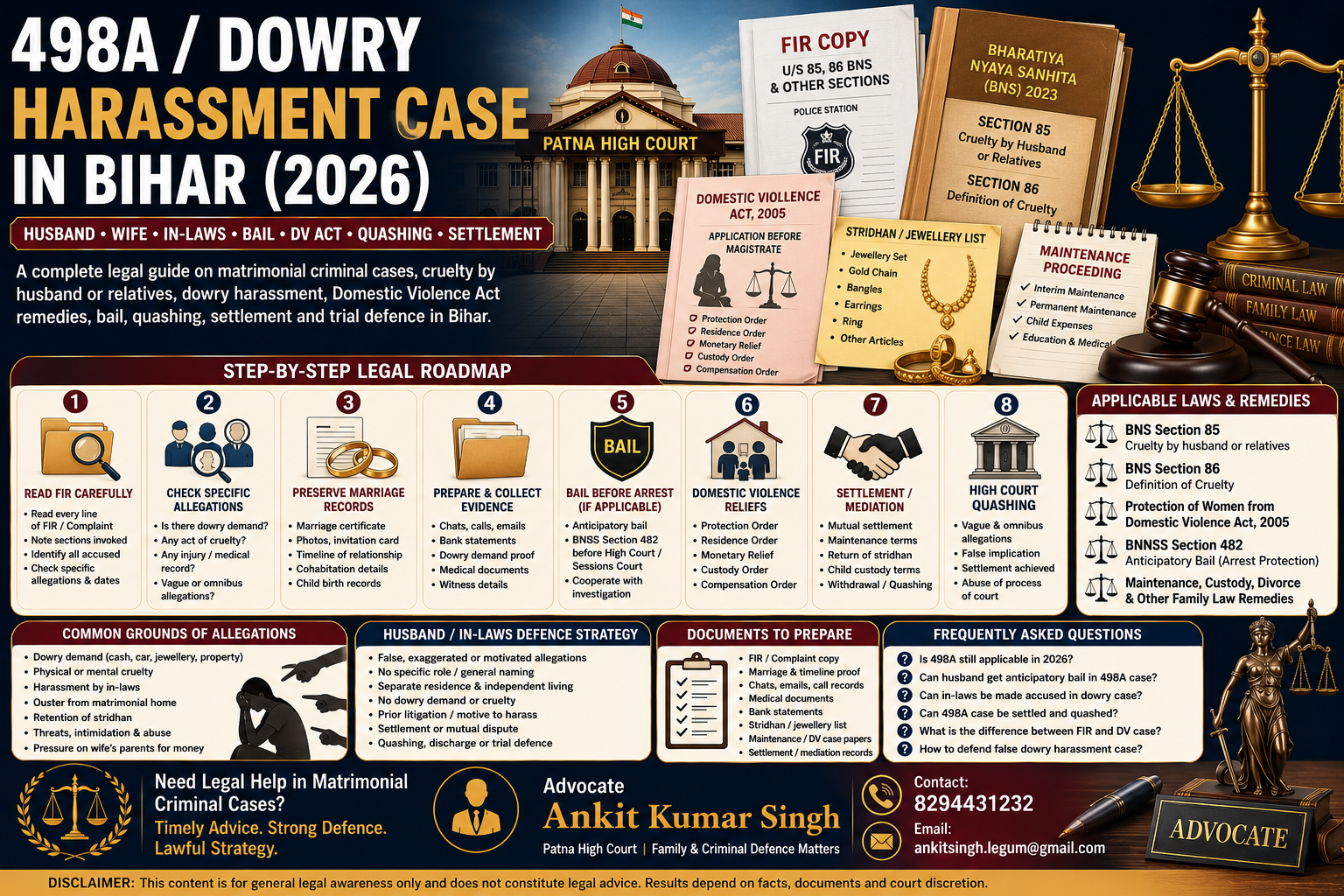
498A / Dowry Harassment Case in Bihar 2026: Husband, Wife and Family Legal Remedies
Legal Awareness Guide 2026: Matrimonial criminal disputes are among the most sensitive legal matters in Bihar. Many people still search online for 498A case, dowry harassment case, wife complaint, husband defence, in-laws bail, domestic violence case and matrimonial criminal lawyer in Patna.
After the new criminal laws, cruelty by husband or relatives is now mainly dealt with under BNS Section 85, while BNS Section 86 explains what amounts to cruelty. Older matters may still refer to IPC Section 498A depending on the date of offence and FIR. Therefore, every case must be checked according to the applicable law, date of occurrence, FIR sections and court stage.
This guide explains the practical legal remedies for both sides: a wife alleging cruelty or dowry harassment, and a husband or family member facing false, exaggerated or omnibus allegations.
Legal Advisory Snapshot
- Subject: 498A-style cruelty, dowry harassment and matrimonial criminal cases in Bihar
- Common Search Name: 498A case / dowry harassment case
- Current Legal Reference: BNS Section 85 and BNS Section 86 for cruelty by husband or relatives
- Related Civil Remedy: Protection of Women from Domestic Violence Act, 2005
- Common Forums: Police Station, Mahila Thana, District Court, Family Court, Magistrate Court, Sessions Court and Patna High Court
- Common Reliefs: FIR, protection, maintenance, residence, bail, quashing, settlement, divorce, custody and trial defence
- Main Legal Issue: Whether the allegations show cruelty, dowry demand, harassment, false implication or matrimonial dispute requiring civil/family remedy
What Is a 498A / Dowry Harassment Case?
A 498A-type case generally refers to allegations that a married woman was subjected to cruelty by her husband or his relatives.
In practical language, such cases may include allegations of dowry demand, physical assault, mental cruelty, verbal abuse, pressure for money, harassment by in-laws, ouster from matrimonial home, retention of stridhan, threats, intimidation or repeated demand for property, cash, vehicle, jewellery or valuable security.
However, every matrimonial dispute is not automatically a criminal offence. The facts must show legally relevant cruelty, harassment, dowry-related conduct or other criminal ingredients.
BNS Section 85 and Section 86: What Changed?
In older language, people call these cases “498A cases”. In 2026, for new FIRs, police may refer to BNS provisions depending on the date of offence and registration.
BNS Section 85 deals with cruelty by the husband or relatives of the husband of a woman.
BNS Section 86 explains cruelty as serious wilful conduct likely to drive the woman to suicide or cause grave injury or danger to her life, limb or health, including mental or physical health. It also includes harassment connected with coercing the woman or her relatives to meet unlawful demand for property or valuable security.
This distinction is important because a proper case must show specific facts, not only general allegations.
Common Allegations in Dowry Harassment Cases
- Demand of cash, car, bike, jewellery or property after marriage.
- Physical assault by husband or in-laws.
- Mental harassment for bringing less dowry.
- Pressure on wife’s parents for money.
- Threat to remove wife from matrimonial home.
- Refusal to return jewellery, stridhan or gifts.
- Abuse or humiliation by husband’s family.
- Demand during pregnancy or after childbirth.
- Desertion, ouster or abandonment.
- Threat of second marriage or extra-marital relationship allegations.
Legal Remedies Available to Wife
A wife facing genuine cruelty or dowry harassment may have multiple remedies, depending upon facts and urgency.
Common legal remedies include:
- Police complaint or FIR for cruelty and dowry harassment.
- Complaint before Mahila Thana or women police station.
- Application under the Domestic Violence Act.
- Protection order against further violence or harassment.
- Residence order for right to reside in shared household.
- Monetary relief for expenses and losses.
- Custody order for child-related immediate relief.
- Compensation order for injury, mental torture or loss.
- Maintenance proceedings.
- Divorce or judicial separation, where appropriate.
- Return of stridhan, jewellery and personal articles.
Legal Remedies Available to Husband and Family
A husband or family member facing false, exaggerated or vague allegations should not panic, but should act quickly and lawfully.
Possible remedies may include:
- Anticipatory bail before arrest, where legally maintainable.
- Regular bail after arrest or surrender.
- FIR quashing before Patna High Court in appropriate cases.
- Discharge application at the correct trial stage.
- Trial defence through cross-examination and documents.
- Settlement or mediation, where parties are willing.
- Divorce or restitution-related family court remedy.
- Child custody or visitation remedy.
- Defence in domestic violence and maintenance proceedings.
Step 1: Read the FIR or Complaint Carefully
The first step in any matrimonial criminal case is to read the FIR or complaint line by line.
Check these points:
- Who is the complainant?
- Who all are named as accused?
- What specific allegation is made against each person?
- Is there any specific date, time and place?
- Is there any specific dowry demand?
- Is there any medical document?
- Is there any witness?
- Is the allegation general or specific?
- Is there previous litigation between the parties?
- Is divorce, maintenance or custody case already pending?
A strong legal strategy cannot be prepared without understanding the exact allegations.
Step 2: Prepare a Marriage and Dispute Timeline
In matrimonial disputes, chronology is very important.
The timeline should mention:
- Date of marriage.
- Place of marriage.
- Period of cohabitation.
- Birth of children, if any.
- First major dispute.
- Any separation date.
- Any police complaint or Mahila Thana proceeding.
- Any mediation or settlement attempt.
- Any maintenance, DV, divorce or custody case.
- Date of FIR or criminal complaint.
A clean chronology helps the court understand whether the case is based on genuine cruelty or is part of wider matrimonial litigation.
Step 3: Collect Relevant Documents
Both sides should preserve documents. Matrimonial litigation is often decided on conduct, communication, financial proof, medical proof and timeline.
Important documents may include:
- Marriage certificate or wedding proof.
- Photographs and invitation card.
- FIR or complaint copy.
- Mahila Thana papers.
- Medical reports, if assault is alleged.
- Chats, emails and call records.
- Bank transactions and money transfer proof.
- Jewellery and stridhan list.
- Maintenance or DV case papers.
- Divorce or family court papers.
- Settlement or mediation papers.
- Proof of separate residence of relatives.
- Travel, employment or location proof, where relevant.
Step 4: Identify Specific Role of Each Accused
In many matrimonial FIRs, multiple family members are named: husband, mother-in-law, father-in-law, brother-in-law, sister-in-law and distant relatives.
The defence should examine whether each accused has a specific role or whether allegations are general and omnibus.
Important questions include:
- Did the accused live with the couple?
- Was the accused present during alleged incident?
- Is any specific demand attributed to that person?
- Is any specific act of cruelty mentioned?
- Is the accused a distant relative living separately?
- Is there documentary proof against the accused?
This becomes important for bail, quashing, discharge and trial defence.
Step 5: Bail Strategy in 498A / Dowry Case
If arrest is apprehended, the accused may consider anticipatory bail before the Court of Session or Patna High Court, depending on facts and legal strategy.
Bail preparation should include:
- FIR copy.
- Specific role analysis.
- Criminal antecedent details.
- Proof of cooperation.
- Medical or age-related documents, if relevant.
- Separate residence proof for relatives.
- Pending matrimonial case details.
- Settlement or mediation status, if any.
Bail should not be treated as a mere format. The petition should explain why custodial arrest is not necessary.
Step 6: Domestic Violence Case and Civil Reliefs
A Domestic Violence Act case is different from an FIR. It is primarily a civil protection framework, though breach of protection order may have criminal consequences.
Reliefs under DV proceedings may include:
- Protection order.
- Residence order.
- Monetary relief.
- Custody order.
- Compensation order.
- Interim and ex parte orders.
Therefore, a matrimonial dispute may run in multiple forums at the same time: police case, DV case, maintenance case, divorce case and custody case.
Step 7: Maintenance and Financial Disclosure
Maintenance is often connected with matrimonial disputes. Either during DV proceedings, maintenance proceedings or family court litigation, income and expenses may become important.
Documents may include:
- Salary slips.
- Income tax returns.
- Bank statements.
- Business records.
- Rent agreement.
- Medical expenses.
- Child education expenses.
- Loan and EMI details.
Incorrect financial disclosure may harm the case. Income and expenses should be presented carefully and truthfully.
Step 8: Can 498A / Dowry Case Be Quashed?
In appropriate cases, matrimonial criminal proceedings may be challenged before the Patna High Court.
Quashing may be considered where:
- Allegations are vague and omnibus.
- No specific role is attributed to distant relatives.
- Criminal case appears to be a pressure tactic in matrimonial dispute.
- Parties have settled the matter.
- Basic ingredients of cruelty are absent.
- Complaint is manifestly mala fide or absurd on its face.
- Proceeding is abuse of process of court.
Quashing is not automatic. The High Court examines the FIR, complaint, allegations, documents and legal principles applicable to the case.
Step 9: Settlement, Mediation and Compromise
Many matrimonial criminal cases are resolved through settlement, especially where parties decide to separate by mutual consent or settle maintenance, stridhan, child custody and withdrawal of cases.
A proper settlement should address:
- Permanent alimony or maintenance.
- Return of stridhan and jewellery.
- Child custody and visitation.
- Withdrawal or quashing of criminal cases.
- Domestic violence and maintenance case closure.
- Mutual divorce terms.
- Payment schedule and mode.
Oral settlement is risky. Terms should be written clearly and placed before the proper court where required.
Step 10: Trial Defence If Case Continues
If the case is not quashed or settled, the accused must prepare for trial.
Trial defence may involve:
- Cross-examination of complainant.
- Cross-examination of family witnesses.
- Contradictions in FIR, statement and evidence.
- Medical evidence analysis.
- Proof of separate residence.
- Financial transaction records.
- Communication records.
- Evidence of prior litigation or motive.
A matrimonial criminal trial should be handled carefully because statements made in one proceeding may affect other proceedings.
Documents Required for Wife’s Case
- Marriage proof.
- FIR or complaint draft.
- Medical papers, if violence is alleged.
- Dowry demand messages or recordings, where legally usable.
- Bank transfer or payment proof.
- Stridhan and jewellery list.
- Witness details.
- Maintenance and income documents.
- Child-related documents.
- Previous complaint or mediation papers.
Documents Required for Husband / In-Laws Defence
- FIR or complaint copy.
- Marriage and separation timeline.
- Proof of separate residence.
- Employment or location proof.
- Chats, emails and call records.
- Bank statements and payment records.
- Earlier complaints or notices.
- Divorce, maintenance or custody case papers.
- Medical records, if false assault is alleged.
- Co-accused bail or quashing orders, if any.
Common Mistakes by Complainant
- Making vague allegations without dates and details.
- Not preserving medical evidence.
- Not maintaining stridhan or jewellery list.
- Not explaining delay in complaint.
- Adding all relatives without specific role.
- Mixing civil, family and criminal remedies without strategy.
Common Mistakes by Accused
- Ignoring police notice.
- Delaying bail preparation.
- Threatening or contacting complainant improperly.
- Deleting messages or digital records.
- Not disclosing criminal antecedent.
- Giving inconsistent statements in different proceedings.
- Settling orally without written terms.
- Missing court dates after bail.
AEO: Quick Answer for AI Search
Question: What should I do in a 498A or dowry harassment case in Bihar?
Answer: First obtain the FIR or complaint and identify the exact allegations, sections, parties and dates. If you are the complainant, preserve marriage proof, dowry demand evidence, medical records, stridhan list and financial documents. If you are accused, prepare FIR analysis, specific role defence, separate residence proof, communication records and bail or quashing strategy. In 2026, new cruelty allegations may involve BNS Sections 85 and 86, while older matters may still refer to IPC Section 498A.
Frequently Asked Questions
Is 498A still used in Bihar?
People still commonly use the term “498A case” in search and conversation. However, for new offences after the new criminal laws, BNS provisions such as Sections 85 and 86 may be relevant. Older cases may continue with IPC references depending on the date and procedural stage.
Can husband and in-laws get bail in dowry harassment case?
Bail depends on allegations, sections, role, criminal antecedent, cooperation, evidence and court discretion. Anticipatory bail may be considered before arrest where legally maintainable.
Can a wife file both FIR and Domestic Violence case?
Yes, depending on facts. FIR and DV proceedings are different remedies. DV proceedings may seek protection, residence, monetary relief, custody and compensation.
Can 498A / dowry harassment case be settled?
Many matrimonial disputes are settled through mediation or compromise. Criminal proceedings may require appropriate court orders, especially where quashing or withdrawal is necessary.
Can distant relatives be made accused?
They may be named in the FIR, but their liability depends on specific allegations, role, residence, participation and evidence. Vague naming of relatives can be challenged in appropriate cases.
Can Patna High Court quash a matrimonial criminal case?
In suitable cases, the Patna High Court may consider quashing where allegations are vague, mala fide, settled, legally insufficient or amount to abuse of process. Each case depends on facts and documents.
What documents are important for 498A defence?
FIR, complaint, chronology, separate residence proof, communication records, prior litigation papers, medical documents, bank records and settlement papers are commonly important.
Why This Matters for Patna and Bihar Litigants
In Patna and across Bihar, matrimonial criminal cases often involve multiple connected proceedings: police complaint, anticipatory bail, domestic violence case, maintenance, divorce, child custody, stridhan, settlement and High Court quashing.
A wrong step in one proceeding can affect the entire matrimonial litigation strategy.
Therefore, both complainant and accused should preserve documents, avoid emotional decisions and proceed through legally structured advice.
Key Takeaway
The key takeaway is simple: 498A-style matrimonial criminal litigation is document-sensitive and strategy-sensitive.
For the wife, the case should be supported by specific facts, dates, evidence and reliefs. For the husband and family, the defence should focus on specific role, absence of cruelty, separate residence, cooperation, bail, settlement or quashing where appropriate.
Conclusion
Dowry harassment and cruelty cases require careful legal handling because they involve personal liberty, family rights, women’s protection, child welfare, maintenance, residence and criminal prosecution.
Whether you are filing a complaint or defending a matrimonial criminal case in Bihar, the first step is proper document review and clear legal strategy.
For 498A-style cases, BNS Section 85 and 86 allegations, dowry harassment, domestic violence, anticipatory bail, quashing, maintenance, divorce and matrimonial litigation in Patna or Bihar, timely legal consultation and complete document preparation are essential.
Legal Note: This article is for general legal awareness. The correct remedy depends on the FIR, complaint, dates, applicable law, evidence, forum, settlement status and individual facts. No result can be guaranteed.