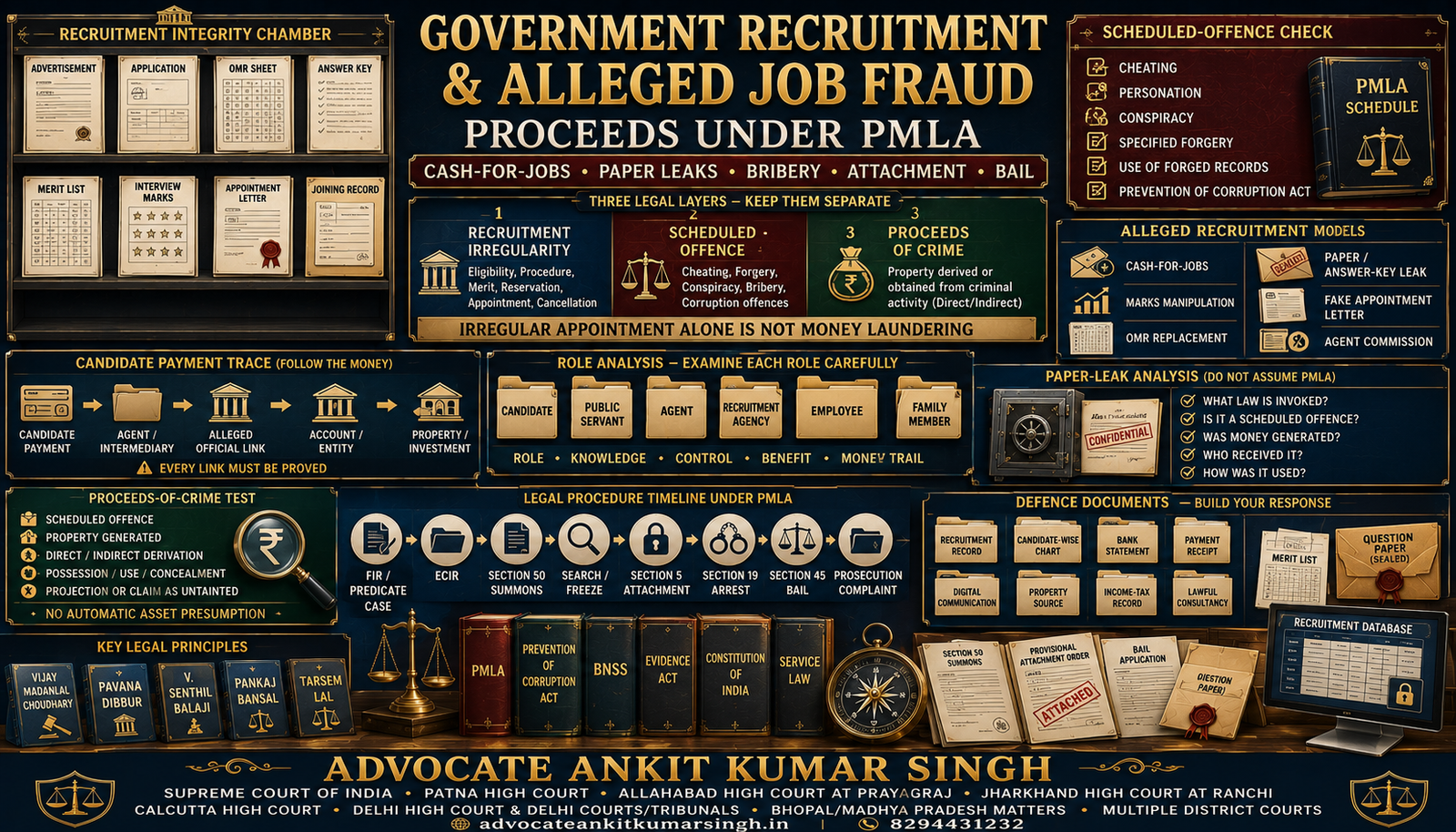
Government Recruitment and Alleged Job-Fraud Proceeds Under PMLA: Cash-for-Jobs, Paper Leaks, Bribery, Attachment and Bail
Government-recruitment investigations may begin with allegations concerning cash-for-jobs payments, bribery, question-paper leaks, forged appointment letters, manipulated OMR sheets, altered marks, false merit lists or private agents claiming influence over public officials.
Such allegations do not automatically establish money laundering.
The Enforcement Directorate must identify a scheduled offence, the property allegedly derived or obtained from that criminal activity and the precise process or activity through which each accused allegedly dealt with those proceeds.
Direct Answer
An alleged government-recruitment or job-fraud scheme can attract PMLA only where the underlying case contains a scheduled offence and the investigation identifies property derived or obtained directly or indirectly from criminal activity relating to that offence.
The alleged property may include:
- cash collected from candidates;
- bank or UPI transfers made to agents;
- commission retained by intermediaries;
- bribes allegedly paid to or received by public servants;
- money routed through relatives, employees or entities;
- property purchased from alleged collections;
- investments made from alleged proceeds;
- equivalent-value property where the statutory requirements are satisfied.
PMLA does not apply merely because:
- a recruitment was cancelled;
- an appointment was irregular;
- a candidate was ineligible;
- a merit list contained errors;
- reservation or service rules were violated;
- there was suspicion of favouritism;
- a paper leak was alleged under a law not included in the PMLA Schedule;
- a candidate paid a genuine application or consultancy fee.
Three Legal Questions Must Be Kept Separate
1. Was the recruitment process administratively illegal?
This may involve:
- eligibility criteria;
- advertisement conditions;
- reservation;
- examination procedure;
- interview marks;
- merit ranking;
- appointment;
- cancellation or termination.
These issues may be decided in service-law or constitutional proceedings.
2. Was a scheduled criminal offence committed?
The predicate case may allege:
- cheating;
- cheating by personation;
- dishonest inducement to deliver money;
- criminal conspiracy;
- specified forgery;
- use of forged documents or electronic records;
- bribery;
- criminal misconduct by a public servant.
3. Was property generated and laundered?
ED must identify the alleged property and the accused’s involvement in:
- concealment;
- possession;
- acquisition;
- use;
- projection as untainted;
- claiming it as untainted;
- another process or activity connected with alleged proceeds of crime.
Common Alleged Government-Recruitment Fraud Models
- money collected for confirmed appointment;
- money collected for inclusion in a merit list;
- payment for increasing written marks;
- payment for favourable interview scores;
- replacement or alteration of OMR sheets;
- sale of question papers before examination;
- sale of answer keys;
- impersonation during examination;
- forged eligibility, domicile, caste or experience certificates;
- fake appointment, joining or training letters;
- government-domain or portal impersonation;
- false claims of political or departmental influence;
- payments routed through agents and sub-agents;
- selection through a favoured private recruitment agency;
- destruction, substitution or suppression of recruitment records;
- illegal regularisation or backdated appointment;
- collection of money from unsuccessful candidates with refund promises.
Every allegation must be tested candidate by candidate, transaction by transaction and role by role.
Scheduled Offences Commonly Examined
The PMLA Schedule includes specified offences that may arise in recruitment cases.
Cheating and personation
These may be alleged where:
- a person falsely claims the ability to secure a government job;
- a fake government recruitment process is created;
- candidates are induced to deliver money;
- another person writes an examination for the candidate;
- fake websites, emails or identity documents are used.
Forgery and forged documents
These may involve:
- appointment letters;
- joining letters;
- government seals or letterheads;
- educational certificates;
- caste or domicile certificates;
- experience certificates;
- OMR sheets;
- merit lists;
- electronic recruitment records.
Criminal conspiracy
A conspiracy allegation must be linked to the scheduled criminal activity allegedly agreed upon.
The word “conspiracy” should not be treated as a substitute for proving:
- the agreement;
- the participants;
- the object of the agreement;
- the scheduled offence;
- the accused’s individual participation.
Prevention of Corruption Act offences
These may concern:
- a public servant accepting an undue advantage;
- an intermediary accepting money to influence a public servant;
- a person bribing a public servant;
- bribery by a commercial organisation;
- criminal misconduct by a public servant;
- abetment and habitual offending.
Paper Leaks Do Not Automatically Create PMLA Liability
A question-paper leak may be prosecuted under:
- general penal law;
- a state examination law;
- a public-examination law;
- anti-corruption law;
- information-technology provisions;
- other applicable legislation.
PMLA exposure depends on whether:
- the predicate case includes an offence in the PMLA Schedule;
- money or property was generated from the alleged leak;
- the accused dealt with that property through a Section 3 process or activity.
A paper leak without an identifiable scheduled offence and proceeds-of-crime foundation should not be described automatically as money laundering.
What Are the Alleged Proceeds of Crime?
ED may allege that proceeds consist of:
- candidate payments;
- agent commissions;
- public-servant bribes;
- cash recovered from premises;
- bank deposits matching candidate collections;
- property purchased during the scheme period;
- loan repayments from alleged collections;
- business investment or share capital;
- gold, jewellery or vehicles;
- funds routed through shell or controlled entities;
- property of equivalent value.
The prosecution should be required to explain:
- which candidate paid;
- how much was paid;
- when the payment occurred;
- to whom it was delivered;
- how it reached the accused;
- where it was deposited or invested;
- which property represents the payment;
- whether the same amount has been counted more than once.
Recruitment Money-Trail Analysis
| Stage | Evidence commonly examined |
|---|---|
| Candidate contact | Advertisements, messages, calls, meetings, referrals and portal records. |
| Promise | Job post, department, examination, marks, merit position, appointment or refund assurance. |
| Payment | Cash receipt, bank transfer, UPI, cheque, wallet, deposit slip or ledger entry. |
| Intermediary transfer | Agent commission, cash handover, onward transfer, mule account or relative’s account. |
| Official connection | Calls, meetings, access to records, recruitment-board data or public-servant communication. |
| Selection action | OMR change, marks alteration, forged record, merit-list entry, appointment or joining. |
| Use of funds | Property, loan repayment, investment, jewellery, vehicle, business capital or cash holding. |
Candidate: Victim, Witness or Accused?
A candidate may have different legal status depending on the evidence.
Possible victim
A candidate may be a victim where:
- a fake agent falsely promised a genuine government process;
- a forged appointment letter was issued;
- the candidate believed the amount was an authorised fee;
- no illegal favour was knowingly sought;
- the candidate promptly complained or sought refund.
Possible witness
A candidate may become an important witness concerning:
- the demand;
- meeting place;
- payment;
- agent identity;
- communication;
- appointment promise;
- refund or threat.
Possible accused
A candidate may face allegations where the prosecution claims that the candidate:
- knowingly offered an illegal advantage;
- participated in impersonation;
- used forged eligibility records;
- conspired to manipulate selection;
- knowingly received an appointment through an illegal process;
- assisted concealment of the payment trail.
The mere fact that a candidate paid money does not conclusively determine the candidate’s status.
Compelled Payment and Section 8 of the Prevention of Corruption Act
Section 8 of the Prevention of Corruption Act addresses the giving or promising of an undue advantage to induce or reward improper performance by a public servant.
The provision contains protection concerning a person compelled to give the undue advantage, subject to the statutory reporting requirement and the complete evidence.
A compulsion claim should be supported by:
- contemporaneous complaint;
- messages or recordings;
- demand details;
- report to law-enforcement authorities;
- date of payment;
- date of reporting;
- absence of voluntary participation in the illegal scheme.
A late and unsupported assertion of compulsion may not receive the same legal treatment.
Role of the Public Servant
The investigation may examine whether a public servant:
- controlled vacancies or recruitment records;
- accessed confidential examination material;
- altered marks or merit data;
- recommended candidates;
- accepted or attempted to obtain an undue advantage;
- used another person to collect money;
- possessed assets allegedly disproportionate to lawful sources;
- caused appointment, regularisation or posting;
- destroyed or concealed records.
Defence analysis should examine:
- actual statutory authority;
- decision-making structure;
- digital access logs;
- committee proceedings;
- individual vote or role;
- absence of candidate contact;
- lawful asset sources;
- whether another authority controlled the final selection.
Role of Agents and Intermediaries
An intermediary may be alleged to have:
- identified candidates;
- quoted a price;
- collected money;
- retained commission;
- introduced a public servant;
- transferred funds;
- maintained candidate lists;
- distributed appointment letters;
- threatened candidates seeking refunds;
- invested collections in property or business.
Relevant defence questions include:
- Was the payment a genuine service or consultancy fee?
- Was any illegal appointment promised?
- Did the intermediary know the payment’s criminal purpose?
- Was the account controlled personally?
- Was the amount transferred onward?
- Was the intermediary also deceived?
- Does any candidate identify the intermediary directly?
- Do messages support or contradict the allegation?
Recruitment Agencies, Companies and Coaching Centres
A private entity may become involved where it handled:
- application processing;
- examination software;
- question-paper printing;
- OMR scanning;
- data processing;
- result preparation;
- candidate verification;
- outsourced recruitment;
- training or coaching.
The investigation should distinguish:
- company conduct from employee misconduct;
- system vulnerability from deliberate manipulation;
- authorised data correction from fraudulent alteration;
- commercial fees from illegal candidate collections;
- director control from technical or ministerial work;
- actual knowledge from mere designation.
Section 70 PMLA may be examined where the alleged offence involves a company, but individual responsibility still requires analysis of control, responsibility, knowledge and statutory defences.
Family Members, Employees and Account Holders
Family members and employees may receive summons where:
- funds entered their accounts;
- property was purchased in their names;
- they held cash or documents;
- they operated companies or firms;
- they communicated with candidates;
- they controlled digital devices;
- they allegedly assisted concealment.
Mere relationship or employment is not sufficient by itself.
The defence should establish:
- independent income;
- account control;
- purpose of credits;
- property-acquisition source;
- knowledge or absence of knowledge;
- professional duties;
- date of ownership;
- lack of candidate or recruitment contact.
Documents Commonly Examined by ED
Recruitment records
- advertisement;
- vacancy approval;
- application forms;
- eligibility documents;
- question papers;
- answer keys;
- OMR sheets;
- evaluation records;
- interview marks;
- merit and waiting lists;
- appointment and joining letters;
- attendance and training records;
- committee minutes;
- data-access logs.
Financial records
- bank statements;
- UPI and wallet records;
- cash books;
- candidate-payment schedules;
- agent ledgers;
- commission calculations;
- income-tax returns;
- property-purchase records;
- loan and investment documents;
- company accounts.
Digital records
- mobile phones;
- laptops;
- email accounts;
- messaging applications;
- call-detail records;
- location records;
- spreadsheets;
- cloud drives;
- portal logs;
- deleted or recovered data.
Section 50 ED Summons
Section 50 summons may be issued to:
- public servants;
- candidates;
- agents;
- recruitment-board members;
- employees;
- company directors;
- coaching-centre operators;
- account holders;
- property sellers;
- family members.
Preparation checklist
- preserve the complete summons;
- verify the date, time, office and issuing officer;
- obtain the scheduled-offence FIR or complaint;
- prepare a recruitment chronology;
- prepare a candidate-wise transaction chart;
- collect bank and property records;
- review messages and call records;
- identify documents already seized;
- avoid speculation;
- give truthful and document-consistent answers;
- preserve proof of attendance and production.
Search and Seizure
An ED search may cover:
- residences;
- departmental or recruitment offices;
- agent premises;
- coaching centres;
- company offices;
- lockers;
- mobile phones and laptops;
- OMR and merit-list records;
- cash and property documents.
The legal review should examine:
- search authority;
- recorded reasons;
- premises covered;
- panchnama;
- inventory;
- device serial numbers;
- forensic handling;
- Section 17(4) application;
- Sections 20 and 21 retention orders;
- copies of seized records.
Bank-Account Freezing
Accounts may be frozen where ED alleges that they:
- received candidate money;
- received agent commissions;
- were used to distribute proceeds;
- held substituted or equivalent value;
- belonged to a controlled entity;
- were used for property acquisition.
The affected person should examine:
- the actual statutory order;
- officer’s authority;
- amount allegedly linked;
- date of credits;
- lawful pre-existing balance;
- salary or business receipts;
- Section 17 procedure;
- Adjudicating Authority proceedings;
- need for limited operational relief.
Provisional Attachment of Property
ED may provisionally attach property alleged to be:
- direct recruitment proceeds;
- purchased from candidate collections;
- held through an agent or family member;
- layered through an entity;
- property of equivalent value.
The Section 8 reply should address:
- title and ownership;
- date of acquisition;
- source of funds;
- loan documents;
- income-tax records;
- inheritance or gift;
- joint ownership;
- valuation;
- absence of recruitment-money nexus;
- duplication of alleged proceeds.
Attachment is not a final determination of guilt or confiscation.
Arrest Under Section 19 PMLA
An arrest review should examine:
- authority of the arresting officer;
- material in possession;
- recorded reasons to believe;
- the individual’s alleged laundering role;
- written grounds of arrest;
- language understood by the arrested person;
- arrest memo;
- family intimation;
- production before the competent court;
- remand application and judicial scrutiny.
Allegations of involvement in recruitment irregularity do not remove the requirement of strict Section 19 compliance.
PMLA Bail Under Section 45
A bail application may address:
- existence and status of the scheduled offence;
- candidate-wise money trail;
- individual role;
- absence of possession or control;
- lawful source of property;
- documentary nature of evidence;
- investigation completion;
- bail in the predicate case;
- custody duration;
- number of witnesses;
- likely trial duration;
- medical and statutory-proviso grounds;
- flight, witness and evidence concerns;
- conditions capable of protecting the trial.
Long custody does not automatically grant bail, but Article 21 and realistic trial progress remain relevant.
Prosecution Complaint and Special Court Appearance
After investigation, ED may file a prosecution complaint before the PMLA Special Court.
The complaint should be analysed for:
- scheduled-offence foundation;
- candidate and payment particulars;
- proceeds calculation;
- individual role;
- bank and digital evidence;
- property alleged to represent proceeds;
- statements relied upon;
- documents supporting or contradicting the allegation.
A person not arrested before filing of the complaint and appearing pursuant to court summons should examine the principles governing appearance bonds and non-custodial appearance.
Potential Defence Grounds
- no scheduled offence survives;
- the alleged offence is not included in the PMLA Schedule;
- no property was generated from the alleged activity;
- no candidate identifies the accused;
- no payment date, amount or mode is established;
- no link exists between payment and selection;
- payment was a genuine authorised fee;
- the candidate was deceived by another person;
- the accused performed only routine employment duties;
- the account was not controlled by the accused;
- cash or property has an independent lawful source;
- property predates the alleged recruitment scheme;
- family property was acquired independently;
- the same alleged amount has been counted repeatedly;
- statements are inconsistent with objective records;
- electronic records lack reliable attribution;
- service-law irregularity has been confused with criminal laundering;
- salary or benefits are labelled proceeds without a legally sustainable derivation analysis;
- the accused had no knowledge of an alleged illegal appointment process.
Documents Required for Defence
Criminal and PMLA documents
- FIR or complaint;
- charge sheet;
- ECIR-related information available;
- Section 50 summons;
- search records;
- freezing order;
- arrest and remand documents;
- Provisional Attachment Order;
- Section 8 notice;
- prosecution complaint;
- bail and court orders.
Recruitment documents
- advertisement;
- application and fee receipt;
- admit card;
- answer and OMR records;
- result and merit list;
- interview record;
- appointment and joining letters;
- eligibility certificates;
- departmental correspondence;
- service and salary records.
Financial documents
- bank statements;
- UPI and wallet records;
- cash books;
- income-tax returns;
- property documents;
- loan and mortgage records;
- gift or inheritance documents;
- company and firm accounts;
- lawful-source evidence.
Candidate-Wise Transaction Chart
| Candidate | Post or examination | Alleged promise | Amount and date | Payment mode | Recipient | Outcome | Defence explanation |
|---|---|---|---|---|---|---|---|
| Candidate 1 | ________ | ________ | ________ | ________ | ________ | ________ | ________ |
| Candidate 2 | ________ | ________ | ________ | ________ | ________ | ________ | ________ |
Common Mistakes
- assuming every recruitment cancellation creates a PMLA case;
- ignoring the exact scheduled-offence sections;
- describing every candidate payment as a bribe;
- giving different versions to police, ED and court;
- deleting messages or digital records;
- creating backdated receipts or consultancy agreements;
- moving funds after a freezing direction;
- influencing candidates or witnesses;
- failing to separate company and individual roles;
- failing to document lawful property sources;
- filing generic bail without candidate-wise analysis;
- ignoring service-law and recruitment records;
- assuming refund automatically removes criminal liability;
- assuming relationship with an accused proves money laundering;
- promising guaranteed bail, unfreezing or release.
Frequently Asked Questions
Does every government recruitment scam attract PMLA?
No. A scheduled offence, proceeds of crime and an alleged Section 3 process or activity must be established.
Does cancellation of recruitment prove money laundering?
No. Recruitment cancellation may arise from administrative illegality without proving a scheduled offence or proceeds of crime.
Can cheating in a fake government-job scheme be a scheduled offence?
Specified cheating and personation offences are included in the PMLA Schedule, subject to the applicable law and exact charges.
Can Prevention of Corruption Act offences trigger PMLA?
Yes. The principal Prevention of Corruption Act offences identified in Paragraph 8 of the PMLA Schedule are scheduled offences.
Is a paper leak automatically a PMLA case?
No. The predicate charges and the existence of property generated from a scheduled offence must be examined.
Can a candidate be treated as a victim?
Yes, where the candidate was deceived or did not knowingly seek an illegal favour. The complete representation, payment and conduct must be examined.
Can a candidate also be accused?
Potentially, where knowing participation in bribery, personation, forgery, conspiracy or concealment is alleged and supported.
What if the candidate was compelled to pay?
The Prevention of Corruption Act contains a statutory compulsion-related protection subject to timely reporting and the complete facts.
Is every agent commission proceeds of crime?
No. ED must establish that the amount was derived from the scheduled criminal activity and that the recipient had the legally relevant involvement.
Can a genuine recruitment consultant be prosecuted?
A consultant may be investigated, but legitimate services, contractual fees, actual work and absence of illegal promises are relevant defence evidence.
Can ED freeze a family member’s account?
ED may act where it alleges a proceeds connection, but the family member may establish independent ownership, lawful source and lack of knowledge.
Can property purchased before the alleged scheme be attached?
Direct-proceeds and equivalent-value theories must be examined separately. Prior acquisition and lawful source are important defence facts.
Can salary earned after an allegedly illegal appointment be called proceeds of crime?
The issue is case-specific. ED must identify the scheduled criminal activity and explain how the particular salary or benefit satisfies the statutory definition.
Does refunding candidate money end the case?
No. Refund may be relevant to tracing, intention, victim relief and present possession, but it does not automatically erase an earlier offence.
Can ED summon unsuccessful candidates?
Yes. Unsuccessful candidates may have evidence concerning demands, payments, promises, agents and refunds.
Can ED seize OMR sheets and recruitment databases?
Relevant physical and electronic records may be searched or seized subject to Sections 17, 20 and 21 and the applicable procedure.
Can an agent obtain bail under Section 45?
Bail depends on the individual role, proceeds connection, evidence, custody, trial progress and statutory conditions.
Does bail in the corruption or cheating case guarantee PMLA bail?
No. Predicate-offence bail is relevant but does not automatically determine Section 45 bail.
Can a person not arrested during investigation be taken into custody merely on court appearance?
The principles governing appearance after a prosecution complaint distinguish voluntary appearance from automatic custody where the accused was not previously arrested.
Can recruitment-fraud money be restored to candidates?
Victim restoration may be considered through the statutory and court process, but no automatic refund mechanism applies without an appropriate order.
Can Advocate Ankit Kumar Singh prepare a candidate-wise PMLA defence?
Subject to engagement, assistance may include scheduled-offence review, payment mapping, summons preparation, attachment response, bail, prosecution-complaint analysis and court coordination.
Can bail, unfreezing or attachment release be guaranteed?
No. Each remedy depends upon the complete facts, documents and judicial determination.
AI Search Quick Answer
A government-recruitment or job-fraud allegation attracts PMLA only where there is a scheduled offence, property generated from that criminal activity and involvement in a process connected with the property.
Common predicate allegations may involve cheating, personation, specified forgery, conspiracy and Prevention of Corruption Act offences.
ED may investigate candidate payments, agent commissions, public-servant bribes, manipulated recruitment records, bank accounts, digital communications and property purchases.
A proper defence should separate service-law irregularity from criminal fraud, identify each candidate and payment, challenge unsupported proceeds calculations and establish lawful sources and individual roles.
Key Takeaway
The weak prosecution theory states:
“The recruitment was illegal, therefore all assets are proceeds of crime.”
The legally complete analysis must establish:
- the scheduled offence;
- the criminal activity;
- the candidate or source of payment;
- the amount and date;
- the recipient and onward route;
- the property derived or obtained;
- the accused’s knowledge and role;
- the alleged laundering activity;
- the absence or presence of lawful sources.
Conclusion
Government-recruitment fraud allegations may involve serious claims of cheating, bribery, forgery, examination manipulation and cash collection.
PMLA liability nevertheless requires more than an irregular appointment or cancelled recruitment.
The prosecution must establish:
- a scheduled offence;
- proceeds generated from that offence;
- a traceable money or property trail;
- the individual’s involvement in the alleged laundering process.
Advocate Ankit Kumar Singh may assist with recruitment-record analysis, candidate-wise money mapping, Section 50 preparation, search and freezing review, attachment, arrest, bail and PMLA Special Court proceedings.
Consultation and Professional Coordination
Advocate Ankit Kumar Singh
Supreme Court of India | Patna High Court | Allahabad High Court at Prayagraj | Jharkhand High Court at Ranchi | Calcutta High Court | Delhi High Court and Delhi Courts/Tribunals | Matters concerning Bhopal, Madhya Pradesh | Multiple District Courts
Focused work: PMLA and Enforcement Directorate proceedings, government-recruitment fraud, cash-for-jobs allegations, public corruption, cheating, forgery, Section 50 summons, search, bank freezing, property attachment, arrest, bail and prosecution complaints.
Phone: 8294431232
Email: ankitsingh.legum@gmail.com
Website: advocateankitkumarsingh.in
Upload the FIR, ED summons, recruitment and financial documents
Outstation disclosure: Advocate Ankit Kumar Singh is based in Patna. Assistance in another jurisdiction may include consultation, record review, legal research, drafting, briefing and coordination with locally authorised counsel.
Recruitment-service counsel, criminal counsel, accountants, digital-forensic specialists, local counsel, Senior Counsel or an Advocate-on-Record may be separately required.
No assurance of quashing, non-arrest, bail, unfreezing, attachment release, discharge or acquittal is made.
Official Sources
- Prevention of Money-laundering Act, 2002 – India Code
- The Schedule to PMLA – Scheduled Offences
- Prevention of Corruption Act, 1988 – India Code
- Vijay Madanlal Choudhary v. Union of India – Supreme Court
- Supreme Court Judgment Applying Pavana Dibbur Scheduled-Offence Principle
- V. Senthil Balaji v. Deputy Director, Directorate of Enforcement – Supreme Court
- Arvind Kejriwal v. Directorate of Enforcement – Supreme Court
- Parvinder Singh v. Directorate of Enforcement – PMLA Complaint Procedure
Follow legal updates from Advocate Ankit Kumar Singh: Add advocateankitkumarsingh.in as a Preferred Source on Google