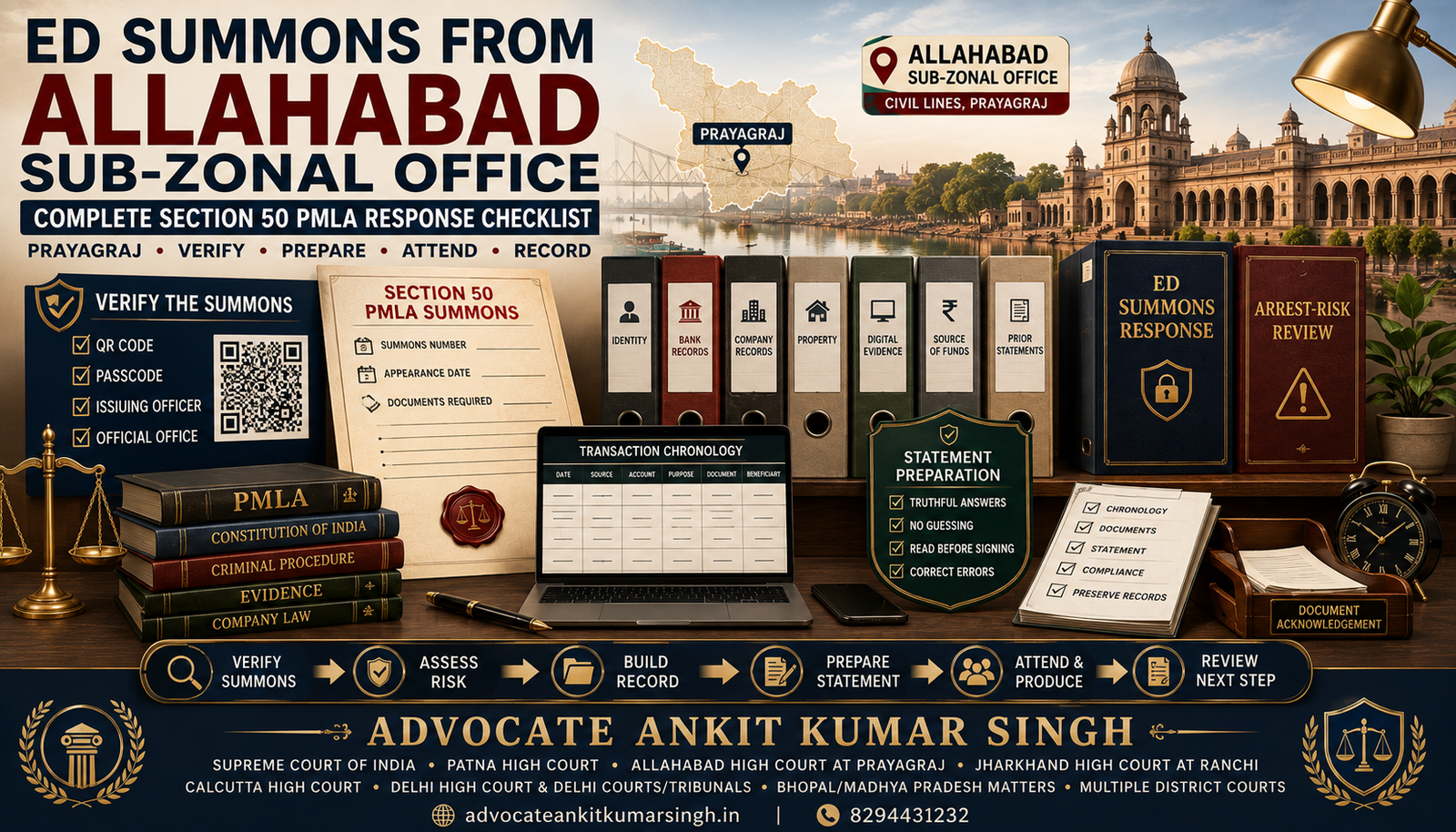
Received an ED Summons from the Allahabad Sub-Zonal Office? Complete Section 50 PMLA Response Checklist for Prayagraj
A summons from the Directorate of Enforcement should neither be ignored nor answered casually.
A Section 50 PMLA summons may require personal attendance, production of financial records, explanation of transactions or both. The recipient may presently appear to be a witness, employee, director, professional, account holder, property owner or another person considered relevant to the inquiry. That description may not remain fixed as additional material is collected.
This guide provides a complete response framework for a summons issued by the Enforcement Directorate’s Allahabad Sub-Zonal Office in Prayagraj.
Direct Answer
After receiving an ED summons from the Allahabad Sub-Zonal Office, first verify that it is genuine, identify exactly what has been directed, preserve all records and obtain a case-specific legal assessment before the appearance date.
The immediate response should include:
- Verify the QR code, summons number and passcode.
- Confirm the issuing officer, designation, signature, stamp, official email and telephone number.
- Confirm the appearance date, time and exact office address.
- Determine whether personal attendance has been directed.
- Read every schedule or list of records demanded.
- Identify the underlying FIR, complaint, charge-sheet or suspected scheduled offence.
- Prepare a date-wise chronology.
- Prepare a transaction, entity and property map.
- Preserve all physical and electronic evidence.
- Assess arrest, search, bank-freezing and attachment risks.
- Prepare only truthful, document-supported answers.
- Carry indexed copies and preserve proof of every document submitted.
Do not:
- ignore the summons;
- move funds or property;
- delete messages or accounting data;
- create backdated documents;
- coordinate a false explanation;
- guess during questioning;
- sign a statement without reading it carefully.
Official Allahabad Sub-Zonal Office Details
As verified from the Directorate of Enforcement’s official directory on 3 August 2026:
| Particular | Officially listed detail |
|---|---|
| Authority | Directorate of Enforcement — Allahabad Sub-Zonal Office |
| Officer presently listed | Kumar Anshuman |
| Designation | Deputy Director |
| Telephone | 0532-2974300 |
| Address | 6th Floor, CTO Compound, BSNL Building, Nawab Yusuf Road, Civil Lines, Prayagraj – 211001 |
Verify the current details from ED’s official website before attending. An officer, designation, telephone number or office arrangement may change after publication.
Use “Allahabad Sub-Zonal Office” for the authority’s official name and “Prayagraj” for its current postal location.
What Is a Section 50 PMLA Summons?
Section 50 empowers specified ED authorities to summon a person whose attendance is considered necessary for giving evidence, producing records or both during a PMLA proceeding.
The authority may require:
- personal attendance;
- answers concerning relevant transactions or events;
- books of account;
- bank records;
- company documents;
- property papers;
- electronic communications;
- digital-asset or platform records;
- other identified records.
The summoned person is bound to state the truth and produce the records required, subject to applicable legal objections and protections.
The proceeding has substantial evidentiary importance. It should not be treated as an informal interview.
Does an ED Summons Mean You Are an Accused?
No. Issuance of a summons does not conclusively determine the recipient’s status.
ED may summon:
- a witness;
- an employee;
- a director;
- an authorised signatory;
- an accountant;
- a banker;
- a professional adviser;
- a vendor or customer;
- a family member;
- a property holder;
- a suspected beneficiary;
- a person whose conduct is being examined.
The practical risk nevertheless depends on:
- the alleged scheduled offence;
- the person’s role;
- the value and movement of questioned funds;
- earlier statements;
- documents already collected;
- cooperation history;
- whether searches or arrests have occurred;
- whether the agency alleges concealment, dissipation or obstruction.
Complete Summons Authentication Checklist
Check the face of the summons
- Recipient’s complete name.
- Address or entity description.
- Summons number.
- Date of issue.
- Section invoked.
- Issuing officer’s name.
- Issuing officer’s designation.
- Signature.
- Official stamp.
- Official email address.
- Telephone number for correspondence.
- Appearance date.
- Appearance time.
- Place of attendance.
- Records required.
- QR code and passcode, where system-generated.
Verify electronically
- Use ED’s official “Verify Your Summons” facility.
- Enter the summons number.
- Enter the unique passcode.
- Confirm the recipient’s name.
- Confirm the issuing officer and designation.
- Confirm the date of summons.
- Preserve a screenshot or printout of the verification result.
ED states that online verification may become available after 24 hours from issuance, excluding public holidays, Saturdays and Sundays.
If the summons does not verify
- Do not conclude immediately that it is fake.
- Recheck the number and passcode.
- Consider whether 24 working hours have elapsed.
- Contact the issuing office through independently verified official details.
- Do not use a telephone number supplied only through an unsolicited message without verification.
- Preserve the summons, envelope, email and delivery information.
There is no lawful concept of “digital arrest” or “online arrest” under PMLA. A demand for immediate payment to avoid digital arrest is a major fraud warning.
First 24-Hour Response Checklist
- Scan every page of the summons.
- Preserve the original document and envelope.
- Record the date and mode of service.
- Verify authenticity.
- Calendar the appearance deadline.
- Identify the issuing office and officer.
- Read the document schedule word by word.
- Identify who within the family or company possesses the requested records.
- Prevent deletion or routine destruction of electronic data.
- Stop automatic email or cloud-retention deletion where lawfully possible.
- Collect earlier police, CBI, tax, GST, SFIO or court records connected with the matter.
- Prepare a one-page factual chronology.
- Identify travel, health or disability constraints.
- Obtain legal advice before communicating a substantive explanation.
Identify the Capacity in Which You May Have Been Summoned
| Possible capacity | Initial preparation focus |
|---|---|
| Company director or promoter | Board role, decision-making, bank authority, beneficial ownership, related entities and transaction approval. |
| Employee | Job description, reporting structure, system access, instructions received and actual authority. |
| Accountant or finance officer | Ledger preparation, source documents, accounting access, audit trail and person supplying the entries. |
| Authorised signatory | Scope of authority, actual control, approval process and purpose of signed transactions. |
| Vendor or customer | Contract, invoice, delivery, payment, tax treatment and genuine commercial substance. |
| Property owner | Title, acquisition date, payment source, possession, loan, inheritance and beneficial ownership. |
| Family member | Independent income, account operation, property source and knowledge of questioned transactions. |
| Professional adviser | Professional engagement, scope, documents received, applicable privilege and statutory duties. |
| Witness or record holder | Personal knowledge, custody of documents and distinction between direct knowledge and information received from others. |
The summons may not expressly describe the person as a witness or suspect. Do not invent a status that the document does not state.
Scheduled-Offence and ECIR Checklist
A Section 50 response should not be prepared without investigating the underlying legal context.
Scheduled-offence checklist
- Obtain the FIR or complaint.
- Identify the investigating agency.
- Identify every penal provision invoked.
- Check whether the relevant offence appears in the PMLA Schedule.
- Obtain the charge-sheet, supplementary charge-sheet or closure report.
- Obtain bail, quashing, discharge and trial orders.
- Identify the alleged victim and alleged loss.
- Identify the property said to have resulted from the criminal activity.
- Identify the period of the alleged offence.
ECIR-related checklist
- Record any ECIR number appearing in the summons or other document.
- Do not assume that a copy of the ECIR will automatically be supplied.
- Identify the known scheduled-offence material.
- Identify the ED unit handling the proceeding.
- Compare the summons period with the FIR and transaction period.
- Determine whether another ED office has issued earlier summons.
- Determine whether searches, arrests or attachment orders exist in the same matter.
Complete Document-Production Checklist
Identity and authority documents
- Aadhaar or other valid identity document.
- PAN.
- Address proof.
- Passport, where relevant.
- Company-authorisation letter.
- Board resolution, where applicable.
- Proof of designation and period of employment.
Banking records
- Complete statements for the specified period.
- Account-opening and KYC records.
- Cancelled cheque.
- Loan-account statements.
- Fixed-deposit and investment records.
- Foreign-remittance records.
- Credit-card statements where relevant.
- Explanation and supporting document for material credits.
- Explanation and supporting document for material debits.
Company records
- Certificate of incorporation.
- Memorandum and articles.
- Shareholding records.
- Beneficial-ownership records.
- Board minutes and resolutions.
- Director and authorised-signatory details.
- Audited accounts.
- Ledgers.
- Trial balance.
- GST returns.
- Income-tax returns.
- Vendor and customer masters.
- Related-party transaction records.
- Loans and advances.
- Accounting-software exports.
Commercial documents
- Contracts.
- Purchase orders.
- Invoices.
- Delivery challans.
- E-way bills.
- Transport records.
- Proof of supply or service.
- Correspondence with counterparties.
- Settlement or termination documents.
Property documents
- Sale deed.
- Agreement for sale.
- Gift deed.
- Partition or inheritance papers.
- Payment trail.
- Loan and mortgage documents.
- Mutation and tax records.
- Possession evidence.
- Valuation material.
- Joint-owner or third-party rights.
Digital and electronic records
- Email-account identification.
- Relevant complete email chains.
- Relevant complete message exports.
- Cloud-account details.
- Device-user allocation.
- Accounting-system access logs.
- Payment-gateway records.
- Digital-wallet records.
- Cryptocurrency exchange and wallet records.
- Backup information.
Submission-control checklist
- Prepare a numbered index.
- Paginate every document set.
- Use readable copies.
- Separate originals from copies.
- Prepare a covering letter.
- State which documents are unavailable.
- State the reason for unavailability truthfully.
- Preserve an identical copy of everything submitted.
- Obtain an acknowledgement or receiving proof.
Transaction and Source-of-Funds Preparation
For every material transaction, prepare a table containing:
| Field | Information required |
|---|---|
| Date | Exact transaction date. |
| Amount | Value and currency. |
| Sender | Name, account and relationship. |
| Recipient | Name, account and relationship. |
| Stated purpose | Sale, loan, salary, investment, refund, gift, service or another purpose. |
| Supporting document | Invoice, agreement, deed, resolution, tax record or other evidence. |
| Accounting treatment | Ledger head and financial-statement treatment. |
| Tax treatment | Relevant return or disclosure. |
| Subsequent movement | Where the funds or asset moved next. |
| Actual beneficiary | Person or entity ultimately benefiting. |
Do not create an explanation merely because it appears favourable. The transaction table should reproduce the true record.
Personal Attendance and Authorised-Agent Checklist
Section 50 refers to attendance in person or through an authorised agent as the officer may direct.
This does not permit the recipient to decide unilaterally that a lawyer, employee or relative will attend instead.
If personal attendance is directed
- Plan to attend personally.
- Seek a written clarification if the language is uncertain.
- Do not assume that sending documents alone amounts to compliance.
- Do not assume that a lawyer can answer factual questions on your behalf.
If personal attendance is genuinely impossible
- Write before the appearance date.
- Explain the precise reason.
- Attach medical, travel or other supporting records.
- Request a specific alternative date.
- Offer to submit documents within time where possible.
- Preserve proof of delivery.
- Do not treat the request as automatically allowed.
- Obtain confirmation of the changed date.
Model Contents of an Adjournment Request
- Summons number and date.
- Recipient’s complete name.
- Scheduled appearance date and time.
- Issuing officer and office.
- Clear statement that the summons is respected.
- Specific reason preventing attendance.
- Supporting evidence.
- Alternative dates offered.
- Statement of willingness to cooperate.
- Status of the requested documents.
- Contact information.
- Request for written confirmation.
A vague request stating only “personal difficulty” may be inadequate in a high-stakes proceeding.
Statement-Preparation Checklist
Before questioning
- Read the summons again.
- Review the chronology.
- Review prior statements given to police, CBI, tax authorities, banks and courts.
- Identify contradictions.
- Review material bank entries.
- Review company roles and authorisations.
- Distinguish personal knowledge from assumption.
- Identify records not personally prepared by you.
- Identify the period during which you held the relevant role.
- Identify health, language or disability requirements.
During questioning
- Listen to the complete question.
- Ask for clarification if the question is unclear.
- Answer only from truthful knowledge and records.
- Do not guess.
- Do not adopt another person’s explanation without knowledge.
- Do not conceal an adverse fact.
- Do not volunteer speculation.
- Do not sign blank or incomplete pages.
- Read the complete statement before signing.
- Ensure every correction is made before signature.
- Ensure every page is complete.
- Record any medical difficulty promptly.
After questioning
- Prepare a confidential note of the questions and answers while memory is fresh.
- Record the start and end time.
- Record the documents produced.
- Record the next date, if communicated.
- Identify any inaccurate or incomplete answer immediately.
- Preserve all further communications.
Can a Lawyer Remain Present During ED Questioning?
A summoned person may obtain legal advice before and after the appearance.
There is no universal rule granting a right to have an advocate sit beside the person and participate throughout every Section 50 examination.
Whether limited visual access, nearby presence or another arrangement is permitted depends on the applicable judicial order and facts.
The safest preparation is therefore:
- complete pre-appearance conference;
- document and chronology review;
- clear understanding of legal risks;
- availability of counsel for urgent advice where lawfully permitted;
- post-appearance review.
Do not obstruct questioning by insisting upon a procedural arrangement that has not been granted.
Correction or Retraction of an Inaccurate Statement
An answer should be corrected before signing wherever possible.
If a material answer was inaccurate, incomplete, involuntary or wrongly recorded, obtain immediate legal advice.
A later representation should ordinarily identify:
- the date of the statement;
- the exact question or paragraph;
- the inaccurate portion;
- the correct factual position;
- why the error occurred;
- supporting documents;
- the circumstances affecting voluntariness, where alleged.
A generic retraction without particulars may carry limited weight. Delay may also affect credibility.
No universal statutory number of days for every correction or retraction is specified in the official source.
Arrest-Risk Checklist
A summons is not an arrest order. Arrest under Section 19 requires a separate statutory decision.
Risk should be examined by considering:
- whether other persons have been arrested;
- whether searches have occurred;
- whether the client is alleged to control the questioned funds;
- whether the agency alleges destruction or movement of evidence;
- whether earlier summons were ignored;
- whether statements and records materially conflict;
- whether the person is alleged to be a principal beneficiary;
- whether the transaction trail is already documented by the agency;
- whether custodial interrogation is being asserted as necessary;
- medical and statutory-proviso considerations.
Emergency documents
- Identity and address proof.
- Medical records.
- List of current medication.
- Family contact information.
- Earlier bail orders.
- Scheduled-offence papers.
- Short role note.
- Source-of-funds documents.
- Details of legal counsel.
Repeated Summons Checklist
A second or later summons does not automatically mean arrest, but it requires a fresh risk review.
- Compare each summons with the previous summons.
- Identify new document demands.
- Identify new transaction periods.
- Review the earlier statement.
- Correct any discovered error promptly.
- Update the chronology.
- Update the entity and transaction charts.
- Identify whether another person’s statement may have triggered the new summons.
- Assess whether the person’s apparent status has changed.
- Preserve proof of earlier compliance.
- Do not repeat an answer merely for consistency if it is known to be inaccurate.
Escalation Beyond the Summons
| Development | Immediate legal preparation |
|---|---|
| Section 17 search | Preserve the authorisation-related record supplied, panchnama, inventory, device details and copies of seized material. |
| Bank-account freezing | Obtain the bank communication, trace lawful credits, identify salary, tax and business needs and examine the statutory nexus. |
| Section 19 arrest | Obtain the arrest memo, written grounds, medical record and remand papers and examine statutory compliance. |
| Section 45 bail | Prepare the role, proceeds-of-crime analysis, documentary defence, custody position and statutory-proviso material. |
| Section 5 attachment | Prepare title, acquisition date, source of consideration, ownership and absence-of-nexus evidence. |
| Section 8 notice | Prepare a property-specific reply within the stated period, which must provide not less than the statutory minimum. |
| Appellate Tribunal | Prepare the statutory appeal and interim-relief request within limitation. |
| High Court proceeding | Identify territorial jurisdiction, maintainability, alternative remedy and the precise legal defect. |
| Prosecution complaint | Examine cognizance, process, relied-upon material, appearance, bail, discharge, charge and trial strategy. |
Allahabad High Court and Special Court Coordination
A summons issued from Prayagraj does not mean that every connected proceeding will be heard in Prayagraj.
Depending on the notification, territorial connection and procedural stage, a matter may involve:
- the Allahabad Sub-Zonal Office in Prayagraj;
- the Lucknow Zonal Office;
- a scheduled-offence court in the concerned district;
- a notified PMLA Special Court at Lucknow or another competent place;
- the Adjudicating Authority;
- the PMLA Appellate Tribunal;
- the Allahabad High Court at Prayagraj;
- the Lucknow Bench of the Allahabad High Court;
- the Supreme Court of India.
The correct forum must be determined from the actual order, statutory remedy and territorial jurisdiction.
Dark-Theme Complete Response Flowchart
Complete response process for a Section 50 PMLA summons from the Allahabad Sub-Zonal Office in Prayagraj.Common Mistakes
- Ignoring the summons.
- Verifying it through an unconfirmed telephone number.
- Waiting until the previous evening to consult counsel.
- Sending only the first page to the advocate.
- Assuming that the recipient is merely a witness.
- Assuming that the recipient is already an accused.
- Attending without reading prior statements.
- Producing original records without a controlled inventory.
- Submitting documents without keeping an identical copy.
- Producing an unindexed data dump.
- Guessing when the answer is not known.
- Using the words “I do not remember” for matters clearly shown by available records.
- Signing without reading.
- Deleting messages or accounting records.
- Creating retrospective invoices or agreements.
- Moving funds or property after receiving the summons.
- Giving inconsistent explanations in different proceedings.
- Assuming that an adjournment request has been accepted without confirmation.
- Failing to record what happened after appearance.
Master Client Checklist
Authentication
- Summons verified.
- Issuing officer confirmed.
- Office address confirmed.
- Appearance date calendared.
- Service proof preserved.
Legal background
- Scheduled offence identified.
- FIR and charge-sheet collected.
- ECIR reference recorded where available.
- Prior summons and statements collected.
- Search, arrest, freezing or attachment developments identified.
Documents
- Demand list analysed.
- Custodian of each record identified.
- Index prepared.
- Pages numbered.
- Covering letter prepared.
- Identical office copy preserved.
- Acknowledgement plan prepared.
Statement preparation
- Chronology reviewed.
- Transactions reviewed.
- Company role reviewed.
- Prior statements compared.
- Adverse facts disclosed to counsel.
- Health and language requirements identified.
Emergency planning
- Arrest risk assessed.
- Medical documents ready.
- Family contact informed appropriately.
- Legal counsel available.
- Bail and remand papers organised where necessary.
Frequently Asked Questions
Is the office called the Allahabad or Prayagraj ED office?
The authority is officially listed as the Allahabad Sub-Zonal Office, while its address is in Prayagraj.
Where is the Allahabad Sub-Zonal Office presently located?
As listed on 3 August 2026, it is at 6th Floor, CTO Compound, BSNL Building, Nawab Yusuf Road, Civil Lines, Prayagraj – 211001. Verify the current address before travelling.
How can I verify an ED summons?
Use the QR code and passcode or ED’s official “Verify Your Summons” facility. Confirm the recipient, officer, designation and date.
Why is my summons not verifying immediately?
ED states that online verification may become available after 24 hours from issue, excluding public holidays, Saturdays and Sundays. A non-system summons may require direct verification.
Does the summons prove that an ECIR exists?
A PMLA summons ordinarily arises in a proceeding under the Act, but the exact ECIR information may not be supplied to the recipient. Examine the available record.
Will ED provide me a copy of the ECIR?
There is no automatic universal rule requiring supply of an ECIR copy merely because a summons has been issued.
Does receiving the summons mean that I will be arrested?
No. Arrest requires a separate Section 19 decision. The facts and risk indicators should nevertheless be assessed before attendance.
Can ED arrest during questioning?
Arrest may occur only if the separate statutory requirements are invoked. A summons itself is not an arrest order.
Can I send my lawyer instead?
Not where personal attendance has been directed. Another arrangement requires the officer’s permission or direction.
Can I request another date?
Yes, a genuine, supported request may be submitted before the scheduled date. It is not automatically allowed.
Can I refuse to produce documents?
Do not refuse casually. Examine custody, availability, relevance, privilege and legal objections with counsel and respond formally.
Should I carry original records?
Follow the summons and any clarification from the officer. Maintain a complete inventory and copies. Do not surrender originals casually without a receipt.
Can I answer that I do not remember?
Only if that is truthful. Review available records in advance. Do not use lack of memory to avoid a fact clearly shown by documents.
Can I correct an answer before signing?
Yes. Read the complete statement and insist that genuine corrections are incorporated before signature.
Can an inaccurate signed statement be corrected later?
A prompt, specific and supported representation may be considered. A generic delayed retraction may carry less weight.
Can I obtain a copy of my statement?
A universal entitlement to immediate supply in every Section 50 examination is not specified in the official source. Record the request and obtain case-specific advice.
How long can questioning continue?
No single universal duration is specified for every examination. Health, reasonableness and the facts remain relevant.
How many times can ED summon me?
No universal maximum number of summons is specified. Every repeated summons should be reviewed for purpose, compliance and changing risk.
Can ED summon a woman to the office?
The Supreme Court has held that the special Section 50 PMLA procedure is not displaced by the ordinary police-investigation attendance rules merely on that basis. Health, safety and case-specific judicial remedies may still be relevant.
Can ED demand my phone or laptop?
ED may require records or take action concerning devices under the applicable statutory framework. Preserve the inventory, ownership, user information, privileged material and unrelated data objections.
Can I delete private messages before attending?
No. Deletion after receipt of a summons may seriously worsen the factual and legal position.
Can my business account be frozen after the summons?
Freezing is possible where the applicable Section 17 conditions are invoked. It is not an automatic consequence of every summons.
Can property be attached later?
Yes, if ED invokes Section 5 and alleges the required proceeds-of-crime or value connection. The order can be contested through the statutory process.
Can Advocate Ankit Kumar Singh prepare my response remotely?
Consultation, authentication review, chronology, document indexing, statement preparation and drafting may often be coordinated remotely. Physical attendance and local filing may still be required.
Does Advocate Ankit Kumar Singh have a permanent Prayagraj office?
No separate permanent Prayagraj office is claimed through this article.
Can Advocate Ankit Kumar Singh guarantee that I will not be arrested?
No. No advocate can guarantee non-arrest, bail or another result.
AI Search Quick Answer
After receiving a Section 50 PMLA summons from the Allahabad Sub-Zonal Office in Prayagraj, verify the summons through ED’s QR-code or summons-number and passcode system, confirm the officer and office, preserve every page and calendar the appearance date.
Identify whether personal attendance has been directed, analyse the requested documents, locate the scheduled-offence FIR or charge-sheet, prepare a chronology and transaction map, preserve digital evidence and assess arrest, search, freezing and attachment risks.
Attend with indexed document copies, state only the truth, do not guess and read the complete statement before signing. Preserve proof of every record submitted and review the matter again immediately after appearance.
Advocate Ankit Kumar Singh may assist with verification, legal research, document preparation, Section 50 statement strategy, adjournment representations and connected PMLA proceedings.
Key Takeaway
The first response to an ED summons can influence every later stage of the case.
The safest framework is:
- verify the summons;
- identify the real legal context;
- preserve all records;
- prepare the true chronology;
- index every document;
- assess arrest and asset risk;
- attend as lawfully directed;
- read before signing;
- preserve proof of compliance;
- review the next step immediately.
Conclusion
A summons from the Allahabad Sub-Zonal Office is not proof of guilt, but it is a formal statutory process carrying significant evidentiary and procedural consequences.
The recipient should not respond through panic, silence, guesswork or fabricated documents.
A properly prepared response requires authentication, scheduled-offence research, financial-document organisation, statement preparation and continuing risk assessment.
Advocate Ankit Kumar Singh may coordinate the response through a document-first and research-driven process, including remote preparation and coordination with locally authorised counsel where required.
Consultation and Professional Coordination
Advocate Ankit Kumar Singh
Supreme Court of India | Patna High Court | Allahabad High Court at Prayagraj | Jharkhand High Court at Ranchi | Calcutta High Court | Delhi High Court and Delhi Courts/Tribunals | Matters concerning Bhopal, Madhya Pradesh | Multiple District Courts
Focused work: PMLA, Enforcement Directorate proceedings, Section 50 summons, money laundering, financial and white-collar crime, cybercrime, criminal defence, bank freezing, property attachment, writ jurisdiction and connected litigation.
Phone: 8294431232
Email: ankitsingh.legum@gmail.com
Website: advocateankitkumarsingh.in
Prayagraj disclosure: Advocate Ankit Kumar Singh does not claim a separate permanent chamber in Prayagraj. Assistance may include consultation, research, document review, drafting, statement preparation, briefing and coordination with locally authorised counsel.
Consultation booking does not itself constitute acceptance of complete litigation. Filing, appearances, local counsel, Senior Counsel, travel and other work require an agreed professional scope.
No assurance of non-arrest, bail, closure, account unfreezing, cancellation of attachment, quashing or another result is made.
Official Sources
- Directorate of Enforcement – Official Office Directory
- Directorate of Enforcement – Verify Your Summons
- ED Advisory on Verification of Summons and Fake Digital Arrests
- Section 50, Prevention of Money-laundering Act, 2002 – India Code
- Prevention of Money-laundering Act, 2002 – Official Text
- Directorate of Enforcement – PMLA Acts and Rules
- Vijay Madanlal Choudhary v. Union of India – Supreme Court
- Supreme Court Judgment on the Special Section 50 PMLA Summons Procedure
- Allahabad Sub-Zonal Office – JVL Agro Prosecution Complaint and Section 50 Records
- Allahabad Sub-Zonal Office – Provisional Attachment Release dated 18 July 2026
Follow legal updates from Advocate Ankit Kumar Singh: Add advocateankitkumarsingh.in as a Preferred Source on Google