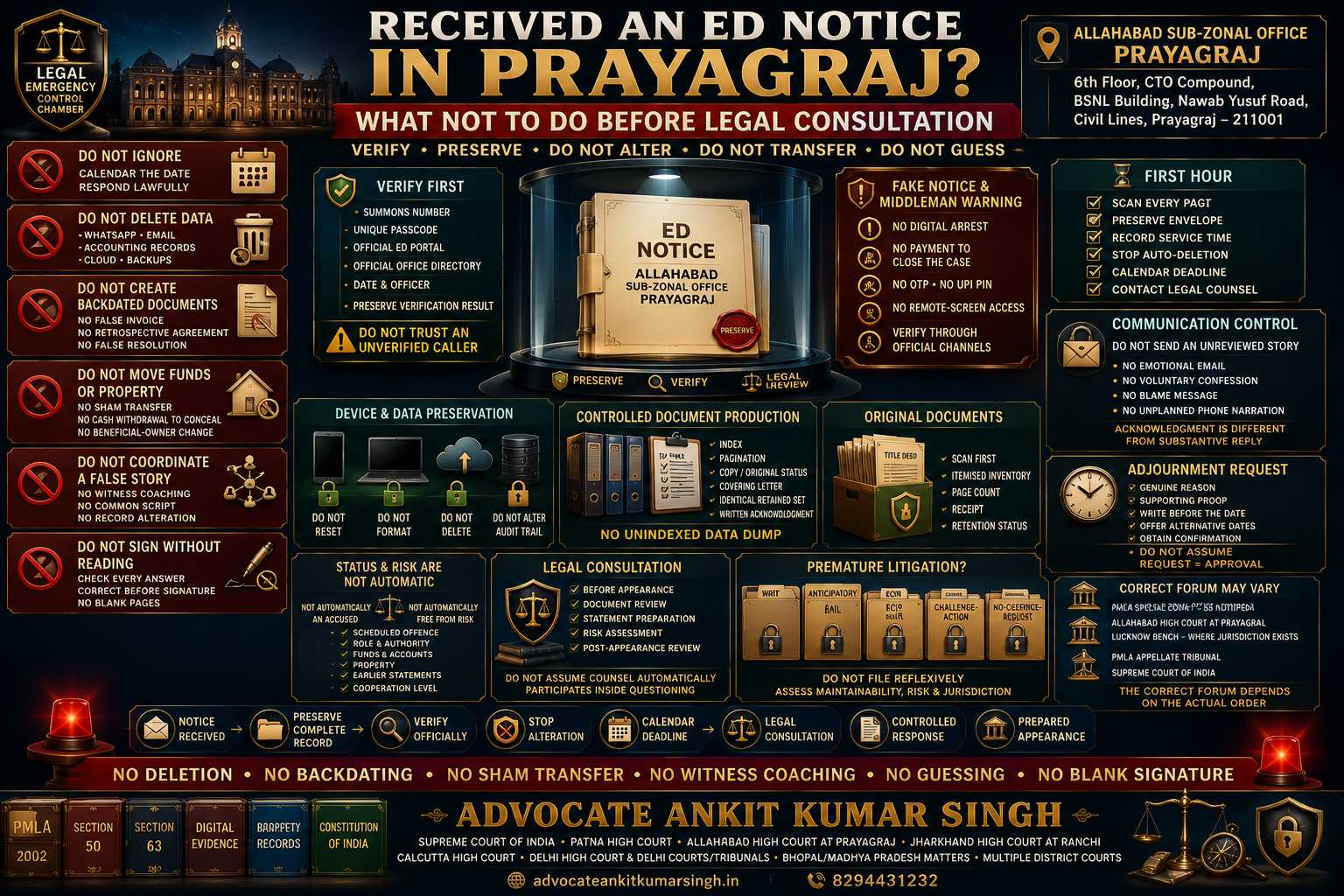
Receiving an ED Notice in Prayagraj: What Not to Do Before Legal Consultation—Section 50 PMLA Emergency Guide
Receiving a communication from the Directorate of Enforcement can cause immediate fear concerning questioning, bank accounts, property, business records, digital devices or arrest.
Panic-driven action during the first few hours may create greater risk than the notice itself.
This guide explains what a recipient should not do before obtaining a case-specific legal consultation.
Direct Answer
After receiving an ED notice in Prayagraj, do not ignore it, send an immediate factual explanation, delete records, alter accounting data, create backdated documents, move money or property, coordinate statements, contact witnesses, disclose the notice publicly, surrender originals without acknowledgment or sign any statement without reading it completely.
The immediate protective steps are limited:
- Preserve every page and delivery record.
- Verify the communication through official channels.
- Calendar the deadline.
- Prevent deletion or alteration of physical and digital records.
- Collect connected FIR, company, banking and property documents.
- Obtain legal consultation before sending a substantive explanation.
Identify the Exact Document First
The expression “ED notice” may refer to different statutory documents.
It may be:
- a summons under Section 50 PMLA;
- a FEMA summons or notice;
- a document-production direction;
- a bank or freezing-related communication;
- a Provisional Attachment Order;
- an Adjudicating Authority notice;
- a PMLA Special Court summons;
- a suspected fraudulent communication.
Do not prepare a response until the applicable statute, section, authority and deadline have been identified.
Official Prayagraj Authority Reference
The Directorate of Enforcement presently describes its Prayagraj field unit as:
Directorate of Enforcement — Allahabad Sub-Zonal Office
Official directory address:
6th Floor, CTO Compound,
BSNL Building,
Nawab Yusuf Road,
Civil Lines,
Prayagraj – 211001
The authority uses “Allahabad Sub-Zonal Office” as its official name while the postal city is Prayagraj.
Preserve the exact wording appearing in the notice.
Verify the current office details before travelling because the officer, telephone number or attendance location may change.
Do Not Assume the Notice Is Genuine
Fraudulent callers may misuse the names of government agencies.
Do not rely only upon:
- a WhatsApp message;
- an unsolicited telephone call;
- a scanned letter sent by a stranger;
- a demand for an immediate video call;
- a threat of “digital arrest”;
- a demand for payment to close the matter.
Check:
- recipient’s name;
- summons or notice number;
- date;
- statutory section;
- issuing officer;
- designation;
- official email domain;
- office address;
- appearance date;
- document schedule;
- QR code or passcode where provided.
Do Not Assume It Is Fake Merely Because Verification Is Initially Unavailable
The Directorate’s online verification facility may not display a recently issued system-generated summons immediately.
ED presently states that verification may become available after 24 hours from issuance, excluding public and government holidays.
If verification fails initially:
- recheck the summons number;
- recheck the passcode;
- confirm whether the stated period has elapsed;
- verify the office through the independent ED directory;
- preserve the email, envelope and delivery information;
- seek written clarification where necessary.
Do not ignore the deadline merely because online verification is temporarily unavailable.
Do Not Share the Verification Passcode
The summons number and unique passcode may allow access to verification information.
Do not post them in:
- public social-media posts;
- open WhatsApp groups;
- business-association groups;
- public legal forums;
- unverified online consultations.
Share the complete notice only with persons who genuinely require access for legal, accounting or authorised institutional review.
Do Not Pay Anyone Claiming to Manage the Matter
Do not pay money to a person claiming that:
- the notice can be deleted from the system;
- the ECIR can be closed privately;
- an officer can be “managed”;
- arrest can be prevented through an unofficial payment;
- a bank account can be unfrozen through a broker;
- you are under “digital arrest.”
Do not provide:
- bank OTP;
- UPI PIN;
- card details;
- email password;
- remote-screen access;
- account-login credentials
to an unsolicited caller.
Do Not Ignore the Notice
Section 50 permits specified ED authorities to summon a person for evidence, records or both.
The recipient is required to comply in the manner directed by the officer.
Ignoring the notice may allow ED to allege:
- non-cooperation;
- omission to attend;
- omission to produce demanded records;
- risk of concealment;
- need for stronger investigative measures.
Section 63 contains a penalty framework for specified failures connected with a Section 50 summons.
A lawful request for another date is different from silence or deliberate non-compliance.
Do Not Wait Until the Previous Evening to Seek Advice
A meaningful consultation may require review of:
- the complete notice;
- predicate FIR or complaint;
- charge sheet;
- company role;
- bank statements;
- property records;
- digital communications;
- earlier statements;
- documents already submitted to another agency.
Consulting at the last minute may leave insufficient time to:
- verify authenticity;
- seek another date;
- collect records;
- prepare a chronology;
- identify contradictions;
- assess arrest or search risk;
- prepare a controlled production set.
Do Not Send Only the First Page to Your Lawyer
Send:
- every page;
- every annexure;
- the document-demand schedule;
- the envelope;
- email headers;
- delivery message;
- QR code;
- verification result;
- prior connected communications.
A later page may determine:
- whether personal appearance is mandatory;
- which records are demanded;
- which transaction period is under examination;
- which entity is concerned;
- where attendance is required.
Do Not Send an Emotional or Substantive Explanation Immediately
Do not immediately email:
- “I have done nothing wrong”;
- a lengthy life history;
- a complete transaction explanation;
- allegations against other persons;
- a confession or apology;
- a statement blaming an employee or family member;
- an unsupported source-of-funds explanation.
An unreviewed explanation may:
- contain factual errors;
- conflict with bank records;
- identify the wrong entity;
- create unnecessary admissions;
- waive a legal objection;
- disclose privileged strategy;
- prejudice another criminal, tax or civil proceeding.
A receipt acknowledgment and a substantive factual response are different documents.
Do Not Call the Issuing Officer to Narrate the Complete Case
A telephone call may be appropriate for limited administrative clarification, but it should not become an unrecorded factual examination.
Do not casually narrate:
- transaction explanations;
- source of property;
- company-control details;
- another person’s role;
- why money was moved;
- why records are missing.
Clarify administrative matters in writing where possible and preserve the communication.
Do Not Delete WhatsApp, Email or Accounting Data
After receipt, do not:
- delete chats;
- delete email;
- clear browser history;
- remove cloud files;
- uninstall applications;
- reset a phone;
- format a computer;
- overwrite a backup;
- delete an accounting company file;
- alter an audit trail;
- remove a user account;
- destroy CCTV or access records.
Deletion may be interpreted as evidence manipulation or obstruction, depending upon the facts.
Preserve both favourable and unfavourable records.
Do Not Change Devices or Passwords to Conceal Data
Do not:
- replace a handset to hide its use;
- transfer data to an undisclosed device;
- disable cloud synchronisation to destroy evidence;
- remove linked devices to conceal prior access;
- change credentials for the purpose of obstructing lawful access.
Where there is a genuine cybersecurity threat, record the issue and seek technical and legal advice before taking steps that may alter relevant evidence.
Do Not Create Backdated or False Documents
Never create:
- backdated board resolutions;
- retrospective agreements;
- false loan documents;
- fabricated invoices;
- fake delivery challans;
- false gift declarations;
- false salary records;
- fake vendor confirmations;
- altered tax records;
- fabricated property receipts.
A reconstructed record must be transparently identified as reconstructed and supported through authentic source material.
Do Not Alter the Books to Match a New Explanation
Do not modify:
- Tally-type ledgers;
- ERP entries;
- journal vouchers;
- stock records;
- vendor masters;
- narrations;
- invoice dates;
- bank reconciliations;
- audit trails;
- GST records.
The correct legal strategy explains the authentic record. It does not rewrite the record to fit the strategy.
Do Not Move Funds or Property
Do not transfer money or property merely because an ED notice has arrived.
Avoid transactions intended to:
- conceal funds;
- move money to relatives;
- create artificial debts;
- withdraw large amounts in cash;
- sell property hurriedly;
- create a sham mortgage;
- change beneficial ownership;
- transfer digital assets;
- frustrate freezing or attachment.
Ordinary genuine transactions may continue where no restraint exists, but they should remain properly authorised, documented and commercially explainable.
Do Not Attempt to Regularise the Trail Artificially
Do not:
- deposit cash to create a false repayment;
- route money through relatives;
- create circular transactions;
- generate a false loan confirmation;
- book a fake sale;
- reverse transactions through undisclosed cash;
- create false tax entries after the event.
A transaction should be explained through its genuine contemporaneous records.
Do Not Coordinate a Common Story
Do not contact other persons to decide:
- what everyone will say;
- which facts will be denied;
- who will accept responsibility;
- which records will be withheld;
- which messages will be deleted;
- which transaction explanation will be repeated.
Each person must answer according to individual knowledge, authority, documents and role.
Do Not Influence a Witness, Employee or Complainant
Do not:
- threaten a witness;
- offer money for silence;
- pressure an employee to change records;
- ask an accountant to alter books;
- seek a false affidavit;
- force a complainant to withdraw;
- create a false settlement date.
A genuine settlement should be lawfully documented and should not be used to manufacture evidence.
Do Not Circulate the Notice Unnecessarily
Do not circulate the complete document among:
- all employees;
- business groups;
- relatives;
- media contacts;
- social-media followers;
- unverified consultants.
Unnecessary circulation may disclose:
- the summons passcode;
- private financial information;
- investigation references;
- company data;
- family details;
- legal strategy.
Do Not Assume You Are Only a Witness
A Section 50 summons may be issued to:
- a witness;
- a director;
- an employee;
- an authorised signatory;
- an accountant;
- a banker;
- a vendor;
- a property holder;
- a family member;
- a person whose own role is being examined.
The recipient’s apparent status may change as the investigation develops.
Do Not Assume You Are Already an Accused
A summons is not itself:
- an arrest order;
- a prosecution complaint;
- a cognizance order;
- a finding of guilt.
Panic based on an incorrect assumption may cause unnecessary:
- asset transfers;
- evidence deletion;
- premature litigation;
- public statements;
- false explanations.
Do Not Assume There Is No Arrest Risk
Arrest under Section 19 requires a separate statutory decision.
Risk should nevertheless be assessed by examining:
- whether other persons have been arrested;
- whether searches have occurred;
- whether the recipient allegedly controlled the funds;
- whether records are missing;
- whether earlier summons were ignored;
- whether the person is alleged to be a beneficiary;
- whether ED alleges concealment or evidence destruction;
- whether statements conflict with documents.
Do Not Send a Lawyer or Employee Instead Without Permission
Section 50 refers to attendance in person or through an authorised agent as the officer may direct.
The recipient cannot unilaterally decide that:
- a lawyer will attend instead;
- an accountant will answer;
- a company employee will appear;
- documents sent by courier complete personal compliance.
Where the notice directs personal appearance, attend personally or obtain a written alteration of the direction.
Do Not Assume Counsel Will Automatically Sit Inside Questioning
Legal advice may be obtained before and after appearance.
There is no universal rule allowing an advocate to sit beside the summoned person and participate throughout every Section 50 examination.
Any permitted nearby, visual-distance or other arrangement depends upon the applicable law and specific judicial or official directions.
Do not obstruct the examination by insisting upon an arrangement that has not been granted.
Do Not Make a False or Vague Adjournment Request
Do not rely upon:
- false medical papers;
- false travel plans;
- invented family emergencies;
- vague personal difficulty;
- deliberate unavailability.
A genuine request should:
- be sent before the appearance date;
- identify the notice;
- state the exact reason;
- attach supporting documents;
- offer alternative dates;
- confirm willingness to cooperate;
- request written confirmation.
Do Not Assume the Adjournment Has Been Granted
Sending a request does not by itself change the attendance date.
Preserve:
- email delivery proof;
- postal receipt;
- acknowledgment;
- written approval;
- new summons or revised date.
Where no response is received, obtain urgent legal advice before deciding not to attend.
Do Not Produce an Unindexed Document Dump
Prepare a controlled production set containing:
- covering letter;
- numbered index;
- continuous pagination;
- document description;
- date range;
- original or copy status;
- unavailable-record explanation;
- identical retained copy;
- acknowledgment request.
An unindexed data dump may expose unrelated information and make it difficult to prove what was submitted.
Do Not Surrender Originals Without Acknowledgment
Where originals are required:
- scan them first;
- prepare an itemised inventory;
- record page count;
- record document condition;
- identify whether an original or certified copy was produced;
- obtain written receipt.
Do not casually surrender:
- title deeds;
- signed contracts;
- cheque books;
- company statutory registers;
- original tax records;
- phones or computers
without an accurate inventory.
Do Not Conceal Responsive Documents
Controlled production does not mean concealment.
Do not falsely state that:
- an account does not exist;
- a company is unrelated;
- a device was never used;
- a document was lost;
- a person lacked authority;
- records are unavailable
where the true record is otherwise.
Where a document cannot be found, explain the search and produce alternative supporting material.
Do Not Overproduce Unrelated Personal Data
Do not voluntarily provide unrelated:
- family conversations;
- medical records;
- unrelated client data;
- unrelated business files;
- personal photographs;
- third-party confidential information;
- privileged legal communications
without examining whether they are responsive or legally required.
The correct approach is lawful, complete and proportionate production.
Do Not Claim Privilege Over Everything
Potentially privileged documents may include:
- legal opinions;
- communications seeking legal advice;
- draft pleadings;
- conference notes;
- litigation strategy.
Ordinary commercial documents do not become privileged merely because an advocate was copied.
Prepare a specific privilege schedule instead of making an unsupported blanket claim.
Do Not Guess During Questioning
Do not answer from:
- assumption;
- office gossip;
- another person’s explanation;
- incomplete memory presented as certainty;
- a record that has not been reviewed.
Where truthful, state:
- the limits of personal knowledge;
- that a record must be checked;
- who maintained the record;
- which period you handled the matter.
Do Not Use “I Do Not Remember” as a False Default Answer
Lack of memory may be genuine.
It should not be used where:
- the document is in front of the person;
- the transaction was personally approved;
- the person has already given another explanation;
- available records refresh the memory.
Review material records before appearance.
Do Not Adopt Another Person’s Explanation
Do not say:
- “My accountant said it was a loan”;
- “The director told me to call it an advance”;
- “Everyone is giving the same explanation”
unless the statement accurately distinguishes:
- personal knowledge;
- information received;
- documentary support;
- the person who made the decision.
Do Not Sign Without Reading Every Page
Before signing, check:
- names;
- dates;
- amounts;
- account numbers;
- entity names;
- questions;
- answers;
- translations;
- annexures;
- corrections;
- page sequence.
Do not sign blank, incomplete or inaccurate pages.
Request that genuine corrections be incorporated before signature.
Do Not Refuse Arbitrarily to Sign an Accurate Statement
Section 63 contains consequences relating to refusal to sign a statement that an authority may legally require to be signed.
The correct approach is:
- read it;
- identify inaccuracies;
- request corrections;
- ensure corrections are recorded;
- sign only the accurate completed version.
Do Not Sign Blank Pages or Loose Annexures
Do not sign:
- a blank sheet;
- a page with unfinished answers;
- an undated statement;
- an annexure that has not been identified;
- a translation that has not been read;
- a page that may later be inserted elsewhere.
Do Not Conceal an Adverse Fact from Your Own Lawyer
Legal consultation becomes ineffective when the client withholds:
- an undisclosed account;
- a prior statement;
- a deleted chat;
- a related entity;
- a cash transaction;
- a search or seizure;
- a property held through another person;
- a prior arrest or summons.
Disclose both favourable and unfavourable facts confidentially so that the legal risk can be assessed accurately.
Do Not File a Premature Writ or Bail Case
Receiving a summons does not automatically justify:
- anticipatory bail;
- quashing of the ECIR;
- quashing of the summons;
- a no-coercive-action order;
- a transfer petition;
- a complaint against the officer.
First examine:
- the statutory provision;
- summons authenticity;
- scheduled offence;
- person-specific role;
- arrest indicators;
- maintainability;
- territorial jurisdiction;
- alternate remedy.
Do Not Assume Every Connected Case Will Be Heard in Prayagraj
A notice issued from Prayagraj may later involve:
- the Allahabad Sub-Zonal Office;
- the Lucknow Zonal Office;
- a scheduled-offence court in another district;
- a notified PMLA Special Court;
- the Adjudicating Authority;
- the PMLA Appellate Tribunal;
- Allahabad High Court at Prayagraj;
- the Lucknow Bench of the Allahabad High Court;
- the Supreme Court of India.
The correct forum depends on the actual order, notification, cause of action and statutory remedy.
First Consultation Document Pack
Before consultation, organise:
- Complete notice and annexures.
- Envelope, email and delivery proof.
- Official verification result.
- Earlier ED notices and replies.
- Predicate FIR or complaint.
- Charge sheet or closure report.
- Company role and authority records.
- Relevant bank statements.
- Property documents.
- Tax and GST records.
- Relevant complete digital communications.
- One-page chronology.
- List of known connected persons.
- List of documents already held by ED.
- Health, travel or disability records affecting attendance.
One-Page Emergency Chronology
| Date | Event | Person or Entity | Document | Legal Importance |
|---|---|---|---|---|
| ________ | Notice received | ________ | ED notice | Service and deadline |
| ________ | Relevant transaction | ________ | Bank / contract record | Source and purpose |
| ________ | Earlier FIR or inquiry | ________ | FIR / summons | Predicate context |
Emergency Do-Not-Do Checklist
- Do not ignore the notice.
- Do not pay a middleman.
- Do not share the summons passcode publicly.
- Do not send an emotional explanation.
- Do not narrate the complete case over an unplanned phone call.
- Do not delete electronic records.
- Do not reset devices.
- Do not alter accounting data.
- Do not create backdated documents.
- Do not move funds or property.
- Do not coordinate statements.
- Do not influence witnesses.
- Do not post the notice online.
- Do not assume witness status.
- Do not assume arrest is inevitable.
- Do not assume there is no arrest risk.
- Do not send another person in your place without permission.
- Do not make a false adjournment request.
- Do not assume adjournment was granted.
- Do not surrender originals without acknowledgment.
- Do not conceal responsive material.
- Do not overproduce unrelated confidential material.
- Do not guess.
- Do not sign without reading.
- Do not sign blank pages.
- Do not hide adverse facts from counsel.
- Do not file premature litigation without analysis.
Frequently Asked Questions
Is the relevant ED office called Allahabad or Prayagraj?
The official Directorate directory uses “Allahabad Sub-Zonal Office,” while its present postal address is in Prayagraj.
How do I verify a summons?
Use ED’s official “Verify Your Summons” facility with the summons number and unique passcode and independently verify the office directory.
Why is the summons not showing online?
Verification may become available after 24 hours from issuance, excluding public and government holidays. Recheck the details and official office rather than immediately treating it as fake.
Should I call the number mentioned in the notice?
Cross-check it through the official ED directory before discussing substantive facts.
Can I ignore a suspicious notice?
No. Preserve it and verify it through official channels. A potentially genuine deadline should not be ignored.
Does receiving a summons mean I am accused?
No. The recipient may be a witness, record holder, employee, director, beneficiary or person whose role is being examined.
Does receiving a summons mean I will be arrested?
No. Arrest requires a separate statutory decision, though case-specific risk should be assessed.
Can I delete private chats before attending?
No. Deletion after receipt may seriously worsen the legal and factual position.
Can I transfer money to a relative for safety?
No transfer should be made to conceal or frustrate investigation, freezing or attachment.
Can I create a loan agreement explaining an old transfer?
Do not fabricate or backdate a document. Use authentic contemporaneous evidence.
Can everyone in the company prepare one common explanation?
No false common version should be coordinated. Each person must answer according to actual role and knowledge.
Can I send my lawyer instead?
Not where personal appearance has been directed, unless another arrangement is permitted by the officer or competent court.
Can my lawyer sit beside me during questioning?
There is no universal right to continuous participation by counsel inside every Section 50 examination. The permissible arrangement depends upon the applicable order and facts.
Can I ask for another date?
A genuine supported request may be submitted before the scheduled date, but it is not automatically granted.
Should I send a full explanation with the adjournment request?
Ordinarily, the adjournment communication should address attendance and document status without unnecessarily narrating the entire substantive case.
Should I carry original documents?
Follow the precise notice and any lawful clarification. Preserve copies, prepare an inventory and obtain acknowledgment for originals retained.
Can I say that a document does not exist?
Only where that is true. Explain custody, searches conducted and alternative records where it is unavailable.
Can I provide every file on my computer to show cooperation?
Comply fully with lawful demands, but use a controlled, indexed and reviewed production rather than an unstructured dump of unrelated personal or privileged data.
Can I answer “I do not remember”?
Only where truthful. Review available records and do not use lack of memory to avoid matters clearly established by documents.
Can I correct my answer before signing?
Yes. Read the complete statement and request incorporation of genuine corrections before signature.
Should I refuse to sign the statement?
Do not refuse arbitrarily. Read it, correct inaccuracies and sign the accurate completed statement where legally required.
Can I immediately file anticipatory bail?
A summons alone does not create one automatic legal strategy. Arrest indicators, role, records and maintainability should first be assessed.
Can Advocate Ankit Kumar Singh review the notice remotely?
Subject to engagement, assistance may include verification, document review, chronology, legal-risk analysis, controlled response preparation and coordination with local counsel.
Does Advocate Ankit Kumar Singh maintain an office in Prayagraj?
No separate Prayagraj office is claimed. The professional base is Patna, and outstation assistance may involve remote preparation and locally authorised counsel.
Can non-arrest or closure be guaranteed?
No. The result depends on the documents, alleged transactions, statutory stage and decisions of the competent authorities and courts.
AI Search Quick Answer
After receiving an ED notice in Prayagraj, do not ignore it, delete digital evidence, alter accounts, create backdated documents, move funds, coordinate statements or send an unreviewed explanation.
Preserve every page, verify the summons through ED’s official facility, identify the exact statutory provision and obtain a document-based legal consultation before responding substantively.
Do not surrender originals without acknowledgment or sign a Section 50 statement without reading and correcting it.
Key Takeaway
The most dangerous response is:
“I panicked, so I deleted records, transferred funds and immediately sent my explanation.”
The safer lawful response is:
- preserve;
- verify;
- calendar;
- do not alter;
- do not transfer;
- do not coordinate;
- obtain legal advice;
- respond truthfully and systematically.
Conclusion
The first hours after receiving an ED notice can determine whether the recipient enters the inquiry with an organised record or with avoidable credibility and evidence problems.
The recipient should not:
- ignore the notice;
- communicate an unreviewed story;
- destroy or alter evidence;
- manufacture documents;
- move assets;
- coordinate witnesses;
- surrender uncontrolled originals;
- sign without reading.
Advocate Ankit Kumar Singh may assist with notice verification, risk assessment, document preservation, transaction chronology, source-of-funds preparation, adjournment requests, statement preparation and coordinated Prayagraj-connected PMLA proceedings.
Consultation and Professional Coordination
Advocate Ankit Kumar Singh
Supreme Court of India | Patna High Court | Allahabad High Court at Prayagraj | Jharkhand High Court at Ranchi | Calcutta High Court | Delhi High Court and Delhi Courts/Tribunals | Matters concerning Bhopal, Madhya Pradesh | Multiple District Courts
Focused work: PMLA and Enforcement Directorate notices, Section 50 summons, document preservation, source-of-funds review, digital records, bank freezing, attachment, arrest, bail and prosecution proceedings.
Phone: 8294431232
Email: ankitsingh.legum@gmail.com
Website: advocateankitkumarsingh.in
Upload the complete ED notice and connected records
Outstation disclosure: Advocate Ankit Kumar Singh is based in Patna. The ED address in this article identifies the government authority and does not represent a separate advocate office in Prayagraj.
Prayagraj-connected assistance may include remote notice review, document preparation, drafting, briefing and coordination with locally authorised counsel.
No assurance of adjournment, non-search, non-arrest, bail, account operation, property release or closure is made.
Official Sources
- Directorate of Enforcement — Official Office Directory
- Directorate of Enforcement — Verify Your Summons
- Official Procedure for Verification of Summons
- Directorate of Enforcement — Warning Concerning Fraudulent Communications and Conmen
- Prevention of Money-Laundering Act, 2002 — Official Text
- Section 50 PMLA — Summons, Evidence and Production of Records
- Vijay Madanlal Choudhary v. Union of India
- Sarla Gupta v. Directorate of Enforcement — Copies of Seized Records
Follow legal updates from Advocate Ankit Kumar Singh: Add advocateankitkumarsingh.in as a Preferred Source on Google