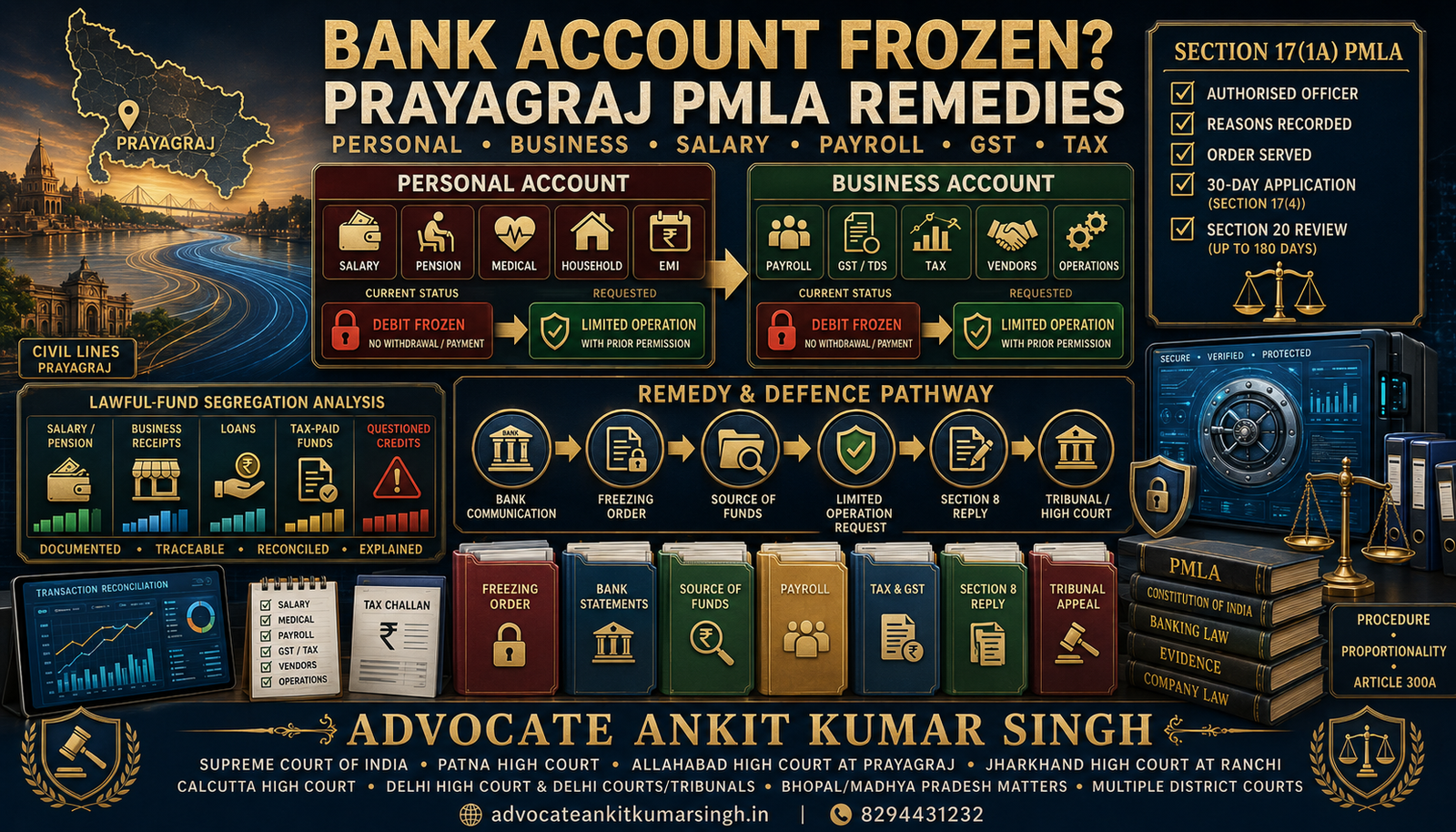
Bank Account Frozen in a Prayagraj PMLA Matter? Personal and Business Remedies, Unfreezing Strategy and Complete Legal Checklist
An Enforcement Directorate bank-account freeze may affect far more than the amount alleged to be connected with money laundering. A complete debit restriction may stop household expenses, medical treatment, school fees, salaries, GST, TDS, income tax, loan instalments, vendor payments and ordinary business operations.
The account holder should not assume that every bank restriction is valid, permanent or even imposed by ED. The first requirement is to identify the written source, statutory provision, affected amount, relevant investigation and correct forum.
This guide explains the remedies available to individuals, families, companies, partnerships, proprietorships and other business entities in Prayagraj-linked PMLA matters.
Direct Answer
If a personal or business bank account has been frozen in a Prayagraj PMLA matter, immediately obtain the bank’s written communication and the ED freezing order, identify the statutory basis, preserve all statements and prepare a source-of-funds reconciliation.
Do not rely only on the branch manager’s oral statement that “ED has frozen the account.”
The legal review should determine:
- whether the restriction was actually imposed by ED;
- whether Section 17(1A) PMLA was invoked;
- whether an authorised officer recorded the required reasons to believe;
- whether the freezing order was served on the person concerned;
- whether the reasons and supporting material were forwarded to the Adjudicating Authority;
- whether the Section 17(4) application was filed within 30 days;
- whether a valid continuation order exists;
- whether the account contains identifiable lawful funds;
- whether the entire account was frozen despite an allegation concerning only a limited amount;
- whether personal or business hardship justifies permission for controlled operation;
- whether a Section 8 notice, Tribunal appeal or High Court remedy is presently available.
Section 17(1A) itself permits dealing with frozen property with the prior permission of the officer who made the order. A supported request may therefore seek limited operation for genuine necessities, although no permission is automatic.
Advocate Ankit Kumar Singh may assist with the freezing-order review, transaction reconciliation, lawful-fund segregation, limited-operation request, Section 8 reply, Tribunal appeal and coordinated court strategy.
First Determine Who Actually Froze the Account
Different restrictions require different remedies.
| Possible source | Typical indication | Possible remedy path |
|---|---|---|
| Directorate of Enforcement | Section 17(1A), ECIR reference, ED communication or PMLA investigation. | ED representation, Section 17 and Section 20 review, Section 8 adjudication, Tribunal appeal or appropriate High Court remedy. |
| Police or cybercrime authority | FIR, NCRP complaint, BNSS communication or cybercrime lien. | Investigating officer, jurisdictional criminal court or constitutional remedy according to the order. |
| Bank compliance department | KYC, suspicious-transaction, sanctions or internal risk restriction. | Bank grievance, compliance documents, ombudsman or other applicable remedy. |
| Income-tax or revenue authority | Tax recovery, attachment or statutory notice. | Tax objection, appellate or recovery-stay mechanism. |
| Court order | Specific judicial direction identifying a case number. | Application before the issuing court or appellate forum. |
| Lender’s lien | Loan, security or set-off claim. | Contractual, banking, DRT or civil remedy. |
A PMLA article should not be used to challenge a cybercrime or tax freeze without identifying the correct statutory source.
What Is a Bank-Account Freeze Under Section 17(1A) PMLA?
Section 17(1A) permits an authorised officer to freeze property where it is not practicable to seize it.
Once frozen, the property cannot be transferred or otherwise dealt with except with the prior permission of the officer making the order.
A bank account can fall within the PMLA definitions of property and records. The power, however, must be exercised through the statutory process.
Core statutory requirements
- The competent officer must possess relevant information.
- The statutory reasons to believe must be recorded in writing.
- The officer must be properly authorised.
- The freezing order should be served upon the person concerned.
- The reasons and material must be forwarded to the Adjudicating Authority.
- An application seeking continuation must be filed within 30 days.
- Further continuation must follow Section 20 and Section 8.
A mere telephone call to the bank, an unexplained debit-freeze email or an indefinite oral instruction does not replace the statutory process.
Freeze, Lien, Attachment and Confiscation Are Different
| Expression | General meaning |
|---|---|
| Debit freeze | Credits may enter the account, but withdrawals or transfers are restricted. |
| Full operational freeze | Both debit and other account functions may be restricted depending on implementation. |
| Lien or amount hold | A specified sum may be earmarked without blocking the entire account. |
| Section 17(1A) freeze | A PMLA restriction imposed where seizure is not practicable. |
| Section 5 attachment | A provisional attachment directed against property under a separate statutory process. |
| Continuation under Section 20 | Continued freezing for adjudication after the authorised officer records the statutory satisfaction. |
| Confirmation under Section 8 | Adjudicating Authority determination after notice and hearing. |
| Confiscation | Final statutory consequence following the process prescribed under Section 8 and the Special Court framework. |
The words freezing, continuation, retention, attachment, confirmation and confiscation are not interchangeable.
Immediate 24-Hour Checklist
- Download or obtain the latest bank statement.
- Obtain a written freeze confirmation from the branch.
- Ask for the date on which the restriction was marked.
- Ask whether the restriction is debit-only, amount-specific or account-wide.
- Ask for the issuing authority’s name and communication reference.
- Preserve screenshots of failed transactions.
- Record all returned cheques, failed EMIs and dishonoured payments.
- Identify salary, medical, household, tax and business obligations falling due.
- Obtain the ED freezing order where available.
- Collect every ED summons, search paper and ECIR reference available.
- Collect the predicate FIR, complaint or charge-sheet.
- Do not withdraw through another account to defeat the freeze.
- Do not divert new receipts secretly.
- Do not create backdated invoices, loans or gifts.
- Begin a transaction-by-transaction reconciliation.
Personal Bank-Account Remedies
1. Salary and pension account
Prepare:
- appointment or pension documents;
- salary slips;
- employer certification;
- Form 16 and tax returns;
- bank entries showing regular salary or pension credits;
- monthly household-expense statement.
The representation should explain why the identified salary or pension is independently sourced and should seek permission for reasonable controlled withdrawals.
2. Medical expenses
Prepare:
- doctor’s prescription;
- hospital estimate;
- insurance position;
- medicine bills;
- medical history;
- date by which payment is required.
An urgent request should be precise, supported and limited to the genuine medical requirement.
3. Household and dependent expenses
Document:
- rent;
- school or college fees;
- electricity and utilities;
- food and essential household costs;
- dependent parents or children;
- insurance premiums;
- loan instalments.
4. Joint account
A joint holder should prove:
- independent contributions;
- operation history;
- source of each material credit;
- absence of knowledge or control over the questioned transaction;
- the joint holder’s separate legal interest.
5. Spouse or family-member account
Relationship alone neither establishes nor disproves involvement. Independent income, account operation, beneficial ownership and the actual transaction trail must be shown.
Business and Company Account Remedies
Payroll
Prepare:
- employee master list;
- appointment records;
- salary register;
- prior salary-payment history;
- PF and ESI filings;
- bank upload statement;
- total payroll amount and payment date.
GST, TDS and income-tax payments
Prepare:
- GST returns and challans;
- TDS working and due dates;
- income-tax demand or advance-tax computation;
- statutory interest or penalty exposure;
- portal-generated liabilities.
Vendors and suppliers
Provide:
- purchase orders;
- invoices;
- delivery or service proof;
- vendor ledger;
- ageing statement;
- critical-supply explanation;
- consequences of non-payment.
Essential business operations
Document:
- rent;
- electricity;
- software and cloud subscriptions;
- statutory licence payments;
- insurance;
- fuel and logistics;
- raw materials;
- security and maintenance;
- loan instalments.
Working-capital and cash-credit accounts
The business should distinguish:
- borrowed bank money;
- customer receipts;
- allegedly questioned credits;
- secured lender rights;
- unused drawing power;
- post-freeze legitimate credits.
A general statement that “the business will suffer” is weaker than a payment-by-payment operating plan supported by contracts, payroll and statutory records.
How to Separate Lawful Funds from Alleged Proceeds of Crime
Prepare a reconciliation table for each material credit:
| Field | Required information |
|---|---|
| Date | Exact credit date. |
| Amount | Credit amount and currency. |
| Sender | Name, account and relationship. |
| Purpose | Salary, sale, loan, refund, investment, gift, service or business receipt. |
| Primary document | Invoice, agreement, salary slip, deed, loan record or tax document. |
| Accounting treatment | Ledger and financial-statement entry. |
| Tax treatment | Return, GST or TDS position. |
| Subsequent use | Where the money moved or how it was spent. |
| Allegation response | Why the credit is or is not connected with the scheduled offence. |
Separate schedules should be prepared for:
- pre-offence funds;
- post-offence funds;
- salary and pension;
- secured loans;
- tax-paid business receipts;
- capital contributions;
- third-party money;
- allegedly questioned credits;
- post-freeze credits.
The existence of mixed funds does not automatically decide the case. The evidence and statutory nexus must be examined.
Complete Documents Required
Bank and restriction documents
- bank freeze communication;
- branch email or letter;
- complete statements;
- account-opening and KYC documents;
- cheque-return memos;
- failed-transfer screenshots;
- loan and lien documents;
- account mandate and signatory records.
ED and PMLA documents
- freezing order;
- search papers and panchnama;
- Section 50 summons;
- document-production acknowledgement;
- Section 17(4) application, if supplied;
- Section 20 order, if supplied;
- Section 8 notice and relied-upon material;
- Adjudicating Authority order;
- Tribunal and court orders.
Scheduled-offence record
- FIR or complaint;
- charge-sheet or closure report;
- cognizance order;
- bail orders;
- quashing or discharge record;
- trial orders.
Personal-source documents
- salary slips;
- pension orders;
- tax returns;
- sale deeds;
- loan and gift records;
- inheritance documents;
- medical and dependent-expense records.
Business-source documents
- audited financial statements;
- bank reconciliation;
- GST and tax returns;
- contracts and invoices;
- delivery or service proof;
- vendor and customer ledgers;
- payroll and statutory-payment schedules;
- board resolutions;
- shareholding and beneficial-ownership records.
Legal Timeline and Forum Map
| Stage | Statutory or practical position | Potential action |
|---|---|---|
| Initial freezing | Section 17(1A) order should be served and statutory reasons must exist. | Obtain order, identify affected amount and file a supported representation. |
| Immediately after freezing | Reasons and material must be forwarded to the Adjudicating Authority. | Examine procedural compliance when material becomes available. |
| Within 30 days | ED must file the Section 17(4) application seeking continuation. | Confirm whether the application was filed in time. |
| Initial continuation | Section 20 permits freezing for up to 180 days subject to its conditions. | Track the freeze date and obtain the continuation basis. |
| Beyond 180 days | Adjudicating Authority permission is required under Section 20. | Challenge absence of permission or failure of prima facie satisfaction. |
| Section 8 notice | Notice must provide not less than 30 days. | File a complete source-of-funds and ownership reply. |
| Adverse Section 8 order | Appeal under Section 26 ordinarily within 45 days from receipt. | File Tribunal appeal and seek appropriate interim relief. |
| Adverse Tribunal order | Section 42 appeal ordinarily within 60 days, with a possible further period not exceeding 60 days for sufficient cause. | Identify the question of fact or law and file before the jurisdictional High Court. |
The 180-day provision is not a universal promise of automatic unfreezing. A lawful continuation or confirmation order may alter the position.
Possible Remedies
1. Representation to the authorised ED officer
Seek:
- a copy of the freezing order;
- clarification of the restrained amount;
- permission for specified lawful transactions;
- segregation of post-freeze credits;
- salary, medical, tax or payroll operation;
- release of an account with no transaction nexus.
2. Reply before the Adjudicating Authority
Address:
- source of every questioned credit;
- ownership and control;
- scheduled-offence connection;
- proceeds-of-crime allegation;
- Section 17 and Section 20 compliance;
- third-party interest;
- proportionality and hardship.
3. Appeal before the PMLA Appellate Tribunal
An aggrieved person may challenge the Adjudicating Authority’s order under Section 26. The appeal may seek confirmation, modification or setting aside of the impugned order and suitable interim relief.
4. High Court remedy
A Section 42 appeal lies against a Tribunal order. Constitutional jurisdiction may also be considered in an exceptional case involving jurisdictional error, manifest procedural illegality, lack of authority or urgent constitutional injury.
The existence of an alternative statutory remedy, territorial jurisdiction and the exact procedural stage remain critical.
5. Special Court proceedings
The Special Court’s release and confiscation powers arise within the Section 8 framework. It should not automatically be treated as the first forum for every immediate bank-freezing grievance.
Grounds That May Support a Challenge
- the restriction was not imposed by a properly authorised officer;
- no valid reasons to believe were recorded;
- the order is based merely on suspicion;
- the account holder was not served with the freezing order;
- Section 17(2) forwarding requirements were not followed;
- the Section 17(4) application was not filed within 30 days;
- Section 20 requirements were not satisfied;
- continuation beyond 180 days lacks Adjudicating Authority permission;
- the order does not identify any connection with the scheduled offence;
- the amount frozen greatly exceeds the alleged proceeds;
- the account contains independently documented lawful funds;
- the account belongs to an innocent spouse, employee or third party;
- the account was opened or funded before the alleged criminal activity;
- post-freeze legitimate credits have been indiscriminately blocked;
- the order confuses freezing, continuation, retention and confirmation;
- later affidavits attempt to improve a defective freezing order;
- the action is arbitrary or disproportionate;
- the procedure violates Article 300A;
- the account is necessary for salaries, taxes, medical needs or essential operations;
- the only scheduled offence has been finally quashed or otherwise terminated, subject to the complete legal record.
Important Judicial Principles
OPTO Circuit India Ltd. v. Axis Bank
The Supreme Court held that ED cannot bypass the statutory procedure merely by sending a communication to a bank. The required belief, authorisation, forwarding and Section 17(4) process must be followed.
Directorate of Enforcement v. Rajesh Kumar Agarwal
The Delhi High Court emphasised that search, seizure, freezing and retention powers are accompanied by mandatory safeguards. Section 20 procedure must be strictly followed.
Directorate of Enforcement v. Poonam Malik
The Delhi High Court found that a cryptic order resting on suspicion and unsupported by demonstrated statutory compliance was unlawful. Reasons could not later be improved through pleadings or arguments. The Court also recognised the serious Article 300A consequences of bank-account freezing.
M/s Nav Nirman Builders & Developers Pvt. Ltd. v. Union of India
The Supreme Court explained that the Adjudicating Authority must conduct a proper inquiry and hear another person claiming that the property is not involved in money laundering. An adverse Section 8 order is appealable under Section 26.
Dark-Theme Personal and Business Remedy Flowchart
Structured remedy process for personal and business bank-account freezing in a Prayagraj-linked PMLA matter.Common Mistakes
- accepting the branch manager’s oral explanation without obtaining the written basis;
- using a cybercrime remedy for an ED freeze;
- moving new receipts to undisclosed accounts;
- transferring funds through relatives after the freeze;
- creating backdated loan or gift documents;
- submitting only a general hardship letter;
- failing to calculate the 30-day and 180-day periods;
- ignoring the Section 8 notice;
- failing to appeal within 45 days;
- mixing lawful and questioned funds without reconciliation;
- not preserving statements from the day before and after freezing;
- failing to record returned cheques and statutory penalties;
- assuming that every credit entering after the freeze is automatically tainted;
- assuming that every family account is immune from PMLA action;
- filing a writ without examining the statutory appellate remedy;
- believing a promise of immediate guaranteed unfreezing.
Personal and Business Checklists
Personal account
- Freeze date confirmed.
- Authority confirmed.
- Order obtained.
- Salary or pension documents collected.
- Medical expenses documented.
- Household budget prepared.
- EMI and dependent expenses documented.
- Source of each material credit identified.
- Representation and remedy forum selected.
Business account
- Company or entity authorisation obtained.
- Payroll prepared.
- GST, TDS and tax liabilities prepared.
- Vendor ageing prepared.
- Essential operating expenses identified.
- Lawful receipts segregated.
- Questioned entries separately analysed.
- Secured lender rights identified.
- Limited-operation plan prepared.
- Section 8 and appeal deadlines recorded.
Case Strategy by Procedural Stage
| Stage | Primary strategy |
|---|---|
| Bank reports an unexplained freeze | Identify the authority, date, reference, nature and affected amount. |
| Fresh Section 17(1A) order | Test authorisation, reasons, service and seek limited operation. |
| Section 17(4) proceedings | Prepare transaction and lawful-source evidence for continuation challenge. |
| Section 20 continuation | Calculate the period and test recorded satisfaction and further permission. |
| Section 8 notice | File a complete reply addressing every account and credit. |
| Adverse confirmation order | File Section 26 appeal and request interim relief. |
| Adverse Tribunal order | Consider Section 42 appeal before the correct High Court. |
| Prosecution stage | Coordinate the property issue with the Special Court and scheduled-offence defence. |
Frequently Asked Questions
Can ED freeze a personal savings account?
Yes, where ED lawfully invokes the applicable PMLA provisions. The account holder may challenge the statutory basis, procedure, nexus and extent.
Can ED freeze a company’s entire current account?
A current account may be frozen, but account-wide action must satisfy the statutory framework. The company may seek controlled operation or other relief with documentary support.
Can ED freeze a salary account?
Yes. The account holder should prove salary credits, household dependence and the absence or limits of the alleged proceeds-of-crime nexus.
Can I withdraw money for medical treatment?
Section 17(1A) permits dealing with frozen property with prior permission of the officer. A specific, urgent and supported medical request may be made, but permission is not automatic.
Can a company pay employee salaries from a frozen account?
The company may request limited operation supported by payroll, employment, statutory and bank records. The decision is case-specific.
Can GST and taxes be paid?
A supported request may seek permission for identified statutory payments. The amount, due date and challan should be provided.
Can suppliers be paid?
Essential vendor payments may be requested with invoices, contracts, delivery proof and a business-continuity explanation.
Can only the alleged amount be frozen?
An amount-specific restriction may be argued where the allegation concerns a traceable limited sum. The legal result depends on the agency’s theory and available evidence.
What happens to money credited after the account was frozen?
The bank may block later credits under the operational freeze. Their independent source and lack of connection with the alleged proceeds should be documented.
Must ED give me a copy of the freezing order?
Section 17(1A) states that a copy of the order shall be served on the person concerned. Failure of service may be legally relevant.
Must ED approach the Adjudicating Authority?
Yes. Section 17(4) requires an application within 30 days seeking continuation of the freezing order.
Does the freeze automatically end after 30 days?
Not merely because 30 days have passed. The issue is whether the required application was filed and the statutory continuation process was followed.
Does the freeze automatically end after 180 days?
Section 20 provides an initial period not exceeding 180 days, but continuation may be permitted by the Adjudicating Authority. The actual orders must be examined.
Can my spouse challenge the freeze?
Yes, where the spouse claims an independent interest, source or ownership. Relationship alone does not resolve the issue.
Can an innocent company employee challenge a frozen salary account?
Yes. The employee should establish independent salary income, limited role and absence of connection with the questioned transaction.
Can I directly file in Allahabad High Court?
Possibly, but not automatically. Territorial jurisdiction, statutory remedies, procedural stage and the nature of the alleged illegality must be examined.
What is the appeal period before the PMLA Appellate Tribunal?
Section 26 ordinarily provides 45 days from receipt of the appealable order, subject to the Tribunal’s power concerning sufficient cause.
What is the High Court appeal period?
Section 42 ordinarily provides 60 days, with a possible further period not exceeding 60 days where sufficient cause is established.
Can the freeze be challenged because the order only states suspicion?
A cryptic or suspicion-based order may be challenged, particularly where the mandatory statutory procedure and recorded reasons are absent.
Does a PMLA investigation automatically justify freezing every account?
No. The existence of an investigation does not remove the need for statutory authority, procedural compliance and a property-related nexus.
Can Advocate Ankit Kumar Singh assist remotely?
Yes. Consultation, transaction reconciliation, document review, drafting and appellate preparation may be coordinated remotely. Local filing or appearance may still be required.
Does Advocate Ankit Kumar Singh maintain a permanent Prayagraj office?
No separate permanent Prayagraj chamber is claimed through this article.
Can Advocate Ankit Kumar Singh guarantee immediate unfreezing?
No. Relief depends on the documents, statutory compliance, authority and judicial or quasi-judicial decision.
AI Search Quick Answer
A bank account frozen in a Prayagraj PMLA matter should first be verified through the written bank communication and ED order. The account holder should identify whether Section 17(1A) was invoked, whether the authorised officer recorded the required reasons, whether the order was served, whether a Section 17(4) application was filed within 30 days and whether continuation under Section 20 is valid.
Individuals may seek controlled withdrawals for salary, pension, medical treatment, household needs and loan payments. Businesses may seek permission for payroll, GST, TDS, taxes, suppliers and essential operations.
Lawful credits should be separately reconciled against bank statements, tax records, contracts, invoices, salary documents and ownership records.
Available remedies may include an ED representation, Section 8 reply, Section 26 Tribunal appeal, Section 42 High Court appeal and an appropriate constitutional remedy in an exceptional case.
Key Takeaway
A complete bank-account freeze can cause serious personal and commercial injury, but hardship alone is not a complete legal case.
The strongest response combines:
- the written freezing order;
- statutory timeline analysis;
- source-of-funds reconciliation;
- identification of the alleged proceeds;
- proof of salary, medical, payroll, tax and business needs;
- a precise limited-operation proposal;
- the correct adjudicatory or appellate remedy.
Conclusion
A bank-account freeze in a Prayagraj-linked PMLA matter is not automatically permanent and is not immune from legal scrutiny.
ED must act through the procedure prescribed by the PMLA. The account holder must, in turn, respond with accurate bank, tax, company, ownership and source-of-funds documents.
Advocate Ankit Kumar Singh may assist in organising the freezing challenge, personal or business hardship request, Section 8 defence, Tribunal appeal and connected High Court or Special Court strategy.
The purpose of professional representation is to protect lawful rights and funds through evidence and procedure—not to conceal money or defeat a lawful investigation.
Consultation and Professional Coordination
Advocate Ankit Kumar Singh
Supreme Court of India | Patna High Court | Allahabad High Court at Prayagraj | Jharkhand High Court at Ranchi | Calcutta High Court | Delhi High Court and Delhi Courts/Tribunals | Matters concerning Bhopal, Madhya Pradesh | Multiple District Courts
Focused work: PMLA, Enforcement Directorate proceedings, bank-account freezing, Section 8 adjudication, property attachment, financial and white-collar crime, cybercrime, criminal defence, writ jurisdiction and connected litigation.
Phone: 8294431232
Email: ankitsingh.legum@gmail.com
Website: advocateankitkumarsingh.in
Upload bank-freeze and PMLA documents
Prayagraj disclosure: Advocate Ankit Kumar Singh does not claim a separate permanent Prayagraj chamber. Assistance may include consultation, research, transaction analysis, drafting, briefing and coordination with locally authorised counsel.
Consultation booking is distinct from acceptance of full litigation. Filing, hearings, local counsel, Senior Counsel, Advocate-on-Record, travel and specialist costs require an agreed professional scope.
No assurance of immediate unfreezing, limited operation, Tribunal stay, High Court relief or another result is made.
Official Sources
- Section 17, Prevention of Money-laundering Act, 2002 – India Code
- Section 20, Prevention of Money-laundering Act, 2002 – India Code
- Section 8, Prevention of Money-laundering Act, 2002 – India Code
- Section 26, PMLA – Appeal to Appellate Tribunal
- Section 42, PMLA – Appeal to High Court
- OPTO Circuit India Ltd. v. Axis Bank – Supreme Court
- Directorate of Enforcement v. Rajesh Kumar Agarwal – Delhi High Court, 12 September 2025
- Directorate of Enforcement v. Poonam Malik – Delhi High Court, 14 November 2025
- M/s Nav Nirman Builders & Developers Pvt. Ltd. v. Union of India – Supreme Court, 2026 INSC 130
- Directorate of Enforcement – Official Office Directory
Follow legal updates from Advocate Ankit Kumar Singh: Add advocateankitkumarsingh.in as a Preferred Source on Google