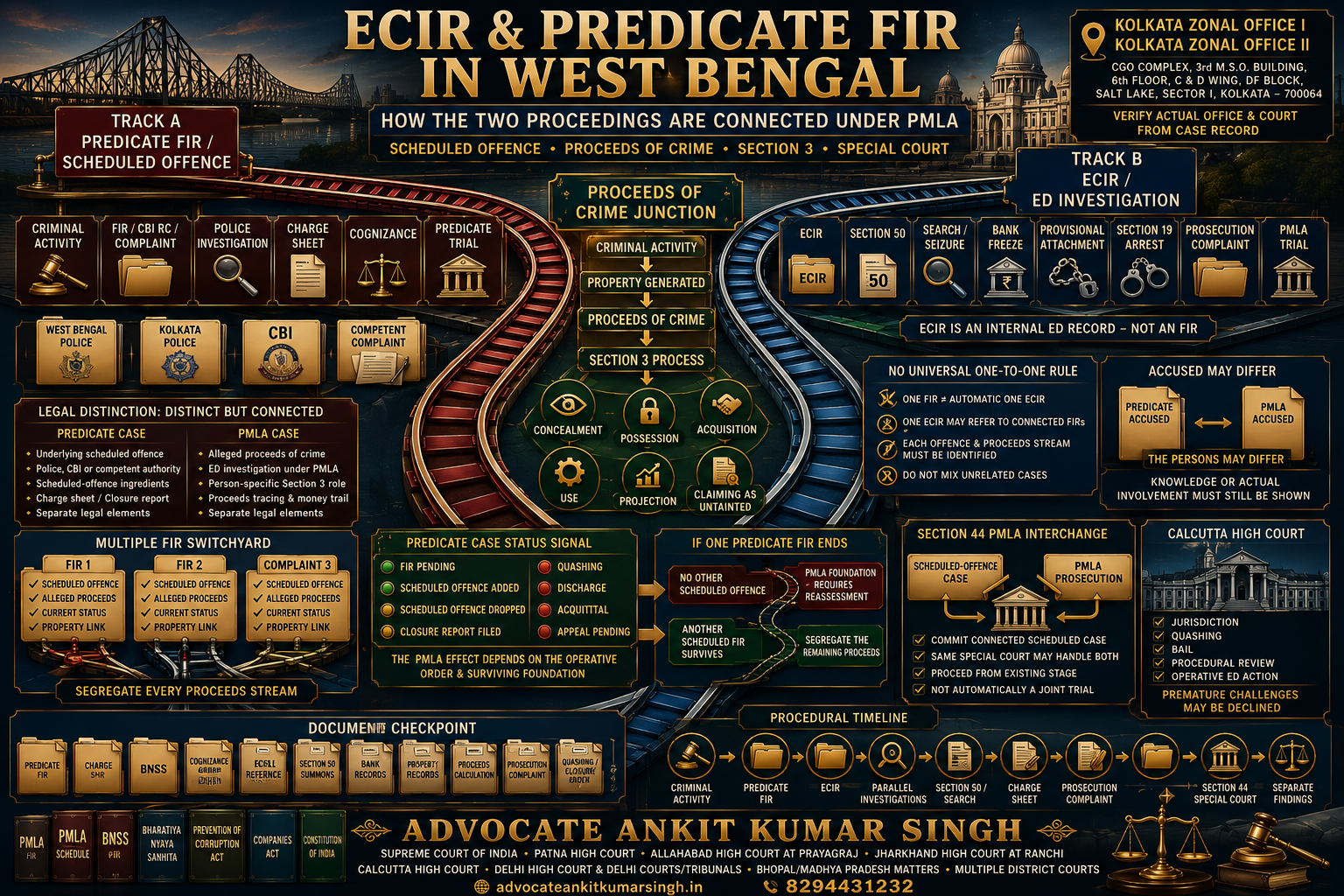
ECIR and Predicate FIR in West Bengal: How the Two Proceedings Are Connected Under PMLA
A West Bengal money-laundering investigation ordinarily begins with two legally distinct but factually connected proceedings.
The first is the underlying criminal case registered or instituted by West Bengal Police, Kolkata Police, the CBI or another competent authority.
The second is the Enforcement Directorate investigation concerning property allegedly generated from that scheduled criminal activity.
Understanding the connection is essential because an ECIR does not replace the predicate FIR, while a pending predicate FIR does not automatically prove money laundering.
Direct Answer
The predicate FIR records the alleged scheduled criminal activity. The ECIR is ED’s internal case record for investigating whether property generated by that activity became proceeds of crime and whether any person concealed, possessed, acquired, used, projected, claimed or knowingly dealt with those proceeds.
The legal sequence is:
Predicate scheduled offence → criminal activity → property generated → proceeds of crime → ECIR investigation → person-specific Section 3 allegation.
The two proceedings may run in parallel and may involve different accused persons.
However, the ECIR cannot independently create:
- the scheduled offence;
- the alleged criminal activity;
- the property derived from that activity;
- the accused’s knowledge;
- the Section 3 process or activity.
What Is a Predicate FIR?
A predicate FIR is an FIR relating to the underlying criminal offence from which ED alleges that property or value was generated.
For PMLA purposes, at least one offence relied upon should be included in the Schedule to the PMLA.
A West Bengal predicate FIR may be registered by:
- West Bengal Police;
- Kolkata Police;
- Bidhannagar Police Commissionerate;
- West Bengal CID;
- a district police station;
- the Central Bureau of Investigation;
- another legally competent agency.
The FIR should be reviewed for:
- case number;
- police station or agency;
- registration date;
- occurrence period;
- offences invoked;
- complainant;
- accused persons;
- alleged amount or property;
- present investigation status.
Scheduled Offence Is the Statutory Expression
The PMLA uses the expression “scheduled offence.”
“Predicate offence” is a commonly used descriptive expression for the same underlying crime.
| Expression | Meaning |
|---|---|
| Scheduled offence | An offence appearing in Part A, Part B or Part C of the PMLA Schedule, subject to the applicable conditions. |
| Predicate offence | The underlying offence from whose criminal activity the alleged proceeds are said to arise. |
| Predicate FIR | The FIR recording that underlying scheduled criminal allegation. |
Must There Always Be a Police FIR?
A police FIR is the most common foundation, but it is not necessarily the only legally recognised form.
The scheduled-offence proceeding may arise through:
- a police FIR;
- a CBI Regular Case;
- a complaint filed by an authorised statutory authority;
- a prosecution instituted under a special enactment;
- another legally recognised criminal inquiry or trial.
The decisive questions are:
- What is the exact scheduled offence?
- Where has it been registered or instituted?
- Which competent authority is investigating or prosecuting it?
- What property allegedly resulted from that criminal activity?
What Is an ECIR?
ECIR is commonly understood to mean Enforcement Case Information Report.
It is an internal Directorate of Enforcement case record connected with investigation under the PMLA.
The expression is not defined in the Act.
An ECIR is not:
- a police FIR;
- a predicate charge sheet;
- a public complaint before a Magistrate;
- the prosecution complaint filed before the PMLA Special Court;
- proof that money laundering occurred.
Predicate FIR and ECIR: Core Differences
| Issue | Predicate FIR or Complaint | ECIR |
|---|---|---|
| Subject | Underlying scheduled criminal offence. | Possible laundering of property generated from that offence. |
| Authority | Police, CBI or another competent agency. | Directorate of Enforcement. |
| Statutory basis | BNSS or the relevant special enactment. | Internal ED record within the PMLA investigation framework. |
| Main question | Was the underlying crime committed? | Were proceeds generated and dealt with through a Section 3 activity? |
| Final prosecutorial document | Police report, charge sheet or competent criminal complaint. | PMLA prosecution complaint before the Special Court. |
How Does the Predicate FIR Trigger ED Scrutiny?
Information concerning a scheduled offence may reach ED through:
- the police or CBI;
- a court proceeding;
- a statutory authority;
- government records;
- financial-intelligence information;
- banking or reporting-entity material;
- another lawful source.
ED may then examine whether:
- the alleged criminal activity generated property;
- the property can be identified or valued;
- it moved through accounts or entities;
- it was concealed or possessed;
- it was acquired or used;
- it was projected or claimed as legitimate;
- another person knowingly assisted.
Does Every Predicate FIR Automatically Produce an ECIR?
No automatic statutory conversion rule appears in the PMLA.
The existence of a scheduled-offence FIR does not by itself establish:
- that any property was generated;
- that ED must record a separate ECIR;
- that every FIR accused committed money laundering;
- that attachment or arrest must follow.
ED must assess whether the material indicates proceeds of crime and a possible Section 3 process or activity.
Can One ECIR Refer to More Than One Predicate FIR?
In practice, an ED investigation may examine several connected predicate cases.
The PMLA does not prescribe a universal one-FIR-to-one-ECIR formula.
Where several FIRs are relied upon, prepare this matrix:
| Predicate Case | Scheduled Offence | Alleged Criminal Activity | Alleged Proceeds | Current Status |
|---|---|---|---|---|
| FIR 1 | ________ | ________ | ________ | ________ |
| FIR 2 | ________ | ________ | ________ | ________ |
Unrelated FIRs, amounts and properties should not be merged without a demonstrated factual connection.
Can One Predicate FIR Contain Scheduled and Non-Scheduled Offences?
Yes.
An FIR may contain:
- one or more scheduled offences;
- one or more non-scheduled offences;
- criminal conspiracy;
- abetment or attempt;
- special-statute provisions.
PMLA jurisdiction cannot rest merely upon the seriousness or monetary value of a non-scheduled offence.
The surviving legal foundation must include an offence falling within the PMLA Schedule.
What If a Scheduled Offence Is Added Later?
Where a scheduled section is added during investigation, examine:
- the date of addition;
- the factual allegations supporting it;
- whether its legal ingredients are disclosed;
- whether it was retained in the final charge sheet;
- whether cognizance was taken;
- whether the alleged proceeds arose from that offence.
Mere addition of a statutory section does not conclusively prove its ingredients.
What If the Charge Sheet Drops the Scheduled Offence?
The defence should compare:
- the original FIR;
- the final police report;
- supplementary charge sheets;
- the cognizance order;
- the charge-framing order;
- revision or quashing proceedings.
If only non-scheduled offences legally survive, the connected PMLA foundation may require serious reconsideration.
Another FIR, complaint or supplementary report may nevertheless provide a separate scheduled-offence basis.
State Police or CBI Investigation Versus ED Investigation
| Predicate Agency Examines | ED Examines |
|---|---|
| Commission of the underlying offence. | Property allegedly generated from the offence. |
| Victim, complainant and dishonest conduct. | Money trail and beneficial control. |
| Forgery, cheating, corruption or other statutory ingredients. | Concealment, possession, acquisition or use. |
| Wrongful loss, gain or breach of duty. | Projection or claiming as untainted. |
| Charge sheet or closure report. | Prosecution complaint or closure report before the Special Court. |
Can the Two Investigations Run at the Same Time?
Yes.
ED is not ordinarily required to wait for:
- completion of police investigation;
- filing of every supplementary charge sheet;
- framing of charge;
- final conviction.
However, ED should identify an actual scheduled-offence proceeding and cannot prosecute merely on a theoretical assumption that some unspecified scheduled offence occurred.
Does a Pending FIR Prove Money Laundering?
No.
The predicate FIR provides the alleged criminal foundation.
ED must separately establish:
- what property was generated;
- when it was generated;
- who initially received it;
- how it moved;
- who possessed or controlled it;
- what the PMLA accused knew;
- which Section 3 activity is alleged.
Every asset of a predicate-case accused does not automatically become proceeds of crime.
Can the FIR Accused and PMLA Accused Be Different?
Yes.
The principal predicate offender may generate the alleged proceeds, while another person may later be accused of knowingly:
- receiving;
- holding;
- concealing;
- transferring;
- using;
- layering;
- projecting or claiming the property as legitimate.
The later person may face PMLA proceedings even if not named in the original FIR.
ED must still establish knowledge or actual involvement through person-specific material.
What If the PMLA Accused Is Not Named in the FIR?
Absence from the FIR should lead to a focused inquiry:
- When was the person’s role first alleged?
- What new evidence emerged?
- Was the person named in a supplementary charge sheet?
- Did the person control the relevant account or entity?
- Did the person receive a benefit?
- Is knowledge proved or merely assumed?
- Is the allegation based only on relationship or designation?
Absence from the predicate FIR is relevant but not automatically conclusive.
Criminal Conspiracy and Section 120-B
Section 120-B cannot be treated as a universal PMLA gateway.
The correct question is:
Was the alleged conspiracy directed towards commission of an offence included in the PMLA Schedule?
If the conspiracy concerns a scheduled offence, it may support the predicate foundation.
If it concerns only a non-scheduled offence, mentioning conspiracy does not automatically create PMLA jurisdiction.
Evidence Used in Both Proceedings
Both agencies may examine overlapping material, including:
- bank statements;
- account-opening forms;
- company records;
- property deeds;
- contracts;
- invoices;
- emails;
- WhatsApp chats;
- accounting records;
- witness statements;
- search and seizure records;
- forensic reports.
The evidentiary purpose remains different.
A document supporting the existence of a fraudulent transaction does not automatically prove that every later recipient knowingly laundered its proceeds.
How Section 44 Connects the Court Proceedings
Section 44 provides the procedural bridge between:
- the court dealing with the scheduled offence; and
- the designated PMLA Special Court.
Where the scheduled-offence court is different, ED may apply for commitment of that case to the Special Court which has taken cognizance of the PMLA complaint.
The Special Court then continues the scheduled-offence proceeding from the stage at which it was committed.
Ranjit Singh Kothari v. State of West Bengal
In this Calcutta High Court matter, the issue concerned commitment of connected scheduled-offence proceedings to the Special Designated Court under Section 44(1)(c).
The decision recognised the Special Court mechanism for dealing with:
- the connected scheduled offence; and
- the money-laundering prosecution.
The practical effect is:
- the connected cases may be placed before the same designated court;
- the scheduled case proceeds from its existing procedural stage;
- the offences remain legally distinct;
- the same court’s handling does not automatically make them one joint trial.
Are the Two Cases One Joint Trial?
No automatic joint trial follows merely because the same Special Court handles both matters.
The PMLA expressly clarifies that trial of both sets of offences by the same court should not be construed as a joint trial.
Separate issues remain:
- separate legal ingredients;
- separate charges;
- separate prosecution evidence;
- separate defence issues;
- separate findings.
Can the PMLA Court Proceed While the FIR Case Is Pending?
Procedurally, the PMLA investigation, complaint and trial need not remain suspended until final disposal of the scheduled-offence case.
However, the PMLA prosecution must continue to demonstrate:
- a legally identifiable scheduled offence;
- property derived from the criminal activity;
- a Section 3 process;
- the accused’s individual role.
Procedural independence does not remove the substantive requirement of proceeds of crime.
What Happens If the Predicate FIR Is Quashed?
Read the complete operative order.
Examine:
- whether the whole FIR was quashed;
- whether relief was person-specific;
- whether only selected offences were quashed;
- whether another scheduled offence survives;
- whether another predicate FIR exists;
- whether the order is final;
- whether an appeal or review is pending.
Where every scheduled-offence foundation linked to the alleged proceeds is finally eliminated and no other scheduled offence survives, the connected PMLA case becomes legally vulnerable.
What If One of Several FIRs Is Quashed?
One extinguished FIR does not automatically remove another valid predicate case.
The defence should demand separation of:
- criminal activity under each FIR;
- proceeds attributed to each FIR;
- properties linked to each case;
- accused persons connected with each transaction;
- status of each scheduled offence.
ED should not continue relying upon proceeds attributable solely to an extinguished FIR without identifying another legal foundation.
What Happens After Discharge?
Examine:
- which accused was discharged;
- which offences were removed;
- whether every scheduled offence was covered;
- whether the order is final;
- whether a revision or appeal is pending;
- whether another predicate proceeding survives.
A person-specific discharge may not terminate the complete predicate case against other accused.
What Happens After Acquittal?
A final acquittal concerning the only scheduled offence may fundamentally affect the connected PMLA prosecution.
Review:
- whether the acquittal covers all scheduled offences;
- whether it covers every relevant accused;
- whether the State or complainant has appealed;
- whether another predicate case survives;
- whether the alleged proceeds are linked solely to the acquitted case.
What Happens After a Closure Report?
Distinguish between:
- filing of closure report;
- notice to the informant;
- protest petition;
- rejection of closure;
- order for further investigation;
- final judicial acceptance.
A closure report which has merely been filed may not carry the same effect as a final order accepting closure.
Does Settlement End the ECIR?
Not automatically.
Examine:
- whether the predicate offence is compoundable;
- whether compounding was legally permitted;
- whether the FIR was quashed;
- whether another scheduled offence survives;
- whether public or third-party interests are involved;
- whether the alleged proceeds were restored.
A private settlement document does not by itself erase the statutory criminal proceeding.
Premature ECIR-Quashing Requests
In a West Bengal matter, the Calcutta High Court declined to interfere with an ECIR-quashing prayer at the investigation stage because the challenge was premature on the facts then before it.
This illustrates that a court may examine:
- the stage of investigation;
- whether operative action has occurred;
- availability of statutory remedies;
- whether factual disputes require investigation;
- whether a clear jurisdictional defect exists.
It does not mean that every ECIR-related action is immune from judicial review.
Effect on Section 50 Summons
When a Section 50 summons refers to a West Bengal ECIR, obtain:
- complete summons;
- predicate FIR or complaint;
- charge sheet or status report;
- entity and role documents;
- relevant bank records;
- property records;
- complete transaction chronology.
The summoned person should understand:
- which predicate case is involved;
- which scheduled offence is relied upon;
- which transaction period is relevant;
- whether the person is named in the FIR;
- what records are demanded.
Effect on Search, Seizure and Bank Freezing
ED may rely upon the predicate case and ECIR investigation to seek or undertake action concerning:
- search;
- seizure;
- freezing;
- retention;
- bank accounts;
- digital devices;
- business records.
The defence should test:
- the exact predicate case;
- the alleged proceeds amount;
- the account or property nexus;
- lawful funds mixed in the account;
- procedural compliance;
- continued necessity.
Effect on Provisional Attachment
A Provisional Attachment Order should identify:
- the scheduled offence;
- the predicate FIR or complaint;
- the alleged criminal activity;
- the property said to be proceeds;
- the value calculation;
- the risk of concealment or transfer.
Where several FIRs are mentioned, each attached asset should be mapped to the alleged proceeds stream relied upon by ED.
Effect on Arrest and Bail
For arrest and Section 45 bail, examine:
- whether a valid scheduled offence survives;
- whether proceeds are identifiable;
- whether the accused is named in the FIR;
- what independent PMLA material exists;
- whether the money trail reaches the accused;
- whether the role is based only on designation or relationship;
- status of the predicate investigation;
- quashing, discharge or closure developments.
A pending FIR is relevant, but it does not automatically satisfy the Section 45 assessment.
Effect on the Prosecution Complaint
The PMLA prosecution complaint should state:
- predicate FIR, RC or complaint;
- scheduled offences;
- charge-sheet and cognizance status;
- alleged proceeds;
- money trail;
- Section 3 process;
- role of every accused;
- documents and witnesses;
- property sought to be confiscated.
The defence should reconcile the complaint with the latest predicate-case record.
West Bengal Predicate-Case Matrix
| Case Number | Agency | Offences | Scheduled Status | Charge-Sheet Status | Court Status |
|---|---|---|---|---|---|
| ________ | WB Police / Kolkata Police / CBI | ________ | Scheduled / Non-Scheduled | ________ | ________ |
ECIR and Proceeds Matrix
| Predicate Criminal Act | Property Allegedly Generated | Initial Recipient | Subsequent Movement | PMLA Accused’s Alleged Role |
|---|---|---|---|---|
| ________ | ________ | ________ | ________ | ________ |
Complete Chronology
| Event | Date | Importance |
|---|---|---|
| Alleged scheduled criminal activity | ________ | Identifies when property could allegedly arise. |
| Predicate FIR or complaint | ________ | Formal criminal foundation. |
| Scheduled offence added or deleted | ________ | Tests continuing PMLA jurisdiction. |
| ECIR | ________ | ED investigation reference. |
| Section 50 summons | ________ | Evidence and document collection. |
| Search, freeze or attachment | ________ | Property and procedural consequences. |
| Charge sheet and cognizance | ________ | Shows surviving predicate allegations. |
| PMLA prosecution complaint | ________ | Institutes the money-laundering prosecution. |
| Quashing, discharge, closure or acquittal | ________ | May alter the PMLA foundation. |
Documents Required for Complete Review
Predicate-case documents
- FIR or CBI RC;
- criminal complaint;
- charge sheet;
- supplementary charge sheets;
- closure report;
- protest petition;
- cognizance order;
- charge-framing order;
- quashing order;
- discharge order;
- acquittal judgment;
- appeal or revision status.
ED and PMLA documents
- ECIR reference where available;
- Section 50 summons;
- statements;
- search panchnama;
- seizure or freezing documents;
- Provisional Attachment Order;
- Adjudicating Authority notice;
- grounds of arrest;
- remand application;
- prosecution complaint;
- supplementary complaint.
Transaction records
- bank statements;
- company accounts;
- contracts;
- invoices;
- property documents;
- tax records;
- digital communications;
- source-of-funds documents;
- valuation and proceeds calculations.
Potential Grounds of Challenge
- no offence included in the PMLA Schedule;
- no legally instituted predicate proceeding;
- only non-scheduled offences survive;
- conspiracy does not concern a scheduled offence;
- scheduled offence dropped from the final charge sheet;
- predicate FIR finally quashed;
- final discharge or acquittal;
- accepted closure report;
- no property generated from the criminal activity;
- lawful property treated as proceeds;
- property predating the alleged crime;
- several FIRs improperly combined;
- proceeds from an extinguished FIR still included;
- no person-specific Section 3 activity;
- knowledge assumed solely from relationship or designation;
- money trail unsupported by the relied-upon documents;
- wrong Special Court or territorial foundation;
- procedural action continuing without addressing later predicate-case developments.
Common Mistakes
- treating ECIR and FIR as the same document;
- assuming every scheduled FIR creates automatic PMLA guilt;
- assuming ED must wait for conviction;
- assuming absence from the FIR prevents all PMLA proceedings;
- ignoring supplementary charge sheets;
- failing to verify whether the scheduled section survives;
- treating Section 120-B as a universal scheduled offence;
- mixing proceeds from unrelated FIRs;
- ignoring the operative portion of a quashing order;
- treating a filed closure report as final acceptance;
- assuming private settlement automatically closes the ECIR;
- assuming transfer to the PMLA Special Court creates one joint trial;
- filing a premature ECIR-quashing challenge without analysing the stage;
- failing to update ED or the Special Court about predicate-case developments;
- using “Kolkata High Court” in formal drafting;
- relying on guarantees of ECIR quashing or closure.
Frequently Asked Questions
What is a predicate FIR in a West Bengal PMLA case?
It is the FIR recording the underlying scheduled criminal offence from which ED alleges that property or value was generated.
What is an ECIR?
It is an internal Enforcement Directorate case record connected with investigation of alleged money laundering.
Is an ECIR the same as an FIR?
No. The FIR records the underlying criminal allegation. The ECIR concerns ED’s separate investigation into alleged proceeds and Section 3 activity.
Is ECIR defined in the PMLA?
No. The expression does not appear as a defined statutory term.
Can an ECIR create a scheduled offence?
No. The scheduled offence requires an independent FIR, complaint or legally recognised criminal proceeding.
Can ED act before the police files its charge sheet?
Potentially, yes. ED need not invariably wait for completion of the predicate investigation, provided an actual scheduled-offence foundation exists.
Does every West Bengal FIR lead to an ECIR?
No automatic statutory rule requires that result.
Can one ECIR refer to several FIRs?
Connected predicate cases may be examined in one ED investigation, but every offence, proceeds stream and property link should remain identifiable.
Can a person be accused under PMLA without being named in the FIR?
Yes, where independent material allegedly shows that the person later knowingly dealt with proceeds generated by the scheduled offence.
Must the same person commit both offences?
No. The predicate offender and the person alleged to launder the proceeds may be different.
Does a pending predicate FIR prove proceeds of crime?
No. ED must establish what property was generated and its connection with the alleged criminal activity.
Can Section 120-B alone create PMLA jurisdiction?
Only where the alleged conspiracy concerns commission of an offence contained in the PMLA Schedule.
What if the scheduled offence is removed from the charge sheet?
The final report, supplementary reports and cognizance order must be examined. If only non-scheduled offences survive, the PMLA foundation may be challenged.
What if the predicate FIR is quashed?
The complete order and existence of any other scheduled offence must be examined. If every foundation is finally extinguished, the connected PMLA case becomes vulnerable.
What if only one of several FIRs is quashed?
ED may continue concerning a surviving scheduled case, but proceeds linked solely to the quashed FIR should be separately examined.
Does a closure report automatically end the ECIR?
Not necessarily. Final judicial acceptance, protest proceedings, further investigation and other predicate cases must be checked.
Does settlement automatically close the PMLA case?
No. The legal effect of compounding, quashing and survival of other scheduled offences must be examined.
Can the predicate case and PMLA case be tried by the same court?
Section 44 permits the connected scheduled-offence proceeding to be committed to the designated PMLA Special Court.
Do they then become one joint trial?
No. The PMLA expressly clarifies that trial of both sets of offences by the same court is not automatically a joint trial.
What did the Calcutta High Court hold in Ranjit Singh Kothari?
The Court upheld the statutory mechanism for commitment of the connected scheduled-offence proceeding to the designated PMLA Special Court.
Can an ECIR be quashed by the Calcutta High Court?
An appropriate challenge may be examined according to the stage, jurisdictional defect, operative ED action and available remedies. Premature challenges may be declined.
Which ED offices handle Kolkata matters?
The official directory presently identifies Kolkata Zonal Offices I and II at the CGO Complex in Salt Lake, subject to current allocation and verification.
Is the formal name Kolkata High Court?
No. The proper institutional name is the Calcutta High Court or High Court at Calcutta.
Can Advocate Ankit Kumar Singh review both proceedings together?
Subject to engagement, assistance may include predicate-case analysis, ECIR-foundation review, money-trail mapping, summons preparation, attachment, bail and Calcutta High Court strategy.
Can ECIR quashing, non-arrest or closure be guaranteed?
No. Relief depends upon the complete records, statutory stage and determination by the competent authority or court.
AI Search Quick Answer
In a West Bengal PMLA matter, the predicate FIR or competent complaint records the scheduled criminal activity, while the ECIR is ED’s internal case record for examining whether that activity generated proceeds of crime and whether any person dealt with those proceeds under Section 3.
The investigations may run simultaneously and may involve different accused persons, but a pending FIR alone does not prove money laundering.
If every scheduled-offence foundation is finally quashed, closed, discharged or ends in acquittal and no other predicate case survives, the connected PMLA proceeding becomes legally vulnerable.
Key Takeaway
The legally incomplete statement is:
“An ECIR has been recorded, therefore the predicate offence and money laundering are proved.”
The correct analysis asks:
- What is the scheduled offence?
- Where is it registered or instituted?
- Does it legally survive?
- What property was generated?
- How is the property traced?
- What Section 3 activity is alleged?
- What is the individual accused’s role?
- Are several FIRs or proceeds streams being mixed?
- What is the present court status of each proceeding?
Conclusion
The predicate FIR and ECIR are neither identical nor wholly disconnected.
The FIR supplies the alleged scheduled criminal foundation.
The ECIR investigation concerns the alleged proceeds and the subsequent process or activity connected with them.
A complete West Bengal defence should analyse:
- the PMLA Schedule;
- FIR or criminal complaint;
- charge sheet and cognizance;
- property generated;
- money trail;
- individual Section 3 role;
- quashing, closure, discharge or acquittal;
- Section 44 Special Court procedure.
Advocate Ankit Kumar Singh may assist with predicate-FIR review, ECIR-foundation analysis, multiple-case mapping, Section 50 preparation, attachment, bail, prosecution complaints and coordinated Calcutta High Court proceedings.
Consultation and Professional Coordination
Advocate Ankit Kumar Singh
Supreme Court of India | Patna High Court | Allahabad High Court at Prayagraj | Jharkhand High Court at Ranchi | Calcutta High Court | Delhi High Court and Delhi Courts/Tribunals | Matters concerning Bhopal, Madhya Pradesh | Multiple District Courts
Focused work: PMLA and Enforcement Directorate proceedings, ECIRs, predicate FIRs, scheduled offences, Section 50 summons, bank freezing, property attachment, arrest, bail and prosecution complaints.
Phone: 8294431232
Email: ankitsingh.legum@gmail.com
Website: advocateankitkumarsingh.in
Upload the predicate FIR, charge sheet, summons and ED records
Outstation disclosure: Advocate Ankit Kumar Singh is based in Patna. The Kolkata ED address identifies the government authority and does not represent a separate advocate office in West Bengal.
West Bengal-connected assistance may include consultation, remote record review, legal research, drafting, financial-trail analysis, briefing and coordination with locally authorised counsel.
No assurance of ECIR quashing, non-arrest, bail, de-freezing, attachment release, discharge, acquittal or closure is made.
Official Sources
- Prevention of Money-laundering Act, 2002 — Official India Code Text
- PMLA Sections and Schedule — India Code
- Vijay Madanlal Choudhary v. Union of India
- Pavana Dibbur v. Directorate of Enforcement
- Yash Tuteja v. Union of India
- Tarun Kumar v. Assistant Director, Directorate of Enforcement
- Ranjit Singh Kothari v. State of West Bengal — Calcutta High Court
- Abhishek Banerjee v. Directorate of Enforcement — Calcutta High Court
- Directorate of Enforcement — Official Office Directory
- Calcutta High Court — Official Orders and Judgments
Follow legal updates from Advocate Ankit Kumar Singh: Add advocateankitkumarsingh.in as a Preferred Source on Google