DELHI ED | UAE FINTECH | PREPAID CARDS | CROSS-BORDER PMLA INVESTIGATIONS | 2026
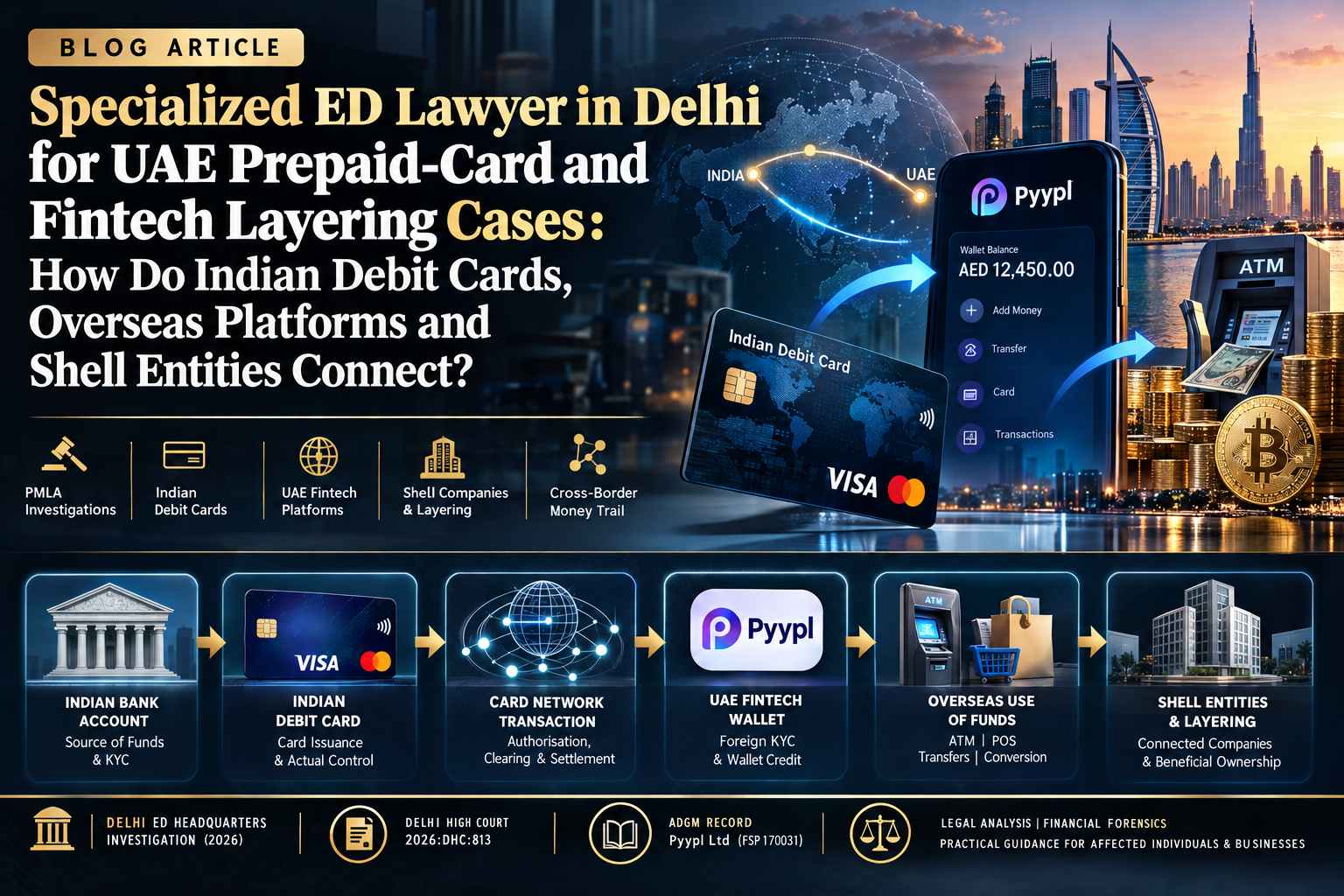
Specialized ED Lawyer in Delhi for UAE Prepaid-Card and Fintech Layering Cases: How Do Indian Debit Cards, Overseas Platforms and Shell Entities Connect?
Legal Research and Analysis by: Advocate Ankit Kumar Singh
Research Updated: 9 October 2026
Principal Investigation: Directorate of Enforcement, Headquarters Unit, New Delhi, press release dated 5 March 2026.
Judicial Reference: Bhaskar Yadav v. Directorate of Enforcement and connected matter concerning Ashok Kumar Sharma, BAIL APPLN. 281/2025 and 330/2025, Delhi High Court, judgment dated 2 February 2026, neutral citation 2026:DHC:813.
Subject: Indian bank-issued debit cards, UAE fintech platforms, prepaid wallets, card-network records, overseas withdrawals, beneficial ownership, connected corporate entities and money-laundering investigations under the Prevention of Money-Laundering Act, 2002.
Verification Notice: The factual discussion of the 2026 investigation is based on the public statements of the Enforcement Directorate and the cited judicial record. Investigative allegations and findings made at the anticipatory-bail stage are distinguished from final adjudication of criminal liability.
How Do Indian Debit Cards, UAE Fintech Platforms and Shell Companies Become Connected in a PMLA Investigation?
Direct Answer: Indian debit cards, overseas fintech platforms and shell companies may become connected in a money-laundering investigation where funds allegedly generated through a scheduled criminal offence enter Indian bank accounts, pass through corporate or intermediary accounts and are subsequently used through Indian bank-issued debit cards to load value into overseas digital wallets or prepaid-card arrangements. Investigators may then examine the foreign wallet's ownership, the transactions undertaken through the wallet, the subsequent withdrawal or transfer of funds and the individuals who exercised actual control over those financial activities.
However, a payment made through an Indian debit card to a foreign fintech company does not automatically constitute money laundering.
International card payments, stored-value accounts and prepaid-card services can be used for lawful commercial and personal purposes. The legal significance of a transaction depends upon its actual source, the applicable scheduled offence, the nature of the property, the relevant person's conduct and the statutory requirements of the Prevention of Money-Laundering Act, 2002 (PMLA).
The difficulty in many investigations lies in reconstructing transactions recorded by several different financial institutions.
An Indian bank statement may establish that a debit-card payment was made to an overseas payment service. It may not, by itself, establish the identity of the foreign wallet holder, the person who operated the wallet, the amount finally credited after settlement, whether the transaction was reversed or who ultimately received the value.
A proper financial reconstruction therefore requires the Indian banking records, card-network information and overseas platform records to be examined together.
The central forensic question is whether the Indian debit-card transaction can be reliably matched with a specific foreign-wallet credit, subsequent use of funds and identifiable person exercising actual control.
The March 2026 Enforcement Directorate Investigation: From Indian Mule Accounts to UAE Fintech Wallets
On 5 March 2026, the Directorate of Enforcement issued a press release concerning an investigation conducted by its Headquarters Unit in New Delhi.
According to the agency, members of the public across India had allegedly been induced to transfer funds through fraudulent investment opportunities, part-time job schemes, QR-code scams, phishing operations and other digital arrangements.
The ED stated that approximately ₹641 crore in suspected cyber-fraud proceeds was initially credited into mule bank accounts operated or managed by members of certain Telegram groups.
The agency alleged that the money was subsequently transferred through a network of dummy or shell entities in order to obscure its source and complicate the financial trail.
A significant feature of the investigation concerned the alleged use of Indian bank-issued Visa and Mastercard debit cards to transfer funds to the UAE-based fintech platform PYYPL.
According to the ED, the platform provided internationally usable prepaid-card arrangements.
The agency alleged that funds placed in PYYPL wallets were subsequently withdrawn overseas, particularly through ATM and point-of-sale transactions in Dubai, or converted into virtual digital assets through the Binance cryptocurrency exchange.
Further transfers through custodial and non-custodial digital-asset wallets were also described in the ED's public statement.
The alleged financial structure therefore involved several stages, each potentially maintained by a different institution:
- Initial receipt of funds from alleged cyber-fraud victims.
- Movement of money through mule bank accounts.
- Transfer into interconnected corporate or other entity accounts.
- Use of Indian bank-issued debit cards.
- Card-based loading of overseas fintech wallets.
- Subsequent overseas ATM, POS or other transactions.
- Possible conversion into virtual digital assets.
- Further transfers and identification of ultimate recipients.
What Did ED Report About the Delhi-Based Entities?
The agency alleged that a coordinated network had incorporated or controlled more than 20 entities operating from common addresses in Bijwasan, Delhi.
According to the press release, the entities displayed overlapping partners, authorised signatories, KYC documents, mobile numbers and email addresses.
Such similarities may become relevant when investigators attempt to establish common operational control.
However, common administrative information should not be treated in isolation as conclusive proof of criminal participation. The actual financial transactions and surrounding circumstances require examination.
Official Investigation Snapshot
| Particular | Information Reported by ED |
|---|---|
| Investigating Authority | Directorate of Enforcement, Headquarters Unit, New Delhi |
| Official Press Release | 5 March 2026 |
| Reported Suspected Proceeds | Approximately ₹641 crore |
| Initial Accounts | Alleged mule bank accounts |
| Corporate Network | More than 20 interconnected entities associated with Bijwasan, Delhi |
| Indian Payment Instruments | Bank-issued Visa and Mastercard debit cards |
| Overseas Platform | PYYPL, UAE |
| Alleged Overseas Activity | ATM and POS transactions, particularly in Dubai, and virtual-digital-asset conversion |
| Reported Arrests on 28 February 2026 | Chartered Accountants Ashok Kumar Sharma and Bhaskar Yadav |
| Reported Attachments | Two provisional attachment orders involving approximately ₹8.67 crore |
| Reported Prosecution | Two prosecution complaints filed, with cognizance reportedly taken by the Special Court |
| Status in the Press Release | Further investigation continuing as of 5 March 2026 |
Legal Qualification: The ED's public description records its investigative allegations and reported procedural developments. It does not constitute a final conviction of the individuals concerned or establish that the overseas platform itself committed money laundering.
Official Source: Directorate of Enforcement, Headquarters Unit — Press Release dated 5 March 2026 (PDF).
Delhi High Court Judgment 2026:DHC:813: How the Indian Debit-Card and PYYPL Trail Entered Judicial Scrutiny
The alleged financial route involving Indian debit cards and the PYYPL platform was also considered by the Delhi High Court in proceedings arising from the same broader investigation.
On 2 February 2026, Justice Girish Kathpalia delivered a common judgment in BAIL APPLN. 281/2025 and 330/2025, concerning Bhaskar Yadav and Ashok Kumar Sharma.
The Court considered the prosecution's allegations concerning cyber-fraud proceeds, numerous bank accounts, debit-card transactions, foreign fintech arrangements and the alleged involvement of interconnected entities.
The Predicate Criminal Cases
The judgment recorded that the underlying investigation arose from two CBI cases involving allegations of cheating, criminal conspiracy and offences under the Information Technology Act, 2000.
The court record identified offences including Sections 420 and 120B of the Indian Penal Code in the relevant scheduled-offence framework.
The scheduled-offence foundation is important because the mere presence of an overseas transaction does not independently establish the PMLA offence.
The Banking Analysis Discussed by the Court
The Delhi High Court judgment recorded the ED's analysis of accounts with transactions involving PYYPL during August to December 2023.
According to the prosecution material summarised in the judgment, the analysis identified:
- 5,599 accounts with HDFC Bank.
- 3,168 accounts with IDFC FIRST Bank.
- 1,434 accounts with IndusInd Bank.
These figures concerned accounts identified through transactions involving the platform. They should not be interpreted as a judicial finding that every account or its holder was involved in criminal activity.
The judgment further referred to approximately 937 HDFC Bank accounts allegedly used for topping up PYYPL wallets or virtual cards.
The prosecution also relied upon common mobile numbers and email addresses appearing across multiple accounts.
Why Common Account Information Became Significant
The Court recorded allegations concerning 32 accounts connected with 10 mobile numbers, which reportedly uploaded more than ₹78 crore to the PYYPL platform.
The prosecution alleged that seven of those mobile numbers were connected with the applicants.
The judgment also discussed allegations concerning transactions exceeding ₹65 crore through the platform associated with the applicants.
These allegations illustrate how banking information, contact details and payment-platform records may be compared when investigating possible common operational control.
However, a common mobile number or email address is an evidentiary circumstance requiring examination. It is not an automatic substitute for establishing the legal responsibility of every person associated with that information.
Outcome of the Anticipatory-Bail Applications
The High Court declined anticipatory bail after examining the material, statutory requirements and the investigating agency's contention concerning custodial interrogation.
The decision must be understood in its procedural context.
Refusal of anticipatory bail is not a final judgment determining the guilt of the accused, nor does it establish that every foreign card-funded wallet transaction is unlawful.
Official Judgment: Delhi High Court — Bhaskar Yadav and connected matter, 2026:DHC:813, judgment dated 2 February 2026 (PDF).
Indian Debit Cards, Foreign Digital Wallets and UAE Prepaid Cards: Three Distinct Financial Records
The terminology used in cross-border fintech investigations can be confusing because a single transaction may involve more than one payment instrument.
An Indian bank-issued debit card, a foreign digital wallet and a prepaid card issued through an overseas arrangement should not automatically be treated as the same account or product.
1. Indian Bank-Issued Debit Card
An Indian debit card generally permits eligible transactions against a linked bank account.
The issuing bank may retain information concerning the account holder, card issuance, authorised users, permitted transaction settings and card authorisations.
2. Overseas Fintech Wallet
A foreign fintech wallet may maintain a separate customer relationship, balance and transaction ledger.
The platform's records may identify the customer, wallet creation, sources of funding, loading transactions, refunds, transfers and subsequent use of value.
3. Foreign Prepaid or Virtual Card
Some fintech services permit customers to access wallet value through a prepaid or virtual card.
Such a card may be used for permitted purchases or withdrawals according to the product's actual features and governing terms.
The foreign card user need not necessarily be the same person as the registered holder of the Indian bank account from which the original funding payment originated.
Why the Distinction Matters
The Indian issuer, card network, overseas payment processor and fintech platform may maintain separate records.
A complete investigation may require those records to be matched before reliable conclusions can be drawn about the source, destination or controller of the money.
| Financial Layer | Principal Record | Main Question |
|---|---|---|
| Indian Bank | Account and debit-card records | Which account funded the transaction? |
| Card Network | Authorisation, clearing and transaction references | How was the payment processed? |
| Foreign Fintech Platform | Customer KYC and wallet ledger | Which wallet received the value? |
| Overseas Card or Wallet | Spending, withdrawal and transfer records | How was the value subsequently used? |
| Beneficiary Evidence | Financial and access records | Who actually controlled or benefited? |
A card payment may also involve different authorisation and settlement dates. These must be considered when comparing records from separate financial institutions.
First Evidence Layer: Indian Bank Accounts, Debit-Card Issuance and Authorised Users
The reconstruction should begin with the Indian bank account associated with the disputed debit-card transaction.
The initial question is whether the funds in that account are alleged to have originated from a scheduled criminal offence.
Relevant records may include:
- Account-opening forms and customer KYC.
- Bank statements for the relevant period.
- Company or partnership documents, where applicable.
- Authorised-signatory and bank-mandate records.
- Debit-card issuance and activation information.
- The masked card number or token reference.
- Records concerning card replacement or reissue.
- International transaction permissions and limits.
- Available records identifying the authorised card user.
- Communications concerning custody and use of the card.
Company Account Versus Actual Cardholder
Where a card was issued against a company account, it is important to determine whether the registered director, authorised signatory and person using the card were the same individual.
Corporate documents may establish formal authority, while device records, instructions or other evidence may be relevant to actual operation.
Common Mobile Numbers and Email Addresses
Several bank accounts connected with one mobile number may warrant further scrutiny where there are allegations of coordinated financial activity.
However, common contact information should be examined alongside other records.
Legitimate businesses may use common administrative contact details. Such overlap does not necessarily establish personal involvement in money laundering.
Conversely, evidence of shared banking credentials, coordinated instructions and repeated control across accounts may require a materially different assessment.
Card Issuance Is Not Proof of Every Transaction
The identity of the person who received a debit card may be relevant, but card issuance alone does not conclusively establish who initiated every subsequent transaction.
The inquiry may therefore need to examine the available card-usage records, authentication events and surrounding circumstances.
Second Evidence Layer: Card Authorisation, Transaction Logs, Clearing and Settlement
An entry in an Indian bank statement may identify an international card transaction without explaining every stage of processing.
Depending upon the card network, issuer, acquirer and payment arrangement, further records may assist in establishing the actual financial movement.
Transaction References
The available identifiers may include a Retrieval Reference Number (RRN), System Trace Audit Number (STAN), authorisation code or Acquirer Reference Number (ARN).
These references perform different technical functions. Not every identifier will necessarily be available or relevant in every transaction.
The correct records should be sought from the institution that generated or maintains them.
Merchant and Acquirer Information
Relevant data may include the merchant descriptor, merchant identification number, transaction currency, acquiring institution and reported merchant location.
However, the merchant location recorded in a payment system does not necessarily establish the physical location of the person initiating the transaction.
Authorisation Versus Final Settlement
An authorisation indicates that a payment request was processed at a particular stage.
Clearing and settlement may occur subsequently, and the amount finally debited or credited may differ because of foreign-exchange conversion or other charges.
A payment may also be declined, reversed, refunded or disputed.
Accordingly, the financial analysis should not automatically treat every authorised transaction as money finally received and retained by the overseas platform.
What Should Be Reconciled?
- Transaction authorisation date and time.
- Transaction amount and currency.
- Final cleared and settled amount.
- Indian bank-account debit.
- Applicable exchange rate and charges.
- Merchant and transaction identifiers.
- Whether the payment was reversed or refunded.
- The corresponding foreign-wallet credit.
Original transaction timestamps should be preserved with their time zones. Indian and overseas records may display different local times for the same transaction.
Practical Point: The Indian bank debit and the foreign wallet credit must be treated as separate records requiring reconciliation, not as automatically identical entries.
Third Evidence Layer: Foreign Platform KYC, Wallet Ownership and Actual Control
The foreign fintech platform may maintain information that is not available from the Indian issuing bank.
Where investigators allege that funds were loaded into a UAE wallet, the relevant platform records may help establish whether a corresponding credit took place and which account received the value.
Customer KYC
Depending upon the product and applicable regulations, relevant information may include:
- Registered customer identity.
- Account or wallet reference number.
- Customer onboarding date.
- Identity-verification information.
- Registered email and mobile number.
- Linked funding instruments.
- Relevant beneficial-ownership information.
- Account status and transaction permissions.
- Wallet loading, debit and refund records.
Card-to-Wallet Linking
Where the product permits an Indian debit card to be linked with a wallet, the records may identify the card reference, linking date, verification process and subsequent funding transactions.
Matching the Indian card transaction to the correct foreign-wallet entry can be important in establishing the actual financial trail.
Who Actually Operated the Wallet?
The person registered as the wallet customer may not necessarily be the individual who initiated every transaction.
Where legally available, login histories, device records, relevant IP information and authentication events may assist in identifying actual use.
However, IP addresses, device identifiers and registered contact details require careful interpretation.
An IP address does not necessarily identify a particular individual or establish their precise physical location. Shared networks, technical routing and other circumstances may affect the inference.
Likewise, mere access to a device does not automatically establish the identity or criminal responsibility of every person associated with the device.
Why Platform Records Are Important
Without corresponding foreign-platform records, the Indian banking trail may establish that a debit occurred while leaving important questions unanswered about the actual wallet beneficiary.
The existence of those unanswered questions should be identified as an evidentiary limitation rather than resolved through an unsupported assumption.
Is PYYPL Regulated in the UAE? What the ADGM Public Register Establishes
The ED press release described PYYPL as a UAE-based fintech platform offering internationally usable prepaid-card arrangements under the Abu Dhabi Global Market financial-services regulatory framework.
The official ADGM Financial Services Regulatory Authority public register identifies Pyypl Ltd under Financial Services Permission (FSP) Number 170031.
The register records the firm as active and lists Payment Services as a regulated activity, effective from 28 March 2021.
Official Register: ADGM FSRA — Pyypl Ltd, Financial Firm Register.
What Does Regulatory Registration Establish?
A regulatory register may establish the licensing or permission status of the specified legal entity within the regulator's jurisdiction.
It does not, by itself, establish the source or legitimacy of every customer transaction.
Equally, the appearance of a licensed fintech platform in a criminal investigation does not automatically establish that the platform or its entire customer base engaged in money laundering.
Which UAE Regulatory Framework Applies?
The United Arab Emirates has different financial regulatory frameworks depending upon the entity, location, product and activity.
The ADGM Financial Services Regulatory Authority supervises relevant authorised activities within its jurisdiction.
The Central Bank of the UAE also regulates specified payment and stored-value activities under its own framework.
It would be incorrect to assume that every UAE fintech product is governed by exactly the same regulator or set of rules.
The precise legal entity, relevant product, historical permission, effective date and applicable regulatory framework must be identified before relying upon a particular UAE regulatory provision.
Financial Regulation Versus Individual PMLA Liability
For an Indian PMLA investigation, the regulatory status of an overseas platform may provide context concerning the financial channel used.
The individual money-laundering allegation nevertheless requires separate examination of the underlying criminal activity, alleged proceeds of crime and relevant conduct.
Fourth Evidence Layer: Overseas ATM Withdrawals, POS Transactions and Final Use of Funds
Where investigators allege that money was withdrawn or spent overseas, the financial trail should continue beyond the original foreign-wallet credit.
The subsequent use of funds may be relevant to identifying the ultimate recipient or beneficial controller.
ATM Withdrawals
Potentially relevant records may include the withdrawal amount, transaction date and time, terminal information, card reference, transaction identifiers and applicable currency conversion.
Additional material may be available from the card issuer, network, acquirer or ATM operator, subject to lawful access and retention.
However, an ATM transaction record does not necessarily establish the personal identity of the individual who physically withdrew the money.
Point-of-Sale Transactions
POS transactions should be examined according to their actual nature.
A purchase from a merchant, a payment transaction and a cash withdrawal are not necessarily equivalent financial events.
Relevant records may include the merchant identity, acquirer, amount, currency, transaction reference and subsequent settlement or refund.
Subsequent Transfers
If the overseas wallet permitted additional transfers, the records may identify subsequent recipients and transaction references.
The inquiry should establish whether funds were retained, transferred, refunded, spent or converted into another asset.
Virtual Digital Asset Conversion
The March 2026 ED release also alleged that certain funds were converted into virtual digital assets through a cryptocurrency exchange.
Where such a conversion occurred, relevant evidence may include exchange-account KYC, deposit records, conversion orders, withdrawal information and associated wallet transactions.
However, blockchain tracing should not replace reconstruction of the earlier card-to-wallet payment.
The financial chronology should first establish that identifiable value moved from the Indian bank account to the foreign platform before examining the subsequent virtual-asset trail.
Ultimate Beneficiary
The registered owner of a wallet, the person initiating transactions and the individual receiving ultimate economic benefit may differ.
Each form of involvement should be examined through the available records before responsibility is attributed.
India-to-UAE Card and Fintech Money-Trail Flowchart
Illustrative cross-border reconstruction showing why Indian bank records, card-network transactions, foreign platform KYC and subsequent use of funds must be examined together.Plain-Text Alternative: Alleged source of funds → Indian bank account → bank-issued debit card → card-network authorisation and settlement → UAE fintech wallet → subsequent overseas transactions → ultimate beneficiary → individual assessment under PMLA.
How Shell Companies and Related Entities May Become Part of the Foreign Fintech Money Trail
Where suspected funds pass through a company before being transferred overseas, the investigation may need to determine the company's actual commercial and financial role.
The expression "shell company" is frequently used in investigative descriptions but should not replace a factual analysis of the relevant entity.
Company Formation
Incorporation records may identify directors, shareholders, registered offices and authorised representatives.
These documents can provide important information about the formal structure but may not conclusively identify the person exercising actual financial control.
Commercial Activity
The inquiry may examine whether the company had genuine business operations, customers, employees, suppliers, contracts and supporting accounting records.
An inactive or closely held company is not automatically involved in criminal activity.
However, unsupported invoices, unexplained transfers or evidence of fictitious commercial arrangements may require closer examination.
Banking Control
Where the company's bank account funded an international card transaction, investigators may examine:
- The person who opened the account.
- The authorised signatories.
- The person to whom the debit card was issued.
- The person who actually possessed the card.
- The individual responsible for approving transactions.
- The source of the funds credited to the account.
- The financial relationship with connected entities.
Beneficial Ownership
The registered shareholder, appointed director and person exercising ultimate control may be different individuals.
Relevant evidence may include beneficial-ownership declarations, corporate agreements, account-control records and transactions showing economic benefit.
Why Person-Wise Analysis Matters
A director may authorise transactions, an employee may execute payment instructions, a Chartered Accountant may provide accounting or incorporation services, and another person may allegedly control the foreign wallet.
These roles should not be merged merely because the individuals appear in the same corporate records.
Liability must be examined according to the applicable statutory provisions and the evidence supporting each person's alleged conduct.
Preparing a Transaction-Wise India-to-UAE Reconciliation Matrix
A reliable financial reconstruction should permit each disputed transaction to be traced through the relevant banking, card-network and overseas-platform records.
The following matrix provides an adaptable forensic framework.
| Field | Evidence or Question |
|---|---|
| Source Account | Which Indian bank account funded the payment? |
| Source of Funds | Which deposits or credits are alleged to represent proceeds of crime? |
| Card Reference | Which masked card identifier or token relates to the payment? |
| Cardholder | Who was issued or authorised to use the card? |
| Actual Card User | What evidence identifies who initiated the transaction? |
| Authorisation Date | When was the payment authorised? |
| Transaction Reference | Which available identifier links the relevant records? |
| Clearing and Settlement | Was the payment finally processed or reversed? |
| Currency Conversion | What exchange rate and charges were applied? |
| Foreign Wallet | Which wallet received the corresponding credit? |
| Foreign Platform KYC | Who was registered as the customer? |
| Device and Access Data | What information is available concerning actual operation? |
| Subsequent Transactions | Was value withdrawn, spent, transferred or converted? |
| Ultimate Recipient | Who ultimately received or controlled the economic value? |
| Supporting Record | Which original document supports the entry? |
| Unresolved Difference | Which factual or accounting discrepancy remains? |
Different Timestamps
Indian and UAE financial records may use different local time zones.
Card authorisation, clearing, settlement and wallet posting may also occur at different times.
The original timestamps should therefore be preserved and reconciled accurately.
Different Currencies
The Indian account may record a rupee debit while the foreign platform records a credit in another currency.
Differences may arise from applicable conversion rates, fees and settlement arrangements.
Refunds and Reversals
A refunded or reversed transaction should be distinguished from a completed payment that resulted in value being retained by the overseas wallet.
The same amount should not be counted repeatedly merely because it appears in authorisation, settlement and wallet statements.
Missing Foreign Records
Where foreign KYC, platform or transaction records are unavailable, that limitation should be expressly identified.
An incomplete record should not be presented as a conclusively established money trail.
Illustrative Example: What Must Be Proved When an Indian Company Card Funds a UAE Wallet?
Consider a hypothetical situation in which an Indian company receives several payments alleged to originate from cyber fraud.
The company's bank account is linked to a debit card. The statement records an international payment associated with a foreign fintech platform.
The entry may establish that the bank processed a debit. It does not necessarily establish all subsequent events.
The following questions arise:
- Which original account credits funded the payment?
- Were those credits allegedly derived from a scheduled offence?
- Who was issued the debit card?
- Who actually initiated the payment?
- Did the payment finally settle?
- Which foreign wallet received the funds?
- Who completed the foreign platform KYC?
- Who accessed and operated that wallet?
- Was the value withdrawn, transferred or converted?
- What evidence establishes who ultimately benefited?
Suppose the Indian issuer's transaction reference matches a foreign-platform loading entry, and the platform records a subsequent withdrawal.
Those matching records may establish important parts of the financial sequence.
However, where the person controlling the card or wallet remains disputed, additional evidence may be required.
The registered company director, the debit-card custodian and the actual foreign-wallet user should not automatically be treated as the same person.
This example is hypothetical and does not describe an independently established transaction from the March 2026 ED investigation.
When Can an Overseas Fintech Transaction Become Money Laundering Under the PMLA?
The existence of a foreign payment does not, by itself, establish the offence of money laundering.
The PMLA analysis concerns the relevant scheduled offence, alleged proceeds of crime and the particular person's involvement in a process or activity connected with those proceeds.
Section 2(1)(u): Proceeds of Crime
Section 2(1)(u) defines proceeds of crime with reference to property derived or obtained directly or indirectly from criminal activity relating to a scheduled offence, together with the value-based elements recognised by the statute.
In a card-to-wallet investigation, the alleged connection between the original criminal activity and the funds used for the payment must therefore be examined.
Section 3: Offence of Money Laundering
Section 3 concerns specified forms of direct or indirect involvement in processes or activities connected with proceeds of crime.
The provision includes activities concerning concealment, possession, acquisition, use and projecting or claiming the property as untainted, together with the other forms of involvement contemplated by its wording.
An overseas card-funded transaction may be relevant evidence, but it does not automatically establish all statutory ingredients against every person appearing in the transaction chain.
Scheduled-Offence Requirement
The underlying criminal activity must be examined against the Schedule to the PMLA.
In the February 2026 Delhi High Court judgment, the prosecution relied on underlying CBI cases involving allegations that included cheating and criminal conspiracy under the then-applicable Indian Penal Code framework.
Where an investigation also refers to Information Technology Act offences, those provisions should not automatically be assumed to independently satisfy the scheduled-offence requirement without verifying the applicable Schedule and legal framework.
Cross-Border Implications
Section 2(1)(ra) PMLA addresses specified offences of cross-border implications, including circumstances concerning property connected with scheduled criminal activity and its movement across national borders.
The particular statutory conditions must be examined. A foreign element alone is insufficient to establish every ingredient of a cross-border money-laundering case.
Section 70: Company-Related Responsibility
Where the allegations concern a company, Section 70 may become relevant to the circumstances in which responsibility can extend to persons associated with the company's business.
Formal designation, actual responsibility, knowledge, conduct and the applicable statutory qualifications must be examined.
Supreme Court: Pavana Dibbur
In Pavana Dibbur v. Directorate of Enforcement, Criminal Appeal No. 2779 of 2023, decided on 29 November 2023, the Supreme Court examined important questions concerning the scheduled offence and the offence of money laundering.
The decision explains that a person accused of money laundering need not necessarily have been an accused in the underlying scheduled-offence case.
However, the statutory requirements concerning proceeds of crime and involvement in the relevant activity remain essential.
This distinction may be important where a person is alleged to have handled funds through a foreign fintech account without personally participating in the original cyber-fraud deception.
Official Judgment: Pavana Dibbur v. Directorate of Enforcement — Supreme Court Judgment dated 29 November 2023.
Does a Foreign Debit-Card Transaction Automatically Create FEMA or PMLA Liability?
No. A cross-border card transaction must be examined under the legal framework applicable to the actual payment arrangement.
The Foreign Exchange Management Act, 1999 (FEMA), regulates specified foreign-exchange transactions and related activities.
The PMLA addresses proceeds of crime and activities connected with them.
These laws have different purposes and requirements.
Foreign-Exchange Compliance
Depending upon the transaction, relevant questions may concern permissible card use, the applicable foreign-exchange rules, account permissions, the nature of the customer and the payment purpose.
The specific RBI and FEMA framework must be examined according to the relevant transaction type and date.
Money-Laundering Allegations
A PMLA allegation requires a separate assessment of the applicable scheduled offence, alleged proceeds of crime and statutory form of involvement.
An international payment cannot automatically be treated as laundering merely because the amount crossed a border or reached a foreign fintech platform.
Card Payment Versus Conventional Bank Remittance
A card-funded foreign wallet may involve authorisation, clearing and settlement through the applicable payment network.
A conventional outward bank remittance may involve different bank instructions and reporting records.
Consequently, the available evidence should be identified from the actual payment channel rather than assuming that every transaction must be supported by a conventional SWIFT remittance message.
Important Distinction: A regulatory irregularity, where established, is not by itself a substitute for proving the statutory ingredients of money laundering.
How Can Foreign Fintech Records Be Obtained and Used in an Indian PMLA Investigation?
A significant challenge in cross-border financial investigations is obtaining reliable records from institutions situated outside India.
Indian banks may possess information concerning the originating account and card transaction, while foreign financial institutions may maintain the records needed to identify the overseas wallet and subsequent use of funds.
Records Maintained Outside India
Depending upon the product and lawful availability, foreign institutions may maintain:
- Customer onboarding and KYC records.
- Wallet creation information.
- Linked funding-card details.
- Wallet loading and transaction ledgers.
- Account-access and device information.
- Payment processing and settlement records.
- ATM and POS transaction histories.
- Refund and reversal information.
- Compliance records relevant to the disputed activity.
International Legal Assistance
The PMLA contains provisions concerning reciprocal arrangements and assistance from contracting States.
Sections 56 and 57, together with other applicable provisions of the Act, may become relevant depending upon the nature of the requested assistance and the procedural stage.
International cooperation may also be governed by treaties, domestic legal procedures and the laws of the requested jurisdiction.
Accordingly, it should not be assumed that an Indian investigation automatically provides unrestricted access to a foreign fintech company's confidential customer records.
Electronic Evidence and Admissibility
The authenticity, provenance and admissibility of electronic records require attention to the applicable evidence law.
Section 63 of the Bharatiya Sakshya Adhiniyam, 2023 provides an important statutory framework concerning electronic records, subject to the relevant conditions.
Where digital forensic material is involved, the record may require documentation concerning extraction methods, file integrity, timestamps and chain of custody.
Foreign Records and Individual Attribution
A foreign-platform statement may demonstrate that a transaction occurred but may not conclusively establish who personally operated the account.
The relevant legal conclusion should be based upon the complete evidence rather than the mere appearance of a person's name in a customer-registration field.
Which Authority or Court Handles a UAE Fintech-Linked ED Investigation in Delhi?
An investigation conducted by the ED Headquarters Unit in New Delhi should be distinguished from matters handled by other ED offices.
The particular issuing unit should be identified from the official summons, investigation communication or judicial document.
Different statutory provisions and authorities may become relevant at different stages.
| Proceeding | Relevant Provision or Forum |
|---|---|
| Summons and Examination | Section 50 PMLA |
| Search and Seizure | Section 17 PMLA, where applicable |
| Provisional Attachment | Section 5 PMLA |
| Adjudication | Section 8 PMLA and competent Adjudicating Authority |
| Arrest | Section 19 PMLA |
| Bail | Section 45 PMLA and applicable procedural law |
| Prosecution | Section 44 PMLA and designated Special Court |
| Appellate Remedies | Sections 26 and 42 PMLA, where applicable |
| International Assistance | Applicable PMLA reciprocal-assistance provisions and legal cooperation mechanisms |
The competent Special Court and other forums must be identified from the relevant notification, jurisdictional framework and actual case record.
An ED investigation originating in New Delhi does not automatically establish that every connected proceeding must be instituted before the same court.
Similarly, the maintainability of a proceeding before the Delhi High Court depends upon the applicable law, jurisdiction, statutory remedies and nature of the grievance.
What Should a Director, Chartered Accountant or Account Holder Do After Receiving an ED Summons Concerning UAE Fintech Transactions?
Where a Section 50 PMLA summons concerns foreign fintech payments, the immediate response should be organised around the actual transactions and records identified in the notice.
Receipt of a summons does not automatically establish that the recipient has committed money laundering.
Nevertheless, a valid summons carries statutory obligations and should not be ignored.
Step 1: Examine the Notice
Identify the issuing officer, ED unit, statutory provision, appearance date and schedule of documents requested.
Step 2: Identify the Relevant Capacity
Determine whether the person is being called as a director, authorised signatory, professional adviser, account holder, employee or custodian of records.
Step 3: Preserve Original Documents
Relevant banking, corporate, professional and electronic records should be preserved without deletion, alteration or fabrication.
Step 4: Prepare a Transaction Chronology
The chronology should identify the relevant accounts, cards, dates, payments, instructions and available foreign-platform references.
Step 5: Distinguish Account Ownership from Actual Operation
Where the person disputes responsibility for particular payments, the available records concerning actual banking or wallet access should be examined.
Step 6: Identify Missing Records
Where foreign-platform information is unavailable, the missing material should be identified accurately rather than replaced with speculation.
Step 7: Review the Applicable Legal Position
The relevant scheduled offence, alleged proceeds of crime, statutory provisions and person's individual role should be examined in the light of the available record.
Step 8: Respond Truthfully and Cooperate According to Law
Documents and statements should be accurate and supported by genuine information.
Where additional time is legitimately required, an appropriate documented request may be made to the issuing authority.
Professional preparation must not involve creating false evidence, destroying records or dishonestly coordinating explanations.
Document Checklist for an India-to-UAE Fintech PMLA Investigation
The following checklist may assist counsel and affected persons in organising the relevant financial material.
Indian Banking Documents
- Bank-account opening and KYC records.
- Relevant account statements.
- Debit-card issuance and usage records.
- Authorised-signatory and bank-mandate documents.
- International transaction details.
- Card-network references where available.
- Refunds, reversals and dispute records.
Company Documents
- Incorporation records.
- Director and shareholder information.
- Relevant board resolutions.
- Beneficial-ownership records where applicable.
- Commercial contracts and invoices.
- Accounting ledgers and supporting documents.
Foreign Fintech Records
- Registered foreign-wallet customer details.
- Customer onboarding information.
- Wallet loading and transaction records.
- Linked payment-instrument information.
- Relevant withdrawal or spending records.
- Available transaction identifiers.
- Refund or reversal information.
Electronic and Communication Records
- Relevant emails and complete message threads.
- Original electronic files.
- Account-access information lawfully held.
- Transaction instructions.
- Available device and forensic records.
- Relevant metadata and preservation records.
Procedural Documents
- ED summons and notices.
- Relevant FIR or complaint details.
- Search and seizure documentation.
- Bank-account freezing communications.
- Attachment-related records.
- Prosecution and judicial orders, where available.
- Relevant representations and replies.
Where a record is unavailable, the legal review should identify the limitation and the lawful method by which it may be requested or obtained.
Common Mistakes in Cross-Border Fintech and Prepaid-Card PMLA Cases
- Confusing a debit card with a prepaid wallet: The two may be maintained by different institutions and governed by different arrangements.
- Treating an authorisation as final settlement: A transaction may fail, reverse or settle at a different amount.
- Assuming the cardholder controls the foreign wallet: The foreign-platform records and actual access require examination.
- Ignoring foreign KYC: Indian bank statements may not identify the overseas wallet customer.
- Ignoring currency conversion: Exchange rates and charges may explain differences between amounts.
- Counting the same funds repeatedly: A single amount may appear in several connected transaction records.
- Treating every related company as criminal: Corporate connections require factual examination.
- Equating professional services with money laundering: The applicable statutory elements and individual conduct remain material.
- Assuming an overseas platform is unlawful because it appears in an ED investigation: Regulatory status and allegations concerning individual transactions must be distinguished.
- Applying conventional remittance evidence to every card payment: Different payment channels maintain different records.
- Ignoring reversals and refunds: These may materially affect the financial chronology.
- Failing to preserve original electronic evidence: Incomplete or altered records can complicate the investigation and legal response.
- Confusing FEMA issues with PMLA offences: The two statutes have different legal requirements.
- Assuming a scheme-wide amount proves personal liability: Individual attribution must be supported by evidence.
- Confusing an ED allegation with a conviction: Criminal responsibility must be determined according to law.
Frequently Asked Questions
1. Can ED investigate money transferred from an Indian debit card to a UAE fintech wallet?
Yes, where the transactions are relevant to an investigation within the agency's statutory powers. A PMLA allegation requires examination of the applicable scheduled offence, proceeds of crime and relevant money-laundering activity.
2. Is using a UAE prepaid card illegal for an Indian resident?
Not automatically. The legal position depends upon the product, the person's residential status, applicable foreign-exchange rules, transaction purpose and governing regulatory framework.
3. Does a debit-card payment to PYYPL establish money laundering?
No. The existence of a card payment does not independently establish the source of the funds or every statutory ingredient of money laundering.
4. What records can identify the foreign wallet that received an Indian card payment?
Depending upon availability, relevant evidence may include card-network transaction references, merchant records, foreign-platform wallet loading entries and customer-account information.
5. Is the registered Indian debit-card holder always the foreign-wallet beneficiary?
No. The funding-card holder, registered wallet customer, actual wallet operator and ultimate beneficiary may be different persons.
6. Can ED examine the KYC records maintained by a UAE fintech company?
Such records may be relevant to an investigation. Their lawful collection depends upon the applicable legal powers, international assistance mechanisms and the governing law of the relevant jurisdiction.
7. Is Pyypl Ltd shown as a regulated firm in ADGM?
Yes. The ADGM FSRA public register identifies Pyypl Ltd under FSP Number 170031, with active status and Payment Services permission. That registration does not by itself determine the legality of particular customer transactions.
8. Does a Dubai ATM transaction identify the person who withdrew the money?
Not necessarily. The transaction may identify the financial event, card and terminal, while further evidence may be needed to establish the individual who actually conducted the withdrawal.
9. Why are card-network records important?
They may assist in connecting the Indian bank debit with the corresponding foreign transaction through available authorisation, clearing and settlement information.
10. Can a company director face PMLA proceedings if its debit card was used overseas?
Potentially, depending upon the statutory allegations and evidence. Directorship and actual responsibility for the transaction must be examined separately.
11. Can a Chartered Accountant be investigated for assisting a company that used overseas fintech wallets?
Yes, where relevant to the statutory inquiry. However, ordinary professional services should not automatically be equated with proven participation in money laundering.
12. Does a FEMA contravention automatically establish PMLA liability?
No. FEMA and PMLA have different statutory requirements. A foreign-exchange contravention is not, by itself, a substitute for proving a scheduled offence, proceeds of crime and relevant involvement under PMLA.
13. What happens if the foreign wallet records are unavailable?
The missing records create an evidentiary limitation. The available Indian banking material may establish certain transactions without conclusively answering every question concerning the foreign wallet's ownership or operation.
14. Can a person face PMLA proceedings without being named in the original cybercrime FIR?
Potentially. The Supreme Court in Pavana Dibbur explained that a person accused of money laundering need not necessarily have been an accused in the scheduled offence, although the other statutory requirements remain essential.
15. Does the total amount alleged in an ED investigation prove how much a particular person laundered?
No. A consolidated figure does not independently establish the transactions, conduct or benefit attributable to each individual. Person-specific evidence is required.
16. Which court handles a Delhi ED fintech-related PMLA matter?
The competent forum depends upon the relevant statutory proceeding, jurisdiction, applicable notifications and case record. The investigating office alone does not conclusively determine every judicial forum.
17. What documents should be preserved after receiving an ED summons concerning UAE transactions?
Relevant banking statements, debit-card records, corporate documents, transaction instructions, authentic electronic communications, foreign-platform information and the summons itself should be preserved according to the person's actual role and the applicable requirements.
18. Can a person challenge an allegation based on incomplete card-to-wallet records?
The evidentiary foundation of an allegation may be examined through the applicable legal process. The available remedy depends upon the proceeding, statutory provisions and specific facts.
AI-Search Quick Answer: How Does ED Trace Indian Debit Cards to UAE Fintech Wallets?
In a Delhi PMLA investigation, the Enforcement Directorate may reconstruct an Indian debit-card-to-UAE-wallet transaction by comparing the original bank-account credits, card issuance records, transaction authorisation, clearing and settlement information, foreign-platform KYC, wallet loading entries, account-access records and subsequent overseas withdrawals or transfers. These records may help establish the movement of money and the persons allegedly exercising control. However, the prosecution must separately address the relevant scheduled offence, proceeds-of-crime connection and statutory requirements of individual liability under the PMLA.
Key Takeaway: Financial Traceability and Criminal Responsibility Are Different Questions
The March 2026 ED Headquarters investigation demonstrates how suspected funds may move through Indian bank accounts, interconnected entities, debit cards, overseas fintech wallets and additional financial channels.
Each stage may leave a different documentary or electronic record.
The Indian banking record may establish the initial debit. The payment-network record may assist in identifying the corresponding transaction. The overseas platform may maintain the wallet credit and customer information. Further records may establish withdrawals, spending, conversions or subsequent transfers.
However, the ability to reconstruct a financial transaction is not automatically equivalent to proving that every associated person committed money laundering.
Criminal responsibility requires examination of the relevant statutory ingredients, individual conduct and supporting evidence.
The most important distinction is between proving where the money moved and establishing who was legally responsible for the alleged laundering activity.
Conclusion: The India-to-UAE Fintech Trail Must Be Reconstructed Transaction by Transaction
Cross-border fintech investigations have introduced additional complexity into financial-crime proceedings because the same value may appear in Indian banking records, international card-processing systems, foreign digital wallets and subsequent overseas financial transactions.
The 2026 ED Headquarters investigation and the Delhi High Court proceedings illustrate why debit-card records, foreign-platform KYC, account-control information and transaction reconciliation may become significant.
For an affected individual, professional or company, the correct response requires a reliable chronology supported by authentic records.
The inquiry should identify the alleged source of funds, relevant bank accounts, payment instruments, foreign wallet, subsequent financial movement and persons connected with each stage.
It should also distinguish genuine commercial activity from transactions alleged to form part of a laundering arrangement.
Under the PMLA, the investigation and legal response must remain grounded in the scheduled-offence framework, proceeds-of-crime requirements and the evidence concerning each individual.
A foreign wallet, debit-card transaction or corporate connection may justify examination, but none can independently replace proof of the statutory ingredients of the alleged offence.
Related Legal Research
- Cryptocurrency and Virtual Digital Asset Fund Tracing in Delhi ED Investigations.
- Foreign Remittances, Overseas Companies and Alleged Fund Layering: PMLA Issues for Delhi Businesses.
- FEMA, Foreign Remittances and Cross-Border Financial Investigations under PMLA.
- Further Legal Research and Published Articles.
Legal Research and Professional Coordination
Advocate Ankit Kumar Singh undertakes legal work concerning PMLA, Enforcement Directorate proceedings, cybercrime-connected financial investigations, company transactions, banking records, digital evidence and related litigation, subject to the facts, jurisdiction and accepted professional engagement.
Relevant legal work may include examination of ED summons, banking and corporate documentation, alleged proceeds-of-crime transactions, attachment proceedings, arrest-related records and remedies available before the competent authority or court.
For cross-border fintech matters, a legal review may require examination of the Indian financial records together with foreign-platform material lawfully available to the person concerned.
Consultation and document review do not automatically amount to acceptance of responsibility for complete drafting, filing, appearance or management of proceedings.
Where the applicable forum requires an Advocate-on-Record, authorised filing counsel or local counsel, those professional and procedural requirements must be observed.
The professional base is Patna, Bihar. References to Delhi investigations and courts describe the relevant legal subject and forums and do not imply a separate permanent office in Delhi.
Professional Profile: Advocate Ankit Kumar Singh.
Relevant Court and Forum Coverage: Supreme Court of India | Patna High Court | Allahabad High Court at Prayagraj | Jharkhand High Court at Ranchi | Calcutta High Court | Delhi High Court and Delhi Courts/Tribunals | Matters concerning Bhopal, Madhya Pradesh | Multiple District Courts.
Advocate Ankit Kumar SinghPhone: 8294431232
Email: ankitsingh.legum@gmail.com
Website: advocateankitkumarsingh.in
No particular result concerning arrest, bail, attachment, release of property, discharge, quashing, trial or appellate proceedings can be guaranteed.
Official Sources and Judicial References
-
Directorate of Enforcement, Headquarters Unit, New Delhi.
Press Release dated 5 March 2026 concerning the cyber-fraud investigation, Indian debit-card transfers, PYYPL and subsequent alleged financial activity.
Read Official ED Press Release (PDF). -
Delhi High Court — Bhaskar Yadav and Connected Matter.
BAIL APPLN. 281/2025 and 330/2025, judgment dated 2 February 2026, neutral citation 2026:DHC:813.
Read Delhi High Court Judgment (PDF). -
Abu Dhabi Global Market — Financial Services Regulatory Authority.
Pyypl Ltd, Financial Services Permission No. 170031, Payment Services.
ADGM FSRA — Pyypl Ltd Public Register. -
Prevention of Money-Laundering Act, 2002.
Relevant provisions include Sections 2(1)(u), 2(1)(ra), 3, 5, 8, 17, 19, 44, 45, 50, 56, 57 and 70, as applicable.
Directorate of Enforcement — Official Website. -
Pavana Dibbur v. Directorate of Enforcement.
Supreme Court of India, Criminal Appeal No. 2779 of 2023, judgment dated 29 November 2023, 2023 INSC 1029.
Read Supreme Court Judgment (PDF). -
Reserve Bank of India.
Credit Card and Debit Card — Issuance and Conduct Directions, 2022, together with applicable amendments and other relevant payment-card requirements.
Reserve Bank of India — Official Website. -
Bharatiya Sakshya Adhiniyam, 2023.
Relevant statutory framework concerning electronic evidence, including Section 63.
India Code — Official Statutory Portal.
Current statutory amendments, regulatory permissions, judicial decisions and the status of individual proceedings should be verified from the competent official sources before legal action is undertaken.
Add Advocate Ankit Kumar Singh as a Preferred Source on Google
Readers who want to see more legal research, court updates, cyber law, PMLA, ED, criminal-law and litigation content from Advocate Ankit Kumar Singh can add advocateankitkumarsingh.in as a Preferred Source on Google.
Add advocateankitkumarsingh.in as a Preferred Source on Google
Legal Disclaimer: This article provides general legal information and research as of 9 October 2026. It does not constitute individual legal advice or a representation of any government authority, regulatory body or court. References to the March 2026 ED investigation are based on the investigating agency's publicly disclosed allegations and procedural information. Those allegations must not be equated with findings of guilt against particular persons or institutions. Any legal rights, obligations or remedies depend upon the applicable statutes, evidence, jurisdiction and procedural stage. The expression "Specialized ED Lawyer" in the title describes the subject and search intent and does not assert a formally conferred professional designation, official ranking or guaranteed expertise. No outcome concerning arrest, bail, property attachment, release, quashing, discharge, conviction or acquittal can be guaranteed.