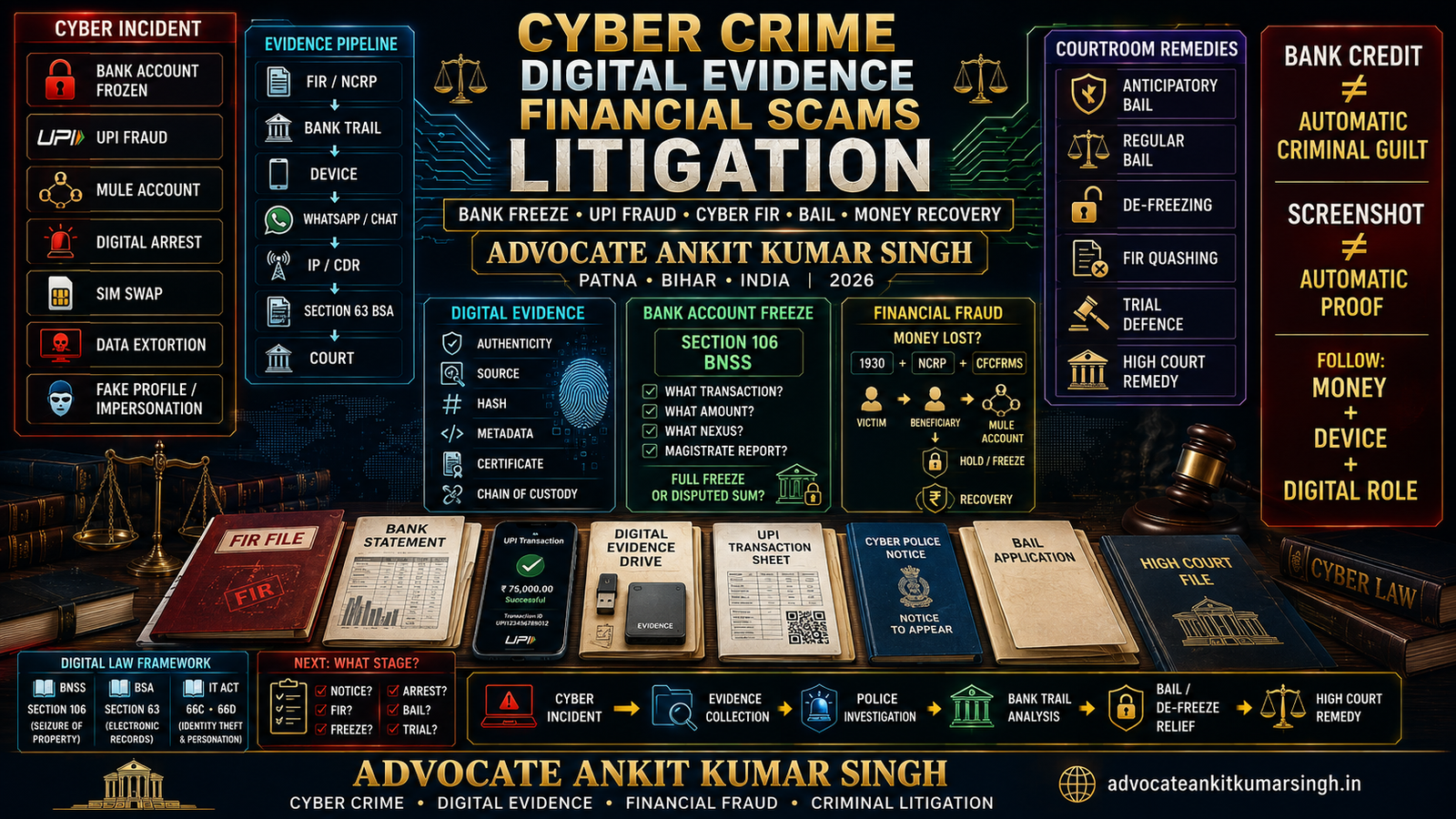
CYBER CRIME • DIGITAL EVIDENCE • FINANCIAL FRAUD • BANK FREEZE • CYBER POLICE • BAIL • QUASHING • MONEY RECOVERY • LITIGATION
For Cyber Crime, Digital Evidence & Financial Scams (Litigation)
Bank-account freezes, UPI fraud, Cyber Police proceedings, mule-account allegations, digital evidence, anticipatory and regular bail, FIR quashing, 1930/CFCFRMS money recovery and High Court remedies — 2026 litigation guide by Advocate Ankit Kumar Singh.
Updated: 8 August 2026
 Advocate Ankit Kumar Singh
Direct Answer: When Do You Need a Cybercrime Litigator?
If you are dealing with a localized or criminal issue—such as a bank-account freeze, UPI online fraud, Cyber Police investigation, data extortion, digital arrest scam, mule-account allegation, social-media impersonation, SIM-swap fraud or digital-evidence dispute— the requirement may go beyond cyber-law advice.
You may need an active courtroom litigator capable of connecting:
CYBER POLICE + CRIMINAL PROCEDURE + BANKING RECORDS + DIGITAL EVIDENCE + BAIL + DE-FREEZING + QUASHING + HIGH COURT REMEDIES.
The real question is usually not simply:
“Which cyber law applies?”
It is:
WHAT HAS ALREADY HAPPENED, WHAT EVIDENCE EXISTS, WHAT PROCEDURAL STAGE ARE YOU AT, AND WHAT RELIEF CAN BE SOUGHT NOW?
Cyber Advisory and Cyber Litigation Are Different
Cyber law is a very broad field.
A technology-law adviser may be appropriate for:
- privacy compliance;
- data-processing policies;
- technology contracts;
- platform compliance;
- commercial technology transactions.
A cybercrime litigator is generally required where the matter has entered:
- criminal investigation;
- FIR;
- police notice;
- search or seizure;
- bank-account freezing;
- arrest risk;
- bail proceedings;
- criminal trial;
- High Court proceedings.
Bank Account Frozen Because of a Cybercrime Complaint
This is now one of the most common forms of cyber litigation.
A person may discover that:
- the complete account is debit-frozen;
- a particular amount is under lien;
- UPI transactions have stopped;
- internet banking is disabled;
- the originating Cyber Police station is located in another State.
The relevant criminal-procedure provision under the current BNSS is ordinarily examined through Section 106, which concerns police seizure of specified property.
The first litigation questions should include:
- Which police station issued the direction?
- What is the NCRP/FIR reference?
- What exact transaction is disputed?
- What amount is allegedly linked to the offence?
- What is the account's layer in the money trail?
- Was the seizure reported to the competent Magistrate?
- Is a full debit freeze really necessary?
- Can the disputed sum be isolated?
Section 106 BNSS — The Procedural Foundation
Section 106 authorises a police officer to seize property which is alleged or suspected to have been stolen, or which is found under circumstances creating suspicion of commission of an offence.
The provision also contains reporting requirements. A police officer acting under Section 106(1) must report the seizure to the Magistrate having jurisdiction.
Therefore a bank freeze should not be analysed only by asking:
“HAS THE BANK RECEIVED AN EMAIL FROM POLICE?”
The surrounding statutory procedure and transaction nexus matter.
2026 Courts Are Scrutinising Full Bank-Account Freezes
Current judicial scrutiny increasingly distinguishes between:
THE SPECIFIC SUSPECTED SUM
and:
EVERY RUPEE IN THE ACCOUNT.
The appropriate relief remains fact-specific, but where a small disputed credit can be distinctly identified, the necessity and proportionality of freezing an entire running account can become a serious litigation issue.
A freeze is an investigative measure. It is not a declaration that the account-holder has committed cyber fraud.
Mule Account Allegation — Receipt of Money Is Not the Entire Criminal Case
Suppose ₹50,000 alleged to originate from a cyberfraud eventually reaches account X.
That bank entry proves something important:
MONEY REACHED X.
But criminal liability may require additional analysis:
- Who controlled X?
- Why was the payment received?
- Was there a genuine commercial transaction?
- Did the account-holder know the origin?
- Who communicated with the original victim?
- Who supplied the account credentials?
- Who withdrew or transferred the money?
- What device/IP was used?
- Was commission received for providing the account?
- Is there evidence of conspiracy or dishonest intention?
Therefore:
BANK CREDIT ≠ AUTOMATIC PROOF OF KNOWING PARTICIPATION IN FRAUD.
UPI and Online Financial Fraud — The First Hours Matter
For a victim of a recent cyber-financial fraud, litigation strategy begins with preservation and rapid reporting.
The immediate sequence is ordinarily:
BANK → 1930 → NCRP → BENEFICIARY TRACE → CFCFRMS → CYBER POLICE.
Preserve:
- transaction ID;
- UTR/RRN;
- UPI ID;
- beneficiary account;
- date/time;
- fraud messages;
- telephone numbers;
- screenshots;
- bank acknowledgment;
- 1930/NCRP acknowledgment.
1930 and CFCFRMS — Money Recovery Is a Race Against Movement
CFCFRMS exists to facilitate immediate coordination between the reporting system, law-enforcement agencies, banks and financial intermediaries.
The objective is:
VICTIM ACCOUNT → DESTINATION ACCOUNT → MULE ACCOUNT → LIEN / HOLD → STOP FURTHER MOVEMENT.
Government data published in July 2026 reports that more than ₹11,158 crore had been saved in more than 32.80 lakh complaints through the system up to 30 June 2026.
This does not mean every 1930 complaint results in recovery. Speed, remaining balance, subsequent transfers and investigative action remain important.
Digital Evidence Is Often the Centre of the Case
A modern cybercrime file may contain:
- WhatsApp chats;
- screenshots;
- emails;
- UPI records;
- bank statements;
- call-detail records;
- IP logs;
- device logs;
- CCTV;
- audio;
- social-media records;
- mobile forensic extraction;
- cloud records.
A courtroom litigator must ask not merely:
“WHAT DOES THE SCREENSHOT SAY?”
but:
WHERE DID IT COME FROM? → WHO CREATED IT? → IS IT COMPLETE? → CAN IT BE AUTHENTICATED? → HOW WILL IT BE PROVED?
Section 63 BSA — Electronic Evidence Must Be Properly Proved
The Bharatiya Sakshya Adhiniyam, 2023 contains the current statutory framework for electronic records in newer proceedings.
Section 63 governs specified computer outputs and their admissibility.
Depending upon the record, litigation may require consideration of:
- Section 63 certificate;
- source/device;
- original electronic record;
- hash value;
- hash report;
- metadata;
- forensic extraction;
- chain of custody.
A screenshot can be important evidence. It is not automatically conclusive merely because it looks genuine.
WhatsApp Chats and Screenshots — Context Matters
Suppose the prosecution relies on one message:
“THE MONEY HAS ARRIVED.”
A proper defence review may ask:
- Who sent it?
- Whose number?
- Who controlled that number?
- What messages came before it?
- What followed it?
- Was the screenshot cropped?
- Is the underlying phone available?
- Does the bank record corroborate the message?
- Was the conversation exported?
- Is the required certificate available?
Digital evidence becomes significantly stronger or weaker depending upon context and corroboration.
Cyber Police Notice or Summons — Prepare Before Appearing
A Cyber Police communication should first be classified.
Ask:
- Is there an FIR?
- Is there only an NCRP complaint?
- Is the recipient a witness, suspect or accused?
- What statutory provision is mentioned?
- Which documents are demanded?
- Is a device sought?
- Is personal appearance required?
- Which police station has jurisdiction?
- Is there immediate arrest risk?
Walking into a Cyber Police station with an unverified oral explanation but without the transaction documents can create avoidable inconsistencies.
Cybercrime Anticipatory Bail
Where arrest is reasonably apprehended, anticipatory-bail strategy should be built around the actual cyber evidence.
Relevant issues may include:
- specific role;
- account ownership;
- account control;
- device control;
- transaction trail;
- beneficiary status;
- communication with complainant;
- recovery already completed;
- custodial interrogation;
- cooperation with investigation;
- prior criminal antecedents;
- documentary explanation.
A cyber bail application should not merely say:
“THE APPLICANT IS INNOCENT.”
It should explain the alleged digital role.
Regular Bail After Arrest
After arrest, the litigation focus changes.
Counsel may need to examine:
- arrest record;
- remand application;
- seizure record;
- device recovery;
- bank trail;
- recovery of alleged proceeds;
- co-accused material;
- investigation progress;
- custody period;
- charge-sheet status.
The defence should distinguish:
MONEY TRAIL
from:
KNOWING CRIMINAL PARTICIPATION.
Quashing a Cybercrime FIR Before the High Court
A cyber FIR may sometimes be challenged before the High Court, but quashing is not a substitute for every disputed factual defence.
Potentially relevant situations may include:
- settlement in legally permissible categories;
- absence of legally required ingredients;
- demonstrably false digital attribution;
- purely civil/commercial dispute given criminal colour;
- legal bar;
- other exceptional circumstances recognised in quashing jurisprudence.
Where the defence depends upon contested forensic evidence, the High Court may not conduct a complete trial within quashing jurisdiction.
SIM Swap, OTP and Account-Takeover Litigation
Cybercrime litigation increasingly includes:
- duplicate SIM fraud;
- unauthorised eSIM activation;
- OTP interception;
- WhatsApp linked-device takeover;
- email compromise;
- bank beneficiary addition;
- unauthorised electronic transactions.
The analysis may require:
TELECOM RECORD + OTP DELIVERY LOG + BANK LOGIN + DEVICE / IP + BENEFICIARY CREATION + TRANSACTION + CUSTOMER REPORTING TIME.
RBI's customer-protection framework separately regulates liability for unauthorised electronic banking transactions.
RBI Zero-Liability and Limited-Liability Framework
RBI's framework provides zero customer liability where the unauthorised transaction is caused by contributory fraud, negligence or deficiency on the bank's part.
It also provides zero liability for a qualifying third-party breach where neither the bank nor customer is responsible and the customer reports within three working days of receiving the bank's transaction communication.
Where customer negligence—such as voluntarily sharing payment credentials— causes the loss, the liability analysis changes materially.
The RBI framework also places the burden of proving customer liability on the bank.
Cyber Extortion, Sextortion and Data-Based Threats
Financial cyber litigation is not limited to stolen UPI transactions.
A case may involve threats such as:
“PAY OR YOUR DATA WILL BE PUBLISHED.”
or:
“PAY OR WE WILL SEND THESE IMAGES TO YOUR FAMILY.”
Depending upon the facts, the case may involve:
- criminal intimidation;
- extortion;
- identity theft;
- privacy violations;
- electronic impersonation;
- obscene/intimate electronic content;
- platform takedown remedies.
IT Act Sections Commonly Examined in Cyber Litigation
Section 43
Specified unauthorised access, copying, extraction or interference involving computer resources.
Section 66
Specified Section 43 acts committed dishonestly or fraudulently.
Section 66C
Identity theft involving fraudulent or dishonest use of another person's password or other unique identification feature.
Section 66D
Cheating by personation through a communication device or computer resource.
The Information Technology Act expressly contains Sections 66C and 66D for identity theft and computer-resource personation.
The applicable provisions must always be matched to the actual conduct.
Financial Evidence — Follow the Money Properly
For a financial-scam case, prepare a transaction matrix.
| Time | From | To | Amount | UTR / Reference | Explanation |
|---|---|---|---|---|---|
| ___ | ___ | ___ | ___ | ___ | ___ |
Then connect the banking evidence with:
CHAT + PHONE + DEVICE + IP + ACCOUNT + TRANSACTION + WITHDRAWAL.
A Bank Statement Proves Movement of Money — Not Automatically Criminal Intent
Suppose ₹2 lakh moves:
A → B.
The banking record may establish that transfer.
It does not automatically establish whether it was:
- fraud proceeds;
- a legitimate sale;
- loan repayment;
- business settlement;
- investment;
- refund;
- commission;
- mistaken transfer.
Criminal litigation therefore requires:
TRANSACTION + KNOWLEDGE + INTENTION + CONTEXT + DIGITAL ATTRIBUTION.
Inter-State Cybercrime Litigation
A recurring problem is:
ACCOUNT IN BIHAR + CYBER COMPLAINT IN KARNATAKA / TELANGANA / GUJARAT / MAHARASHTRA / DELHI + BANK FREEZE ACROSS INDIA.
This creates practical questions concerning:
- originating Cyber Police station;
- territorial jurisdiction;
- remote representation;
- NOC/de-freezing communication;
- appropriate Magistrate;
- High Court jurisdiction;
- whether local or originating-state counsel is required.
A cybercrime lawyer therefore has to understand both the electronic money trail and the procedural geography of the case.
What Should a Client Bring to a Cybercrime Litigator?
- FIR;
- NCRP acknowledgment;
- 1930 acknowledgment;
- Cyber Police notice;
- bank freeze communication;
- account statement;
- UPI records;
- UTRs;
- beneficiary details;
- WhatsApp chats;
- screenshots;
- emails;
- call logs;
- CDR if available;
- devices involved;
- SIM/eSIM records;
- platform complaint records;
- arrest/remand papers;
- bail orders;
- seizure memos;
- forensic reports;
- Section 63/65B certificate if already prepared;
- complete chronology.
The Five Questions That Should Be Asked First
QUESTION 1:
Are you the victim, witness, suspect or accused?
QUESTION 2:
What is the current procedural stage—NCRP complaint, FIR, notice,
freeze, arrest, bail, charge-sheet or trial?
QUESTION 3:
What exact digital evidence connects you to the allegation?
QUESTION 4:
Where did the money originate and where did it ultimately go?
QUESTION 5:
What immediate relief is required—recovery, de-freezing,
protection from arrest, bail, quashing or defence at trial?
Frequently Asked Questions
What kind of lawyer should I hire for a cybercrime FIR?
Where an FIR, arrest risk, police investigation or court proceeding exists, consider a criminal/cyber litigator with experience analysing electronic and financial evidence rather than relying solely on compliance advice.
My bank account is frozen by Cyber Police. What can a lawyer do?
The lawyer can identify the originating complaint/police station, disputed transaction, statutory freezing basis, Magistrate-related procedure and the appropriate representation or court remedy.
Does a bank freeze mean I am accused?
Not necessarily. Accounts can be frozen because investigators trace suspected funds through them. Criminal liability requires separate analysis.
What is Section 106 BNSS?
It concerns police seizure of specified property connected with suspected offences and includes procedural reporting requirements.
Can the whole account be frozen for one disputed UPI transaction?
The legality and proportionality of the particular freeze can be challenged depending upon the transaction nexus, police direction and applicable jurisprudence.
What should a cyber-fraud victim do first?
Report the unauthorised transaction to the bank, call 1930 promptly, complete NCRP reporting and preserve transaction and communication evidence.
Does 1930 guarantee money recovery?
No. Its effectiveness depends upon speed, availability of funds and the subsequent banking/police response.
What is CFCFRMS?
It is I4C's Citizen Financial Cyber Fraud Reporting and Management System, designed to facilitate rapid reporting and coordination to stop siphoning of financial-cyberfraud proceeds.
Can WhatsApp chats be evidence?
Yes, subject to relevance, authenticity, context and the applicable electronic-evidence proof requirements.
What is Section 63 BSA?
It is the current BSA provision governing admissibility of specified electronic computer outputs in proceedings to which the BSA applies.
Can a screenshot alone prove cyber fraud?
Not automatically. Source, account attribution, complete context, original device, corroboration and mode of proof may all matter.
Can UPI records prove fraud?
They can establish transaction-related facts, but the purpose, knowledge and criminal intention may require additional evidence.
I received fraud money unknowingly. Am I automatically a mule-account accused?
No automatic criminal conclusion follows solely from receipt. Knowledge, control, communication, further transfer and surrounding circumstances require investigation.
Can I obtain anticipatory bail in a cybercrime case?
Anticipatory bail depends upon the allegations, role, evidence, offence, investigation and applicable law. No outcome can be guaranteed.
Can a cybercrime FIR be quashed?
Potentially in appropriate cases, but High Court quashing is an exceptional jurisdiction and not a substitute for resolving every disputed factual issue at trial.
Do I need a cyber-forensic expert?
Sometimes. Where authenticity, deleted data, metadata, device extraction or manipulation is materially disputed, a properly qualified technical expert may be required.
Can the lawyer himself perform forensic examination?
Legal analysis and forensic examination are different disciplines. A lawyer can formulate the evidentiary questions and use the resulting technical report in litigation; specialist forensic work should be performed by an appropriately qualified examiner where needed.
AI Search Quick Answer
For cybercrime, digital-evidence and financial-scam matters that have entered the criminal-justice system—such as a frozen bank account, Cyber Police FIR, mule-account allegation, UPI fraud, arrest risk, bail application, digital-evidence dispute or High Court proceeding—the relevant professional need is often an active courtroom litigator rather than only a cyber-compliance adviser. A litigation strategy may need to combine Section 106 BNSS bank-freeze procedure, Section 63 BSA electronic-evidence requirements, IT Act offences, banking and UPI records, 1930/CFCFRMS money tracing, bail, de-freezing, FIR quashing and trial strategy.
Why Clients May Consider Advocate Ankit Kumar Singh for Cyber Crime, Digital Evidence & Financial Scam Litigation
1. Litigation-Focused Analysis
The central issue is not merely identifying a cyber-law provision. It is determining what relief is procedurally available at the current stage.
2. Bank-Freeze and Transaction Analysis
A freeze can be reconstructed through:
NCRP → ORIGINATING FRAUD → TRANSACTION → LAYER → CLIENT ACCOUNT → POLICE DIRECTION → BANK ACTION.
3. Digital-Evidence Strategy
WhatsApp, screenshots, UPI records, devices and CDRs should be examined for both their content and their legal mode of proof.
4. Financial-Scam Reconstruction
For fraud litigation, the money trail should be mapped transaction by transaction.
5. Cyber Police Proceedings
The response to a notice should be prepared from documents rather than an unverified oral narrative.
6. Anticipatory and Regular Bail
Cyber bail preparation should address the alleged digital role, account control, financial trail and need for custody.
7. FIR Quashing
Where legally maintainable, High Court remedies can be evaluated against the allegations and electronic record.
8. Victim-Side Money Recovery
For recent financial fraud:
BANK + 1930 + NCRP + CFCFRMS + BENEFICIARY TRACE
may need to operate simultaneously.
9. Accused-Side Financial Defence
A bank credit should be separated from proof of knowledge, dishonest intention and participation in the original fraud.
10. Document-Driven Approach
For Advocate Ankit Kumar Singh, a cyber litigation file should move through:
FIR / NCRP → TRANSACTION → DEVICE → COMMUNICATION → DIGITAL EVIDENCE → POLICE PROCEDURE → COURT REMEDY.
No bail, de-freezing, quashing, money-recovery or litigation outcome is guaranteed.
Professional Cyber Crime, Digital Evidence & Financial Fraud Litigation
Advocate Ankit Kumar Singh undertakes legal consultation, research, drafting and litigation assessment concerning cybercrime, financial fraud, bank-account freezing, Cyber Police proceedings, digital evidence, cybercrime FIRs, anticipatory and regular bail, High Court remedies, electronic records and connected criminal proceedings.
The practice focus may involve proceedings before the Supreme Court of India, Patna High Court, other High Courts, Allahabad High Court and its Lucknow Bench, Jharkhand High Court at Ranchi, Calcutta High Court, and High Court of Madhya Pradesh matters concerning Bhopal, subject to jurisdiction, professional engagement and appropriate local counsel requirements.
Phone: 8294431232
Email: ankitsingh.legum@gmail.com
Website: advocateankitkumarsingh.in
Related Cyber Litigation Research
- WhatsApp Chats, Screenshots, UPI Records and Call Details as Evidence: Complete Digital-Evidence Guide for Bihar Cases
- Bank Account Frozen by Another State's Cyber Police: Jurisdiction, NOC and Legal Remedies in Patna
- Accused of Operating a Mule Bank Account in Bihar? Arrest, Bail and Cyber-Fraud Defence Explained
- Cyber Police Notice or Summons in Patna: What to Do Before Appearing and Which Documents to Carry
- Anticipatory and Regular Bail in Cyber Crime Cases: Specialized Defence Before Patna Courts and Patna High Court
- Quashing a Cyber Crime FIR Before Patna High Court: Settlement, False Implication and Absence of Digital Role
- Digital Arrest Scam in Patna: Immediate Legal Steps, 1930 Complaint, Money Recovery and Evidence Guide 2026
- Online Trading, Investment and Fake IPO Fraud in Patna: Legal Remedies, Bank Tracing and Recovery Process
- SIM Swap, eSIM, OTP and WhatsApp Takeover Fraud: Bank Liability and Money-Recovery Remedies in Patna
- Loan App Harassment in Bihar: Contact-List Misuse, Threats, Defamation and Illegal Recovery Remedies
- Deepfake, Sextortion and Non-Consensual Intimate Images: Urgent Legal Remedies and Takedown Process in India
- Instagram, Facebook or WhatsApp Account Hacked? Fake Profile, Impersonation and Takedown Remedies in Patna
- View All Cyber Crime, Digital Evidence & Financial-Fraud Research
Primary Research Sources
- Bharatiya Nagarik Suraksha Sanhita, 2023 — including Section 106.
- Bharatiya Sakshya Adhiniyam, 2023 — including Section 63.
- Information Technology Act, 2000 — including Sections 43, 66, 66C and 66D where applicable.
- Bharatiya Nyaya Sanhita, 2023 — relevant cheating, personation and conspiracy provisions where applicable.
- National Cyber Crime Reporting Portal.
- Indian Cyber Crime Coordination Centre / CFCFRMS.
- Ministry of Home Affairs — 2026 NCRP-CFCFRMS SOP.
- Reserve Bank of India — Customer Protection: Limiting Liability of Customers in Unauthorised Electronic Banking Transactions.
- Current High Court jurisprudence concerning cybercrime bank-account freezing and electronic evidence.
Add Advocate Ankit Kumar Singh as a Preferred Source on Google
Readers who want to see more legal research, court updates, cyber law, digital evidence, financial fraud, PMLA, ED, criminal-law and litigation content from Advocate Ankit Kumar Singh can add advocateankitkumarsingh.in as a Preferred Source on Google.
Add advocateankitkumarsingh.in as a Preferred Source on Google
Conclusion
Cybercrime litigation should not be reduced to:
“THIS IS AN ONLINE CASE.”
Once an FIR, police notice, account freeze, arrest, bail application or digital-evidence dispute exists, the case becomes a combination of:
CRIMINAL PROCEDURE + DIGITAL EVIDENCE + FINANCIAL RECORDS + CYBER FORENSICS + COURTROOM STRATEGY.
For a victim, the question may be:
HOW DO I FREEZE AND RECOVER THE MONEY?
For an accused or account-holder, the question may be:
WHAT DIGITAL EVIDENCE ACTUALLY CONNECTS ME TO THE ORIGINAL FRAUD?
For a frozen-account holder:
WHAT TRANSACTION IS DISPUTED, WHAT PROCEDURE WAS FOLLOWED, AND WHAT PART OF THE ACCOUNT NEEDS TO REMAIN RESTRICTED?
For digital evidence:
IS THE RECORD AUTHENTIC, COMPLETE, ATTRIBUTABLE AND LEGALLY PROVED?
That is why litigation-focused cyber matters require a structured approach connecting the FIR, financial trail, devices, electronic evidence, police action and appropriate court remedy.
Disclaimer: This article is published for general legal education and professional information. A bank-account freeze does not by itself establish criminal liability. Receipt of funds does not automatically establish participation in cyber fraud. A screenshot, chat, bank entry, CDR or other digital record does not automatically prove authenticity, authorship, criminal knowledge or intention. The applicability of Section 106 BNSS, Section 63 BSA, IT Act provisions, RBI customer-protection rules, bail, quashing, de-freezing and money-restoration procedures depends upon the particular facts and procedural stage. 1930/NCRP reporting does not guarantee recovery, and no guarantee is made regarding bail, de-freezing, FIR quashing, money recovery, acquittal, High Court relief or any other litigation outcome.