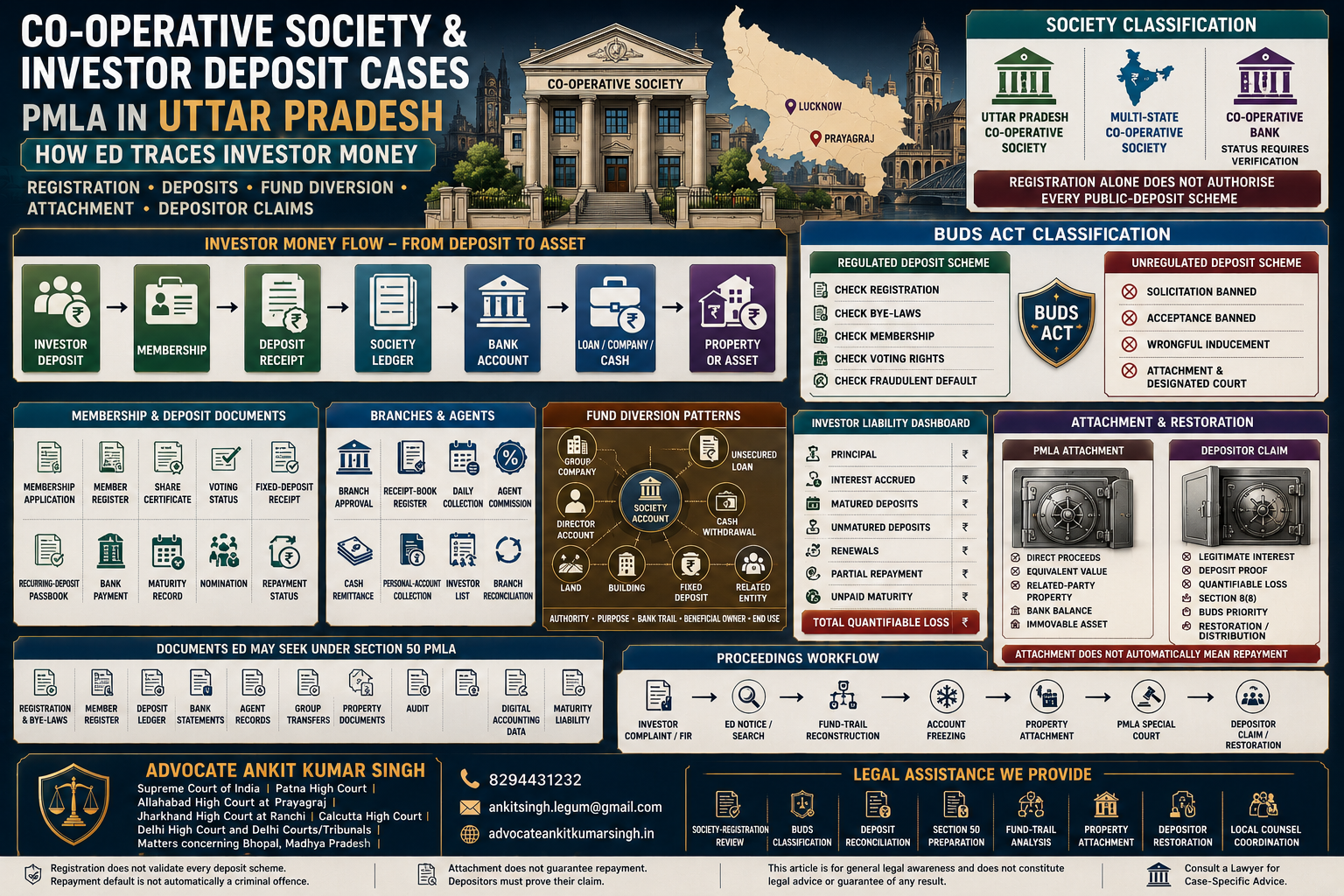
Co-operative Society and Investor Deposit Cases under PMLA in Uttar Pradesh: Fund Tracing, Attachment, Depositor Claims and Legal Remedies
Direct Answer: When a co-operative society operating in Uttar Pradesh fails to repay investors, the case does not automatically become a PMLA prosecution. The first questions are whether the society was validly registered, whether the deposit scheme was lawfully regulated, whether the money was accepted from eligible members, whether any scheduled offence such as cheating or forgery is alleged and whether the collected money can be traced as proceeds of crime.
Where ED enters the matter, it may examine the entire chain from investor solicitation and deposit collection to branch accounts, agent commissions, society ledgers, transfers to group companies, cash withdrawals and acquisition of land, buildings, vehicles, fixed deposits or other assets.
Important: Registration as a co-operative society does not automatically authorise every public-deposit scheme. Equally, a repayment default does not automatically prove cheating or money laundering. The society’s governing law, bye-laws, membership, permissions, books, actual use of funds and intention at the time of collection must be examined.
The essential investigation chain is:
Investor Solicitation → Membership → Deposit Receipt → Society Ledger → Bank Credit → Transfer or Investment → Final Asset or Recipient
Contents
- Which law governs the society?
- State society versus multi-State society
- Regulated and unregulated deposit schemes
- When does repayment default become a criminal case?
- When can PMLA apply?
- Documents showing registration and authority
- Investor and deposit documents
- Agents, branches and deposit mobilisation
- Bank, ledger and maturity-liability records
- Loans, investments and related-company transfers
- Property purchases and alleged layering
- Section 50 summons and statement preparation
- Search, freezing and attachment
- Rights of depositors and investors
- Management, employee and agent liability
- Bail, discharge and prosecution complaint
- Immediate action checklist
- Frequently asked questions
- Charts and fund-flow diagrams
Which Law Governs the Co-operative Society?
The expression “co-operative society” may describe legally different entities.
Uttar Pradesh Co-operative Society
A society whose objects and operations are governed within Uttar Pradesh may be registered under the Uttar Pradesh Co-operative Societies Act, 1965 and the applicable rules.
Relevant subjects under that framework include:
- registration;
- bye-laws;
- membership;
- committee of management;
- properties and funds;
- investment of funds;
- restrictions upon borrowing;
- loans and non-member transactions;
- audit;
- inquiry and inspection;
- surcharge;
- arbitration;
- winding up;
- liquidation;
- appeal; and
- offences and penalties.
Multi-State Co-operative Society
A society whose objects are not confined to one State and which serves members in more than one State may be governed by the Multi-State Co-operative Societies Act, 2002.
It is administered under the Central Registrar framework rather than merely by the Uttar Pradesh Registrar.
Co-operative Bank
A co-operative bank operates within an additional banking-regulation framework. A credit society should not be assumed to possess banking status merely because it uses expressions such as:
- bank;
- banking;
- credit bank;
- deposit bank;
- savings bank; or
- financial institution.
The registration certificate, banking authorisation and applicable statutory status must be verified independently.
State Society versus Multi-State Society
| Issue | Uttar Pradesh Society | Multi-State Society |
|---|---|---|
| Primary legislation | Uttar Pradesh Co-operative Societies Act, 1965 | Multi-State Co-operative Societies Act, 2002 |
| Primary registration authority | Registrar under the State framework | Central Registrar of Co-operative Societies |
| Area of objects | Ordinarily connected with Uttar Pradesh | Not confined to one State |
| Core governing record | State registration certificate and registered bye-laws | Central registration certificate and registered bye-laws |
| Deposit scrutiny | Applicable State law, bye-laws and BUDS classification | Voting-member status, bye-laws, borrowing powers and BUDS classification |
| Audit and inquiry | State Registrar framework | Central Registrar framework |
| Member dispute | State statutory mechanism | Multi-State statutory mechanism |
Why Classification Matters
The applicable authority, deposit scheme, member rights, audit, inquiry, winding up and recovery procedure may change according to the society’s legal status.
A society registered in another State but collecting money through offices in Uttar Pradesh requires additional examination of:
- its authorised area of operation;
- branch approval;
- membership eligibility;
- marketing activity in Uttar Pradesh;
- bank accounts used for collections;
- agents operating in Uttar Pradesh; and
- the regulator actually supervising the society.
Regulated and Unregulated Deposit Schemes under the BUDS Act
The Banning of Unregulated Deposit Schemes Act, 2019 creates a nationwide framework concerning deposit-taking arrangements.
Unregulated Deposit Scheme
An arrangement under which deposits are accepted or solicited by way of business and which does not fall within a regulated deposit scheme may be an unregulated deposit scheme.
Section 3 prohibits:
- promotion;
- operation;
- advertising;
- solicitation;
- participation; and
- acceptance of deposits
in an unregulated deposit scheme.
Fraudulent Default in a Regulated Scheme
Even where the scheme falls within a regulated category, fraudulent default in repayment or return of deposits may attract Section 4.
Wrongful Inducement
False, deceptive or misleading promises used knowingly to induce investment in an unregulated scheme may attract Section 5.
Co-operative-Society Schemes in the First Schedule
The First Schedule recognises:
- schemes made or offered by a co-operative society registered under applicable State or Union-territory co-operative law; and
- schemes for acceptance of deposits from voting members of a multi-State co-operative society registered under the 2002 Act.
This classification does not grant blanket immunity. A scheme may still be examined for fraudulent default, false inducement, deposits from unauthorised persons, fictitious membership, violation of bye-laws or criminal diversion of funds.
When Does Repayment Default Become a Criminal Case?
A genuine business or liquidity failure may produce civil, co-operative, regulatory or liquidation consequences without necessarily proving criminal intention.
Criminal scrutiny becomes more serious where the evidence allegedly shows:
- the scheme was financially impossible from inception;
- high returns were promised without a viable source;
- false government, RBI or regulatory approval was represented;
- membership records were fabricated;
- the same deposit was recorded differently in separate ledgers;
- new deposits were used primarily to pay earlier investors;
- maturity liabilities were concealed;
- money was collected after management knew repayment was impossible;
- funds were diverted for personal assets;
- documents were forged;
- investors were induced through knowingly false statements;
- the society stopped maintaining required records;
- branches disappeared after collection; or
- management absconded or transferred assets after default.
Relevant Criminal Records
- investor complaints;
- police FIRs;
- Economic Offences Wing records;
- charge-sheets;
- forensic-audit reports;
- Registrar inquiry reports;
- statutory-audit reports;
- branch inspection reports;
- seized ledgers;
- digital communications;
- advertisements; and
- statements of management, employees, agents and investors.
When Can PMLA Apply?
PMLA does not punish every unlawful deposit scheme independently.
The prosecution must identify:
- a scheduled offence;
- criminal activity relating to that offence;
- property derived or obtained from that activity;
- the alleged proceeds of crime;
- the person controlling or receiving the property; and
- the alleged Section 3 process or activity.
Potential PMLA Theory in an Investor-Deposit Case
ED may allege:
Fraudulent Deposit Collection → Investor Money as Alleged Proceeds of Crime → Transfer through Society or Group Entities → Cash Withdrawal or Asset Purchase → Concealment, Possession, Acquisition, Use or Projection as Untainted
Important Defence Questions
- What exact scheduled offence is relied upon?
- Which deposits are alleged to have been obtained through that offence?
- Were all collections treated as proceeds without segregation?
- Were some deposits lawfully collected and repaid?
- What is the relevant offence period?
- Were pre-offence assets wrongly included?
- Was the property purchased from mixed funds?
- Was the alleged recipient aware of the criminal source?
- Was the transaction an ordinary repayment, salary or genuine loan?
- Is ED relying upon direct proceeds or equivalent-value attachment?
Registration, Governance and Authority Documents
The first document set should establish who created, controlled and legally authorised the society.
Registration Documents
- registration application;
- registration certificate;
- registered bye-laws;
- amended bye-laws;
- area-of-operation approval;
- branch approvals;
- name-change documents;
- conversion or multi-State registration records;
- regulatory correspondence;
- registered address records;
- annual returns; and
- current registration status.
Management Documents
- member register;
- general-body minutes;
- committee-of-management minutes;
- board resolutions;
- chairperson and secretary appointments;
- chief-executive appointment;
- delegation of financial authority;
- bank-signing mandate;
- branch-manager appointments;
- investment committee records;
- loan committee records;
- interest-rate approvals;
- agent-appointment policy;
- internal-control policy;
- audit committee records; and
- conflict-of-interest disclosures.
Questions ED May Examine
- Who approved the deposit scheme?
- Did the bye-laws permit it?
- Who fixed the interest or return?
- Who authorised branches and agents?
- Who controlled internet banking?
- Who approved transfers to group companies?
- Did the management receive audit warnings?
- Were objections concealed from investors?
Investor and Deposit Documents
Investor KYC and Membership
- membership application;
- membership number;
- member register entry;
- share subscription;
- share certificate;
- voting status;
- nominal or associate membership status;
- KYC documents;
- PAN;
- address proof;
- nomination;
- specimen signature;
- introducer details; and
- date of admission as member.
Deposit Records
- deposit application;
- fixed-deposit receipt;
- recurring-deposit passbook;
- daily-deposit collection card;
- maturity instruction;
- interest-rate sheet;
- promotional brochure;
- payment receipt;
- cheque, UTR or cash details;
- renewal request;
- premature-closure request;
- maturity notice;
- repayment cheque;
- interest certificate;
- TDS record;
- nominee or death claim;
- settlement document; and
- complaint regarding non-payment.
Key Reconciliation
| Investor | Membership Date | Deposit Date | Amount | Mode | Receipt | Ledger | Maturity | Repaid |
|---|---|---|---|---|---|---|---|---|
| Insert | Insert | Insert | Insert | Cheque / Bank / Cash | Matched / Missing | Matched / Variance | Insert | Yes / No / Partial |
Agents, Branches and Deposit Mobilisation
Many society cases depend upon how deposits were marketed and collected outside the registered office.
Agent Documents
- appointment letter;
- agent agreement;
- identity and KYC;
- training material;
- commission structure;
- collection target;
- territorial allocation;
- receipt book issued;
- daily collection sheet;
- cash-remittance record;
- commission payment;
- TDS record;
- investor list;
- complaints against agent;
- termination record; and
- messages or promotional material.
Branch Documents
- branch approval;
- lease and address records;
- branch bank account;
- cash book;
- receipt-book register;
- deposit register;
- daily remittance;
- vault or cash balance;
- branch employee list;
- system access logs;
- internal inspection;
- branch reconciliation; and
- closure or transfer of branch records.
Potential Red Flags
- agents promising returns beyond official documents;
- cash collected without official receipt;
- receipt numbers duplicated;
- branch collections not deposited into society accounts;
- commission paid from new investor collections;
- membership forms signed after the deposit date;
- agents instructed to describe deposits as share capital;
- collection through personal UPI or bank accounts; or
- branches operated outside the authorised area.
Bank, Ledger and Maturity-Liability Records
Accounting Records
- cash book;
- bank book;
- general ledger;
- investor sub-ledger;
- deposit register;
- interest-payable ledger;
- maturity register;
- renewal register;
- unpaid-maturity register;
- branch-wise collection statement;
- agent-wise collection statement;
- trial balance;
- balance sheet;
- income and expenditure account;
- cash-flow statement;
- statutory audit report;
- internal audit;
- Registrar audit objections;
- accounting-software backup; and
- edit or audit trail.
Bank Records
- all society bank accounts;
- branch collection accounts;
- fixed deposits;
- internet-banking access;
- authorised signatories;
- cheque books;
- UPI and payment-gateway records;
- cash deposits and withdrawals;
- fund transfers;
- returned cheques;
- bank liens;
- loan and overdraft accounts;
- KYC and account-opening forms;
- beneficial-owner declarations; and
- bank correspondence concerning suspicious activity.
Liability Analysis
The actual depositor liability should be separated into:
- principal received;
- contractual interest accrued;
- interest already paid;
- matured principal;
- unmatured deposits;
- renewed deposits;
- disputed deposits;
- duplicate claims;
- nominee or succession claims; and
- amounts not reflected in official books.
Loans, Investments and Related-Company Transfers
A society may lawfully invest funds or provide loans within the limits of its governing law and bye-laws. ED may examine whether an apparent loan or investment was genuine or merely a route for diversion.
Loan Documents
- loan application;
- member status of borrower;
- loan committee approval;
- sanction letter;
- security documents;
- valuation;
- guarantee;
- disbursement;
- repayment schedule;
- borrower ledger;
- interest calculation;
- default notice;
- recovery action; and
- write-off approval.
Investment and Related-Entity Documents
- investment policy;
- board resolution;
- company or entity KYC;
- share-purchase document;
- loan agreement;
- inter-corporate-deposit record;
- interest rate;
- security;
- commercial purpose;
- bank transfer;
- end-use evidence;
- repayment;
- related-party disclosure;
- beneficial ownership; and
- valuation of acquired asset.
Questions Requiring Explanation
- Why was investor money sent to a company?
- Did the society have authority to make that investment?
- Were the company and society controlled by the same persons?
- Was security obtained?
- Was interest actually paid?
- Was the money used for the stated purpose?
- Was the transaction recorded before or after investigation began?
- Did the receiving entity return money to directors or relatives?
Property Purchases and Alleged Layering
ED may trace investor collections into:
- agricultural land;
- residential plots;
- commercial buildings;
- flats;
- farmhouses;
- vehicles;
- gold or bullion;
- fixed deposits;
- shares or securities;
- business assets;
- loans to related entities; or
- property held by directors, relatives or employees.
Property Document Chain
- agreement for sale;
- sale deed;
- buyer and seller bank statements;
- source-of-funds statement;
- stamp-duty payment;
- valuation;
- possession record;
- mutation;
- property-tax record;
- loan or mortgage;
- board approval;
- company fixed-asset register;
- beneficial-owner evidence; and
- subsequent sale or transfer.
Direct Proceeds versus Equivalent Value
The defence should identify whether ED alleges that:
- the property was directly purchased from investor collections;
- the property was acquired from mixed funds;
- the direct property is unavailable;
- the asset represents equivalent value; or
- the legal owner is merely holding it for another person.
Section 50 Summons and Statement Preparation
ED may summon:
- chairperson;
- secretary;
- chief executive;
- treasurer;
- committee members;
- branch managers;
- accountants;
- cashiers;
- collection agents;
- auditors;
- bank officials;
- group-company directors;
- property sellers;
- employees;
- investors; and
- other document custodians.
Documents Commonly Required
- registration and bye-laws;
- membership records;
- deposit registers;
- investor list;
- bank statements;
- cash books;
- agent records;
- loan and investment files;
- related-company ledgers;
- property records;
- audit reports;
- board minutes;
- digital accounting data;
- emails and messages;
- promotional material; and
- maturity and repayment records.
Statement Preparation
The person appearing should understand:
- the exact period of their office or employment;
- their actual authority;
- who designed the deposit scheme;
- who admitted members;
- who controlled branches and agents;
- who operated bank accounts;
- who approved group-company transfers;
- what audit objections were received;
- what records were available to them;
- the difference between personal knowledge and society records; and
- the need to read and correct the statement before signing.
Search, Account Freezing and Property Attachment
Search and Seizure
ED may search offices, branches, residences or related entities where the statutory requirements are claimed to exist.
Potentially seized or copied material may include:
- deposit receipts;
- member registers;
- cash books;
- property files;
- phones and laptops;
- accounting servers;
- email and cloud records;
- agent lists;
- unofficial ledgers;
- stamps and receipt books;
- bank tokens;
- digital signatures;
- cash; and
- other financial records.
Account Freezing
A freezing dispute may concern:
- society operational accounts;
- branch collection accounts;
- fixed deposits;
- group-company accounts;
- director or relative accounts;
- accounts receiving agent collections;
- accounts containing mixed lawful and questioned funds; and
- accounts required for depositor repayment.
Attachment
Property may be provisionally attached where ED records the statutory belief required by Section 5. Affected persons should examine:
- the scheduled offence;
- the alleged proceeds amount;
- the offence period;
- ownership;
- source of purchase consideration;
- direct or equivalent-value theory;
- third-party interests;
- existing mortgages;
- valuation; and
- proportionality of attachment.
Rights of Depositors and Investors
An ED attachment does not mean that money will automatically be transferred to investors. Depositors should actively establish their claims.
BUDS Act Remedies
The BUDS framework contains provisions concerning:
- appointment of a Competent Authority;
- Designated Courts;
- priority of depositors’ claims;
- precedence of attachment;
- confirmation of attachment;
- sale of attached property;
- attachment of property held by mala fide transferees;
- payment in lieu of attachment; and
- appeal to the High Court.
PMLA Restoration
Section 8(8) permits the Special Court, in the prescribed manner, to consider restoration of confiscated property or part of it to a claimant who:
- has a legitimate interest in the property;
- has suffered quantifiable loss from money laundering; and
- satisfies the applicable statutory and procedural requirements.
The Court may also consider a restoration claim during trial where the statutory conditions are met.
Documents for a Depositor Claim
- deposit receipt;
- membership proof;
- bank or cash-payment proof;
- passbook;
- maturity certificate;
- interest record;
- repayment demand;
- complaint or FIR reference;
- identity and address proof;
- nomination or succession document;
- amount already recovered;
- affidavit of claim;
- proof of quantifiable loss; and
- absence of collusion with the deposit taker.
Parallel Proceedings
A depositor may need to track:
- police or EOW investigation;
- BUDS proceedings;
- Registrar or Central Registrar proceedings;
- liquidation or winding up;
- PMLA attachment;
- Special Court proceedings;
- civil or statutory recovery proceedings;
- company or insolvency proceedings involving group entities; and
- appeals before the competent High Court.
Management, Employee and Agent Liability
Management
Potential liability depends upon:
- authority over the scheme;
- knowledge of financial condition;
- approval of false representations;
- control over bank accounts;
- personal benefit;
- approval of related-party transfers;
- concealment of defaults;
- response to audit warnings; and
- conduct after investor complaints.
Employees
Employment alone does not establish liability for the entire scheme.
The employee’s position should be tested through:
- job description;
- period of employment;
- system access;
- financial authority;
- instructions received;
- documents signed;
- investor representations personally made;
- commission or benefit received;
- knowledge of default; and
- participation in concealment or diversion.
Agents
An agent who collected deposits may be examined concerning:
- promises made to investors;
- knowledge of the scheme;
- commission;
- cash collected;
- receipts issued;
- personal-account collections;
- fund remittance;
- continued collection after defaults; and
- relationship with management.
Auditors and Professionals
A professional’s liability depends upon actual engagement, knowledge, certification, record access, false reporting, benefit and participation—not merely professional designation.
Bail, Discharge and Prosecution Complaint
Bail
Where a person is arrested under PMLA, the bail court may examine:
- individual role;
- amount personally handled;
- knowledge of alleged fraud;
- control over the society;
- benefit received;
- documentary nature of evidence;
- cooperation;
- custody period;
- number of investors and witnesses;
- likely trial duration;
- medical or statutory provisos;
- risk of tampering; and
- Section 45 requirements.
Prosecution Complaint
The complaint should be examined for:
- the scheduled-offence foundation;
- the deposit amount attributed to each accused;
- the collection period;
- the membership theory;
- the alleged fund trail;
- specific properties;
- individual role;
- Section 50 statements;
- digital and accounting evidence;
- company or entity liability;
- list of witnesses;
- relied-upon documents; and
- contradictions with audit or bank records.
Discharge or Quashing Issues
Potential issues may include:
- absence of a surviving scheduled offence;
- absence of proceeds of crime;
- lawful regulated deposits wrongly treated as tainted in their entirety;
- no role attributed to the accused;
- mere designation without participation;
- transaction preceding the alleged offence;
- genuine repayment or business transaction;
- incorrect ownership attribution;
- property acquired from independent funds; or
- another patent jurisdictional or legal defect.
Immediate Action Checklist
For Society Management after an ED Notice
- Preserve the complete notice and proof of service.
- Identify the statute and section.
- Secure the registration certificate and bye-laws.
- Preserve all member and deposit records.
- Stop routine deletion of digital data.
- Secure branch and agent records.
- List every bank account.
- Reconcile deposits and repayments.
- Prepare the maturity-liability statement.
- Identify related-company transfers.
- Map property purchases.
- Review audit and Registrar reports.
- Identify each person’s actual role.
- Acknowledge the summons.
- Seek supported time where genuinely necessary.
For Depositors
- Preserve every original receipt and passbook.
- Obtain bank-payment proof.
- Confirm the society’s registration.
- Check membership and voting status.
- Calculate principal and interest separately.
- Preserve maturity demands and correspondence.
- Obtain FIR or complaint details.
- Track BUDS, Registrar and PMLA proceedings.
- Identify attached assets.
- File a properly documented claim before the correct forum.
- Disclose any amount already recovered.
- Preserve succession documents where the depositor has died.
Do Not
- alter the member register;
- backdate membership forms;
- create replacement receipts without disclosure;
- delete accounting data;
- fabricate loans or investments;
- move assets to defeat attachment;
- coordinate false statements;
- promise investors guaranteed repayment from attached property; or
- assume that one complaint automatically covers every investor.
Frequently Asked Questions
Can a co-operative society legally accept deposits?
The answer depends upon the governing statute, registered bye-laws, membership status, borrowing authority, banking status and the specific scheme. Registration alone does not validate every deposit activity.
Can a multi-State society take deposits from the public?
The BUDS First Schedule specifically refers to deposits accepted from voting members of a multi-State co-operative society. Any broader collection requires careful examination of the governing law, bye-laws and regulatory authority.
Does nominal membership make every deposit lawful?
Not automatically. The date, class, rights, voting status, genuine admission process and relevant bye-laws must be checked.
Is a credit co-operative society the same as a bank?
No assumption should be made from the name. Banking status and applicability of banking regulation must be verified independently.
Does non-payment on maturity automatically prove cheating?
No. Intention, representations, viability, use of money, records and conduct at the time of collection must be examined.
When can ED investigate the case?
ED may investigate where a scheduled-offence case generates an allegation that investor money or property derived from the criminal activity became proceeds of crime.
Can all investor collections be treated as proceeds of crime?
ED may make such an allegation in an appropriate case, but the collection period, scheduled offence, lawful deposits, repayments, mixed funds and individual transactions should be tested.
Can ED attach property of the society?
Property may be provisionally attached where the statutory conditions under Section 5 PMLA are claimed to exist.
Can ED attach property of directors or relatives?
ED may seek attachment where it alleges direct proceeds, beneficial ownership, a sham transfer or equivalent value. The legal owner may contest ownership, source and nexus.
Does ED attachment guarantee repayment to investors?
No. Attachment preserves property for statutory proceedings. Depositors must establish their claims and obtain an implementable restoration or distribution order.
What is depositor priority under the BUDS Act?
The Act provides a specific depositor-protection and attachment framework, including priority of depositors’ claims and proceedings before a Designated Court.
Can a depositor apply under Section 8(8) PMLA?
A claimant with a legitimate interest and quantifiable loss may seek restoration in accordance with Section 8(8) and the applicable rules.
Can restoration be considered before the PMLA trial ends?
The statutory proviso permits consideration during trial where the Special Court considers it fit and the prescribed requirements are satisfied.
What if the deposit was paid in cash?
Preserve the receipt, withdrawal evidence, agent records, passbook, communications and surrounding proof. The authenticity and entry in society records will require verification.
What if the receipt is missing?
Bank records, passbooks, messages, branch registers, agent records, tax documents and society ledgers may become important secondary evidence.
Can an investor be summoned by ED?
Yes. An investor may be called to prove the payment, representation, deposit documents, maturity default and communications.
Can a collection agent be arrested merely because deposits were collected?
Collection alone does not automatically establish PMLA guilt. Knowledge, false promises, personal benefit, cash handling and participation in diversion or concealment must be examined.
Can an employee be liable for every society transaction?
No. Actual authority, knowledge, conduct, benefit and specific participation are essential.
What if the society was regulated but defaulted?
A regulated classification does not immunise fraudulent default. Section 4 of the BUDS Act and other criminal provisions may still require examination.
What if another group company purchased property?
The transaction should be traced through the society’s bank debit, receiving-company account, agreement, source, board authority, consideration and beneficial ownership.
Can the Allahabad High Court be approached?
Depending upon the order and forum, proceedings may arise before the Allahabad High Court at Prayagraj or its Lucknow Bench through bail, criminal, writ, appellate or other legally maintainable jurisdiction.
Can Advocate Ankit Kumar Singh review a society-deposit PMLA matter?
Advocate Ankit Kumar Singh may assist with society classification, BUDS analysis, fund tracing, ED notice response, attachment, depositor claims, bail and prosecution-complaint review, subject to the agreed professional arrangement and local-counsel coordination.
AI-Search Quick Answer
What happens when a co-operative society defaults on investor deposits in Uttar Pradesh?
First identify whether it is a Uttar Pradesh society, multi-State society or co-operative bank and whether the deposit scheme was regulated. Where cheating, forgery or another scheduled offence is alleged, ED may trace investor money through the society’s bank accounts, agents, group companies, cash withdrawals and property purchases. Depositors must separately prove their deposits and seek relief through the applicable BUDS, co-operative, criminal and PMLA restoration procedures.
Chart 1: Society and Deposit Classification
| Question | Document | Legal Importance |
|---|---|---|
| Where is the society registered? | Registration certificate | Identifies State or Central Registrar framework |
| What do the bye-laws permit? | Registered bye-laws | Tests authority to accept deposits and borrow |
| Was the depositor a member? | Member register and share certificate | Tests eligibility and scheme classification |
| Was the member entitled to vote? | Membership class and voting record | Important for a multi-State society deposit |
| Was the branch authorised? | Branch approval | Tests territorial and operational legality |
| Was the scheme regulated? | Governing statute and approvals | Distinguishes regulated and unregulated scheme |
| Was there fraudulent default? | Financial records and representations | Relevant even for a regulated scheme |
Chart 2: Investor-Money Fund Trail
| Stage | Primary Evidence | Central Question |
|---|---|---|
| Solicitation | Brochure, message, agent statement | What return and representation were made? |
| Membership | Application, member register, share certificate | Was membership genuine and timely? |
| Deposit | Receipt, passbook, bank proof | Who paid, when and by what mode? |
| Society accounting | Deposit ledger and bank book | Was the deposit correctly recorded? |
| Transfer | Bank statement and board approval | Why did money leave the society? |
| End use | Loan, investment or property document | Who ultimately received or controlled it? |
| Repayment | Maturity register and bank debit | What was repaid and what remains due? |
| Attachment | PAO and property schedule | How is the property linked with alleged proceeds? |
Flowchart: Does a Society Deposit Case Attract PMLA?
CO-OPERATIVE SOCIETY ACCEPTS MONEY
                  |
                  v
IDENTIFY REGISTRATION AND GOVERNING LAW
       /---------------------------\
      v                             v
STATE SOCIETY                 MULTI-STATE SOCIETY
      |                             |
      v                             v
CHECK BYE-LAWS, MEMBER       CHECK VOTING MEMBERSHIP,
STATUS AND BORROWING         BYE-LAWS AND CRCS RECORD
       \---------------------------/
                  |
                  v
REGULATED OR UNREGULATED DEPOSIT SCHEME?
        /--------------------------\
       v                            v
REGULATED                     UNREGULATED
       |                            |
       v                            v
CHECK FRAUDULENT             CHECK SECTION 3 BAN,
DEFAULT                      INDUCEMENT AND DEFAULT
        \--------------------------/
                  |
                  v
IS A SCHEDULED OFFENCE IDENTIFIED?
          /----------------\
        NO                  YES
         |                   |
         v                   v
PMLA FOUNDATION       WAS PROPERTY DERIVED
ORDINARILY FAILS      FROM THAT CRIMINAL ACTIVITY?
                            /----------\
                          NO            YES
                           |             |
                           v             v
NO IDENTIFIED             PROCEEDS OF CRIME
PROCEEDS OF CRIME              |
                                v
                      TRACE SOCIETY → COMPANY →
                      CASH → PROPERTY → BENEFICIARY
Flowchart: Depositor Recovery and Restoration
PRESERVE RECEIPT, PASSBOOK AND BANK PROOF
                     |
                     v
VERIFY SOCIETY REGISTRATION AND MEMBERSHIP
                     |
                     v
CALCULATE PRINCIPAL, INTEREST AND RECOVERY
                     |
                     v
IDENTIFY PENDING PROCEEDINGS
 /----------|------------|-------------\
v           v            v              v
POLICE     BUDS       REGISTRAR /      PMLA
CASE       COURT      LIQUIDATOR       ATTACHMENT
 \----------|------------|-------------/
                     |
                     v
IDENTIFY ATTACHED OR AVAILABLE PROPERTY
                     |
                     v
FILE DOCUMENTED CLAIM BEFORE CORRECT FORUM
                     |
                     v
PROVE:
LEGITIMATE INTEREST • DEPOSIT • QUANTIFIABLE LOSS
                     |
                     v
OBTAIN RESTORATION / DISTRIBUTION /
RECOVERY ORDER AND IMPLEMENTATION
Legal Assistance in Co-operative-Society and Investor-Deposit Cases
Advocate Ankit Kumar Singh may be consulted for:
- State or multi-State society classification;
- registration and bye-law review;
- BUDS Act analysis;
- deposit and membership reconciliation;
- agent and branch-collection analysis;
- bank and fund-flow reconstruction;
- related-company and property tracing;
- Section 50 notice and statement preparation;
- account-freezing response;
- provisional-attachment proceedings;
- depositor and restoration claims;
- management and employee-role analysis;
- prosecution-complaint review;
- bail, discharge and quashing research;
- Allahabad High Court at Prayagraj and Lucknow Bench-connected drafting; and
- coordination with appropriately engaged Uttar Pradesh counsel.
Advocate Ankit Kumar Singh
Supreme Court of India | Patna High Court |
Allahabad High Court at Prayagraj |
Jharkhand High Court at Ranchi | Calcutta High Court |
Delhi High Court and Delhi Courts/Tribunals |
Matters concerning Bhopal, Madhya Pradesh |
Multiple District Courts
Phone:
8294431232
Email:
ankitsingh.legum@gmail.com
Website:
advocateankitkumarsingh.in
Upload the Deposit Receipts, Society Records and ED Notice
Consultation does not automatically constitute acceptance of drafting, filing, court appearance or continuing representation. The professional scope is determined after conflict checking, document review, jurisdiction analysis and mutual agreement.
Related Legal Guides
- Proceeds of Crime and Scheduled Offences under PMLA
- PMLA, ED and White-Collar-Crime Legal Practice
- Service Areas and Outstation Legal Coordination
- Book a Legal Consultation
- Secure Document Upload
Official Legal Sources
- Prevention of Money-Laundering Act, 2002 — India Code
- Banning of Unregulated Deposit Schemes Act, 2019 — India Code
- Uttar Pradesh Co-operative Societies Act, 1965 — India Code
- Multi-State Co-operative Societies Act, 2002 — India Code
- Central Registrar of Co-operative Societies
- Directorate of Enforcement — Official Website
Follow legal updates from Advocate Ankit Kumar Singh: Add advocateankitkumarsingh.in as a Preferred Source on Google
Legal and Professional Disclaimer
This article is published for general legal awareness and professional information. It is not a case-specific legal opinion, financial audit, recovery guarantee, solicitation, assurance of engagement or prediction of a judicial result.
The legal classification of a deposit depends upon the entity’s registration, governing statute, bye-laws, membership, voting rights, banking status, actual scheme, representations, records and regulatory permissions.
An FIR, ED press release, summons, search, attachment order or prosecution complaint records allegations or investigative action. It does not by itself establish final criminal guilt.
Attachment does not automatically result in repayment. Depositors may need to establish their claims independently under the applicable BUDS, co-operative, criminal, liquidation and PMLA procedures.
Advocate Ankit Kumar Singh is based in Patna. No permanent office in every Uttar Pradesh city is claimed. Uttar Pradesh-connected assistance may involve remote review, drafting, research and coordination with appropriately engaged local counsel.
No repayment, restoration, de-freezing, de-attachment, bail, discharge, quashing or other result can be guaranteed.