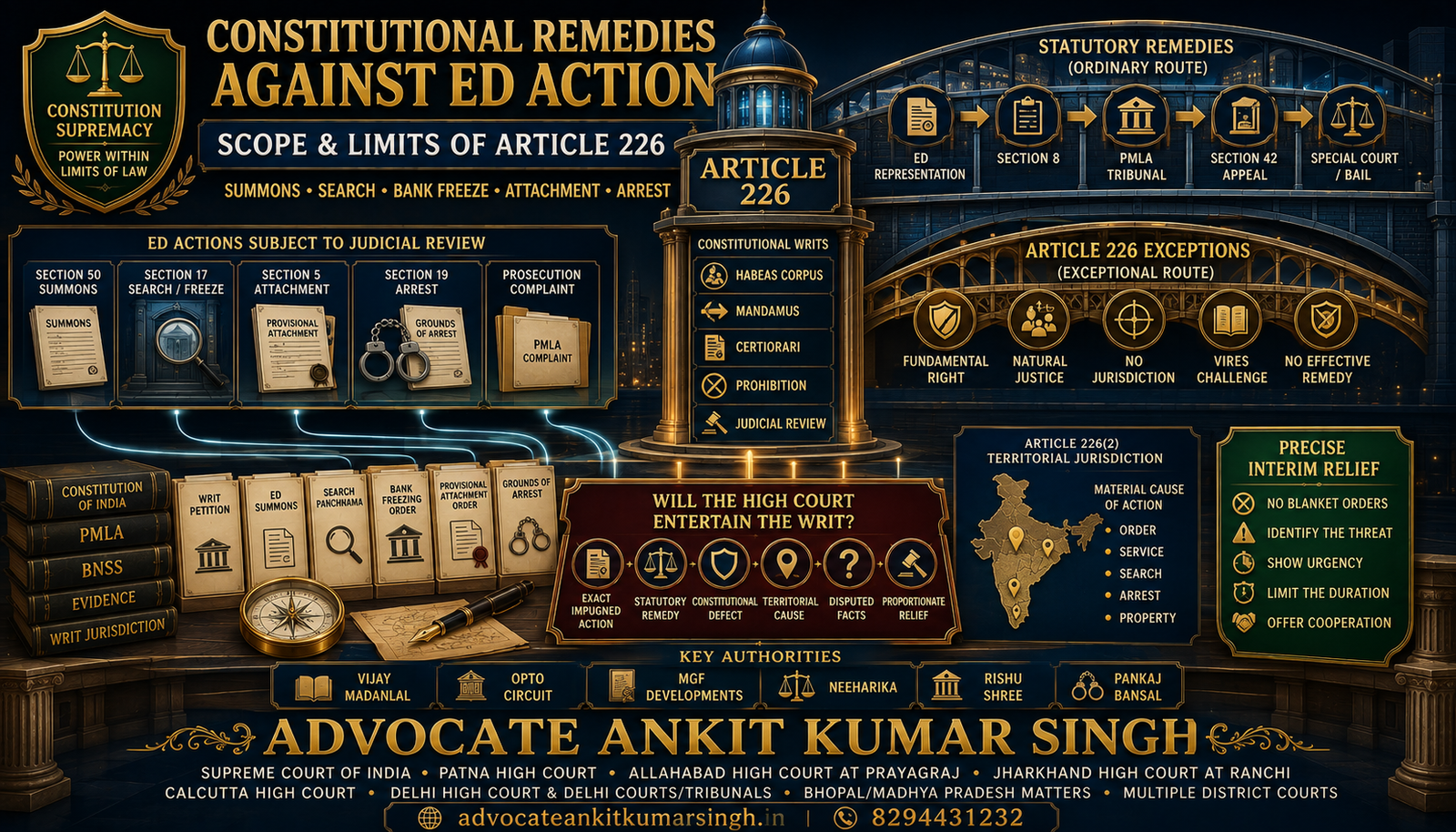
Constitutional Remedies Against ED Action: Scope and Limits of Article 226 in PMLA Proceedings
The Enforcement Directorate exercises substantial statutory powers concerning summons, financial records, searches, digital devices, bank accounts, property attachment, arrest and prosecution.
Those powers remain subject to the Constitution and the procedure prescribed by the Prevention of Money-laundering Act, 2002.
Article 226 permits a High Court to intervene in an appropriate case, but it does not convert the High Court into the first forum for every factual, investigative or appellate PMLA dispute.
Direct Answer
ED action can be challenged under Article 226 where the petitioner demonstrates a genuine constitutional, jurisdictional or procedural defect.
Examples may include:
- violation of a fundamental right;
- arrest contrary to Article 21 or Article 22;
- action by an officer without statutory authority;
- absence of a jurisdictional scheduled offence;
- failure to follow mandatory Section 17 freezing safeguards;
- a Provisional Attachment Order for which no immediate statutory challenge is available;
- denial of natural justice;
- action contrary to a binding judicial order;
- constitutional challenge to a statutory provision.
Article 226 ordinarily should not be used merely to:
- avoid an ED summons;
- obtain anticipatory or regular bail without following the applicable procedure;
- prevent a lawful investigation;
- secure a blanket “no coercive steps” order;
- argue disputed financial facts requiring evidence;
- bypass the Adjudicating Authority or PMLA Appellate Tribunal;
- replace discharge, trial or appeal proceedings.
The correct question is not only:
“Is a writ petition legally maintainable?”
The more important question is:
“Will the High Court exercise its discretionary jurisdiction at this particular procedural stage?”
What Does Article 226 Provide?
Article 226 empowers a High Court to issue directions, orders or writs to any person or authority, including government authorities, for:
- enforcement of fundamental rights; and
- any other lawful purpose.
The recognised writs include:
| Writ | Possible relevance to ED action |
|---|---|
| Habeas corpus | Challenge to detention alleged to be wholly illegal or without lawful authority. |
| Mandamus | Direction requiring a public authority to perform a mandatory legal duty. |
| Certiorari | Quashing an order passed without jurisdiction, contrary to natural justice or through a manifest legal error. |
| Prohibition | Preventing an authority or tribunal from continuing proceedings beyond its jurisdiction. |
| Quo warranto | Challenge to unlawful occupation of a public office; ordinarily not the principal remedy in an ED dispute. |
Article 226 is wider than Article 32 because it extends beyond enforcement of fundamental rights.
Its exercise nevertheless remains discretionary.
Maintainability and Entertainment Are Different
A writ petition may be legally maintainable because the High Court possesses constitutional jurisdiction.
The Court may still decline to entertain it because:
- a statutory remedy exists;
- the petition is premature;
- the facts are seriously disputed;
- the petitioner has not approached the proper forum;
- the investigation remains lawful and incomplete;
- the petitioner seeks an appellate reappraisal of evidence;
- material facts were concealed;
- equitable conduct does not justify relief.
A professionally drafted petition should address both:
- constitutional jurisdiction; and
- why the Court should exercise it despite self-imposed restraint.
The Alternative-Remedy Rule
Where PMLA creates a right, liability and a complete remedy, the affected person ordinarily should use the statutory mechanism.
The relevant structure may include:
- representation before the authorised ED officer;
- Section 8 reply before the Adjudicating Authority;
- Section 26 appeal before the PMLA Appellate Tribunal;
- Section 42 appeal before the jurisdictional High Court;
- application before the PMLA Special Court;
- regular or anticipatory bail;
- discharge;
- criminal revision, appeal or inherent jurisdiction where applicable.
The alternative-remedy rule is a rule of:
- policy;
- convenience;
- institutional discipline;
- judicial discretion.
It is not a constitutional removal of Article 226 power.
Recognised Exceptions to Alternative Remedy
| Exception | What the petitioner should establish |
|---|---|
| Fundamental-right violation | A direct, present and serious infringement rather than a general allegation. |
| Natural-justice violation | Absence of notice, hearing, disclosure or impartial adjudication where the statute requires it. |
| Complete lack of jurisdiction | The authority lacked the legal foundation to begin or continue the action. |
| Challenge to statutory validity | A properly pleaded constitutional challenge to the provision or rule. |
| No efficacious remedy | No presently available forum can address the immediate injury. |
| Patent mandatory-procedure breach | The record itself shows failure to comply with an essential statutory safeguard. |
| Exceptional urgency | Waiting for the ordinary remedy would cause irreversible constitutional or property injury. |
Merely inserting the words “fundamental rights,” “natural justice” or “without jurisdiction” does not establish an exception.
The pleadings and documents must prove it.
Can an ECIR Be Quashed Under Article 226?
An ECIR is treated as an internal document of the Enforcement Directorate rather than a police FIR.
Non-supply of the ECIR does not by itself establish a violation requiring quashing.
A general prayer to quash an ECIR is ordinarily weak where:
- a scheduled offence exists;
- the ED has statutory authority;
- investigation remains incomplete;
- the alleged proceeds and transactions require evidence;
- the petitioner merely apprehends future coercive action;
- no specific operative order is challenged.
Potential jurisdictional grounds
- the only alleged offence is not scheduled under PMLA;
- the scheduled offence has been finally quashed or terminated and no legal foundation survives;
- the proceeding directly violates a binding court order;
- the same authority is acting outside its territorial or statutory competence;
- the ECIR is used for a legally prohibited collateral purpose;
- the PMLA proceeding lacks the jurisdictional criminal-activity foundation.
The legal effect of bail, discharge, closure, quashing or acquittal in the predicate case must be examined from the exact operative order and its finality.
Can a Section 50 Summons Be Quashed?
Section 50 gives specified ED authorities power to summon persons for evidence and records.
A recipient ordinarily should not invoke Article 226 merely because:
- personal attendance is inconvenient;
- the summons does not identify the person as a witness or accused;
- the recipient apprehends arrest;
- the ECIR has not been supplied;
- questions may concern financial transactions;
- several appearances have been required.
The ordinary response is to:
- verify the summons;
- seek legal advice;
- preserve records;
- appear as directed;
- seek a supported adjournment where genuinely required;
- record objections lawfully;
- avoid speculation or fabrication.
Exceptional challenge grounds
- the summons was issued by an unauthorised officer;
- the summons concerns a subject legally outside PMLA;
- the direction is impossible, oppressive or facially arbitrary;
- the summons deliberately violates a binding judicial order;
- repeated summons demonstrate a collateral purpose unsupported by investigation;
- the authority demands an act prohibited by law;
- the proceeding is wholly without a surviving scheduled-offence foundation.
A High Court ordinarily will not grant anticipatory bail through an indirect summons-quashing prayer.
Rishu Shree and the Limits of a Summons-Stage Writ
In a May 2026 decision, the Patna High Court declined to:
- quash Section 50 summons;
- quash the petitioner’s earlier statements;
- restrain ED from every further coercive action;
- interfere with investigation authorised by PMLA.
The decision illustrates that a summons-stage writ becomes difficult where:
- ED possesses statutory authority;
- the investigation remains ongoing;
- the petition requires evaluation of disputed allegations;
- the relief sought is a broad restraint against future investigation.
The judgment does not mean that every ED action is immune from judicial review.
It reinforces the need to identify a specific and demonstrable constitutional or jurisdictional defect.
Article 226 Against Search and Seizure Under Section 17
A search challenge should begin with the statutory record.
Review checklist
- identity and rank of the authorised officer;
- authorisation issued by the competent authority;
- information stated to be in possession;
- written reasons to believe;
- premises and persons covered;
- search date and time;
- panchnama;
- witness details;
- inventory of documents and devices;
- copying or imaging procedure;
- sealing and hash details for digital data;
- privileged or unrelated records;
- Section 17(2) forwarding;
- Section 17(4) application within the statutory period.
Possible constitutional grounds
- search by an officer without authority;
- search beyond the authorised premises or subject;
- complete absence of the required statutory satisfaction;
- seizure wholly unrelated to the investigation;
- retention without following the statutory process;
- denial of inventory or basic procedural record;
- disregard of legal professional privilege;
- violation of a binding protective order;
- disproportionate invasion unsupported by a legitimate statutory purpose.
The High Court generally will not decide the entire evidentiary value of seized material at the writ stage.
Article 226 Against Bank-Account Freezing
A bank restriction should first be classified as:
- Section 17(1A) freezing;
- Section 5 attachment;
- police or cybercrime freezing;
- tax attachment;
- bank compliance restriction;
- lender’s lien;
- court-ordered restraint.
In OPTO Circuit India Ltd. v. Axis Bank, the Supreme Court held that PMLA’s prescribed freezing procedure must be followed.
The review should determine whether:
- the officer was authorised;
- reasons to believe were recorded;
- a lawful freezing order exists;
- the order was served;
- the reasons and material were forwarded;
- the Section 17(4) application was filed;
- continuation has a lawful basis;
- the entire account was frozen without an amount nexus;
- salary, taxes, payroll and post-freeze lawful credits were considered.
Article 226 may be especially relevant where the bank is acting only upon an informal or indefinite communication and no effective immediate statutory remedy exists.
Where adjudication and appeal proceedings are already available, the petitioner must explain why those remedies are ineffective.
Article 226 Against a Provisional Attachment Order
Section 5 permits provisional attachment subject to statutory conditions.
In MGF Developments Limited v. Directorate of Enforcement, the Supreme Court held that the High Court should not have rejected the writ merely because the Section 5(5) thirty-day period had not expired.
The Supreme Court noted that no statutory remedy was then available to challenge the PAO itself.
Possible immediate PAO grounds
- the officer lacked authority;
- mandatory reasons were not recorded;
- the order states no legally sustainable proceeds-of-crime theory;
- the property belongs to an independent third party and the order discloses no basis;
- the same alleged value is duplicated across several attachments;
- the order directly violates a binding judgment;
- the property is outside the proceeding’s territorial or statutory foundation;
- the PAO causes immediate irreversible harm for which no present remedy exists.
MGF Developments does not create automatic writ relief against every PAO.
It confirms that the High Court must correctly examine whether a statutory remedy presently exists rather than dismissing the petition mechanically.
Section 8 Notice and Adjudicating Authority Proceedings
Once a Section 8 notice is issued, the affected person ordinarily should file a complete response before the Adjudicating Authority.
The reply should address:
- source of income;
- source of acquisition;
- ownership;
- beneficial interest;
- scheduled-offence connection;
- proceeds-of-crime allegation;
- valuation;
- third-party rights;
- procedural defects;
- jurisdictional objections.
A writ against the notice may be considered only where the defect is fundamental and cannot be effectively corrected through adjudication.
Ordinary disagreement with the PAO’s facts should be placed before the statutory authority.
Section 26 and Section 42 Remedies
| Stage | Ordinary remedy |
|---|---|
| Adjudicating Authority order | Appeal under Section 26 before the PMLA Appellate Tribunal. |
| Appellate Tribunal order | Appeal under Section 42 before the jurisdictional High Court on a question of fact or law arising from the order. |
| Immediate PAO before an appealable order | Assess MGF Developments and whether any presently efficacious remedy exists. |
| Exceptional jurisdictional defect | Article 226 may remain available subject to judicial discretion. |
A petitioner should not deliberately allow the statutory limitation period to expire and then claim that Article 226 is the only remedy.
Article 226 Against Arrest Under Section 19
Section 19 arrest is subject to statutory and constitutional safeguards.
Review checklist
- rank and authority of the arresting officer;
- material in possession;
- recorded reasons to believe;
- conclusion that the person is guilty of the Section 3 offence;
- written grounds of arrest;
- language understood by the arrested person;
- date and time of service;
- arrest memo;
- family or nominated-person information;
- medical examination;
- production before the competent court;
- remand application and order.
Possible constitutional relief may arise where:
- written grounds were not furnished;
- the officer lacked authority;
- the arrest rested on no legally relevant material;
- the arrest violated a binding court order;
- production before the court was unlawfully delayed;
- the remand court failed to examine a patent arrest illegality.
An Article 226 petition is not an ordinary substitute for Section 45 bail.
Where a judicial remand order exists, the petitioner must challenge the arrest and remand through the appropriate, properly framed remedy rather than assuming habeas corpus will automatically secure release.
Habeas Corpus and Judicial Remand
Habeas corpus protects against detention without lawful authority.
Its scope becomes narrower where:
- the arrested person has been produced before a competent court;
- a judicial remand order presently authorises custody;
- the remand order has not been challenged;
- the grievance concerns prosecution merits rather than custody authority.
A stronger case may arise where:
- the remand order is wholly without jurisdiction;
- the arrested person was not produced before a competent court;
- the custody continues after the authority legally expired;
- the judicial order is a mere mechanical façade over a patent constitutional violation.
The arrest, remand and bail strategy should be coordinated from the first production date.
Can Article 226 Provide Anticipatory or Regular Bail?
High Courts possess constitutional power to protect liberty, but an Article 226 petition should not ordinarily be used to bypass:
- Section 45 PMLA;
- anticipatory-bail procedure;
- regular-bail procedure;
- the Special Court;
- the jurisdictional criminal court.
Exceptional constitutional questions may include:
- patently illegal arrest threat despite binding protection;
- action wholly without PMLA jurisdiction;
- prolonged incarceration violating Article 21;
- failure to follow written-grounds safeguards;
- detention continuing without lawful authority.
The petition must distinguish:
- preventing an illegal arrest; and
- seeking immunity from a lawful investigation.
The Limits of “No Coercive Steps” Orders
A prayer stating only “no coercive action shall be taken” is vague.
It may improperly restrain:
- summons;
- questioning;
- search;
- document collection;
- freezing;
- attachment;
- arrest;
- filing of a complaint.
The Supreme Court has cautioned that investigation should not ordinarily be blocked through unreasoned blanket interim orders.
A proportionate interim prayer should identify
- the exact threatened action;
- the date on which it may occur;
- the statutory defect;
- the right requiring protection;
- the limited duration requested;
- the petitioner’s cooperation undertaking;
- why ordinary remedies cannot prevent the injury.
Examples of narrower relief may include:
- time to appear pursuant to summons;
- direction to decide a representation;
- limited operation of an account for identified statutory expenses;
- preservation of property status pending immediate adjudication;
- production of the arrested person and arrest record;
- protection limited to a specific jurisdictional issue.
Article 226 Against a Prosecution Complaint or Cognizance
After filing of the prosecution complaint, the accused should examine:
- authority of the complainant;
- scheduled-offence foundation;
- ingredients under Section 3;
- individual role;
- cognizance order;
- process issuance;
- pre-cognizance procedure under BNSS where applicable;
- discharge remedy;
- Tarsem Lal appearance procedure;
- bail where the accused is in custody.
Article 226 ordinarily should not replace:
- appearance before the Special Court;
- an application for discharge;
- challenge to charge;
- cross-examination;
- trial;
- criminal appeal.
A constitutional challenge may remain available for a patent jurisdictional or procedural defect that the ordinary forum cannot effectively correct.
Territorial Jurisdiction Under Article 226(2)
A High Court may exercise jurisdiction where the material cause of action arises wholly or partly within its territory.
Potential connecting facts
- place of service of the summons or order;
- place of search or seizure;
- place of arrest;
- location of the frozen bank account;
- location of the attached property;
- place where the order produces legal consequences;
- location of the investigating office;
- location of adjudication or trial.
The petitioner should not rely only on:
- personal residence;
- location of counsel;
- a bank branch with no material connection;
- receipt of an email deliberately arranged to create jurisdiction;
- a trivial or incidental fact.
The writ petition should contain a separate territorial-jurisdiction section identifying each material fact and its legal effect.
Disputed Questions of Fact
High Courts may decline Article 226 jurisdiction where the dispute requires:
- oral evidence;
- cross-examination;
- forensic accounting;
- determination of beneficial ownership;
- authentication of electronic records;
- comparison of conflicting witness statements;
- complete tracing of layered transactions.
A writ petition is stronger where the defect is visible from:
- the summons;
- the arrest memo;
- the freezing order;
- the PAO;
- the cognizance order;
- undisputed statutory dates;
- admitted absence of authority;
- a binding judicial direction.
Dark-Theme Article 226 Remedy Flowchart
Stage-specific method for deciding whether to invoke Article 226 against Enforcement Directorate action.Documents Required for an Article 226 Challenge
Impugned ED documents
- Section 50 summons;
- search authorisation supplied or identified;
- panchnama and inventory;
- freezing order;
- bank communication;
- Provisional Attachment Order;
- Section 8 notice;
- arrest memo;
- written grounds of arrest;
- prosecution complaint;
- cognizance and process order.
Scheduled-offence documents
- FIR or complaint;
- charge-sheet or closure report;
- cognizance and charge orders;
- bail orders;
- quashing, discharge or acquittal orders;
- orders staying or consolidating proceedings.
Statutory-remedy documents
- representations filed before ED;
- Section 8 reply;
- Adjudicating Authority orders;
- Tribunal pleadings and orders;
- Special Court applications;
- bail or remand orders;
- proof of limitation.
Constitutional-injury documents
- custody certificate;
- medical records;
- failed bank transactions;
- salary, payroll and statutory dues;
- property title and possession records;
- proof of privileged documents seized;
- proof of violation of a court order;
- communications showing immediate threatened action.
Jurisdiction documents
- place of issue and service;
- location of search or arrest;
- bank and property location;
- ED office handling the case;
- Adjudicating Authority or Special Court record;
- material facts showing cause of action.
Step-by-Step Article 226 Strategy
- Identify the exact action: Do not challenge “all ED proceedings” without classifying each order.
- Identify the statutory provision: Section 17, 19, 50, 5, 8 or another provision.
- Identify the present statutory remedy: Representation, adjudication, appeal, bail, discharge or trial.
- Identify the constitutional exception: Fundamental right, natural justice, lack of jurisdiction or no effective remedy.
- Separate disputed facts from legal defects: Place factual disputes before the competent forum.
- Confirm territorial jurisdiction: Plead the material cause of action.
- Prepare the complete chronology: Include every summons, appearance, search, order and court proceeding.
- Frame narrow prayers: Seek the minimum relief necessary to cure the illegality.
- Prepare interim-relief evidence: Show urgency, irreparable injury and cooperation.
- Disclose parallel proceedings: Concealment may defeat discretionary relief.
- Preserve statutory remedies: Do not allow appeal limitation to expire while awaiting the writ.
- Coordinate criminal and property strategy: Avoid contradictory positions before different forums.
Potential Grounds for Constitutional Intervention
- absence of any scheduled offence recognised by PMLA;
- ED action contrary to a final binding court order;
- action by an officer lacking statutory rank or authorisation;
- failure to provide written grounds of arrest;
- custody without lawful remand authority;
- informal bank freezing without Section 17 compliance;
- PAO without a presently available statutory challenge;
- complete denial of a mandatory hearing;
- non-service on a legally affected joint holder;
- proceedings before an authority lacking jurisdiction;
- use of power for an extraneous or collateral purpose;
- manifestly impossible or oppressive summons;
- retention of material beyond statutory authority;
- seizure of privileged or wholly unrelated documents;
- disproportionate action affecting lawful third-party rights;
- violation of Articles 14, 20, 21, 22 or 300A;
- constitutional invalidity of a statutory provision or rule.
Common Mistakes
- filing a writ merely because an ED summons was received;
- seeking regular or anticipatory bail through vague Article 226 prayers;
- asking to quash an undisclosed ECIR without identifying a jurisdictional defect;
- using “no coercive steps” without defining the prohibited action;
- ignoring the Section 8 reply or Tribunal appeal period;
- allowing statutory limitation to expire deliberately;
- filing in the High Court of personal convenience rather than cause of action;
- concealing earlier petitions, bail applications or statutory proceedings;
- asking the writ court to conduct a transaction-by-transaction trial;
- not producing the impugned order;
- pleading mala fides without particulars;
- alleging violation of natural justice despite having a hearing opportunity;
- challenging an informal bank restriction without identifying who imposed it;
- filing against search without preserving the panchnama and inventory;
- seeking habeas corpus without addressing the judicial remand order;
- assuming MGF Developments makes every PAO writ automatically maintainable;
- assuming OPTO Circuit invalidates every bank freeze;
- assuming Article 226 guarantees interim protection.
Master Maintainability Checklist
Impugned action
- Exact ED action identified.
- Statutory provision identified.
- Operative order collected.
- Date of action verified.
- Immediate legal effect documented.
Alternative remedy
- Available statutory remedy identified.
- Limitation calculated.
- Ability of statutory forum to grant relief assessed.
- Reason for not using that remedy explained.
- Parallel remedy preserved.
Constitutional exception
- Fundamental right specifically identified.
- Natural-justice defect documented.
- Jurisdictional defect explained.
- Urgency and irreparable injury proved.
- Disputed facts separated.
Territorial jurisdiction
- Issuing authority located.
- Service location identified.
- Search or arrest location identified.
- Property or bank location identified.
- Material cause of action pleaded.
Interim relief
- Precise action to be restrained identified.
- Limited duration requested.
- Cooperation undertaking offered.
- Balance of convenience documented.
- Public-interest concerns addressed.
Case Strategy by Procedural Stage
| ED or PMLA stage | Primary remedy assessment |
|---|---|
| Section 50 summons | Ordinarily comply or seek adjournment; use Article 226 only for a concrete jurisdictional or constitutional defect. |
| ECIR investigation | Challenge only where the jurisdictional foundation is demonstrably absent or binding judicial directions are violated. |
| Section 17 search | Review authorisation, recorded reasons, scope, inventory, forwarding and retention procedure. |
| Bank freezing | Identify the actual authority and test Section 17 compliance; assess immediate writ relief if no effective remedy exists. |
| Fresh PAO | Assess MGF Developments, absence of immediate statutory remedy and any patent jurisdictional defect. |
| Section 8 notice | File a full reply; writ intervention is exceptional. |
| Confirmed attachment | Ordinarily use Section 26 Tribunal appeal and preserve Section 42 remedy. |
| Section 19 arrest | Challenge illegal arrest immediately, address remand and separately prepare Section 45 bail. |
| Judicial custody | Use bail and appropriate challenge to arrest or remand; habeas corpus is limited where lawful remand exists. |
| Prosecution complaint | Use Tarsem Lal appearance, bail, exemption, discharge and trial remedies; Article 226 remains exceptional. |
| Long delayed trial | Invoke Article 21 through bail and constitutional-court jurisprudence with exact custody and trial data. |
Frequently Asked Questions
Can every ED action be challenged under Article 226?
A petition may be filed, but the High Court may decline to entertain it because of statutory remedies, prematurity, disputed facts or lack of a constitutional defect.
Is alternative remedy an absolute bar?
No. It is a rule of judicial restraint and discretion rather than a removal of constitutional power.
What are the main exceptions?
Fundamental-right violation, natural-justice failure, complete lack of jurisdiction, constitutional challenge and absence of an efficacious remedy are the principal recognised categories.
Can an ECIR be quashed?
Only in an appropriate case. A general apprehension or non-supply of the ECIR is ordinarily insufficient.
Can a Section 50 summons be stayed?
Exceptional relief may be considered where the summons is without authority, contrary to a binding order or facially oppressive. Ordinary inconvenience or arrest apprehension is insufficient.
Can the High Court direct ED not to arrest me?
A narrowly framed protection may be considered in an exceptional case, but Article 226 should not ordinarily bypass anticipatory-bail and Section 45 procedure.
Can the High Court order “no coercive steps”?
It possesses interim power, but blanket and unreasoned restraints against investigation are strongly disfavoured.
Can a search under Section 17 be challenged?
Yes, particularly for absence of authority, reasons, statutory procedure or violation of protected rights. The Court ordinarily will not decide the full evidentiary merits at that stage.
Can a bank freeze be challenged by writ?
Yes, where the freeze lacks a lawful order or Section 17 compliance, especially when no effective immediate remedy exists.
What did OPTO Circuit decide?
It held that PMLA’s prescribed procedure must be followed for freezing bank accounts and that an informal communication cannot replace statutory compliance.
Can a PAO be challenged immediately?
MGF Developments confirms that a writ cannot be rejected mechanically where no statutory remedy presently exists against the PAO. Relief remains discretionary and fact-specific.
Does MGF Developments mean every PAO writ will succeed?
No. The judgment restored the writ for consideration and left the merits open.
Should I ignore a Section 8 notice while filing a writ?
No. Unless the competent court orders otherwise, the reply and statutory limitation should be protected.
Can I file a writ after an Adjudicating Authority order?
The Section 26 appeal ordinarily becomes the appropriate remedy. A writ requires an exceptional justification.
Can I directly approach the High Court after the Tribunal?
Section 42 provides a statutory High Court appeal subject to its requirements and limitation.
Can illegal ED arrest be challenged under Article 226?
Yes. Section 19 and Articles 21 and 22 must be complied with. The arrest, remand and bail remedies should be coordinated immediately.
Does a remand order defeat every habeas corpus petition?
Judicial remand substantially limits habeas corpus, but custody wholly without jurisdiction or lacking lawful authority may still raise a constitutional issue.
Can the High Court examine financial transactions in a writ?
It may review legal and jurisdictional defects, but complex disputed transaction evidence ordinarily belongs before the statutory or trial forum.
Which High Court should be approached?
The High Court within whose territory the material cause of action arose wholly or partly. Personal convenience alone is insufficient.
Does my residence create jurisdiction?
Not automatically. The residence must connect materially with the impugned action or its legal consequences.
Can mala fides justify Article 226 relief?
Potentially, but mala fides must be pleaded with precise facts and the relevant persons ordinarily should be impleaded.
Can a prosecution complaint be quashed through writ jurisdiction?
Only exceptionally. Appearance, bail, discharge, cognizance challenge and trial remedies ordinarily must be considered first.
Can Advocate Ankit Kumar Singh prepare an Article 226 petition concerning ED action?
Subject to engagement, assistance may include maintainability analysis, drafting, statutory-remedy comparison, interim-relief preparation and local-counsel briefing.
Does Advocate Ankit Kumar Singh maintain offices in every High Court city?
No. His principal professional base is Patna, and outstation work may require coordination with locally authorised counsel.
Can High Court relief against ED be guaranteed?
No. Article 226 relief is discretionary and depends on the complete statutory, factual and constitutional record.
AI Search Quick Answer
Article 226 allows a High Court to review Enforcement Directorate action involving summons, search, freezing, attachment, arrest and prosecution.
The High Court ordinarily requires the petitioner to use PMLA remedies such as Section 8 adjudication, Section 26 Tribunal appeal, Section 42 appeal, bail, discharge or Special Court applications.
Exceptional writ intervention may be available for a direct fundamental-right violation, denial of natural justice, complete lack of jurisdiction, constitutional challenge, absence of an effective remedy or patent failure to comply with mandatory PMLA safeguards.
A writ petition must identify the exact ED action, the statutory provision, the constitutional defect, territorial cause of action and the limited relief required.
Key Takeaway
The weak writ petition says:
“ED is harassing me; stop all coercive action.”
The stronger petition proves:
- the exact impugned order;
- the authority’s statutory defect;
- the constitutional right affected;
- why the PMLA remedy is unavailable or ineffective;
- the material territorial cause of action;
- the proportionate relief required;
- the petitioner’s willingness to cooperate lawfully.
Conclusion
Article 226 is a constitutional safeguard against unlawful State action, including unlawful exercise of PMLA powers.
It is not a universal substitute for:
- ED investigation procedure;
- Section 8 adjudication;
- the PMLA Appellate Tribunal;
- bail;
- discharge;
- trial;
- statutory appeal.
The strongest constitutional challenge identifies a patent legal defect capable of judicial review without converting the writ court into a financial trial court.
Advocate Ankit Kumar Singh may assist with Article 226 maintainability, drafting, interim relief, statutory-remedy planning and coordinated PMLA litigation.
Consultation and Professional Coordination
Advocate Ankit Kumar Singh
Supreme Court of India | Patna High Court | Allahabad High Court at Prayagraj | Jharkhand High Court at Ranchi | Calcutta High Court | Delhi High Court and Delhi Courts/Tribunals | Matters concerning Bhopal, Madhya Pradesh | Multiple District Courts
Focused work: Article 226 writ petitions, constitutional remedies, PMLA and Enforcement Directorate proceedings, ECIR-connected strategy, summons, search, bank freezing, provisional attachment, arrest, bail, prosecution complaints and appellate litigation.
Phone: 8294431232
Email: ankitsingh.legum@gmail.com
Website: advocateankitkumarsingh.in
Upload the ED order, summons and court documents
Outstation disclosure: Advocate Ankit Kumar Singh is based in Patna. Assistance in another jurisdiction may include research, drafting, written submissions, briefing and coordination with locally authorised filing and appearing counsel.
Supreme Court filing and acting require an Advocate-on-Record. Local counsel, Senior Counsel, accountants, valuers and digital-forensic specialists may be separately required.
No assurance of maintainability, interim protection, quashing, unfreezing, release, bail or another outcome is made.
Official Sources
- Constitution of India 2026 – Legislative Department
- Prevention of Money-laundering Act, 2002 – Official Text
- Vijay Madanlal Choudhary v. Union of India – Supreme Court
- OPTO Circuit India Ltd. v. Axis Bank – Supreme Court
- MGF Developments Limited v. Directorate of Enforcement – Supreme Court, 10 February 2025
- Neeharika Infrastructure Pvt. Ltd. v. State of Maharashtra – Supreme Court
- Supreme Court Restatement of Article 226 and Alternative-Remedy Principles – 4 May 2026
- Rishu Shree and Connected Matter – Patna High Court, May 2026
- Supreme Court Judgment on Article 226(2) Territorial Jurisdiction
Follow legal updates from Advocate Ankit Kumar Singh: Add advocateankitkumarsingh.in as a Preferred Source on Google