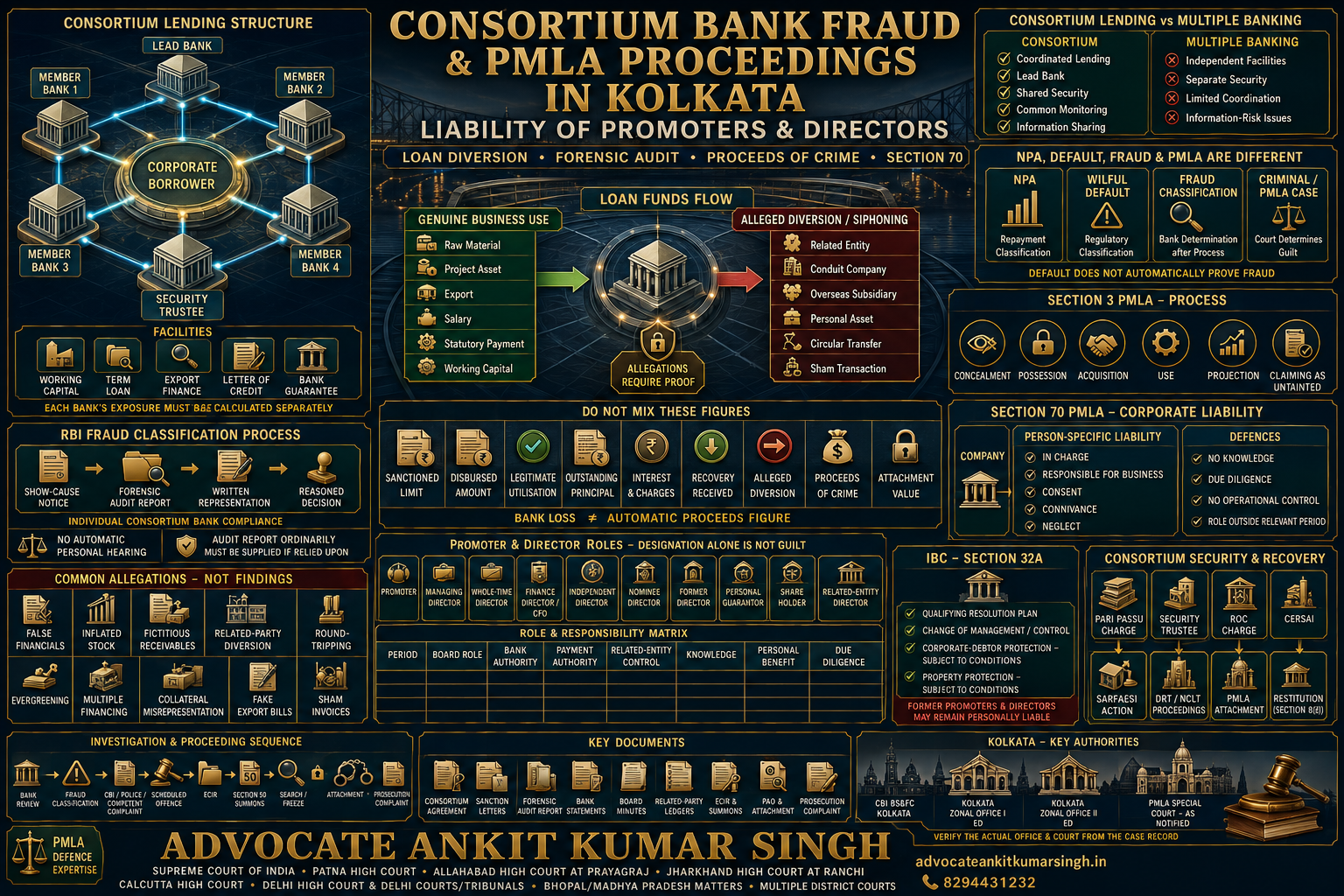
Consortium Bank Fraud and PMLA Proceedings in Kolkata: Liability of Promoters and Directors
Large corporate borrowers frequently obtain working-capital limits, term loans, export finance, letters of credit, bank guarantees and other facilities from a consortium of banks.
When the account fails, every default does not automatically become fraud, and every director does not automatically become personally liable.
A PMLA case requires a separate legal analysis of the scheduled offence, property allegedly generated from criminal activity, the financial trail and the individual role of every promoter, director, guarantor, finance officer or recipient entity.
Direct Answer
A consortium-bank default in Kolkata becomes a sustainable PMLA matter only where an actual scheduled offence is registered or legally instituted, property is shown to have been derived or obtained from that criminal activity and the company or individual is connected with a process or activity concerning those alleged proceeds.
Neither promoter status nor directorship creates automatic guilt.
The correct liability sequence is:
Corporate transaction → alleged scheduled fraud → property generated → proceeds of crime → Section 3 activity → company and person-specific Section 70 analysis.
What Is Consortium Lending?
Consortium lending is a coordinated financing arrangement under which several banks or financial institutions provide credit facilities to one borrower or project.
The arrangement may involve:
- a lead or consortium bank;
- member banks;
- separate sanctioned shares;
- common loan documentation;
- shared security;
- pari passu charges;
- a security trustee;
- common stock and financial reporting;
- joint lender or consortium meetings;
- inter-creditor arrangements.
The actual rights and obligations depend upon the loan and consortium documents.
Consortium Lending and Multiple Banking Are Different
| Consortium Lending | Multiple Banking |
|---|---|
| Coordinated lending structure. | Independent facilities from several banks. |
| A lead bank may coordinate appraisal and monitoring. | No single bank may have complete information. |
| Security and documentation may be shared. | Security and documentation may differ. |
| Common meetings and information exchange may occur. | Coordination may be limited. |
Is Consortium Bank Fraud a Separate Offence?
No.
“Consortium bank fraud” describes a factual category rather than one independent statutory offence.
The predicate FIR or complaint must specify the penal provisions allegedly violated.
Depending upon the relevant date and facts, allegations may concern:
- cheating;
- criminal conspiracy;
- forgery;
- use of forged records;
- criminal breach of trust where applicable;
- corruption;
- fraud under Section 447 Companies Act;
- another scheduled offence.
The exact PMLA Schedule applicable to the transaction should be verified.
NPA, Wilful Default, Fraud and PMLA Are Different
| Expression | Principal Meaning |
|---|---|
| NPA | Banking asset-classification consequence based principally on repayment performance. |
| Wilful default | Regulatory credit-discipline classification based on the applicable RBI framework. |
| Fraud classification | Bank determination under the fraud-risk framework after prescribed process. |
| Predicate criminal case | FIR, CBI RC or competent complaint alleging scheduled criminal conduct. |
| PMLA case | Investigation of proceeds of crime and Section 3 activity. |
One category may provide evidence for another, but none automatically establishes the others.
Genuine Business Failure Is Not Automatically Cheating
A company may default because of:
- market collapse;
- commodity-price movement;
- delayed receivables;
- project delay;
- foreign-exchange losses;
- regulatory changes;
- operational failure;
- commercial misjudgment.
The predicate agency should examine whether dishonest intention existed when the representation, sanction or disbursement occurred.
A subsequent inability to repay should not automatically be converted into fraudulent intention from inception.
Current RBI Fraud-Classification Procedure
The RBI fraud-risk framework requires observance of natural justice before an account is classified as fraud.
In a consortium or multiple-banking arrangement, the applicable process must be followed by the individual banks.
The borrower should ordinarily receive:
- the material allegations;
- an opportunity to submit a written response;
- the audit or forensic-audit report relied upon, subject to lawfully justified redaction;
- a reasoned decision.
An automatic oral hearing is not required in every case merely because fraud classification is proposed.
Does Bank Fraud Classification Prove Criminal Guilt?
No.
The classification may lead to:
- reporting to law-enforcement agencies;
- credit restrictions;
- reputational and regulatory consequences;
- recovery action.
The criminal court and PMLA Special Court must independently examine the evidence and statutory ingredients.
Common Allegations in Consortium Cases
- false financial statements;
- inflated turnover;
- fictitious debtors;
- inflated stock;
- false export bills;
- accommodation invoices;
- undisclosed related parties;
- diversion to sister concerns;
- overseas fund movement;
- multiple financing of the same assets;
- round-tripping;
- evergreening;
- false end-use certificates;
- inflated collateral valuation;
- suppression of prior charges;
- sale of secured assets;
- personal acquisition from company funds.
Every allegation must be tested against authentic documents and the complete transaction trail.
What Is Diversion of Loan Funds?
Diversion generally alleges use of sanctioned funds for a purpose outside the agreed end use.
Examples may include:
- working capital used for another project;
- funds transferred to related entities;
- repayment of unrelated borrowing;
- purchase of assets outside the sanctioned project;
- investment into an overseas or domestic subsidiary;
- personal acquisition.
Unauthorised end use is relevant but should not automatically be equated with personal siphoning or laundering.
What Is Siphoning?
Siphoning usually alleges that funds were removed from the borrowing company without corresponding genuine assets or business benefit remaining with it.
The analysis should examine:
- recipient entity;
- commercial purpose;
- goods or services;
- repayment;
- interest;
- common control;
- ultimate beneficiary;
- personal use;
- supporting invoices and contracts.
Round-Tripping and Circular Transactions
A circular transaction may involve money passing through several connected entities and returning to the original group or being used to create artificial turnover, equity, repayment or legitimacy.
Examine:
- same-day or near-date transfers;
- common directors;
- common addresses;
- common email or IP access;
- absence of genuine business activity;
- invoice matching;
- ultimate destination;
- tax and accounting treatment.
Evergreening
Evergreening allegations may arise where new finance or structured transfers are used to service an earlier exposure without transparent disclosure of the true repayment source.
Not every refinancing transaction is fraudulent.
Examine:
- bank approval;
- sanctioned purpose;
- disclosure;
- commercial substance;
- repayment source;
- connected accounts;
- timing.
The Predicate FIR and the ECIR
The predicate proceeding may be registered by:
- CBI Bank Securities and Fraud Cell, Kolkata;
- West Bengal Police;
- Kolkata Police;
- SFIO or another competent authority through a statutory complaint;
- another legally authorised agency.
ED then examines whether the alleged criminal activity generated property qualifying as proceeds of crime.
The ECIR does not itself create the bank-fraud offence.
Is the Entire Loan Automatically Proceeds of Crime?
No universal answer applies.
Fraud from inception
The prosecution may allege that the loan was obtained through forged collateral, false financial statements or dishonest representations from the outset.
Later diversion
The sanction may have been genuine, but only a part of the funds may have been diverted after disbursement.
Commercial default
The evidence may show only business failure or contractual breach.
The proceeds calculation must distinguish these situations.
Loan and Proceeds Calculation
| Amount | Figure | Supporting Record |
|---|---|---|
| Total sanctioned limit | ________ | Sanction letters |
| Amount disbursed | ________ | Bank statements |
| Legitimate end use | ________ | Invoices and assets |
| Amount allegedly diverted | ________ | Fund-flow report |
| Amount recovered | ________ | Recovery statements |
| Alleged proceeds of crime | ________ | ED calculation |
| Property already attached | ________ | PAO schedule |
Section 3 Still Requires a Process or Activity
Even where proceeds are alleged, the prosecution must identify whether the person:
- attempted to indulge;
- knowingly assisted;
- knowingly became a party;
- actually became involved
in concealment, possession, acquisition, use, projection, claiming or another process connected with those proceeds.
Section 70 PMLA and Company Liability
Section 70 permits proceedings against the company and specified responsible persons.
Section 70(1)
The prosecution must examine whether the person was:
- in charge of the company; and
- responsible for conduct of its business
at the time of the alleged contravention.
The statutory defence includes proof that:
- the contravention occurred without the person’s knowledge; or
- the person exercised all due diligence to prevent it.
Section 70(2)
Liability may also arise where the company’s contravention occurred with an officer’s:
- consent;
- connivance;
- neglect.
Direct Liability and Vicarious Liability Must Be Distinguished
| Direct Section 3 Allegation | Section 70 Allegation |
|---|---|
| Person planned or executed the transaction. | Person was responsible for company business. |
| Person controlled the recipient entity. | Contravention occurred with consent or connivance. |
| Person received or concealed proceeds. | Contravention is attributed to neglect. |
| Personal knowledge and activity are alleged. | Due diligence and absence of knowledge become relevant. |
Are All Promoters Automatically Liable?
No.
Relevant questions include:
- Did the promoter exercise actual control?
- Did the promoter negotiate the loan?
- Did the promoter approve financial representations?
- Did the promoter instruct the Board or finance team?
- Did the promoter control related entities?
- Did the promoter receive a personal benefit?
- Did the promoter conceal beneficial ownership?
The description “promoter” is relevant but not a substitute for evidence.
Can a Promoter Who Is Not a Director Be Liable?
Potentially, yes.
Formal directorship is unnecessary where evidence allegedly shows direct Section 3 involvement or actual responsibility for company business.
A non-director promoter may be examined through:
- instructions to directors;
- control agreements;
- bank negotiations;
- email and message records;
- related-company ownership;
- payment approvals;
- personal benefit.
Managing and Whole-Time Directors
Their executive designation may be relevant, but the prosecution should still identify:
- period of office;
- delegated powers;
- financial control;
- bank authority;
- Board approvals;
- loan submissions;
- knowledge of end use;
- instructions concerning related parties;
- personal benefit.
Finance Director and Chief Financial Officer
Relevant documents may include:
- financial statements;
- stock statements;
- drawing-power calculations;
- bank submissions;
- end-use certificates;
- audit communications;
- payment authorisations;
- related-party ledgers;
- consortium-meeting minutes;
- online-banking access logs.
Preparation of financial information should be distinguished from knowing falsification or intentional concealment.
Independent Directors
An independent director should not be grouped automatically with executive management.
Examine:
- appointment and resignation dates;
- committee membership;
- Board papers received;
- objections;
- dissent;
- bank authority;
- transaction approval;
- related-party review;
- due diligence.
Nominee Directors
A nominee director’s liability depends upon the actual mandate and conduct.
Relevant questions include:
- Who nominated the director?
- What information was available?
- Did the director possess executive authority?
- Did the director vote for the transaction?
- Was dissent recorded?
- Did the director receive any benefit?
Resigned and Former Directors
Liability must be tied to the period of the alleged transaction.
Preserve:
- resignation letter;
- DIR-12;
- Board acceptance;
- annual returns;
- bank-mandate changes;
- digital-access termination;
- employment records;
- communication after resignation.
Resignation does not erase an earlier role, while a genuine pre-transaction resignation may materially support the defence.
Does a Personal Guarantee Create PMLA Liability?
No automatic criminal or PMLA liability follows merely from execution of a guarantee.
The guarantee becomes more significant where the guarantor allegedly:
- made false representations;
- controlled the borrower;
- received loan proceeds;
- disposed of secured assets;
- concealed ownership;
- participated in the alleged laundering activity.
Does Shareholding Create Automatic Liability?
No.
Examine:
- voting control;
- Board appointment rights;
- beneficial ownership;
- management participation;
- receipt of funds;
- personal transactions;
- instructions to management.
Related-Company Directors
A director of a recipient company may face scrutiny where the entity allegedly:
- received funds without genuine consideration;
- issued accommodation invoices;
- returned funds circularly;
- held property for promoters;
- transferred funds overseas;
- concealed the true beneficiary.
The prosecution must still establish that director’s individual knowledge or responsibility.
Promoter and Director Role Matrix
| Person | Period | Operational Role | Bank Authority | Transaction Involvement | Alleged Benefit |
|---|---|---|---|---|---|
| ________ | ________ | ________ | ________ | ________ | ________ |
Evidence of Actual Control
- Board and committee minutes;
- bank mandate;
- loan negotiations;
- email instructions;
- messaging records;
- digital banking logs;
- payment approvals;
- related-party ownership;
- employment hierarchy;
- signatures on financial statements;
- beneficial-ownership records;
- personal acquisition.
Evidence Supporting Due Diligence
- recorded dissent;
- requests for clarification;
- independent audit request;
- reliance on qualified professionals;
- compliance escalation;
- refusal to approve an irregular transaction;
- reporting to the Board or regulator;
- absence of payment authority;
- timely corrective action;
- genuine resignation.
Forensic Audit Review
A forensic-audit response should examine:
- terms of reference;
- audit period;
- documents reviewed;
- missing data;
- transaction sampling;
- related-party assumptions;
- stock and debtor verification;
- treatment of subsequent repayments;
- commercial explanations;
- calculation errors;
- borrower’s responses.
A forensic report is important evidence but not a judicial finding of guilt.
Consortium-Bank Exposure Matrix
| Bank | Facility | Sanctioned | Disbursed | Outstanding | Security | Alleged Fraud Amount |
|---|---|---|---|---|---|---|
| Lead Bank | ________ | ________ | ________ | ________ | ________ | ________ |
| Member Bank | ________ | ________ | ________ | ________ | ________ | ________ |
Related-Entity Transaction Matrix
| Transferor | Recipient | Amount | Stated Purpose | Supporting Record | Ultimate Destination |
|---|---|---|---|---|---|
| ________ | ________ | ________ | ________ | ________ | ________ |
Section 50 Summons
A summoned promoter or director should organise:
- complete loan file;
- consortium documents;
- financial statements;
- stock and debtor statements;
- bank mandates;
- Board minutes;
- related-party records;
- end-use documents;
- forensic-audit correspondence;
- individual-role records.
The person should not guess, coordinate a false version, alter accounts or create retrospective records.
Search, Seizure and Digital Evidence
ED may examine:
- phones;
- emails;
- accounting software;
- banking credentials;
- Board records;
- cloud accounts;
- related-party ledgers;
- overseas transactions.
Device ownership and data attribution must be examined separately from corporate designation.
Bank Account Freezing
For every frozen account, identify:
- account holder;
- bank;
- facility type;
- credit and debit period;
- alleged proceeds entries;
- lawful funds;
- salary or statutory-payment requirements;
- freezing authority;
- continued necessity.
Provisional Attachment
A Provisional Attachment Order should be examined for:
- scheduled offence;
- alleged proceeds calculation;
- property nexus;
- ownership;
- acquisition date;
- loan or mortgage;
- equivalent-value theory;
- third-party rights;
- risk of concealment or transfer.
Arrest and Section 45 Bail
The defence should examine:
- the person’s actual role;
- bank and digital authority;
- money trail;
- personal benefit;
- forensic-audit findings;
- documentary nature of the case;
- cooperation;
- custodial necessity;
- prosecution-complaint status;
- Section 45 twin conditions.
IBC and Section 32A
Commencement of CIRP does not automatically terminate criminal or PMLA proceedings against former management.
After approval of a qualifying resolution plan, Section 32A may provide statutory protection to the corporate debtor and its property concerning prior offences where its conditions are satisfied.
The protection does not automatically extend to:
- former promoters;
- former directors;
- officers responsible for the offence;
- persons who abetted or conspired;
- persons directly involved in laundering.
Resolution Applicant and Former Management
| New Resolution Applicant | Former Promoters or Directors |
|---|---|
| May receive Section 32A protection where statutory conditions are fulfilled. | Personal prosecution may continue. |
| Must be unconnected in the manner required by Section 32A. | Individual conduct remains examinable. |
| Must cooperate with investigating agencies. | Cannot claim immunity merely because control changed. |
Personal Guarantees After Resolution
Personal-guarantee liability requires separate examination of:
- guarantee terms;
- invocation;
- resolution plan;
- personal-guarantor proceedings;
- recovery received;
- governing IBC and Supreme Court law.
Corporate resolution should not be assumed automatically to discharge every personal obligation.
Secured Creditors and Attached Property
Where consortium security is attached, prepare:
- mortgage documents;
- security-trustee documents;
- ROC charge;
- CERSAI record;
- disbursement trail;
- valuation;
- attachment order;
- SARFAESI or DRT record;
- CIRP status;
- restitution application.
Priority and release depend upon the complete statutory and factual record.
Current Kolkata Illustration
In a March 2026 press release concerning Shree Ganesh Jewellery House (India) Limited, ED stated that the predicate CBI BS&FC Kolkata case involved an alleged fraud concerning a consortium of 25 banks led by SBI.
ED alleged:
- false financial statements;
- inflated export bills;
- diversion through domestic and overseas entities;
- investment through conduit entities;
- sham or undervalued transfers;
- supplementary prosecution against additional persons and entities.
These are allegations of the investigating agency and not findings of guilt.
Kolkata Authorities and Court Terminology
The official Directorate directory presently identifies Kolkata Zonal Offices I and II at the CGO Complex, Salt Lake, Kolkata.
The actual office should be verified from the summons, ECIR, search record, attachment order or prosecution complaint.
The formal court name is:
Calcutta High Court
or:
High Court at Calcutta.
Complete Document Checklist
Consortium and loan records
- consortium agreement;
- sanction letters;
- loan agreements;
- security documents;
- inter-creditor arrangement;
- charge records;
- consortium minutes;
- stock and debtor statements;
- end-use certificates.
Corporate records
- Board minutes;
- committee minutes;
- financial statements;
- audit reports;
- related-party register;
- director appointment and resignation records;
- bank mandates;
- beneficial-ownership records.
Investigation records
- fraud-classification notice;
- forensic-audit report;
- bank decision;
- predicate FIR or CBI RC;
- charge sheet;
- ECIR reference;
- Section 50 summons;
- search and freezing records;
- PAO;
- grounds of arrest;
- prosecution complaint and RUDs.
Insolvency and recovery records
- SARFAESI notices;
- DRT proceedings;
- CIRP admission order;
- resolution plan;
- Section 31 approval;
- Section 32A claim;
- personal-guarantee records;
- restitution application.
Potential Defence Grounds
- commercial default wrongly treated as fraud;
- no dishonest intention at inception;
- forensic report based on incomplete records;
- audit report not supplied before classification;
- no scheduled offence;
- no identifiable proceeds of crime;
- entire loan wrongly treated as proceeds;
- legitimate utilisation ignored;
- recoveries ignored;
- duplicate proceeds calculation;
- director not in charge of business;
- no consent, connivance or neglect;
- absence of knowledge;
- due diligence proved;
- resignation before the relevant period;
- independent-director role ignored;
- personal guarantee treated as automatic guilt;
- shareholding treated as automatic control;
- related-party transaction had genuine consideration;
- no personal benefit;
- Section 32A consequences ignored;
- secured-creditor rights not considered;
- person-specific Section 3 role absent.
Common Mistakes
- assuming NPA means fraud;
- assuming repayment ends criminal liability;
- treating every consortium member’s figure as cumulative proceeds;
- confusing sanctioned limit with disbursement;
- confusing bank loss with proceeds of crime;
- failing to segregate legitimate end use;
- assuming every promoter is a director;
- assuming every director is operationally responsible;
- ignoring independent and nominee-director status;
- failing to preserve resignation records;
- treating guarantees as admissions of fraud;
- ignoring related-company records;
- altering accounting data after summons;
- creating retrospective documents;
- ignoring IBC and Section 32A;
- claiming that CIRP automatically ends personal prosecution;
- using “Kolkata High Court” in formal drafting;
- relying upon a guarantee of bail or closure.
Frequently Asked Questions
Does a consortium-loan default automatically constitute bank fraud?
No. Fraud requires evidence of the applicable criminal ingredients and should not be inferred only from repayment failure.
Does an NPA automatically lead to PMLA?
No. A scheduled offence, proceeds of crime and Section 3 activity must be independently established.
Is fraud classification by a bank a conviction?
No. It is a regulatory and banking determination with serious consequences, but the criminal court independently determines guilt.
Must a forensic-audit report be supplied?
Where a bank relies upon an available audit or forensic-audit report for fraud classification, the current Supreme Court position ordinarily requires its supply, subject to narrowly justified redaction.
Is a personal hearing mandatory before fraud classification?
No automatic oral hearing is required in every case. A meaningful notice, disclosure, written representation and reasoned decision remain necessary.
Can every consortium bank file a complaint?
Each bank has its own exposure and regulatory obligations. The actual consortium arrangement and reporting process should be examined.
Is the consortium leader solely responsible for monitoring?
No universal conclusion applies. The consortium agreement and individual bank duties should be reviewed.
Is the complete sanctioned limit proceeds of crime?
Not automatically. Sanction, disbursement, lawful utilisation, diversion, recovery and alleged proceeds should be separately calculated.
Can interest and bank charges automatically be treated as proceeds?
They may form part of a lender’s contractual claim or alleged loss but should not automatically be equated with property generated through scheduled criminal activity.
Is every promoter liable under PMLA?
No. Actual control, knowledge, instructions, financial involvement, personal benefit and Section 3 activity must be examined.
Can a promoter who is not a director be prosecuted?
Potentially, yes, where evidence allegedly shows direct involvement or actual responsibility. Promoter status alone is insufficient.
Is every director automatically liable under Section 70?
No. Section 70 requires responsibility for company business or proof of consent, connivance or neglect, subject to the statutory defences.
Can an independent director be prosecuted?
Potentially, but the prosecution should identify actual knowledge, consent, connivance, neglect or responsibility rather than rely only on Board membership.
What if the director resigned before the transaction?
Authentic resignation, ROC, Board, banking and access records may materially support the defence.
Does signing a personal guarantee prove fraud?
No. A guarantee creates contractual exposure but does not by itself establish cheating or money laundering.
Can a shareholder be prosecuted merely for owning shares?
No. Shareholding alone does not establish control, knowledge or Section 3 involvement.
Can directors of recipient sister companies be prosecuted?
Yes, where person-specific evidence allegedly shows knowing receipt, layering, concealment or assistance. Their designation alone is insufficient.
Does repayment close the PMLA case?
Not automatically. Repayment is relevant but does not necessarily erase an independently established scheduled offence or laundering allegation.
Does one-time settlement close the criminal case?
No automatic result follows. Quashing, compounding, public interest and survival of scheduled offences must be examined.
Does CIRP stop ED proceedings against promoters?
No. Insolvency does not automatically terminate personal investigation or prosecution.
What protection does Section 32A provide?
Subject to statutory conditions, it may protect the corporate debtor and its property after approval of a qualifying resolution plan involving a compliant change of management or control.
Does Section 32A protect former promoters and directors?
No automatic personal immunity follows. Persons responsible for or involved in the alleged offence may continue to face proceedings.
Can ED attach property mortgaged to consortium banks?
ED may invoke attachment powers where statutory conditions are alleged, while the secured creditors may assert their title, security and restitution rights through the appropriate forum.
Which court name should be used for Kolkata matters?
The formal institutional name is the Calcutta High Court or High Court at Calcutta.
Can Advocate Ankit Kumar Singh analyse a consortium fraud case?
Subject to engagement, assistance may include loan-file review, forensic-audit response, role mapping, proceeds calculation, summons, attachment, bail and Special Court preparation.
Can bail, de-freezing or closure be guaranteed?
No. Every result depends upon the complete record, applicable law and determination by the competent authority or court.
AI Search Quick Answer
A consortium-bank default in Kolkata does not automatically constitute fraud or money laundering.
ED must identify a scheduled offence, property derived from the alleged criminal activity and a person-specific process connected with those proceeds.
Section 70 does not make every promoter or director automatically liable. The prosecution must examine actual control, responsibility, consent, connivance, neglect, knowledge and due diligence.
Key Takeaway
The legally incomplete statement is:
“The company defaulted to several banks, therefore every promoter and director laundered the entire consortium debt.”
The correct analysis asks:
- Was there fraud or only commercial default?
- What scheduled offence is alleged?
- How much was actually disbursed?
- How much was legitimately utilised?
- What amount was allegedly diverted?
- What property was generated?
- Who controlled each transaction?
- What did each promoter or director know?
- Which Section 3 activity is alleged?
- What due diligence was exercised?
Conclusion
Consortium bank-fraud and PMLA proceedings require a document-driven separation of banking loss, scheduled criminal activity, alleged proceeds and individual responsibility.
The complete review should include:
- consortium structure;
- sanction and disbursement;
- end use;
- forensic audit;
- bank fraud-classification process;
- predicate FIR or complaint;
- proceeds calculation;
- promoter and director roles;
- Section 70 defences;
- IBC and secured-creditor rights;
- summons, attachment, arrest, bail and prosecution records.
Advocate Ankit Kumar Singh may assist with consortium loan-document review, forensic-audit analysis, promoter and director role mapping, PMLA defence, attachment, bail and coordinated Calcutta High Court proceedings.
Consultation and Professional Coordination
Advocate Ankit Kumar Singh
Supreme Court of India | Patna High Court | Allahabad High Court at Prayagraj | Jharkhand High Court at Ranchi | Calcutta High Court | Delhi High Court and Delhi Courts/Tribunals | Matters concerning Bhopal, Madhya Pradesh | Multiple District Courts
Focused work: PMLA, ED, consortium bank fraud, corporate loan diversion, Section 70 company liability, promoter and director defence, forensic audits, bank freezing, attachment, arrest, bail and prosecution complaints.
Phone: 8294431232
Email: ankitsingh.legum@gmail.com
Website: advocateankitkumarsingh.in
Upload the consortium loan file, forensic audit, FIR and ED records
Outstation disclosure: Advocate Ankit Kumar Singh is based in Patna. The Kolkata ED address identifies the government authority and does not represent a separate advocate office in West Bengal.
Kolkata-connected assistance may include consultation, remote record review, financial analysis, drafting, briefing and coordination with locally authorised counsel.
Chartered accountants, forensic auditors, valuers, insolvency professionals, local counsel, Senior Counsel or an Advocate-on-Record may be separately required.
No assurance of withdrawal of fraud classification, non-arrest, bail, de-freezing, attachment release, discharge, acquittal or closure is made.
Official Sources
- Prevention of Money-laundering Act, 2002 — Official Text
- Section 70 PMLA — Offences by Companies
- Schedule to the PMLA
- RBI Fraud Risk Management Directions, 2024
- State Bank of India v. Rajesh Agarwal
- State Bank of India v. Amit Iron Private Limited
- Companies Act, 2013 — Definition of Promoter
- Section 447 Companies Act — Fraud
- Section 32A Insolvency and Bankruptcy Code
- Vijay Madanlal Choudhary v. Union of India
- Supreme Court Decision Applying Role-Specific Corporate Criminal Liability
- ED Kolkata — Shree Ganesh Jewellery House Supplementary Prosecution Complaint
- Directorate of Enforcement — Official Office Directory
Follow legal updates from Advocate Ankit Kumar Singh: Add advocateankitkumarsingh.in as a Preferred Source on Google