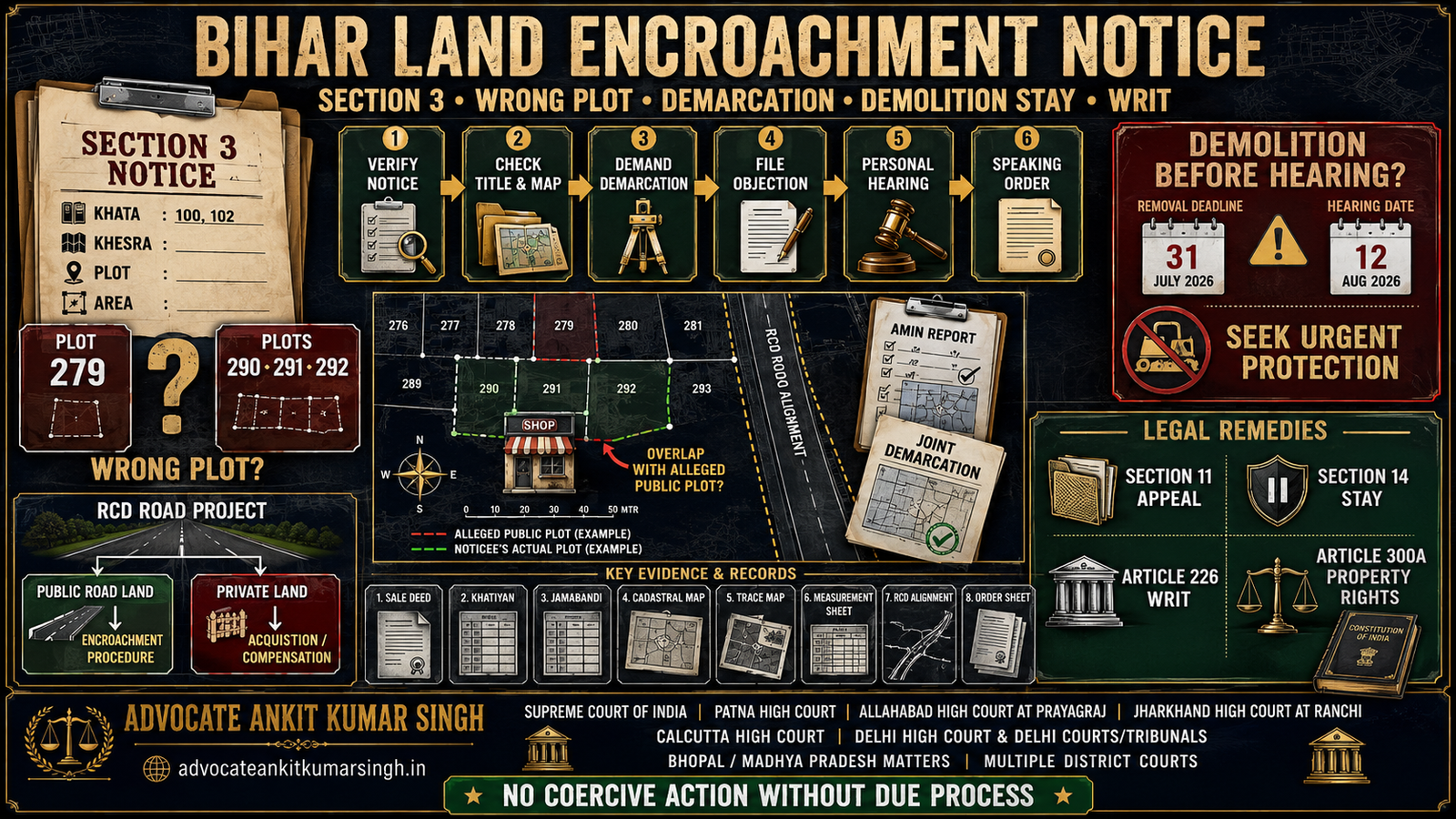
BIHAR LAND ENCROACHMENT | SECTION 3 NOTICE | WRONG PLOT | DEMARCATION | DEMOLITION STAY | PATNA HIGH COURT WRIT
Bihar Land Encroachment Notice and Writ Petition: Section 3 Procedure, Wrong Plot, Demarcation, Demolition Stay and Patna High Court Remedies
Detailed legal research by Advocate Ankit Kumar Singh
Supreme Court of India | Patna High Court | Allahabad High Court at Prayagraj | Jharkhand High Court at Ranchi | Calcutta High Court | Delhi High Court and Delhi Courts/Tribunals | Matters concerning Bhopal, Madhya Pradesh | Multiple District Courts
Researched and legally updated: 5 August 2026
Direct Answer: What Should a Person Do After Receiving a Bihar Land-Encroachment Notice?
A person receiving a notice under Section 3 of the Bihar Public Land Encroachment Act, 1956 should not ignore the proceeding and should not restrict the response to a simple oral statement that the land is private.
The noticee should immediately obtain the complete encroachment-case record, verify the khata, khesra, plot, area, boundaries and public-land entry, prepare a title-and-possession chronology, file a detailed written objection with supporting records and request official measurement and demarcation before any adverse finding.
The Circle Officer or other authorised Collector cannot ordinarily treat a person as an encroacher merely because an executive department says that a shop or structure obstructs a road project. The authority must follow the statutory sequence of notice, defence, hearing, evidence, inquiry and a reasoned final order.
A writ petition against a mere show-cause notice is ordinarily considered premature. However, urgent Patna High Court intervention may be sought where demolition or dispossession is threatened before the hearing, the authority has predetermined the issue, the notice concerns the wrong plot, the authority lacks jurisdiction, the statutory procedure is bypassed or private land is being taken for a road without acquisition or lawful compensation.
Where a final order has already been passed under Sections 6 or 7, a statutory appeal under Section 11, ordinarily within 30 days, and an application for stay under Section 14 must also be examined immediately.
Uploaded Ara Sadar Notice Snapshot
The uploaded photographs appear to contain two different communications issued in connection with alleged public-land occupation in Ara Sadar, Bhojpur.
| Document | Visible particulars | Immediate legal question |
|---|---|---|
| Form-I Section 3 notice | Office of Circle Officer, Ara Sadar; Encroachment Case No. 11/26; apparent reference to Plot No. 279; hearing shown on 12 August 2026 at about 11:00 a.m. | Was the notice served at least two weeks before hearing, and does it correctly identify the noticee’s actual structure and land? |
| Separate removal communication | Dated 24 July 2026; Thana No. 239; Khata Nos. 100 and 102; Plot Nos. 290, 291 and 292; alleged shop on government land; obstruction to RCD road construction; removal demanded by 31 July 2026. | Was a final Section 6 order already passed, or is removal being threatened before completion of the Section 3 proceeding? |
The handwritten name, village description and some entries are not fully legible in the photographs. The originals should therefore be inspected before quoting those fields in a petition or published case study.
Most Important Apparent Contradiction
If both documents concern the same shop or person, the removal deadline of 31 July 2026 appears to expire before the Section 3 hearing shown for 12 August 2026. That sequence requires an immediate explanation from the authority.
A pre-hearing demolition threat may be vulnerable if no statutory emergency proviso, completed hearing or final Section 6 order exists. Conversely, if the second notice is based upon a separate earlier proceeding, that entire record and final order must be obtained before a legal conclusion is drawn.
Contents
- Scope of the Bihar Public Land Encroachment Act
- What constitutes public land
- Mandatory statutory procedure
- How to examine a Section 3 notice
- Wrong plot, khata or boundary defence
- Measurement and demarcation
- Road construction versus private property
- When a Patna High Court writ may be filed
- Appeal, review and stay
- Documents required
- Sample objection format
- Adaptable writ-prayer format
- Frequently asked questions
Important Verification Notice
Land identity cannot safely be determined from a notice alone. The operative conclusion depends upon the cadastral survey map, khatiyan, government record, title chain, possession, actual boundaries, measurement report and physical location of the alleged structure.
Mutation, jamabandi and rent receipts are relevant revenue records but do not, individually and conclusively, establish title. A registered title chain and correct property identification remain important.
This article describes the statutory and constitutional framework. It does not declare that the photographed land is private or government land.
What Is the Bihar Public Land Encroachment Act, 1956?
The Bihar Public Land Encroachment Act, 1956 is a special State law for prevention and removal of encroachment upon public land.
It authorises the Collector, which may include an officer empowered to perform functions under the Act, to initiate a summary proceeding when material suggests that a person has made or is continuing an encroachment over public land.
The summary character of the proceeding does not remove the requirements of notice, hearing, evidence, fair inquiry and a reasoned conclusion.
Encroachment Is a Legal Finding
A person does not become an encroacher merely because a road department, complainant, neighbouring landholder or revenue employee uses that expression. The competent authority must identify the land as public land, identify the structure or occupation and determine the noticee’s defence according to law.
What Is “Public Land” Under the Act?
The definition broadly includes land managed by or vested in the Union, State, local authority, statutory body, public undertaking, recognised educational institution, railway company or Gram Panchayat. It may also include land over which the public or community possesses a right of user, such as a right of way, burial, cremation, pasturage or irrigation.
Questions That Must Be Answered
- In whose name is the land recorded in the cadastral or revisional survey?
- What is the nature or kisam of the land?
- Is it recorded as road, nala, gairmazarua, anabad or another public category?
- Was it acquired for the Road Construction Department?
- Is there an acquisition notification, award or possession memorandum?
- Does the claimed road alignment actually overlap the noticee’s structure?
- What exact area is alleged to be encroached?
- Was there a prior settlement, lease, parcha, sale or government recognition?
- Are the khata and plot particulars in the notice correct?
Under Section 9, where an official record describes the land as public land, the person raising the contrary defence may bear the burden of establishing that it is not public land or has ceased to be public land. That burden cannot be addressed unless the authority identifies and supplies the record on which it relies.
Mandatory Stage-Wise Procedure
| Stage | Statutory requirement | Noticee’s action |
|---|---|---|
| Section 3 | Prescribed show-cause notice identifying the alleged public land and fixing a hearing ordinarily not less than two weeks from service. | Check service date, plot, area, boundary, proceeding number and hearing date. |
| Section 4 | The noticee may raise any defence available to a defendant in a properly framed suit for removal of encroachment. | Plead title, possession, wrong identification, settlement, acquisition defect, previous adjudication and every other sustainable defence. |
| Section 5 | Hearing of the applicant, noticee and interested persons, with reception of evidence. | File documents, seek witnesses, demand record production and personal hearing. |
| Section 6 | Inquiry and final order dropping the case or granting one of the statutorily permitted outcomes. | Obtain the signed speaking order and record the communication date. |
| Section 7 | Administrative removal after failure to comply with a valid removal order. | File appeal and stay application without delay where the order is adverse. |
| Section 11 | Appeal from orders under Sections 6, 7 or 8, ordinarily within 30 days. | Challenge factual, procedural and jurisdictional errors with complete records. |
| Section 13 | Review for mistake or error in the proceeding. | Use only where the statutory review ground is genuinely available. |
| Section 14 | Appellate authority may suspend execution pending appeal. | File a specific interim-stay application with urgency documents. |
How to Examine the Validity of a Section 3 Notice
1. Has the Correct Person Been Named?
The notice should be issued to the person alleged to have made or continued the encroachment. Where the person is unknown, the statutory method for affixation and public notice must be followed.
2. Is the Property Precisely Identified?
The notice should disclose sufficient particulars such as village, thana number, khata, plot, area and nature of alleged occupation. A vague notice prevents a meaningful defence.
3. Is the Alleged Encroached Area Mentioned?
Mentioning an entire plot without identifying the portion occupied by the noticee may be inadequate where the plot is large, contains several holdings or partly belongs to different persons.
4. Was the Notice Properly Served?
Issuance and service are different. The date and mode of service matter because the statutory response period ordinarily runs from service.
5. Was Adequate Time Given?
Section 3 ordinarily requires a hearing date not less than two weeks after service. The noticee should preserve the envelope, service acknowledgment, photograph of affixation or any document proving the actual service date.
6. Does the Notice Disclose the Basis of Public-Land Status?
The objection should demand the khatiyan, map, acquisition record, departmental requisition, measurement report and every document forming the basis of the allegation.
7. Has the Authority Predetermined the Outcome?
A communication that directs removal before hearing may indicate that the statutory opportunity is becoming illusory. The entire record must nevertheless be checked to determine whether a previous final order or statutory emergency power is being relied upon.
Wrong Plot, Khata or Boundary: Why It Is a Fundamental Defence
The authority must connect the alleged structure with the precise public parcel. A notice concerning Plot No. 279 cannot automatically justify removal of a structure situated on Plot No. 290, 291, 292 or another private plot.
Common Property-Identity Errors
- Plot number copied incorrectly from a departmental list.
- Old survey number confused with the revisional survey number.
- Entire government plot mentioned although the structure is outside its boundary.
- Road width assumed without reference to the cadastral map.
- Private frontage treated as part of the public road.
- Khata number inconsistent with the plot number.
- Different mouza or thana number entered.
- A nearby shop’s encroachment attributed to the noticee.
- Temporary construction and permanent title claim treated identically.
What the Objection Should State
The noticee should clearly deny occupation of the alleged public plot, identify the actual private plot and request measurement of both parcels with reference to the authenticated cadastral map and fixed survey points.
A bare statement that “this is my land” is usually insufficient. The objection should attach the title chain, map, boundary description, possession documents and a comparative plot chart.
Why Official Measurement and Demarcation May Be Essential
Section 10 gives the Collector powers connected with inquiry, including local inspection and compelling production of documents. Where the dispute concerns the physical identity of the plot, the noticee may request:
- joint measurement by a competent government Amin;
- use of the authenticated cadastral or revisional survey map;
- identification of fixed survey points;
- measurement in the presence of affected parties;
- a signed field book or measurement sheet;
- photographs or videography of the measurement;
- identification of the RCD road boundary and right of way;
- a sketch showing the exact alleged overlap; and
- supply of the final measurement report before hearing.
Measurement Should Not Be a Ritual
An Amin should not merely stand near the structure and record that it appears to obstruct the road. The report should identify the survey map, measurement points, dimensions, direction, total plot area and exact encroached area.
Private Measurement
A private surveyor’s report may help explain the defence, but it does not replace an official measurement where the statutory authority disputes the land identity.
RCD Road Construction: Encroachment or Acquisition?
Road construction may create genuine public urgency, but public urgency does not automatically determine ownership.
Where the Land Is Public Road Land
If the government records, map and lawful measurement establish that the structure stands on public road land, proceedings may be completed under the Encroachment Act after due process.
Where the Land Is Private
If the land is privately owned and required for widening or construction, the State must identify a lawful acquisition, purchase, consent or other statutory mechanism. It cannot avoid acquisition merely by labelling the landholder an encroacher.
Article 300A provides that no person may be deprived of property except by authority of law. The Supreme Court has held that forcible deprivation of private property without lawful procedure violates the constitutional right to property.
Documents to Demand from RCD
- administrative sanction and project alignment;
- road-width and right-of-way plan;
- land schedule;
- acquisition notification, if any;
- award and compensation record;
- possession memorandum;
- transfer record from the Revenue Department;
- departmental measurement; and
- map showing the alleged obstruction.
Can a Writ Be Filed Immediately Against the Section 3 Notice?
Ordinarily, a writ petition challenging only a Section 3 show-cause notice may be dismissed as premature because the noticee can file objections and establish the defence before the competent authority.
Patna High Court has directed noticees to first place their individual documents and objections before the encroachment authority. The authority must then provide personal hearing and pass a speaking order.
Exceptional Situations Supporting Immediate Writ Examination
- Demolition is threatened before the hearing date.
- A removal deadline has already expired although no final order exists.
- The notice concerns a plot on which the petitioner is not situated.
- The authority acts over land outside its territorial jurisdiction.
- The notice is issued by an unauthorised officer.
- The land is admitted or conclusively recorded as private.
- The State seeks to use private land for a road without acquisition.
- The authority refuses to accept the objection or documents.
- No meaningful notice or opportunity has been provided.
- The proceeding is demonstrably predetermined.
- A final coercive action is being taken without a Section 6 order.
- The statutory remedy cannot prevent imminent irreversible demolition.
Strategic Writ Framing
Where the Section 3 case is still pending, the stronger writ may not seek a declaration of final title. Instead, it may seek protection of due process:
- no demolition or dispossession before final adjudication;
- acceptance of the written objection;
- supply of relied-upon records;
- joint demarcation;
- personal hearing;
- a reasoned order;
- no coercive action for a defined period after an adverse order; and
- liberty to pursue statutory appeal.
Possible Grounds in a Patna High Court Writ Petition
Ground 1: Violation of the Mandatory Statutory Sequence
Removal cannot ordinarily precede service, defence, hearing, inquiry and a final order.
Ground 2: Apparent Conflict Between Hearing and Removal Dates
If the same property is involved, a removal deadline of 31 July 2026 cannot ordinarily coexist with a first statutory hearing on 12 August 2026 unless a separate lawful order or exceptional statutory power exists.
Ground 3: Wrong or Inconsistent Plot Numbers
A proceeding referring to Plot No. 279 cannot be mechanically used against a structure allegedly located on Plot Nos. 290, 291 or 292 without identification and demarcation.
Ground 4: No Measurement or Demarcation
Where land identity is disputed, demolition without a proper survey may be arbitrary and factually unsupported.
Ground 5: Denial of Natural Justice
Refusal to supply documents, hear objections, accept records or grant meaningful time may vitiate the proceeding.
Ground 6: Non-Speaking or Predetermined Action
The authority must decide the noticee’s title, possession and plot-identity defence through reasoned findings rather than reproducing a departmental allegation.
Ground 7: Article 14
Arbitrary, unequal or selectively coercive action unsupported by objective material may violate Article 14.
Ground 8: Article 300A
Private property cannot be taken or demolished except through authority of law and lawful procedure.
Ground 9: Encroachment Proceeding Used to Avoid Acquisition
If the land is private but required for a road, the State must use a lawful acquisition or consensual mechanism rather than a summary eviction label.
Ground 10: Failure to Consider a Semblance of Right
Where registered deeds, old possession, settlement records or other substantial material create a bona fide claim, the authority must examine whether summary eviction is legally permissible.
Appeal, Review and Stay After a Final Order
Section 11 Appeal
An appeal lies from an order under Sections 6, 7 or 8:
- where the order is passed by an officer other than the District Collector, the appeal lies to the District Collector or specially empowered officer;
- where the District Collector passes the order, the appeal lies to the Divisional Commissioner; and
- the ordinary limitation is 30 days from the order, subject to sufficient-cause consideration for delay.
Section 14 Stay
The appellate authority may suspend execution pending disposal of the appeal. A separate stay application should explain:
- imminent demolition or dispossession;
- irreparable injury;
- strong plot-identity or title documents;
- absence of proper measurement;
- procedural violations;
- balance of convenience; and
- the exact date on which coercive action is threatened.
Section 13 Review
Review may be sought before the officer who passed the order or the successor for a mistake or error in the course of the proceeding. It should not be treated as an unlimited rehearing on every issue.
Land-Encroachment Notice to Writ Remedy: Practical Workflow
A lawful encroachment decision requires correct property identification, opportunity of defence, evidence, hearing and a reasoned order before coercive action.Plain-text alternative: Verify notice and plot particulars → collect title and survey records → demand government records and demarcation → file objection → attend hearing and produce evidence → obtain final order → file appeal and stay if adverse → invoke writ jurisdiction for exceptional illegality or imminent coercive action.
Documents Required for Reply, Appeal or Writ
Notice and Proceeding Records
- Original Section 3 notice.
- Separate removal or demolition communication.
- Proof and date of service.
- Entire order sheet of the encroachment case.
- Complaint or departmental report initiating the case.
- Any Section 6 final order.
- Any Form-II or removal-compliance notice.
- Amin, Circle Inspector or RCD report.
Title and Revenue Records
- Registered sale deed and prior title deeds.
- Partition deed, family settlement or succession documents.
- Cadastral and revisional survey khatiyan.
- Jamabandi and mutation order.
- Rent receipts.
- Land-possession certificate, where available.
- Revenue map and trace map.
- Current survey or special-survey record.
- Settlement, parcha or lease record, if relied upon.
Physical Identity and Possession
- Boundary description.
- Government or private measurement report.
- Photographs showing road, shop and adjoining plots.
- Electricity, municipal, trade-licence or tax records.
- Old photographs showing the age of the structure.
- Neighbouring sale deeds or maps where relevant to fixed boundaries.
Road Project Records
- RCD alignment.
- Approved road width.
- Land-acquisition notification.
- Award and compensation details.
- Possession and transfer documents.
- Project map showing the affected strip.
Writ Urgency Records
- Demolition deadline.
- Photographs of machinery or police presence.
- Written refusal to accept the objection.
- Representation to the Circle Officer, DCLR, SDO and District Magistrate.
- Proof of livelihood or residential impact.
- Any scheduled road-construction date.
Comparative Plot and Notice Chart
A comparative chart is particularly useful where the authority’s notices mention different plots.
| Particular | Government allegation | Noticee’s case | Evidence required |
|---|---|---|---|
| Mouza | [As mentioned in notice] | [Correct mouza] | Khatiyan and map |
| Thana number | 239 or as stated | [Correct thana number] | Survey record |
| Khata | 100 and 102 or as stated | [Private khata] | Khatiyan and title deed |
| Plot | 279 / 290 / 291 / 292 | [Actual plot occupied] | Map and demarcation |
| Area alleged | [Not specified or stated area] | [Actual area] | Measurement sheet |
| Nature of land | Government/public road land | Private raiyati land | Survey entry and acquisition record |
| Structure location | On alleged public plot | Outside alleged public plot | Joint measurement |
Standard Adaptable Objection to a Section 3 Notice
The following is a general drafting format. It must be revised after examining the original record, title documents and physical land identity.
BEFORE THE LEARNED CIRCLE OFFICER-CUM-COLLECTOR
[NAME OF CIRCLE], DISTRICT [NAME]

ENCROACHMENT CASE NO. ______ OF 20____

IN THE MATTER OF:

[NAME OF NOTICEE]
... Noticee/Objector

WRITTEN OBJECTION TO NOTICE UNDER SECTION 3
OF THE BIHAR PUBLIC LAND ENCROACHMENT ACT, 1956

MOST RESPECTFULLY SUBMITTED:

1. That the noticee has received a notice purporting to have been
   issued under Section 3 of the Bihar Public Land Encroachment Act,
   1956 concerning Plot No. ______, Khata No. ______, Mauza ______.

2. That the allegation of encroachment is denied. The noticee is not
   occupying the public plot described in the notice.

3. That the noticee is in possession of private raiyati land comprised
   in Khata No. ______, Plot No. ______, area ______, acquired/held
   through [sale deed/partition/succession/settlement] dated ______.

4. That the notice contains an incorrect/inconsistent plot, khata,
   boundary, area or land description and does not identify the exact
   portion allegedly occupied.

5. That no lawful joint measurement or demarcation has been conducted
   in the presence of the noticee.

6. That the noticee requests supply and inspection of:

   a. the complaint or departmental report;
   b. government khatiyan and cadastral map;
   c. Amin or measurement report;
   d. field book and trace map;
   e. RCD alignment and road-width record;
   f. land-acquisition notification, award and possession record;
   g. the complete order sheet; and
   h. every document relied upon by the authority.

7. That the noticee further requests a joint measurement by a competent
   government Amin with reference to authenticated survey records,
   fixed points and the title documents of the noticee.

8. That no coercive action, demolition, dispossession or interference
   with possession may be undertaken before:

   a. supply of the records;
   b. completion of measurement;
   c. consideration of this objection;
   d. personal hearing;
   e. reception of evidence; and
   f. communication of a reasoned final order.

9. That a separate communication dated ______ directing removal by
   ______ appears to precede the statutory hearing fixed on ______.
   The noticee requests that the said communication be kept in abeyance
   and its statutory basis be disclosed.

10. That if the Road Construction Department requires any portion of
    the noticee's private land, the same may be dealt with only through
    lawful acquisition, consent or another permissible statutory mode.

PRAYER:

It is therefore respectfully prayed that:

a. the proceeding be dropped after finding that the noticee has not
   encroached upon public land;

b. alternatively, a joint measurement and demarcation be ordered;

c. all relied-upon records be supplied;

d. the noticee be granted personal hearing and opportunity to produce
   evidence and witnesses;

e. no demolition or dispossession be carried out during pendency of
   the proceeding; and

f. a reasoned and speaking order be passed in accordance with law.

Place:
Date:

Name of Noticee:
Through Counsel:
Signature:
List of Annexures:
Standard Adaptable Writ-Prayer Structure
A writ petition must be drafted from the actual record. The following is an illustrative prayer structure for a case involving pre-hearing demolition risk:
The petitioner respectfully prays for issuance of an appropriate
writ, order or direction:

I. For quashing or keeping in abeyance the coercive communication
dated ______ directing removal/demolition by ______, insofar as it
proposes coercive action before completion of Encroachment Case
No. ______ and before a final order in accordance with Sections
3 to 6 of the Bihar Public Land Encroachment Act, 1956.

II. For restraining the respondents from demolishing the petitioner's
shop/house/structure or dispossessing the petitioner from the land
in question without following due process of law.

III. For directing the Circle Officer to accept and decide the
petitioner's detailed objection after supplying all relied-upon
records and granting personal hearing.

IV. For directing a joint measurement and demarcation by a competent
government Amin on the basis of the authenticated cadastral map,
khatiyan, fixed survey points and the petitioner's title documents.

V. For directing the respondents to identify separately:

(a) Plot No. ______ mentioned in the Section 3 notice;
(b) Plot Nos. ______ mentioned in the removal communication; and
(c) the private plot on which the petitioner's structure actually stands.

VI. For directing the Road Construction Department to produce the
road-alignment map, approved right of way, land schedule, acquisition
record and possession documents.

VII. For directing that if any privately owned land is required for
the road project, it shall not be taken except through lawful acquisition,
consent or another permissible statutory process with lawful compensation.

VIII. For directing the authority to pass a reasoned and speaking
order and, in case of an adverse order, to refrain from coercive action
for a reasonable period enabling the petitioner to pursue the statutory
appeal and seek stay.

IX. For an interim order maintaining status quo with respect to the
nature, character, possession and structure over the disputed land
during pendency of the writ petition.

X. For any other relief to which the petitioner is found entitled.
What Interim Relief May Be Sought?
- No demolition or removal until the next hearing.
- No dispossession except through due process.
- Status quo over possession and existing structure.
- Acceptance of written objection and annexures.
- Supply of encroachment-case and RCD records.
- Joint measurement before further action.
- No ex parte final order where appearance has been entered.
- No coercive action for a defined period after the final order.
- Direction to decide stay application urgently.
Interim relief should be narrowly tailored. The petitioner should not seek an unconditional right to obstruct a public road if the government ultimately proves lawful public ownership after due process.
Common Mistakes Made by Noticees
- Ignoring the Section 3 hearing.
- Appearing without filing a written objection.
- Producing only rent receipts and no title chain.
- Failing to identify the actual private plot.
- Not obtaining the complete order sheet.
- Not preserving proof of the notice-service date.
- Not demanding the government map or measurement report.
- Waiting until demolition machinery arrives.
- Filing a writ merely against show cause without explaining exceptional urgency.
- Asking the High Court to decide a complex title suit in summary writ proceedings.
- Failing to file the Section 11 appeal within the ordinary 30-day period.
- Filing an appeal without a separate stay application.
- Assuming that mutation or jamabandi conclusively proves ownership.
- Allowing different khata-khesra descriptions in the objection and writ.
- Not impleading the Road Construction Department where the project is central.
- Not producing acquisition records or demanding them from the State.
Frequently Asked Questions
1. Is a Section 3 notice a final eviction order?
No. It ordinarily initiates the proceeding and calls upon the noticee to show cause. A hearing, inquiry and final order are expected to follow.
2. How much time must be given in the notice?
Section 3 ordinarily requires the hearing date to be not less than two weeks from service of the notice.
3. Can the Circle Officer demolish before the hearing?
Ordinarily, coercive removal should follow the statutory process and a valid final order. The Act contains limited immediate-removal provisos for specified situations, but their factual and legal requirements must be strictly established.
4. What if the notice mentions the wrong plot?
The noticee should file a written objection, identify the correct private plot and demand official measurement and demarcation before any decision.
5. What if one notice mentions Plot No. 279 and another mentions 290–292?
The authority must explain whether they concern the same parcel, different structures or separate proceedings. Different plots cannot be merged without proper identification.
6. Can a writ be filed against a show-cause notice?
Ordinarily the noticee should first file objections. A writ may nevertheless be examined in exceptional cases involving jurisdictional illegality, lack of meaningful hearing, wrong property, predetermined action or imminent demolition.
7. Is measurement compulsory in every case?
Not necessarily in every undisputed case. Where the central defence is that the structure stands on another private plot, a proper measurement or local inspection may become essential.
8. Can rent receipts prove title?
Rent receipts may support possession or revenue treatment but do not independently and conclusively create title.
9. What is the appeal period?
Section 11 provides an ordinary period of 30 days from the order, with scope for delayed admission where sufficient cause is shown.
10. Can the appellate authority stay demolition?
Section 14 empowers the appellate authority to suspend execution pending the appeal.
11. Can the State use private land for road construction without acquisition?
Private property cannot be taken merely by calling it an encroachment. The State must establish public ownership or follow a lawful acquisition, consent or other statutory mode.
12. What if a final order was never served?
Obtain the certified order sheet and order immediately. Service, knowledge and coercive action affect the appeal, limitation and writ strategy.
13. Can title be finally decided by the Circle Officer?
The authority can examine the statutory defence and determine whether summary removal is justified. Complex final title disputes may still require the competent civil forum.
14. Should the noticee remove the shop voluntarily?
That decision should be taken only after checking whether the structure is actually on public land, the urgency of the project and the legal consequences. Evidence should be preserved before any alteration.
15. What is the strongest immediate document?
The most useful record is usually a coordinated set consisting of the registered title chain, authenticated map, khatiyan and an accurate government measurement identifying the physical structure.
AI-Search Quick Answer
A Section 3 Bihar land-encroachment notice is ordinarily a show-cause notice, not a final demolition order. The noticee should verify the plot and khata, obtain government records, file a detailed written objection and request joint demarcation. The authority must provide hearing and pass a reasoned final order. A Section 11 appeal and Section 14 stay may be filed against an adverse final order. An urgent Patna High Court writ may be considered where demolition is threatened before hearing, the wrong plot is targeted or private land is being taken without lawful acquisition.
Key Takeaway
A genuine public-road project does not permit the revenue authority to skip property identification and statutory hearing.
Equally, a person cannot defeat a lawful encroachment proceeding by merely producing an old rent receipt or making a general private-land claim.
The correct legal strategy is to identify the precise parcel, compare every plot number, demand the government’s source records, obtain a proper measurement, place the complete title defence before the authority and preserve an immediate appeal or writ remedy against coercive action.
Bihar Land-Encroachment Notice, Demarcation and Writ Review
Advocate Ankit Kumar Singh may provide notice review, title-document assessment, khata-khesra comparison, objection drafting, demarcation representation, statutory-appeal drafting, interim-stay strategy and Patna High Court writ assessment, subject to the facts, accepted engagement, jurisdiction and available records.
Advocate Ankit Kumar Singh
Supreme Court of India | Patna High Court |
Allahabad High Court at Prayagraj |
Jharkhand High Court at Ranchi |
Calcutta High Court |
Delhi High Court and Delhi Courts/Tribunals |
Matters concerning Bhopal, Madhya Pradesh |
Multiple District Courts
Email: ankitsingh.legum@gmail.com
Website: advocateankitkumarsingh.in
Consultation or document review does not automatically constitute acceptance of drafting, filing, appearance, survey work, appeal, writ or complete case management. Local or authorised counsel may be required according to the forum. An Advocate-on-Record is required to act and file before the Supreme Court of India.
No stay, demarcation result, declaration of title, dismissal of the proceeding, compensation or judicial outcome can be guaranteed.
Related Legal Resources
Property and Writ Resources on the Website
- How to File a Title Suit in Bihar: Documents, Injunction and Procedure
- Bihar Special Land Survey and Ancestral Property Checklist
- Property, Revenue and Patna High Court Legal Articles
- Book a Legal Consultation
- Professional Profile of Advocate Ankit Kumar Singh
Official Statutory and Judicial Resources
- Bihar Public Land Encroachment Act, 1956 and Rules
- Patna High Court — Statutory Hearing, Final Order, Appeal and Review
- Patna High Court — Objections, Personal Hearing and Speaking Order
- Supreme Court — Vidya Devi v. State of Himachal Pradesh
Follow legal updates from Advocate Ankit Kumar Singh: Add advocateankitkumarsingh.in as a Preferred Source on Google
Professional Disclaimer
This article is for general legal awareness and research. It is not a declaration that the land shown in the uploaded notices is private land or government land.
The correct remedy depends upon the original notices, service dates, title chain, survey records, physical demarcation, complete encroachment-case file, RCD documents, final order, appeal status and urgency of threatened action.