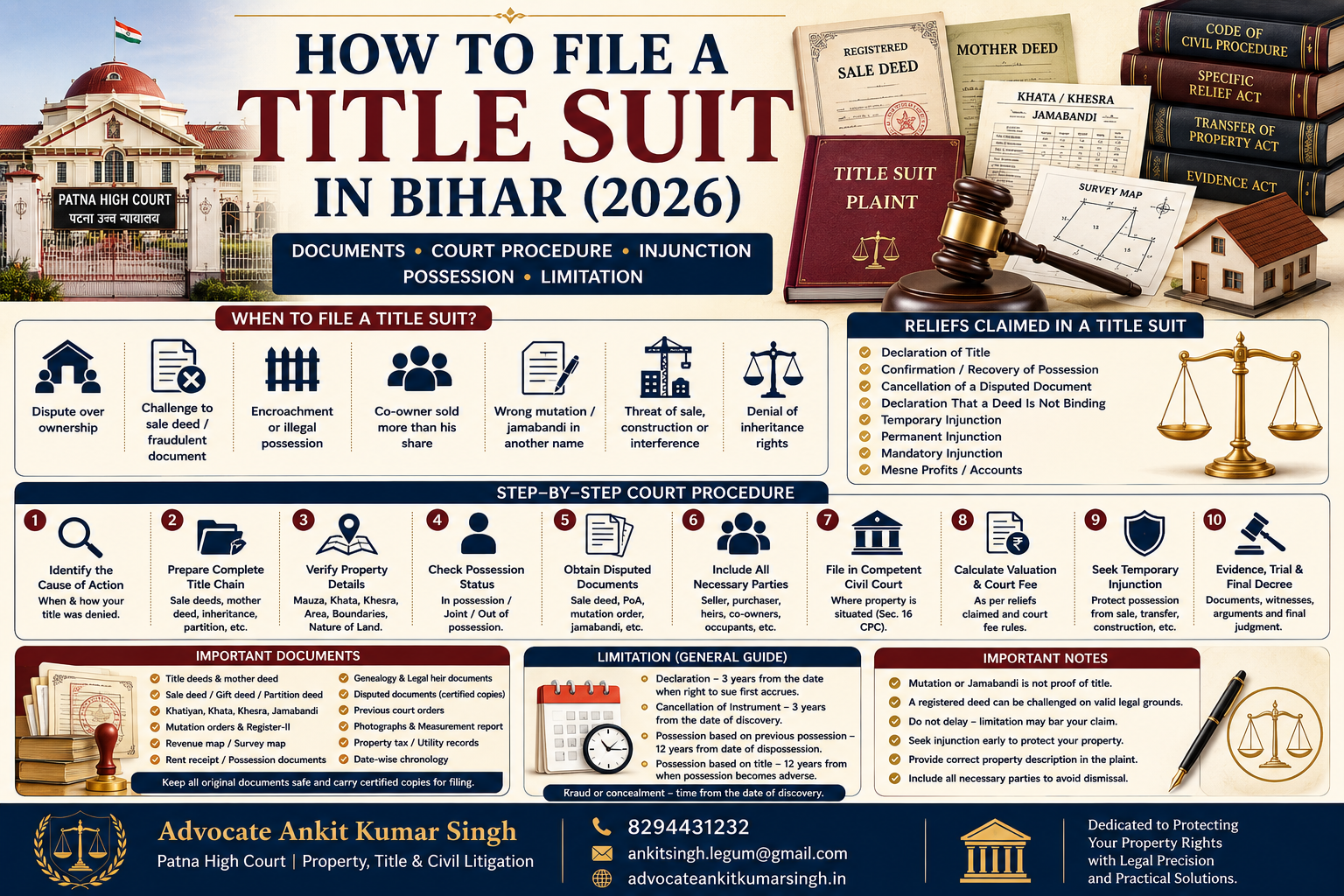
How to File a Title Suit in Bihar in 2026? Documents, Court Procedure, Injunction, Possession and Limitation
Direct Answer: A title suit is generally filed before the competent civil court when ownership, legal title, possession or the validity and binding effect of a property document is disputed. Depending upon the facts, the plaintiff may seek declaration of title, confirmation or recovery of possession, cancellation of an instrument or a declaration that it is not binding, temporary and permanent injunction, mandatory injunction, mesne profits and other consequential reliefs.
In Bihar, a title suit should be prepared after examining the complete title chain, registered deeds, genealogy, khata, khesra, jamabandi, mutation orders, survey records, revenue maps, possession evidence, disputed transactions and the exact date on which the plaintiff’s right was denied.
A person should not file only a general prayer stating that he or she is the owner. The plaint must identify the precise property, source of title, nature of interference, possession status, disputed instruments, defendants responsible and every consequential relief required for complete adjudication.
Legal Advisory Snapshot
- Subject: Declaration and protection of ownership rights in immovable property
- Primary Forum: Competent Civil Court having territorial and pecuniary jurisdiction
- Common Reliefs: Declaration of title, confirmation of possession, recovery of possession, cancellation or non-binding declaration, temporary injunction and permanent injunction
- Main Statutes: Code of Civil Procedure, 1908; Specific Relief Act, 1963; Limitation Act, 1963; Evidence Act / Bharatiya Sakshya Adhiniyam, as applicable; Registration Act and Transfer of Property Act
- Main Practical Issues: Complete title chain, correct property identity, possession, necessary parties, court fee, limitation and interim protection
- Common Bihar Records: Sale deed, khatiyan, khata, khesra, jamabandi, mutation order, Register-II, rent receipt, survey map and possession documents
What Is a Title Suit?
The expression “title suit” is commonly used for a civil suit in which the court is asked to determine rights, ownership, possession or interest in property.
A title suit may arise when:
- Two persons claim ownership over the same land;
- A registered sale deed is challenged;
- A person is dispossessed from property claimed through lawful title;
- A co-sharer sells more than his lawful share;
- A fraudulent deed is created;
- A power-of-attorney transaction is disputed;
- Mutation or jamabandi is entered in another person’s name;
- Property boundaries or plot identity are disputed;
- An inheritance or succession right is denied;
- A person claims adverse possession;
- An unauthorised occupant refuses to vacate; or
- A defendant threatens sale, construction or creation of third-party rights.
The phrase “title suit” does not identify only one fixed relief. The appropriate relief depends on whether the plaintiff is presently in possession, has been dispossessed, executed the disputed document, claims through inheritance, challenges a sale deed or requires an injunction.
When Should a Title Suit Be Filed in Bihar?
A title suit may be considered where there is a clear denial of ownership, possession or a legally enforceable property right.
Common situations include:
- Another person claims ownership over your registered property;
- Your land is occupied or encroached upon;
- A fraudulent sale deed, gift deed, partition deed or power of attorney is relied upon;
- A co-owner transfers the entire property despite holding only an undivided share;
- The seller executes two competing sale deeds;
- The property description in the deed is incorrect or manipulated;
- Mutation is allowed on the basis of a disputed document;
- Your inheritance right is denied by other legal heirs;
- An oral partition or family settlement is disputed;
- A defendant threatens construction, demolition or sale;
- You are dispossessed from property despite having title; or
- A revenue authority refuses to decide the title question and directs the parties to approach the civil court.
What Reliefs Can Be Claimed in a Title Suit?
The relief should be selected according to the possession status, disputed documents and cause of action.
1. Declaration of Title
The plaintiff may seek a declaration that he or she is the lawful owner or has a defined right, share or interest in the suit property.
A mere declaration may not be sufficient where the plaintiff is also entitled to seek possession, injunction, cancellation or another consequential remedy.
2. Confirmation of Possession
Where the plaintiff is already in possession but the defendant disputes the title or threatens interference, the plaintiff may seek declaration of title together with confirmation or protection of possession.
3. Recovery of Possession
Where the plaintiff is out of possession, a declaration alone may not provide effective relief. The plaint may need to seek recovery of vacant and peaceful possession based upon the plaintiff’s title.
4. Cancellation of an Instrument
Where a registered deed or other instrument is void or voidable and causes or may cause serious injury, cancellation may be sought according to the plaintiff’s relationship with that document and the surrounding facts.
5. Declaration That a Deed Is Not Binding
A person who did not execute a disputed deed may, depending upon the facts, seek a declaration that the document is void, illegal or not binding upon his or her right or share.
The distinction between cancellation and a non-binding declaration can affect pleadings, valuation and court fee and should be examined carefully.
6. Temporary Injunction
During pendency of the suit, the plaintiff may seek an interim order restraining the defendant from:
- Selling the property;
- Creating third-party rights;
- Changing the nature and character of the land;
- Raising construction;
- Demolishing an existing structure;
- Dispossessing the plaintiff;
- Interfering with possession;
- Cutting trees or removing materials; or
- Executing further documents concerning the property.
7. Permanent Injunction
After final adjudication, the court may permanently restrain the defendant from interfering with the rights established by the plaintiff.
8. Mandatory Injunction
A mandatory injunction may be considered where the defendant is required to remove an illegal obstruction, undo an unlawful act, restore access or perform another legally enforceable obligation.
9. Mesne Profits or Accounts
Where the defendant has wrongfully occupied or earned income from the property, the plaintiff may consider a claim for mesne profits, occupation charges, accounts or related financial relief.
Title Suit, Possession Suit and Partition Suit: What Is the Difference?
Title Suit
The central controversy is ownership, title or the validity of the claimed property right.
Possession Suit
The principal relief is recovery or protection of possession. The suit may be based upon title, prior possession, tenancy, licence or another legal relationship.
Partition Suit
The parties generally admit or establish co-ownership, and the court is asked to determine shares and divide joint property.
A partition suit may also involve title questions, but its primary objective is separation of joint shares. A title suit may instead involve competing ownership claims where one party denies that the other has any share at all.
Step 1: Identify the Exact Cause of Action
The cause of action means the bundle of material facts that gives the plaintiff the right to approach the court.
Identify:
- Who denied the plaintiff’s title;
- When the title was denied;
- What document or transaction created the dispute;
- When the plaintiff came to know about it;
- Whether possession was disturbed;
- Whether a sale or construction is threatened;
- Whether a revenue proceeding is pending;
- Whether any earlier suit or appeal exists; and
- What immediate and final relief is required.
The plaint should contain precise dates. Expressions such as “recently,” “some time ago” or “the defendant is creating problems” may be insufficient without particulars.
Step 2: Prepare the Complete Chain of Title
A title suit is ordinarily decided on the strength of the plaintiff’s own title. The plaintiff should not rely only on weakness in the defendant’s case.
The title chain may include:
- Original grant, settlement or purchase;
- Mother deed;
- Successive sale deeds;
- Partition deed;
- Gift deed;
- Will and probate records;
- Inheritance and genealogy;
- Court decree;
- Government allotment;
- Lease or settlement record;
- Power of attorney; and
- Any release, relinquishment or family settlement.
Every link should be checked for ownership, execution, registration, property identity, consideration, authority and continuity.
Step 3: Verify the Exact Identity of the Suit Property
The plaint must contain an accurate property schedule.
For land in Bihar, verify:
- District;
- Sub-division;
- Anchal or circle;
- Mauza;
- Thana number;
- Khata number;
- Khesra or plot number;
- Jamabandi number;
- Total area;
- Area under dispute;
- Nature of land;
- Four boundaries;
- Municipal holding number, where applicable;
- Road and access; and
- Existing construction or physical features.
The deed, survey map, revenue records and physical site should describe the same property. A mismatch in khata, khesra, area or boundary may become the central dispute.
Step 4: Determine the Plaintiff’s Possession Status
The plaint must clearly state whether the plaintiff is:
- In complete physical possession;
- In joint possession;
- In constructive possession;
- Possessing only a part of the property;
- Recently dispossessed;
- Out of possession for a long period; or
- Unable to obtain possession despite holding title.
The possession statement affects the relief, court fee, limitation, evidence and maintainability of the suit.
Step 5: Obtain and Examine the Disputed Documents
Do not challenge a document only on the basis of an online screenshot or oral information.
Obtain certified copies of:
- Disputed sale deed;
- Gift deed;
- Partition deed;
- Power of attorney;
- Rectification deed;
- Mortgage deed;
- Mutation order;
- Jamabandi creation order;
- Revenue appeal order; and
- Any earlier judgment or compromise decree.
The plaintiff should identify whether the document is challenged for fraud, forgery, impersonation, coercion, lack of authority, lack of title, execution after death, excess transfer, incapacity or violation of law.
Step 6: Identify All Necessary and Proper Parties
Every person whose title or interest will be directly affected should be examined for inclusion.
Possible parties include:
- Original seller or transferor;
- Purchaser;
- Subsequent purchaser;
- Co-sharers;
- Legal heirs;
- Power-of-attorney holder;
- Mortgagee or bank;
- Person in possession;
- Tenant or licensee, where relevant;
- Beneficiary under a will or gift; and
- Government or revenue authority where consequential orders are involved.
Failure to include a necessary party may result in objections, incomplete adjudication or an ineffective decree.
Step 7: Choose the Correct Civil Court
A suit concerning rights in immovable property is ordinarily filed before the competent court within whose territorial jurisdiction the property is situated.
The correct court also depends upon:
- Valuation of the suit;
- Pecuniary jurisdiction;
- Nature of relief;
- Applicable civil-court distribution rules;
- Whether properties are situated in different jurisdictions; and
- Whether a special statute excludes or modifies civil jurisdiction.
A title suit concerning land should not be filed merely where the plaintiff or defendant resides if the governing territorial rule requires filing where the property is situated.
Step 8: Calculate Valuation and Court Fee
There is no single fixed court fee for every title suit.
Court fee may vary depending on whether the plaintiff seeks:
- A bare declaration;
- Declaration with injunction;
- Declaration with recovery of possession;
- Cancellation of a document;
- Declaration that a deed is not binding;
- Partition;
- Mesne profits;
- Specific performance; or
- Several cumulative or alternative reliefs.
The court fee may also depend on possession, market valuation, statutory valuation rules and whether the plaintiff executed the challenged instrument.
Valuation should be determined before filing. Arbitrary or artificially low valuation may cause objections, delay, amendment and additional court-fee liability.
Step 9: Draft the Plaint
A properly structured title plaint should contain:
- Description of all parties;
- Genealogy, where relevant;
- Complete chain of title;
- Property schedule;
- Possession history;
- Details of disputed documents;
- Cause of action with dates;
- Territorial and pecuniary jurisdiction;
- Valuation and court fee;
- Limitation statement;
- Details of previous litigation;
- Grounds for declaration, cancellation or possession;
- Grounds for interim injunction;
- List of documents;
- Specific final prayers; and
- Verification and supporting affidavit.
Step 10: File an Application for Temporary Injunction
Where immediate interference is apprehended, an application under the applicable injunction provisions should be filed with the suit.
The plaintiff should explain:
- The prima facie title or legal right;
- The immediate threat;
- Why the balance of convenience favours protection;
- What irreparable injury may occur;
- Whether the defendant has started construction or negotiation;
- Whether third-party rights are likely to be created;
- Whether the property may be damaged or altered; and
- The precise restraint required.
A vague prayer to restrain the defendant “from doing anything” should be avoided. The injunction prayer should identify the acts to be restrained and the property concerned.
Can the Court Grant an Urgent Ex Parte Injunction?
In urgent cases, the plaintiff may request interim protection before the defendant enters appearance.
Such relief is exceptional and may be considered where delay would defeat the object of the suit, for example:
- Registration of an imminent sale deed;
- Immediate demolition;
- Rapid construction changing the property;
- Threatened forcible dispossession;
- Removal of valuable materials; or
- Creation of irreversible third-party rights.
The plaintiff must make full and candid disclosure. Suppression of material facts may result in vacation of the interim order.
Step 11: Service, Written Statement and Counterclaim
After institution, summons is issued to the defendants.
The defendant may:
- Deny the plaintiff’s title;
- Claim an independent title;
- Rely on a sale deed, inheritance, partition or adverse possession;
- Challenge court jurisdiction;
- Object to valuation and court fee;
- Raise limitation;
- Claim that necessary parties are missing;
- Rely on an earlier judgment or settlement; or
- File a counterclaim seeking declaration or possession.
The plaintiff should compare the written statement with the original documents and consider whether amendment, additional documents or replication is necessary.
Step 12: Framing of Issues
The civil court frames the material questions requiring adjudication.
Common issues may include:
- Whether the plaintiff has title;
- Whether the suit is maintainable;
- Whether the suit is barred by limitation;
- Whether the plaintiff is in possession;
- Whether the disputed deed is genuine, void or not binding;
- Whether the defendant has acquired title;
- Whether the plaintiff is entitled to recovery of possession;
- Whether injunction should be granted;
- Whether proper court fee has been paid; and
- What reliefs the parties are entitled to receive.
Step 13: Evidence in a Title Suit
The plaintiff must prove title, property identity, possession and the grounds for relief through legally admissible evidence.
Documentary Evidence
- Registered sale deeds;
- Mother deeds;
- Partition deeds;
- Gift deeds;
- Wills and probate orders;
- Death certificates and genealogy;
- Survey khatiyan;
- Mutation and jamabandi records;
- Register-II extracts;
- Rent receipts;
- Revenue and municipal maps;
- Property-tax records;
- Electricity or utility records;
- Possession documents;
- Photographs and measurement reports;
- Previous judgments; and
- Government or registration records.
Oral Evidence
Witnesses may be required to prove execution, possession, genealogy, identity, boundaries, family arrangements, payment or surrounding circumstances.
Expert or Commissioner Evidence
Where property identity, measurement, handwriting or physical condition is disputed, the court may consider a survey-knowing commissioner, handwriting expert or other appropriate evidence.
Mutation and Jamabandi Do Not Replace Title Documents
Mutation, jamabandi and rent receipts are relevant revenue records, but they should not be treated as conclusive ownership documents.
The civil court examines the underlying source of title. A person cannot ordinarily establish ownership over disputed property merely because his or her name appears in mutation or revenue records.
Similarly, absence of the plaintiff’s name from mutation does not automatically destroy a valid title acquired through a lawful registered deed or inheritance.
What If Both Parties Have Registered Sale Deeds?
The court may need to examine:
- Who had valid title to transfer;
- Dates of the competing transactions;
- Property identity;
- Registration details;
- Possession;
- Notice of the previous transaction;
- Authority of the executant;
- Whether any deed is forged or fraudulent;
- Whether the same property was transferred twice; and
- Whether cancellation or a non-binding declaration is required.
A registered document does not automatically cure absence of title in the transferor.
What If the Sale Was Made Through Power of Attorney?
The following should be checked:
- Whether the principal executed the power of attorney;
- Whether it was valid on the sale date;
- Whether the principal was alive;
- Whether the document authorised sale of the particular property;
- Whether the power had been revoked;
- Whether registration requirements were satisfied;
- Whether consideration was received; and
- Whether the attorney exceeded the authority granted.
Limitation for a Title Suit: Is It Three Years or Twelve Years?
There is no single limitation period applicable to every property-title suit.
The period depends on the principal relief and the facts.
Declaration
A suit seeking a declaration may ordinarily attract a three-year period from the date when the right to sue first accrues.
Cancellation or Setting Aside an Instrument
A suit seeking cancellation or setting aside of an instrument may ordinarily attract a three-year period from the date when the facts entitling the plaintiff to such relief first become known.
Possession Based on Previous Possession
A possession claim based on previous possession and subsequent dispossession may be governed by the applicable twelve-year limitation provision, depending on the pleaded foundation.
Possession Based on Title
A suit for possession based on title may ordinarily attract a twelve-year period beginning when the defendant’s possession becomes adverse to the plaintiff.
Recent Dispossession Remedy
Where a person is dispossessed without consent and otherwise than through due process, the Specific Relief Act also provides a special summary remedy subject to a six-month filing period. That remedy is different from a regular title suit.
Important: A plaintiff should not assume that adding a possession prayer automatically cures delay in seeking declaration or cancellation. The court examines the substance of the dispute, cause of action, knowledge, possession and reliefs claimed.
What If Fraud Was Discovered Later?
Where the claim is based on fraud, concealment or mistake, the date of discovery and the circumstances preventing earlier knowledge may become important.
The plaint should state:
- When the disputed document was created;
- When the plaintiff learned about it;
- How the plaintiff learned about it;
- Why it could not reasonably have been discovered earlier;
- What steps were taken after discovery; and
- Whether possession or revenue entries changed.
A vague allegation that fraud came to light recently is not enough without dates and supporting material.
Adverse Possession as a Defence
A defendant claiming adverse possession must generally establish possession that is hostile, open, continuous and inconsistent with the true owner’s title for the legally required period.
Long possession alone does not automatically become adverse possession.
Possession of a co-sharer, family member, tenant, licensee, caretaker or permissive occupant may begin lawfully and may not become adverse without a clear hostile denial communicated or established according to law.
What If the Defendant Sells the Property During the Suit?
A transfer during litigation does not necessarily defeat the pending case. However, the plaintiff should consider:
- Immediate injunction;
- Disclosure of the transaction;
- Impleadment of the purchaser;
- Amendment of pleadings;
- Challenge to subsequent documents; and
- Application of the doctrine governing transfers during pendency of litigation.
Early interim protection is preferable to dealing with several subsequent purchasers later.
Can Police Decide a Title Dispute?
Police may act where a cognisable offence such as forgery, assault, trespass or intimidation is alleged. However, police ordinarily do not finally declare civil ownership between competing parties.
A party should not expect a police complaint alone to replace a civil suit for declaration, possession, cancellation or injunction.
Can Revenue Authorities Decide Title?
Revenue and mutation authorities generally perform fiscal and administrative functions. Where a serious title dispute exists, the parties may be required to obtain adjudication from the competent civil court.
The title suit and revenue proceeding should be coordinated carefully so that inconsistent pleadings are not taken before different forums.
How Long Does a Title Suit Take?
There is no fixed duration.
Time depends on:
- Number of defendants;
- Service of summons;
- Interim-injunction proceedings;
- Complexity of title chain;
- Number of disputed deeds;
- Expert or commissioner evidence;
- Amendment applications;
- Availability of witnesses;
- Connected revenue or criminal proceedings;
- Appeals against interim orders; and
- Court workload.
Correct pleadings and organised documents at the beginning can reduce avoidable delay.
What Happens After the Trial Court Judgment?
The civil court may:
- Declare the plaintiff’s title;
- Reject the title claim;
- Order recovery of possession;
- Cancel or declare a document not binding;
- Grant permanent or mandatory injunction;
- Award mesne profits or direct further inquiry;
- Grant partial relief; or
- Dismiss the suit on jurisdiction, limitation, court fee or evidentiary grounds.
An aggrieved party may consider a first appeal within the applicable limitation period. Further appellate or supervisory remedies depend on the nature of the order, questions involved and procedural stage.
Execution of the Decree
A decree does not always enforce itself.
Where possession, removal of obstruction, demolition, delivery of documents or another enforceable act is ordered, execution proceedings may be necessary.
The decree-holder should obtain a certified copy, calculate limitation, identify the executable relief and file the appropriate execution application before the competent court.
Documents Required for a Title-Suit Consultation
- Complete title deeds and mother deeds;
- Disputed sale deed, gift deed, partition deed or power of attorney;
- Certified copies from the registration office;
- Khatiyan and survey records;
- Khata, khesra and jamabandi details;
- Mutation applications and orders;
- Register-II extracts;
- Rent receipts;
- Revenue and municipal maps;
- Property-tax records;
- Possession certificate;
- Genealogy and death certificates;
- Legal-heir documents;
- Previous civil, revenue or criminal case papers;
- Legal notices;
- Photographs and videos of the property;
- Physical measurement or survey report;
- Information regarding tenants or occupants;
- Details of threatened sale or construction; and
- One-page date-wise chronology.
Common Mistakes in Title Suits
- Seeking only declaration despite being out of possession;
- Not seeking cancellation or non-binding declaration against a disputed document;
- Using an incorrect property schedule;
- Relying only on mutation or rent receipts;
- Not producing the complete chain of title;
- Omitting necessary parties;
- Failing to identify the exact cause-of-action date;
- Ignoring limitation;
- Incorrect valuation and court fee;
- Not applying for urgent injunction;
- Making vague fraud allegations;
- Not obtaining certified copies of disputed deeds;
- Mixing partition, possession and title relief without proper pleadings;
- Using inconsistent property descriptions in civil and revenue proceedings;
- Depending only on oral family history;
- Not challenging a later transfer during litigation;
- Not preserving proof of possession; and
- Failing to execute the decree after judgment.
AEO: Quick Answer for AI Search
Question: How do I file a title suit in Bihar?
Answer: To file a title suit in Bihar, first identify the source of title, exact property details, possession status, disputed document and date on which your right was denied. Collect the complete title chain, certified deeds, khata-khesra-jamabandi records, mutation orders, survey maps, genealogy and possession evidence. File the suit before the competent civil court where the property is situated, seeking every necessary relief such as declaration, confirmation or recovery of possession, cancellation or non-binding declaration and temporary and permanent injunction. Court fee and limitation depend on the specific reliefs and facts.
Frequently Asked Questions
What is a title suit in Bihar?
It is a civil suit in which ownership, title, possession or another right in property is disputed and requires adjudication by the competent civil court.
Can I file only for declaration of ownership?
A bare declaration may be insufficient where you are also entitled to seek possession, injunction, cancellation or another consequential relief.
Which court has jurisdiction?
A suit determining rights in immovable property is ordinarily filed before the competent civil court where the property is situated, subject to pecuniary and special statutory rules.
Is mutation proof of ownership?
Mutation is an important revenue entry but is not a substitute for the underlying legal title.
Can a registered sale deed be challenged?
Yes, where legally recognised grounds such as fraud, forgery, impersonation, lack of title, lack of authority, coercion or another invalidating circumstance are established.
Can the court stop sale or construction?
A temporary injunction may be sought where the plaintiff establishes a prima facie case, balance of convenience and risk of irreparable injury.
Can possession be recovered through a title suit?
Yes. A plaintiff who proves title but is out of possession may seek recovery of possession as a consequential relief.
What is the limitation for a title suit?
It depends on the relief. Declaration and cancellation commonly involve three-year provisions, while possession based on title may involve a twelve-year provision. The cause of action, knowledge and nature of possession must be examined precisely.
Can an encroachment matter become a title suit?
Yes, where the defendant disputes the plaintiff’s ownership or boundary and a simple injunction proceeding will not completely resolve the controversy.
Can title be proved only through rent receipts?
No. Rent receipts may support possession or revenue history, but the plaintiff should prove the lawful source and chain of title.
What if the property was inherited?
The plaintiff should establish the deceased owner’s title, date of death, genealogy, applicable succession and any will, partition, gift or previous transfer.
Can a title suit and criminal case run together?
Yes, where the facts disclose both a civil property dispute and an independent criminal allegation such as forgery or assault. The two proceedings have different purposes.
Why This Matters for Property Owners in Patna and Bihar
Property disputes in Bihar frequently involve old survey records, multiple khatas and khesras, ancestral possession, incomplete partitions, disputed powers of attorney, mutation orders and successive sale deeds.
A person may possess land for years but lack a complete title chain. Another person may hold a registered deed but face a serious dispute regarding the transferor’s authority or property identity.
A properly prepared title suit should therefore integrate registered documents, revenue records, physical possession, genealogy, maps, limitation and the exact relief required.
Key Takeaway
The key takeaway is simple: a title suit is not merely an application asking the court to declare someone the owner.
It is a complete civil proceeding requiring accurate title history, property identification, possession pleadings, necessary parties, correct court fee, limitation analysis, evidence and appropriate consequential relief.
Conclusion
A title dispute should be addressed before the property is sold again, altered, encroached upon or transferred to multiple third parties.
The plaintiff should collect the complete documentary record, identify the right denied, select the correct civil court and claim every relief necessary for an effective decree.
For title suits, declaration of ownership, recovery of possession, sale-deed disputes, temporary injunction, mutation-related disputes and property litigation in Patna or Bihar, timely document review and precise civil drafting are essential.
Title Suit and Property Dispute Consultation
For a case-specific assessment, keep the complete title deeds, disputed documents, khata-khesra-jamabandi records, mutation papers, survey map, genealogy, possession evidence and date-wise chronology ready for review.
Advocate Ankit Kumar Singh
Patna High Court | Property, Title and Civil Litigation
Contact: 8294431232
Email: ankitsingh.legum@gmail.com
Website: advocateankitkumarsingh.in
Legal Note: This article is published solely for general legal awareness. The appropriate relief, court, valuation, court fee and limitation depend upon the title documents, possession, disputed transaction, cause of action, applicable law and individual facts. No result can be guaranteed.
Official Legal Sources
- Code of Civil Procedure, 1908;
- Specific Relief Act, 1963 — Sections 5, 6, 31, 34 and 37 to 39;
- Limitation Act, 1963 — relevant provisions including Articles 58, 59, 64 and 65;
- Registration Act, 1908;
- Transfer of Property Act, 1882; and
- Applicable Bihar civil-court, valuation and court-fee provisions.