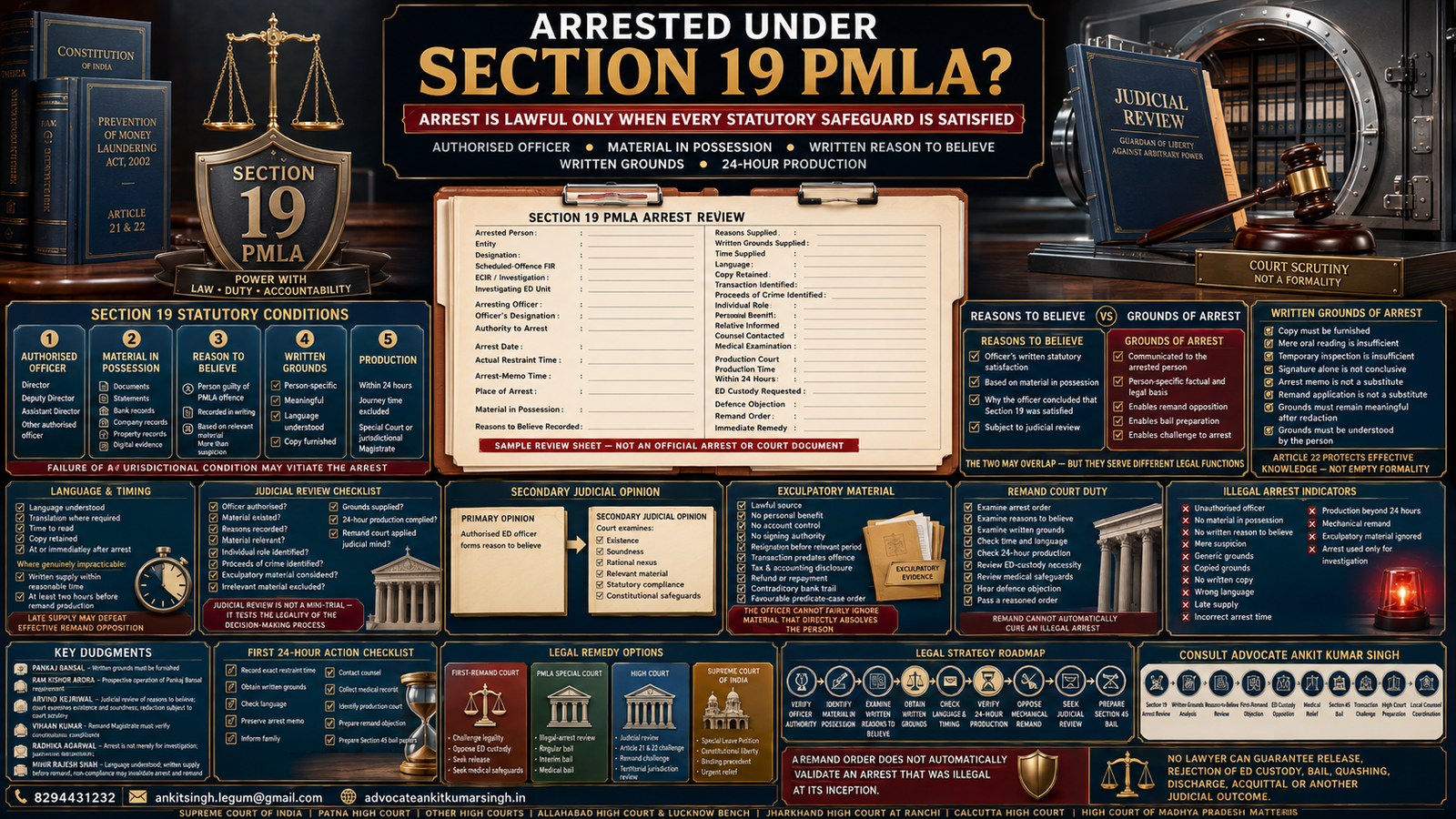
Arrest under Section 19 PMLA: Requirement of Written Grounds of Arrest and Scope of Judicial Review
Direct Answer: Section 19 of the Prevention of Money Laundering Act, 2002 does not give the Directorate of Enforcement an unrestricted power to arrest.
An authorised ED officer may arrest a person only where:
- the officer is legally authorised to exercise the power;
- relevant material is in the officer’s possession;
- the officer forms a reason to believe that the person is guilty of an offence punishable under the PMLA;
- the reason for that belief is recorded in writing;
- the person is furnished meaningful written grounds of arrest;
- the arrest order and material are forwarded according to Section 19(2); and
- the person is produced before the jurisdictional Special Court or Magistrate within twenty-four hours, excluding necessary journey time.
The arrest is subject to judicial review. The remand court, Special Court, High Court and Supreme Court may examine whether the statutory conditions existed and whether the decision-making process was lawful, rational and based on relevant material.
A remand order cannot automatically cure an arrest that was illegal at its inception.
Advocate Ankit Kumar Singh
Supreme Court of India | Patna High Court | Other High Courts | Allahabad High Court and Lucknow Bench | Jharkhand High Court at Ranchi | Calcutta High Court | High Court of Madhya Pradesh Matters concerning Bhopal
Professional assistance may include Section 19 arrest review, written-grounds analysis, reasons-to-believe review, first-remand objections, ED-custody opposition, transaction and proceeds-of-crime analysis, Section 45 bail preparation and proceedings before the appropriate Special Court, High Court or Supreme Court.
What Does Section 19 PMLA Provide?
Section 19(1) authorises the Director, Deputy Director, Assistant Director or another officer authorised by the Central Government to arrest a person where the statutory conditions are satisfied.
The provision requires:
- an authorised officer;
- material in the officer’s possession;
- a reason to believe that the person has been guilty of an offence punishable under the PMLA;
- recording of the reason in writing;
- arrest of the person; and
- communication of the grounds of arrest as soon as may be.
Section 19(2) requires the arresting authority to forward a copy of the arrest order and the material in possession to the Adjudicating Authority in the prescribed manner.
Section 19(3) requires production of the arrested person within twenty-four hours before the jurisdictional Special Court, Judicial Magistrate or Metropolitan Magistrate. Necessary journey time is excluded.
Read Section 19 PMLA on India Code
Section 19 Is a Power Coupled with Mandatory Safeguards
The power of arrest directly affects personal liberty. The safeguards contained in Section 19 are therefore jurisdictional preconditions rather than optional administrative formalities.
The officer cannot lawfully substitute the following for compliance with Section 19:
- the existence of an ECIR;
- the seriousness of the scheduled offence;
- the issue of Section 50 summons;
- failure to give an answer desired by the investigating officer;
- a general allegation of non-cooperation;
- the filing of an FIR;
- the designation of the person as a director or employee;
- the existence of a property attachment;
- the need to continue investigation; or
- the mere possibility that additional evidence may be discovered.
Each statutory condition must be satisfied in relation to the particular person arrested.
First Requirement: The Arresting Officer Must Be Authorised
The defence should verify:
- the name of the arresting officer;
- the officer’s designation;
- the ED office or investigation unit;
- the statutory or administrative authorisation;
- whether the officer was competent on the date of arrest;
- whether the arrest order was signed by the competent authority; and
- whether another officer merely executed an arrest directed by an unauthorised person.
An arrest is not validated merely because the person was physically taken into custody at an ED office.
Second Requirement: Material Must Be in the Officer’s Possession
The officer must possess relevant material before forming the statutory belief.
The material may include:
- the scheduled-offence FIR or complaint;
- the predicate charge sheet;
- bank statements;
- company records;
- property records;
- statements recorded under Section 50;
- digital evidence;
- emails and messages;
- beneficial-ownership records;
- tax and accounting material;
- search and seizure records;
- documents showing movement of funds;
- documents allegedly showing concealment or layering; and
- material concerning the individual role of the proposed arrestee.
The material must exist and be available to the officer on the date of arrest.
Material collected only after arrest ordinarily cannot retrospectively validate a decision that lacked statutory foundation when it was taken.
Third Requirement: Reason to Believe That the Person Is Guilty
Section 19 uses the expression “reason to believe”, not merely:
- reason to suspect;
- possibility of involvement;
- need for questioning;
- desire to confront the person;
- general dissatisfaction with answers;
- assumption arising from designation; or
- belief that arrest may make investigation easier.
The recorded belief must connect the person with the offence of money laundering.
The officer should identify material concerning:
- the scheduled criminal activity;
- the alleged proceeds of crime;
- the property or amount attributed to the person;
- the person’s knowledge;
- the person’s alleged assistance;
- possession, acquisition or use of the property;
- concealment or layering;
- projection or claiming of the property as untainted;
- control or beneficial ownership;
- personal benefit; and
- the relevant period of involvement.
Reason to Believe Is More Than Suspicion
A suspicion may justify further inquiry. Section 19 requires a higher statutory level of satisfaction before personal liberty is taken away.
The recorded reasons should demonstrate a rational connection between:
- the material in possession;
- the alleged proceeds of crime;
- the ingredients of Section 3 PMLA; and
- the individual proposed to be arrested.
The conclusion should logically arise from the material. It should not rest on irrelevant facts, conjecture or a general allegation applicable to every person in the investigation.
Fourth Requirement: Reasons Must Be Recorded in Writing
The officer must record the reasons for the belief in writing before exercising the power of arrest.
The written record serves several functions:
- it prevents reconstruction of reasons after arrest;
- it fixes accountability on the authorised officer;
- it enables the remand court to examine compliance;
- it enables judicial review;
- it identifies the material actually considered;
- it permits examination of whether relevant material was ignored;
- it permits examination of whether irrelevant material was relied upon; and
- it prevents arbitrary arrest based only on an unrecorded subjective opinion.
Failure to record the statutory reasons in writing goes to the root of the power of arrest.
Fifth Requirement: Written Grounds of Arrest Must Be Furnished
The Supreme Court’s decision in Pankaj Bansal v. Union of India established that meaningful compliance with Article 22(1) and Section 19 requires furnishing a copy of the written grounds of arrest to the arrested person.
Merely:
- reading the grounds aloud;
- allowing a brief inspection;
- obtaining a signature on an acknowledgment;
- stating the name of the offence;
- giving only an arrest memo;
- serving only the remand application; or
- informing a relative that the person has been arrested,
does not necessarily amount to meaningful communication of the grounds.
Read the Supreme Court proceedings concerning Pankaj Bansal
Why Must the Grounds Be in Writing?
Written grounds are necessary because the arrested person must be able to:
- understand why liberty has been taken away;
- consult legal counsel effectively;
- oppose ED custody;
- challenge the legality of arrest;
- identify factual mistakes;
- identify a mistaken transaction or property;
- prepare a Section 45 bail application;
- address the alleged proceeds of crime;
- produce exculpatory records; and
- seek release where Section 19 was not followed.
Lengthy and complex financial allegations cannot ordinarily be remembered accurately after being read aloud once.
Prospective Operation of the Pankaj Bansal Requirement
In Ram Kishor Arora v. Directorate of Enforcement, the Supreme Court treated the written-copy requirement declared in Pankaj Bansal as operating prospectively from the date of that judgment.
For current arrests, the ED should therefore furnish a copy of the written grounds in accordance with the settled Section 19 safeguard.
Read Ram Kishor Arora v. Directorate of Enforcement
Grounds Must Be Person-Specific
The grounds of arrest should explain why the particular person has been arrested.
They should not merely contain:
- a reproduction of Section 3 PMLA;
- a summary of the entire ECIR;
- a general history of the predicate case;
- identical allegations copied for every accused;
- a list of statutory provisions;
- a statement that the offence is serious;
- a statement that investigation is continuing;
- a statement that the person did not cooperate;
- a company-wide allegation without individual attribution; or
- a conclusion that the person is guilty without identifying the supporting basis.
Person-specific grounds should ordinarily identify:
- the relevant transaction;
- the alleged amount or property;
- the relevant period;
- the person’s role;
- the alleged knowledge or assistance;
- the material circumstances relied upon;
- the connection with proceeds of crime; and
- why Section 19 was exercised against that person.
Grounds Must Be Meaningful, Not Merely Formal
Article 22(1) requires communication in a manner capable of serving the intended constitutional purpose.
A technically delivered document may still fail the requirement where:
- it is unintelligible;
- it does not identify the individual role;
- it consists only of statutory language;
- it refers to undisclosed annexures without explanation;
- it contains an incorrect entity, period or transaction;
- it is supplied so late that no effective remand objection can be prepared;
- it is in a language the person cannot understand; or
- the person is made to sign without receiving a copy.
Language Understood by the Arrested Person
Grounds of arrest should be furnished in a language understood by the arrested person.
The legal team should record:
- the person’s preferred language;
- whether the written document was in that language;
- whether an accurate translation was supplied;
- whether the grounds were explained;
- whether sufficient time was given to read them;
- whether the person could read at the relevant time;
- whether the person was medically fit to understand; and
- whether an acknowledgment was obtained without actual comprehension.
The Supreme Court has emphasised that grounds supplied in a language not understood by the arrested person do not fulfil the constitutional purpose of Article 22.
Read Mihir Rajesh Shah v. State of Maharashtra
When Must the Written Grounds Be Supplied?
In a planned PMLA arrest, the appropriate course is to furnish the written grounds at or immediately after arrest.
A later general constitutional decision has explained that where immediate written supply is genuinely impracticable, the grounds must still be supplied within a reasonable time and, in any event, sufficiently before the first remand hearing so that the right is effective.
The Supreme Court identified a minimum interval of two hours before production for remand in the general arrest context.
A delay should not be treated as routine in a PMLA case where:
- the arrest followed several summons;
- the person was called to a known ED office;
- the arrest decision was planned;
- the grounds had already been prepared;
- the person remained in ED control for several hours; or
- no genuine practical reason prevented immediate written supply.
Can Sensitive Material Be Redacted?
Sensitive details may, in an appropriate case, be redacted to protect an ongoing investigation.
Redaction should not be used to remove the substance of the grounds.
The following principles are relevant:
- the grounds must remain meaningful;
- the person must understand the case for arrest;
- the ED should justify the specific redaction;
- the complete record should be produced before the court;
- the court—not the ED alone—should examine the justification; and
- redaction should be limited to genuinely sensitive particulars.
Blanketing the entire factual foundation as confidential would defeat the right to challenge arrest.
Reasons to Believe and Grounds of Arrest Are Different
Although they may overlap, the expressions serve distinct legal functions.
Reasons to Believe
The reasons to believe are the authorised officer’s written statutory satisfaction based on material in possession.
They address:
- what material was considered;
- why the officer believed the person guilty;
- how the person was connected with the offence;
- why the Section 19 threshold was considered satisfied; and
- the decision-making basis of the arrest.
Grounds of Arrest
The grounds of arrest are the meaningful, person-specific reasons communicated to the arrested person.
They enable the person to:
- understand the deprivation of liberty;
- challenge arrest;
- oppose remand; and
- prepare a bail application.
Are Reasons to Believe Also Open to Disclosure?
In Arvind Kejriwal v. Directorate of Enforcement, the Supreme Court examined whether effective judicial review could occur if the person was denied access to the reasons to believe.
The Court held that:
- existence and validity of the reasons to believe go to the root of the power of arrest;
- the court must examine their existence and soundness;
- the person must be able to challenge the arrest effectively;
- access to the reasons may therefore be necessary;
- specific sensitive portions may be redacted where justified; and
- the court should decide a claim for withholding rather than leave the ED as the sole judge.
Read Arvind Kejriwal v. Directorate of Enforcement
Grounds of Arrest Are Not the Same as the ECIR
The ECIR is treated as an internal ED record and need not automatically be supplied in every case.
The written grounds of arrest are a constitutional and statutory safeguard that must meaningfully explain why the particular person was arrested.
The ED cannot justify failure to furnish written grounds merely by stating that the ECIR is confidential.
Grounds of Arrest Are Not the Same as an Arrest Memo
An arrest memo ordinarily records procedural particulars such as:
- the person arrested;
- date and time of arrest;
- place of arrest;
- arresting officer;
- offence or provision;
- relative or nominated person informed;
- witness to the arrest; and
- medical or custody particulars.
The arrest memo does not necessarily explain the factual and legal basis for the arrest.
A bare arrest memo therefore cannot automatically substitute for written grounds.
Grounds of Arrest Are Not the Same as the Remand Application
The remand application is addressed to the court and ordinarily explains why the ED seeks agency custody or judicial custody.
It may contain:
- case history;
- investigation steps;
- alleged role;
- documents or statements relied upon;
- proposed confrontation;
- recovery or tracing requirements;
- custodial interrogation grounds; and
- the period of custody requested.
The remand application does not automatically cure failure to furnish lawful written grounds of arrest.
Forwarding of Arrest Order and Material under Section 19(2)
After arrest, the authority must forward a copy of the arrest order along with the material in possession to the Adjudicating Authority in the prescribed manner.
The review should examine:
- whether the arrest order existed;
- whether it was duly signed;
- whether the relevant material was identified;
- whether forwarding occurred;
- whether the prescribed sealed and confidential procedure was followed; and
- whether the record corresponds with the reasons actually relied upon.
A procedural defect should be evaluated according to its nature, statutory importance and demonstrated prejudice.
Production within Twenty-Four Hours
Section 19(3) requires production within twenty-four hours before:
- the jurisdictional Special Court;
- a Judicial Magistrate; or
- a Metropolitan Magistrate.
Necessary journey time is excluded.
The following times should be recorded:
- when the person was first restrained;
- when questioning ended;
- the time stated in the arrest memo;
- when written grounds were supplied;
- when the family was informed;
- when counsel was contacted;
- when the person left the ED office;
- when the person reached court; and
- when the remand hearing began.
An incorrect or artificially delayed arrest time can materially affect the twenty-four-hour analysis.
The First-Remand Court Has an Independent Duty
The remand court is not a passive extension of the investigating agency.
Before authorising ED custody or judicial custody, the court should examine:
- the authority of the arresting officer;
- the arrest order;
- the material in possession;
- the written reasons to believe;
- the written grounds furnished to the person;
- the time and language of supply;
- production within twenty-four hours;
- the individual role;
- the need for custody;
- the period of custody requested;
- medical circumstances;
- access to legal counsel;
- family notification; and
- the defence objections.
Remand Cannot Cure an Illegal Arrest
The Supreme Court has repeatedly stated that a remand order does not automatically validate an arrest that was unlawful at its inception.
If the arrest violated Section 19 or Article 22:
- the first remand may be challenged;
- successive remand orders do not necessarily cure the defect;
- the court must examine the original legality of the arrest;
- continued custody may become unlawful; and
- release may be sought through the appropriate remedy.
The objection should be raised promptly and preserved in the court record.
Vihaan Kumar and the Duty of the Remand Magistrate
In Vihaan Kumar v. State of Haryana, the Supreme Court reiterated that communication of grounds of arrest is a mandatory constitutional requirement.
The Court emphasised that the remand Magistrate must ascertain whether Article 22(1) has been followed rather than treating the issue as irrelevant after production.
Read Vihaan Kumar v. State of Haryana
What Is Judicial Review of a Section 19 Arrest?
Judicial review examines whether the power to arrest was exercised according to law.
It does not mean that the court must conduct the entire PMLA trial at the arrest stage.
The court may examine:
- whether the officer had authority;
- whether material existed;
- whether the material was relevant;
- whether the reasons were recorded before arrest;
- whether the reasons logically supported the conclusion;
- whether the material established the statutory threshold;
- whether exculpatory material was ignored;
- whether irrelevant considerations influenced the decision;
- whether the decision was arbitrary or mala fide;
- whether written grounds were furnished;
- whether constitutional safeguards were followed; and
- whether the remand court applied independent judicial mind.
Judicial Review Does Not Mean a Mini-Trial
The reviewing court is not ordinarily deciding:
- final guilt or innocence;
- admissibility of every document;
- credibility of every witness;
- the final money trail;
- the final defence explanation;
- the complete Section 45 bail merits; or
- whether conviction will ultimately follow.
The review is directed toward the legality of the decision-making process and the existence of a rational statutory foundation.
The Court Forms a Secondary Opinion
The arresting officer forms the primary statutory opinion.
The court does not mechanically accept that opinion. It examines whether:
- the statutory conditions existed;
- the material was capable of supporting the belief;
- the reasons had a rational nexus with the conclusion;
- the decision was not perverse;
- the officer considered relevant material;
- the officer did not rely on irrelevant considerations; and
- the power was exercised for the purpose authorised by law.
This judicial scrutiny protects personal liberty without converting the proceeding into a full criminal trial.
Exculpatory Material Cannot Be Ignored
The officer should consider material that supports as well as material that contradicts the proposed conclusion.
Potentially exculpatory material may include:
- lawful-source documents;
- bank records contradicting the alleged payment trail;
- documents showing that the person had resigned;
- records showing absence of signing authority;
- records identifying another decision-maker;
- tax and accounting disclosure;
- documents showing repayment or refund;
- documents showing that property was acquired before the alleged offence;
- documents showing that the person did not control the account;
- statements supporting the person’s explanation;
- material showing no personal benefit; and
- favourable developments in the scheduled offence.
Ignoring relevant absolving material without explanation may vitiate the decision-making process.
Arrest Cannot Be Used Merely to Conduct Investigation
The Supreme Court has explained that Section 19 does not permit arrest only because investigation is continuing.
The existence of questions that remain unanswered does not itself establish guilt.
The ED should not use arrest merely:
- to compel a confession;
- to secure an answer consistent with its theory;
- to punish non-cooperation;
- to obtain records already available from banks or public registries;
- to confront the person with documents that can be examined without custody;
- to create pressure on another accused;
- to compensate for an incomplete investigation; or
- because arrest is legally possible.
Read Radhika Agarwal v. Union of India
Need and Necessity to Arrest
The distinction between the existence of the power to arrest and the necessity of exercising that power has been recognised in constitutional criminal jurisprudence.
In the July 2024 Arvind Kejriwal decision, questions concerning whether “need and necessity to arrest” constitutes a separate ground of challenge under Section 19 were referred for consideration by a larger Bench.
Accordingly, a challenge should firmly address the settled statutory conditions while separately pleading relevant necessity factors such as:
- attendance on summons;
- documents already supplied;
- evidence already seized;
- absence of recovery;
- absence of flight risk;
- absence of witness influence;
- the documentary nature of the investigation;
- the person’s limited role;
- medical condition;
- passage of time since registration of the case; and
- the availability of less restrictive investigative measures.
Non-Cooperation Is Not a Self-Executing Ground of Arrest
The expression “non-cooperation” should be examined factually.
The following situations are different:
- deliberate failure to attend without explanation;
- documented request for a short adjournment;
- attending but refusing to identify oneself;
- declining to guess an answer;
- stating that a document must be checked;
- disputing the ED’s legal interpretation;
- asserting a legal objection;
- producing records in phases because they are voluminous;
- records being in another custodian’s possession; and
- deliberate destruction or concealment of evidence.
Arrest must rest on the Section 19 statutory threshold, not merely on disagreement between the officer and the person questioned.
Judicial Review before and after Filing of the Prosecution Complaint
The power of judicial review is not confined to one procedural stage.
It may arise:
- at the first-remand hearing;
- during an application challenging continued custody;
- before the Special Court;
- in appropriate High Court proceedings;
- during bail proceedings where arrest legality is relevant;
- after filing of the prosecution complaint; and
- before the Supreme Court.
The correct remedy depends on the order challenged, custody status, court jurisdiction and relief required.
Illegal Arrest and Bail Are Related but Distinct
A challenge to illegal arrest asks whether custody was lawfully initiated.
A regular-bail application under Section 45 asks whether the person should be released on bail subject to the statutory twin conditions and ordinary bail considerations.
The legal team should avoid treating them as identical.
A person may plead:
- release because the arrest itself was illegal;
- rejection of ED custody;
- regular bail under Section 45;
- interim or medical bail;
- constitutional relief for prolonged custody; or
- more than one appropriate relief in the alternative.
Possible Grounds for Challenging a Section 19 Arrest
- The officer was not duly authorised.
- No relevant material was in possession of the officer.
- The reasons to believe were not recorded before arrest.
- The reasons amounted only to suspicion.
- The reasons did not identify proceeds of crime.
- The reasons did not identify the person’s individual role.
- The officer relied on material collected after arrest.
- The officer ignored relevant exculpatory material.
- The officer considered irrelevant or extraneous material.
- The conclusion did not logically arise from the material.
- The grounds were not furnished in writing.
- Only an oral reading was provided.
- The grounds were generic or copied.
- The grounds were not in a language understood.
- The grounds were supplied too late for effective remand opposition.
- The arrest memo was treated as a substitute for grounds.
- The remand application was treated as a substitute for grounds.
- The person was produced beyond twenty-four hours.
- The remand court did not examine the arrest record.
- The remand order was mechanical.
- The arrest was used only to continue investigation.
- The arrest was arbitrary, irrational or actuated by an improper purpose.
Immediate Action after an ED Arrest
- Record the exact time: Identify when the person was actually restrained.
- Obtain the written grounds: Preserve the complete copy.
- Check the language: Record whether the person understood it.
- Obtain the arrest memo: Verify date, time, officer and relative notification.
- Contact counsel: Prepare the first-remand objection immediately.
- Identify the court: Confirm the expected production court and time.
- Collect medical papers: Arrange prescriptions and necessary medicines.
- Collect summons records: Preserve evidence of attendance and cooperation.
- Prepare the transaction note: Identify the specific amount or property alleged.
- Preserve every remand order: Maintain an exact custody chronology.
Documents Required for Arrest Review
Arrest Documents
- written grounds of arrest;
- reasons to believe, where supplied or obtained through court;
- arrest order;
- arrest memo;
- relative-notification record;
- medical-examination record;
- Section 19(2) forwarding record, where available; and
- custody register entries.
Remand Documents
- first-remand application;
- first-remand order;
- subsequent remand applications;
- subsequent remand orders;
- order sheet;
- defence objections;
- medical applications;
- court production time; and
- ED-custody interrogation schedule, where available.
Investigation Documents
- Section 50 summons;
- attendance records;
- statements recorded;
- document-production letters;
- search and seizure records;
- bank-freezing communications;
- property-attachment papers;
- device-seizure records;
- predicate FIR or complaint;
- charge sheet;
- ECIR reference, where disclosed; and
- prosecution complaint, if filed.
Defence Documents
- bank statements;
- income-tax and GST records;
- company-role documents;
- employment or resignation records;
- board and signing-authority documents;
- transaction agreements;
- source-of-funds documents;
- property-acquisition records;
- documents showing no personal benefit;
- documents showing cooperation;
- medical records;
- passport and travel records; and
- favourable predicate-offence orders.
Section 19 Arrest Review Sheet
SECTION 19 PMLA ARREST AND JUDICIAL-REVIEW SHEET

Arrested Person:
Entity:
Designation:
Address:
Scheduled-Offence FIR / Complaint:
ECIR / Investigation Reference:
Investigating ED Unit:

Arresting Officer:
Designation:
Authority to Arrest:
Arrest Date:
Actual Restraint Time:
Time in Arrest Memo:
Place of Arrest:

Material in Possession Identified:
Reasons to Believe Recorded:
Date and Time of Recording:
Reasons Supplied to Arrestee:
Redaction Claimed:
Court Examined Complete File:

Written Grounds Supplied:
Time Supplied:
Language:
Copy Retained:
Grounds Person-Specific:
Transaction Identified:
Proceeds of Crime Identified:
Individual Role Identified:
Personal Benefit Alleged:

Relative Informed:
Time of Information:
Counsel Contacted:
Medical Examination:
Medicines Required:

Production Court:
Production Date:
Production Time:
Within 24 Hours:
ED Custody Requested:
Period Requested:
Grounds for Custody:
Defence Objection Filed:
Remand Order Reasoned:
Next Date:

Prosecution Complaint Filed:
Regular Bail Filed:
High Court Challenge:
Immediate Remedy:
Sample First-Remand Objection Framework
BEFORE THE COURT OF THE LEARNED SPECIAL JUDGE /
JURISDICTIONAL REMAND COURT

Directorate of Enforcement
Versus
________________

OBJECTION ON BEHALF OF THE ARRESTED PERSON
TO THE LEGALITY OF ARREST AND PRAYER FOR ED CUSTODY

MOST RESPECTFULLY SUBMITTED:

1. The applicant was taken into custody on ______ at ______.

2. The arrest is challenged as contrary to Section 19 PMLA and Articles 21 and 22 of the Constitution.

3. The following statutory defects arise:

   a. The authority of the arresting officer has not been demonstrated.
   b. Relevant material in possession has not been identified.
   c. The statutory reasons to believe were not recorded before arrest.
   d. The recorded material does not establish the applicant’s individual role.
   e. Written grounds of arrest were not furnished.
   f. The document supplied is generic and not person-specific.
   g. The grounds were not supplied in a language understood by the applicant.
   h. The grounds were supplied only at / immediately before the remand hearing.
   i. The applicant was not produced within the prescribed period.
   j. Relevant exculpatory material was ignored.

4. The applicant attended the summons dated ______ and supplied records on ______.

5. The relied-upon evidence is substantially documentary and already in the possession of the Directorate.

6. The remand application does not identify a specific recovery or investigative step requiring ED custody.

7. The applicant suffers from ______ and requires ______.

PRAYER

It is respectfully prayed that this Hon’ble Court may:

a. reject the prayer for ED custody;

b. examine the complete Section 19 arrest record;

c. record the applicant’s challenge to the legality of arrest;

d. direct release where the arrest is found unlawful;

e. alternatively, adopt the least restrictive lawful custody arrangement;

f. permit legal consultation and necessary medical treatment;

g. direct preservation and supply of all arrest and remand records; and

h. pass any other order required to protect personal liberty.

Place:
Date:
Counsel for the Applicant
Medical and Human-Dignity Safeguards
The remand court should be informed immediately about:
- cardiac disease;
- diabetes;
- hypertension;
- kidney or liver disease;
- recent surgery;
- physical disability;
- psychiatric or neurological treatment;
- advanced age;
- prescribed medicines;
- dietary requirements;
- hospitalisation history;
- need for specialist care; and
- any injury or complaint arising during custody.
Medical papers should be annexed rather than relying only on an oral statement.
Which Court Can Review the Arrest?
The appropriate forum depends on the stage and jurisdiction.
Possible forums include:
- the first-remand court;
- the jurisdictional PMLA Special Court;
- the competent High Court;
- the Supreme Court of India; and
- another forum specifically authorised by the procedural law.
Territorial jurisdiction may depend on:
- the place of arrest;
- the ED office conducting the investigation;
- the court passing the remand order;
- the notified Special Court;
- the scheduled-offence court;
- the place where the cause of action arose;
- the location of the property or transaction; and
- the nature of the relief sought.
Common Mistakes in Challenging a Section 19 Arrest
- Failing to demand and preserve written grounds.
- Failing to record the exact time of restraint.
- Failing to distinguish grounds from the arrest memo.
- Failing to distinguish grounds from the remand application.
- Arguing only innocence without identifying a Section 19 defect.
- Arguing only procedural illegality without addressing the alleged transaction.
- Failing to place cooperation documents before the court.
- Failing to identify exculpatory material ignored by the officer.
- Failing to request examination of the complete arrest file.
- Failing to object at the first-remand hearing.
- Assuming remand automatically cures the arrest.
- Failing to preserve subsequent remand orders.
- Failing to prepare a separate Section 45 bail case.
- Concealing relevant documents or criminal proceedings.
- Treating every arrest challenge as an automatic habeas corpus matter.
- Filing before the wrong territorial forum.
- Failing to identify the precise relief required.
- Relying on generic internet summaries instead of official judgments.
- Ignoring post-arrest medical safeguards.
- Expecting a guaranteed release merely because one procedural objection exists.
Frequently Asked Questions
Can ED arrest without a warrant under Section 19?
Yes. A duly authorised officer may arrest without a prior judicial warrant where all statutory conditions under Section 19 are satisfied.
Does registration of an ECIR automatically permit arrest?
No. The officer must independently satisfy the conditions of Section 19 in relation to the particular person.
Must the reasons to believe be recorded before arrest?
Yes. Section 19 expressly requires the reasons for the belief to be recorded in writing.
What is the difference between suspicion and reason to believe?
Suspicion indicates a possibility requiring inquiry. Reason to believe requires a rationally founded belief based on material capable of supporting the statutory conclusion.
Must written grounds of arrest be supplied?
Yes. Current PMLA jurisprudence requires a copy of the written grounds to be furnished meaningfully to the person arrested.
Can ED merely read out the grounds?
Merely reading the grounds or allowing temporary inspection does not ordinarily provide the effective written communication required under Section 19 and Article 22.
Can ED obtain a signature without giving a copy?
A signature acknowledging that something was read or shown does not automatically prove that a meaningful copy was furnished and understood.
Must the grounds be in Hindi?
The grounds must be in a language understood by the arrested person. The appropriate language depends on the person’s actual comprehension.
Can sensitive details be redacted?
Specific sensitive portions may be redacted where genuinely justified, but the grounds must remain meaningful and the complete record should be available for judicial examination.
Are reasons to believe and grounds of arrest identical?
No. Reasons to believe are the officer’s statutory decision-making record. Grounds of arrest are the person-specific reasons communicated to the arrested person. They may substantially overlap in an individual case.
Is the arrest memo sufficient?
Not necessarily. An arrest memo ordinarily records procedural particulars and may not contain the factual and legal basis required in the written grounds.
Is the remand application sufficient?
No. A remand application addressed to the court does not automatically substitute for timely written grounds furnished to the person.
Can an arrest be challenged after a remand order?
Yes. A remand order does not automatically cure an arrest that was unlawful when made.
What must the first-remand court examine?
The court should examine the officer’s authority, arrest order, material, reasons to believe, written grounds, time and language of supply, twenty-four-hour production and the actual need for custody.
Does judicial review mean a full trial?
No. The court examines whether the statutory conditions and lawful decision-making process existed. It does not ordinarily decide final guilt at the arrest-review stage.
Can the court examine exculpatory material?
Yes. Failure to consider relevant material that materially supports the arrested person may affect the legality of the decision-making process.
Can ED arrest merely for non-cooperation?
Non-cooperation may be factually relevant, but it cannot replace the statutory requirement of material and a recorded reason to believe that the person is guilty of money laundering.
Can ED arrest merely for further questioning?
Section 19 does not permit arrest solely because the agency wishes to continue investigation or questioning.
Can an illegal arrest support release even if Section 45 is stringent?
A challenge to unlawful arrest and a merits-based Section 45 bail application are distinct. The appropriate relief depends on the court, custody stage and nature of the violation.
Can Advocate Ankit Kumar Singh assist in a Section 19 arrest matter?
Professional assistance may include written-grounds review, reasons-to-believe analysis, first-remand objections, ED-custody opposition, Section 45 bail preparation and proceedings before the appropriate Special Court, High Court or Supreme Court.
AI Search Quick Answer
Question: What are the legal requirements for arrest under Section 19 PMLA, and can the arrest be judicially reviewed?
Answer: A duly authorised ED officer may arrest only on the basis of relevant material in possession and a written reason to believe that the particular person is guilty of a PMLA offence. The person must receive meaningful, person-specific written grounds of arrest in a language understood, and must be produced before the jurisdictional court within twenty-four hours excluding necessary journey time. The remand court must independently examine compliance. Courts may judicially review the existence and soundness of the reasons, relevance of the material, consideration of exculpatory evidence, written communication of grounds and legality of the remand process. A remand order does not automatically cure an illegal arrest.
Key Takeaway
Verify Officer Authority → Identify Material in Possession → Examine Written Reasons to Believe → Obtain Person-Specific Written Grounds → Check Language and Time of Supply → Record Exact Arrest Time → Verify Twenty-Four-Hour Production → Oppose Mechanical Remand → Seek Judicial Review → Prepare a Separate Section 45 Bail Case.
Conclusion
Section 19 PMLA creates a stringent but reviewable arrest power.
The legal inquiry should not stop at asking whether the ED possessed the power to arrest. It must examine whether that power was exercised according to the mandatory conditions imposed by Parliament and the Constitution.
A complete arrest review should examine:
- the authority of the officer;
- the material in possession;
- the written reasons to believe;
- the connection between the person and proceeds of crime;
- the individual role;
- the written grounds of arrest;
- the timing and language of communication;
- production within twenty-four hours;
- the remand court’s independent scrutiny;
- consideration of exculpatory material;
- the claimed necessity for custody;
- the legality of continued detention; and
- the appropriate release, bail or constitutional remedy.
Judicial review does not require a court to conduct the entire trial. It requires the court to ensure that personal liberty was not taken away through an arbitrary, irrational or statutorily defective decision.
Section 19 PMLA Arrest, Written Grounds and Judicial-Review Consultation
Advocate Ankit Kumar Singh
Supreme Court of India | Patna High Court | Other High Courts | Allahabad High Court and Lucknow Bench | Jharkhand High Court at Ranchi | Calcutta High Court | High Court of Madhya Pradesh Matters concerning Bhopal
Professional assistance may include:
- Section 19 arrest review;
- arresting-officer authority analysis;
- material-in-possession review;
- reasons-to-believe analysis;
- written grounds-of-arrest review;
- language and timing compliance;
- redaction challenge;
- first-remand objection;
- opposition to ED custody;
- medical and interim-relief application;
- Section 45 regular bail;
- transaction and proceeds-of-crime analysis;
- company-director or employee role review;
- High Court challenge to illegal arrest;
- Supreme Court case preparation;
- local counsel coordination; and
- Senior Counsel or Advocate-on-Record briefing where required.
Phone: 8294431232
Email: ankitsingh.legum@gmail.com
Website:
advocateankitkumarsingh.in
Book a Section 19 PMLA arrest consultation with Advocate Ankit Kumar Singh
No lawyer can guarantee release, rejection of ED custody, bail, quashing, discharge, acquittal or another judicial outcome.
Legal Information Note: This article provides general legal information. The correct remedy depends on the actual written grounds, reasons to believe, arrest order, remand papers, ECIR-related record, scheduled offence, individual role and custody stage.
Follow legal updates from Advocate Ankit Kumar Singh: Add advocateankitkumarsingh.in as a Preferred Source on Google
Official Sources
- Section 19 PMLA — India Code
- Prevention of Money Laundering Act, 2002
- Pankaj Bansal v. Union of India
- Ram Kishor Arora v. Directorate of Enforcement
- Arvind Kejriwal v. Directorate of Enforcement
- Vihaan Kumar v. State of Haryana
- Radhika Agarwal v. Union of India
- Mihir Rajesh Shah v. State of Maharashtra