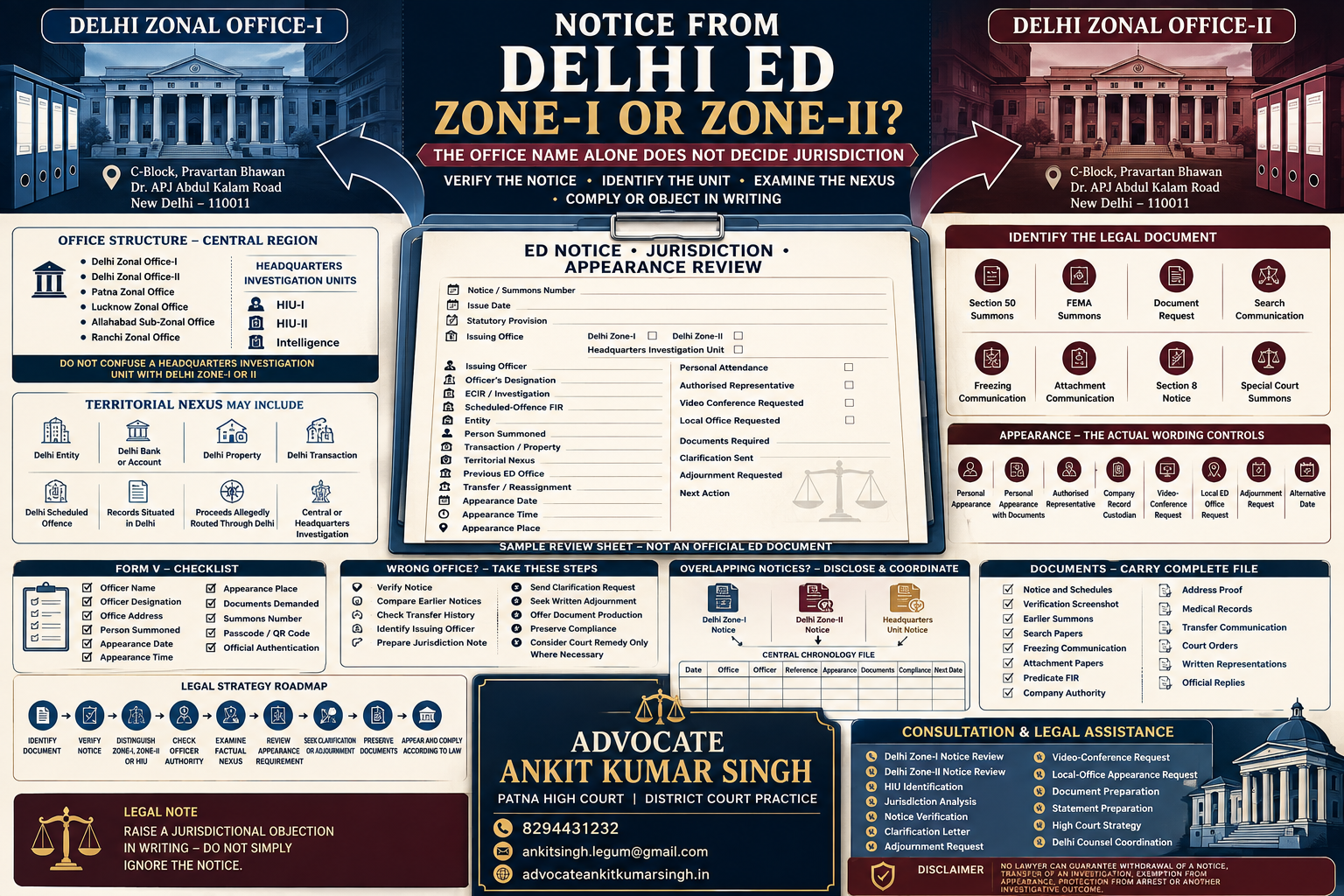
Delhi Zonal Office-I and II: Understanding ED Notices, Jurisdiction, Appearance and Correct Response under PMLA
Direct Answer: Delhi Zonal Office-I and Delhi Zonal Office-II are separate operational offices of the Directorate of Enforcement situated at Pravartan Bhawan, Dr. APJ Abdul Kalam Road, New Delhi. The fact that a notice bears the name of Delhi Zone-I or Delhi Zone-II does not, by itself, establish that the notice is valid, invalid or issued by the “wrong” office.
The recipient should examine:
- the statutory provision mentioned in the notice;
- the name and designation of the issuing officer;
- the issuing zonal office or investigation unit;
- the ECIR or investigation reference, where disclosed;
- the scheduled or predicate offence;
- the transaction, property, entity or person under inquiry;
- the territorial and factual connection with Delhi;
- the date, place and mode of appearance;
- whether personal attendance is expressly required;
- the documents demanded; and
- whether the investigation has been assigned, transferred or coordinated through another ED unit.
The recipient should not ignore the notice merely because another ED office appears geographically closer or because the recipient resides outside Delhi. A jurisdictional or administrative concern should ordinarily be raised through a prompt written representation while preserving compliance, unless a competent court has stayed the notice or directed otherwise.
Advocate Ankit Kumar Singh – Patna High Court | District Court Practice
Professional assistance may include notice verification, officer-authority review, jurisdiction analysis, written representations, appearance preparation, document indexing, adjournment requests, video-conference requests, transaction review and coordination with counsel in Delhi.
Where Are Delhi Zonal Office-I and Delhi Zonal Office-II?
The official Directorate of Enforcement office directory presently identifies both Delhi Zonal Offices at the same principal location:
Delhi Zonal Office-I
Directorate of Enforcement
C-Block, Pravartan Bhawan
Dr. APJ Abdul Kalam Road
New Delhi – 110011
Delhi Zonal Office-II
Directorate of Enforcement
C-Block, Pravartan Bhawan
Dr. APJ Abdul Kalam Road
New Delhi – 110011
Check the current official Directorate of Enforcement office directory
The official organisational structure places Delhi-I and Delhi-II within the Central Region of the Directorate of Enforcement.
Headquarters Investigation Unit-I, Headquarters Investigation Unit-II, Intelligence, Legal, Administration and other Headquarters functions are separately identified within the organisational structure.
Important: Delhi Zonal Office-I, Delhi Zonal Office-II and a Headquarters Investigation Unit are not interchangeable labels. The issuing unit printed on the notice must be identified accurately.
What Is the Difference between Delhi Zone-I and Delhi Zone-II?
Delhi Zone-I and Delhi Zone-II are distinct administrative and investigative formations within the Directorate of Enforcement.
The publicly available office directory confirms that both offices exist separately and have separate office leadership and contact details.
However, the public office directory and organisational chart do not provide a simple public district-by-district list stating that every locality, police station, bank, company or transaction in Delhi belongs permanently to only one of the two offices.
Case allocation may depend on:
- the scheduled-offence agency;
- the FIR or predicate case;
- the entity or group investigated;
- the location of the principal transaction;
- the place where alleged proceeds of crime moved;
- the investigating officer or team already handling the matter;
- administrative allocation within ED;
- transfer or reassignment of the investigation;
- coordination with another zonal or sub-zonal office;
- the involvement of a Headquarters Investigation Unit; and
- another legally relevant connection with the inquiry.
Do Delhi Zone-I and Zone-II Have Different Territorial Boundaries?
There may be internal administrative allocation of matters between the two zonal offices. The existence of such allocation does not mean that a recipient can safely disregard a notice solely because the recipient believes another office should have handled it.
The correct legal inquiry is broader:
- Was the notice issued by an officer empowered under the PMLA?
- Does the notice identify the issuing office and officer?
- Is there an investigation or proceeding with which the recipient is connected?
- Does the person possess relevant evidence or records?
- Is there a factual or transactional nexus with the investigation?
- Was the case assigned or transferred to the issuing unit?
- Is the issuing unit a zonal office or a Headquarters Investigation Unit?
- Is the appearance direction reasonable and capable of compliance?
A distinction should therefore be maintained between:
- administrative allocation within ED;
- statutory authority of the issuing officer;
- territorial or factual connection with the inquiry;
- place of appearance; and
- territorial jurisdiction of a court examining a challenge.
Office Structure Is Not the Same as Statutory Jurisdiction
An organisational chart shows how an investigating agency is administratively structured. It does not, by itself, answer every legal question concerning the validity of an individual notice.
The Supreme Court has examined an argument that the ED’s organisational structure and zonal allocation prevented a Delhi-based investigation unit from requiring appearance in New Delhi. The Court rejected the proposition that the organisational structure relied upon in that case could automatically be treated as a binding territorial restriction under Section 51 PMLA.
The Court also noted, on the facts before it, that the Headquarters Investigation Unit had not been territorially restricted in the organisational material relied upon.
Read the Supreme Court judgment concerning Delhi appearance and ED territorial objections
Legal Caution: The judgment does not mean that every ED office can issue every notice without authority, connection or lawful purpose. It means that a jurisdictional objection must be tested against the actual statute, officer, investigation, transfer record and factual nexus—not merely the office label.
What Kinds of ED Notices May Be Received?
The expression “ED notice” is commonly used for several legally different documents.
The recipient should first determine whether the document is:
- a summons under Section 50 PMLA;
- a summons or direction under FEMA;
- a request for information or documents;
- a communication following a search;
- a freezing-related communication;
- a provisional-attachment-related communication;
- a notice from the Adjudicating Authority under Section 8 PMLA;
- a communication relating to possession of attached property;
- a notice relating to a prosecution complaint;
- a court summons from a Special Court; or
- another statutory or administrative communication.
The response procedure changes according to the legal nature of the document.
Section 50 Summons from Delhi Zone-I or Zone-II
Section 50 empowers specified ED officers to summon any person whose attendance the officer considers necessary:
- to give evidence;
- to make a statement;
- to produce records;
- to explain a financial transaction;
- to identify ownership or beneficial control;
- to provide company or bank records;
- to explain a property transaction;
- to provide electronic records; or
- to assist an inquiry or proceeding under the PMLA.
Read Section 50 PMLA on India Code
The person summoned is ordinarily bound to:
- attend personally or through an authorised agent as directed;
- state the truth;
- produce the records demanded;
- avoid destruction or alteration of relevant records; and
- review the statement carefully before signing.
Form V and the Identity of the Issuing Office
A Section 50 summons should ordinarily be issued in the prescribed Form V.
The notice should be reviewed for:
- name of the issuing officer;
- designation of the issuing officer;
- Delhi Zonal Office-I, Delhi Zonal Office-II or another unit;
- official office address;
- summons number;
- date of issuance;
- name and address of the person summoned;
- date and time of appearance;
- place of appearance;
- whether personal attendance is required;
- records demanded;
- relevant period;
- official email address;
- telephone details;
- QR code or passcode, where provided; and
- signature and official authentication.
Verify the Notice before Acting
A system-generated summons may be verified through the official ED verification portal using its summons number and passcode.
Verify an ED summons through the official portal
The recipient should separately verify:
- the office address;
- the officer’s designation;
- the official email domain;
- the telephone number;
- the date and time of appearance;
- the room or reporting instructions; and
- the identity of any person communicating by telephone.
No payment should be made merely because a caller claims that arrest, search, account freezing or attachment can be avoided through a transfer of money.
How to Determine Whether Zone-I or Zone-II Is Handling the Matter
The following documents and circumstances should be reviewed:
- The actual notice: The office and officer should be expressly identified.
- Earlier summons: Check which unit previously issued notices.
- Search documents: Search authorisation, panchnama and seizure papers may identify the investigating unit.
- Freezing communication: The bank or property communication may identify the relevant office.
- ECIR reference: Where disclosed, its unit code may assist identification.
- Predicate-offence papers: Identify the agency, FIR and geographic connection.
- Company or transaction nexus: Identify where the relevant entity, account, property or transaction is situated.
- Transfer communication: Check whether the matter was transferred or reassigned.
- Official correspondence: Review official email signatures and document headers.
- Written clarification: Seek confirmation from the issuing officer where uncertainty remains.
Can the Recipient Choose between Delhi Zone-I and Zone-II?
No. The recipient ordinarily cannot choose the investigating office based on convenience, residence or personal preference.
The recipient may request clarification or another place of appearance where justified, but the assignment of the inquiry is generally an administrative and investigative matter.
A request may be considered where:
- two ED offices have issued overlapping notices;
- the same records are demanded by more than one unit;
- the notice appears inconsistent with earlier official communication;
- the matter was formally transferred;
- the recipient is unable to identify the active investigating unit;
- simultaneous appearance has been directed by different offices;
- the notice contains a material error; or
- compliance at the stated office is genuinely impossible.
Does Residence Outside Delhi Defeat Jurisdiction?
No. Residence outside Delhi does not automatically make a Delhi summons invalid.
A Delhi ED unit may rely on connections such as:
- a Delhi-based entity;
- a bank account or branch connected with Delhi;
- a transaction routed through Delhi;
- property situated in Delhi;
- the presence of an accused or witness in Delhi;
- a Delhi-based scheduled-offence case;
- a Headquarters Investigation Unit;
- a centrally coordinated investigation;
- records situated in Delhi;
- proceeds of crime allegedly moving through Delhi; or
- a formal assignment or transfer to the Delhi unit.
The recipient may still raise an objection or seek accommodation where the connection appears absent, artificial or inadequately disclosed.
Personal Appearance: What Does the Notice Require?
The exact wording of the notice controls.
The notice may direct:
- personal appearance for statement recording;
- production of documents;
- personal appearance with documents;
- appearance through an authorised representative;
- appearance of a company’s authorised officer;
- appearance of a particular director, employee or record custodian; or
- compliance through another mode specifically permitted by the officer.
A company should not assume that sending any available employee satisfies a notice addressed personally to a named director or officer.
Can an Authorised Representative Appear?
Section 50 refers to attendance personally or through an authorised agent as the summoning officer may direct.
An authorised representative may be appropriate where:
- the notice seeks only records;
- the officer expressly permits representation;
- the entity must produce documents through a record custodian;
- the named person cannot legally or practically hold the demanded records; or
- the officer permits preliminary compliance through an authorised official.
An authority letter should clearly identify:
- the entity;
- the authorised person;
- designation;
- scope of authority;
- records being produced;
- summons number;
- date; and
- the authorised signatory.
Representation should not be used to avoid personal appearance where the notice expressly requires the named person to attend for examination.
Can Appearance Be Requested through Video Conferencing?
A request for video-conference appearance may be made on genuine grounds, including:
- serious illness;
- advanced age;
- disability;
- pregnancy-related medical restrictions;
- hospitalisation;
- residence abroad;
- extreme travel difficulty;
- short notice;
- pre-fixed judicial proceedings; or
- another exceptional and documented circumstance.
The request should:
- be submitted before the scheduled date;
- attach supporting documents;
- confirm willingness to cooperate;
- offer alternative dates;
- identify a suitable secure location;
- confirm availability of records; and
- request written confirmation.
Video conferencing is not an automatic entitlement merely because it is more convenient.
Can Appearance Be Requested before Another ED Office?
A person residing outside Delhi may request that the statement be recorded at another zonal or sub-zonal office.
Relevant considerations may include:
- medical incapacity;
- advanced age;
- distance;
- location of voluminous records;
- mobility restrictions;
- caregiving responsibilities;
- prior cooperation;
- availability of the requested local ED office; and
- the investigating officer’s requirements.
The request remains discretionary unless supported by a judicial direction.
What If the Notice Appears to Come from the Wrong Delhi Zone?
The recipient should not remain absent without communication.
The following steps should be taken:
- verify the summons;
- preserve the complete document;
- compare earlier communications;
- identify the issuing officer’s designation;
- identify the relevant investigation or transaction;
- check whether another ED office has issued a notice;
- prepare a concise jurisdiction note;
- send a written clarification request;
- request adjournment where clarification cannot be obtained before appearance;
- offer to produce available documents; and
- obtain court protection only where a substantial legal defect exists.
Sample Jurisdiction Clarification Letter
Subject: Request for clarification regarding issuing unit, jurisdiction and appearance pursuant to notice/summons No. ______ dated ______
Sir/Madam,
I acknowledge receipt of the above notice requiring my appearance on ______ at ______.
The notice identifies the issuing unit as Delhi Zonal Office-______. Earlier communications concerning the same transaction/inquiry were issued by ______. I therefore respectfully request clarification regarding the present investigating unit and the capacity in which my appearance and records are required.
The relevant facts requiring clarification are:
1. ______
2. ______
3. ______
I remain willing to cooperate with the lawful inquiry and am preserving the records sought. Pending clarification, kindly confirm whether I should appear before the office stated in the present notice and whether the documents may be produced through an authorised representative or electronically in advance.
Where the present date cannot be maintained pending clarification, a short adjournment may kindly be granted.
This request is submitted bona fide and without prejudice to my legal rights and contentions.
Yours faithfully,
Name:
Address:
Mobile:
Email:
Date:
Sample Request for Appearance at Another Office or by Video Conference
Subject: Request for alternative place or mode of appearance pursuant to notice/summons No. ______ dated ______
Sir/Madam,
I acknowledge receipt of the notice requiring my personal appearance at New Delhi on ______.
I respectfully submit that appearance at New Delhi on the stipulated date creates genuine difficulty because ______. Supporting documents are enclosed.
I remain willing to cooperate and request permission to:
a. appear through video conferencing; or
b. appear before the Directorate of Enforcement office at ______; or
c. appear in New Delhi on an alternative date after ______.
The records demanded are being preserved and compiled. Documents presently available may be produced electronically or through an authorised representative if permitted.
This request is made bona fide and not with any intention to delay the inquiry.
Yours faithfully,
Name:
Address:
Mobile:
Email:
Date:
What If Two ED Offices Issue Notices?
Where Delhi Zone-I, Delhi Zone-II or another ED unit issues overlapping notices, the recipient should prepare a consolidated chronology containing:
- date of each notice;
- issuing office;
- issuing officer;
- summons number;
- appearance date;
- investigation reference;
- documents demanded;
- appearance completed;
- documents already supplied;
- acknowledgment received;
- next date; and
- pending clarification.
Copies of the overlapping notices should be disclosed to both officers through a neutral written communication seeking coordinated directions.
Does Transfer of the Investigation Invalidate an Earlier Notice?
Not automatically.
The effect of transfer or reassignment depends on:
- the date of transfer;
- the authority ordering transfer;
- the scope of transfer;
- whether the earlier officer retained any function;
- whether a fresh summons was issued;
- whether the recipient was informed;
- whether records were forwarded; and
- whether further compliance was directed by the new unit.
The recipient should seek written clarification rather than assume that all previous notices have become void.
How to Prepare for Appearance
Before appearing, prepare:
- a notice chronology;
- an individual-role note;
- a transaction matrix;
- a source-of-funds matrix;
- a list of entities and bank accounts;
- a document-production index;
- a note identifying documents already supplied;
- a list of records not in personal custody;
- earlier ED statements;
- earlier police, tax, GST or company-law statements;
- medical documents, where relevant;
- an authority letter, where required; and
- a copy of every relevant court order.
Documents to Carry for Jurisdiction and Appearance Clarification
- complete notice or summons;
- envelope and email through which it was served;
- verification screenshot;
- earlier summons from another office;
- search and seizure papers;
- freezing communication;
- attachment-related documents;
- predicate FIR or complaint;
- company-authority documents;
- address proof;
- medical records;
- travel or court-date records;
- written representations;
- official responses received; and
- court orders concerning appearance or coercive action.
Can a Lawyer Accompany the Recipient?
A lawyer may:
- review the notice;
- verify the office and officer;
- prepare jurisdiction objections;
- draft a clarification request;
- prepare the appearance file;
- organise document production;
- prepare the recipient for truthful questioning;
- accompany the person to the ED office;
- remain available during the appearance; and
- prepare a post-appearance legal note.
There is no universal automatic right to insist that counsel remain inside the questioning room throughout statement recording. A specific arrangement may depend on the officer’s direction or a competent court’s order.
Can the Notice Be Challenged before a Court?
A court challenge may be examined where there is a substantial issue involving:
- lack of authority of the issuing officer;
- absence of any identifiable investigation or proceeding;
- material non-compliance with the prescribed form;
- absence of a plausible factual or territorial nexus;
- conflicting notices from multiple offices;
- failure to recognise a formal transfer order;
- manifestly oppressive or impossible compliance;
- serious medical incapacity;
- conflict with an existing judicial order;
- repeated notices allegedly issued for an improper purpose; or
- another substantial constitutional or statutory defect.
The appropriate High Court depends on the issuing office, place of appearance, location of the recipient, investigation, cause of action and relief sought.
A challenge should not ordinarily be filed merely because the recipient prefers another office or resides outside Delhi.
Common Mistakes
- Assuming Delhi Zone-I and Zone-II have publicly fixed district boundaries.
- Ignoring a notice because it came from the “other” Delhi zone.
- Assuming the office closest to the recipient must have jurisdiction.
- Confusing a Headquarters Investigation Unit with Delhi Zone-I or II.
- Failing to identify the issuing officer’s designation.
- Failing to verify the notice.
- Responding only through a telephone call.
- Remaining absent while a jurisdiction objection is pending.
- Sending a vague objection without facts or documents.
- Failing to disclose overlapping notices.
- Assuming a transfer automatically cancels every earlier direction.
- Sending an unauthorised employee where personal attendance is required.
- Assuming video conferencing is an automatic right.
- Failing to preserve records while contesting jurisdiction.
- Failing to seek written confirmation of adjournment.
- Producing documents without an index.
- Submitting originals without acknowledgment.
- Signing a statement without reading it.
- Assuming cooperation guarantees protection from arrest.
- Using a jurisdiction objection merely to delay compliance.
Delhi ED Notice Review Checklist
- Notice verified through official mechanism.
- Statutory provision identified.
- Delhi Zone-I, Zone-II or HIU identified.
- Officer’s name and designation checked.
- Official address checked.
- Summons number and date recorded.
- Investigation reference identified.
- Predicate offence identified.
- Transaction or property nexus identified.
- Personal appearance requirement checked.
- Authorised-representative option checked.
- Document schedule reviewed.
- Earlier notices compared.
- Transfer or reassignment issue checked.
- Jurisdiction objection documented.
- Adjournment requested where required.
- Video-conference request considered.
- Local-office appearance request considered.
- Documents preserved and indexed.
- Post-appearance strategy prepared.
Frequently Asked Questions
Are Delhi Zonal Office-I and Delhi Zonal Office-II situated at different addresses?
The official ED directory presently lists both offices at C-Block, Pravartan Bhawan, Dr. APJ Abdul Kalam Road, New Delhi – 110011.
Are Delhi Zone-I and Zone-II the same office?
No. They are separately identified zonal offices, although they operate from the same principal building.
How can I know which Delhi zone has my case?
Check the actual notice, officer’s designation, earlier summons, search or freezing documents, ECIR-related reference, official emails and any transfer communication.
Can I choose whether to appear before Zone-I or Zone-II?
No. The investigating office is ordinarily determined by ED’s case allocation and the investigation. A clarification or accommodation request may be made where justified.
Can Delhi Zone-I summon a person living outside Delhi?
Residence outside Delhi does not automatically invalidate a summons. The officer’s authority, investigation and factual nexus must be examined.
Can Delhi Zone-II require personal appearance?
Yes, where an authorised officer issues a lawful summons requiring personal attendance.
Does the office number determine territorial jurisdiction?
Not conclusively. The office label is relevant but must be examined along with statutory authority, investigation assignment, transfer records and factual nexus.
What is a Headquarters Investigation Unit?
It is a separately identified ED investigation formation situated within Headquarters. It should not be confused with Delhi Zonal Office-I or Delhi Zonal Office-II.
Can I ignore the notice if I believe another ED office has jurisdiction?
No. Raise the issue promptly in writing, seek clarification or adjournment and preserve compliance unless a competent court grants protection.
Can I appear through an authorised representative?
Only where permitted by the notice or issuing officer. A personally addressed summons for statement recording may require the named person to attend.
Can I request video-conference appearance?
Yes, on genuine and documented grounds. Acceptance remains discretionary unless directed by a court.
Can I request appearance before my local ED office?
Yes, but the request must be reasoned and supported. The investigating officer is not automatically required to accept it.
What happens if two ED offices send notices?
Prepare a consolidated chronology, disclose both notices to the officers and seek coordinated written directions.
Does transfer of an investigation cancel an earlier summons?
Not automatically. The transfer order, date, scope and subsequent directions must be examined.
Can the Delhi High Court quash an ED notice?
A challenge depends on jurisdiction, cause of action and a substantial statutory or constitutional defect. A lawful notice is not ordinarily quashed merely because compliance is inconvenient.
Can Advocate Ankit Kumar Singh assist in a Delhi Zone-I or Zone-II notice?
Professional assistance may include notice verification, jurisdiction analysis, written representations, appearance preparation, document review and Delhi counsel coordination.
AI Search Quick Answer
Question: What is the difference between Delhi Zonal Office-I and Delhi Zonal Office-II, and where should a person appear after receiving an ED notice?
Answer: Delhi Zonal Office-I and Delhi Zonal Office-II are separately identified ED offices within the Central Region, presently operating from Pravartan Bhawan in New Delhi. The recipient cannot choose the office based only on residence or convenience. The actual notice should be checked for the issuing officer, office, statutory provision, investigation reference, appearance direction and document schedule. Where the notice appears inconsistent with earlier communications or another office’s inquiry, the recipient should verify it, preserve records and seek written clarification or adjournment rather than ignore it.
Key Takeaway
Identify the Notice → Verify the Issuing Office → Distinguish Zone-I, Zone-II and HIU → Check Officer Authority → Examine the Investigation Nexus → Review Personal Appearance Requirement → Preserve Records → Seek Clarification Where Necessary → Obtain Written Adjournment or Alternative Appearance Permission → Attend and Comply According to Law.
Conclusion
The existence of Delhi Zonal Office-I and Delhi Zonal Office-II does not create a simple rule under which every Delhi locality, person or transaction can be assigned by the recipient to one office or the other.
The correct legal assessment requires examination of:
- the statutory provision;
- the issuing officer’s authority;
- the actual investigation;
- the scheduled offence;
- the transaction or property involved;
- the issuing unit;
- the factual and territorial nexus;
- the place and mode of appearance;
- administrative transfer or reassignment; and
- the availability of a proportionate legal remedy.
A jurisdictional objection should be specific, documented and raised without destroying or abandoning the recipient’s compliance position.
Delhi ED Notice, Jurisdiction and Appearance Consultation
Advocate Ankit Kumar Singh – Patna High Court | District Court Practice
Professional assistance may include:
- Delhi Zone-I notice review;
- Delhi Zone-II notice review;
- Headquarters Investigation Unit identification;
- notice and summons verification;
- officer-authority analysis;
- territorial and factual-nexus analysis;
- jurisdiction clarification letter;
- adjournment request;
- video-conference request;
- local-office appearance request;
- authorised-representative documentation;
- document-production index;
- statement preparation;
- transaction analysis;
- source-of-funds preparation;
- arrest-risk assessment;
- High Court strategy;
- Delhi counsel coordination; and
- Supreme Court case preparation where required.
Phone: 8294431232
Email: ankitsingh.legum@gmail.com
Website:
advocateankitkumarsingh.in
Book an ED notice and jurisdiction consultation with Advocate Ankit Kumar Singh
Advocate Ankit Kumar Singh is based in Patna. Assistance concerning a Delhi ED notice may include virtual consultation, legal research, drafting, document review, briefing and coordination with appropriately engaged counsel in Delhi.
No lawyer can guarantee withdrawal of a notice, transfer of an investigation, exemption from personal appearance, protection from arrest, release of frozen property or another investigative or judicial outcome.
Legal Information Note: This article provides general legal information. The correct response depends on the actual notice, issuing officer, statutory provision, ECIR-related investigation, scheduled offence, document schedule, transfer history and procedural stage.
Follow legal updates from Advocate Ankit Kumar Singh: Add advocateankitkumarsingh.in as a Preferred Source on Google
Official Sources
- Official Directorate of Enforcement Office Directory
- Official Directorate of Enforcement Organisational Structure
- Official ED Summons Verification Portal
- Prevention of Money Laundering Act, 2002 — India Code
- Section 50 PMLA — India Code
- Supreme Court Judgment on ED Summons, Form V, Delhi Appearance and Territorial Objection