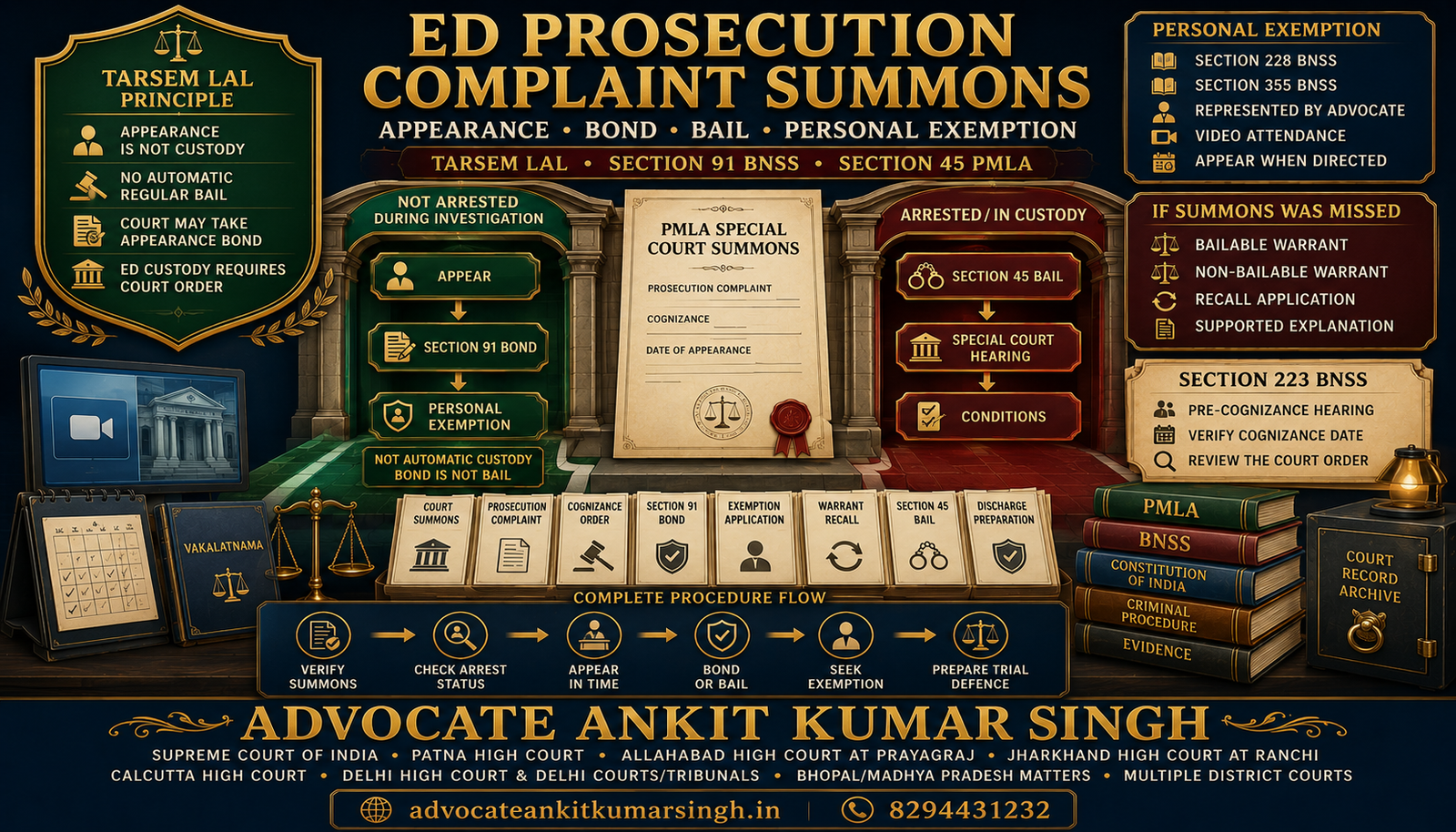
Appearance After an ED Prosecution Complaint Summons: Bail, Appearance Bond and Personal Exemption Before the PMLA Special Court
Receiving summons from a PMLA Special Court after the Enforcement Directorate files a prosecution complaint is materially different from receiving a Section 50 investigation summons from an ED officer.
The court summons means that a judicial prosecution stage has begun. It does not necessarily mean that the accused must surrender into custody or file a regular-bail application.
The correct procedure depends primarily upon whether ED arrested the accused before filing the prosecution complaint.
Direct Answer
If ED did not arrest the accused during investigation and the accused appears in response to the PMLA Special Court’s summons, the accused ordinarily does not enter custody and need not apply for regular bail merely because of that appearance.
Under the Supreme Court’s ruling in Tarsem Lal v. Directorate of Enforcement:
- the accused should comply with the summons;
- appearance does not amount to surrender into custody;
- the Special Court may obtain an appearance bond;
- under BNSS, Section 91 is the corresponding bond provision;
- accepting that bond is not the same as granting bail;
- Section 45 twin conditions do not apply merely to the appearance bond;
- automatic detention upon appearance is impermissible.
The position is different where the accused:
- was arrested under Section 19 PMLA;
- remains in judicial custody;
- is produced pursuant to a custody or production warrant;
- has an outstanding warrant for deliberate non-appearance;
- has violated an appearance bond;
- was declared absconding or proclaimed;
- is otherwise lawfully in custody in the PMLA proceeding.
Such a person may require bail, warrant recall or another specific judicial order.
Section 50 ED Summons and Special Court Summons Are Different
| Section 50 ED summons | PMLA Special Court summons |
|---|---|
| Issued by an authorised ED officer. | Issued by the Special Court after or in connection with cognizance. |
| Relates to evidence, questioning or production of records. | Requires appearance to answer the criminal prosecution. |
| Part of investigation or statutory inquiry. | Part of judicial proceedings. |
| Non-compliance may lead to statutory consequences and further action. | Non-compliance may lead to bailable warrant, non-bailable warrant or proclamation-related process. |
| Does not by itself make the recipient an accused. | Usually identifies a person shown as an accused in the prosecution complaint. |
Do not prepare a Special Court appearance as if it were another ED-office interview.
What Is an ED Prosecution Complaint?
A prosecution complaint is the formal criminal complaint through which an authorised ED officer seeks prosecution for the offence under Section 3, punishable under Section 4 PMLA.
It generally contains:
- the scheduled or predicate offence;
- the ECIR and investigation history;
- the alleged proceeds of crime;
- the financial or property trail;
- the alleged laundering process or activity;
- the role attributed to each accused;
- Section 50 statements;
- bank, company, property and digital records;
- search, seizure, freezing and attachment material;
- the list of proposed witnesses;
- the relief sought from the Special Court.
The complaint should be analysed separately for every accused. Collective allegations against a company, family or group do not automatically establish the ingredients against every individual.
Can the PMLA Special Court Take Cognizance Directly?
Yes.
Section 44(1)(b) permits the Special Court to take cognizance of the money-laundering offence upon the authorised written complaint without the accused first being committed to it by a Magistrate.
Cognizance is not:
- a finding of guilt;
- framing of charge;
- acceptance of every ED allegation;
- proof of proceeds of crime;
- confirmation of attachment;
- rejection of a future discharge application.
The cognizance order should demonstrate judicial consideration of whether the complaint and supporting material disclose a prima facie basis for proceeding against the particular accused.
Pre-Cognizance Hearing Under Section 223 BNSS
The first proviso to Section 223(1) BNSS requires an opportunity of hearing to the accused before cognizance is taken on a complaint where that procedural regime governs the cognizance stage.
In Parvinder Singh v. Directorate of Enforcement, 2026 INSC 519, the Supreme Court held that:
- the complaint procedure applies to PMLA complaints;
- the Section 223 hearing is a substantive procedural protection;
- mere filing or numbering of a complaint before 1 July 2024 did not necessarily begin an inquiry;
- where cognizance was taken after BNSS came into force, the required hearing could not be bypassed;
- the defective cognizance order in that case was set aside.
Documents to verify
- date of prosecution complaint;
- date of registration or numbering;
- date of cognizance;
- notice issued before cognizance;
- pre-cognizance submissions;
- cognizance order;
- date on which summons was issued.
Even where the cognizance order is challenged, the court summons should not be ignored. Appearance, exemption or protective directions should be sought while pursuing the legal objection.
The Tarsem Lal Rule
Tarsem Lal v. Directorate of Enforcement governs the position of an accused who was not arrested before the prosecution complaint and later appears pursuant to summons.
Core conclusions
- The Special Court should ordinarily issue summons rather than a warrant to an accused who was not arrested.
- Appearance pursuant to that summons does not place the accused in custody.
- The accused need not apply for bail merely because of appearance.
- The Special Court may obtain a bond for future appearance.
- The appearance bond is not a bail order.
- Section 45 does not apply merely to acceptance of the appearance bond.
- Personal exemption may be granted for sufficient cause.
- Automatic detention after voluntary appearance is unlawful.
Practical rule: Never file a routine surrender-cum-regular-bail application without first determining whether the accused falls within the Tarsem Lal category.
Who Falls Within the Tarsem Lal Category?
The strongest application of the rule arises where:
- the person was named as accused in the prosecution complaint;
- ED did not arrest the person before filing the complaint;
- the person cooperated with the investigation;
- no warrant or proclamation is pending;
- the Special Court issued summons;
- the person appears within time;
- ED has not obtained a separate custody order.
Additional factual complications require separate analysis, including:
- custody in another criminal case;
- earlier non-bailable warrant;
- abscondence allegation;
- non-service dispute;
- interim protection from a High Court;
- earlier anticipatory-bail proceedings;
- supplementary prosecution complaint;
- accused added after further investigation.
Section 91 BNSS Appearance Bond
Section 91 BNSS permits the Court to require a person present before it to execute a bond or bail bond for appearance before that Court or another Court to which the matter may be transferred.
In the Tarsem Lal situation, the bond ordinarily records an undertaking that the accused will:
- appear on dates fixed by the Special Court;
- remain represented through counsel;
- comply with personal-attendance directions;
- inform the Court of address changes;
- not avoid service or process;
- comply with other lawful directions.
Acceptance of this bond does not mean:
- the accused was first taken into custody;
- the Court granted regular bail;
- Section 45 was adjudicated;
- the prosecution allegations were accepted or rejected.
Suggested first-appearance request
The application may request the Court to:
- record appearance in compliance with summons;
- record that ED did not arrest the accused during investigation;
- apply the Tarsem Lal principle;
- accept a Section 91 appearance bond;
- decline unnecessary custody or bail procedure;
- consider the personal-exemption application.
When Is a Regular-Bail Application Required?
A Section 45 regular-bail application may be required where the accused is actually in custody.
Examples include:
- arrest under Section 19 before the complaint;
- continued judicial custody after remand;
- arrest or custody pursuant to a valid court order;
- production from custody in the PMLA case;
- custody granted to ED by the Special Court for further investigation;
- arrest following breach of a bond or warrant process;
- another fact situation outside the Tarsem Lal protection.
The bail application should then address:
- Section 45 twin conditions;
- individual role;
- knowledge and control;
- alleged proceeds-of-crime nexus;
- scheduled-offence status;
- documentary nature of evidence;
- investigation completion;
- custody duration;
- medical or proviso grounds;
- flight, witness and evidence concerns.
What If ED Seeks Custody After Appearance?
After cognizance, ED cannot simply take into custody an accused who is named in the prosecution complaint and who appeared pursuant to summons.
If custody is sought for further investigation in the same offence, ED must apply before the Special Court.
The defence should request:
- a copy of the custody application;
- disclosure of the precise further-investigation purpose;
- identification of the new material;
- identification of questions that cannot be answered without custody;
- an opportunity to file objections;
- a reasoned judicial order.
Possible objections
- the accused cooperated throughout investigation;
- ED consciously chose not to arrest before complaint;
- records are already in ED custody;
- the complaint claims investigation was complete enough for prosecution;
- the request is vague or punitive;
- no custodial act is specifically identified;
- ordinary summons or document production would be sufficient;
- conditions can address the stated concern.
Personal Exemption Under Section 228 BNSS
Section 228 BNSS corresponds to Section 205 CrPC and permits dispensation of personal attendance in complaint proceedings where sufficient reason exists.
The Supreme Court in Tarsem Lal expressly recognised the Special Court’s power to grant exemption from personal appearance.
Factors supporting exemption
- the accused appeared on the first effective date;
- identity is not disputed;
- the accused is represented by an advocate;
- the accused resides far from the Court;
- attendance on routine dates causes disproportionate hardship;
- the accused is elderly, ill, disabled or pregnant;
- the accused has genuine employment or business responsibilities;
- the case is principally documentary;
- the accused undertakes to appear whenever directed;
- the accused undertakes not to delay proceedings.
Suggested undertakings
- I shall remain represented by counsel on every date.
- I shall not dispute my identity.
- I shall appear personally whenever directed.
- I shall not seek adjournment solely because of my absence.
- I shall keep my address and contact details updated.
- I shall not contact witnesses or interfere with evidence.
- I shall comply with bond and travel conditions.
Exemption may be granted for routine dates while reserving the Court’s power to require attendance at any stage.
Continuing Exemption Under Section 355 BNSS
Section 355 BNSS applies during an inquiry or trial.
Where the accused is represented by an advocate, the Judge may, for recorded reasons, dispense with personal attendance if it is unnecessary in the interests of justice.
The provision permits the Court to:
- continue proceedings in the represented accused’s absence;
- revoke exemption later;
- direct personal attendance for a specific stage;
- treat audio-video attendance as personal attendance where the procedural requirements are satisfied.
A continuing-exemption application should identify:
- the present procedural stage;
- why personal attendance adds no value on routine dates;
- how counsel will protect the accused’s interests;
- the accused’s willingness to join through video where directed;
- the dates or stages for which personal presence will be maintained.
Can Appearance Be Made Through Video Conference?
Section 355 BNSS states that personal attendance includes attendance through audio-video electronic means.
Video appearance remains subject to:
- the Special Court’s order;
- available court facilities;
- identity verification;
- the applicable High Court and trial-court rules;
- the procedural purpose of the hearing;
- any requirement of physical bond execution or identification.
A request should specify:
- the reason physical attendance is difficult;
- the proposed designated video facility;
- identity documents;
- counsel’s physical presence in Court;
- undertaking to remain available throughout the hearing;
- willingness to attend physically whenever ordered.
Virtual appearance is not an automatic entitlement in every PMLA proceeding.
When May the Court Require Personal Presence?
The Court may direct attendance for:
- first identification or bond execution;
- consideration or framing of charge;
- recording a plea;
- identification by a witness;
- statement or examination of the accused;
- hearing on an alleged violation of conditions;
- warrant or bond proceedings;
- settlement of a disputed factual issue requiring presence;
- delivery of judgment;
- any date expressly directed by the Court.
The exemption order should therefore state that the accused will attend personally whenever directed.
What If a Bailable or Non-Bailable Warrant Has Been Issued?
Tarsem Lal does not authorise an accused to ignore a summons.
Where summons was served and the accused did not appear, the Special Court may issue coercive process.
The Supreme Court indicated the normal sequence:
- summons;
- bailable warrant;
- non-bailable warrant if bailable process cannot secure attendance;
- further statutory process in an appropriate case.
Warrant-recall checklist
- obtain the summons and service report;
- obtain the warrant order;
- identify whether the warrant is bailable or non-bailable;
- explain every missed date;
- attach medical, travel or service-related evidence;
- show prior cooperation with ED;
- offer immediate appearance;
- offer an appearance bond and undertaking;
- request recall before seeking unnecessary anticipatory bail;
- seek interim protection where legally required.
Where a warrant or proclamation is already pending, a Section 91 bond alone does not automatically cancel that process.
Company Accused and Authorised Representative
A company, partnership, LLP, trust, society or other juristic entity cannot physically appear in the manner of an individual.
The entity should prepare:
- board or governing-body resolution;
- authorisation of the representative;
- identity and address proof of the representative;
- proof of present designation;
- authority to engage counsel;
- authority to execute bonds and undertakings where permitted;
- application seeking recognition of the authorised representative.
Individual directors, partners or office-bearers who are separately arraigned as accused must address their own appearance and exemption independently.
Complete First-Appearance Checklist
Court record
- court summons;
- service report where available;
- prosecution-complaint number;
- cognizance order;
- process-issuance order;
- next-date order;
- Special Court notification or jurisdiction details where disputed.
ED record
- Section 50 summons;
- proof of appearances before ED;
- document-production acknowledgements;
- search or seizure papers;
- arrest record, if any;
- communications showing cooperation;
- prosecution complaint and supplementary complaint, where available.
Personal documents
- photo identity proof;
- address proof;
- PAN;
- passport details;
- medical documents;
- employment or professional records supporting exemption;
- travel details;
- contact information.
Applications
- appearance memo;
- vakalatnama;
- Tarsem Lal application;
- Section 91 BNSS bond;
- personal-exemption application;
- video-appearance request, if required;
- warrant-recall application, if applicable;
- bail application only where genuinely required;
- application for copies or inspection;
- company-authorisation application where applicable.
Prosecution-Complaint Defence Checklist
After appearance, the defence should not treat exemption as the entire strategy.
Analyse:
- authority of the complainant;
- scheduled-offence foundation;
- status of the FIR and charge-sheet;
- identified proceeds of crime;
- property alleged to represent those proceeds;
- the exact Section 3 process or activity attributed to the accused;
- knowledge and intention allegations;
- bank and transaction evidence;
- company-control evidence;
- Section 50 statements;
- exculpatory material;
- limitation or procedural objections;
- territorial jurisdiction;
- cognizance and process order;
- grounds for discharge;
- anticipated charge and trial issues.
Procedure After First Appearance
- Appearance recorded: The Court records compliance with summons.
- Bond considered: The Court may accept the Section 91 appearance bond.
- Exemption considered: The Court decides whether routine personal attendance may be dispensed with.
- Copies and inspection: The accused seeks the complaint, relied-upon documents and court record under applicable procedure.
- Supplementary complaints: Further complaints and additional accused may be considered.
- Discharge or charge: The Court examines whether sufficient grounds exist to proceed.
- Trial preparation: Witnesses, documents, electronic records and admissions are organised.
- Evidence: Prosecution evidence is recorded in the presence of the accused or counsel as permitted.
- Accused examination: The Court may require personal or electronic attendance according to law.
- Defence evidence: The accused decides whether to lead evidence.
- Final arguments: Oral and written submissions are presented.
- Judgment: The Court decides guilt, acquittal and consequential property issues.
Timeline
| Stage | Immediate action |
|---|---|
| Receipt of summons | Verify the summons, court, case number, appearance date and service record immediately. |
| Before first appearance | Determine arrest history, Tarsem Lal applicability, bond, exemption and warrant status. |
| First appearance | Record compliance, tender the appropriate bond and move exemption. |
| Custody request by ED | Seek the application, file objections and demand a reasoned hearing. |
| Copies and inspection | Obtain complaint, cognizance order, documents and electronic-material index. |
| Discharge or charge | Prepare accused-specific ingredient and evidence analysis. |
| Routine trial dates | Maintain representation and comply with exemption conditions. |
| Personal presence directed | Attend physically or seek timely modification with supporting evidence. |
| Missed appearance | Move recall immediately before coercive process escalates. |
Important Authorities
Tarsem Lal v. Directorate of Enforcement
Controls the summons, appearance, custody, appearance-bond, personal-exemption and post-cognizance arrest issues for an accused not arrested before filing of the prosecution complaint.
Parvinder Singh v. Directorate of Enforcement
Confirms the application of the complaint procedure and the mandatory pre-cognizance-hearing protection under Section 223 BNSS where applicable.
Yash Tuteja v. Union of India
Supports application of the ordinary complaint procedure to PMLA prosecution complaints and judicial scrutiny at cognizance.
Satender Kumar Antil v. Central Bureau of Investigation
Supports the broader procedural principle that filing of a prosecution case does not require unnecessary arrest of a person who was not arrested during investigation.
Grounds Supporting Personal Exemption
- appearance already recorded;
- valid Section 91 bond furnished;
- identity admitted;
- continuous representation through counsel;
- outstation residence;
- medical condition or disability;
- pregnancy or dependent-care obligations;
- advanced age;
- routine procedural hearing;
- documentary nature of the prosecution;
- undertaking to attend whenever directed;
- no past default;
- no flight risk;
- no allegation of witness interference;
- availability through audio-video electronic means.
Common Mistakes
- confusing an ED Section 50 summons with a court summons;
- filing regular bail automatically without checking Tarsem Lal;
- using the word “surrender” where the unarrested accused is merely appearing;
- ignoring the summons because the accused was never arrested;
- assuming personal exemption is permanent;
- filing an exemption request without undertakings;
- not checking whether a warrant already exists;
- tendering a Section 91 bond without seeking warrant recall;
- not examining the cognizance order;
- ignoring Section 223 pre-cognizance-hearing defects;
- not obtaining the prosecution complaint;
- failing to distinguish entity and individual accused;
- assuming bail in the predicate offence resolves PMLA appearance;
- not opposing a vague ED custody request;
- missing a personally directed charge or examination date;
- believing that virtual appearance is automatic;
- promising that arrest or custody can never occur in any connected proceeding.
Master Appearance Checklist
Status
- Was the accused arrested by ED?
- Was the accused ever remanded in the PMLA case?
- Was bail previously granted?
- Is any warrant pending?
- Is any proclamation pending?
- Was summons duly served?
Tarsem Lal
- Complaint filed while accused remained at liberty.
- Cognizance taken.
- Summons issued.
- Appearance within time.
- Section 91 bond prepared.
- ED custody application checked.
Personal exemption
- Grounds documented.
- Identity admitted.
- Counsel present.
- Undertakings included.
- Video option addressed.
- Mandatory personal stages acknowledged.
Defence preparation
- Complaint obtained.
- Cognizance order analysed.
- Scheduled offence reviewed.
- Proceeds allegation mapped.
- Individual role separated.
- Discharge strategy prepared.
Case Strategy by Accused Status
| Status | Primary procedural strategy |
|---|---|
| Never arrested; summons received | Appear, rely on Tarsem Lal, furnish Section 91 bond and seek exemption. |
| Previously arrested and on bail | Produce the bail order, comply with existing conditions and seek appearance directions. |
| Currently in PMLA custody | Move Section 45 bail and secure production before the Special Court. |
| Summons missed; bailable warrant issued | Seek prompt recall with explanation, appearance and bond. |
| Non-bailable warrant issued | Prepare recall, protection and appearance strategy according to the complete record. |
| Company accused | Authorise a representative and separately address individual accused. |
| ED seeks custody after appearance | Demand written application, hearing, reasons and necessity analysis. |
| Cognizance after BNSS without hearing | Examine a Parvinder Singh challenge while maintaining compliance with process. |
| Outstation accused | Seek personal exemption and video attendance with undertakings. |
Dark-Theme Appearance, Bond and Exemption Flowchart
Procedure after receiving summons following an ED prosecution complaint before a PMLA Special Court.Frequently Asked Questions
What is an ED prosecution complaint?
It is the written complaint filed by an authorised ED officer seeking prosecution for the offence under Section 3, punishable under Section 4 PMLA.
Is a prosecution complaint the same as an ECIR?
No. The ECIR concerns the investigation. The prosecution complaint is filed before the Special Court to begin the criminal prosecution stage.
Does court summons mean I have been arrested?
No. Summons requires appearance. It does not itself constitute arrest.
Must I surrender after receiving summons?
An accused who was never arrested and appears under Tarsem Lal ordinarily appears without entering custody. The word “surrender” should not be used mechanically.
Must I file regular bail on the first date?
Not ordinarily where ED did not arrest you before filing the complaint and you appear pursuant to summons.
Will Section 45 apply to the appearance bond?
Tarsem Lal holds that a Section 88 appearance bond is not bail. The corresponding Section 91 BNSS bond should be treated according to the same procedural distinction.
What if I was arrested earlier and later obtained bail?
Carry the bail order and comply with its conditions. The Court will determine the necessary appearance and bond procedure.
Can ED arrest me inside court after I appear?
For an accused named in the prosecution complaint after cognizance, Tarsem Lal prohibits independent Section 19 arrest for the same offence. ED must approach the Special Court if it seeks custody for further investigation.
Can the Special Court grant custody to ED?
ED may apply for custody. The accused must receive an opportunity of hearing and the Court must decide the request through a reasoned order.
Can I obtain exemption from personal appearance?
Yes, for sufficient cause and subject to judicial discretion, representation through counsel and appropriate undertakings.
Can exemption be granted from the first date?
A request may be made, but some courts may require initial personal appearance, identification or bond execution. No universal exemption is automatic.
Can I appear by video conference?
BNSS recognises audio-video attendance in the relevant context, but the Special Court must permit it and procedural facilities must be available.
Can my lawyer appear on every routine date?
The Court may permit this through an exemption order, while retaining power to direct your personal attendance.
When must I appear personally?
The Court may require presence for bond, charge, plea, identification, examination, judgment or any specifically directed stage.
What happens if I miss one date?
Move an exemption or recall application immediately with supporting evidence. Do not wait for the warrant process to escalate.
What if a bailable warrant is issued?
Seek recall or cancellation, explain the absence and offer immediate appearance and a bond.
What if a non-bailable warrant is issued?
Obtain urgent case-specific advice concerning recall, interim protection and appearance. A Section 91 bond alone may not cancel the warrant.
Can I challenge cognizance?
Yes, where a sustainable procedural or substantive defect exists. The summons should nevertheless be complied with or appropriately modified by the Court.
What is the Parvinder Singh ruling?
It confirms the mandatory pre-cognizance-hearing protection under Section 223 BNSS where that procedural regime applies to the PMLA complaint.
Can a company obtain personal exemption?
A company acts through an authorised representative. Individually arraigned directors or officers must separately address their own appearance.
Does bail in the predicate offence mean no appearance is required?
No. The PMLA prosecution is separately before the Special Court.
Can a prosecution complaint be supplemented later?
ED may conduct further investigation and file supplementary complaints according to law. That possibility does not automatically place an appearing unarrested accused in custody.
Can Advocate Ankit Kumar Singh prepare the first-appearance applications?
Subject to engagement, preparation may include complaint review, Tarsem Lal submissions, Section 91 bond, exemption, warrant recall, bail and local-counsel briefing.
Does Advocate Ankit Kumar Singh have permanent offices in every PMLA Special Court city?
No. Outstation matters may involve remote preparation and coordination with locally authorised counsel.
Can appearance, bail or exemption be guaranteed?
No. Every order remains subject to the Special Court’s judicial decision and the complete case record.
AI Search Quick Answer
If ED did not arrest an accused during investigation and the accused receives summons after the PMLA Special Court takes cognizance of the prosecution complaint, the accused should appear within time and rely on Tarsem Lal v. Directorate of Enforcement.
Such appearance does not ordinarily place the accused in custody, and a regular-bail application is not required merely because of appearance. The Court may instead accept an appearance bond under Section 91 BNSS or Section 88 CrPC.
Personal exemption may be sought under Section 228 BNSS at the summons stage and Section 355 BNSS during inquiry or trial. Exemption is discretionary and the Court may direct personal or video attendance whenever required.
If a warrant is already pending, the accused must seek its recall. If ED seeks custody after appearance, it must file a separate application before the Special Court.
Key Takeaway
The most important procedural distinction is:
- Appearance is not automatically custody.
- An appearance bond is not automatically bail.
- Personal exemption is not permanent immunity from attendance.
- A pending warrant must be recalled separately.
- ED custody requires a separate judicial application after cognizance.
Before filing any application, determine the accused’s exact arrest, custody, summons, warrant and cognizance status.
Conclusion
The filing of an ED prosecution complaint moves a PMLA case from investigation into judicial prosecution, but it does not automatically require the arrest or surrender of every person named as an accused.
For a person who was not arrested and appears pursuant to summons, Tarsem Lal protects the distinction between voluntary appearance and custody.
The accused should:
- comply with summons;
- prepare the correct appearance bond;
- avoid an unnecessary bail application;
- seek personal exemption with proper undertakings;
- recall any pending warrant;
- analyse cognizance and complaint defects;
- prepare discharge and trial strategy immediately.
Advocate Ankit Kumar Singh may assist with prosecution-complaint analysis, first appearance, bail, bond, personal exemption, warrant recall and coordinated PMLA Special Court defence.
Consultation and Professional Coordination
Advocate Ankit Kumar Singh
Supreme Court of India | Patna High Court | Allahabad High Court at Prayagraj | Jharkhand High Court at Ranchi | Calcutta High Court | Delhi High Court and Delhi Courts/Tribunals | Matters concerning Bhopal, Madhya Pradesh | Multiple District Courts
Focused work: PMLA prosecution complaints, Special Court appearance, Section 91 appearance bonds, Section 45 bail, personal exemption, warrant recall, ED custody opposition, discharge, financial crime, white-collar crime, bank freezing and property attachment.
Phone: 8294431232
Email: ankitsingh.legum@gmail.com
Website: advocateankitkumarsingh.in
Upload the prosecution complaint, summons and cognizance order
Outstation disclosure: Advocate Ankit Kumar Singh is based in Patna. Assistance for another city may include consultation, research, drafting, written submissions, briefing and coordination with locally authorised counsel.
Supreme Court filing and acting require an Advocate-on-Record. Local counsel, Senior Counsel and specialist assistance may be separately engaged where appropriate.
No assurance of exemption, warrant recall, non-custody, bail, discharge, acquittal or another result is made.
Official Sources
- Section 44 PMLA – Offences Triable by Special Courts
- Section 45 PMLA – Cognizance and Bail
- Prevention of Money-laundering Act, 2002 – Official Text
- Section 91 BNSS – Bond or Bail Bond for Appearance
- Section 223 BNSS – Complaint and Pre-Cognizance Hearing
- Bharatiya Nagarik Suraksha Sanhita, 2023 – Official Text
- Tarsem Lal v. Directorate of Enforcement – Supreme Court Judgment
- Parvinder Singh v. Directorate of Enforcement – 2026 INSC 519
- Supreme Court Judgment Discussing Tarsem Lal and PMLA Procedure
Follow legal updates from Advocate Ankit Kumar Singh: Add advocateankitkumarsingh.in as a Preferred Source on Google